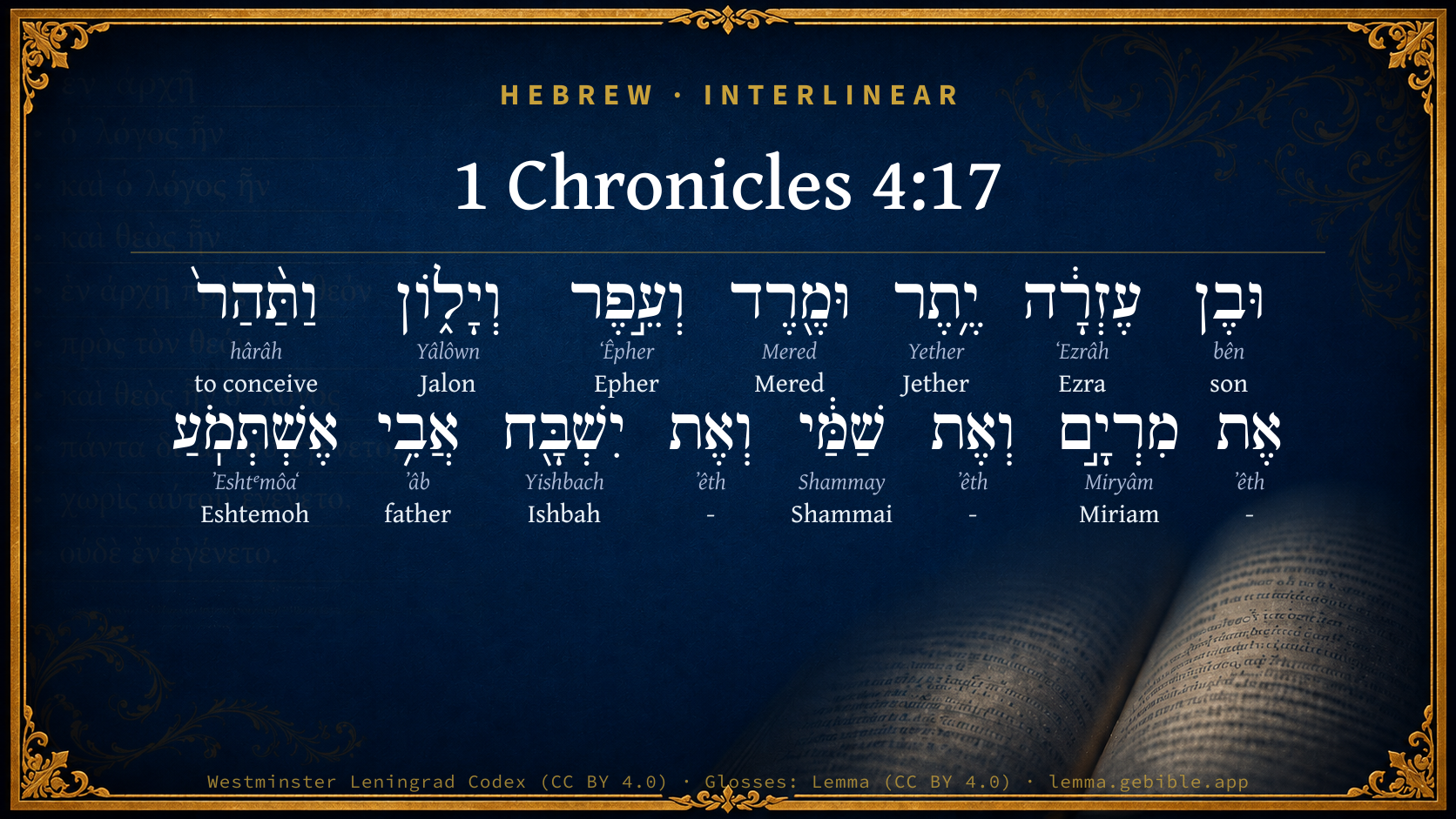
1 Chronicles 4:17

Hebrew (Westminster Leningrad Codex) 1 Chronicles 4:17 appears in the Hebrew Old Testament. The text above is from the Westminster Leningrad Codex. Each word links to its Strong’s number, a concise gloss, and parsing drawn from the Open Scriptures Hebrew Bible morphology. Click any word for its full Brown-Driver-Briggs (BDB) entry.
Download image
Cite this verse

1 Chronicles 4:17 (World English Bible). Public Domain. Lemma interlinear Bible study tool, https://lemma.gebible.app/v/1-chronicles/4/17.

Show BibTeX & RIS
BibTeX
RIS
English Translation
The sons of Ezrah: Jether, and Mered, and Epher, and Jalon; and she bore Miriam, and Shammai, and Ishbah the father of Eshtemoa.
World English Bible · Public Domain
Highlights
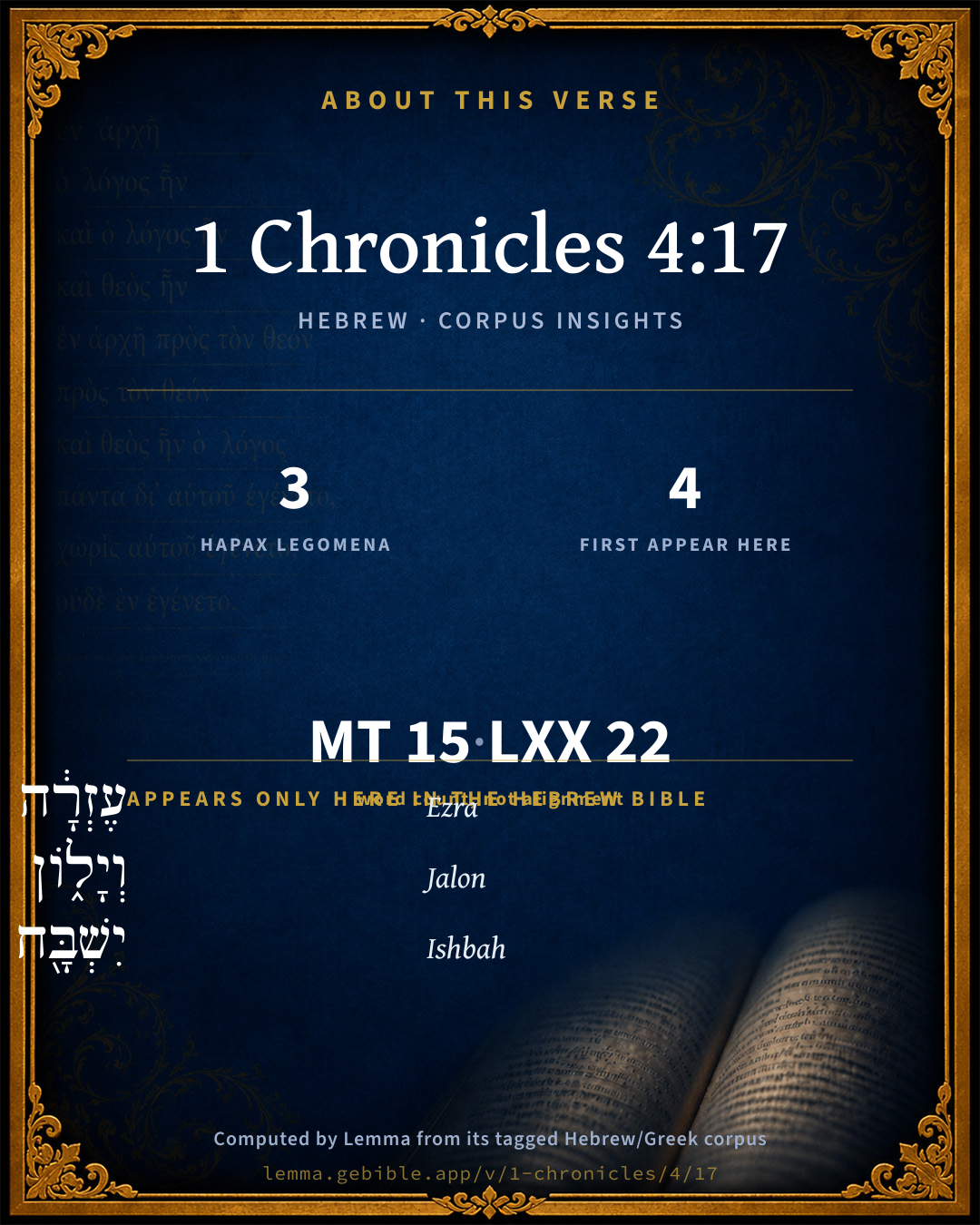
  • 3 hapax legomena — only here in the Hebrew Bible
  • 4 first appearances in the Hebrew Bible
Full analysis ↓
Download a study sheet

One document with this verse’s original text, its word-by-word gloss line, the meaning frame, cross-references with their text, attributed commentary, and full source and license credits — printable, and it pastes into notes with its structure intact.

This verse Autodidact and up

Study sheet (.html) Plain text (.txt)

A passage Seminary Student

Up to 50 verses in one chapter. A passage sheet keeps up to 6 commentary sources and 12 cross-references per verse, in the order this page ranks them, and says so on the sheet whenever that leaves anything out. Ask for a single verse and you get the Autodidact verse sheet above.

Everything on this page stays free to read, with no account — the sheet is a download of what is already on screen, not access to it.

Want to remove ads? Support Godless Engineer
Compare translations 3

The same verse in 3 English versions, stacked beneath the original-language interlinear above. Click any original word for its lexicon entry.

Each is an independent rendering of the whole verse — the interlinear is not word-aligned to these translations.

Highlighted words mark where these versions differ — a whole-verse word diff, not a word-by-word alignment.

  • World English Bible Public Domain
    The sons of Ezrah: Jether, and Mered, and Epher, and Jalon; and she bore Miriam, and Shammai, and Ishbah the father of Eshtemoa.
  • King James Version Public Domain
    And the sons of Ezra were, Jether, and Mered, and Epher, and Jalon: and she bare Miriam, and Shammai, and Ishbah the father of Eshtemoa.
  • unfoldingWord Literal Text CC BY-SA 4.0
    And the sons of Ezrah: Jether and Mered and Epher and Jalon. And she conceived Miriam and Shammai and Ishbah, the father of Eshtemoa.

unfoldingWord Literal Text — © unfoldingWord, licensed CC BY-SA 4.0. Word-aligned USFM3 via Door43 (git.door43.org/unfoldingWord/en_ult).

Versions to compare (up to 4)

3 of 4 selected

Show all 18 translations

Every available English version of this verse, each an independent rendering of the whole verse.

  • World English Bible Public Domain
    The sons of Ezrah: Jether, and Mered, and Epher, and Jalon; and she bore Miriam, and Shammai, and Ishbah the father of Eshtemoa.
  • Berean Standard Bible Public Domain
    The sons of Ezrah: Jether, Mered, Epher, and Jalon. And Mered’s wife Bithiah gave birth to Miriam, Shammai, and Ishbah the father of Eshtemoa.
  • Majority Standard Bible Public Domain
    The sons of Ezrah: Jether, Mered, Epher, and Jalon. And Mered’s wife Bithiah gave birth to Miriam, Shammai, and Ishbah the father of Eshtemoa.
  • King James Version Public Domain
    And the sons of Ezra were, Jether, and Mered, and Epher, and Jalon: and she bare Miriam, and Shammai, and Ishbah the father of Eshtemoa.
  • American Standard Version (1901) Public Domain
    And the sons of Ezrah: Jether, and Mered, and Epher, and Jalon; and she bare Miriam, and Shammai, and Ishbah the father of Eshtemoa.
  • Revised Version (1885) Public Domain
    And the sons of Ezrah; Jether, and Mered, and Epher, and Jalon: and she bare Miriam, and Shammai, and Ishbah the father of Eshtemoa.
  • Geneva Bible (1599) Public Domain
    And the sonnes of Ezrah were Iether and Mered, and Epher, and Ialon, and he begate Miriam, and Shammai, and Ishbah the father of Eshtemoa.
  • Douay-Rheims (1899) Public Domain
    And the sons of Esra, Jether, and Mered, and Epher, and Jalon, and he beget Mariam, and Sammai, and Jesba the father of Esthamo.
  • Young's Literal Translation Public Domain
    And sons of Ezra `are' Jether, and Mered, and Epher, and Jalon: and she beareth Miriam, and Shammai, and Ishbah father of Eshtemoa.
  • Literal Standard Version CC BY-SA 4.0
    And sons of Ezra: Jether, and Mered, and Epher, and Jalon. And she bears Miriam, and Shammai, and Ishbah father of Eshtemoa.
  • Unlocked Literal Bible CC BY-SA 4.0
    Ezrah's sons were Jether, Mered, Epher, and Jalon. Mered's Egyptian wife bore Miriam, Shammai, and Ishbah, who became the father of Eshtemoa. These were the sons of Bithiah, daughter of Pharaoh, whom Mered married. Mered's Judahite wife bore Jered, who became the father of Gedor; Heber, who became the father of Soko; and Jekuthiel, who became the father of Zanoah.
  • unfoldingWord Literal Text CC BY-SA 4.0
    And the sons of Ezrah: Jether and Mered and Epher and Jalon. And she conceived Miriam and Shammai and Ishbah, the father of Eshtemoa.
  • Darby Bible Public Domain
    -- And the sons of Ezra: Jether, and Mered, and Epher, and Jalon; and she conceived [and bore] Miriam, and Shammai, and Jishbah the father of Eshtemoa.
  • World Messianic Bible Public Domain
    The sons of Ezrah: Jether, Mered, Epher, and Jalon; and Mered’s wife bore Miriam, Shammai, and Ishbah the father of Eshtemoa.
  • Webster's Bible Public Domain
    And the sons of Ezra were, Jethur, and Mered, and Epher, and Jalon: and she bore Miriam, and Shammai, and Ishbah the father of Eshtemoa.
  • Free Bible Version CC BY-SA 4.0
    The sons of Ezrah: Jether, Mered, Epher, and Jalon. One wife of Mered was the mother of Miriam, Shammai and Ishbah the father of Eshtemoa.
  • Bible in Basic English Public Domain
    And the sons of Ezrah: Jether and Mered and Epher and Jalon; and these are the sons of Bithiah, the daughter of Pharaoh, the wife of Mered. And she became the mother of Miriam and Shammai and Ishbah, the father of Eshtemoa.
  • JPS Tanakh (1917) Public Domain
    And the sons of Ezrah: Jether, and Mered, and Epher, and Jalon. And she bore Miriam, and Shammai, and Ishbah the father of Eshtemoa —

Literal Standard Version (2020), Covenant Press — licensed CC BY-SA 4.0. Text via the HelloAO Bible API (eBible.org). Unlocked Literal Bible (unfoldingWord) — licensed CC BY-SA 4.0. Text via the HelloAO Bible API (eBible.org). unfoldingWord Literal Text — © unfoldingWord, licensed CC BY-SA 4.0. Word-aligned USFM3 via Door43 (git.door43.org/unfoldingWord/en_ult). Free Bible Version, Dr. Jonathan Gallagher — licensed CC BY-SA 4.0. Text via the HelloAO Bible API (eBible.org).

Word by word

More ways to search: Search by grammar → Find every occurrence → Compare this word →

Practice this passage: Drill this verse → Learn its vocabulary →

עֶזְרָ֔ה
ʻEzrâh
H5834
“Ezra”
Noun, Proper
Part of Speech
Noun
Type
Proper
Full BDB Definition

Origin: the same as H5833

TWOT: None

Ezra = "help" - a Judaite, father of Jether, Mered, Epher, and Jalon
  1. וּבֶן bên H1121 “and · son of” Conjunction + Noun, Common, Masculine, Singular, Construct
  2. יֶ֥תֶר Yether H3500 “Jether” Noun, Proper
  3. וּמֶ֖רֶד Mered H4778 “and · Mered” Conjunction + Noun, Proper
  4. וְעֵ֣פֶר ʻÊpher H6081 “and · Epher” Conjunction + Noun, Proper
  5. וְיָל֑וֹן Yâlôwn H3210 “and · Jalon” Conjunction + Noun, Proper
  6. וַתַּ֨הַר֙ hârâh H2029 “and · to conceive” Conjunction + Verb, Qal, Sequential Imperfect, 3rd Person, Feminine, Singular
  7. אֶת ʼêth H853 “-” Particle, Direct Object
  8. מִרְיָ֣ם Miryâm H4813 “Miriam” Noun, Proper
  9. וְאֶת ʼêth H853 “and · -” Conjunction + Particle, Direct Object
  10. שַׁמַּ֔י Shammay H8060 “Shammai” Noun, Proper
  11. וְאֶת ʼêth H853 “and · -” Conjunction + Particle, Direct Object
  12. יִשְׁבָּ֖ח Yishbach H3431 “Ishbah” Noun, Proper
  13. אֲבִ֥י ʼâb H1 “father of” Noun, Common, Masculine, Singular, Construct
  14. אֶשְׁתְּמֹֽעַ ʼEshtᵉmôaʻ H851 “Eshtemoh” Noun, Proper

About this verse

These counts appear in no published source. They are computed here, from the morphology-tagged text and Lemma’s own curated glosses. What Lemma adds →

15
words
13
distinct lemmas
Historical
section

Notable vocabulary

3 hapax legomena — words that appear only here in the entire Hebrew Bible:

  • עֶזְרָ֔ה Ezra H5834
  • וְיָל֑וֹן Jalon H3210
  • יִשְׁבָּ֖ח Ishbah H3431

First appearance in Scripture

These words make their first canonical appearance in the Hebrew Bible here:

  • עֶזְרָ֔ה Ezra H5834
  • וּמֶ֖רֶד Mered H4778
  • וְיָל֑וֹן Jalon H3210
  • יִשְׁבָּ֖ח Ishbah H3431

Shared distinctive vocabulary

וּמֶ֖רֶד Mered H4778 occurs in 2 verses of the Hebrew Bible. Also found in:

Grammatical profile

  • 1 verb
  • 11 nouns
  • 3 particles

Verb forms

  • וַתַּ֨הַר֙ Qal · Sequential Imperfect

Hebrew & Septuagint length

In English translation the verse runs 23 words from the Hebrew and 23 from the Septuagint (LXX English) — the same length.

A rough comparison of the two English renderings, which tokenize alike — not a word-level alignment.

Word counts can differ between the Hebrew and the Greek without any difference in meaning — e.g. the Hebrew direct-object marker אֵת has no separate Greek word, and Greek often adds the article ὁ.

In the original languages it is 15 Hebrew tokens and 22 Greek tokens — but the two are counted differently (Hebrew bundles its prefixes and suffixes into one token; the Greek is in lemma form), so that isn’t a like-for-like length.

Cross-references

5

Topical passages linked to 1 Chronicles 4:17 in the Treasury of Scripture Knowledge — connected by theme and wording, ordered by reader-vote popularity; previews shown in the World English Bible.

  • 1 Chronicles 4:19 The sons of the wife of Hodiah, the sister of Naham, were the father of Keilah the Garmite, and Eshtemoa the Maacathite.
  • Joshua 15:50 and Anab, and Eshtemoh, and Anim,
  • 1 Samuel 30:28 and to those who were in Aroer, and to those who were in Siphmoth, and to those who were in Eshtemoa,
  • 1 Chronicles 6:57 To the sons of Aaron they gave the cities of refuge, Hebron; Libnah also with its suburbs, and Jattir, and Eshtemoa with its suburbs,
  • 1 Chronicles 21:24 King David said to Ornan, No; but I will most assuredly buy it for the full price: for I will not take that which is your for Yahweh, nor offer a burnt-offering without cost.

Cross-references courtesy of OpenBible.info (CC BY 4.0).

Hebrew and Greek witnesses Masoretic Hebrew ↔ Greek Septuagint

The same verse in the two great witnesses to the Old Testament, shown verse-for-verse.

These are two independent witnesses, not word-aligned to each other, and the Septuagint is shown in lemma (dictionary) form.

Hebrew 1 Chronicles 4:17 Masoretic · Westminster Leningrad Codex

וּבֶן עֶזְרָ֔ה יֶ֥תֶר וּמֶ֖רֶד וְעֵ֣פֶר וְיָל֑וֹן וַתַּ֨הַר֙ אֶת מִרְיָ֣ם וְאֶת שַׁמַּ֔י וְאֶת יִשְׁבָּ֖ח אֲבִ֥י אֶשְׁתְּמֹֽעַ

The sons of Ezrah: Jether, and Mered, and Epher, and Jalon; and she bore Miriam, and Shammai, and Ishbah the father of Eshtemoa.

World English Bible · Public Domain

Greek LXX 1 Chronicles 4:17 Septuagint · lemma form

καί υἱός εσρι ιεθερ μωραδ καί αφερ καί ιαλων καί γεννάω ιεθερ ὁ μαρων καί ὁ σεμαι καί ὁ μαρεθ πατήρ εσθεμων

And the sons of Esri; Jether, Morad, and Apher, and Jamon: and Jether begot Maron, and Semei, and Jesba the father of Esthaemon.

LXX2012 (modern English Septuagint) · Public Domain

On this verse, Ellicott's Commentary for English Readers discusses the Septuagint’s reading. Read the note in Commentary ↓

Hebrew: Westminster Leningrad Codex (CC BY 4.0). Greek: Septuagint (public domain); English from LXX2012 (modern English Septuagint) (Public Domain). How the Septuagint differs from the Hebrew →

Commentary

Notes on 1 Chronicles 4:17 from classic Christian and Jewish commentators (each source and its license shown beneath its notes). The classic Christian expositions comment on the surrounding passage and are grouped to its opening verse, so a note may address several verses; the Jewish commentaries on the Tanakh (Rashi and others) are per-verse, so they appear only where the commentator wrote on this verse.

Lemma curates 59 commentaries, every one of them public domain or Creative Commons licensed, each selected and text-cleaned for this edition rather than reprinted as found. About our sources →

Ellicott's Commentary for English Readers

(17) And the sons of Ezra.—Heb., son, but some MSS. have sons (see Note on 1Ch_3:19; 1Ch_3:21). Ezra means help = Ezer, 1Ch_4:4.

Jether occurred 1Ch_2:32, as a Jerahmeelite.

Epher recurs 1Ch_5:24, as a Manassite name.

Jalon and Mered occur nowhere else.

And she bare.—Literally, conceived. Who bare the three sons, whose names follow, is not clear from the preceding statement, which includes none but male appellations. The LXX. reads, “And Jether bare Maron (Miriam),” &c, and the Syriac and Arabic omit 1Ch_4:17-18. This confirms our suspicion that the text is faulty.

A Bible Commentary for English Readers, edited by Charles John Ellicott (1878–1897) — public domain. Text from a community e-Sword module.

Trapp's Complete Commentary

John Trapp

1Ch 4:17 And the sons of Ezra [were], Jether, and Mered, and Epher, and Jalon: and she bare Miriam, and Shammai, and Ishbah the father of Eshtemoa.

Ver. 17. And the sons of Ezra.] Not that learned scribe, {Ezr 7:1} - there is a difference in the last letter of their names - but the son, as it seems, of Asareel.

And she bare,] i.e., Bithiah {1Ch 4:18} bare.

Miriam.] The name of a man in this place.

John Trapp, A Commentary or Exposition upon All the Books of the Old and New Testament (1647–1656) — public domain. Text from a community e-Sword module.

unfoldingWord translationNotes

Door43 World Missions Community

General Information:

The information in 1 Chronicles 4:17-18 has been rearranged so its meaning can be more easily understood. (See: Verse Bridges)

Ezrah ... Jether ... Mered ... Epher ... Jalon ... Miriam ... Shammai ... Ishbah ... Eshtemoa ... Jered ... Gedor ... Heber ... Soko ... Jekuthiel ... Zanoah

These are the names of men. (See: How to Translate Names)

These were the sons of Bithiah

The word "these" refers to Miriam, Shammai, and Ishbah. They were the sons Bithiah bore for her husband Mered.

Bithiah

This is the name of a woman.

Mered's Judahite wife

The Hebrew text says, "His Judahite wife," but most versions understand "his" to refer to Mered. This refers to a different wife of Mered, in addition to Bithiah.

translationWords

Egypt

Pharaoh

Jew

unfoldingWord translationNotes — © Distant Shores Media and the Door43 World Missions Community, licensed CC BY-SA 4.0. Source: git.door43.org/Door43/en_tn.

Jamieson, Fausset & Brown

Robert Jamieson, A. R. Fausset & David Brown

she bare Miriam--It is difficult, as the verses stand at present, to see who is meant. The following readjustment of the text clears away the obscurity: "These are the sons of Bithiah the daughter of Pharaoh, which Mered took, and she bare Miriam, and his wife Jehudijah bare Jezreel," &c.

Jamieson, Fausset & Brown — Commentary Critical and Explanatory on the Whole Bible (1871) — public domain (CC PDM 1.0). Text via the HelloAO Bible API.

The Cambridge Bible for Schools and Colleges

gen. ed. J. J. S. Perowne

17. and Jalon: and she bare Miriam] As the text stands she has no antecedent. It has therefore been proposed to transfer from 1Ch_4:18 the words And these are the sons of Bithiah the daughter of Pharaoh, which Mered took, and put them after Jalon. Bithiah then appears as the mother of Miriam, Shammai and Ishbah, and the difficulty of the absence of her sons’ names from 1Ch_4:18 disappears. For father of Eshtemoa see 1Ch_2:14 note, and for Eshtemoa see Jos_21:14.

The Cambridge Bible for Schools and Colleges (gen. ed. J. J. S. Perowne; Cambridge University Press, 1878–1918) — public domain. Text from a community e-Sword module.

John Gill's Exposition

And the sons of Ezra,.... Who was perhaps the son of Asareel, last mentioned:

Jether, and Mered, and Epher, and Jalon; only one of them, Mered, is after mentioned:

and she bare Miriam; which is not the name of a woman, but of a man, as Kimchi observes; and, according to him, his mother was the wife of Mered, which he gathers from the next verse; though she seems to be the wife of Ezra, who bare him other sons:

and Shammai, and Ishbah the father of Eshtemoa; a prince of a city in the tribe of Judah, so called, Jos 15:50.

John Gill's Exposition of the Whole Bible (1746–1763) — public domain (CC PDM 1.0). Text via the HelloAO Bible API.

Albert Barnes' Notes on the Bible

She bare Miriam - Rather, “she conceived.” The mother is not mentioned, and it seems impossible to restore the original text with any certainty.

Albert Barnes' Notes on the Bible (1834–1885) — public domain. Text from a community e-Sword/MySword module.

Matthew Poole's English Annotations

Ezra; the son of Ashriel last named.

She bare; she, i.e. Bithiah, bare unto Mered, as may seem by comparing this with 1Ch 4:18.

Matthew Poole's English Annotations on the Holy Bible (1683–1685) — public domain. Text from a community e-Sword/MySword module.

The Pulpit Commentary

Vers. 17, 18. From the tangle of these verses it is hopeless to attempt any certain conclusions. The fact of the antithesis of the Jewess wife (by some assigned as wife to Ezra), and the presumably Egyptian wife mentioned in the latter verse, is perhaps just enough in the general obscurity to suggest that Mered, the asserted husband of the latter, is to be understood as the husband of the former also But to compass so much as this, we have to overlook omission in ver. 17 and inversion in ver. 18. There is a tone about the verses, due to names they contain, that might suggest to us the times of Egypt and Moses, and traditions in keeping do not fail to come to view in Jerome ("Quaestiones," etc.; see also art. "Meted," Smith"s "Bible Dictionary"). The four places, Eshtemoa, Gedor, Socho, Zanoah, may all with tolerable confidence be identified in Jos_15:48-58, as of the number of the cities "in the mountains," though Zanoah and Socho are found also "in the valley". (Jos_15:33-36) In this passage the Septuagint gives us no help, but betrays its own perplexity, offering to make Jether the father of Miriam; while the Syriac and Arabic versions simply skip the verses as incoherent.

The Pulpit Commentary (1880–1919), ed. H.D.M. Spence-Jones & Joseph S. Exell — public domain. Text from a community e-Sword module.

Keil & Delitzsch

C. F. Keil & F. Delitzsch

And the sons of Ezra,.... Who was perhaps the son of Asareel, last mentioned:

Jether, and Mered, and Epher, and Jalon; only one of them, Mered, is after mentioned:

and she bare Miriam; which is not the name of a woman, but of a man, as Kimchi observes; and, according to him, his mother was the wife of Mered, which he gathers from the next verse; though she seems to be the wife of Ezra, who bare him other sons:

and Shammai, and Ishbah the father of Eshtemoa; a prince of a city in the tribe of Judah, so called, Jos 15:50.

Keil & Delitzsch — Biblical Commentary on the Old Testament (1861–1891) — public domain (CC PDM 1.0). Text via the HelloAO Bible API. (Old Testament only.)

Lesson kit

Teaching starters — assembled from the data on this page, not authored interpretation. Every prompt links to the verse data it draws on. Edit before teaching.

1 Chronicles, in the Historical, opens this verse with 15 words (13 distinct Hebrew lemmas). Its most distinctive word is ʻEzrâh (“Ezra”). A historical commentator’s framing appears above. Read the whole chapter for the surrounding context.

Discussion questions

  1. What does “Ezra” (ʻEzrâh) contribute to the verse as a whole?
  2. 3 words here appear nowhere else in the Hebrew Bible. Why might the author reach for such rare wording?
  3. 4 words make their first appearance in Scripture here. What does this debut establish?
  4. How does 1 Chronicles 4:18, which shares the word «Mered», read alongside this verse?
  5. These translations render this verse differently; the difference is in the English rendering, not the original. What questions does that raise?
  6. «וַתַּ֨הַר֙» is a Qal Sequential Imperfect verb. How does that grammatical form shape the action described?
  7. Compare how Ellicott's Commentary for English Readers and Trapp's Complete Commentary read this verse. Where do they agree or differ?

Things to notice

Reading settings

Reading text

Shown beneath each verse's original-language words.

Old Testament
Old Testament edition

Read the OT as the Masoretic Hebrew (MT) or the Greek Septuagint (LXX).

English shown for the Greek Septuagint (in the Hebrew ↔ Greek comparison).

Comparing translations? Open the Compare panel on any verse page to stack up to four side by side.