
2 Kings 19:3

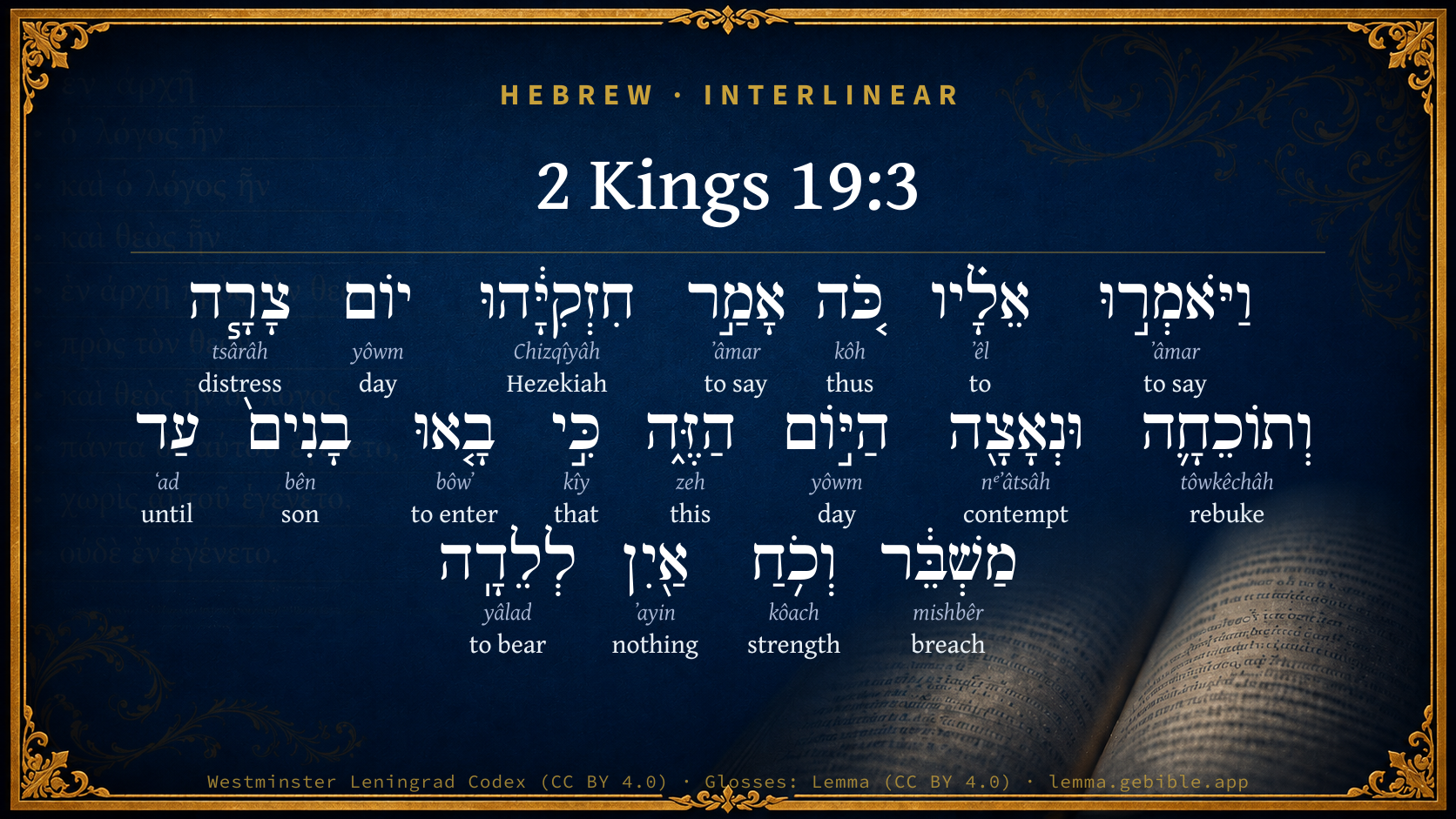
Hebrew (Westminster Leningrad Codex) 2 Kings 19:3 appears in the Hebrew Old Testament. The text above is from the Westminster Leningrad Codex. Each word links to its Strong’s number, a concise gloss, and parsing drawn from the Open Scriptures Hebrew Bible morphology. Click any word for its full Brown-Driver-Briggs (BDB) entry.
Download image
Cite this verse

2 Kings 19:3 (World English Bible). Public Domain. Lemma interlinear Bible study tool, https://lemma.gebible.app/v/2-kings/19/3.

Show BibTeX & RIS
BibTeX
RIS
English Translation
They said to him, Thus says Hezekiah, This day is a day of trouble, and of rebuke, and of rejection; for the children are come to the birth, and there is not strength to bring forth.
World English Bible · Public Domain
Highlights
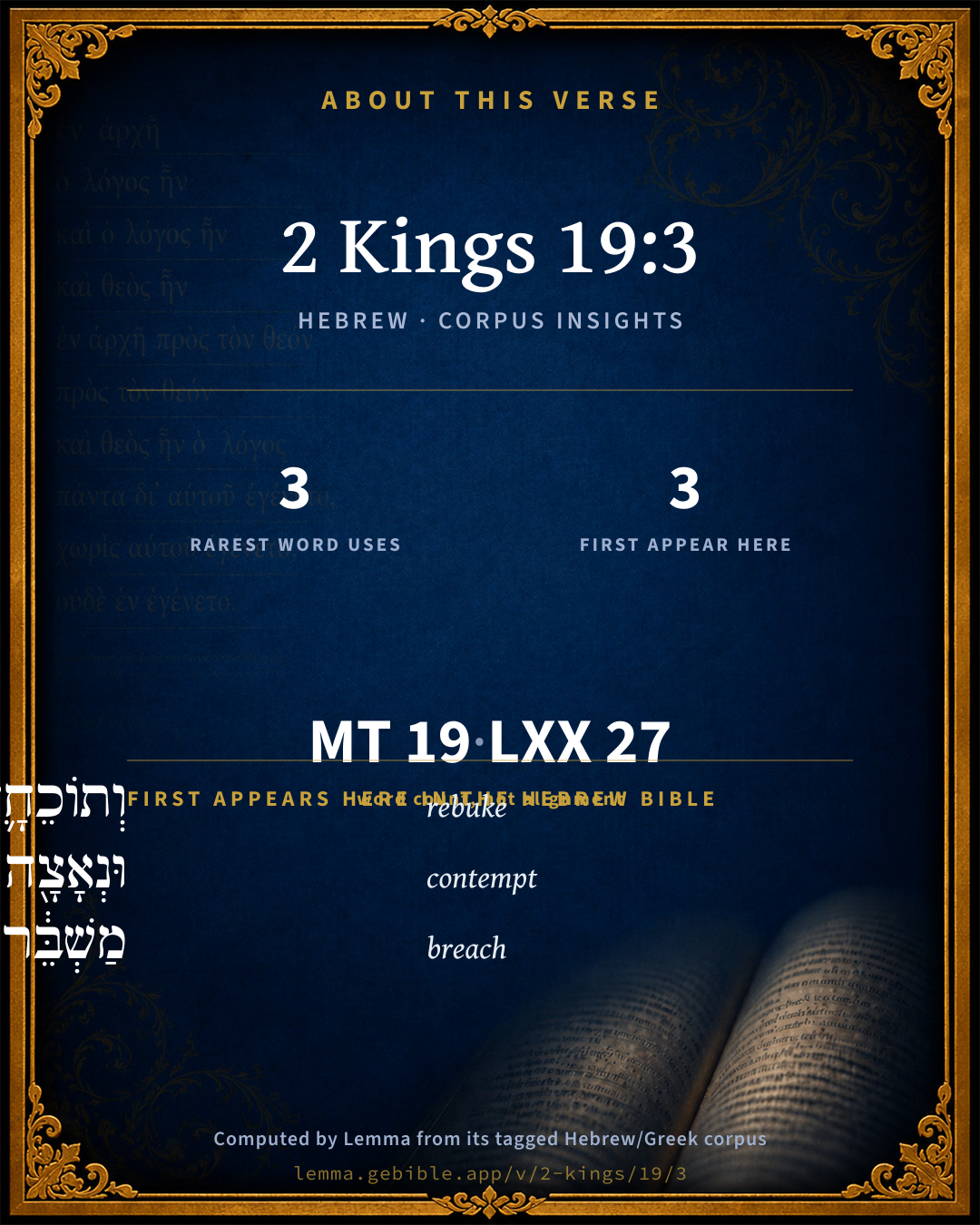
  • 3 first appearances in the Hebrew Bible
Full analysis ↓
Download a study sheet

One document with this verse’s original text, its word-by-word gloss line, the meaning frame, cross-references with their text, attributed commentary, and full source and license credits — printable, and it pastes into notes with its structure intact.

This verse Autodidact and up

Study sheet (.html) Plain text (.txt)

A passage Seminary Student

Up to 50 verses in one chapter. A passage sheet keeps up to 6 commentary sources and 12 cross-references per verse, in the order this page ranks them, and says so on the sheet whenever that leaves anything out. Ask for a single verse and you get the Autodidact verse sheet above.

Everything on this page stays free to read, with no account — the sheet is a download of what is already on screen, not access to it.

Want to remove ads? Support Godless Engineer
Compare translations 3

The same verse in 3 English versions, stacked beneath the original-language interlinear above. Click any original word for its lexicon entry.

Each is an independent rendering of the whole verse — the interlinear is not word-aligned to these translations.

Highlighted words mark where these versions differ — a whole-verse word diff, not a word-by-word alignment.

  • World English Bible Public Domain
    They said to him, Thus says Hezekiah, This day is a day of trouble, and of rebuke, and of rejection; for the children are come to the birth, and there is not strength to bring forth.
  • King James Version Public Domain
    And they said unto him, Thus saith Hezekiah, This day is a day of trouble, and of rebuke, and blasphemy; for the children are come to the birth, and there is not strength to bring forth.
  • unfoldingWord Literal Text CC BY-SA 4.0
    And they said to him, “Thus says Hezekiah, ‘This day a day of trouble and chastisement and reproach, for sons have come to the birth canal, but no strength to give birth.

unfoldingWord Literal Text — © unfoldingWord, licensed CC BY-SA 4.0. Word-aligned USFM3 via Door43 (git.door43.org/unfoldingWord/en_ult).

Versions to compare (up to 4)

3 of 4 selected

Show all 18 translations

Every available English version of this verse, each an independent rendering of the whole verse.

  • World English Bible Public Domain
    They said to him, Thus says Hezekiah, This day is a day of trouble, and of rebuke, and of rejection; for the children are come to the birth, and there is not strength to bring forth.
  • Berean Standard Bible Public Domain
    to tell him, “This is what Hezekiah says: Today is a day of distress, rebuke, and disgrace; for children have come to the point of birth, but there is no strength to deliver them.
  • Majority Standard Bible Public Domain
    to tell him, “This is what Hezekiah says: Today is a day of distress, rebuke, and disgrace; for children have come to the point of birth, but there is no strength to deliver them.
  • King James Version Public Domain
    And they said unto him, Thus saith Hezekiah, This day is a day of trouble, and of rebuke, and blasphemy; for the children are come to the birth, and there is not strength to bring forth.
  • American Standard Version (1901) Public Domain
    And they said unto him, Thus saith Hezekiah, This day is a day of trouble, and of rebuke, and of contumely; for the children are come to the birth, and there is not strength to bring forth.
  • Revised Version (1885) Public Domain
    And they said unto him, Thus saith Hezekiah, This day is a day of trouble, and of rebuke, and of contumely: for the children are come to the birth, and there is not strength to bring forth.
  • Geneva Bible (1599) Public Domain
    And they said vnto him, Thus saith Hezekiah, This day is a day of tribulation and of rebuke, and blasphemie: for the childre are come to the birth, and there is no strength to bring foorth.
  • Douay-Rheims (1899) Public Domain
    And they said to him: Thus saith Ezechias: This day is a day of tribulation, and of rebuke, and of blasphemy: the children are come to the birth, and the woman in travail hath not strength.
  • Young's Literal Translation Public Domain
    and they say unto him, `Thus said Hezekiah -- A day of distress, and rebuke, and despising `is' this day; for come have sons unto the birth, and power there is not to bring forth.
  • Literal Standard Version CC BY-SA 4.0
    and they say to him, “Thus said Hezekiah: This day [is] a day of distress, and rebuke, and despising; for sons have come to the birth, and there is not power to bring forth.
  • Unlocked Literal Bible CC BY-SA 4.0
    They said to him, “Hezekiah says, 'This day is a day of distress, rebuke, and disgrace, for the children have come to the time of birth, but there is no strength for them to be born.
  • unfoldingWord Literal Text CC BY-SA 4.0
    And they said to him, “Thus says Hezekiah, ‘This day a day of trouble and chastisement and reproach, for sons have come to the birth canal, but no strength to give birth.
  • Darby Bible Public Domain
    And they said to him, Thus says Hezekiah: This day is a day of trouble and of rebuke and of reviling; for the children are come to the birth, and there is not strength to bring forth.
  • World Messianic Bible Public Domain
    They said to him, “Hezekiah says, ‘Today is a day of trouble, of rebuke, and of rejection; for the children have come to the point of birth, and there is no strength to deliver them.
  • Webster's Bible Public Domain
    And they said to him, Thus saith Hezekiah, This day is a day of trouble, and of rebuke, and blasphemy: for the children have come to the birth, and there is not strength to bring forth.
  • Free Bible Version CC BY-SA 4.0
    They told him, “This is what Hezekiah says: Today is a day of trouble, of punishment and disgrace. It's like when babies arrive at the entrance to the birth canal but there's no strength to deliver them.
  • Bible in Basic English Public Domain
    And they said to him, Hezekiah says, This day is a day of trouble and punishment and shame; for the children are ready to come to birth, but there is no strength to give birth to them.
  • JPS Tanakh (1917) Public Domain
    And they said unto him: 'Thus saith Hezekiah: This day is a day of trouble, and of rebuke, and of contumely; for the children are come to the birth, and there is not strength to bring forth.

Literal Standard Version (2020), Covenant Press — licensed CC BY-SA 4.0. Text via the HelloAO Bible API (eBible.org). Unlocked Literal Bible (unfoldingWord) — licensed CC BY-SA 4.0. Text via the HelloAO Bible API (eBible.org). unfoldingWord Literal Text — © unfoldingWord, licensed CC BY-SA 4.0. Word-aligned USFM3 via Door43 (git.door43.org/unfoldingWord/en_ult). Free Bible Version, Dr. Jonathan Gallagher — licensed CC BY-SA 4.0. Text via the HelloAO Bible API (eBible.org).

Word by word

More ways to search: Search by grammar → Find every occurrence → Compare this word →

Practice this passage: Drill this verse → Learn its vocabulary →

מַשְׁבֵּ֔ר
mishbêr
H4866
“breach”
Noun, Common, Masculine, Singular, Absolute
Part of Speech
Noun
Type
Common
Gender
Masculine
Number
Singular
State
Absolute
Full BDB Definition

Origin: from H7665

TWOT: 2321c

place of breaking forth, place of breach, opening - of womb
  1. וַיֹּאמְר֣וּ ʼâmar H559 “and · to say” Conjunction + Verb, Qal, Sequential Imperfect, 3rd Person, Masculine, Plural
  2. אֵלָ֗יו ʼêl H413 “to · him” Preposition + Suffix, Personal, 3rd Person, Masculine, Singular
  3. כֹּ֚ה kôh H3541 “thus” Adverb
  4. אָמַ֣ר ʼâmar H559 “to say” Verb, Qal, Perfect, 3rd Person, Masculine, Singular
  5. חִזְקִיָּ֔הוּ Chizqîyâh H2396 “Hezekiah” Noun, Proper
  6. יוֹם yôwm H3117 “day of” Noun, Common, Masculine, Singular, Construct
  7. צָרָ֧ה tsârâh H6869 “distress” Noun, Common, Feminine, Singular, Absolute
  8. וְתוֹכֵחָ֛ה tôwkêchâh H8433 “and · rebuke” Conjunction + Noun, Common, Feminine, Singular, Absolute
  9. וּנְאָצָ֖ה nᵉʼâtsâh H5007 “and · contempt” Conjunction + Noun, Common, Feminine, Singular, Absolute
  10. הַיּ֣וֹם yôwm H3117 “the · day” Particle, Definite Article + Noun, Common, Masculine, Singular, Absolute
  11. הַזֶּ֑ה zeh H2088 “the · this” Particle, Definite Article + Pronoun, Demonstrative, Masculine, Singular
  12. כִּ֣י kîy H3588 “that” Conjunction
  13. בָ֤אוּ bôwʼ H935 “to enter” Verb, Qal, Perfect, 3rd Person, Common, Plural
  14. בָנִים֙ bên H1121 “sons” Noun, Common, Masculine, Plural, Absolute
  15. עַד ʻad H5704 “until” Preposition
  16. וְכֹ֥חַ kôach H3581 “and · strength” Conjunction + Noun, Common, Masculine, Singular, Absolute
  17. אַ֖יִן ʼayin H369 “nothing” Particle, Negative
  18. לְלֵדָֽה yâlad H3205 “to/for · childbirth” Preposition + Noun, Common, Feminine, Singular, Absolute

About this verse

These counts appear in no published source. They are computed here, from the morphology-tagged text and Lemma’s own curated glosses. What Lemma adds →

19
words
17
distinct lemmas
Historical
section

Notable vocabulary

The rarest word here is מַשְׁבֵּ֔ר breach H4866 — appearing just 3 times in the whole Hebrew Bible.

First appearance in Scripture

These words make their first canonical appearance in the Hebrew Bible here:

  • וְתוֹכֵחָ֛ה rebuke H8433
  • וּנְאָצָ֖ה contempt H5007
  • מַשְׁבֵּ֔ר breach H4866

Shared distinctive vocabulary

מַשְׁבֵּ֔ר breach H4866 occurs in 3 verses of the Hebrew Bible. Also found in:

Grammatical profile

  • 3 verbs
  • 10 nouns
  • 1 pronoun
  • 2 prepositions
  • 1 conjunction
  • 1 adverb
  • 1 particle

Verb forms

  • וַיֹּאמְר֣וּ Qal · Sequential Imperfect
  • אָמַ֣ר Qal · Perfect
  • בָ֤אוּ Qal · Perfect

Repetition

Words recur within this verse — often emphatic in Hebrew:

  • וַיֹּאמְר֣וּ to say H559 ×2
  • יוֹם day H3117 ×2

Hebrew & Septuagint length

In English translation the verse runs 36 words from the Hebrew and 33 from the Septuagint (LXX English) — closely comparable.

A rough comparison of the two English renderings, which tokenize alike — not a word-level alignment.

Word counts can differ between the Hebrew and the Greek without any difference in meaning — e.g. the Hebrew direct-object marker אֵת has no separate Greek word, and Greek often adds the article ὁ.

In the original languages it is 19 Hebrew tokens and 27 Greek tokens — but the two are counted differently (Hebrew bundles its prefixes and suffixes into one token; the Greek is in lemma form), so that isn’t a like-for-like length.

Cross-references

10

Topical passages linked to 2 Kings 19:3 in the Treasury of Scripture Knowledge — connected by theme and wording, ordered by reader-vote popularity; previews shown in the World English Bible.

  • Isaiah 66:9 Shall I bring to the birth, and not cause to bring forth? says Yahweh: shall I who cause to bring forth shut [the womb]? says your God.
  • Jeremiah 30:5–7 For thus says Yahweh: We have heard a voice of trembling, of fear, and not of peace.
  • Isaiah 26:17–18 Like as a woman with child, who draws near the time of her delivery, is in pain and cries out in her pangs; so we have been before you, Yahweh.
  • Hosea 13:13 The sorrows of a travailing woman will come on him. He is an unwise son; For when it is time, he doesn't come to the opening of the womb.
  • Hebrews 3:15–16 while it is said, "Today if you will hear his voice, Don't harden your hearts, as in the rebellion."
  • 2 Kings 18:29 Thus says the king, Don't let Hezekiah deceive you; for he will not be able to deliver you out of his hand:
  • Psalms 39:11 When you rebuke and correct man for iniquity, You consume his wealth like a moth. Surely every man is but a breath." Selah.
  • Psalms 95:8 Don't harden your heart, as at Meribah, As in the day of Massah in the wilderness,
  • Psalms 123:3–4 Have mercy on us, Yahweh, have mercy on us, For we have endured much contempt.
  • Hosea 5:15–6:1 I will go and return to my place, until they acknowledge their offense, And seek my face. In their affliction they will seek me earnestly."

Cross-references courtesy of OpenBible.info (CC BY 4.0).

Hebrew and Greek witnesses Masoretic Hebrew ↔ Greek Septuagint

The same verse in the two great witnesses to the Old Testament, shown verse-for-verse.

These are two independent witnesses, not word-aligned to each other, and the Septuagint is shown in lemma (dictionary) form.

Hebrew 2 Kings 19:3 Masoretic · Westminster Leningrad Codex

וַיֹּאמְר֣וּ אֵלָ֗יו כֹּ֚ה אָמַ֣ר חִזְקִיָּ֔הוּ יוֹם צָרָ֧ה וְתוֹכֵחָ֛ה וּנְאָצָ֖ה הַיּ֣וֹם הַזֶּ֑ה כִּ֣י בָ֤אוּ בָנִים֙ עַד מַשְׁבֵּ֔ר וְכֹ֥חַ אַ֖יִן לְלֵדָֽה

They said to him, Thus says Hezekiah, This day is a day of trouble, and of rebuke, and of rejection; for the children are come to the birth, and there is not strength to bring forth.

World English Bible · Public Domain

Greek LXX 2 Kings 19:3 Septuagint · lemma form

καί εἶπον πρός αὐτός ὅδε λέγω εζεκιας ἡμέρα θλῖψις καί ἐλεγμός καί παροργισμός ὁ ἡμέρα οὗτος ὅτι ἔρχομαι υἱός ἕως ὠδίν καί ἰσχύς οὐ εἰμί ὁ τίκτω

And they said to him, Thus says Ezekias, This day is a day of tribulation, and rebuke, and provocation: for the children are come to the travail-pangs, but the mother has no strength.

LXX2012 (modern English Septuagint) · Public Domain

Hebrew: Westminster Leningrad Codex (CC BY 4.0). Greek: Septuagint (public domain); English from LXX2012 (modern English Septuagint) (Public Domain). How the Septuagint differs from the Hebrew →

Targum (Aramaic paraphrase)

1

The Targum is the ancient Jewish Aramaic paraphrase of the Hebrew Scriptures — an interpretive translation, not the Hebrew text itself. Onkelos (literal) and Pseudo-Jonathan (expansive) render the Torah, and Jonathan the Prophets. Coverage is partial: where no permissively-licensed English translation exists for a verse, only the Aramaic is shown. This is verse-level text, not a word-by-word alignment to the Hebrew.

  1. Targum Jonathan Prophets (Joshua–Malachi)
    וַאֲמָרוּ לֵיהּ כִּדְנַן אֲמַר חִזְקִיָהוּ יוֹם עָקָא וְחִיסוּדִין וְנִיאוּצָא יוֹמָא הָדֵין אֲרֵי אֲקֵיפְתָּנָא עָקָא כְּאִתְּתָא דְיַתְבָא עַל מַתְבְּרָא וְחֵיל לֵית לָהּ לְמֵילַד:

    (no public-domain English translation for this verse)

    Targum Jonathan — Aramaic: “Mikraot Gedolot” (public domain). English: “Sefaria Community Translation” (CC0 1.0 (public-domain dedication)); “London "Chaldee Paraphrase," 1871” (public domain). Text via Sefaria.

Commentary

Notes on 2 Kings 19:3 from classic Christian and Jewish commentators (each source and its license shown beneath its notes). The classic Christian expositions comment on the surrounding passage and are grouped to its opening verse, so a note may address several verses; the Jewish commentaries on the Tanakh (Rashi and others) are per-verse, so they appear only where the commentator wrote on this verse.

Lemma curates 59 commentaries, every one of them public domain or Creative Commons licensed, each selected and text-cleaned for this edition rather than reprinted as found. About our sources →

Trapp's Complete Commentary

John Trapp

2Ki 19:3 And they said unto him, Thus saith Hezekiah, This day [is] a day of trouble, and of rebuke, and blasphemy: for the children are come to the birth, and [there is] not strength to bring forth.

Ver. 3. For the children are come to the birth.] We are greatly pained and perplexed, our hearts do even ache and quake within us, at the hearing of these horrid blasphemies; but we want strength to punish them: we humbly put them into God’s holy hands, and beseech him to take an order with them, for which end thy prayers are requested. Or, We are now in extreme danger, and do therefore earnestly implore Heaven’s help at a dead lift.

John Trapp, A Commentary or Exposition upon All the Books of the Old and New Testament (1647–1656) — public domain. Text from a community e-Sword module.

Joseph Benson's Commentary

2Ki 19:3. This is a day of rebuke and blasphemy — From the Assyrian, who reviles and reproaches us. For the children, &c. — We are like a poor travailing woman in great extremity, having no strength left to help herself, and to bring forth her infant into the world. We have attempted to deliver ourselves from the Assyrian yoke, and carried on that work to some maturity, and, as we thought, brought it to the birth; but now we have no might to finish. We have begun a happy reformation, and are hindered by this insolent Assyrian from bringing it to perfection.

Joseph Benson's Commentary on the Old and New Testaments (1811–1818) — public domain. Text from a community e-Sword module.

Geneva Bible (1599)

Geneva Bible translators

The dangers are so great, that we can neither avenge this blasphemy, nor help ourselves no more than a woman in her travail.

Geneva Bible (1599) marginal notes — public domain. Text via Bolls.life.

Adam Clarke's Commentary

Verse 3. The children are come to the birth] The Jewish state is here represented under the emblem of a woman in travail, who has been so long in the pangs of parturition, that her strength is now entirely exhausted, and her deliverance is hopeless, without a miracle. The image is very fine and highly appropriate.

A similar image is employed by Homer, when he represents the agonies which Agamemnon suffers from his wound: -

Οφρα οἱ αἱμ' ετι θερμον ανηνοθεν εξ ωτειλης·

Λυταρ επει το μεν ἑλκος ετερσετο παυσατο δ' αἱμα,

Οξειαι οδυναι δυνον μενος Ατρειδαο·

Ως δ' ὁταν ωδινουσαν εχῃ βελος οξυ γυναικα,

Δριμυ, το τε προΐεισι μογοστοκοι Ειλειθυιαι

Ἡρης θυγατερες πικ ρας ωδινας εχουσαι·

Ὡς οξει' οδυναι δυνον μενος Ατρειδαο.

Il. xi., ver. 266.

This, while yet warm, distill'd the purple flood;

But when the wound grew stiff with clotted blood,

Then grinding tortures his strong bosom rend.

Less keen those darts the fierce Ilythiae send,

The powers that cause the teeming matron's throes,

Sad mothers of unutterable woes.

POPE.

Better translated by Macpherson; but in neither well: "So long as from the gaping wound gushed forth, in its warmth, the blood; but when the wound became dry, when ceased the blood to flow amain, sharp pains pervade the strength of Atrides. Racking pangs glide through his frame; as when the Ilythiae, who preside over births, the daughters of white armed Juno, fierce dealers of bitter pains, throw all their darts on hapless women, that travail with child. Such pains pervade the strength of Atrides."

Adam Clarke's Commentary on the Bible (1810–1826) — public domain. Text from a community e-Sword/MySword module.

Ellicott's Commentary for English Readers

(3) Rebuke.—Rather, chastisement (Hos_5:9). The verb means to give judgment, punish, &c. It occurs in the next verse, “will reprove the words,” or rather, punish for the words.

Blasphemy.—Comp. Isa_1:4; Isa_5:24, where the cognate verb is used; and Neh_9:18; Neh_9:26, where the noun “provocations” is almost identical.

The children are come . . .—With this proverb, expressive of the utter collapse of all human resources, comp. the similar language of Hosea (Hos_13:13).

A Bible Commentary for English Readers, edited by Charles John Ellicott (1878–1897) — public domain. Text from a community e-Sword module.

The Cambridge Bible for Schools and Colleges

gen. ed. J. J. S. Perowne

3. This day is a day of trouble, and of rebuke, and of blasphemy] R.V. contumely. The words refer to the condition of Hezekiah and his people. First they are in great anguish, kept in and surrounded by a threatening and mighty enemy, this is the trouble: then they are reminded of their offences and feel that for their wrong they are under chastisement and reproof: and lastly, that they are given over to the adversaries so that their enemies mock at their confidence with insolent derision. Hence without help from God, and with no hope from men, their conceptions of freedom and liberty were likely all to prove abortive, and come to no result. The figure which the king employs indicates that they were in the extremest danger, and had no power to save themselves.

The Cambridge Bible for Schools and Colleges (gen. ed. J. J. S. Perowne; Cambridge University Press, 1878–1918) — public domain. Text from a community e-Sword module.

Albert Barnes' Notes on the Bible

The “trouble” consisted in rebuke” (rather, “chastisement,”) for sins at the hand of God, and “blasphemy” (rather, “reproach,”) at the hands of man.

The children ... - i. e., “we are in a fearful extremity - at the last gasp - and lack the strength that might carry us through the danger.”

Albert Barnes' Notes on the Bible (1834–1885) — public domain. Text from a community e-Sword/MySword module.

Haydock's Catholic Bible Commentary

Blasphemy. The enemy insults over us (Calmet) and over God. (Haydock) --- Birth. Hebrew, "the mouth of the womb." (Vatable) --- This comparison shews the utmost distress to which the people of Jerusalem were reduced. Any great anguish is denoted by a woman in travail, Deuteronomy ii. 25., and Psalm xlvii. 7. Homer (Iliad A) thus describes the uneasiness of Agamemnon. (Calmet) --- Ezechias found himself unable to contend with the Assyrian, though he wished to do it. (Menochius) --- Without courage, all hope of escaping is lost. (Du Hamel)

George Leo Haydock (1774–1849), Haydock's Catholic Family Bible and Commentary, 1859 edition — public domain. Excludes Psalms (Douay-Rheims chapter numbering differs from Protestant) and Deuterocanonical books (Catholic canon only).

Matthew Poole's English Annotations

A day of trouble and of rebuke; either,

1. From God, wherein God rebukes and chastens us sorely. Or rather,

2. From the Assyrian, who reviles and reproacheth us; for his business here is to complain, not of God, but of the Assyrian. We are like a poor travailing woman in great extremity, and having no strength left to help herself, and to bring forth her infant into the world. We have attempted to deliver ourselves from the Assyrian yoke; and had carried on that work to some maturity, and, as we thought, brought it to the birth; but now we have no might to finish, unless thou assist us. We have begun a happy reformation, and are hindered by this insolent Assyrian from bringing it to perfection. See 2Ch 32:1.

Matthew Poole's English Annotations on the Holy Bible (1683–1685) — public domain. Text from a community e-Sword/MySword module.

Whedon's Commentary on the Bible

Daniel D. Whedon

3. A day of trouble — Better, a day of anguish, or, of deep distress.

Rebuke — Hezekiah recognised in his affliction a Divine reproval and chastisement.

Blasphemy — A reference to the contempt with which Rab-shakeh had treated the God of Israel; a day when such blasphemy abounds, or goes unpunished. Others render נאצהrejection, or disdain, and understand it of contemptuous treatment and rejection of Judah on the part of God. The word is capable of either sense.

Not strength to bring forth — “The proverb is taken from the crisis in childbearing, where the child is in the midst of the birth, but the strength of the mother fails on account of the continuous pains, so that she and the child are both in danger. Clericus, therefore, interprets it of the situation of those in great peril, who know what they must do in order to escape, but who feel that it is beyond their power to take the necessary measures, and who fear that, if they should make the attempt, all would be lost.” — Bahr.

Daniel D. Whedon (gen. ed.), Commentary on the Old and New Testaments (1874–1909) — public domain. Text from a community e-Sword module.

The Pulpit Commentary

And they said unto him, Thus saith Hezekiah, This day is a day of trouble, and of rebuke, and of Blasphemy. Of "trouble," or "distress," manifestly a day on which the whole nation is troubled, grieved, alarmed, distressed, made miserable. It is also a day of "rebuke," or rather of "chastisement a day on which God"s hand lies heavy upon us and chastises us for our sins. And it is a day, not of "blasphemy," but of "abhorrence" or of "contumely a day on which God contumeliously rejects his people, and allows them to be insulted by their enemies (see the comments of Keil and Bahr). For the children are come to the birth, and there is not strength to bring forth. A proverbial expression, probably meaning that a dangerous crisis approaches, and that the nation has no strength to carry it through the peril.

The Pulpit Commentary (1880–1919), ed. H.D.M. Spence-Jones & Joseph S. Exell — public domain. Text from a community e-Sword module.

John Wesley's Explanatory Notes

The children - We are like a poor travailing woman in great extremity, having no strength left to help herself, and to bring forth her infant into the world. We have attempted to deliver ourselves from the Assyrian yoke; and had carried on that work to some maturity, and as we thought, brought it to the birth; but now we have no might to finish. We have begun an happy reformation, and are hindered by this insolent Assyrian, from bringing it to perfection.

John Wesley, Explanatory Notes Upon the Whole Bible (1754–1765) — public domain. Text via the GEBible commentary corpus.

Keil & Delitzsch

C. F. Keil & F. Delitzsch

"A day of distress, and of chastisement, and of rejection is this day." תּוכחה: the divine chastisement. נאצה: contemptuous treatment, or rejection of the people on the part of God (compare נאץ, Deu 32:19; Jer 14:21; Lam 2:6). "For children have come to the birth, and there is not strength to bring forth." A figure denoting extreme danger, the most desperate circumstances. If the woman in travail has not strength to bring forth the child which has come to the mouth of the womb, both the life of the child and that of the mother are exposed to the greatest danger; and this was the condition of the people here (see the similar figure in Hos 13:13). For לדה instead of לדת, see Ges. 69, 2 Anm.

Keil & Delitzsch — Biblical Commentary on the Old Testament (1861–1891) — public domain (CC PDM 1.0). Text via the HelloAO Bible API. (Old Testament only.)

unfoldingWord translationNotes

Door43 World Missions Community

This day is a day of distress

"This is a time of distress"

the children have come to the time of birth, but there is no strength for them to be born

This is a metaphor to describe how the people and their leaders have become so weak and unable to fight the enemy. (See: Metaphor)

all the words of the chief commander

"everything that the chief commander has said"

lift up your prayer

This a common way (an idiom) to use the action of lifting to metaphorically represent praying earnestly to Yahweh who is above us. AT: "pray earnestly" (See: Metaphor and Idiom)

translationWords

rebuke

Yahweh

God

word

Assyria

lord

life

pray

remnant

unfoldingWord translationNotes — © Distant Shores Media and the Door43 World Missions Community, licensed CC BY-SA 4.0. Source: git.door43.org/Door43/en_tn.

Rashi

Rabbi Shlomo Yitzchaki (Rashi)

[And] debate. That the wicked are debating and showing evidence to [support] their words, claiming, “We have the power and the strength.”

Children. Yisroel.

As far as the birthstool. As far as a distress similar to a woman sitting on the birthstool, but not having strength to give birth.

Rashi on the Tanakh — English translations: “The Judaica Press complete Tanach with Rashi, translated by A. J. Rosenberg” (CC BY 4.0); “Pentateuch with Rashi's commentary by M. Rosenbaum and A.M. Silbermann, 1929-1934” (public domain); “The Metsudah Tanach series, Lakewood, N.J” (CC BY 4.0); and “The Book of Joshua, Metsudah Publications, 1997” (CC BY 4.0). Text via Sefaria.

Lesson kit

Teaching starters — assembled from the data on this page, not authored interpretation. Every prompt links to the verse data it draws on. Edit before teaching.

2 Kings, in the Historical, opens this verse with 19 words (17 distinct Hebrew lemmas). Its most distinctive word is mishbêr (“breach”). A historical commentator’s framing appears above. Read the whole chapter for the surrounding context.

Discussion questions

  1. How does “breach” (mishbêr) shape what this verse is saying?
  2. 3 words make their first appearance in Scripture here. What does this debut establish?
  3. How does Isaiah 37:3, which shares the word «breach», read alongside this verse?
  4. What does the repetition of “to say” (2× in this one verse) do in this verse?
  5. These translations render this verse differently; the difference is in the English rendering, not the original. What questions does that raise?
  6. «וַיֹּאמְר֣וּ» is a Qal Sequential Imperfect verb. How does that grammatical form shape the action described?
  7. Compare how Trapp's Complete Commentary and Joseph Benson's Commentary read this verse. Where do they agree or differ?

Things to notice

Reading settings

Reading text

Shown beneath each verse's original-language words.

Old Testament
Old Testament edition

Read the OT as the Masoretic Hebrew (MT) or the Greek Septuagint (LXX).

English shown for the Greek Septuagint (in the Hebrew ↔ Greek comparison).

Comparing translations? Open the Compare panel on any verse page to stack up to four side by side.