
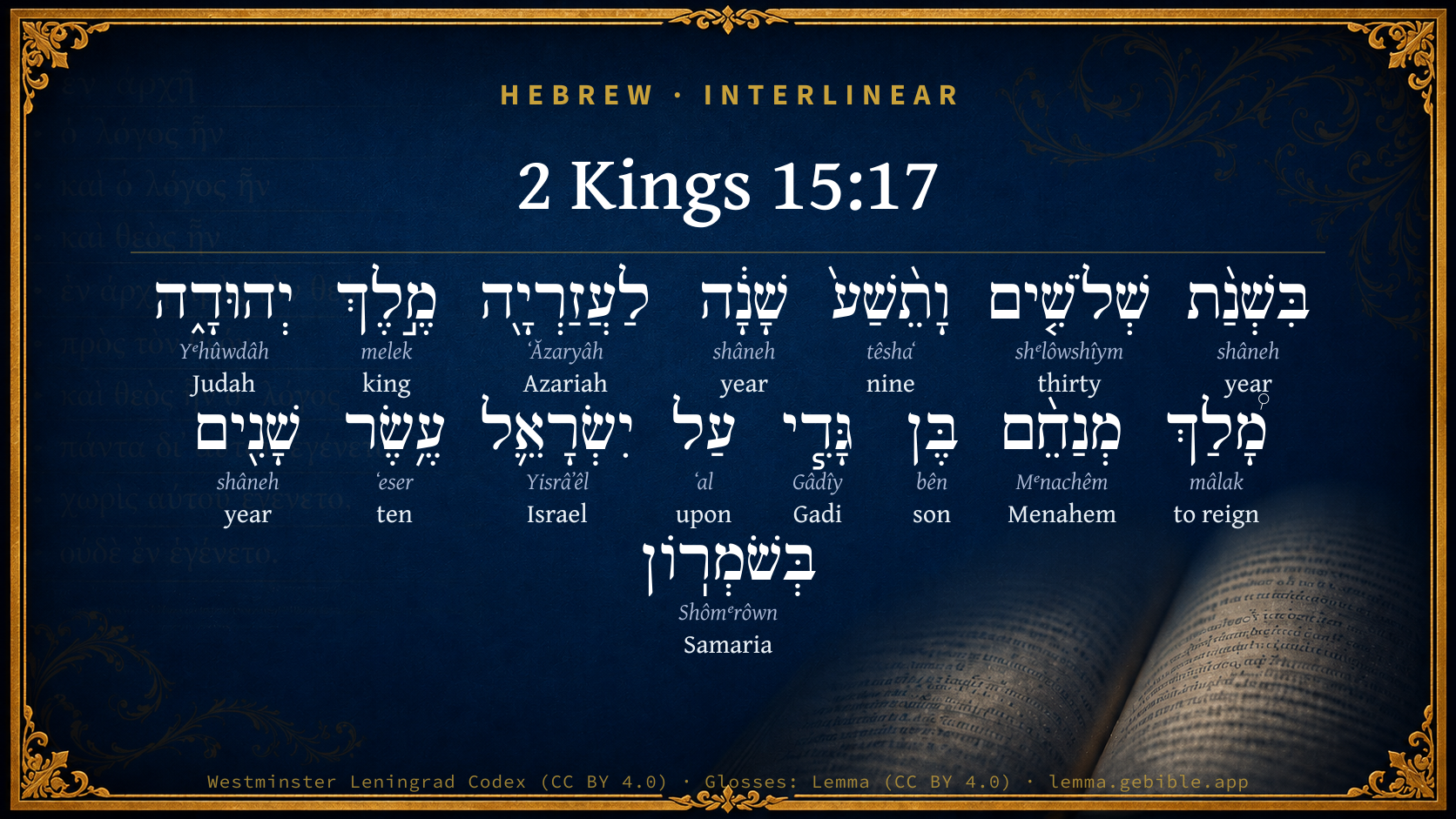
2 Kings 15:17

Hebrew (Westminster Leningrad Codex) 2 Kings 15:17 appears in the Hebrew Old Testament. The text above is from the Westminster Leningrad Codex. Each word links to its Strong’s number, a concise gloss, and parsing drawn from the Open Scriptures Hebrew Bible morphology. Click any word for its full Brown-Driver-Briggs (BDB) entry.
Download image
Cite this verse

2 Kings 15:17 (World English Bible). Public Domain. Lemma interlinear Bible study tool, https://lemma.gebible.app/v/2-kings/15/17.

Show BibTeX & RIS
BibTeX
RIS
English Translation
In the nine and thirtieth year of Azariah king of Judah began Menahem the son of Gadi to reign over Israel, [and reigned] ten years in Samaria.
World English Bible · Public Domain
Download a study sheet

One document with this verse’s original text, its word-by-word gloss line, the meaning frame, cross-references with their text, attributed commentary, and full source and license credits — printable, and it pastes into notes with its structure intact.

This verse Autodidact and up

Study sheet (.html) Plain text (.txt)

A passage Seminary Student

Up to 50 verses in one chapter. A passage sheet keeps up to 6 commentary sources and 12 cross-references per verse, in the order this page ranks them, and says so on the sheet whenever that leaves anything out. Ask for a single verse and you get the Autodidact verse sheet above.

Everything on this page stays free to read, with no account — the sheet is a download of what is already on screen, not access to it.

Want to remove ads? Support Godless Engineer
Compare translations 3

The same verse in 3 English versions, stacked beneath the original-language interlinear above. Click any original word for its lexicon entry.

Each is an independent rendering of the whole verse — the interlinear is not word-aligned to these translations.

Highlighted words mark where these versions differ — a whole-verse word diff, not a word-by-word alignment.

  • World English Bible Public Domain
    In the nine and thirtieth year of Azariah king of Judah began Menahem the son of Gadi to reign over Israel, [and reigned] ten years in Samaria.
  • King James Version Public Domain
    In the nine and thirtieth year of Azariah king of Judah began Menahem the son of Gadi to reign over Israel, and reigned ten years in Samaria.
  • unfoldingWord Literal Text CC BY-SA 4.0
    In the year of 39, the year to Azariah, the king of Judah, Menahem, the son of Gadi, reigned over Israel, ten years in Samaria.

unfoldingWord Literal Text — © unfoldingWord, licensed CC BY-SA 4.0. Word-aligned USFM3 via Door43 (git.door43.org/unfoldingWord/en_ult).

Versions to compare (up to 4)

3 of 4 selected

Show all 18 translations

Every available English version of this verse, each an independent rendering of the whole verse.

  • World English Bible Public Domain
    In the nine and thirtieth year of Azariah king of Judah began Menahem the son of Gadi to reign over Israel, [and reigned] ten years in Samaria.
  • Berean Standard Bible Public Domain
    In the thirty-ninth year of Azariah’s reign over Judah, Menahem son of Gadi became king of Israel, and he reigned in Samaria ten years.
  • Majority Standard Bible Public Domain
    In the thirty-ninth year of Azariah’s reign over Judah, Menahem son of Gadi became king of Israel, and he reigned in Samaria ten years.
  • King James Version Public Domain
    In the nine and thirtieth year of Azariah king of Judah began Menahem the son of Gadi to reign over Israel, and reigned ten years in Samaria.
  • American Standard Version (1901) Public Domain
    In the nine and thirtieth year of Azariah king of Judah began Menahem the son of Gadi to reign over Israel, `and reigned' ten years in Samaria.
  • Revised Version (1885) Public Domain
    In the nine and thirtieth year of Azariah king of Judah began Menahem the son of Gadi to reign over Israel, and reigned ten years in Samaria.
  • Geneva Bible (1599) Public Domain
    The nine and thirtieth yeere of Azariah King of Iudah, beganne Menahem the sonne of Gadi to reigne ouer Israel, and reigned ten yeeres in Samaria.
  • Douay-Rheims (1899) Public Domain
    In the nine and thirtieth year of Azarias king of Juda, reigned Manahem son of Gadi over Israel ten years in Samaria.
  • Young's Literal Translation Public Domain
    In the thirty and ninth year of Azariah king of Judah reigned hath Menahem son of Gadi over Israel -- ten years in Samaria.
  • Literal Standard Version CC BY-SA 4.0
    In the thirty-ninth year of Azariah king of Judah, Menahem son of Gadi has reigned over Israel in Samaria, ten years.
  • Unlocked Literal Bible CC BY-SA 4.0
    In the thirty-ninth year of Azariah king of Judah, Menahem son of Gadi began to reign over Israel; he reigned ten years in Samaria.
  • unfoldingWord Literal Text CC BY-SA 4.0
    In the year of 39, the year to Azariah, the king of Judah, Menahem, the son of Gadi, reigned over Israel, ten years in Samaria.
  • Darby Bible Public Domain
    In the thirty-ninth year of Azariah king of Judah, Menahem the son of Gadi began to reign over Israel, for ten years, in Samaria.
  • World Messianic Bible Public Domain
    In the thirty ninth year of Azariah king of Judah, Menahem the son of Gadi began to reign over Israel for ten years in Samaria.
  • Webster's Bible Public Domain
    In the nine and thirtieth year of Azariah king of Judah began Menahem the son of Gadi to reign over Israel, and reigned ten years in Samaria.
  • Free Bible Version CC BY-SA 4.0
    Menahem, son of Gadi, became king of Israel in the thirty-ninth year of the reign of King Azariah of Judah. He reigned in Samaria for ten years.
  • Bible in Basic English Public Domain
    In the thirty-ninth year of Azariah, king of Judah, Menahem, the son of Gadi, became king over Israel, and was ruling in Samaria for ten years.
  • JPS Tanakh (1917) Public Domain
    In the nine and thirtieth year of Azariah king of Judah began Menahem the son of Gadi to reign over Israel, and reigned ten years in Samaria.

Literal Standard Version (2020), Covenant Press — licensed CC BY-SA 4.0. Text via the HelloAO Bible API (eBible.org). Unlocked Literal Bible (unfoldingWord) — licensed CC BY-SA 4.0. Text via the HelloAO Bible API (eBible.org). unfoldingWord Literal Text — © unfoldingWord, licensed CC BY-SA 4.0. Word-aligned USFM3 via Door43 (git.door43.org/unfoldingWord/en_ult). Free Bible Version, Dr. Jonathan Gallagher — licensed CC BY-SA 4.0. Text via the HelloAO Bible API (eBible.org).

Word by word

More ways to search: Search by grammar → Find every occurrence → Compare this word →

Practice this passage: Drill this verse → Learn its vocabulary →

גָּדִ֧י
Gâdîy
H1424
“Gadi”
Noun, Proper
Part of Speech
Noun
Type
Proper
Full BDB Definition

Origin: from H1409

TWOT: None

Gadi = "my fortune" - the Gadite father of Menahem, a king of Israel
  1. בִּשְׁנַ֨ת shâneh H8141 “in/at · year of” Preposition + Noun, Common, Feminine, Singular, Construct
  2. שְׁלֹשִׁ֤ים shᵉlôwshîym H7970 “thirty” Adjective, Cardinal number, Both, Plural, Absolute
  3. וָתֵ֨שַׁע֙ têshaʻ H8672 “and · nine” Conjunction + Adjective, Cardinal number, Feminine, Singular, Absolute
  4. שָׁנָ֔ה shâneh H8141 “year” Noun, Common, Feminine, Singular, Absolute
  5. לַעֲזַרְיָ֖ה ʻĂzaryâh H5838 “to/for · Azariah” Preposition + Noun, Proper
  6. מֶ֣לֶךְ melek H4428 “king of” Noun, Common, Masculine, Singular, Construct
  7. יְהוּדָ֑ה Yᵉhûwdâh H3063 “Judah” Noun, Proper
  8. מָ֠לַךְ mâlak H4427 “to reign” Verb, Qal, Perfect, 3rd Person, Masculine, Singular
  9. מְנַחֵ֨ם Mᵉnachêm H4505 “Menahem” Noun, Proper
  10. בֶּן bên H1121 “son of” Noun, Common, Masculine, Singular, Construct
  11. עַל ʻal H5921 “upon” Preposition
  12. יִשְׂרָאֵ֛ל Yisrâʼêl H3478 “Israel” Noun, Proper
  13. עֶ֥שֶׂר ʻeser H6235 “ten” Adjective, Cardinal number, Feminine, Singular, Absolute
  14. שָׁנִ֖ים shâneh H8141 “years” Noun, Common, Feminine, Plural, Absolute
  15. בְּשֹׁמְרֽוֹן Shômᵉrôwn H8111 “in/at · Samaria” Preposition + Noun, Proper

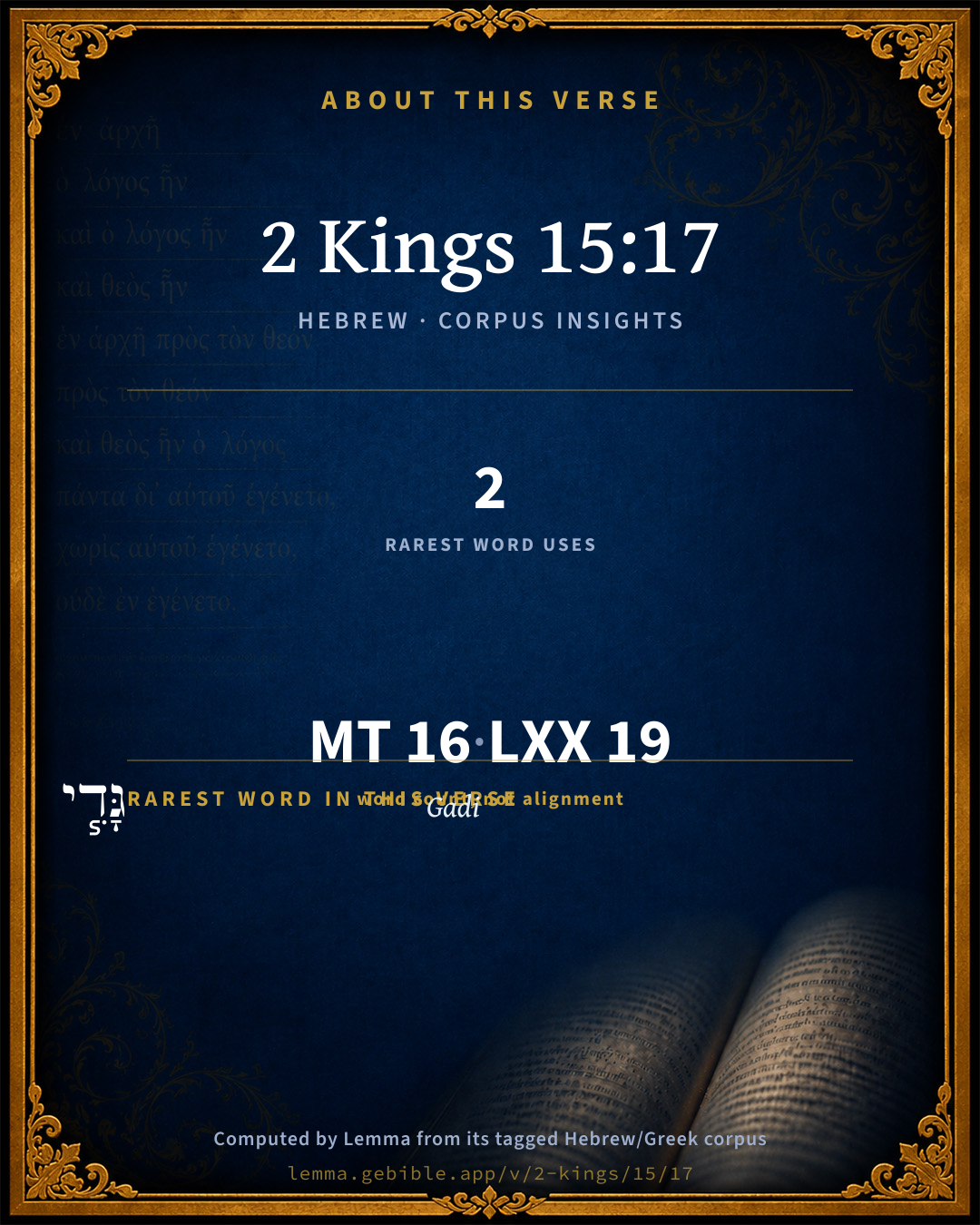
About this verse

These counts appear in no published source. They are computed here, from the morphology-tagged text and Lemma’s own curated glosses. What Lemma adds →

16
words
14
distinct lemmas
Historical
section

Notable vocabulary

The rarest word here is גָּדִ֧י Gadi H1424 — appearing just 2 times in the whole Hebrew Bible.

Shared distinctive vocabulary

גָּדִ֧י Gadi H1424 occurs in 2 verses of the Hebrew Bible. Also found in:

Grammatical profile

  • 1 verb
  • 11 nouns
  • 3 adjectives
  • 1 preposition

Verb forms

  • מָ֠לַךְ Qal · Perfect

Repetition

A word recurs within this verse — often emphatic in Hebrew:

  • בִּשְׁנַ֨ת year H8141 ×3

Hebrew & Septuagint length

In English translation the verse runs 27 words from the Hebrew and 25 from the Septuagint (LXX English) — closely comparable.

A rough comparison of the two English renderings, which tokenize alike — not a word-level alignment.

Word counts can differ between the Hebrew and the Greek without any difference in meaning — e.g. the Hebrew direct-object marker אֵת has no separate Greek word, and Greek often adds the article ὁ.

In the original languages it is 16 Hebrew tokens and 19 Greek tokens — but the two are counted differently (Hebrew bundles its prefixes and suffixes into one token; the Greek is in lemma form), so that isn’t a like-for-like length.

Hebrew and Greek witnesses Masoretic Hebrew ↔ Greek Septuagint

The same verse in the two great witnesses to the Old Testament, shown verse-for-verse.

These are two independent witnesses, not word-aligned to each other, and the Septuagint is shown in lemma (dictionary) form.

Hebrew 2 Kings 15:17 Masoretic · Westminster Leningrad Codex

בִּשְׁנַ֨ת שְׁלֹשִׁ֤ים וָתֵ֨שַׁע֙ שָׁנָ֔ה לַעֲזַרְיָ֖ה מֶ֣לֶךְ יְהוּדָ֑ה מָ֠לַךְ מְנַחֵ֨ם בֶּן גָּדִ֧י עַל יִשְׂרָאֵ֛ל עֶ֥שֶׂר שָׁנִ֖ים בְּשֹׁמְרֽוֹן

In the nine and thirtieth year of Azariah king of Judah began Menahem the son of Gadi to reign over Israel, [and reigned] ten years in Samaria.

World English Bible · Public Domain

Greek LXX 2 Kings 15:17 Septuagint · lemma form

ἐν ἔτος τριακοστός καί ἔνατος αζαριας βασιλεύς ιουδα καί βασιλεύω μαναημ υἱός γαδδι ἐπί ἰσραήλ δέκα ἔτος ἐν σαμαρεία

In the thirty and ninth year of Azarias king of Juda began Manaem the son of Gaddi to reign over Israel in Samaria ten years.

LXX2012 (modern English Septuagint) · Public Domain

On this verse, Keil & Delitzsch discusses the Septuagint’s reading. Read the note in Commentary ↓

Hebrew: Westminster Leningrad Codex (CC BY 4.0). Greek: Septuagint (public domain); English from LXX2012 (modern English Septuagint) (Public Domain). How the Septuagint differs from the Hebrew →

Targum (Aramaic paraphrase)

1

The Targum is the ancient Jewish Aramaic paraphrase of the Hebrew Scriptures — an interpretive translation, not the Hebrew text itself. Onkelos (literal) and Pseudo-Jonathan (expansive) render the Torah, and Jonathan the Prophets. Coverage is partial: where no permissively-licensed English translation exists for a verse, only the Aramaic is shown. This is verse-level text, not a word-by-word alignment to the Hebrew.

  1. Targum Jonathan Prophets (Joshua–Malachi)
    בִּשְׁנַת תְּלָתִין וּתְשַׁע שְׁנִין לַעֲזַרְיָה מֶלֶךְ שִׁבְטָא דְבֵית יְהוּדָה מְלַךְ מְנַחֵם בַּר גָדִי עַל יִשְׂרָאֵל עֲסַר שְׁנִין בְּשֹׁמְרוֹן:

    (no public-domain English translation for this verse)

    Targum Jonathan — Aramaic: “Mikraot Gedolot” (public domain). English: “Sefaria Community Translation” (CC0 1.0 (public-domain dedication)); “London "Chaldee Paraphrase," 1871” (public domain). Text via Sefaria.

Commentary

Notes on 2 Kings 15:17 from classic Christian and Jewish commentators (each source and its license shown beneath its notes). The classic Christian expositions comment on the surrounding passage and are grouped to its opening verse, so a note may address several verses; the Jewish commentaries on the Tanakh (Rashi and others) are per-verse, so they appear only where the commentator wrote on this verse.

Lemma curates 59 commentaries, every one of them public domain or Creative Commons licensed, each selected and text-cleaned for this edition rather than reprinted as found. About our sources →

Jamieson, Fausset & Brown

Robert Jamieson, A. R. Fausset & David Brown

MENAHEM'S REIGN. (Kg2 15:17-21)

reigned ten years in Samaria--His government was conducted on the religious policy of his predecessors.

Jamieson, Fausset & Brown — Commentary Critical and Explanatory on the Whole Bible (1871) — public domain (CC PDM 1.0). Text via the HelloAO Bible API.

Trapp's Complete Commentary

John Trapp

2Ki 15:17 In the nine and thirtieth year of Azariah king of Judah began Menahem the son of Gadi to reign over Israel, [and reigned] ten years in Samaria.

Ver. 17. In the nine and thirtieth year of Azariah.] In this one year there were four kings in Israel, one after another: and those direful threatenings of Amo 7:9 began to be fulfilled.

John Trapp, A Commentary or Exposition upon All the Books of the Old and New Testament (1647–1656) — public domain. Text from a community e-Sword module.

Ellicott's Commentary for English Readers

(17-22) THE REIGN OF MENAHEM. HIS TRIBUTE TO PUL, KING OF ASSYRIA.

(17) Reigned ten years.—And some months over. (Comp. 2Ki_15:23.)

A Bible Commentary for English Readers, edited by Charles John Ellicott (1878–1897) — public domain. Text from a community e-Sword module.

John Gill's Exposition

In the fiftieth year of Azariah king of Judah, Pekahiah the son of Menahem began to reign over Israel in Samaria,.... As it was in the thirty ninth of Azariah that his father began his reign, and he reigned ten years, they must end in the forty ninth of Azariah, and therefore there must be an interregnum of a year; perhaps the title of Pekahiah might be disputed, and it was a year before he could get settled on the throne:

and reigned two years; being slain by one of his captains, as after related.

John Gill's Exposition of the Whole Bible (1746–1763) — public domain (CC PDM 1.0). Text via the HelloAO Bible API.

Haydock's Catholic Bible Commentary

Ten years. Dating from the time that he was enabled to enjoy the throne in peace, after a struggle of eleven months. (Usher, the year of the world 3233.) --- Phul rendered him this service, having received presents, and one of the golden calves, (Osee x. 6., and xiii.) besides 1000 talents, ver. 19.

George Leo Haydock (1774–1849), Haydock's Catholic Family Bible and Commentary, 1859 edition — public domain. Excludes Psalms (Douay-Rheims chapter numbering differs from Protestant) and Deuterocanonical books (Catholic canon only).

The Pulpit Commentary

In the nine and thirtieth year of Azariah King of Judah began Menahem the son of Gadi to reign over Israel (comp. ver. 13, and the comment), and reigned ten years in Samaria. So Josephus ("Ant. Jud:," 9:11.

The Pulpit Commentary (1880–1919), ed. H.D.M. Spence-Jones & Joseph S. Exell — public domain. Text from a community e-Sword module.

Keil & Delitzsch

C. F. Keil & F. Delitzsch

Reign of Menahem. - Menahem's reign lasted ten full years (see at Kg2 15:23), and resembled that of his predecessors in its attitude towards God. In Kg2 15:18, the expression כּל־ימיו (all his days) is a very strange one, inasmuch as no such definition of time occurs in connection with the usual formula, either in this chapter (cf. Kg2 15:24 and Kg2 15:28) or elsewhere (cf. Kg2 3:3; Kg2 10:31; Kg2 13:2, Kg2 13:11, etc.). The lxx have instead of this, ἐν ταῖς ἡμέραις αὐτοῦ (in his days). If we compare Kg2 15:29, בּא פּקח בּימי (in the days of Pekah came, etc.), בּא בּימיו might possibly be regarded as the original reading, from which a copyist's error בּא כּל־מיו arose, after which כּל־ימיו was connected with the preceding clause.

Keil & Delitzsch — Biblical Commentary on the Old Testament (1861–1891) — public domain (CC PDM 1.0). Text via the HelloAO Bible API. (Old Testament only.)

unfoldingWord translationNotes

Door43 World Missions Community

In the thirty-ninth year of Azariah king of Judah

It can be stated clearly that this is the thirty-ninth year of his reign. AT: "In year 39 of the reign of Azariah king of Judah" (See: Assumed Knowledge and Implicit Information and Numbers)

what was evil in the sight of Yahweh

The sight of Yahweh represents Yahweh's judgment. See how you translated this in 2 Kings 3:2. AT: "what was evil in Yahweh's judgment" or "what Yahweh considers to be evil" (See: Metaphor)

For his whole life

The abstract noun "life" can be translated with the verb "live." AT: "The whole time that he lived" (See: Abstract Nouns)

he did not depart from the sins of Jeroboam son of Nebat

Departing from sins represents refusing to do those sins. AT: "Zechariah did not refuse to commit the sins of Jeroboam son of Nebat" or "He sinned as Jeroboam son of Nebat had sinned" (See: Metaphor)

who had caused Israel to sin

Here the word "Israel" represents the people of the kingdom of Israel. AT: "who had caused the people of Israel to sin" (See: Metonymy)

translationWords

Uzziah

Samaria

evil

Yahweh

Jeroboam

unfoldingWord translationNotes — © Distant Shores Media and the Door43 World Missions Community, licensed CC BY-SA 4.0. Source: git.door43.org/Door43/en_tn.

Lesson kit

Teaching starters — assembled from the data on this page, not authored interpretation. Every prompt links to the verse data it draws on. Edit before teaching.

2 Kings, in the Historical, opens this verse with 16 words (14 distinct Hebrew lemmas). Its most distinctive word is Gâdîy (“Gadi”). A historical commentator’s framing appears above. Read the whole chapter for the surrounding context.

Discussion questions

  1. What does “Gadi” (Gâdîy) contribute to the verse as a whole?
  2. 2 Kings 15:14 shares the word «Gadi» with this verse. How do the two illuminate each other?
  3. “year” occurs 3× in this one verse. What is the effect of the repetition?
  4. These translations render this verse differently; the difference is in the English rendering, not the original. What questions does that raise?
  5. The verb «מָ֠לַךְ» is Qal Perfect. How does its form color the action?
  6. Reading how Jamieson, Fausset & Brown and Trapp's Complete Commentary read this verse, where do the two commentators agree and where do they part?

Things to notice

Reading settings

Reading text

Shown beneath each verse's original-language words.

Old Testament
Old Testament edition

Read the OT as the Masoretic Hebrew (MT) or the Greek Septuagint (LXX).

English shown for the Greek Septuagint (in the Hebrew ↔ Greek comparison).

Comparing translations? Open the Compare panel on any verse page to stack up to four side by side.