
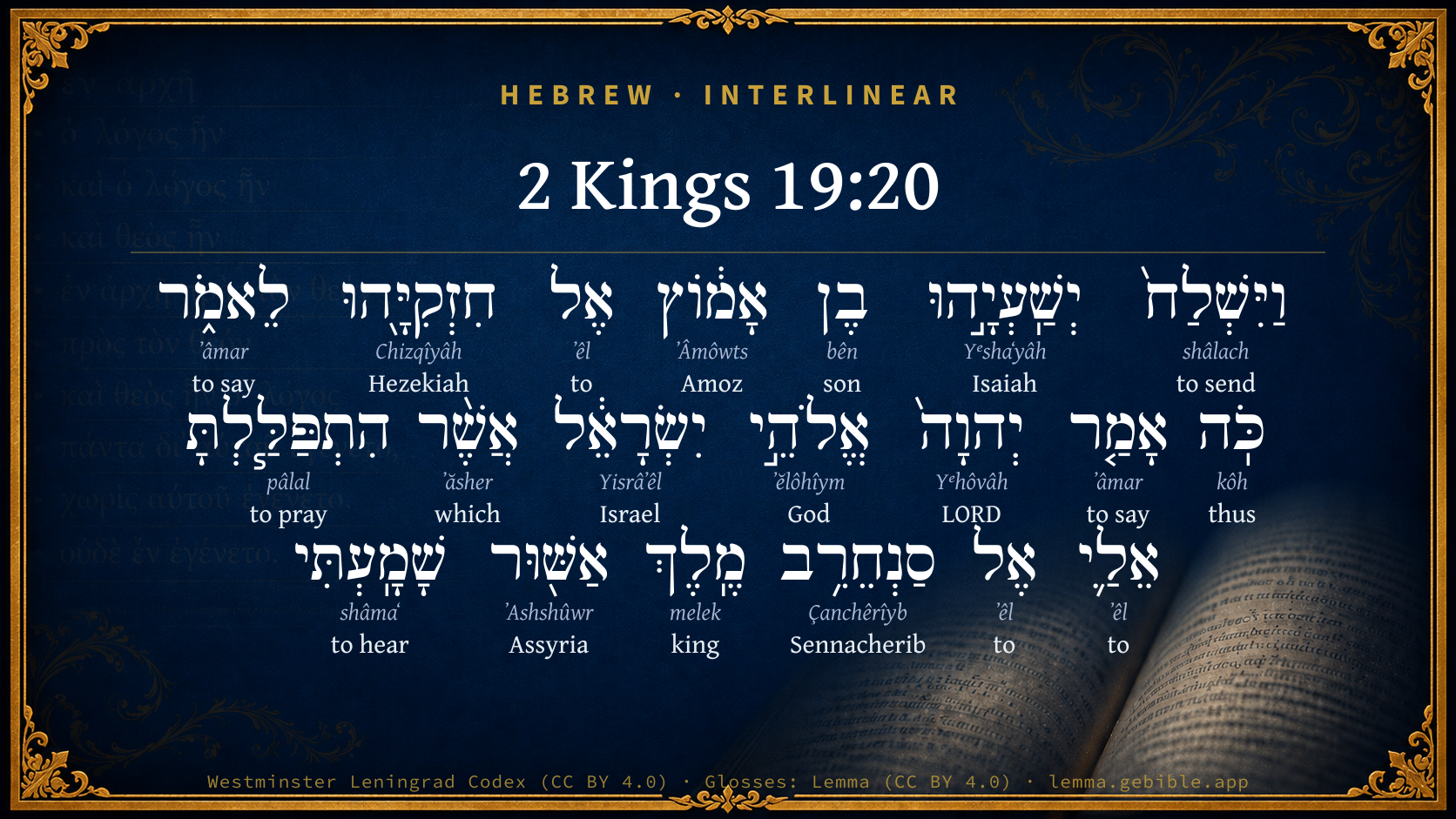
2 Kings 19:20

Hebrew (Westminster Leningrad Codex) 2 Kings 19:20 appears in the Hebrew Old Testament. The text above is from the Westminster Leningrad Codex. Each word links to its Strong’s number, a concise gloss, and parsing drawn from the Open Scriptures Hebrew Bible morphology. Click any word for its full Brown-Driver-Briggs (BDB) entry.
Download image
Cite this verse

2 Kings 19:20 (World English Bible). Public Domain. Lemma interlinear Bible study tool, https://lemma.gebible.app/v/2-kings/19/20.

Show BibTeX & RIS
BibTeX
RIS
English Translation
Then Isaiah the son of Amoz sent to Hezekiah, saying, Thus says Yahweh, the God of Israel, Whereas you have prayed to me against Sennacherib king of Assyria, I have heard [you].
World English Bible · Public Domain
Download a study sheet

One document with this verse’s original text, its word-by-word gloss line, the meaning frame, cross-references with their text, attributed commentary, and full source and license credits — printable, and it pastes into notes with its structure intact.

This verse Autodidact and up

Study sheet (.html) Plain text (.txt)

A passage Seminary Student

Up to 50 verses in one chapter. A passage sheet keeps up to 6 commentary sources and 12 cross-references per verse, in the order this page ranks them, and says so on the sheet whenever that leaves anything out. Ask for a single verse and you get the Autodidact verse sheet above.

Everything on this page stays free to read, with no account — the sheet is a download of what is already on screen, not access to it.

Want to remove ads? Support Godless Engineer
Compare translations 3

The same verse in 3 English versions, stacked beneath the original-language interlinear above. Click any original word for its lexicon entry.

Each is an independent rendering of the whole verse — the interlinear is not word-aligned to these translations.

Highlighted words mark where these versions differ — a whole-verse word diff, not a word-by-word alignment.

  • World English Bible Public Domain
    Then Isaiah the son of Amoz sent to Hezekiah, saying, Thus says Yahweh, the God of Israel, Whereas you have prayed to me against Sennacherib king of Assyria, I have heard [you].
  • King James Version Public Domain
    Then Isaiah the son of Amoz sent to Hezekiah, saying, Thus saith the LORD God of Israel, That which thou hast prayed to me against Sennacherib king of Assyria I have heard.
  • unfoldingWord Literal Text CC BY-SA 4.0
    And Isaiah, the son of Amoz, sent to Hezekiah, saying, “Thus says Yahweh, the God of Israel, ‘What you have prayed to me about Sennacherib, the king of Assyria, I have heard.’

unfoldingWord Literal Text — © unfoldingWord, licensed CC BY-SA 4.0. Word-aligned USFM3 via Door43 (git.door43.org/unfoldingWord/en_ult).

Versions to compare (up to 4)

3 of 4 selected

Show all 18 translations

Every available English version of this verse, each an independent rendering of the whole verse.

  • World English Bible Public Domain
    Then Isaiah the son of Amoz sent to Hezekiah, saying, Thus says Yahweh, the God of Israel, Whereas you have prayed to me against Sennacherib king of Assyria, I have heard [you].
  • Berean Standard Bible Public Domain
    Then Isaiah son of Amoz sent a message to Hezekiah: “This is what the LORD, the God of Israel, says: I have heard your prayer concerning Sennacherib king of Assyria.
  • Majority Standard Bible Public Domain
    Then Isaiah son of Amoz sent a message to Hezekiah: “This is what the LORD, the God of Israel, says: I have heard your prayer concerning Sennacherib king of Assyria.
  • King James Version Public Domain
    Then Isaiah the son of Amoz sent to Hezekiah, saying, Thus saith the LORD God of Israel, That which thou hast prayed to me against Sennacherib king of Assyria I have heard.
  • American Standard Version (1901) Public Domain
    Then Isaiah the son of Amoz sent to Hezekiah, saying, Thus saith Jehovah, the God of Israel, Whereas thou hast prayed to me against Sennacherib king of Assyria, I have heard `thee'.
  • Revised Version (1885) Public Domain
    Then Isaiah the son of Amoz sent to Hezekiah, saying, Thus saith the LORD, the God of Israel, Whereas thou hast prayed to me against Sennacherib king of Assyria, I have heard thee.
  • Geneva Bible (1599) Public Domain
    Then Isaiah the sonne of Amoz sent to Hezekiah, saying, Thus saith the Lord God of Israel, I haue heard that which thou hast prayed me, concerning Saneherib King of Asshur.
  • Douay-Rheims (1899) Public Domain
    And Isaias the son of Amos sent to Ezechias, saying: Thus saith the Lord the God of Israel: I have heard the prayer thou hast made to me concerning Sennacherib king of the Assyrians.
  • Young's Literal Translation Public Domain
    And Isaiah son of Amoz sendeth unto Hezekiah, saying, `Thus said Jehovah, God of Israel, That which thou hast prayed unto Me concerning Sennacherib king of Asshur I have heard:
  • Literal Standard Version CC BY-SA 4.0
    And Isaiah son of Amoz sends to Hezekiah, saying, “Thus said YHWH, God of Israel: That which you have prayed to Me concerning Sennacherib king of Asshur I have heard;
  • Unlocked Literal Bible CC BY-SA 4.0
    Then Isaiah son of Amoz sent a message to Hezekiah, saying, “Yahweh, the God of Israel says, 'Because you have prayed to me concerning Sennacherib king of Assyria, I have heard you.
  • unfoldingWord Literal Text CC BY-SA 4.0
    And Isaiah, the son of Amoz, sent to Hezekiah, saying, “Thus says Yahweh, the God of Israel, ‘What you have prayed to me about Sennacherib, the king of Assyria, I have heard.’
  • Darby Bible Public Domain
    And Isaiah the son of Amoz sent to Hezekiah, saying, Thus saith Jehovah the God of Israel: That which thou hast prayed to me concerning Sennacherib king of Assyria I have heard.
  • World Messianic Bible Public Domain
    Then Isaiah the son of Amoz sent to Hezekiah, saying, “The LORD, the God of Israel, says ‘You have prayed to me against Sennacherib king of Assyria, and I have heard you.
  • Webster's Bible Public Domain
    Then Isaiah the son of Amoz sent to Hezekiah, saying, Thus saith the LORD God of Israel, That which thou hast prayed to me against Sennacherib king of Assyria I have heard.
  • Free Bible Version CC BY-SA 4.0
    Then Isaiah, son of Amoz, sent a message to Hezekiah, saying, “This is what the Lord, the God of Israel, says: I have heard your prayer about Sennacherib, king of Assyria.
  • Bible in Basic English Public Domain
    Then Isaiah, the son of Amoz, sent to Hezekiah, saying, The Lord, the God of Israel, says, The prayer which you have made to me against Sennacherib, king of Assyria, has come to my ears.
  • JPS Tanakh (1917) Public Domain
    Then Isaiah the son of Amoz sent to Hezekiah, saying: 'Thus saith the LORD, the God of Israel: Whereas thou hast prayed to Me against Sennacherib king of Assyria, I have heard thee.

Literal Standard Version (2020), Covenant Press — licensed CC BY-SA 4.0. Text via the HelloAO Bible API (eBible.org). Unlocked Literal Bible (unfoldingWord) — licensed CC BY-SA 4.0. Text via the HelloAO Bible API (eBible.org). unfoldingWord Literal Text — © unfoldingWord, licensed CC BY-SA 4.0. Word-aligned USFM3 via Door43 (git.door43.org/unfoldingWord/en_ult). Free Bible Version, Dr. Jonathan Gallagher — licensed CC BY-SA 4.0. Text via the HelloAO Bible API (eBible.org).

Word by word

More ways to search: Search by grammar → Find every occurrence → Compare this word →

Practice this passage: Drill this verse → Learn its vocabulary →

אָמ֔וֹץ
ʼÂmôwts
H531
“Amoz”
Noun, Proper
Part of Speech
Noun
Type
Proper
Full BDB Definition

Origin: from H553

TWOT: None

Amoz = "strong" - father of Isaiah
  1. וַיִּשְׁלַח֙ shâlach H7971 “and · to send” Conjunction + Verb, Qal, Sequential Imperfect, 3rd Person, Masculine, Singular
  2. יְשַֽׁעְיָ֣הוּ Yᵉshaʻyâh H3470 “Isaiah” Noun, Proper
  3. בֶן bên H1121 “son of” Noun, Common, Masculine, Singular, Construct
  4. אֶל ʼêl H413 “to” Preposition
  5. חִזְקִיָּ֖הוּ Chizqîyâh H2396 “Hezekiah” Noun, Proper
  6. לֵאמֹ֑ר ʼâmar H559 “to say” Preposition + Verb, Qal, Infinitive Construct
  7. כֹּֽה kôh H3541 “thus” Adverb
  8. אָמַ֤ר ʼâmar H559 “to say” Verb, Qal, Perfect, 3rd Person, Masculine, Singular
  9. יְהוָה֙ Yᵉhôvâh H3068 “LORD” Noun, Proper
  10. אֱלֹהֵ֣י ʼĕlôhîym H430 “God(s) of” Noun, Common, Masculine, Plural, Construct
  11. יִשְׂרָאֵ֔ל Yisrâʼêl H3478 “Israel” Noun, Proper
  12. אֲשֶׁ֨ר ʼăsher H834 “which” Particle, Relative
  13. הִתְפַּלַּ֧לְתָּ pâlal H6419 “to pray” Verb, Hithpael, Perfect, 2nd Person, Masculine, Singular
  14. אֵלַ֛י ʼêl H413 “to · me” Preposition + Suffix, Personal, 1st Person, Common, Singular
  15. אֶל ʼêl H413 “to” Preposition
  16. סַנְחֵרִ֥ב Çanchêrîyb H5576 “Sennacherib” Noun, Proper
  17. מֶֽלֶךְ melek H4428 “king of” Noun, Common, Masculine, Singular, Construct
  18. אַשּׁ֖וּר ʼAshshûwr H804 “Assyria” Noun, Proper
  19. שָׁמָֽעְתִּי shâmaʻ H8085 “to hear” Verb, Qal, Perfect, 1st Person, Common, Singular

About this verse

These counts appear in no published source. They are computed here, from the morphology-tagged text and Lemma’s own curated glosses. What Lemma adds →

20
words
17
distinct lemmas
Historical
section

Notable vocabulary

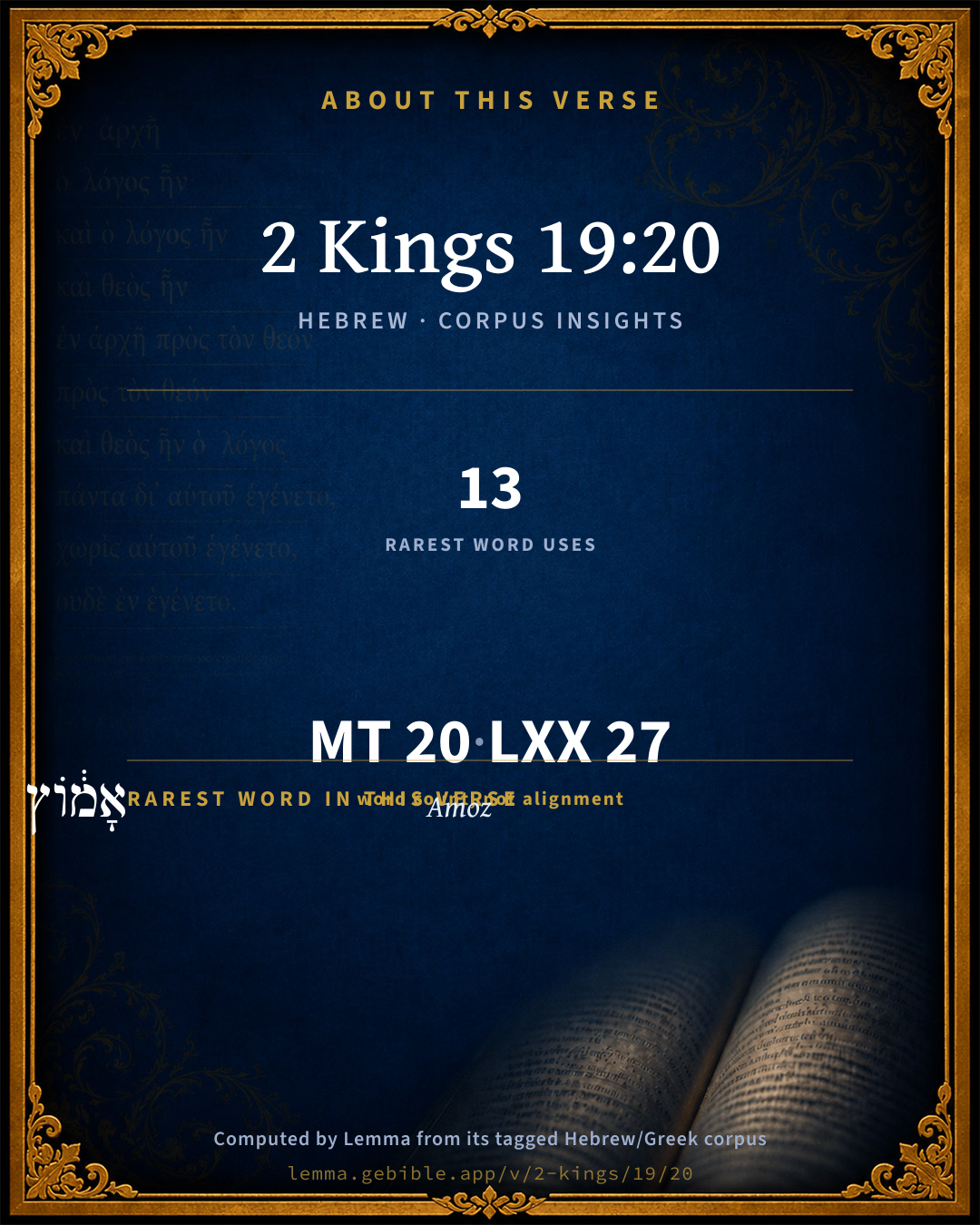
The rarest word here is אָמ֔וֹץ Amoz H531 — appearing just 13 times in the whole Hebrew Bible.

Shared distinctive vocabulary

אָמ֔וֹץ Amoz H531 occurs in 13 verses of the Hebrew Bible. Also found in:

Grammatical profile

  • 5 verbs
  • 10 nouns
  • 3 prepositions
  • 1 adverb
  • 1 particle

Verb forms

  • וַיִּשְׁלַח֙ Qal · Sequential Imperfect
  • לֵאמֹ֑ר Qal · Infinitive Construct
  • אָמַ֤ר Qal · Perfect
  • הִתְפַּלַּ֧לְתָּ Hithpael · Perfect
  • שָׁמָֽעְתִּי Qal · Perfect

Repetition

Words recur within this verse — often emphatic in Hebrew:

  • לֵאמֹ֑ר to say H559 ×2
  • אֶל to H413 ×3

Hebrew & Septuagint length

In English translation the verse runs 32 words from the Hebrew and 34 from the Septuagint (LXX English) — closely comparable.

A rough comparison of the two English renderings, which tokenize alike — not a word-level alignment.

Word counts can differ between the Hebrew and the Greek without any difference in meaning — e.g. the Hebrew direct-object marker אֵת has no separate Greek word, and Greek often adds the article ὁ.

In the original languages it is 20 Hebrew tokens and 27 Greek tokens — but the two are counted differently (Hebrew bundles its prefixes and suffixes into one token; the Greek is in lemma form), so that isn’t a like-for-like length.

Cross-references

15

Topical passages linked to 2 Kings 19:20 in the Treasury of Scripture Knowledge — connected by theme and wording, ordered by reader-vote popularity; previews shown in the World English Bible.

  • 2 Kings 20:5 Turn back, and tell Hezekiah the prince of my people, Thus says Yahweh, the God of David your father, I have heard your prayer, I have seen your tears: behold, I will heal you; on the third day you shall go up to the house of Yahweh.
  • 2 Chronicles 32:20–21 Hezekiah the king, and Isaiah the prophet the son of Amoz, prayed because of this, and cried to heaven.
  • Isaiah 65:24 It shall happen that, before they call, I will answer; and while they are yet speaking, I will hear.
  • Jeremiah 33:3 Call to me, and I will answer you, and will show you great things, and difficult, which you don't know.
  • Acts 10:31 and said, 'Cornelius, your prayer is heard, and your gifts to the needy are remembered in the sight of God.
  • 1 John 5:14–15 This is the boldness which we have toward him, that, if we ask anything according to his will, he listens to us.
  • 2 Samuel 15:31 One told David, saying, Ahithophel is among the conspirators with Absalom. David said, Yahweh, please turn the counsel of Ahithophel into foolishness.
  • John 11:42 I know that you always listen to me, but because of the multitude that stands around I said this, that they may believe that you sent me."
  • Acts 10:4 He, fastening his eyes on him, and being frightened, said, "What is it, Lord?" He said to him, "Your prayers and your gifts to the needy have gone up for a memorial before God.
  • 2 Samuel 17:23 When Ahithophel saw that his counsel was not followed, he saddled his donkey, and arose, and got him home, to his city, and set his house in order, and hanged himself; and he died, and was buried in the tomb of his father.
  • Job 22:27 You shall make your prayer to him, and he will hear you. You shall pay your vows.
  • Psalms 50:15 Call on me in the day of trouble. I will deliver you, and you will honor me."
  • Isaiah 58:9 Then shall you call, and Yahweh will answer; you shall cry, and he will say, Here I am. If you take away from the midst of you the yoke, the putting forth of the finger, and speaking wickedly;
  • Daniel 9:20–23 While I was speaking, and praying, and confessing my sin and the sin of my people Israel, and presenting my supplication before Yahweh my God for the holy mountain of my God;
  • Psalms 65:2 You who hear prayer, To you all men will come.

Cross-references courtesy of OpenBible.info (CC BY 4.0).

Hebrew and Greek witnesses Masoretic Hebrew ↔ Greek Septuagint

The same verse in the two great witnesses to the Old Testament, shown verse-for-verse.

These are two independent witnesses, not word-aligned to each other, and the Septuagint is shown in lemma (dictionary) form.

Hebrew 2 Kings 19:20 Masoretic · Westminster Leningrad Codex

וַיִּשְׁלַח֙ יְשַֽׁעְיָ֣הוּ בֶן אָמ֔וֹץ אֶל חִזְקִיָּ֖הוּ לֵאמֹ֑ר כֹּֽה אָמַ֤ר יְהוָה֙ אֱלֹהֵ֣י יִשְׂרָאֵ֔ל אֲשֶׁ֨ר הִתְפַּלַּ֧לְתָּ אֵלַ֛י אֶל סַנְחֵרִ֥ב מֶֽלֶךְ אַשּׁ֖וּר שָׁמָֽעְתִּי

Then Isaiah the son of Amoz sent to Hezekiah, saying, Thus says Yahweh, the God of Israel, Whereas you have prayed to me against Sennacherib king of Assyria, I have heard [you].

World English Bible · Public Domain

Greek LXX 2 Kings 19:20 Septuagint · lemma form

καί ἀποστέλλω ησαιας υἱός αμως πρός εζεκιας λέγω ὅδε λέγω κύριος ὁ θεός ὁ δύναμις ὁ θεός ἰσραήλ ὅς προςεὔχομαι πρός ἐγώ περί σενναχηριμ βασιλεύς ἀσσύριος ἀκούω

And Esaias the son of Amos sent to Ezekias, saying, Thus says the Lord God of hosts, the God of Israel, I have heard your prayer to me concerning Sennacherim king of the Assyrians.

LXX2012 (modern English Septuagint) · Public Domain

On this verse, The Cambridge Bible for Schools and Colleges discusses the Septuagint’s reading. Read the note in Commentary ↓

Hebrew: Westminster Leningrad Codex (CC BY 4.0). Greek: Septuagint (public domain); English from LXX2012 (modern English Septuagint) (Public Domain). How the Septuagint differs from the Hebrew →

Targum (Aramaic paraphrase)

1

The Targum is the ancient Jewish Aramaic paraphrase of the Hebrew Scriptures — an interpretive translation, not the Hebrew text itself. Onkelos (literal) and Pseudo-Jonathan (expansive) render the Torah, and Jonathan the Prophets. Coverage is partial: where no permissively-licensed English translation exists for a verse, only the Aramaic is shown. This is verse-level text, not a word-by-word alignment to the Hebrew.

  1. Targum Jonathan Prophets (Joshua–Malachi)
    וּשְׁלַח יְשַׁעְיָהוּ בַר אָמוֹץ לְוַת חִזְקִיָהוּ לְמֵימָר כִּדְנַן אֲמַר יְיָ אֱלָהָא דְיִשְׂרָאֵל דִבְעֵיתָא מִן קֳדָמַי עַל סַנְחֵרִיב מַלְכָּא דְאַתּוּר שְׁמִיעַ קֳדָמָי:

    (no public-domain English translation for this verse)

    Targum Jonathan — Aramaic: “Mikraot Gedolot” (public domain). English: “Sefaria Community Translation” (CC0 1.0 (public-domain dedication)); “London "Chaldee Paraphrase," 1871” (public domain). Text via Sefaria.

Commentary

Notes on 2 Kings 19:20 from classic Christian and Jewish commentators (each source and its license shown beneath its notes). The classic Christian expositions comment on the surrounding passage and are grouped to its opening verse, so a note may address several verses; the Jewish commentaries on the Tanakh (Rashi and others) are per-verse, so they appear only where the commentator wrote on this verse.

Lemma curates 59 commentaries, every one of them public domain or Creative Commons licensed, each selected and text-cleaned for this edition rather than reprinted as found. About our sources →

Matthew Henry's Commentary

We have here the gracious copious answer which God gave to Hezekiah's prayer. The message which he sent him by the same hand (Kg2 19:6, Kg2 19:7), one would think, was an answer sufficient to his prayer; but, that he might have strong consolation, he was encouraged by two immutable things, in which it was impossible for God to lie, Heb 6:18. In general, God assured him that his prayer was heard, his prayer against Sennacherib, Kg2 19:20. Note, The case of those that have the prayers of God's people against them is miserable. For, if the oppressed cry to God against the oppressor, he will hear, Exo 22:23. God hears and answers, hears with the saving strength of his right hand, Psa 20:6.

This message bespeaks two things: -

I. Confusion and shame to Sennacherib and his forces. It is here foretold that he should be humbled and broken. The prophet elegantly directs his speech to him, as he does, Isa 10:5. O Assyrian! the rod of my anger. Not that this message was sent to him, but what is here said to him he was made to know by the event. Providence spoke it to him with a witness; and perhaps his own heart was made to whisper this to him: for God has more ways than one of speaking to sinners in his wrath, so as to vex them in his sore displeasure, Psa 2:5. Sennacherib is here represented,

1. As the scorn of Jerusalem, Kg2 19:21. He thought himself the terror of the daughter of Zion, that chaste and beautiful virgin, and that by his threats he could force her to submit to him: "But, being a virgin in her Father's house and under his protection, she defies thee, despises thee, laughs thee to scorn. Thy impotent malice is ridiculous; he that sits in heaven laughs at thee, and therefore so do those that abide under his shadow." By this word God intended to silence the fears of Hezekiah and his people. Though to an eye of sense the enemy looked formidable, to an eye of faith he looked despicable.

2. As an enemy to God; and that was enough to make him miserable. Hezekiah pleaded this: "Lord, he has reproached thee," Kg2 19:16. "He has," saith God, "and I take it as against myself (Kg2 19:22): Whom hast thou reproached? Is it not the Holy One of Israel, whose honour is dear to him, and who has power to vindicate it, which the gods of the heathen have not?" Meno me impune lacesset - No one shall provoke me with impunity.

3. As a proud vainglorious fool, that spoke great swelling words of vanity, and boasted of a false gift, by his boasts, as well as by his threats, reproaching the Lord. For, (1.) He magnified his own achievements out of measure and quite above what really they were (Kg2 19:23, Kg2 19:24): Thou hast said so and so. This was not in the letter he wrote, but God let Hezekiah know that he not only saw what was written there, but heard what he said elsewhere, probably in the speeches he made to his councils or armies. Note, God takes notice of the boasts of proud men, and will call them to an account, that he may look upon them and abuse them, Job 40:11. What a mighty figure does Sennacherib think he makes! Driving his chariots to the tops of the highest mountains, forcing his way through woods and rivers, breaking through all difficulties, making himself master of all he had a mind to. Nothing could stand before him or be withheld from him; no hills too high for him to climb, no trees too strong for him to fell, no waters too deep for him to dry up; as if he had the power of a God, to speak and it is done. (2.) He took to himself the glory of doing these great things, whereas they were all the Lord's doing, Kg2 19:25, Kg2 19:26. Sennacherib, in his letter, had appealed to what Hezekiah had heard (Kg2 19:11): Thou hast heard what the kings of Assyria have done; but, in answer to that, he is reminded of what God has done for Israel of old, drying up the Red Sea, leading them through the wilderness, planting them in Canaan. "What are all thy doings to these? And as for the desolations thou hast made in the earth, and particularly in Judah, thou art but the instrument in God's hand, a mere tool: it is I that have brought it to pass. I gave thee thy power, gave thee thy success, and made thee what thou art, raised thee up to lay waste fenced cities and so to punish them for their wickedness, and therefore their inhabitants were of small power." What a foolish insolent thing was it for him to exalt himself above God, and against God, upon that which he had done by him and under him. Sennacherib's boasts here are expounded in Isa 10:13, Isa 10:14, By the strength of my hand I have done it, and by my wisdom, etc.; and they are answered (Kg2 19:15), Shall the axe boast itself against him that heweth therewith? It is surely absurd for the fly upon the wheel to say, What a dust do I make! or for the sword in the hand to say, What execution I do! If God be the principal agent in all that is done, boasting is for ever excluded.

4. As under the check and rebuke of that God whom he blasphemed. All his motions were, (1.) Under the divine cognizance (Kg2 19:27): "I have thy abode, and what thou dost secretly devise and design, thy going out and coming in, marches and counter-marches, and thy rage against me and my people, the tumult of thy passions, the tumult of thy preparations, the noise and bluster thou makest: I know it all." That was more than Hezekiah did, who wished for intelligence of the enemy's motions; but what need was there for this when the eye of God was a constant spy upon him? Ch2 16:9. (2.) Under the divine control (Kg2 19:28): "I will put my hook in thy nose, thou great Leviathan (Job 41:1, Job 41:2), my bridle in thy jaws, thou great Behemoth. I will restrain thee, manage thee, turn thee where I please, send thee home like a fool as thou camest, re infecta - disappointed of thy aim." Note, It is a great comfort to all the church's friends that God has a hook in the nose and a bridle in the jaws of all her enemies, can make even their wrath to serve and praise him and then restrain the remainder of it. Here shall its proud waves be stayed.

II. Salvation and joy to Hezekiah and his people. This shall be a sign to them of God's favour, and that he is reconciled to them, and his anger is turned away (Isa 12:1), a wonder in their eyes (for so a sign sometimes signifies), a token for good, and an earnest of the further mercy God has in store for them, that a good issue shall be put to their present distress in every respect.

1. Provisions were scarce and dear; and what should they do for food? The fruits of the earth were devoured by the Assyrian army, Isa 32:9, Isa 32:10, etc. Why, they shall not only dwell in the land, but verily they shall be fed. If God save them, he will not starve them, nor let them die by famine, when they have escaped the sword: "Eat you this year that which groweth of itself, and you shall find enough of that. Did the Assyrians reap what you sowed? You shall reap what you did not sow." But the next year was the sabbatical year, when the land was to rest, and they must neither sow nor reap. What must they do that year? Why, Jehovah-jireh - The Lord will provide. God's blessing shall save them seed and labour, and, that year too, the voluntary productions of the earth shall serve to maintain them, to remind them that the earth brought forth before there was a man to till it, Gen 1:11. And then, the third year, their husbandry should return into its former channel, and they should sow and reap as they used to do. 2. The country was laid waste, families were broken up and scattered, and all was in confusion; how should it be otherwise when it was over-run by such an army? As to this, it is promised that the remnant that has escaped of the house of Judah (that is, of the country people) shall yet again be planted in their own habitations, upon their own estates, shall take root there, shall increase and grow rich, Kg2 19:30. See how their prosperity is described: it is taking root downwards, and bearing fruit upwards, being well fixed and well provided for themselves, and then doing good to others. Such is the prosperity of the soul: it is taking root downwards by faith in Christ, and then being fruitful in fruits of righteousness. 3. The city was shut up, none went out or came in; but now the remnant in Jerusalem and Zion shall go forth freely, and there shall be none to hinder them, or make them afraid, Kg2 19:31. Great destruction had been made both in city and country, bit in both there was a remnant that escaped, which typified the saved remnant of Israelites indeed (as appears by comparing Isa 10:22, Isa 10:23, which speaks of this very event, with Rom 9:27, Rom 9:28), and they shall go forth into the glorious liberty of the children of God. 4. The Assyrians were advancing towards Jerusalem, and would in a little time besiege it in form, and it was in great danger of falling into their hands. But it is here promised that the siege they feared should be prevented, - that, though the enemy had now (as it should seem) encamped before the city, yet they should never come into the city, no, nor so much as shoot an arrow into it (Kg2 19:32, Kg2 19:33), - that he should be forced to retire with shame, and a thousand times to repent his undertaking. God himself undertakes to defend the city (Kg2 19:34), and that person, that place, cannot but be safe, the protection of which he undertakes. 5. The honour and truth of God are engaged for the doing of all this. These are great things, but how will they be effected? Why, the zeal of the Lord of hosts shall do this, Kg2 19:31. He is Lord of hosts, has all creatures at his beck, therefore he is able to do it; he is jealous for Jerusalem with great jealousy (Zac 1:14); having espoused her a chaste virgin to himself, he will not suffer he to be abused, Kg2 19:21. "You have reason to think yourselves unworthy that such great things should be done for you; but God's own zeal will do it." His zeal, (1.) For his own honour (Kg2 19:34): "I will do it for my own sake, to make myself an everlasting name." God's reasons of mercy are fetched from within himself. (2.) For his own truth: "I will do it for my servant David's sake; not for the sake of his merit, but the promise made to him and the covenant made with him, those sure mercies of David." Thus all the deliverances of the church are wrought for the sake of Christ, the Son of David.

Matthew Henry's Commentary on the Whole Bible (1708–1710) — public domain (CC PDM 1.0). Text via the HelloAO Bible API.

Trapp's Complete Commentary

John Trapp

2Ki 19:20 Then Isaiah the son of Amoz sent to Hezekiah, saying, Thus saith the LORD God of Israel, [That] which thou hast prayed to me against Sennacherib king of Assyria I have heard.

Ver. 20. Then Isaiah the son of Amos.] God suffered him not to stay for an answer, but prevented his sending again to the prophet, by causing the prophet to send to him. So the angel Gabriel came with weariness of flight to praying Daniel. {Dan 9:23}

Which thou hast prayed unto me against Sen.] See 2Ki 19:15.

John Trapp, A Commentary or Exposition upon All the Books of the Old and New Testament (1647–1656) — public domain. Text from a community e-Sword module.

Joseph Benson's Commentary

2Ki 19:20. Then Isaiah, the son of Amoz, sent to Hezekiah — Isaiah was informed, by the spirit of prophecy, that Hezekiah had represented his case to God in the temple, and he was commissioned to assure him his petition was granted.

Joseph Benson's Commentary on the Old and New Testaments (1811–1818) — public domain. Text from a community e-Sword module.

Whedon's Commentary on the Bible

Daniel D. Whedon

ISAIAH’S ORACLE, 2Ki_19:20-34.

This prophecy, so rich in poetic diction, so emphatic in its outbursts of righteous indignation and scorn against Assyria, and so comforting to Judah for its predictions of Assyrian defeat and of coming prosperity and glory for the people of God, consists, 1.) of a scornful rebuke of Sennacherib’s pride and boasting, with a prophecy of his humiliation and retreat, (2Ki_19:21-28;) 2.) of a cheering pledge that Jehovah would bring about the peace and triumph of Judah and Jerusalem, (29-31;) and, 3.) a solemn announcement of the utter failure of Sennacherib to take the holy city, (32-34.)

20. Sent to Hezekiah — This oracle was delivered to Hezekiah in the form of a letter, just as Sennacherib’s message had been sent. 2Ki_19:14. As by one letter Hezekiah had been brought to profoundest grief and humiliation before God, so would Jehovah, by another letter, cheer his soul.

Daniel D. Whedon (gen. ed.), Commentary on the Old and New Testaments (1874–1909) — public domain. Text from a community e-Sword module.

Keil & Delitzsch

C. F. Keil & F. Delitzsch

The divine promise. - Kg2 19:20, Kg2 19:21. When Hezekiah had prayed, the prophet Isaiah received a divine revelation with regard to the hearing of this prayer, which he sent, i.e., caused to be handed over, to the king. שׁמעתּי (Kg2 19:21) is omitted in Isaiah, so that וגו התפּלּלתּ אשׁר is to be taken in the sense of "with regard to that which thou hast prayed to me," whilst שׁמעתּי (I have heard) elucidates the thought and simplifies the construction. The word of the Lord announced to the king, (1) the shameful retreat of Sennacherib as a just retribution for his mockery of the living God (Kg2 19:21-28; Isa 37:22-29); (2) the confirmation of this assurance through the indication of a sign by which Hezekiah was to recognise the deliverance of Jerusalem (Kg2 19:29-31; Isa 37:30-32), and through the distinct promise, that the Assyrian would neither come into the city nor besiege it, because the Lord was sheltering it (Kg2 19:32-34; Isa 37:33-35). In the first part the words are addressed with poetic vivacity directly to Sennacherib, and scourge his haughty boastings by pointing to the ridicule and scorn which would follow him on his departure from the land.

Kg2 19:21

"The virgin daughter Zion despises thee, the daughter Jerusalem shakes the head behind thee." By daughter Zion, daughter Jerusalem, we are not to understand the inhabitants of Zion, or of Jerusalem, as though בּת stood for בּנים or בּני (Ges., Hitzig, and others); but the city itself with its inhabitants is pictorially personified as a daughter and virgin, and the construct state בּת־ציּון is to be taken, like פּרת נהר, as in apposition: "daughter Zion," not daughter of Zion (vid., Ges. 116, 5; Ewald, 287, e.). Even in the case of בּתוּלת the construct state expresses simply the relation of apposition. Zion is called a "virgin" as being an inviolable city to the Assyrians, i.e., one which they cannot conquer. Shaking the head is a gesture denoting derision and pleasure at another's misfortune (cf. Psa 22:8; Psa 109:25, etc.). "Behind thee," i.e., after thee as thou goest away, is placed first as a pictorial feature for the sake of emphasis.

Kg2 19:22-23

This derision falls upon the Assyrian, for having blasphemed the Lord God by his foolish boasting about his irresistible power. "Whom hast thou despised and blasphemed, and against whom hast thou lifted up the voice? and thou liftest up thine eyes against the Holy One of Israel." Lifting up the voice refers to the tone of threatening assumption, in which Rabshakeh and Sennacherib had spoken. Lifting up the eyes on high, i.e., to the heavens, signifies simply looking up to the sky (cf. Isa 40:26), not "directing proud looks against God" (Ges.). Still less is מרום to be taken adverbially in the sense of haughtily, as Thenius and Knobel suppose. The bad sense of proud arrogance lies in the words which follow, "against the Holy One of Israel," or in the case of Isaiah, where אל stands for על, in the context, viz., the parallelism of the members. God is called the Holy One of Israel as He who manifests His holiness in and upon Israel. This title of the Deity is one of the peculiarities of Isaiah's range of thought, although it originated with Asaph (Psa 78:41; see at Isa 1:4). This insult to the holy God consisted in the fact that Sennacherib had said through his servants (Kg2 19:23, Kg2 19:24): "With my chariots upon chariots I have ascended the height of the mountains, the uttermost part of Lebanon, so that I felled the tallness of its cedars, the choice of its cypresses, and came to the shelter of its border, to the forest of its orchard. I have dug and drunk strange water, so that I dried up all the rivers of Egypt with the sole of my feet." The words put into the mouth of the Assyrian are expressive of the feeling which underlay all his blasphemies (Drechsler). The two verses are kept quite uniform, the second hemistich in both cases expressing the result of the first, that is to say, what the Assyrian intended still further to perform after having accomplished what is stated in the first hemistich. When he has ascended the heights of Lebanon, he devastates the glorious trees of the mountain. Consequently in Kg2 19:24 the drying up of the Nile of Egypt is to be taken as the result of the digging of wells in the parched desert; in other words, it is to be interpreted as descriptive of the devastation of Egypt, whose whole fertility depended upon its being watered by the Nile and its canals. We cannot therefore take these verses exactly as Drechsler does; that is to say, we cannot assume that the Assyrian is speaking in the first hemistichs of both verses of what he (not necessarily Sennacherib himself, but one of his predecessors) has actually performed. For even if the ascent of the uttermost heights of Lebanon had been performed by one of the kings of Assyria, there is no historical evidence whatever that Sennacherib or one of his predecessors had already forced his way into Egypt. The words are therefore to be understood in a figurative sense, as an individualizing picture of the conquests which the Assyrians had already accomplished, and those which they were still intending to effect; and this assumption does not necessarily exhibit Sennacherib "as a mere braggart, who boastfully heaps up in ridiculous hyperbole an enumeration of the things which he means to perform" (Drechsler). For if the Assyrian had not ascended with the whole multitude of his war-chariots to the loftiest summits of Lebanon, to feel its cedars and its cypresses, Lebanon had set no bounds to his plans of conquest, so that Sennacherib might very well represent his forcing his way into Canaan as an ascent of the lofty peaks of this mountain range. Lebanon is mentioned, partly as a range of mountains that was quite inaccessible to war-chariots, and partly as the northern defence of the land of Canaan, through the conquest of which one made himself lord of the land. And so far as Lebanon is used synecdochically for the land of which it formed the defence, the hewing down of its cedars and cypresses, those glorious witnesses of the creation of God, denotes the devastation of the whole land, with all its glorious works of nature and of human hands. The chief strength of the early Asiatic conquerors consisted in the multitude of their war-chariots: they are therefore brought into consideration simply as signs of vast military resources; the fact that they could only be used on level ground being therefore disregarded. The Chethb רכבּי רכב, "my chariots upon chariots," is used poetically for an innumerable multitude of chariots, as גּובי גּוב for an innumerable host of locusts (Nah 3:17), and is more original than the Keri רכבּי רב, the multitude of my chariots, which simply follows Isaiah. The "height of the mountains" is more precisely defined by the emphatic לבנון ירכּתי, the uttermost sides, i.e., the loftiest heights, of Lebanon, just as בור ירכּתי in Isa 14:15 and Eze 32:23 are the uttermost depths of Sheol. ארזיו קומת, his tallest cedars. בּרשׁיו מבחור, his most select or finest cypresses. קצּה מלון, for which Isaiah has the more usual קצּו מרום, "the height of his end," is the loftiest point of Lebanon on which a man can rest, not a lodging built on the highest point of Lebanon (Cler., Vitr., Ros.). כּרמלּו יער, the forest of his orchard, i.e., the forest resembling an orchard. The reference is to the celebrated cedar-forest between the loftiest peaks of Lebanon at the village of Bjerreh.

Kg2 19:24

Kg2 19:24 refers to the intended conquest of Egypt. Just as Lebanon could not stop the expeditions of the Assyrians, or keep them back from the conquest of the land of Canaan, so the desert of et Tih, which separated Egypt from Asia, notwithstanding its want of water (cf. Herod. iii. 5; Rob. Pal. i. p. 262), was no hindrance to him, which could prevent his forcing his way through it and laying Egypt waste. The digging of water is, of course, not merely "a reopening of the wells that had been choked with rubbish, and the cisterns that had been covered up before the approaching enemy" (Thenius), but the digging of wells in the waterless desert. זרים מים, strange water, is not merely water belonging to others, but water not belonging to this soil (Drechsler), i.e., water supplied by a region which had none at other times. By the perfects the thing is represented as already done, as exposed to no doubt whatever; we must bear in mind, however, that the desert of et Tih is not expressly named, but the expression is couched in such general terms, that we may also assume that it includes what the Assyrian had really effected in his expeditions through similar regions. The drying up of the rivers with the soles of the feet is a hyperbolical expression denoting the omnipotence with which the Assyrian rules over the earth. Just as he digs water in the desert where no water is to be had, so does he annihilate it where mighty rivers exist.

(Note: Compare the similar boasting of Alarich, already quoted by earlier commentators, in Claudian, de bello Geth. v. 526ff.:

cum cesserit omnis

Obsequiis natura meis? subsidere nostris

Sub pedibus montes, arescere vidimus amnes.

v. 532. Fregi Alpes. galeis Padum victricibus hausi.)

יאורי are the arms and canals of the Yeor, i.e., of the Nile. מצור, a rhetorical epithet for Egypt, used not only here, but also in Isa 19:6 and Mic 7:12.

Kg2 19:25-34

To this foolish boasting the prophet opposes the divine purpose which had been formed long ago, and according to which the Assyrian, without knowing it or being willing to acknowledge it, had acted simply as the instrument of the Lord, who had given him the power to destroy, but who would soon restrain his ranting against Him, the true God.

Kg2 19:25

"Hast thou not heard? Long ago have I done this, from the days of olden time have I formed it! Now have I brought it to pass, that fortified cities should be to be destroyed into waste heaps." Kg2 19:26. "And their inhabitants, short of hand, were dismayed and put to shame; they were herb of the field and green of the turf, grass of the roofs and blighted corn before the stalk." Kg2 19:27. "And thy sitting and thy going out and thy coming I know, and thy raging against me." Kg2 19:28. "Because of thy raging against me and thy safety, which rise up into my ears, I put my ring into thy nose, and my bridle into thy lips, and bring thee back by the way by which thou hast come." The words are still addressed to the Assyrian, of whom the Lord inquires whether he does not know that the destructive deeds performed by him had been determined very long before. "Hast thou not heart?" namely, what follows, what the Lord had long ago made known through His prophets in Judah (cf. Isa 7:7-9; Isa 8:1-4 and Isa 8:7, etc.). למרחוק, from distant time have I done it, etc., refers to the divine ordering and governing of the events of the universe, which God has purposed and established from the very beginning of time. The pronoun אתהּ, and the suffixes attached to יצרתּיה and הביאתיה, do not refer with vague generality to the substance of Kg2 19:23 and Kg2 19:24, i.e., to the boastings of the Assyrians quoted there (Drechsler), but to להשׁות וּתהי, i.e., to the conquests and devastations which the Assyrian had really effected. The ו before יצרתיה introduces the apodosis, as is frequently the case after a preceding definition of time (cf. Ges. 155, a). להשׁות וּתהי, "that it may be to destroy" (להשׁות, a contraction of להשׁאות, Keri and Isaiah, from שׁאה; see Ewald, 73, c., and 245, b.), i.e., that it shall be destroyed, - according to a turn which is very common in Isaiah, like לבער היה, it is to burn = it shall be burned (cf. Isa 5:5; Isa 6:13; Isa 44:15, and Ewald, 237, c.). The rendering given by Ges., Knob., Then., and others, "that thou mayest be for destruction," is at variance with this usage.

Kg2 19:26-28

Kg2 19:26 is closely connected, so far as the sense is concerned, with the last clause of Kg2 19:25, but in form it is only loosely attached: "and their inhabitants were," instead of "that their inhabitants might be." יד קצרי, of short hand, i.e., without power to offer a successful resistance (cf. Num 11:23, and Isa 50:2; Isa 59:1). - They were herbage of the field, etc., just as perishable as the herbage, grass, etc., which quickly fade away (cf. Psa 37:2; Psa 90:5-6; Isa 40:6). The grass of the roofs fades still more quickly, because it cannot strike deep roots (cf. Psa 129:6). Blighted corn before the stalk, i.e., corn which is blighted and withered up, before it shoots up into a stalk. In Isaiah we have שׁדמה instead of שׁדפה, with a change of the labials, probably for the purpose of preserving an assonance with קמה, which must not therefore be altered into שׁדמה. The thought in the two verses is this: The Assyrian does not owe his victories and conquests to his irresistible might, but purely to the fact that God had long ago resolved to deliver the nations into his hands, so that it was possible to overcome them without their being able to offer any resistance. This the Assyrian had not perceived, but in his daring pride had exalted himself above the living God. This conduct of his the Lord was well acquainted with, and He would humble him for it. Sitting and going out and coming denote all the actions of a man, like sitting down and rising up in Psa 139:2. Instead of rising up, we generally find going out and coming in (cf. Deu 28:6 and Psa 121:8). התרגּזך, thy raging, commotio furibunda, quae ex ira nascitur superbiae mixta (Vitr.). We must repeat רען before שׁאננך; and באזני עלה is to be taken in a relative sense: on account of thy self-security, which has come to my ears. שׁאנן is the security of the ungodly which springs from the feeling of great superiority in power. The figurative words, "I put my ring into thy nose," are taken from the custom of restraining wild animals, such as lions (Eze 19:4) and other wild beasts (Eze 29:4 and Isa 30:28), in this manner. For "the bridle in the lips" of ungovernable horses, see Psa 32:9. To lead a person back by the way by which he had come, i.e., to lead him back disappointed, without having reached the goal that he set before him.

Kg2 19:29

To confirm what he had said, the prophet gave to Hezekiah a sign (Kg2 19:29.): "Eat this year what groweth in the fallow, and in the second year what groweth wild, and in the third year sow and reap and plant vineyards, and eat the fruit thereof." That the words are not addressed to the king of Assyria as in Kg2 19:28, but to Hezekiah, is evident from their contents. This sudden change in the person addressed may be explained from the fact that from Kg2 19:29 the words contain a perfectly fresh train of thought. For האות זה־לּך see Exo 3:12; Sa1 2:34 and Sa1 14:10; also Jer 44:29. In all these passages אות, σημεῖον, is not a (supernatural) wonder, a מופת as in Kg1 13:3, but consists simply in the prediction of natural events, which serve as credentials to a prediction, whereas in Isa 7:14 and Isa 38:7 a miracle is given as an אות. The inf. abs. אכול is not used for the pret. (Ges., Then., and others), but for the imperf. or fut.: "one will eat." השּׁנה, the (present) year. ספיח signifies the corn which springs up and grows from the grains that have been shaken out the previous year (Lev 25:5, Lev 25:11). סחישׁ (in Isa. שׁחיס) is explained by Abulw. as signifying the corn which springs up again from the roots of what has been sown. The etymology of the word is uncertain, so that it is impossible to decide which of the two forms is the original one. For the fact itself compare the evidence adduced in the Comm. on Lev 25:7, that in Palestine and other lands two or three harvests can be reaped from one sowing. - The signs mentioned do not enable us to determine with certainty how long the Assyrians were in the land. All that can be clearly gathered from the words, "in this and the following year will they live upon that which has sprung up without any sowing," is that for two years, i.e., in two successive autumns, the fields could not be cultivated because the enemy had occupied the land and laid it waste. But whether the occupation lasted two years, or only a year and a little over, depends upon the time of the year at which the Assyrians entered the land. If the invasion of Judah took place in autumn, shortly before the time for sowing, and the miraculous destruction of the Assyrian forces occurred a year after about the same time, the sowing of two successive years would be prevented, and the population of Judah would be compelled to live for two years upon what had sprung up without sowing. Consequently both the prophecy of Isaiah and the fulfilment recorded in vv. 35, 36 would fall in the autumn, when the Assyrians had ruled for a whole year in the land; so that the prophet was able to say: in this year and in the second (i.e., the next) will they eat after-growth and wild growth; inasmuch as when he said this, the first year had not quite expired. Even if the overthrow of the Assyrians took place immediately afterwards (cf. Kg2 19:35), with the extent to which they had carried out the desolation of the land, many of the inhabitants having been slain or taken prisoners, and many others having been put to flight, it would be utterly impossible in the same year to cultivate the fields and sow them, and the people would be obliged to live in the second or following year upon what had grown wild, until the harvest of the second year, when the land could be properly cultivated, or rather till the third year, when it could be reaped again.

(Note: There is no necessity, therefore, to explain the sign here given, either by the assumption of a sabbatical year, with or without a year of jubilee following, or by supposing that the Assyrians did not depart immediately after the catastrophe described in Kg2 19:35, but remained till after they had attempted an expedition into Egypt, or indeed by any other artificial hypothesis.)

Kg2 19:30-34

The sign is followed in Kg2 19:30, Kg2 19:31 by the distinct promise of the deliverance of Judah and Jerusalem, for which Isaiah uses the sign itself as a type. "And the remnant that is escaped of the house of Judah will again strike roots downwards and bear fruit upwards; for from Jerusalem will go forth a remnant, and that which is escaped from Mount Zion; the zeal of Jehovah will do this." שׁרשׁ יסף, to add roots, i.e., to strike fresh roots. The meaning is, that Judah will not succumb to this judgment. The remnant of the nation that has escaped from destruction by the Assyrians will once more grow and flourish vigorously; for from Jerusalem will a rescued remnant go forth. פּליטה denotes those who have escaped destruction by the judgment (cf. Isa 4:2; Isa 10:20, etc.). The deliverance was attached to Jerusalem or to Mount Zion, not so much because the power of the Assyrians was to be destroyed before the gates of Jerusalem, as because of the greater importance which Jerusalem and Mount Zion, as the centre of the kingdom of God, the seat of the God-King, possessed in relation to the covenant-nation, so that, according to Isa 2:3, it was thence that the Messianic salvation was also to proceed. This deliverance is traced to the zeal of the Lord on behalf of His people and against His foes (see at Exo 20:5), like the coming of the Messiah in Isa 9:6 to establish an everlasting kingdom of peace and righteousness. The deliverance of Judah out of the power of Asshur was a prelude and type of the deliverance of the people of God by the Messiah out of the power of all that was ungodly. The צבאות of Isaiah is omitted after יהוה, just as in Kg2 19:15; though here it is supplied by the Masora as Keri. - In Kg2 19:32-34 Isaiah concludes by announcing that Sennacherib will not come to Jerusalem, nor even shoot at the city and besiege it, but will return disappointed, because the Lord will defend and save the city for the sake of His promise. The result of the whole prophecy is introduced with לכן: therefore, because this is how the matter stands, viz., as explained in what precedes. אל־מלך, with regard to the king, as in Kg2 19:20. מגן יקדּמנּה לא, "he will not attack it with a shield," i.e., will not advance with shields to make an attack upon it. קדּם with a double accusative, as in Psa 21:4. It only occurs here in a hostile sense: to come against, as in Psa 18:19, i.e., to advance against a city, to storm it. The four clauses of the verse stand in a graduated relation to one another: not to take, not even to shoot at and attack, yea, not even to besiege the city, will he come. In Kg2 19:33 we have Kg2 19:28 taken up again, and Kg2 19:32 is repeated in Kg2 19:33 for the purpose of strengthening the promise. Instead of בּהּ יבוא we have in Isaiah בּהּ בּא: "by which he has come." The perfect is actually more exact, and the imperfect may be explained from the fact that Sennacherib was at that very time advancing against Jerusalem. In Kg2 19:34 we have אל גּנּותי instead of the על גּנּותי of Isaiah: על is more correct than אל. "For my sake," as Hezekiah had prayed in v. 19; and "for my servant David's sake," because Jehovah, as the unchangeably true One, must fulfil the promise which He gave to David (sees at Kg1 11:13).

Keil & Delitzsch — Biblical Commentary on the Old Testament (1861–1891) — public domain (CC PDM 1.0). Text via the HelloAO Bible API. (Old Testament only.)

MacLaren's Expositions of Holy Scripture

Alexander MacLaren

2 Kings

‘HE UTTERED HIS VOICE, THE EARTH MELTED’

2Ki 19:20 - 2Ki 19:22; 2Ki 19:28 - 2Ki 19:37.

At an earlier stage of the Assyrian invasion Hezekiah had sent to Isaiah, asking him to pray to his God for deliverance, and had received an explicit assurance that the invasion would be foiled. When the second stage was reached, and Hezekiah was personally summoned to surrender, by a letter which scoffed at Isaiah’s promise, he himself prayed before the Lord. Isaiah does not seem to have been present, and may not have known of the prayer. At all events, the answer was given to him to give to the king; and it is noteworthy that, as in the former case, he does not himself come, but sends to Hezekiah. He did come when he had to bring a message of death, and again when he had to rebuke {2Ki 20:1 - 2Ki 20:21}, but now he only sends. As the chosen speaker of Jehovah’s will, he was mightier than kings, and must not imperil the dignity of the message by the behaviour of the messenger. In a sentence, Hezekiah’s prayer is answered, and then the prophet, in Jehovah’s name, bursts into a wonderful song of triumph over the defeated invader. ‘I have heard.’ That is enough. Hezekiah’s prayer has, as it were, fired the fuse or pulled the trigger, and the explosion follows, and the shot is sped. ‘Whereas thou hast prayed, . . . I have heard,’ is ever true, and God’s hearing is God’s acting in answer. The methods of His response vary, the fact that He responds to the cry of despair driven to faith by extremity of need does not vary.

But it is noteworthy that, with that brief, sufficient assurance, Hezekiah, as it were, is put aside, and instead of three fighters in the field, the king, with God to back him, and on the other side Sennacherib, two only, appear. It is a duel between Jehovah and the arrogant heathen who had despised Him. Jerusalem appears for a moment, in a magnificent piece of poetical scorn, as despising and making gestures of contempt at the baffled would-be conqueror, as Miriam and her maidens did by the Red Sea. The city is ‘virgin,’ as many a fortress in other lands has been named, because uncaptured. But she, too, passes out of sight, and Jehovah and Sennacherib stand opposed on the field. God speaks now not ‘concerning,’ but to, him, and indicts him for insane pride, which was really a denial of dependence on God, and passionate antagonism to Him, as manifested not only in his war against Jehovah’s people, but also in the tone of his insolent defiances of Hezekiah, in which he scoffed at the vain trust which the latter was placing in his God, and paralleled Jehovah with the gods of the nations whom he had already conquered {Isa 19:12}.

The designation of God, characteristic of Isaiah, as ‘the Holy One of Israel,’ expresses at once His elevation above, and separation from, all mundane, creatural limitations, and His special relation to His people, and both thoughts intensify Sennacherib’s sin. The Highest, before whose transcendent height all human elevations sink to a uniform level, has so joined Israel to Himself that to touch it is to strike at Him, and to vaunt one’s self against it is to be arrogant towards God. That mighty name has received wider extension now, but the wider sweep does not bring diminished depth, and lowly souls who take that name for their strong tower can still run into it and be safe from ‘the oppressor’s wrong, the proud man’s contumely,’ and the strongest foes.

There is tremendous scorn in the threat with which the divine address to Sennacherib ends. The dreaded world-conqueror is no more in God’s eyes than a wild beast, which He can ring and lead as He will, and not even as formidable as that, but like a horse or a mule, that can easily be bridled and directed. What majestic assertion lies in these figures and in ‘My hook’ and ‘My bridle!’ How many conquerors and mighty men since then have been so mastered, and their schemes balked! Sennacherib had to return by ‘the way that he came,’ and to tramp back, foiled and disappointed, over all the weary miles which he had trodden before with such insolent confidence of victory. A modern parallel is Napoleon’s retreat from Moscow. But the same experience really befalls all who order life regardless of God. Their schemes may seem to succeed, but in deepest truth they fail, and the schemers never reach their goal.

In 2Ki 19:29 the prophet turns away abruptly and almost contemptuously from Sennacherib to speak comfortably to Jerusalem, addressing Hezekiah first, but turning immediately to the people. The substance of his words to them is, first, the assurance that the Assyrian invasion had limits of time set to it by God; and, second, that beyond it lay prosperous times, when the prophetic visions of a flourishing Israel should be realised in fact. For two seed-times only field work was to be impossible on account of the Assyrian occupation, but it was to foam itself away, like a winter torrent, before a third season for sowing came round.

But how could this sequence of events, which required time for its unfolding, be ‘a sign’? We must somewhat modify our notions of a sign to understand the prophet. The Scripture usage does not only designate by that name a present event or thing which guarantees the truth of a prophecy, but it sometimes means an event, or sequence of events, in the future, which, when they have come to pass in accordance with the divine prediction of them, will shed back light on other divine words or acts, and demonstrate that they were of God. Thus Moses was given as a sign of his mission the worshipping in Mount Sinai, which was to take place only after the Exodus. So with Isaiah’s sign here. When the harvest of the third year was gathered in, then Israel would know that the prophet had spoken from God when he had sung Sennacherib’s defeat. For the present, Hezekiah and Judah had to live by faith; but when the deliverance was complete, and they were enjoying the fruits of their labours and of God’s salvation, then they could look back on the weary years, and recognise more clearly than while these were slowly passing how God had been in all the trouble, and had been carrying on His purposes of mercy through it all. And there will be a ‘sign’ for us in like manner when we look back from eternity on the transitory conflicts of earthly life, and are satisfied with the harvest which He has caused to spring from our poor sowings to the Spirit.

The definite promise of deliverance in 2Ki 19:32 - 2Ki 19:34 is addressed to Judah, and emphasises the completeness of the frustration of the invader’s efforts. There is a climax in the enumeration of the things that he will not be allowed to do-he will not make his entry into the city, nor even shoot an arrow there, nor even make preparation for a siege. His whole design will be overturned, and as had already been said {2Ki 19:28}, he will retrace his steps a baffled man.

Note the strong antithesis: ‘He shall not come into this city, . . . for I will defend this city.’ Zion is impregnable because Jehovah defends it. Sennacherib can do nothing, for he is fighting against God. And if we ‘are come unto the city of the living God,’ we can take the same promise for the strength of our lives. God saves Zion ‘for His own sake,’ for His name is concerned in its security, both because He has taken it for His own and because He has pledged His word to guard it. It would be a blot on His faithfulness, a slur on His power, if it should be conquered while it remains true to Him, its King. His honour is involved in protecting us if we enter into the strong city of which the builder and maker is God. And ‘for David’s sake,’ too, He defends Zion, because He had sworn to David to dwell there. But Zion’s security becomes an illusion if Zion breaks away from God. If it becomes as Sodom, it shares Sodom’s fate.

It is remarkable that neither in the song of triumph nor in the prophecy of deliverance is there allusion to the destruction of the Assyrian army. How the exultant taunts of the one and the definite promises of the other were to be fulfilled was not declared till the event declared it. But faithful expectation had not long to wait, for ‘that night’ the blow fell, and no second was needed. We are not told where the Assyrian army was, but clearly it was not before Jerusalem. Nor do we learn what was the instrument of destruction wielded by the ‘angel of the Lord,’ if there was any. The catastrophe may have been brought about by a pestilence, but however effected, it was ‘the act of God,’ the fulfilment of His promise, the making bare of His arm. ‘By terrible things in righteousness’ did He answer the prayer of Hezekiah, and give to all humble souls who are oppressed and cry to Him a pledge that ‘as they have heard, so’ will they ‘see, in the city of’ their ‘God.’ How much more impressive is the stern, naked brevity of the Scriptural account than a more emotional expansion of it, like, for instance, Byron’s well-known, and in their way powerful lines, would have been! To the writer of this book it seemed the most natural thing in the world that the foes of Zion should be annihilated by one blow of the divine hand. His business is to tell the facts; he leaves commentary and wonder and triumph or terror to others.

There is but one touch of patriotic exultation apparent in the half-sarcastic and half-rejoicing accumulation of synonyms descriptive of Sennacherib’s retreat. He ‘departed, and went and returned.’ It is like the picture in Psa 48:1 - Psa 48:14, which probably refers to the same events: ‘They saw it, and so they marvelled; they were troubled, and hasted away.’

About twenty years elapsed between Sennacherib’s retreat and his assassination. During all that time he ‘dwelt at Nineveh,’ so far as Judah was concerned. He had had enough of attacking it and its God. But the notice of his death is introduced here, not only to complete the narrative, but to point a lesson, which is suggested by the fact that he was murdered ‘as he was worshipping in the house of Nisroch his god.’ Hezekiah had gone into the house of his God with Sennacherib’s letter, and the dead corpses of an army showed what Jehovah could do for His servant; Sennacherib was praying in the temple of his god, and his corpse lay stretched before his idol, an object lesson of the impotence of Nisroch and all his like to hear or help their worshippers.

Alexander MacLaren, Expositions of Holy Scripture (1904–1910) — public domain. Text from a community e-Sword module.

Jamieson, Fausset & Brown

Robert Jamieson, A. R. Fausset & David Brown

Then Isaiah . . . sent--A revelation having been made to Isaiah, the prophet announced to the king that his prayer was heard. The prophetic message consisted of three different portions:--First, Sennacherib is apostrophized (Kg2 19:21-28) in a highly poetical strain, admirably descriptive of the turgid vanity, haughty pretensions, and presumptuous impiety of the Assyrian despot. Secondly, Hezekiah is addressed (Kg2 19:29-31), and a sign is given him of the promised deliverance--namely, that for two years the presence of the enemy would interrupt the peaceful pursuits of husbandry, but in the third year the people would be in circumstances to till their fields and vineyards and reap the fruits as formerly. Thirdly, the issue of Sennacherib's invasion is announced (Kg2 19:32-34).

Jamieson, Fausset & Brown — Commentary Critical and Explanatory on the Whole Bible (1871) — public domain (CC PDM 1.0). Text via the HelloAO Bible API.

Ellicott's Commentary for English Readers

(20) Then Isaiah . . .—The prophet, as Hezekiah’s trusted adviser, may have counselled the king to “go up into the house of the Lord,” or, at least, would be cognisant of his intention in the matter.

Against.—Hebrew text, in regard to. . . . touching.

I have heard.—The verb has fallen out in Isa_37:21.

A Bible Commentary for English Readers, edited by Charles John Ellicott (1878–1897) — public domain. Text from a community e-Sword module.

The Cambridge Bible for Schools and Colleges

gen. ed. J. J. S. Perowne

20–37. The answer of the Lord through Isaiah, and the manner of its fulfilment (2Ch_32:21-22; Isa_37:21-38)

20. The Lord God [R.V. the God] of Israel] The LXX. represents here ‘the Lord, the God of hosts, the God of Israel’, a very suitable expression at such a crisis but not in the Hebrew either here or in Isaiah.

That which [R.V. whereas] thou hast prayed to me] This change is in conformity with Isaiah. But in the Hebrew there, the words ‘I have heard’ are not represented. In the verse before us the R.V. puts ‘thee’ in italics after them. ‘I have heard thee’.

The Cambridge Bible for Schools and Colleges (gen. ed. J. J. S. Perowne; Cambridge University Press, 1878–1918) — public domain. Text from a community e-Sword module.

Matthew Poole's English Annotations

i.e. Accepted it, and will answer it; a common synecdoche.

Matthew Poole's English Annotations on the Holy Bible (1683–1685) — public domain. Text from a community e-Sword/MySword module.

The Pulpit Commentary

Then Isaiah the son of Amos sent to Hezekiah, saying. As Hezekiah prays, Isaiah is by Divine revelation made cognizant of his prayer, and commissioned to answer it favorably. That he sends his answer, instead of taking it, is indicative of the high status of the prophets at this period, which made it not unseemly that, in spiritual matters, they should claim at least equality with the monarch. Thus saith the Lord God of Israel, That which thou hast prayed to me against Sennacherib King of Assyria I have heard. First of all, Hezekiah is assured that his prayer has been "heard." God has "bowed down his ear" to it (ver. 16) has taken it into his consideration, and has sent a reply. Then the reply follows, in fourteen verses arranged in four strophes or stanzas. The first (vers. 21-24) and second (vers. 25-28) are addressed to Sennacherib, and breathe a tone of scorn and contempt. The third (vers. 29-31), is addressed to Hezekiah, and is encouraging and consolatory. The fourth (vers. 32-34) is an assurance to all whom it may concern, that Jerusalem is safe, that Sennacherib will not take it, that he will not even commence its siege.

Vers. 20-34. Isaiah"s oracle.

God is the Hearer of prayer. As in the case of Daniel, (Dan_9:20) while Hezekiah was still speaking, an answer was sent to him through Isaiah the prophet (cf. 2Ki_20:4) Thus also answers to prayer were sent in the cases of Paul (Act_9:10-18) and Cornelius. (Act_10:1-8) Isaiah was the one person whose faith had remained unshaken through all this crisis. But it is not merely Isaiah"s confidence which speaks in this composition. He brought to the king a direct "word of God." His oracle is one of surpassing beauty, grand and sustained in style, and expressing the greatest truths.

I ZION"S DERISION OF THE INVADER. The introductory picture is very striking. The city Jerusalem is represented as a maiden, standing on a height, derision imprinted on every feature, shaking her head, and sending out bursts of mocking laughter after the retreating Sennacherib. Is she insane? So to the world it might have seemed. Insane at least it might appear to draw such a picture at a time when the condition of the city seemed past salvation. But faith"s manifestations often seem like madness to the worldly (Act_26:24; 2Co_5:13) Faith triumphs beforehand over all the power of the enemy. (Luk_10:19, Luk_10:20) It does not need to wait to see their overthrow; it is assured of it as if it had already happened. The strength of faith is seen in the degree in which it enables its possessor to rise above adverse circumstances. In its higher reaches it cannot only hope and wait, but exults and treats the threats of the enemy with ridicule and scorn (cf. Psa_2:4)

II SENNACHERIB AS GLASSED IN HIS OWN EYES. Jehovah next asserts himself as "the Holy One of Israel," and takes Sennacherib to task for his blasphemies against him. He puts language into Sennacherib"s lips poetically expressive of that monarch"s lofty ideas of his own power. Alluding both to what he has done and to what he intends to do, Sennacherib boasts, "With the multitude of my chariots I am come up to the height of the mountains I have digged and drunk strange waters; and with the sole of my feet will I dry up all the rivers of Egypt." The meaning is that no obstacles of nature can prevent the accomplishment of his designs. Mountains like Lebanon cannot stop his march; he will find water even in the desert; Egypt"s rivers will be trodden disdainfully underfoot. His chariots pass over all heights; cedar trees and fir trees fall before him; he penetrates to the farthest lodging-place and most fruitful region of the country. It is "I," Sennacherib says, "who do all this." Such boasting is:

1. Extravagant. In his inflated self-consciousness, Sennacherib sets no bounds to what he can accomplish. His language is exaggerated and hyperbolical. It is a man puffing himself up to the dimensions of a god (cf. Isa_10:13, 14 14:13, 14; Dan_4:30) Napoleon was accustomed to use similar language to impress the minds of his ignorant enemies (Bahr"s "Commentary on 2 Kings," p. 226). Only in part is this extravagant self-assertion delusion. Those who give vent to it know very well that much of it is theatrical and unreal mere froth and foam. But it gratifies their pride to indulge in it.

2. Irrational This on two grounds:

(1) Even granting that these boastings rested on real exploits, such self-exaltation is unbecoming in any mortal. The mightiest conqueror has only to reflect how soon he will become weak as other men, (Isa_14:10-17) to see how foolish is his self-glorying.

(2) The past is an unsafe ground for boasting as to the future. Because his arms had hitherto been so uniformly successful, Sennacherib imagined that it was impossible any reverse could now befall him. He had got into his head the idea of his own invincibility. Napoleon had the same confidence in the invincibility of his arms. Experience shows the baselessness of such confidence. A long run of victories, intoxicating the conqueror with his own success, is generally followed by a disastrous calamity. The castle gets built up too high, and in the end topples over. Napoleon learnt this at Moscow and Waterloo. Excess of pride usually ends in an overthrow.

3. Impious. Boastings, finally, were impious. It was the creature arrogating to himself the power of God. Any reference to Asshur Sennacherib may have made in his inscriptions was but a thin veil to cover his self-glorying. His particular blasphemies against the God of Israel arose from ignorance of Jehovah"s true character. He thought he was contending against the petty god of a small tribe, whereas he had to deal with "the Holy One" who made heaven and earth. Men"s mistakes as to God do not alter the realities of their relation to him. Because God is "the Holy One," he cannot overlook men"s impieties. Holiness is the principle which guards the Divine honor. It "guards the eternal distinction between Creator and creature, between God and man, in the union effected between them; it preserves the Divine dignity and majesty from being infringed upon" (Martensen).

III SENNACHERIB AS BEHELD BY GOD. Vastly different from Sennacherib s view of himself was the view taken of him by God his Maker.

1. Sennacherib a mere instrument in Gods hands for the execution of his purposes. "Hast thou not heard how I have done it long ago, and formed it of ancient times? Now have I brought it to pass that thou shouldest be to lay waste," etc. Sennacherib was defying Jehovah, hut it was this God who from everlasting had decreed the events that were taking place, and had assigned to Sennacherib the part he was to bear in them. Here was a strange reversal of Sennacherib"s ideas! It was the axe boasting itself against him that heweth herewith, and the saw magnifying itself against him that shaketh it, and the rod shaking itself against them that lift it up. (Isa_10:16) This is the truth which ungodly men constantly ignore.

They exalt themselves against God, forgetful that, without God, they could not think a thought or move a finger; that it is he who gave them their being, and continually sustains them; that his providence girds them round, and uses them as executors of its purposes; and that they have only as much power as he chooses to give them.

1. His successes due to God. "Therefore their inhabitants were of small power," etc. Sennacherib ascribed all his victories to his own prowess, and founded on them an argument for despising Jehovah, whereas it was because Jehovah had prospered him that he had gained these victories. It is God who brings low, and lifts up. (1Sa_2:7) When he is against a people, their strength is small, they are dismayed and confounded, they are like grass that withers, and blasted grain. Sennacherib did not understand this, and took all the glory to himself.

2. God prescribes the limits of his power. As the Assyrian was thus an instrument in God"s hand, it was for God to say how far he would be permitted to go. The limit was reached when he began to rage and blaspheme against the power which controlled him. God had heard his words and seen his doings. "I know thy abode, and thy going out, and thy coming in, and thy rage against me." He had done enough. The curb was now to be applied. Drawing a metaphor from Sennacherib"s own treatment of his captives, the oracle declared, "I will put my hook in thy nose, and my bridle in thy lips, and I will turn thee back by the way by which thou camest. The prediction was soon to be fulfilled. No comfort can be greater, in times of "trouble, and rebuke, and blasphemy," than to know that the hostile powers are under absolute Divine control, and that they cannot take one step beyond what God allows. "Surely the wrath of man shall praise thee: the remainder of wrath shalt thou restrain". (Psa_76:10) When men turn against God in open blasphemy, their power is nearly at an end.

IV A SIGN TO THE PEOPLE.

1. A pledge of God"s favor. The immediate sign of the truth of this oracle would be the destruction of the invading army, which was to take place that very night. But as a further pledge of complete deliverance from the Assyrian a token that he would not return it was foretold that within three years the whole land would be again under cultivation. In the interval the people would be provided for by that which grew of itself. Material blessings are withdrawn when God frowns; restored when he smiles.

2. The remnant would take root and increase. The land had been deplorably thinned by invasion and captivity. Had the process gone on much longer, Judah would have disappeared, as Israel had done. A remnant, however, would be saved, and this, taking root downward, and bearing fruit upward, would by God"s blessing so multiply and strengthen as speedily to renew the population.

3. God"s zeal engaged for the fulfillment of his promises. They were great things which God had promised, but the "zeal" of the Lord of hosts his jealousy for his own honor, and for his people and his land would perform it. When God"s "zeal" is engaged in any undertaking, can we doubt that it will prosper? "If God be for us, who can be against us?". (Rom_8:39) God"s zeal is engaged in giving effect to all efforts for the extension of his gospel, the salvation of men, and the triumph of righteousness in the world.

V THE SAFETY OF THE CITY. Finally, a definite assurance is given that, let Sennacherib rage as he may, the city would not be harmed. He should neither come into it, nor shoot an arrow into it, nor come before it with shield, nor cast a bank against it, as once before he had done. Instead, he would return by the way he came. This God would do

(1) for his own sake, i.e. for the vindication of his own honor from the reproaches of Sennacherib; and

(2) for his servant David"s sake. Succeeding generations little know how much they owe to God"s regard for his holy servants in days past. As was Jerusalem, so is the Church safe under God"s protection. (Mat_16:18) For the higher David"s sake, he will not let it perish. But for God"s care and shielding power, it would long ere this have been destroyed. J.O.

The Pulpit Commentary (1880–1919), ed. H.D.M. Spence-Jones & Joseph S. Exell — public domain. Text from a community e-Sword module.

unfoldingWord translationNotes

Door43 World Missions Community

The virgin daughter of Zion

"Virgin daughter" here is a metaphor for the people of Jerusalem as if they are young, vibrant and beautiful. The term "daughter" was used to give personal characteristics to cities by some biblical writers. AT: "The beautiful people of Jerusalem" (See: Metaphor and Personification)

The virgin daughter of Zion despises you and laughs you to scorn. The daughter of Jerusalem shakes her head at you.

Both of these sentences intend to give the same meaning. (See: Parallelism)

The daughter of Jerusalem

"Daughter" is metaphor for the people of Jerusalem. AT: "The people of the city of Jerusalem" (See: Metaphor)

shakes her head at you

This action is a metaphor to represent disdain at the pride of the Assyrians. AT: "scorns you" (See: Metaphor)

Whom have you defied and insulted? Against whom have you exalted your voice and lifted up your eyes in pride? Against the Holy One of Israel!

Yahweh uses rhetorical questions to rebuke Sennacherib. AT: "You have defied and insulted me! You have exalted your voice and lifted up your eyes in pride against me, the Holy One of Israel!" (See: Rhetorical Question)

lifted up your eyes in pride

"lifted up your eyes in pride" is metonymy for a haughty or arrogant facial expression. AT: "looked at very proudly" (See: Metonymy)

the Holy One of Israel

An expression for the God of Israel, Yahweh.

translationWords

Isaiah

Amoz

Hezekiah

pray

word

virgin

Zion

Jerusalem

exalt

voice

proud

Holy One

unfoldingWord translationNotes — © Distant Shores Media and the Door43 World Missions Community, licensed CC BY-SA 4.0. Source: git.door43.org/Door43/en_tn.

Lesson kit

Teaching starters — assembled from the data on this page, not authored interpretation. Every prompt links to the verse data it draws on. Edit before teaching.

2 Kings, in the Historical, opens this verse with 20 words (17 distinct Hebrew lemmas). Its most distinctive word is ʼÂmôwts (“Amoz”). A historical commentator’s framing appears above. Read the whole chapter for the surrounding context.

Discussion questions

  1. How does “Amoz” (ʼÂmôwts) shape what this verse is saying?
  2. 2 Kings 19:2 shares the word «Amoz» with this verse. How do the two illuminate each other?
  3. “to say” occurs 2× in this one verse. What is the effect of the repetition?
  4. The translations on this page render this verse differently — a whole-verse word diff, not a word-by-word alignment. What might account for the different wordings?
  5. The verb «וַיִּשְׁלַח֙» is Qal Sequential Imperfect. How does its form color the action?
  6. Reading how Matthew Henry's Commentary and Trapp's Complete Commentary read this verse, where do the two commentators agree and where do they part?

Things to notice

Reading settings

Reading text

Shown beneath each verse's original-language words.

Old Testament
Old Testament edition

Read the OT as the Masoretic Hebrew (MT) or the Greek Septuagint (LXX).

English shown for the Greek Septuagint (in the Hebrew ↔ Greek comparison).

Comparing translations? Open the Compare panel on any verse page to stack up to four side by side.