
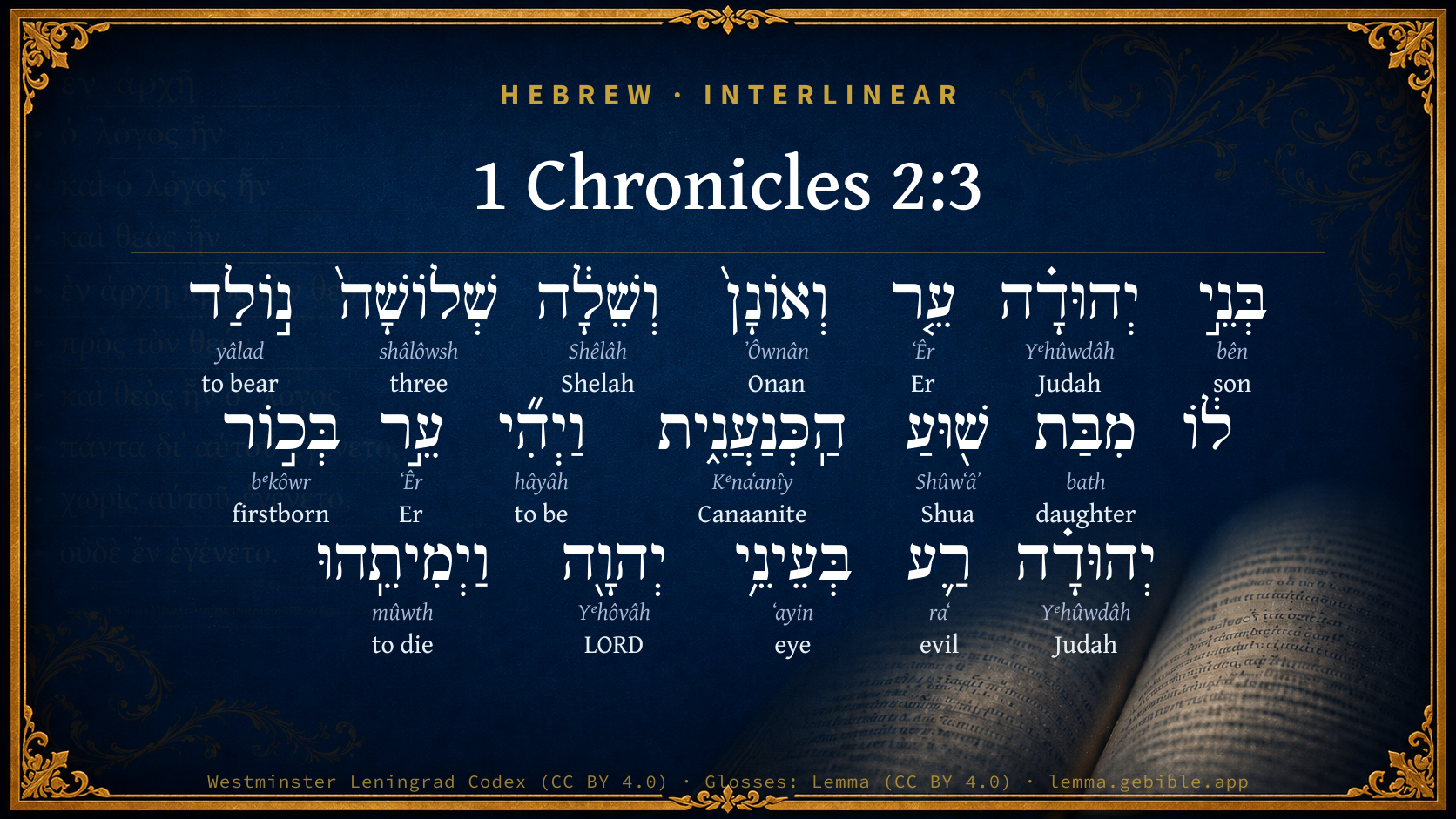
1 Chronicles 2:3

Hebrew (Westminster Leningrad Codex) 1 Chronicles 2:3 appears in the Hebrew Old Testament. The text above is from the Westminster Leningrad Codex. Each word links to its Strong’s number, a concise gloss, and parsing drawn from the Open Scriptures Hebrew Bible morphology. Click any word for its full Brown-Driver-Briggs (BDB) entry.
Download image
Cite this verse

1 Chronicles 2:3 (World English Bible). Public Domain. Lemma interlinear Bible study tool, https://lemma.gebible.app/v/1-chronicles/2/3.

Show BibTeX & RIS
BibTeX
RIS
English Translation
The sons of Judah: Er, and Onan, and Shelah; which three were born to him of Shua's daughter the Canaanitess. Er, Judah's firstborn, was wicked in the sight of Yahweh; and he killed him.
World English Bible · Public Domain
Highlights
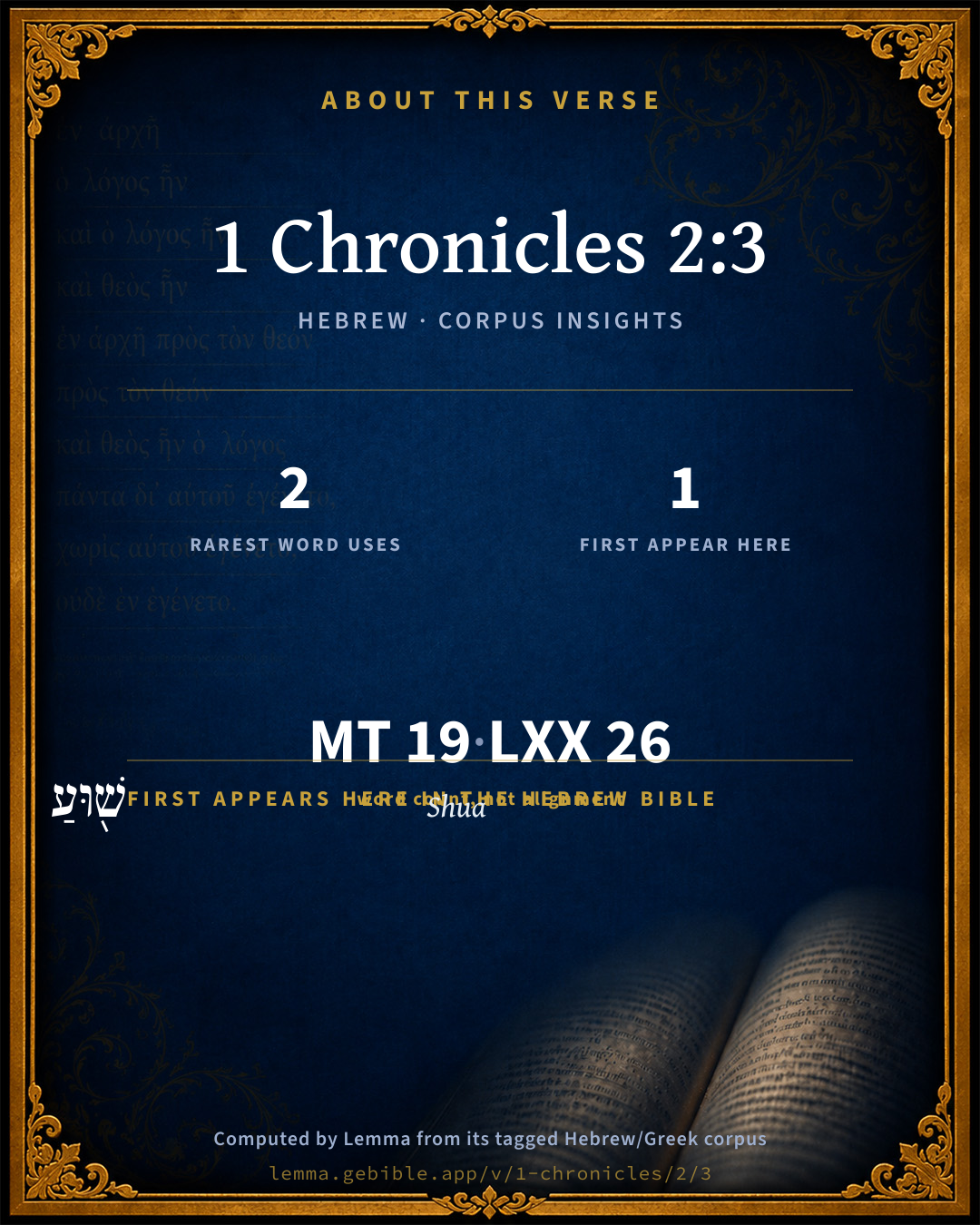
  • 1 first appearance in the Hebrew Bible
Full analysis ↓
Download a study sheet

One document with this verse’s original text, its word-by-word gloss line, the meaning frame, cross-references with their text, attributed commentary, and full source and license credits — printable, and it pastes into notes with its structure intact.

This verse Autodidact and up

Study sheet (.html) Plain text (.txt)

A passage Seminary Student

Up to 50 verses in one chapter. A passage sheet keeps up to 6 commentary sources and 12 cross-references per verse, in the order this page ranks them, and says so on the sheet whenever that leaves anything out. Ask for a single verse and you get the Autodidact verse sheet above.

Everything on this page stays free to read, with no account — the sheet is a download of what is already on screen, not access to it.

Want to remove ads? Support Godless Engineer
Compare translations 3

The same verse in 3 English versions, stacked beneath the original-language interlinear above. Click any original word for its lexicon entry.

Each is an independent rendering of the whole verse — the interlinear is not word-aligned to these translations.

Highlighted words mark where these versions differ — a whole-verse word diff, not a word-by-word alignment.

  • World English Bible Public Domain
    The sons of Judah: Er, and Onan, and Shelah; which three were born to him of Shua's daughter the Canaanitess. Er, Judah's firstborn, was wicked in the sight of Yahweh; and he killed him.
  • King James Version Public Domain
    The sons of Judah; Er, and Onan, and Shelah: which three were born unto him of the daughter of Shua the Canaanitess. And Er, the firstborn of Judah, was evil in the sight of the LORD; and he slew him.
  • unfoldingWord Literal Text CC BY-SA 4.0
    The sons of Judah: Er and Onan and Shelah. Three were born to him by Bath Shua the Canaanitess. And Er, the firstborn of Judah, was wicked in the eyes of Yahweh, and he killed him.

unfoldingWord Literal Text — © unfoldingWord, licensed CC BY-SA 4.0. Word-aligned USFM3 via Door43 (git.door43.org/unfoldingWord/en_ult).

Versions to compare (up to 4)

3 of 4 selected

Show all 18 translations

Every available English version of this verse, each an independent rendering of the whole verse.

  • World English Bible Public Domain
    The sons of Judah: Er, and Onan, and Shelah; which three were born to him of Shua's daughter the Canaanitess. Er, Judah's firstborn, was wicked in the sight of Yahweh; and he killed him.
  • Berean Standard Bible Public Domain
    The sons of Judah: Er, Onan, and Shelah. These three were born to him by Bath-shua the Canaanite. Er, Judah’s firstborn, was wicked in the sight of the LORD, who put him to death.
  • Majority Standard Bible Public Domain
    The sons of Judah: Er, Onan, and Shelah. These three were born to him by Bath-shua the Canaanite. Er, Judah’s firstborn, was wicked in the sight of the LORD. So the LORD put him to death.
  • King James Version Public Domain
    The sons of Judah; Er, and Onan, and Shelah: which three were born unto him of the daughter of Shua the Canaanitess. And Er, the firstborn of Judah, was evil in the sight of the LORD; and he slew him.
  • American Standard Version (1901) Public Domain
    The sons of Judah: Er, and Onan, and Shelah; which three were born unto him of Shua's daughter the Canaanitess. And Er, Judah's first-born, was wicked in the sight of Jehovah; and he slew him.
  • Revised Version (1885) Public Domain
    The sons of Judah; Er, and Onan, and Shelah: which three were born unto him of Bath-shua the Canaanitess. And Er, Judah’s firstborn, was wicked in the sight of the LORD; and he slew him.
  • Geneva Bible (1599) Public Domain
    The sonnes of Iudah, Er, and Onan, and Shelah. these three were borne to him of ye daughter of Shua the Canaanite: but Er the eldest sonne of Iudah was euil in the sight of the Lord, and he slew him.
  • Douay-Rheims (1899) Public Domain
    The sons of Juda: Her, Onan and Sela. These three were born to him of the Chanaanitess the daughter of Sue. And Her the firstborn of Juda, was wicked in the sight of the Lord, and he slew him.
  • Young's Literal Translation Public Domain
    Sons of Judah: Er, and Onan, and Shelah, three have been born to him of a daughter of Shua the Canaanitess. And Er, first-born of Judah, is evil in the eyes of Jehovah, and He putteth him to death.
  • Literal Standard Version CC BY-SA 4.0
    Sons of Judah: Er, and Onan, and Shelah, three have been born to him of a daughter of Shua the Canaanitess. And Er, firstborn of Judah, is evil in the eyes of YHWH, and He puts him to death.
  • Unlocked Literal Bible CC BY-SA 4.0
    Judah's sons were Er, Onan, and Shelah, who were born to him by Shua's daughter, a Canaanite woman. Er, Judah's firstborn, was wicked in the sight of Yahweh, and Yahweh killed him.
  • unfoldingWord Literal Text CC BY-SA 4.0
    The sons of Judah: Er and Onan and Shelah. Three were born to him by Bath Shua the Canaanitess. And Er, the firstborn of Judah, was wicked in the eyes of Yahweh, and he killed him.
  • Darby Bible Public Domain
    The sons of Judah: Er, and Onan, and Shelah: [which] three were born to him of the daughter of Shua the Canaanitess. And Er, Judah's firstborn, was wicked in the sight of Jehovah; and he slew him.
  • World Messianic Bible Public Domain
    The sons of Judah: Er, Onan, and Shelah, which three were born to him of Shua’s daughter the Canaanitess. Er, Judah’s firstborn, was wicked in the LORD’s sight; and he killed him.
  • Webster's Bible Public Domain
    The sons of Judah; Er, and Onan, and Shelah: which three were born to him of the daughter of Shua the Canaanitess. And Er, the first-born of Judah, was evil in the sight of the LORD; and he slew him.
  • Free Bible Version CC BY-SA 4.0
    The sons of Judah: Er, Onan, and Shelah—these three the daughter of Shua, a Canaanite woman, bore to him. Er, Judah's firstborn, was wicked in the sight of the Lord, so he put him to death.
  • Bible in Basic English Public Domain
    The sons of Judah: Er and Onan and Shelah; these three were his sons by Bathshua, the Canaanite woman. And Er, Judah's oldest son, did evil in the eyes of the Lord; and he put him to death.
  • JPS Tanakh (1917) Public Domain
    The sons of Judah: Er, and Onan, and Shelah; which three were born unto him of Bath-shua the Canaanitess. And Er, Judah's first-born, was wicked in the sight of the LORD; and He slew him.

Literal Standard Version (2020), Covenant Press — licensed CC BY-SA 4.0. Text via the HelloAO Bible API (eBible.org). Unlocked Literal Bible (unfoldingWord) — licensed CC BY-SA 4.0. Text via the HelloAO Bible API (eBible.org). unfoldingWord Literal Text — © unfoldingWord, licensed CC BY-SA 4.0. Word-aligned USFM3 via Door43 (git.door43.org/unfoldingWord/en_ult). Free Bible Version, Dr. Jonathan Gallagher — licensed CC BY-SA 4.0. Text via the HelloAO Bible API (eBible.org).

Word by word

More ways to search: Search by grammar → Find every occurrence → Compare this word →

Practice this passage: Drill this verse → Learn its vocabulary →

שׁ֖וּעַ
Shûwʻâʼ
H7774
“Shua”
Noun, Proper
Part of Speech
Noun
Type
Proper
Full BDB Definition

Origin: from H7768

TWOT: None

Shua = "wealth" - an Asheritess, daughter of Heber and sister to Japhlet, Shomer, and Hotham
  1. בְּנֵ֣י bên H1121 “sons of” Noun, Common, Masculine, Plural, Construct
  2. יְהוּדָ֗ה Yᵉhûwdâh H3063 “Judah” Noun, Proper
  3. עֵ֤ר ʻÊr H6147 “Er” Noun, Proper
  4. וְאוֹנָן֙ ʼÔwnân H209 “and · Onan” Conjunction + Noun, Proper
  5. וְשֵׁלָ֔ה Shêlâh H7956 “and · Shelah” Conjunction + Noun, Proper
  6. שְׁלוֹשָׁה֙ shâlôwsh H7969 “three” Adjective, Cardinal number, Masculine, Singular, Absolute
  7. נ֣וֹלַד yâlad H3205 “to bear” Verb, Niphal, Perfect, 3rd Person, Masculine, Singular
  8. מִבַּת bath H1323 “from · daughter of” Preposition + Noun, Common, Feminine, Singular, Construct
  9. הַֽכְּנַעֲנִ֑ית Kᵉnaʻanîy H3669 “the · Canaanite” Particle, Definite Article + Noun, Gentilic, Feminine, Singular, Absolute
  10. וַיְהִ֞י hâyâh H1961 “and · to be” Conjunction + Verb, Qal, Sequential Imperfect, 3rd Person, Masculine, Singular
  11. עֵ֣ר ʻÊr H6147 “Er” Noun, Proper
  12. בְּכ֣וֹר bᵉkôwr H1060 “firstborn of” Noun, Common, Masculine, Singular, Construct
  13. יְהוּדָ֗ה Yᵉhûwdâh H3063 “Judah” Noun, Proper
  14. רַ֛ע raʻ H7451 “evil” Adjective, Adjective, Masculine, Singular, Absolute
  15. בְּעֵינֵ֥י ʻayin H5869 “in/at · eyes of” Preposition + Noun, Common, Both, Dual, Construct
  16. יְהוָ֖ה Yᵉhôvâh H3068 “LORD” Noun, Proper
  17. וַיְמִיתֵֽהוּ mûwth H4191 “and · to die · him” Conjunction + Verb, Hiphil, Sequential Imperfect, 3rd Person, Masculine, Singular + Suffix, Personal, 3rd Person, Masculine, Singular

About this verse

These counts appear in no published source. They are computed here, from the morphology-tagged text and Lemma’s own curated glosses. What Lemma adds →

19
words
16
distinct lemmas
Historical
section

Notable vocabulary

The rarest word here is שׁ֖וּעַ Shua H7774 — appearing just 2 times in the whole Hebrew Bible.

First appearance in Scripture

This word makes its first canonical appearance in the Hebrew Bible here:

  • שׁ֖וּעַ Shua H7774

Shared distinctive vocabulary

שׁ֖וּעַ Shua H7774 occurs in 2 verses of the Hebrew Bible. Also found in:

Grammatical profile

  • 3 verbs
  • 13 nouns
  • 2 adjectives
  • 1 preposition

Verb forms

  • נ֣וֹלַד Niphal · Perfect
  • וַיְהִ֞י Qal · Sequential Imperfect
  • וַיְמִיתֵֽהוּ Hiphil · Sequential Imperfect

Repetition

Words recur within this verse — often emphatic in Hebrew:

  • יְהוּדָ֗ה Judah H3063 ×2
  • עֵ֤ר Er H6147 ×2

Hebrew & Septuagint length

In English translation the verse runs 34 words from the Hebrew and 36 from the Septuagint (LXX English) — closely comparable.

A rough comparison of the two English renderings, which tokenize alike — not a word-level alignment.

Word counts can differ between the Hebrew and the Greek without any difference in meaning — e.g. the Hebrew direct-object marker אֵת has no separate Greek word, and Greek often adds the article ὁ.

In the original languages it is 19 Hebrew tokens and 26 Greek tokens — but the two are counted differently (Hebrew bundles its prefixes and suffixes into one token; the Greek is in lemma form), so that isn’t a like-for-like length.

Cross-references

4

Topical passages linked to 1 Chronicles 2:3 in the Treasury of Scripture Knowledge — connected by theme and wording, ordered by reader-vote popularity; previews shown in the World English Bible.

  • Genesis 38:2–10 Judah saw there a daughter of a certain Canaanite whose name was Shua. He took her, and went in to her.
  • Genesis 46:12 The sons of Judah: Er, Onan, Shelah, Perez, and Zerah; but Er and Onan died in the land of Canaan. The sons of Perez were Hezron and Hamul.
  • Numbers 26:19 The sons of Judah: Er and Onan; and Er and Onan died in the land of Canaan.
  • 1 Chronicles 9:5 Of the Shilonites: Asaiah the firstborn, and his sons.

Cross-references courtesy of OpenBible.info (CC BY 4.0).

Hebrew and Greek witnesses Masoretic Hebrew ↔ Greek Septuagint

The same verse in the two great witnesses to the Old Testament, shown verse-for-verse.

These are two independent witnesses, not word-aligned to each other, and the Septuagint is shown in lemma (dictionary) form.

Hebrew 1 Chronicles 2:3 Masoretic · Westminster Leningrad Codex

בְּנֵ֣י יְהוּדָ֗ה עֵ֤ר וְאוֹנָן֙ וְשֵׁלָ֔ה שְׁלוֹשָׁה֙ נ֣וֹלַד ל֔וֹ מִבַּת שׁ֖וּעַ הַֽכְּנַעֲנִ֑ית וַיְהִ֞י עֵ֣ר בְּכ֣וֹר יְהוּדָ֗ה רַ֛ע בְּעֵינֵ֥י יְהוָ֖ה וַיְמִיתֵֽהוּ

The sons of Judah: Er, and Onan, and Shelah; which three were born to him of Shua's daughter the Canaanitess. Er, Judah's firstborn, was wicked in the sight of Yahweh; and he killed him.

World English Bible · Public Domain

Greek LXX 1 Chronicles 2:3 Septuagint · lemma form

υἱός ἰουδά ηρ αυναν σηλων τρεῖς γεννάω αὐτός ἐκ ὁ θυγάτηρ σαυας ὁ χαναανῖτις καί εἰμί ηρ ὁ πρωτότοκος ἰουδά πονηρός ἐναντίον κύριος καί ἀποκτείνω αὐτός

The sons of Juda; Er, Aunan, Selom. These three were born to him of the daughter of Sava the Chananitish woman: and Er, the firstborn of Juda, was wicked before the Lord, and he killed him.

LXX2012 (modern English Septuagint) · Public Domain

On this verse, The Pulpit Commentary discusses the Septuagint’s reading. Read the note in Commentary ↓

Hebrew: Westminster Leningrad Codex (CC BY 4.0). Greek: Septuagint (public domain); English from LXX2012 (modern English Septuagint) (Public Domain). How the Septuagint differs from the Hebrew →

Commentary

Notes on 1 Chronicles 2:3 from classic Christian and Jewish commentators (each source and its license shown beneath its notes). The classic Christian expositions comment on the surrounding passage and are grouped to its opening verse, so a note may address several verses; the Jewish commentaries on the Tanakh (Rashi and others) are per-verse, so they appear only where the commentator wrote on this verse.

Lemma curates 59 commentaries, every one of them public domain or Creative Commons licensed, each selected and text-cleaned for this edition rather than reprinted as found. About our sources →

Trapp's Complete Commentary

John Trapp

1Ch 2:3 The sons of Judah; Er, and Onan, and Shelah: [which] three were born unto him of the daughter of Shua the Canaanitess. And Er, the firstborn of Judah, was evil in the sight of the LORD; and he slew him.

Ver. 3. The sons of Judah.] These are first set down, (1.) For the royal dignity; (2.) For the descent of the Messiah.

Was evil in the sight of the Lord.] Quem nihil latet , Who seeth and punisheth secret sins.

John Trapp, A Commentary or Exposition upon All the Books of the Old and New Testament (1647–1656) — public domain. Text from a community e-Sword module.

Joseph Benson's Commentary

1Ch 2:3. The sons of Judah — He puts Judah first, because the best part of the right of the firstborn, namely, the dominion, was conferred on him, Gen 49:8; in consequence of which, his tribe obtained a pre- eminence among, and a kind of superiority over the rest, even before the time of David. And from David’s time, it is without doubt, that till the Babylonish captivity a kingly power continued in this tribe; Zerubbabel, also, who was their leader, when they returned to their own land, was of the same tribe. The chief reason, however, why the genealogy of Judah is set down first, is because the Messiah was to descend from him.

Joseph Benson's Commentary on the Old and New Testaments (1811–1818) — public domain. Text from a community e-Sword module.

Tyndale Open Study Notes

Tyndale Open Resources

2:3–4:23 While the genealogies present the entire people of Israel (2:1-2), David’s ancestors in the tribe of Judah receive priority.

2:3-8 The genealogy of Judah is as comprehensive as possible, recording peripheral material as the background to the main line of David’s ancestors. Cp. Gen 46:12.

2:3 Er and Onan, the first two sons of Judah, were destroyed because of their sin (Gen 38:6-10). The descendants of Shelah are listed as an appendix at the end of the genealogies of Judah (1 Chr 4:21-23).

Tyndale Open Study Notes — © Tyndale Open Resources, licensed CC BY-SA 4.0. Text via the HelloAO Bible API.

Geneva Bible (1599)

Geneva Bible translators

Though Judah was not Jacob’s eldest son, yet he first beginneth at him, because he would come to the genealogy of David, of whom came Christ.

Geneva Bible (1599) marginal notes — public domain. Text via Bolls.life.

Ellicott's Commentary for English Readers

THE FIVE SONS OF JUDAH, FROM Genesis 38.

(3) The daughter of Shua the Canaanitess.—Shua was the father of Judah’s wife.

Er, the firstborn of Judah, was (became, proved) evil.—Word for word from Gen_38:7. Suppressing other details relating to the sons of Judah, the chronicler copies this statement intact from Genesis, because it thoroughly harmonises with the moral he wishes to be drawn from the entire history of his people.

A Bible Commentary for English Readers, edited by Charles John Ellicott (1878–1897) — public domain. Text from a community e-Sword module.

The Cambridge Bible for Schools and Colleges

gen. ed. J. J. S. Perowne

3–17. The Descent of the Sons of Jesse from Judah

4. Pharez] R.V. Perez.

The Cambridge Bible for Schools and Colleges (gen. ed. J. J. S. Perowne; Cambridge University Press, 1878–1918) — public domain. Text from a community e-Sword module.

John Gill's Exposition

And Tamar his daughter in law bare him Pharez and Zerah,.... Through incest; they were twins, Gen 38:27 all the sons of Judah were five; who are before mentioned by name.

all the sons of Judah were five; who are before mentioned by name.

1 Chronicles 2:5

ch1 2:5

ch1 2:5

ch1 2:5The sons of Pharez,.... One of the above twins, born to Judah:

Hezron and Hamul; see Gen 46:12.

John Gill's Exposition of the Whole Bible (1746–1763) — public domain (CC PDM 1.0). Text via the HelloAO Bible API.

Haydock's Catholic Bible Commentary

Her. The crime for which he was punished is not specified in Scripture. (Calmet) --- The Rabbins say that he was so enamoured of the beauty of his wife, that he treated her in the same manner as Onan did afterwards. (Cassian viii. 11.) --- It is supposed that he was slain by a devil, (Calmet) like the (Tirinus) impure husbands of Sarai, Tobias vi. 14. (Haydock)

George Leo Haydock (1774–1849), Haydock's Catholic Family Bible and Commentary, 1859 edition — public domain. Excludes Psalms (Douay-Rheims chapter numbering differs from Protestant) and Deuterocanonical books (Catholic canon only).

Matthew Poole's English Annotations

He puts

Judah first, because the best part of the right of the first-born, to wit, the dominion, was conferred upon him, Gen 49:8, and because the Messiah was to come out of his loins.

Matthew Poole's English Annotations on the Holy Bible (1683–1685) — public domain. Text from a community e-Sword/MySword module.

The Pulpit Commentary

Vers. 3-9. 2. THE LINE OF JUDAH, TO HIS THREE GREATGRANDSONS. The line of Judah is, with a well-known object, the first to be taken up, although Judah stands fourth of Israel"s sons. Judah has five sons: three, Er, Onan, Shelah, by a Canaanitess, the daughter of Shad; and two, Pharez and Zerah, by Tamar, his own daughter-in-law, under the circumstances described. (Gen_38:6-30) There all these names are found in exact accord in the Authorized Version, in the Hebrew text, and in the Septuagint. The Septuagint Version, however, (Gen_38:2) by an evident inaccuracy of translation, gives Shua as the name, not of the father, but of the daughter, h=| onoma Saua. Parallel passages are also found (Gen_46:12; Num_26:19-22) Er and Onan died without issue, and the descendants of Shelah are not mentioned till we 1Ch_4:21-23. The line is now carried on by the twin sons of Tamar (vers. 5, 6). Pharez, with two sons, Hezron and Hamul (Gen_46:12; Rth_4:18) and Zerah, with five sons, Zimri (or, Jos_7:1) Ethan, Heman, Calcol, Dara (or with many manuscripts, followed by the Targum, Syriac, and Arabic versions, Darda). If these last four names are not identical with those in 1Ki_4:31, they are not to be found in any available connection elsewhere, and the last two not at all. Upon this supposition, it is held by some that this very passage proves that the compiler drew on resources not possessed by us.

The weight of evidence seems, however, largely in favour of the persons being the same. (See Gilbert Barrington"s "Old Testament Genealogies," 1:206-208, well summarized in art. "Darda," Smith"s "Bible Dictionary," for as competent a discussion of the question as the present data will allow.) It needs to be constantly remembered that an enumeration like the above, of five so-called sons, does not necessarily involve their being five brothers, although in this case it looks the more as though they were so, as it is said five of them in all Divine judgment on individual sin.

Very little is known of Er. The account in Genesis (Gen_38:7) is as brief as that given in the Chronicles. Yet it sets clearly before us a case of early death, probably a sudden and violent death, and it declares to us that, in this particular instance, the death, and the manner of the death, were immediate judgments on personal transgression. There is a strong tendency to assume individual sin as the cause of calamities and so-called accidents, but our Lord taught us that we cannot always, or necessarily, trace such a connection. It may be so, but it may not be so; and we, in Christian charity, had better leave the discovery of the connection in God"s own hands. (see Luk_13:1-5) Still, we should be ready to learn the lessons which God may design to teach us, when he is pleased to give us illustrative cases in his Word. Oftentimes we find the Divine recognition and judgment of social and national sins illustrated. The old divine bids us remember that "God can only punish nations, as such, in this world; he can punish individuals in this world and the next." Israel is, as a nation, the subject of frequent Divine judgments, and Israel is bidden observe how Divine judgments fall on the guilty nations around her. But as this feature of the Divine dealings is set forth so prominently and so constantly, there is some danger of our assuming that Divine judgments, as executed here on earth, do not concern the individual; and that God may be said directly to govern the race, but not the man. Such a delusion would tend to nourish human wilfulness and pride, and still more completely separate men from God; and, therefore, we have men"s personal sins, and the immediate Divine judgment on those sins, impressively narrated.

I ER"S SIN WAS SOME PERSONAL ACT OF WRONG-DOING. Exactly what it was we are not told, but we know the ways in which men nowadays transgress God"s laws and insult the Divine honour. There are acts of wilful disobedience and rebellion, acts of bodily self-indulgence, and acts of violence and cruelty toward others. We have to see that this evil of Er"s was distinctly personal. He did not merely share in the errors, or follies, or sins of his age, in a blind and heedless way; he made wicked ways for himself, and wrought evil in his own wilfulness. Therefore the Divine observation rested upon him as a man who strove to set himself against God.

II ER"S SIN REVEALED A HOPELESSLY CORRUPTED NATURE. It was such a fruitage as could only come out of a corrupt tree. Distinguish between the one sin into which man may be tempted; even the good man may be "drawn aside and enticed," "overtaken in a fault;" and the continuing in sin, which indicates the love for it, and the deteriorating influence it has exerted on mind and heart. A time may come for the man (as Er), or for the nation (as Sodom), when remedial agencies cease to be of avail, and then they can but be "cut down." Illustrate from Pharaoh, with the hardened heart, from King Saul, and from the expression used in Hosea, (Hos_4:17) "Ephraim is joined to idols: let him alone.

III ER"S SIN BROUGHT UPON HIMSELF DIVINE JUDGMENT. This is briefly but forcibly intimated in the words, "and he slew him." His early and sudden and violent death, was no disease and no accident. It was direct Divine judgment. God deals with the individual exactly as with the hopelessly corrupted world and the utterly degraded Sodom. Life on earth is forfeited it" it is so shamefully abused. Discuss the question how far we may recognize calamities reaching individuals as Divine judgment on their personal transgressions. In every age there are open and notorious cases, e.g. Ananias and Sapphira. We may say that it is quite possible for any accident to be a judgment; but it may be a judgment on a bad system, and the sufferer may not be the direct cause. Impress God"s constant inspection of individual conduct and character. R.T.

The Pulpit Commentary (1880–1919), ed. H.D.M. Spence-Jones & Joseph S. Exell — public domain. Text from a community e-Sword module.

John Wesley's Explanatory Notes

Judah - Whom he puts first, because the best part of the right of the firstborn, namely, the dominion, was conferred upon him, Gen. xlix, 8, and because the Messiah was to come out of his loins.

John Wesley, Explanatory Notes Upon the Whole Bible (1754–1765) — public domain. Text via the GEBible commentary corpus.

Keil & Delitzsch

C. F. Keil & F. Delitzsch

And Tamar his daughter in law bare him Pharez and Zerah,.... Through incest; they were twins, Gen 38:27 all the sons of Judah were five; who are before mentioned by name.

all the sons of Judah were five; who are before mentioned by name.

1 Chronicles 2:5

ch1 2:5

ch1 2:5

ch1 2:5The sons of Pharez,.... One of the above twins, born to Judah:

Hezron and Hamul; see Gen 46:12.

Keil & Delitzsch — Biblical Commentary on the Old Testament (1861–1891) — public domain (CC PDM 1.0). Text via the HelloAO Bible API. (Old Testament only.)

unfoldingWord translationNotes

Door43 World Missions Community

General Information:

This list includes the names of both men and women names. (See: How to Translate Names)

Er, Onan, and Shelah ... Shua ... Perez ... Zerah

These are the names of men. (See: How to Translate Names)

who were born to him by Shua's daughter

This can be translated in active form. AT: "his sons whom Shua bore" (See: Active or Passive)

Yahweh

This is the name of God that he revealed to his people in the Old Testament. See the translationWord page about Yahweh concerning how to translate this.

bore him Perez and Zerah

"gave birth to his sons Perez and Zerah"

in the sight of Yahweh

The sight of Yahweh represents his judgment or evaluation. AT: "as Yahweh judged" (See: Metaphor)

Yahweh killed him

The reader should understand that Yahweh probably had a person kill Er. (See: Metonymy)

Tamar

This is the name of a woman. (See: How to Translate Names)

daughter-in-law

This is a reference to the wife of his son.

five sons

"5 sons" (See: Numbers)

translationWords

Canaan

firstborn

evil

Yahweh

Tamar

unfoldingWord translationNotes — © Distant Shores Media and the Door43 World Missions Community, licensed CC BY-SA 4.0. Source: git.door43.org/Door43/en_tn.

Rashi

Rabbi Shlomo Yitzchaki (Rashi)

was evil in the eyes of the Lord It is explained (Gen. Rab. (85:4) that he would “plow in the gardens,” meaning he was intimate with her in an unnatural way.

Rashi on the Tanakh — English translations: “The Judaica Press complete Tanach with Rashi, translated by A. J. Rosenberg” (CC BY 4.0); “Pentateuch with Rashi's commentary by M. Rosenbaum and A.M. Silbermann, 1929-1934” (public domain); “The Metsudah Tanach series, Lakewood, N.J” (CC BY 4.0); and “The Book of Joshua, Metsudah Publications, 1997” (CC BY 4.0). Text via Sefaria.

Lesson kit

Teaching starters — assembled from the data on this page, not authored interpretation. Every prompt links to the verse data it draws on. Edit before teaching.

1 Chronicles, in the Historical, opens this verse with 19 words (16 distinct Hebrew lemmas). Its most distinctive word is Shûwʻâʼ (“Shua”). A historical commentator’s framing appears above. Read the whole chapter for the surrounding context.

Discussion questions

  1. The word Shûwʻâʼ carries the sense “Shua.” How does it shape the verse?
  2. The word “Shua” first appears here in Scripture. What is being introduced at this debut?
  3. 1 Chronicles 7:32 shares the word «Shua» with this verse. How do the two illuminate each other?
  4. “Judah” occurs 2× in this one verse. What is the effect of the repetition?
  5. These translations render this verse differently; the difference is in the English rendering, not the original. What questions does that raise?
  6. The verb «נ֣וֹלַד» is Niphal Perfect. How does its form color the action?
  7. Reading how Trapp's Complete Commentary and Joseph Benson's Commentary read this verse, where do the two commentators agree and where do they part?

Things to notice

Reading settings

Reading text

Shown beneath each verse's original-language words.

Old Testament
Old Testament edition

Read the OT as the Masoretic Hebrew (MT) or the Greek Septuagint (LXX).

English shown for the Greek Septuagint (in the Hebrew ↔ Greek comparison).

Comparing translations? Open the Compare panel on any verse page to stack up to four side by side.