
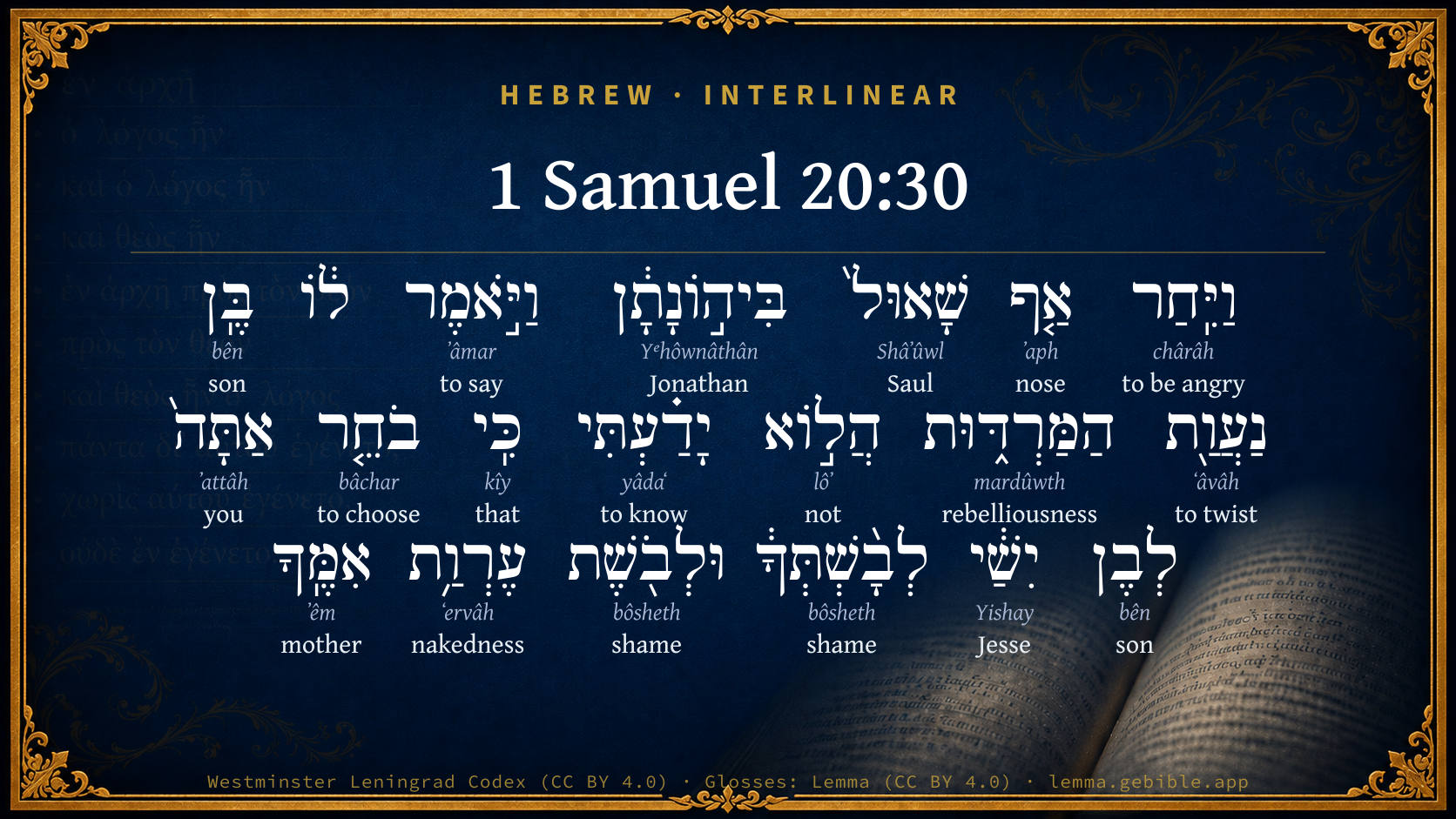
1 Samuel 20:30

Hebrew (Westminster Leningrad Codex) 1 Samuel 20:30 appears in the Hebrew Old Testament. The text above is from the Westminster Leningrad Codex. Each word links to its Strong’s number, a concise gloss, and parsing drawn from the Open Scriptures Hebrew Bible morphology. Click any word for its full Brown-Driver-Briggs (BDB) entry.
Download image
Cite this verse

1 Samuel 20:30 (World English Bible). Public Domain. Lemma interlinear Bible study tool, https://lemma.gebible.app/v/1-samuel/20/30.

Show BibTeX & RIS
BibTeX
RIS
English Translation
Then Saul's anger was kindled against Jonathan, and he said to him, You son of a perverse rebellious woman, don't I know that you have chosen the son of Jesse to your own shame, and to the shame of your mother's nakedness?
World English Bible · Public Domain
Highlights
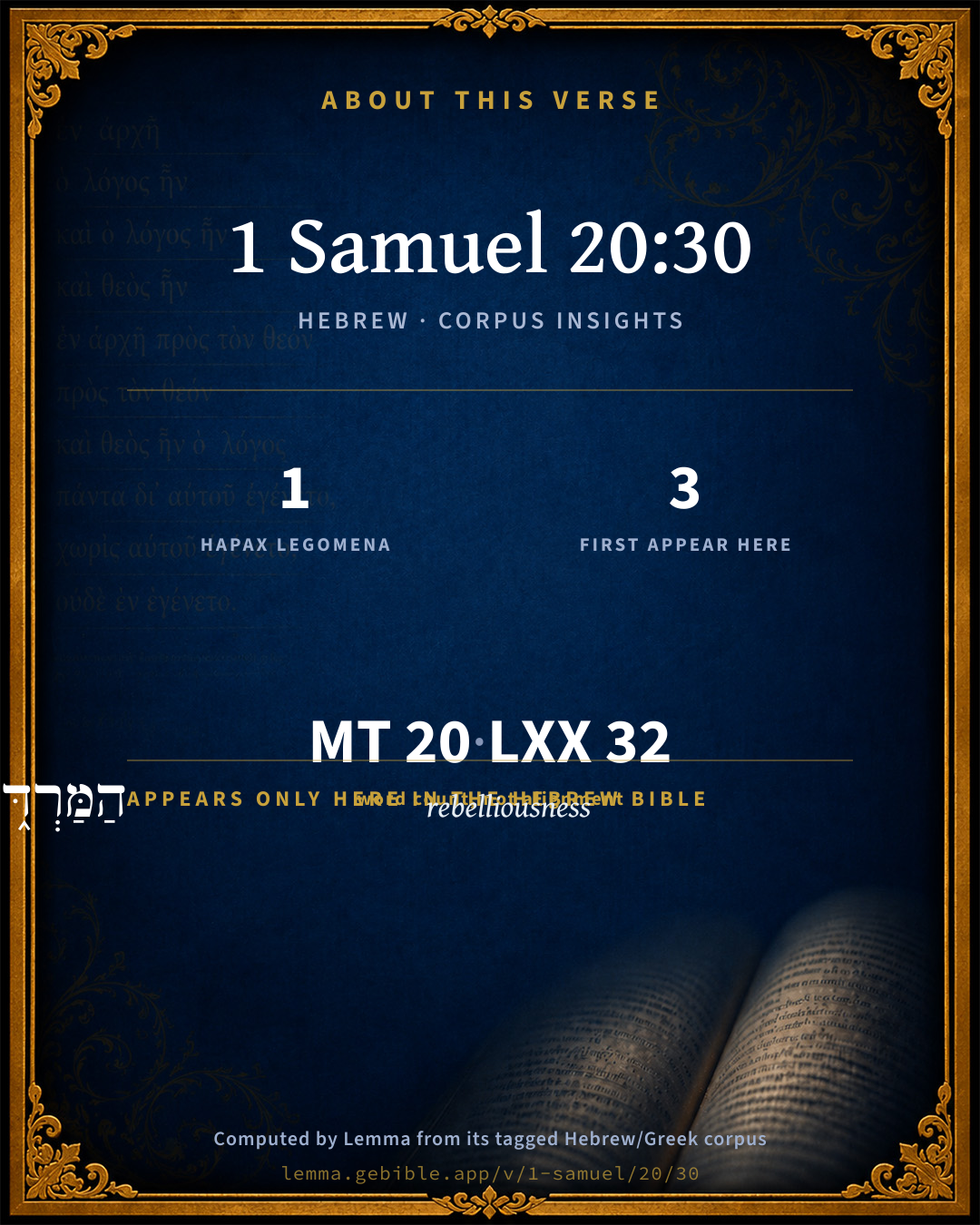
  • 1 hapax legomenon — only here in the Hebrew Bible
  • 3 first appearances in the Hebrew Bible
Full analysis ↓
Download a study sheet

One document with this verse’s original text, its word-by-word gloss line, the meaning frame, cross-references with their text, attributed commentary, and full source and license credits — printable, and it pastes into notes with its structure intact.

This verse Autodidact and up

Study sheet (.html) Plain text (.txt)

A passage Seminary Student

Up to 50 verses in one chapter. A passage sheet keeps up to 6 commentary sources and 12 cross-references per verse, in the order this page ranks them, and says so on the sheet whenever that leaves anything out. Ask for a single verse and you get the Autodidact verse sheet above.

Everything on this page stays free to read, with no account — the sheet is a download of what is already on screen, not access to it.

Want to remove ads? Support Godless Engineer
Compare translations 3

The same verse in 3 English versions, stacked beneath the original-language interlinear above. Click any original word for its lexicon entry.

Each is an independent rendering of the whole verse — the interlinear is not word-aligned to these translations.

Highlighted words mark where these versions differ — a whole-verse word diff, not a word-by-word alignment.

  • World English Bible Public Domain
    Then Saul's anger was kindled against Jonathan, and he said to him, You son of a perverse rebellious woman, don't I know that you have chosen the son of Jesse to your own shame, and to the shame of your mother's nakedness?
  • King James Version Public Domain
    Then Saul's anger was kindled against Jonathan, and he said unto him, Thou son of the perverse rebellious woman, do not I know that thou hast chosen the son of Jesse to thine own confusion, and unto the confusion of thy mother's nakedness?
  • unfoldingWord Literal Text CC BY-SA 4.0
    And the nose of Saul burned against Jonathan, and he said to him, “Son of one perverting herself in rebellion! Do I not know that you are choosing the son of Jesse to your shame and to the shame of the nakedness of your mother?

unfoldingWord Literal Text — © unfoldingWord, licensed CC BY-SA 4.0. Word-aligned USFM3 via Door43 (git.door43.org/unfoldingWord/en_ult).

Versions to compare (up to 4)

3 of 4 selected

Show all 18 translations

Every available English version of this verse, each an independent rendering of the whole verse.

  • World English Bible Public Domain
    Then Saul's anger was kindled against Jonathan, and he said to him, You son of a perverse rebellious woman, don't I know that you have chosen the son of Jesse to your own shame, and to the shame of your mother's nakedness?
  • Berean Standard Bible Public Domain
    Then Saul’s anger burned against Jonathan, and he said to him, “You son of a perverse and rebellious woman! Do I not know that you have chosen the son of Jesse to your own shame and to the disgrace of the mother who bore you?
  • Majority Standard Bible Public Domain
    Then Saul’s anger burned against Jonathan, and he said to him, “You son of a perverse and rebellious woman! Do I not know that you have chosen the son of Jesse to your own shame and to the shame of the mother who bore you?
  • King James Version Public Domain
    Then Saul's anger was kindled against Jonathan, and he said unto him, Thou son of the perverse rebellious woman, do not I know that thou hast chosen the son of Jesse to thine own confusion, and unto the confusion of thy mother's nakedness?
  • American Standard Version (1901) Public Domain
    Then Saul's anger was kindled against Jonathan, and he said unto him, Thou son of a perverse rebellious woman, do not I know that thou hast chosen the son of Jesse to thine own shame, and unto the shame of thy mother's nakedness?
  • Revised Version (1885) Public Domain
    Then Saul’s anger was kindled against Jonathan, and he said unto him, Thou son of a perverse rebellious woman, do not I know that thou hast chosen the son of Jesse to thine own shame, and unto the shame of thy mother’s nakedness?
  • Geneva Bible (1599) Public Domain
    Then was Saul angrie with Ionathan, and sayde vnto him, Thou sonne of the wicked rebellious woman, doe not I know, that thou hast chosen the sonne of Ishai to thy confusion, and to the confusion and shame of thy mother?
  • Douay-Rheims (1899) Public Domain
    Then Saul being angry against Jonathan said to him: Thou son of a woman that is the ravisher of a man, do I not know that thou lovest the son of Isai to thy own confusion and to the confusion of thy shameless mother?
  • Young's Literal Translation Public Domain
    And the anger of Saul burneth against Jonathan, and he saith to him, `Son of a perverse rebellious woman! have I not known that thou art fixing on the son of Jesse to thy shame, and to the shame of the nakedness of thy mother?
  • Literal Standard Version CC BY-SA 4.0
    And the anger of Saul burns against Jonathan, and he says to him, “Son of a perverse [woman] of rebellion! Have I not known that you are fixing on the son of Jesse to your own shame, and to the shame of the nakedness of your mother?
  • Unlocked Literal Bible CC BY-SA 4.0
    Then Saul's anger burned against Jonathan, and he said to him, “You son of a perverse, rebellious woman! Do I not know that you have chosen the son of Jesse to your own shame, and to the shame of your mother's nakedness?
  • unfoldingWord Literal Text CC BY-SA 4.0
    And the nose of Saul burned against Jonathan, and he said to him, “Son of one perverting herself in rebellion! Do I not know that you are choosing the son of Jesse to your shame and to the shame of the nakedness of your mother?
  • Darby Bible Public Domain
    And Saul's anger was kindled against Jonathan, and he said to him, Son of the perverse rebellious woman, do not I know that thou hast chosen the son of Jesse to thine own shame and to the shame of thy mother's nakedness?
  • World Messianic Bible Public Domain
    Then Saul’s anger burned against Jonathan, and he said to him, “You son of a perverse rebellious woman, don’t I know that you have chosen the son of Jesse to your own shame, and to the shame of your mother’s nakedness?
  • Webster's Bible Public Domain
    Then Saul's anger was kindled against Jonathan, and he said to him, Thou son of the perverse rebellious woman, do not I know that thou hast chosen the son of Jesse to thy own confusion, and to the confusion of thy mother's nakedness?
  • Free Bible Version CC BY-SA 4.0
    Saul got very angry with Jonathan and said, “You rebellious son of a whore! Don't you think I know that you prefer the son of Jesse? Shame on you! You're a disgrace to the mother who bore you!
  • Bible in Basic English Public Domain
    Then Saul was moved to wrath against Jonathan, and he said to him, You son of an evil and uncontrolled woman, have I not seen how you have given your love to the son of Jesse, to your shame and the shame of your mother?
  • JPS Tanakh (1917) Public Domain
    Then Saul's anger was kindled against Jonathan, and he said unto him: 'Thou son of perverse rebellion, do not I know that thou hast chosen the son of Jesse to thine own shame, and unto the shame of thy mother's nakedness?

Literal Standard Version (2020), Covenant Press — licensed CC BY-SA 4.0. Text via the HelloAO Bible API (eBible.org). Unlocked Literal Bible (unfoldingWord) — licensed CC BY-SA 4.0. Text via the HelloAO Bible API (eBible.org). unfoldingWord Literal Text — © unfoldingWord, licensed CC BY-SA 4.0. Word-aligned USFM3 via Door43 (git.door43.org/unfoldingWord/en_ult). Free Bible Version, Dr. Jonathan Gallagher — licensed CC BY-SA 4.0. Text via the HelloAO Bible API (eBible.org).

Word by word

More ways to search: Search by grammar → Find every occurrence → Compare this word →

Practice this passage: Drill this verse → Learn its vocabulary →

הַמַּרְדּ֑וּת
mardûwth
H4780
“the · rebelliousness”
Particle, Definite Article + Noun, Common, Feminine, Singular, Absolute
Part of Speech
Particle + Noun
Type
Common
Gender
Feminine
Number
Singular
State
Absolute
Full BDB Definition

Origin: from H4775

TWOT: 1240b

rebellion, rebelliousness
  1. וַיִּֽחַר chârâh H2734 “and · to be angry” Conjunction + Verb, Qal, Sequential Imperfect, 3rd Person, Masculine, Singular
  2. אַ֤ף ʼaph H639 “nose” Particle, Accusative
  3. שָׁאוּל֙ Shâʼûwl H7586 “Saul” Noun, Proper
  4. בִּיה֣וֹנָתָ֔ן Yᵉhôwnâthân H3083 “in/at · Jonathan” Preposition + Noun, Proper
  5. וַיֹּ֣אמֶר ʼâmar H559 “and · to say” Conjunction + Verb, Qal, Sequential Imperfect, 3rd Person, Masculine, Singular
  6. בֶּֽן bên H1121 “son of” Noun, Common, Masculine, Singular, Construct
  7. נַעֲוַ֖ת ʻâvâh H5753 “twisting” Verb, Niphal, Participle Active, Feminine, Singular, Construct
  8. הֲל֣וֹא lôʼ H3808 “not” Particle, Interrogative + Particle, Negative
  9. יָדַ֗עְתִּי yâdaʻ H3045 “to know” Verb, Qal, Perfect, 1st Person, Common, Singular
  10. כִּֽי kîy H3588 “that” Conjunction
  11. בֹחֵ֤ר bâchar H977 “choosing” Verb, Qal, Participle Active, Masculine, Singular, Absolute
  12. אַתָּה֙ ʼattâh H859 “you” Pronoun, Personal, 2nd Person, Masculine, Singular
  13. לְבֶן bên H1121 “to/for · son of” Preposition + Noun, Common, Masculine, Singular, Construct
  14. יִשַׁ֔י Yishay H3448 “Jesse” Noun, Proper
  15. לְבָ֨שְׁתְּךָ֔ bôsheth H1322 “to/for · shame · your” Preposition + Noun, Common, Feminine, Singular, Construct + Suffix, Personal, 2nd Person, Masculine, Singular
  16. וּלְבֹ֖שֶׁת bôsheth H1322 “and · to/for · shame of” Conjunction + Preposition + Noun, Common, Feminine, Singular, Construct
  17. עֶרְוַ֥ת ʻervâh H6172 “nakedness of” Noun, Common, Feminine, Singular, Construct
  18. אִמֶּֽךָ ʼêm H517 “mother · your” Noun, Common, Feminine, Singular, Construct + Suffix, Personal, 2nd Person, Masculine, Singular

About this verse

These counts appear in no published source. They are computed here, from the morphology-tagged text and Lemma’s own curated glosses. What Lemma adds →

20
words
17
distinct lemmas
Historical
section

Notable vocabulary

1 hapax legomenon — a word that appears only here in the entire Hebrew Bible:

  • הַמַּרְדּ֑וּת rebelliousness H4780

First appearance in Scripture

These words make their first canonical appearance in the Hebrew Bible here:

  • נַעֲוַ֖ת to twist H5753
  • הַמַּרְדּ֑וּת rebelliousness H4780
  • לְבָ֨שְׁתְּךָ֔ shame H1322

Shared distinctive vocabulary

נַעֲוַ֖ת to twist H5753 occurs in 17 verses of the Hebrew Bible. Also found in:

Grammatical profile

  • 5 verbs
  • 10 nouns
  • 1 pronoun
  • 1 preposition
  • 1 conjunction
  • 2 particles

Verb forms

  • וַיִּֽחַר Qal · Sequential Imperfect
  • וַיֹּ֣אמֶר Qal · Sequential Imperfect
  • נַעֲוַ֖ת Niphal · Participle Active
  • יָדַ֗עְתִּי Qal · Perfect
  • בֹחֵ֤ר Qal · Participle Active

Repetition

Words recur within this verse — often emphatic in Hebrew:

  • בֶּֽן son H1121 ×2
  • לְבָ֨שְׁתְּךָ֔ shame H1322 ×2

Hebrew & Septuagint length

In English translation the verse runs 42 words from the Hebrew and 42 from the Septuagint (LXX English) — the same length.

A rough comparison of the two English renderings, which tokenize alike — not a word-level alignment.

Word counts can differ between the Hebrew and the Greek without any difference in meaning — e.g. the Hebrew direct-object marker אֵת has no separate Greek word, and Greek often adds the article ὁ.

In the original languages it is 20 Hebrew tokens and 32 Greek tokens — but the two are counted differently (Hebrew bundles its prefixes and suffixes into one token; the Greek is in lemma form), so that isn’t a like-for-like length.

Cross-references

12

Topical passages linked to 1 Samuel 20:30 in the Treasury of Scripture Knowledge — connected by theme and wording, ordered by reader-vote popularity; previews shown in the World English Bible.

  • Proverbs 21:24 The proud and haughty man, "scoffer" is his name; He works in the arrogance of pride.
  • James 1:19–20 So, then, my beloved brothers, let every man be swift to hear, slow to speak, and slow to anger;
  • Job 5:2 For resentment kills the foolish man, And jealousy kills the simple.
  • Proverbs 14:29 He who is slow to anger has great understanding, But he who has a quick temper displays folly.
  • Proverbs 15:2 The tongue of the wise commends knowledge, But the mouth of fools gush out folly.
  • Proverbs 19:12 The king's wrath is like the roaring of a lion, But his favor is like dew on the grass.
  • Proverbs 19:19 A hot-tempered man must pay the penalty, For if you rescue him, you must do it again.
  • Proverbs 25:28 Like a city that is broken down and without walls Is a man whose spirit is without restraint.
  • Proverbs 27:3 A stone is heavy, And sand is a burden; But a fool's provocation is heavier than both.
  • Matthew 5:22 But I tell you, that everyone who is angry with his brother without a cause shall be in danger of the judgment; and whoever shall say to his brother, 'Raca!' shall be in danger of the council; and whoever shall say, 'You fool!' shall be in danger of the fire of Gehenna.
  • Ephesians 4:31 Let all bitterness, wrath, anger, outcry, and slander, be put away from you, with all malice.
  • Ephesians 6:4 You fathers, don't provoke your children to wrath, but nurture them in the discipline and instruction of the Lord.

Cross-references courtesy of OpenBible.info (CC BY 4.0).

Hebrew and Greek witnesses Masoretic Hebrew ↔ Greek Septuagint

The same verse in the two great witnesses to the Old Testament, shown verse-for-verse.

These are two independent witnesses, not word-aligned to each other, and the Septuagint is shown in lemma (dictionary) form.

Hebrew 1 Samuel 20:30 Masoretic · Westminster Leningrad Codex

וַיִּֽחַר אַ֤ף שָׁאוּל֙ בִּיה֣וֹנָתָ֔ן וַיֹּ֣אמֶר ל֔וֹ בֶּֽן נַעֲוַ֖ת הַמַּרְדּ֑וּת הֲל֣וֹא יָדַ֗עְתִּי כִּֽי בֹחֵ֤ר אַתָּה֙ לְבֶן יִשַׁ֔י לְבָ֨שְׁתְּךָ֔ וּלְבֹ֖שֶׁת עֶרְוַ֥ת אִמֶּֽךָ

Then Saul's anger was kindled against Jonathan, and he said to him, You son of a perverse rebellious woman, don't I know that you have chosen the son of Jesse to your own shame, and to the shame of your mother's nakedness?

World English Bible · Public Domain

Greek LXX 1 Samuel 20:30 Septuagint · lemma form

καί θυμόω ὀργή σαούλ ἐπί ιωναθαν σφόδρα καί εἶπον αὐτός υἱός κοράσιον αὐτομολέω οὐ γάρ οἶδα ὅτι μέτοχος εἰμί σύ ὁ υἱός ιεσσαι εἰς αἰσχύνη σύ καί εἰς αἰσχύνη ἀποκάλυψις μήτηρ σύ

And Saul was exceedingly angry with Jonathan, and said to him, You son of traitorous damsels! for do I not know that you are an accomplice with the son of Jessae to your shame, and to the shame of your mother's nakedness?

LXX2012 (modern English Septuagint) · Public Domain

On this verse, Adam Clarke's Commentary discusses the Septuagint’s reading. Read the note in Commentary ↓

Hebrew: Westminster Leningrad Codex (CC BY 4.0). Greek: Septuagint (public domain); English from LXX2012 (modern English Septuagint) (Public Domain). How the Septuagint differs from the Hebrew →

Targum (Aramaic paraphrase)

1

The Targum is the ancient Jewish Aramaic paraphrase of the Hebrew Scriptures — an interpretive translation, not the Hebrew text itself. Onkelos (literal) and Pseudo-Jonathan (expansive) render the Torah, and Jonathan the Prophets. Coverage is partial: where no permissively-licensed English translation exists for a verse, only the Aramaic is shown. This is verse-level text, not a word-by-word alignment to the Hebrew.

  1. Targum Jonathan Prophets (Joshua–Malachi)
    וּתְקֵיף רוּגְזָא דְשָׁאוּל בִּיהוֹנָתָן וַאֲמַר לֵיהּ בַּר סַרְבָנִיתָא דְמַרְדוּתָא קַשְׁיָא הֲלָא יָדַעְנָא אֲרֵי רָעֵי אַתְּ לְבַר יִשַׁי לְבַהֲתָתָךְ וּלְבַהֲתַת קְלַן אִמָךְ:

    (no public-domain English translation for this verse)

    Targum Jonathan — Aramaic: “Mikraot Gedolot” (public domain). English: “Sefaria Community Translation” (CC0 1.0 (public-domain dedication)); “London "Chaldee Paraphrase," 1871” (public domain). Text via Sefaria.

Commentary

Notes on 1 Samuel 20:30 from classic Christian and Jewish commentators (each source and its license shown beneath its notes). The classic Christian expositions comment on the surrounding passage and are grouped to its opening verse, so a note may address several verses; the Jewish commentaries on the Tanakh (Rashi and others) are per-verse, so they appear only where the commentator wrote on this verse.

Lemma curates 59 commentaries, every one of them public domain or Creative Commons licensed, each selected and text-cleaned for this edition rather than reprinted as found. About our sources →

Trapp's Complete Commentary

John Trapp

1Sa 20:30 Then Saul’s anger was kindled against Jonathan, and he said unto him, Thou son of the perverse rebellious [woman], do not I know that thou hast chosen the son of Jesse to thine own confusion, and unto the confusion of thy mother’s nakedness?

Ver. 30. Thou son of the perverse rebellious woman.] Or, O thou son of perverse rebellion. He calleth good Jonathan all that is naught, and holdeth the worst word in his belly, as they say, too good for him. Nihil tam volucre quam maledictum, saith Cicero, nihil facilius emittitur. If passionate people be but crossed of their wills, oh the tragedies, the blusters, the thunder cracks of fierce and furious language that they presently vent and utter, railing with as much bitterness as if they went as far as hell for every word that comes from them! How basely doth this tyrant revile both his wife as perverse and rebellious, who perhaps was neither; and his son as a bastard, and so like the mother, that he was the worse again!

And unto the confusion of thy mother’s nakedness.] As if she were a harlot, and thou illegitimate; and so not fit to inherit the kingdom.

John Trapp, A Commentary or Exposition upon All the Books of the Old and New Testament (1647–1656) — public domain. Text from a community e-Sword module.

Tyndale Open Study Notes

Tyndale Open Resources

20:30 You stupid son of a whore! This epithet was as strong and insulting in Hebrew as it is in English. • shaming yourself: Saul was interested in the legacy of his own dynasty. He viewed David’s actions as ultimately directed against Jonathan, the hereditary successor. To Saul, Jonathan was stupidly hurting and shaming himself by supporting David.

Tyndale Open Study Notes — © Tyndale Open Resources, licensed CC BY-SA 4.0. Text via the HelloAO Bible API.

Geneva Bible (1599)

Geneva Bible translators

Thou art ever contrary unto me as thy mother is.

Geneva Bible (1599) marginal notes — public domain. Text via Bolls.life.

Jamieson, Fausset & Brown

Robert Jamieson, A. R. Fausset & David Brown

Thou son of the perverse rebellious woman--This is a striking Oriental form of abuse. Saul was not angry with his wife; it was the son alone, upon whom he meant, by this style of address, to discharge his resentment. The principle on which it is founded seems to be, that to a genuine filial instinct it is a more inexpiable offense to hear the name or character of a parent traduced, than any personal reproach. This was, undoubtedly, one cause of "the fierce anger" in which the high-minded prince left the table without tasting a morsel.

Jamieson, Fausset & Brown — Commentary Critical and Explanatory on the Whole Bible (1871) — public domain (CC PDM 1.0). Text via the HelloAO Bible API.

Adam Clarke's Commentary

Verse 30. Thou son of the perverse rebellious woman] This clause is variously translated and understood. The Hebrew might be translated, Son of an unjust rebellion; that is, "Thou art a rebel against thy own father." The Vulgate, Fili mulieris virum ultro rapientis; "Son of the woman who, of her own accord, forces the man." The Septuagint is equally curious, Υἱε κορασιων αυτομολουντων; "Son of the damsels who came of their own accord." Were these the meaning of the Hebrew, then the bitter reflection must refer to some secret transaction between Saul and Jonathan's mother; which certainly reflects more dishonour on himself than on his brave son. Most sarcasms bear as hard upon the speaker, as they do on him against whom they are spoken. Abusive language always argues a mean, weak, and malevolent heart.

Adam Clarke's Commentary on the Bible (1810–1826) — public domain. Text from a community e-Sword/MySword module.

Ellicott's Commentary for English Readers

(30) Saul’s anger was kindled.—As David expected, his absence kindled into a flame the anger of Saul. Probably he had determined at that very feast, surrounded by his own devoted friends and members of his family, to carry out his evil designs against David’s life.

Murder was, probably enough, one of the incidents arranged for at that banquet, but the absence of the intended victim marred the plot; besides which, the king, too, with the cunning which the partially insane so often display, saw through the veil of the specious excuse that David too clearly suspected his wicked design, and purposely stayed away; nay, more, that his own son Jonathan, the heir of his kingdom, suspected him, and openly sympathised with his friend David, for whose pointed absence he thus publicly apologised.

Thou son of the perverse rebellious woman.—These words, spoken in public, in any sense were a bitter insult to the prince. Another and better rendering has, however, been suggested. The word naãvath, rendered perverse, instead of being a feminine adjective, is probably an abstract noun. The translation would then run, “Thou son of perversity of rebellion,” a common Hebraism for “a man of perverse and refractory nature;” so Clericus, Lange, and Payne Smith. This avoids the extreme improbability that Saul insulted his own wife, Jonathan’s mother, which, as has been observed, contradicts the Hebrew family spirit.

The confusion of thy mother’s nakedness.—This is far from insulting Jonathan’s mother; it is simply an Oriental mode of saying, “she will feel ashamed at having brought such a son into the world.”

A Bible Commentary for English Readers, edited by Charles John Ellicott (1878–1897) — public domain. Text from a community e-Sword module.

The Cambridge Bible for Schools and Colleges

gen. ed. J. J. S. Perowne

30. Thou son of the perverse rebellious woman] “To any Oriental, nothing is so grievously insulting as a reproach cast upon his mother.… The mother herself is not held to be affronted in such cases, but the son who hears such words applied to her is insulted, and meant to be insulted, beyond expiation.” Kitto, Bible Illustr. The words might also be rendered, “thou son of perverse rebellion,” i.e. according to a common Heb. idiom (cp. 1Sa_1:16), “thou perverse rebel.”

that thou hast chosen] The Sept. reads, “that thou consortest with.”

to thine own confusion, &c.] Thy unfilial conduct disgraces both thyself and the mother who bare thee.

The Cambridge Bible for Schools and Colleges (gen. ed. J. J. S. Perowne; Cambridge University Press, 1878–1918) — public domain. Text from a community e-Sword module.

John Gill's Exposition

Then Saul's anger was kindled against Jonathan,.... For giving David leave to go, and for excusing him in this manner:

and he said unto him, thou son of the perverse and rebellious woman; most of the Jewish commentators supply it as we do, but the supplement of woman may as well be left out, and be read, "thou son of perverse rebellion" (f); thou perverse and rebellious wretch, perverse in thy temper, and rebellious in thy conduct; for the design of the expression is not to reproach his mother, for which there seems no provocation, but Jonathan only; and the next clause confirms it, which expresses a concern for his mother's honour and credit; the Targum is,"an obstinate son, whose rebellion is hard,''or intolerable; according to which, Abarbinel says, it may refer to David:

do not I know that thou hast chosen the son of Jesse to thine own confusion, and unto the confusion of thy mother's nakedness? The above writer observes, that he does not say to his own confusion, because David would not reign in his lifetime, only after his death, but to the shame of Jonathan and his mother; to Jonathan's shame, who would be reckoned by men an arrant fool, to be so friendly to a rival, and who in all probability would jostle him out of the throne; and what would men say of him? that either he was not fit to reign, or had no right to the throne, that a son-in-law took place before him; and that his mother had played the whore, and he was no son of Saul, having nothing of his genius, temper, and disposition in him, as appeared by loving such his father hated; and besides, his mother would not have the honour she expected, to be the mother of a king.

(f) "fili perversae rebellionis", Pagninus, Montanus.

John Gill's Exposition of the Whole Bible (1746–1763) — public domain (CC PDM 1.0). Text via the HelloAO Bible API.

Albert Barnes' Notes on the Bible

The greatest insult and most stinging reproach that can be cast upon an Oriental is to reproach his parents or ancestors (see Job 30:8). Saul means to intimate that Jonathan was stubborn from his mother’s womb.

Albert Barnes' Notes on the Bible (1834–1885) — public domain. Text from a community e-Sword/MySword module.

Haydock's Catholic Bible Commentary

A man. Hebrew, "of an unjust revolt." Thou hast taken part against thy father. (Calmet) --- Protestants, "son of the perverse rebellious woman." Septuagint, "of the fugitive, (Haydock) or of those girls who go in quest of men." We must not suppose that Jonathan’s mother was really of this description. Saul, in rage, wishes to affront his son, (Calmet) as some frantic parents call their children bastards, not reflecting that the reproach would fall upon themselves. --- Isai, as he styles him out of contempt, ver. 27. --- Mother. Hebrew, &c., "of thy mother’s nakedness or shame." (Menochius) --- Instead of a crown, thou must expect ot be reduced to a private station, to the disgrace of my family. (Haydock)

George Leo Haydock (1774–1849), Haydock's Catholic Family Bible and Commentary, 1859 edition — public domain. Excludes Psalms (Douay-Rheims chapter numbering differs from Protestant) and Deuterocanonical books (Catholic canon only).

Matthew Poole's English Annotations

Thou son of the perverse rebellious woman; this base temper of thine thou hast not from me, but from thy mother; of whose perverseness I have had so much experience. Or,

thou son of perverse rebellion, i.e. thou perverse and rebellious son. Or, thou most perverse rebel; for in the Hebrew language, the word

son thus used, is an aggravation of a man’s crime, and notes one who is extraordinarily addicted to it. Thus he calls him, because he hid and preserved that man whom the king had commanded to be brought forth, that he might be slain.

To thine own confusion; for it will be a horrible shame and reproach unto thee, that David by his crafty insinuations, and fair pretences, should cheat thee of thy kingdom. To the confusion of thy mother’s nakedness; men will conclude, that thy mother was a whore, and thou a bastard; and that thou hast no royal blood in thy veins, that canst so tamely give up thy crown to so contemptible a person.

Matthew Poole's English Annotations on the Holy Bible (1683–1685) — public domain. Text from a community e-Sword/MySword module.

Whedon's Commentary on the Bible

Daniel D. Whedon

30. Son of the perverse rebellious woman — On this passage the versions vary, but ours conveys the meaning of the Hebrew. “There are some traces of this form of abuse, in principle, among the least refined portion of our own population; but in the East no man is too high or too refined to be above it. Even a son will abuse his brother by casting contumely upon his mother, regardless of the fact that she is also his own mother, and whom, as such, he venerates and loves. The mother herself is not held to be affronted in such cases, but the son who hears such words applied to her is insulted, and is meant to be insulted, beyond expiation.” — Kitto.

Daniel D. Whedon (gen. ed.), Commentary on the Old and New Testaments (1874–1909) — public domain. Text from a community e-Sword module.

The Pulpit Commentary

Vers. 30, 31. Thou son of the perverse rebellious woman. Literally, "thou son of one perverse in rebellion." In the East it is the greatest possible insult to a man to call his mother names; but the word rendered perverse, instead of being a feminine adjective, is probably an abstract noun, and "son of perversity of rebellion" would mean one who was thoroughly perverse in his resistance to his father"s will. Unto the confusion of thy mother"s nakedness. Ie. thy mother will feel ashamed and disgraced at having borne such a son. He shall surely die. Hebrew, "he is a son of death," son, being constantly used in Hebrew to express qualities, or, as here, the fate to which a man is destined.

The Pulpit Commentary (1880–1919), ed. H.D.M. Spence-Jones & Joseph S. Exell — public domain. Text from a community e-Sword module.

John Wesley's Explanatory Notes

Thy confusion - Men will conclude that thou hast no royal blood in thy veins, that canst so tamely give up thy crown to so contemptible a person.

John Wesley, Explanatory Notes Upon the Whole Bible (1754–1765) — public domain. Text via the GEBible commentary corpus.

unfoldingWord translationNotes

Door43 World Missions Community

Saul's anger burned against Jonathan

Here "anger burned" is a metonym that refers to becoming very angry. AT: "Saul became very angry with Jonathan" (See: Metonymy)

You son of a perverse, rebellious woman!

This is an idiom. Saul uses this phrase as a harsh rebuke to Jonathan and his concern for David. AT: "You stupid son of a prostitute" or "You stupid traitor" (See: Idiom)

Do I not know that you have chosen the son of Jesse ... mother's nakedness?

Saul uses this question to emphasize that he knows that Jonathan and David are friends. This rhetorical question can be translated as a statement. AT: "I know that you have chosen the son of Jesse ... mother's nakedness." (See: Rhetorical Question)

to the shame of your mother's nakedness

Here "mother's nakedness" is an idiom that refers to the mother who gave birth to you. AT: "to the shame of your mother who gave birth to you" (See: Idiom)

neither you nor your kingdom will be established

This can be stated in active form. AT: "you will not become king and will not establish your kingdom" (See: Active or Passive)

translationWords

anger

Jonathan

perverse

rebel

shame

life

earth

kingdom

die

unfoldingWord translationNotes — © Distant Shores Media and the Door43 World Missions Community, licensed CC BY-SA 4.0. Source: git.door43.org/Door43/en_tn.

Rashi

Rabbi Shlomo Yitzchaki (Rashi)

A straying woman, deserving of punishment.נָע is an expression of straying and wandering, a gadding woman. Just as you have זַעֲוָה from זָע, similarly you have נַעֲוָה from נָע, and the 'ת' is for construct state, for it is connected to הַמַּרְדּוּת.

Deserving of punishment. Who deserves to be chastised and disciplined. Another explanation is that when the men of Binyomin grabbed the girls of Shiloh, who came out to dance in the vineyards, Shaul was bashful, and did not want to grab, until she herself came, behaving insolently, and pursued him.

Straying. Because of the vineyards. And that is the winepress, as in 'purge the winepress' [and] 'His winepresses will drip with wine,' in the Targum's translation of 'His eyes are red [from wine].'

Rashi on the Tanakh — English translations: “The Judaica Press complete Tanach with Rashi, translated by A. J. Rosenberg” (CC BY 4.0); “Pentateuch with Rashi's commentary by M. Rosenbaum and A.M. Silbermann, 1929-1934” (public domain); “The Metsudah Tanach series, Lakewood, N.J” (CC BY 4.0); and “The Book of Joshua, Metsudah Publications, 1997” (CC BY 4.0). Text via Sefaria.

Lesson kit

Teaching starters — assembled from the data on this page, not authored interpretation. Every prompt links to the verse data it draws on. Edit before teaching.

1 Samuel, in the Historical, opens this verse with 20 words (17 distinct Hebrew lemmas). Its most distinctive word is mardûwth (“rebelliousness”). A historical commentator’s framing appears above. Read the whole chapter for the surrounding context.

Discussion questions

  1. The word mardûwth carries the sense “rebelliousness.” How does it shape the verse?
  2. 1 word here appears nowhere else in the Hebrew Bible. Why might the author reach for such rare wording?
  3. 3 words make their first appearance in Scripture here. What does this debut establish?
  4. How does 2 Samuel 7:14, which shares the word «to twist», read alongside this verse?
  5. What does the repetition of “son” (2× in this one verse) do in this verse?
  6. The translations on this page render this verse differently — a whole-verse word diff, not a word-by-word alignment. What might account for the different wordings?
  7. «וַיִּֽחַר» is a Qal Sequential Imperfect verb. How does that grammatical form shape the action described?
  8. Compare how Trapp's Complete Commentary and Tyndale Open Study Notes read this verse. Where do they agree or differ?

Things to notice

  • 1 word in this verse appears nowhere else in the Hebrew Bible.
  • 3 words make their first canonical appearance in Scripture here.
  • This verse counts 20 Hebrew ↔ 32 Greek words.
  • These translations choose different wording for 24 words in this verse.
  • “son” occurs 2× in this single verse.

Reading settings

Reading text

Shown beneath each verse's original-language words.

Old Testament
Old Testament edition

Read the OT as the Masoretic Hebrew (MT) or the Greek Septuagint (LXX).

English shown for the Greek Septuagint (in the Hebrew ↔ Greek comparison).

Comparing translations? Open the Compare panel on any verse page to stack up to four side by side.