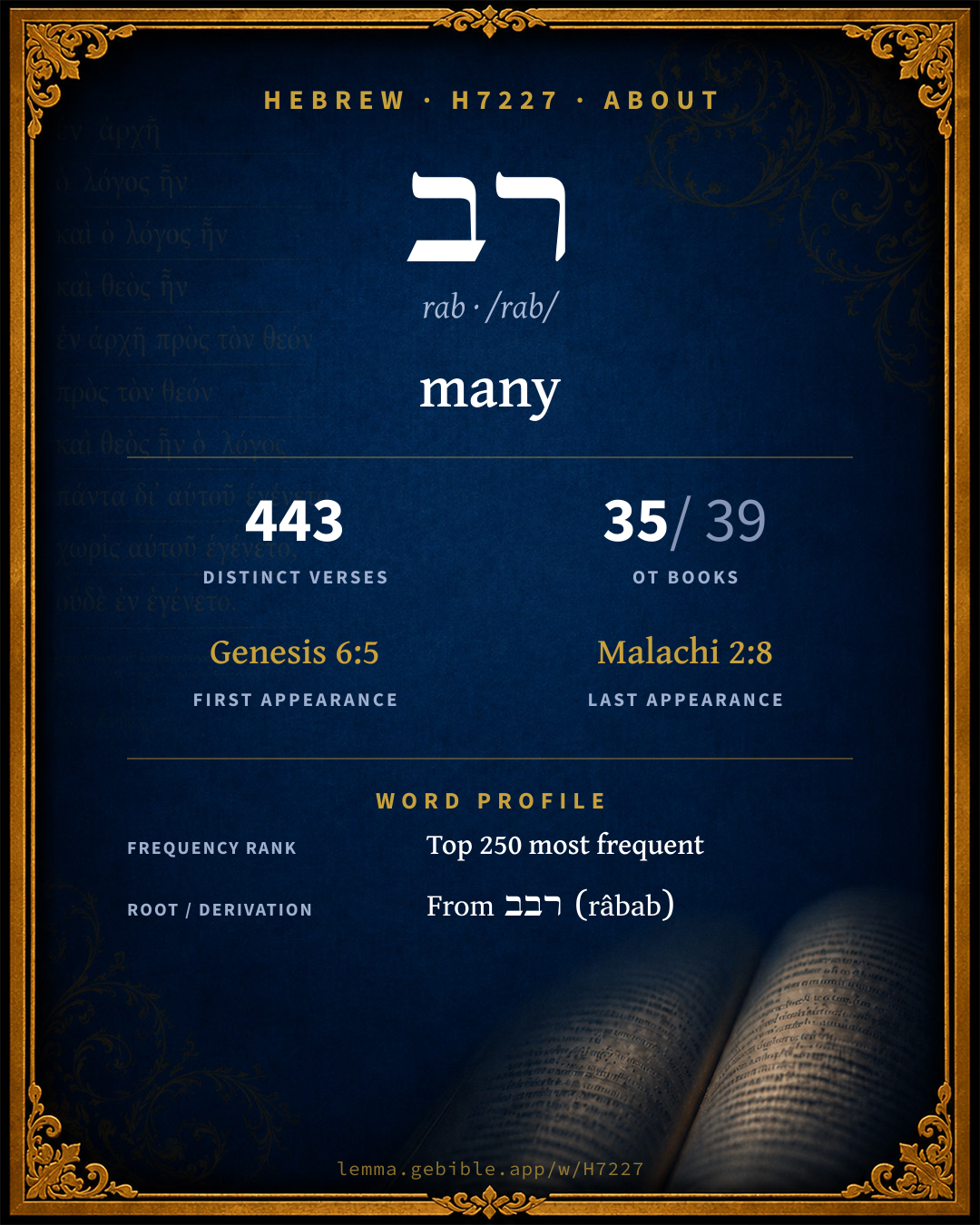
רַב
many
also: much, great fuller range ↓
Full lexicon entry — Brown-Driver-Briggs (BDB)
From Brown-Driver-Briggs (BDB)
Where this word appears
See every Absolute-state word in the Hebrew Bible →
Grammar key — what these labels mean
Part of speech
- Adjective
- A word that describes or qualifies a noun.
- Noun
- A naming word — a person, place, thing, or idea.
- Verb
- An action or state-of-being word.
Noun type
- Common
- A common noun — a general class of person, place, or thing (“king,” “city,” “water”), not a specific name.
Stem
- Qal
- The basic, simple active stem — the plain form of the verb (“he wrote”).
Form
- Sequential Perfect
- A perfect with prefixed waw continuing a preceding imperfect or command (waw-consecutive perfect).
- Participle Active
- A verbal adjective expressing ongoing or characteristic action (“writing / one who writes”).
- Perfect
- A completed action or state — Hebrew marks aspect (completeness) more than strict tense (“he wrote”).
State
- Absolute
- The independent form of a noun, not bound to a following word.
- Construct
- A noun bound to a following noun in a possessive / “of” relationship (the construct chain).
Person
- 3rd Person
- The one spoken about (“he / she / it / they”).
Gender
- Masculine
- Grammatically masculine.
- Feminine
- Grammatically feminine.
Number
- Plural
- More than one (in Hebrew, generally three or more).
- Singular
- One.
Grammatical forms 12 distinct
- Adjective, Adjective, Masculine, Plural, Absolute 200 times (43%)
- Adjective, Adjective, Masculine, Singular, Absolute 119 times (26%)
- Adjective, Adjective, Feminine, Singular, Absolute 36 times (8%)
- Adjective, Adjective, Feminine, Plural, Absolute 31 times (7%)
- Noun, Common, Masculine, Singular, Construct 31 times (7%)
- Adjective, Adjective, Masculine, Singular, Construct 24 times (5%)
- Adjective, Adjective, Feminine, Singular, Construct 13 times (3%)
- Verb, Qal, Sequential Perfect, 3rd Person, Feminine, Singular 2 times (0%)
+4 more forms (5 occurrences)
Parsed forms decoded from the imported morphology (morphhb / Westminster Leningrad Codex — WLC text public domain, morphhb tagging CC BY 4.0), counted across 461 parsed occurrences — not distinct verses.
Page 1 of 3 — showing verses 1–200 of 443 distinct verses where H7227 appears, across 35 books. Click any verse to open its interlinear word-by-word view. Verse text shown in the World English Bible for context — . Each verse’s Hebrew form is shown with its reference; the English is not keyword-highlighted, since the data carries no word-level English alignment. Use “Compare translations” on any verse to read it across multiple English versions. This concordance covers the Hebrew Bible; Septuagint (Greek Old Testament) occurrences are not indexed here.
Genesis 14 verses
- Genesis 6:5 רַבָּ֛ה adj Adjective fs Yahweh saw that the wickedness of man was great in the earth, and that every imagination of the thoughts of his heart was only evil continually.
- Genesis 7:11 רַבָּ֔ה adj Adjective fs In the six hundredth year of Noah's life, in the second month, on the seventeenth day of the month, on the same day all the fountains of the great deep were burst open, and the sky's windows were opened.
- Genesis 13:6 רָ֔ב adj Adjective ms The land was not able to bear them, that they might live together: for their substance was great, so that they could not live together.
- Genesis 18:20 רָ֑בָּה Qal pf 3fs Yahweh said, "Because the cry of Sodom and Gomorrah is great, and because their sin is very grievous,
- Genesis 21:34 רַבִּֽים adj Adjective mp Abraham lived as a foreigner in the land of the Philistines many days.
- Genesis 24:25 רַ֣ב adj Adjective ms She said moreover to him, "We have both straw and provender enough, and room to lodge in."
- Genesis 25:23 וְ/רַ֖ב conj + Adjective Adjective ms Yahweh said to her, Two nations are in your womb, Two peoples will be separated from your body. The one people will be stronger than the other people. The elder will serve the younger.
- Genesis 26:14 רַבָּ֑ה adj Adjective fs He had possessions of flocks, possessions of herds, and a great household. The Philistines envied him.
- Genesis 30:43 רַבּ֔וֹת adj Adjective fp The man increased exceedingly, and had large flocks, maid-servants and men-servants, and camels and donkeys.
- Genesis 33:9 רָ֑ב adj Adjective ms Esau said, "I have enough, my brother; let that which you have be yours."
- Genesis 36:7 רָ֖ב adj Adjective ms For their substance was too great for them to dwell together, and the land of their travels couldn't bear them because of their cattle.
- Genesis 37:34 רַבִּֽים adj Adjective mp Jacob tore his clothes, and put sackcloth on his loins, and mourned for his son many days.
- Genesis 45:28 רַ֛ב adj Adjective ms Israel said, "It is enough. Joseph my son is still alive. I will go and see him before I die."
- Genesis 50:20 רָֽב adj Adjective ms As for you, you meant evil against me, but God meant it for good, to bring to pass, as it is this day, to save many people alive.
Exodus 9 verses
- Exodus 1:9 רַ֥ב adj Adjective ms He said to his people, "Behold, the people of the children of Israel are more and mightier than we.
- Exodus 2:23 הָֽ/רַבִּ֜ים ptcl def.art + Adjective Adjective mp It happened in the course of those many days, that the king of Egypt died, and the children of Israel sighed because of the bondage, and they cried, and their cry came up to God because of the bondage.
- Exodus 5:5 רַבִּ֥ים adj Adjective mp Pharaoh said, "Behold, the people of the land are now many, and you make them rest from their burdens."
- Exodus 9:28 וְ/רַ֕ב conj + Adjective Adjective ms Pray to Yahweh; for there has been enough of mighty thunderings and hail. I will let you go, and you shall stay no longer."
- Exodus 12:38 רַ֖ב adj Adjective ms A mixed multitude went up also with them, with flocks, herds, and even very much cattle.
- Exodus 19:21 רָֽב adj Adjective ms Yahweh said to Moses, "Go down, charge the people, lest they break through to Yahweh to gaze, and many of them perish.
- Exodus 23:2 רַבִּ֖ים רַבִּ֖ים adj Adjective mp adj Adjective mp You shall not follow a crowd to do evil; neither shall you testify in court to side with a multitude to pervert justice;
- Exodus 23:29 וְ/רַבָּ֥ה conj + Qal wpf 3fs I will not drive them out from before you in one year, lest the land become desolate, and the animals of the field multiply against you.
- Exodus 34:6 וְ/רַב conj + Adjective Adjective ms cs Yahweh passed by before him, and proclaimed, "Yahweh! Yahweh, a merciful and gracious God, slow to anger, and abundant in loving kindness and truth,
Leviticus 2 verses
- Leviticus 15:25 רַבִּ֗ים adj Adjective mp "'If a woman has a discharge of her blood many days not in the time of her period, or if she has a discharge beyond the time of her period; all the days of the discharge of her uncleanness shall be as in the days of her period: she is unclean.
- Leviticus 25:51 רַבּ֖וֹת adj Adjective fp If there are yet many years, according to them he shall give back the price of his redemption out of the money that he was bought for.
Numbers 17 verses
- Numbers 9:19 רַבִּ֑ים adj Adjective mp When the cloud stayed on the tabernacle many days, then the children of Israel kept the charge of Yahweh, and didn't travel.
- Numbers 11:33 רַבָּ֥ה adj Adjective fs While the flesh was yet between their teeth, before it was chewed, the anger of Yahweh was kindled against the people, and Yahweh struck the people with a very great plague.
- Numbers 13:18 רָֽב adj Adjective ms and see the land, what it is; and the people who dwell therein, whether they are strong or weak, whether they are few or many;
- Numbers 14:18 וְ/רַב conj + Adjective Adjective ms cs Yahweh is slow to anger, and abundant in loving kindness, forgiving iniquity and disobedience; and that will by no means clear [the guilty], visiting the iniquity of the fathers on the children, on the third and on the fourth generation.
- Numbers 16:3 רַב adj Adjective ms and they assembled themselves together against Moses and against Aaron, and said to them, You take too much on you, seeing all the congregation are holy, everyone of them, and Yahweh is among them: why then lift yourselves up above the assembly of Yahweh?
- Numbers 16:7 רַב adj Adjective ms and put fire in them, and put incense on them before Yahweh tomorrow: and it shall be that the man whom Yahweh does choose, he [shall be] holy: you take too much on you, you sons of Levi.
- Numbers 20:11 רַבִּ֔ים adj Adjective mp Moses lifted up his hand, and struck the rock with his rod twice: and water came forth abundantly, and the congregation drank, and their cattle.
- Numbers 20:15 רַבִּ֑ים adj Adjective mp how our fathers went down into Egypt, and we lived in Egypt a long time; and the Egyptians dealt ill with us, and our fathers:
- Numbers 21:6 רָ֖ב adj Adjective ms Yahweh sent fiery serpents among the people, and they bit the people; and much people of Israel died.
- Numbers 22:3 רַב adj Adjective ms Moab was sore afraid of the people, because they were many: and Moab was distressed because of the children of Israel.
- Numbers 22:15 רַבִּ֥ים adj Adjective mp Balak sent yet again princes, more, and more honorable than they.
- Numbers 24:7 רַבִּ֑ים adj Adjective mp Water shall flow from his buckets, His seed shall be in many waters, His king shall be higher than Agag, His kingdom shall be exalted.
- Numbers 26:54 לָ/רַ֗ב prep det + Adjective Adjective ms To the more you shall give the more inheritance, and to the fewer you shall give the less inheritance: to everyone according to those who were numbered of him shall his inheritance be given.
- Numbers 26:56 רַ֖ב adj Adjective ms According to the lot shall their inheritance be divided between the more and the fewer.
- Numbers 32:1 רַ֗ב adj Adjective ms Now the children of Reuben and the children of Gad had a very great multitude of cattle: and when they saw the land of Jazer, and the land of Gilead, that behold, the place was a place for cattle;
- Numbers 33:54 לָ/רַ֞ב prep det + Adjective Adjective ms You shall inherit the land by lot according to your families; to the more you shall give the more inheritance, and to the fewer you shall give the less inheritance: wherever the lot falls to any man, that shall be his; according to the tribes of your fathers shall you inherit.
- Numbers 35:8 הָ/רַב֙ ptcl def.art + Adjective Adjective ms Concerning the cities which you shall give of the possession of the children of Israel, from the many you shall take many; and from the few you shall take few: everyone according to his inheritance which he inherits shall give of his cities to the Levites.
Deuteronomy 21 verses
- Deuteronomy 1:6 רַב adj Adjective ms cs Yahweh our God spoke to us in Horeb, saying, You have lived long enough in this mountain:
- Deuteronomy 1:46 רַבִּ֑ים adj Adjective mp So you abode in Kadesh many days, according to the days that you abode [there].
- Deuteronomy 2:1 רַבִּֽים adj Adjective mp Then we turned, and took our journey into the wilderness by the way to the Red Sea, as Yahweh spoke to me; and we compassed Mount Seir many days.
- Deuteronomy 2:3 רַב adj Adjective ms cs You have compassed this mountain long enough: turn you northward.
- Deuteronomy 2:10 וְ/רַ֛ב conj + Adjective Adjective ms (The Emim lived therein before, a people great, and many, and tall, as the Anakim:
- Deuteronomy 2:21 וְ/רַ֛ב conj + Adjective Adjective ms a people great, and many, and tall, as the Anakim; but Yahweh destroyed them before them; and they succeeded them, and lived in their place;
- Deuteronomy 3:19 רַ֖ב adj Adjective ms But your wives, and your little ones, and your cattle, (I know that you have much cattle), shall abide in your cities which I have given you,
- Deuteronomy 3:26 רַב adj Adjective ms cs But Yahweh was angry with me for your sakes, and didn't listen to me; and Yahweh said to me, Let it suffice you; speak no more to me of this matter.
- Deuteronomy 7:1 רַבִּ֣ים רַבִּ֥ים adj Adjective mp adj Adjective mp When Yahweh your God shall bring you into the land where you go to possess it, and shall cast out many nations before you, the Hittite, and the Girgashite, and the Amorite, and the Canaanite, and the Perizzite, and the Hivite, and the Jebusite, seven nations greater and mightier than you;
- Deuteronomy 7:17 רַבִּ֛ים adj Adjective mp If you shall say in your heart, These nations are more than I; how can I dispossess them?
- Deuteronomy 9:14 וָ/רָ֖ב conj + Adjective Adjective ms let me alone, that I may destroy them, and blot out their name from under the sky; and I will make of you a nation mightier and greater than they.
- Deuteronomy 15:6 רַבִּ֗ים רַבִּ֔ים adj Adjective mp adj Adjective mp For Yahweh your God will bless you, as he promised you: and you shall lend to many nations, but you shall not borrow; and you shall rule over many nations, but they shall not rule over you.
- Deuteronomy 20:1 רַ֣ב adj Adjective ms When you go forth to battle against your enemies, and see horses, and chariots, [and] a people more than you, you shall not be afraid of them; for Yahweh your God is with you, who brought you up out of the land of Egypt.
- Deuteronomy 20:19 רַבִּ֜ים adj Adjective mp When you shall besiege a city a long time, in making war against it to take it, you shall not destroy the trees of it by wielding an axe against them; for you may eat of them, and you shall not cut them down; for is the tree of the field man, that it should be besieged of you?
- Deuteronomy 25:3 רַבָּ֔ה adj Adjective fs Forty stripes he may give him, he shall not exceed; lest, if he should exceed, and beat him above these with many stripes, then your brother should seem vile to you.
- Deuteronomy 26:5 וָ/רָֽב conj + Adjective Adjective ms You shall answer and say before Yahweh your God, A Syrian ready to perish was my father; and he went down into Egypt, and sojourned there, few in number; and he became there a nation, great, mighty, and populous.
- Deuteronomy 28:12 רַבִּ֔ים adj Adjective mp Yahweh will open to you his good treasure in the sky, to give the rain of your land in its season, and to bless all the work of your hand: and you shall lend to many nations, and you shall not borrow.
- Deuteronomy 28:38 רַ֖ב adj Adjective ms You shall carry much seed out into the field, and shall gather little in; for the locust shall consume it.
- Deuteronomy 31:17 רַבּ֖וֹת adj Adjective fp Then my anger shall be kindled against them in that day, and I will forsake them, and I will hide my face from them, and they shall be devoured, and many evils and troubles shall come on them; so that they will say in that day, Haven't these evils come on us because our God is not among us?
- Deuteronomy 31:21 רַבּוֹת֮ adj Adjective fp It shall happen, when many evils and troubles are come on them, that this song shall testify before them as a witness; for it shall not be forgotten out of the mouths of their seed: for I know their imagination which they frame this day, before I have brought them into the land which I swore.
- Deuteronomy 33:7 רָ֣ב Qal pf 3ms This is [the blessing] of Judah: and he said, Hear, Yahweh, the voice of Judah, Bring him in to his people. With his hands he contended for himself; You shall be a help against his adversaries.
Joshua 13 verses
- Joshua 10:11 רַבִּ֗ים adj Adjective mp It happened, as they fled from before Israel, while they were at the descent of Beth Horon, that Yahweh cast down great stones from the sky on them to Azekah, and they died: they were more who died with the hailstones than they whom the children of Israel killed with the sword.
- Joshua 11:4 רָ֕ב רַב adj Adjective ms adj Adjective ms They went out, they and all their hosts with them, much people, even as the sand that is on the sea-shore in multitude, with horses and chariots very many.
- Joshua 11:8 רַבָּ֗ה adj Adjective fs Yahweh delivered them into the hand of Israel, and they struck them, and chased them to great Sidon, and to Misrephoth Maim, and to the valley of Mizpeh eastward; and they struck them, until they left them none remaining.
- Joshua 11:18 רַבִּ֗ים adj Adjective mp Joshua made war a long time with all those kings.
- Joshua 17:14 רָ֔ב adj Adjective ms The children of Joseph spoke to Joshua, saying, Why have you given me but one lot and one part for an inheritance, seeing I am a great people, because hitherto Yahweh has blessed me?
- Joshua 17:15 רַ֤ב adj Adjective ms Joshua said to them, If you are a great people, go up to the forest, and cut down for yourself there in the land of the Perizzites and of the Rephaim; since the hill-country of Ephraim is too narrow for you.
- Joshua 17:17 רַ֣ב adj Adjective ms Joshua spoke to the house of Joseph, even to Ephraim and to Manasseh, saying, You are a great people, and have great power; you shall not have one lot only:
- Joshua 19:9 רַ֣ב adj Adjective ms Out of the part of the children of Judah was the inheritance of the children of Simeon; for the portion of the children of Judah was too much for them: therefore the children of Simeon had inheritance in the midst of their inheritance.
- Joshua 19:28 רַבָּֽה adj Adjective fs and Ebron, and Rehob, and Hammon, and Kanah, even to great Sidon;
- Joshua 22:3 רַבִּ֔ים adj Adjective mp you have not left your brothers these many days to this day, but have kept the charge of the commandment of Yahweh your God.
- Joshua 22:8 רַבִּ֜ים רַב adj Adjective mp adj Adjective ms and spoke to them, saying, Return with much wealth to your tents, and with very much cattle, with silver, and with gold, and with brass, and with iron, and with very much clothing: divide the spoil of your enemies with your brothers.
- Joshua 23:1 רַבִּ֔ים adj Adjective mp It happened after many days, when Yahweh had given rest to Israel from all their enemies round about, and Joshua was old and well stricken in years;
- Joshua 24:7 רַבִּֽים adj Adjective mp When they cried out to Yahweh, he put darkness between you and the Egyptians, and brought the sea on them, and covered them; and your eyes saw what I did in Egypt: and you lived in the wilderness many days.
Judges 5 verses
- Judges 7:2 רַ֗ב adj Adjective ms Yahweh said to Gideon, The people who are with you are too many for me to give the Midianites into their hand, lest Israel vaunt themselves against me, saying, My own hand has saved me.
- Judges 7:4 רָב֒ adj Adjective ms Yahweh said to Gideon, The people are yet too many; bring them down to the water, and I will try them for you there: and it shall be, that of whom I tell you, This shall go with you, the same shall go with you; and of whoever I tell you, This shall not go with you, the same shall not go.
- Judges 8:30 רַבּ֖וֹת adj Adjective fp Gideon had seventy sons conceived from his body; for he had many wives.
- Judges 9:40 רַבִּ֖ים adj Adjective mp Abimelech chased him, and he fled before him, and there fell many wounded, even to the entrance of the gate.
- Judges 16:30 רַבִּ֕ים adj Adjective mp Samson said, Let me die with the Philistines. He bowed himself with all his might; and the house fell on the lords, and on all the people who were therein. So the dead that he killed at his death were more than those who he killed in his life.
1 Samuel 5 verses
- 1 Samuel 2:5 וְ/רַבַּ֥ת conj + Adjective Adjective fs cs Those who were full have hired out themselves for bread; Those who were hungry have ceased [to hunger]: Yes, the barren has borne seven; She who has many children languishes.
- 1 Samuel 12:17 רַבָּה֙ adj Adjective fs Isn't it wheat harvest today? I will call to Yahweh, that he may send thunder and rain; and you shall know and see that your wickedness is great, which you have done in the sight of Yahweh, in asking you a king.
- 1 Samuel 14:6 בְּ/רַ֖ב prep + Adjective Adjective ms Jonathan said to the young man who bore his armor, Come, and let us go over to the garrison of these uncircumcised: it may be that Yahweh will work for us; for there is no restraint to Yahweh to save by many or by few.
- 1 Samuel 14:19 וָ/רָ֑ב conj + Adjective Adjective ms It happened, while Saul talked to the priest, that the tumult that was in the camp of the Philistines went on and increased: and Saul said to the priest, Withdraw your hand.
- 1 Samuel 26:13 רַ֥ב adj Adjective ms Then David went over to the other side, and stood on the top of the mountain afar off; a great space being between them;
2 Samuel 8 verses
- 2 Samuel 3:22 רָ֖ב adj Adjective ms Behold, the servants of David and Joab came from a foray, and brought in a great spoil with them: but Abner was not with David in Hebron; for he had sent him away, and he was gone in peace.
- 2 Samuel 13:34 רַ֜ב adj Adjective ms But Absalom fled. The young man who kept the watch lifted up his eyes, and looked, and, behold, there came much people by the way of the hill-side behind him.
- 2 Samuel 14:2 רַבִּ֔ים adj Adjective mp Joab sent to Tekoa, and fetched there a wise woman, and said to her, please act like a mourner, and put on mourning clothing, Please, and don't anoint yourself with oil, but be as a woman who has a long time mourned for the dead:
- 2 Samuel 15:12 וָ/רָ֖ב conj + Adjective Adjective ms Absalom sent for Ahithophel the Gilonite, David's counselor, from his city, even from Giloh, while he was offering the sacrifices. The conspiracy was strong; for the people increased continually with Absalom.
- 2 Samuel 22:17 רַבִּֽים adj Adjective mp He sent from on high, he took me; He drew me out of many waters;
- 2 Samuel 23:20 רַב adj Adjective ms cs Benaiah the son of Jehoiada, the son of a valiant man of Kabzeel, who had done mighty deeds, he killed the two [sons of] Ariel of Moab: he went down also and killed a lion in the midst of a pit in time of snow.
- 2 Samuel 24:14 רַבִּ֣ים adj Adjective mp David said to Gad, I am in a great strait: let us fall now into the hand of Yahweh; for his mercies are great; and let me not fall into the hand of man.
- 2 Samuel 24:16 רַ֔ב adj Adjective ms When the angel stretched out his hand toward Jerusalem to destroy it, Yahweh repented him of the evil, and said to the angel who destroyed the people, It is enough; now stay your hand. The angel of Yahweh was by the threshing floor of Araunah the Jebusite.
1 Kings 12 verses
- 1 Kings 2:38 רַבִּֽים adj Adjective mp Shimei said to the king, The saying is good: as my lord the king has said, so will your servant do. Shimei lived in Jerusalem many days.
- 1 Kings 3:8 רָ֕ב adj Adjective ms Your servant is in the midst of your people which you have chosen, a great people, that can't be numbered nor counted for multitude.
- 1 Kings 3:11 רַבִּ֗ים adj Adjective mp God said to him, Because you have asked this thing, and have not asked for yourself long life, neither have asked riches for yourself, nor have asked the life of your enemies, but have asked for yourself understanding to discern justice;
- 1 Kings 4:20 רַבִּ֔ים adj Adjective mp Judah and Israel were many as the sand which is by the sea in multitude, eating and drinking and making merry.
- 1 Kings 5:7 הָ/רָ֖ב ptcl def.art + Adjective Adjective ms It happened, when Hiram heard the words of Solomon, that he rejoiced greatly, and said, Blessed be Yahweh this day, who has given to David a wise son over this great people.
- 1 Kings 10:2 רַב adj Adjective ms She came to Jerusalem with a very great train, with camels that bore spices, and very much gold, and precious stones; and when she was come to Solomon, she talked with him of all that was in her heart.
- 1 Kings 11:1 רַבּ֖וֹת adj Adjective fp Now king Solomon loved many foreign women, together with the daughter of Pharaoh, women of the Moabites, Ammonites, Edomites, Sidonians, and Hittites;
- 1 Kings 12:28 רַב adj Adjective ms Whereupon the king took counsel, and made two calves of gold; and he said to them, It is too much for you to go up to Jerusalem: see your gods, Israel, which brought you up out of the land of Egypt.
- 1 Kings 18:1 רַבִּ֔ים adj Adjective mp It happened after many days, that the word of Yahweh came to Elijah, in the third year, saying, Go, show yourself to Ahab; and I will send rain on the earth.
- 1 Kings 18:25 הָ/רַבִּ֑ים ptcl def.art + Adjective Adjective mp Elijah said to the prophets of Baal, "Choose one bull for yourselves, and dress it first; for you are many; and call on the name of your god, but put no fire under it."
- 1 Kings 19:4 רַ֗ב adj Adjective ms But he himself went a day's journey into the wilderness, and came and sat down under a juniper tree: and he requested for himself that he might die, and said, It is enough; now, O Yahweh, take away my life; for I am not better than my fathers.
- 1 Kings 19:7 רַ֥ב adj Adjective ms The angel of Yahweh came again the second time, and touched him, and said, Arise and eat, because the journey is too great for you.
2 Kings 10 verses
- 2 Kings 6:16 רַבִּים֙ adj Adjective mp He answered, Don't be afraid; for those who are with us are more than those who are with them.
- 2 Kings 9:22 הָ/רַבִּֽים ptcl def.art + Adjective Adjective mp It happened, when Joram saw Jehu, that he said, Is it peace, Jehu? He answered, What peace, so long as the prostitution of your mother Jezebel and her witchcraft abound?
- 2 Kings 12:10 רַ֥ב adj Adjective ms It was so, when they saw that there was much money in the chest, that the king's scribe and the high priest came up, and they put up in bags and counted the money that was found in the house of Yahweh.
- 2 Kings 25:8 רַב n c ms cs Now in the fifth month, on the seventh day of the month, which was the nineteenth year of king Nebuchadnezzar, king of Babylon, came Nebuzaradan the captain of the guard, a servant of the king of Babylon, to Jerusalem.
- 2 Kings 25:10 רַב n c ms cs All the army of the Chaldeans, who were [with] the captain of the guard, broke down the walls of Jerusalem round about.
- 2 Kings 25:11 רַב n c ms cs The residue of the people who were left in the city, and those who fell away, who fell to the king of Babylon, and the residue of the multitude, did Nebuzaradan the captain of the guard carry away captive.
- 2 Kings 25:12 רַב n c ms cs But the captain of the guard left of the poorest of the land to work the vineyards and fields.
- 2 Kings 25:15 רַב n c ms cs The fire pans, and the basins, that which was of gold, in gold, and that which was of silver, in silver, the captain of the guard took away.
- 2 Kings 25:18 רַב n c ms cs The captain of the guard took Seraiah the chief priest, and Zephaniah the second priest, and the three keepers of the threshold:
- 2 Kings 25:20 רַב n c ms cs Nebuzaradan the captain of the guard took them, and brought them to the king of Babylon to Riblah.
1 Chronicles 10 verses
- 1 Chronicles 4:27 רַבִּ֑ים adj Adjective mp Shimei had sixteen sons and six daughters; but his brothers didn't have many children, neither did all their family multiply like the children of Judah.
- 1 Chronicles 5:22 רַבִּים֙ adj Adjective mp For there fell many slain, because the war was of God. They lived in their place until the captivity.
- 1 Chronicles 7:22 רַבִּ֑ים adj Adjective mp Ephraim their father mourned many days, and his brothers came to comfort him.
- 1 Chronicles 11:22 רַב adj Adjective ms cs Benaiah the son of Jehoiada, the son of a valiant man of Kabzeel, who had done mighty deeds, he killed the two [sons of] Ariel of Moab: he went down also and killed a lion in the midst of a pit in time of snow.
- 1 Chronicles 18:8 רַבָּ֣ה adj Adjective fs From Tibhath and from Cun, cities of Hadarezer, David took very much brass, with which Solomon made the brazen sea, and the pillars, and the vessels of brass.
- 1 Chronicles 21:13 רַבִּ֤ים adj Adjective mp David said to Gad, I am in a great strait: let me fall, I pray, into the hand of Yahweh; for very great are his mercies: and let me not fall into the hand of man.
- 1 Chronicles 21:15 רַ֔ב adj Adjective ms God sent an angel to Jerusalem to destroy it: and as he was about to destroy, Yahweh saw, and he repented him of the evil, and said to the destroying angel, It is enough; now stay your hand. The angel of Yahweh was standing by the threshing floor of Ornan the Jebusite.
- 1 Chronicles 22:8 רַבִּ֔ים adj Adjective mp But the word of Yahweh came to me, saying, You have shed blood abundantly, and have made great wars: you shall not build a house to my name, because you have shed much blood on the earth in my sight.
- 1 Chronicles 24:4 רַבִּ֞ים adj Adjective mp There were more chief men found of the sons of Eleazar than of the sons of Ithamar; and [thus] were they divided: of the sons of Eleazar there were sixteen, heads of fathers' houses; and of the sons of Ithamar, according to their fathers' houses, eight.
- 1 Chronicles 28:5 רַבִּ֣ים adj Adjective mp Of all my sons (for Yahweh has given me many sons), he has chosen Solomon my son to sit on the throne of the kingdom of Yahweh over Israel.
2 Chronicles 28 verses
- 2 Chronicles 1:9 רַ֖ב adj Adjective ms Now, Yahweh God, let your promise to David my father be established; for you have made me king over a people like the dust of the earth in multitude.
- 2 Chronicles 1:11 רַבִּ֖ים adj Adjective mp God said to Solomon, Because this was in your heart, and you have not asked riches, wealth, or honor, nor the life of those who hate you, neither yet have asked long life; but have asked wisdom and knowledge for yourself, that you may judge my people, over whom I have made you king:
- 2 Chronicles 13:8 רָ֔ב adj Adjective ms Now you think to withstand the kingdom of Yahweh in the hand of the sons of David; and you are a great multitude, and there are with you the golden calves which Jeroboam made you for gods.
- 2 Chronicles 13:17 רַבָּ֑ה adj Adjective fs Abijah and his people killed them with a great slaughter: so there fell down slain of Israel five hundred thousand chosen men.
- 2 Chronicles 14:11 רַב֙ adj Adjective ms Asa cried to Yahweh his God, and said, Yahweh, there is none besides you to help, between the mighty and him who has no strength: help us, Yahweh our God; for we rely on you, and in your name are we come against this multitude. Yahweh, you are our God; don't let man prevail against you.
- 2 Chronicles 14:14 רַבָּ֖ה adj Adjective fs They struck all the cities round about Gerar; for the fear of Yahweh came on them: and they despoiled all the cities; for there was much spoil in them.
- 2 Chronicles 15:3 רַבִּ֖ים adj Adjective mp Now for a long season Israel was without the true God, and without a teaching priest, and without law:
- 2 Chronicles 15:5 רַבּ֔וֹת adj Adjective fp In those times there was no peace to him who went out, nor to him who came in; but great vexations were on all the inhabitants of the lands.
- 2 Chronicles 17:13 רַבָּ֛ה adj Adjective fs He had many works in the cities of Judah; and men of war, mighty men of valor, in Jerusalem.
- 2 Chronicles 20:2 רָ֛ב adj Adjective ms Then there came some who told Jehoshaphat, saying, There comes a great multitude against you from beyond the sea from Syria; and, behold, they are in Hazazon Tamar (the same is En Gedi).
- 2 Chronicles 20:12 הָ/רָ֛ב ptcl def.art + Adjective Adjective ms Our God, will you not judge them? for we have no might against this great company that comes against us; neither know we what to do: but out eyes are on you.
- 2 Chronicles 20:15 הָ/רָב֙ ptcl def.art + Adjective Adjective ms and he said, Listen you, all Judah, and you inhabitants of Jerusalem, and you king Jehoshaphat: Thus says Yahweh to you, Don't be afraid you, neither be dismayed by reason of this great multitude; for the battle is not yours, but God's.
- 2 Chronicles 20:25 רַב adj Adjective ms When Jehoshaphat and his people came to take the spoil of them, they found among them in abundance both riches and dead bodies, and precious jewels, which they stripped off for themselves, more than they could carry away: and they were three days in taking the spoil, it was so much.
- 2 Chronicles 21:3 רַבּ֜וֹת adj Adjective fp Their father gave them great gifts, of silver, and of gold, and of precious things, with fortified cities in Judah: but the kingdom gave he to Jehoram, because he was the firstborn.
- 2 Chronicles 21:15 רַבִּ֖ים adj Adjective mp and you shall have great sickness by disease of your bowels, until your bowels fall out by reason of the sickness, day by day.
- 2 Chronicles 24:11 רַ֣ב adj Adjective ms It was so, that whenever the chest was brought to the king's officers by the hand of the Levites, and when they saw that there was much money, the king's scribe and the chief priest's officer came and emptied the chest, and took it, and carried it to its place again. Thus they did day by day, and gathered money in abundance.
- 2 Chronicles 24:25 רַבִּים֒ adj Adjective mp When they were departed for him (for they left him very sick), his own servants conspired against him for the blood of the sons of Jehoiada the priest, and killed him on his bed, and he died; and they buried him in the city of David, but they didn't bury him in the tombs of the kings.
- 2 Chronicles 25:13 רַבָּֽה adj Adjective fs But the men of the army whom Amaziah sent back, that they should not go with him to battle, fell on the cities of Judah, from Samaria even to Beth Horon, and struck of them three thousand, and took much spoil.
- 2 Chronicles 26:10 רַבִּ֔ים רַּב֙ adj Adjective mp adj Adjective ms He built towers in the wilderness, and hewed out many cisterns, for he had much cattle; in the lowland also, and in the plain: [and he had] farmers and vineyard keepers in the mountains and in the fruitful fields; for he loved farming.
- 2 Chronicles 28:8 רָ֖ב adj Adjective ms The children of Israel carried away captive of their brothers two hundred thousand, women, sons, and daughters, and took also away much spoil from them, and brought the spoil to Samaria.
- 2 Chronicles 28:13 רַבָּ֤ה adj Adjective fs and said to them, You shall not bring in the captives here: for you purpose that which will bring on us a trespass against Yahweh, to add to our sins and to our trespass; for our trespass is great, and there is fierce wrath against Israel.
- 2 Chronicles 30:13 רָ֔ב adj Adjective ms There assembled at Jerusalem much people to keep the feast of unleavened bread in the second month, a very great assembly.
- 2 Chronicles 30:17 רַבַּ֥ת adj Adjective fs cs For there were many in the assembly who had not sanctified themselves: therefore the Levites had the charge of killing the Passovers for everyone who was not clean, to sanctify them to Yahweh.
- 2 Chronicles 30:18 רַ֠בַּת adj Adjective fs cs For a multitude of the people, even many of Ephraim and Manasseh, Issachar and Zebulun, had not cleansed themselves, yet did they eat the Passover otherwise than it is written. For Hezekiah had prayed for them, saying, The good Yahweh pardon everyone
- 2 Chronicles 32:4 רָ֔ב רַבִּֽים adj Adjective ms adj Adjective mp So there was gathered much people together, and they stopped all the springs, and the brook that flowed through the midst of the land, saying, Why should the kings of Assyria come, and find much water?
- 2 Chronicles 32:7 רַ֖ב adj Adjective ms Be strong and of good courage, don't be afraid nor dismayed for the king of Assyria, nor for all the multitude who is with him; for there is a greater with us than with him:
- 2 Chronicles 32:23 וְ֠/רַבִּים conj + Adjective Adjective mp Many brought gifts to Yahweh to Jerusalem, and precious things to Hezekiah king of Judah; so that he was exalted in the sight of all nations from thenceforth.
- 2 Chronicles 32:29 רַ֥ב adj Adjective ms Moreover he provided him cities, and possessions of flocks and herds in abundance; for God had given him very much substance.
Ezra 3 verses
- Ezra 3:12 וְ/רַבִּ֡ים וְ/רַבִּ֛ים conj + Adjective Adjective mp conj + Adjective Adjective mp But many of the priests and Levites and heads of fathers' [houses], the old men who had seen the first house, when the foundation of this house was laid before their eyes, wept with a loud voice; and many shouted aloud for joy:
- Ezra 10:1 רַב adj Adjective ms Now while Ezra prayed and made confession, weeping and casting himself down before the house of God, there was gathered together to him out of Israel a very great assembly of men and women and children; for the people wept very sore.
- Ezra 10:13 רָב֙ adj Adjective ms But the people are many, and it is a time of much rain, and we are not able to stand outside: neither is this a work of one day or two; for we have greatly transgressed in this matter.
Nehemiah 11 verses
- Nehemiah 5:2 רַבִּ֑ים adj Adjective mp For there were that said, We, our sons and our daughters, are many: let us get grain, that we may eat and live.
- Nehemiah 6:18 רַבִּ֣ים adj Adjective mp For there were many in Judah sworn to him, because he was the son-in-law of Shecaniah the son of Arah; and his son Jehohanan had taken the daughter of Meshullam the son of Berechiah as wife.
- Nehemiah 7:2 מֵ/רַבִּֽים prep + Adjective Adjective mp that I gave my brother Hanani, and Hananiah the governor of the castle, charge over Jerusalem; for he was a faithful man, and feared God above many.
- Nehemiah 9:17 וְ/רַב conj + Adjective Adjective ms cs and refused to obey, neither were mindful of your wonders that you did among them, but hardened their neck, and in their rebellion appointed a captain to return to their bondage. But you are a God ready to pardon, gracious and merciful, slow to anger, and abundant in loving kindness, and didn't forsake them.
- Nehemiah 9:19 הָֽ/רַבִּ֔ים ptcl def.art + Adjective Adjective mp yet you in your manifold mercies didn't forsake them in the wilderness: the pillar of cloud didn't depart from over them by day, to lead them in the way; neither the pillar of fire by night, to show them light, and the way in which they should go.
- Nehemiah 9:27 הָֽ/רַבִּ֗ים ptcl def.art + Adjective Adjective mp Therefore you delivered them into the hand of their adversaries, who distressed them: and in the time of their trouble, when they cried to you, you heard from heaven; and according to your manifold mercies you gave them saviors who saved them out of the hand of their adversaries.
- Nehemiah 9:28 רַבּ֥וֹת adj Adjective fp But after they had rest, they did evil again before you; therefore left you them in the hand of their enemies, so that they had the dominion over them: yet when they returned, and cried to you, you heard from heaven; and many times did you deliver them according to your mercies,
- Nehemiah 9:30 רַבּ֔וֹת adj Adjective fp Yet many years did you bear with them, and testified against them by your Spirit through your prophets: yet would they not give ear: therefore gave you them into the hand of the peoples of the lands.
- Nehemiah 9:31 הָ/רַבִּ֛ים ptcl def.art + Adjective Adjective mp Nevertheless in your manifold mercies you did not make a full end of them, nor forsake them; for you are a gracious and merciful God.
- Nehemiah 9:35 הָ/רָ֜ב ptcl def.art + Adjective Adjective ms For they have not served you in their kingdom, and in your great goodness that you gave them, and in the large and fat land which you gave before them, neither turned they from their wicked works.
- Nehemiah 13:26 הָ/רַבִּים֩ ptcl def.art + Adjective Adjective mp Did not Solomon king of Israel sin by these things? yet among many nations was there no king like him, and he was beloved of his God, and God made him king over all Israel: nevertheless even him did foreign women cause to sin.
Esther 7 verses
- Esther 1:4 רַבִּ֔ים adj Adjective mp when he shown the riches of his glorious kingdom and the honor of his excellent majesty many days, even one hundred eighty days.
- Esther 1:7 רָ֖ב adj Adjective ms They gave them drink in vessels of gold (the vessels being diverse one from another), and royal wine in abundance, according to the bounty of the king.
- Esther 1:8 רַ֣ב n c ms cs The drinking was according to the law; none could compel: for so the king had appointed to all the officers of his house, that they should do according to every man's pleasure.
- Esther 1:20 רַבָּ֖ה adj Adjective fs When the king's decree which he shall make shall be published throughout all his kingdom (for it is great), all the wives will give to their husbands honor, both to great and small.
- Esther 2:8 רַבּ֛וֹת adj Adjective fp So it happened, when the king's commandment and his decree was heard, and when many maidens were gathered together to Shushan the palace, to the custody of Hegai, that Esther was taken into the king's house, to the custody of Hegai, keeper of the women.
- Esther 4:3 לָֽ/רַבִּֽים prep det + Adjective Adjective mp In every province, wherever the king's commandment and his decree came, there was great mourning among the Jews, and fasting, and weeping, and wailing; and many lay in sackcloth and ashes.
- Esther 8:17 וְ/רַבִּ֞ים conj + Adjective Adjective mp In every province, and in every city, wherever the king's commandment and his decree came, the Jews had gladness and joy, a feast and a good day. Many from among the peoples of the land became Jews; for the fear of the Jews was fallen on them.
Job 17 verses
- Job 1:3 רַבָּ֣ה adj Adjective fs His possessions also were seven thousand sheep, three thousand camels, five hundred yoke of oxen, five hundred she-donkeys, and a very great household; so that this man was the greatest of all the children of the east.
- Job 4:3 רַבִּ֑ים adj Adjective mp Behold, you have instructed many, You have strengthened the weak hands.
- Job 5:25 רַ֣ב adj Adjective ms You shall know also that your seed shall be great, Your offspring as the grass of the earth.
- Job 11:19 רַבִּֽים adj Adjective mp Also you shall lie down, and none shall make you afraid; Yes, many shall court your favor.
- Job 16:2 רַבּ֑וֹת adj Adjective fp "I have heard many such things. Miserable comforters are you all!
- Job 22:5 רַבָּ֑ה adj Adjective fs Isn't your wickedness great? Neither is there any end to your iniquities.
- Job 23:6 הַ/בְּ/רָב ptcl inter + prep + n c ms cs Would he contend with me in the greatness of his power? No, but he would listen to me.
- Job 23:14 רַבּ֣וֹת adj Adjective fp For he performs that which is appointed for me. Many such things are with him.
- Job 30:18 בְּ/רָב prep + n c ms cs By great force is my garment disfigured. It binds me about as the collar of my coat.
- Job 31:25 רַ֣ב adj Adjective ms If I have rejoiced because my wealth was great, And because my hand had gotten much;
- Job 31:34 רַבָּ֗ה adj Adjective fs Because I feared the great multitude, And the contempt of families terrified me, So that I kept silence, and didn't go out of the door--
- Job 32:9 רַבִּ֥ים adj Adjective mp It is not the great who are wise, Nor the aged who understand justice.
- Job 35:9 רַבִּֽים adj Adjective mp "By reason of the multitude of oppressions they cry out; They cry for help by reason of the arm of the mighty.
- Job 36:18 וְ/רָב conj + n c ms cs Don't let riches entice you to wrath, Neither let the great size of a bribe turn you aside.
- Job 36:28 רָֽב adj Adjective ms Which the skies pour down And drop on man abundantly.
- Job 38:21 רַבִּֽים adj Adjective mp Surely you know, for you were born then, And the number of your days is great!
- Job 39:11 רַ֣ב adj Adjective ms Will you trust him, because his strength is great? Or will you leave to him your labor?
Psalms 57 verses
- Psalms 3:1 רַ֝בִּ֗ים adj Adjective mp Yahweh, how my adversaries have increased! Many are those who rise up against me.
- Psalms 3:2 רַבִּים֮ adj Adjective mp Many there are who say of my soul, "There is no help for him in God." Selah.
- Psalms 4:6 רַבִּ֥ים adj Adjective mp Many say, "Who will show us any good?" Yahweh, let the light of your face shine on us.
- Psalms 18:16 רַבִּֽים adj Adjective mp He sent from on high. He took me. He drew me out of many waters.
- Psalms 19:10 רָ֑ב adj Adjective ms More to be desired are they than gold, yes, than much fine gold; Sweeter also than honey and the extract of the honeycomb.
- Psalms 19:11 רָֽב adj Adjective ms Moreover by them is your servant warned. In keeping them there is great reward.
- Psalms 19:13 רָֽב adj Adjective ms Keep back your servant also from presumptuous sins. Let them not have dominion over me. Then I will be upright, I will be blameless and innocent of great transgression.
- Psalms 22:12 רַבִּ֑ים adj Adjective mp Many bulls have surrounded me. Strong bulls of Bashan have encircled me.
About this entry
At a glance — auto-summarized from this page’s data, not written by a person. Every figure links to its source below. This summary describes the numbers; it doesn’t interpret them.
At its core, רב (rab) means “many.” Scripture first uses it in Genesis 6:5. Spanning 443 verses in 35 books, it ranks among the common words of the Hebrew Bible. Not a single-sense word: its full sense range also takes in “much” and “great”. From the same root come רבב, רב and רבב. Dig into 443-verse concordance and the renderings breakdown below.
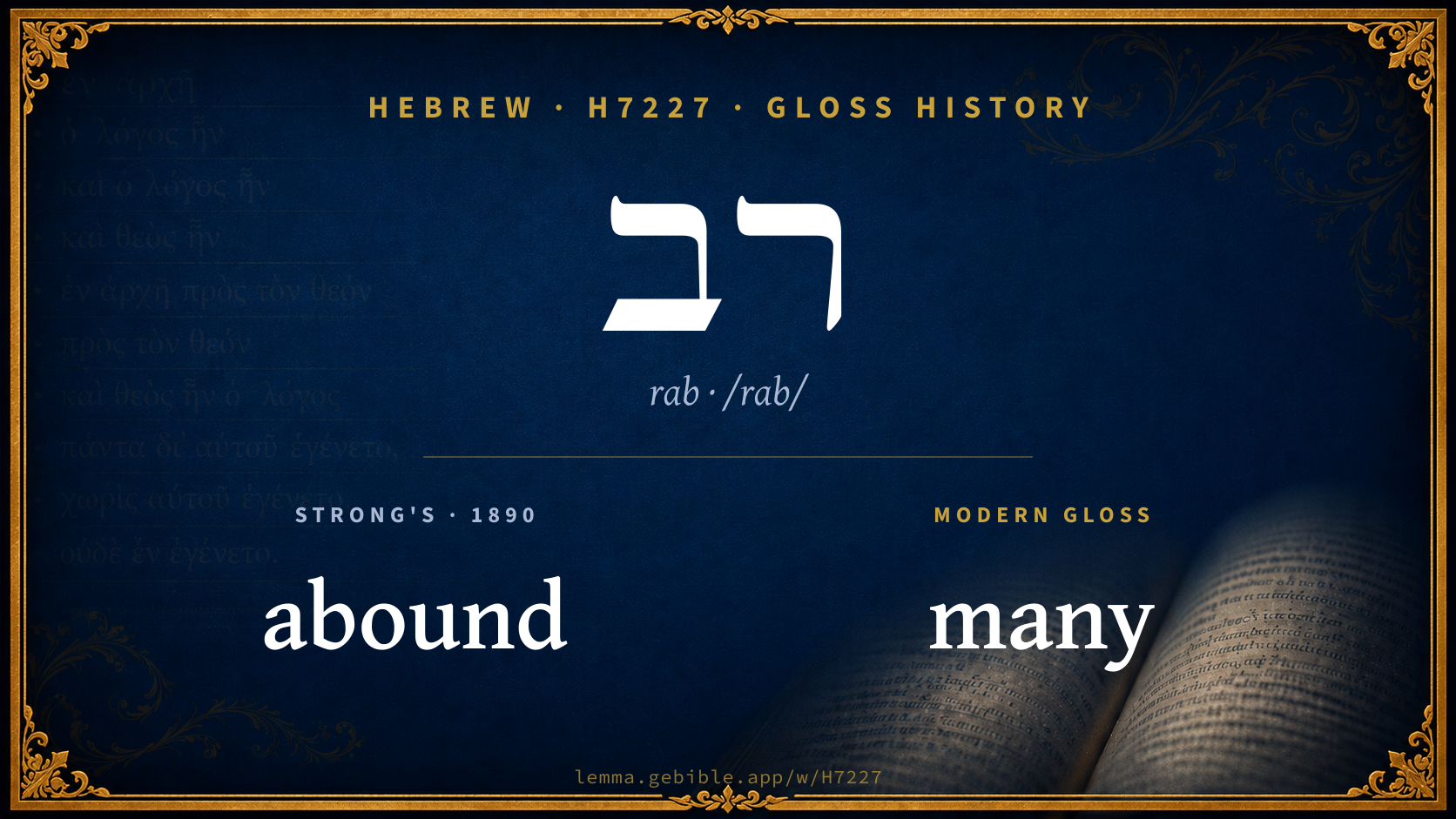
Gloss history
Strong's 1890 vs modern scholarship
About this word
Strong's H7227 catalogs a Hebrew word from the Hebrew Old Testament.
These counts are not copied from any lexicon or concordance. They are computed here, from the morphology-tagged Hebrew Old Testament. What Lemma adds →
- 443
- distinct verses
- The word appears in 443 distinct verses.
- 35 / 39
- OT books
- The word appears in 35 of 39 Old Testament books.
- #108
- by frequency
- Top 250 most frequent Hebrew words (rank 108 of 8,640 Hebrew words by occurrence).
View all 443 occurrences in the concordance →
By section of the Old Testament
By traditional corpus
Conventional, traditional groupings — biblical authorship is debated, so this is a traditional corpus grouping, not an authorship claim. Each share is this word’s portion of its verses in that division of the Hebrew canon. Each figure is a share of the word’s 443 distinct verses.
- Prophets (Nevi'im) 192 verses · 43%
- Writings (Ketuvim) 188 verses · 42%
- Torah (Pentateuch) 63 verses · 14%
How translations render this word
Counts come from each version’s own published word-to-Strong’s tagging or interlinear alignment — an approximate guide to how each version renders this word, not a word-level alignment the data otherwise carries. Because each total is that version’s own tagged count, the per-version totals vary from one another and need not match the appearance or distinct-verse counts above. These counts may also differ from a printed concordance because Lemma counts each distinctly tagged rendering and does not collapse phrase taggings into a single head-word total. This is a fixed set of word-tagged versions (KJV, ASV, BSB, ULT) and does not change with the reading translation you choose elsewhere. Each version’s license is shown beside its name below (and on Sources).
BDB lists this Strong’s number as 4 distinct words (homographs). Each count above pools all of them and is not split by sense — see the Senses section below. A low-frequency rendering may belong to a different one of those words, not the primary meaning.
- King James Version†: Many 130×, Great 73×, Captain 22×
- American Standard Version†: Many 118×, Great 57×, Captain 22×
- Berean Standard Bible†: Many 146×, Great 53×, Captain 24×
- unfoldingWord Literal Text†: Many 193×, Great 62×, Much 21×
King James Version Public Domain
Renders H7227 across 456† tagged occurrences — most commonly:
Plus other, less common renderings. Plus 114 renderings that appear only once — usually multi-word phrases or single function words the recovered tagging swept in, not distinct renderings. Not rendered by a distinct English word in 2 further occurrences.
American Standard Version Public Domain
Renders H7227 across 457† tagged occurrences — most commonly:
Plus other, less common renderings. Plus 136 renderings that appear only once — usually multi-word phrases or single function words the recovered tagging swept in, not distinct renderings.
Berean Standard Bible Public Domain
Renders H7227 across 444† tagged occurrences — most commonly:
Plus other, less common renderings. Plus 94 renderings that appear only once — usually multi-word phrases or single function words the recovered tagging swept in, not distinct renderings. Not rendered by a distinct English word in 10 further occurrences.
unfoldingWord Literal Text CC BY-SA 4.0
Renders H7227 across 452† tagged occurrences — most commonly:
Plus other, less common renderings. Plus 67 renderings that appear only once — usually multi-word phrases or single function words the recovered tagging swept in, not distinct renderings.
12 senses and sub-senses in the full BDB
What do BDB’s symbols mean?
BDB uses these scholarly abbreviations:
| Symbol | Meaning |
|---|---|
| 𝔊 | the Septuagint (the ancient Greek translation, LXX) |
| 𝔙 | the Vulgate (the Latin translation) |
| 𝔖 | the Syriac version (the Peshitta) |
| 𝔗 | the Targum (the Aramaic translation) |
| ψ | the Psalms |
| √ | root (the underlying root or stem) |
| ‖ | parallel passage (a synonymous or contrasted parallel) |
| † | the dagger: every passage where the word occurs is cited |
The 12 senses and sub-senses the full Brown-Driver-Briggs lexicon distinguishes for this word, in lexicon order (not ranked by frequency), with BDB’s own verbatim wording and sub-sense lettering. Shown in Hebrew script with BDB’s own scholarly abbreviations. The condensed entry is in the Lexicon Entry tab. See also the Forms in the corpus table below.
רב I much, many, great
- a. (1) much: of substances, gold 1 K 10:2 ψ 19:11, silver (money) 2 K 12:11 = 2 Ch 24:11, bronze 1 Ch 18:8, wine Est 1:7; of other quantities, e.g. spoil 2 S 3:22, property 2 Ch 32:29, seed Dt 28:38, etc.; רַב שֶׁיִּהְיוּ Ec 6:3b be it much that his days amount to; (2) especially of collectives, numerous, עַם־רַב Jos 11:4 2 S 13:34, עֲבֻדָּה רַבָּה Gn 26:14 Jb 1:3, מִקְנֶה רַב Dt 3:19 +, etc. e.g. 1 Kings 10:2
- b. pl. many: pers. Ex 5:5; Ju 8:30; 9:40; 1 K 4:20; 11:1 +, things Gn 30:43 Am 5:12 Dt 31:17 +; n. om. רַבּוֹת Dn 11:41 (sc. lands; read רִבּוֹת myriads Kmp Bev Behrm Marti Prince); יָמִים רַבִּים many days (a long time) Gn 21:34; 37:24 + 28 times, שָׁנִים רַבּוֹת Ne 9:30; Ec 6:3a, אִם עוֹד רַבּוֹת בַּשָּׁנִים Lv 25:51; רַבּוֹת עִתִּים Ne 9:28 many times (v. supr.) = פְּעָמִים רַבּוֹת ψ 106:43 Ec 7:22; מַכָּה רַבָּה Dt 25:3 many blows; מַיִם רַבִּים many waters Nu 20:11; 24:7 + 27 times, cf. Is 8:7; etc. e.g. Exodus 5:5
- c. רַב as subst. coll. pers. Ex 19:21, also (opp. מְעַט) 1 S 14:6; Nu 13:18; 26:54, 56; 33:54; 35:8; so רַבַּת (Ges§ 130a) 2 Ch 30:17, 18, and (rei; = much) Ez 24:12; רַב cstr. before abstr. (= רֹב) Is 21:7; 63:7 ψ 145:7; especially pl. רֵבִּים of pers. Ex 23:2(×2) + 37 times + בַּת־רַבִּים Ct 7:5 (v. p. 123). e.g. Exodus 19:21
- d. cstr. = abounding in, רַב־בְּרָכוֹת Pr 28:20, רַב־חֶסֶד (v. 1. חֶסֶד 3), רַב־כֹּחַ ψ 147:5, רַב־מְאֵרוֹת Pr 28:27, רַב הַמְּהוּמָה Ez 22:5, רַב־נוֹצָה 17:7, רַב־הָעֲלִילִיָּה Je 32:19, רַב־פְּעָלִים 2 S 23:20 = 1 Ch 11:22, רַב־פָּ֑שַׁע Pr 29:22, רַב־תְּבוּנָה 14:29; רַבַּת אוֹצָרֹת Je 51:13, רַבַּת בָּנִים 1 S 2:5, רַבָּ֫תִי עָם La 1:1 (Ges§ 90 1). e.g. Proverbs 28:20
- e. + מִן comp. = more numerous than Ex 1:9; Nu 22:15; Jos 10:11; Ju 16:30; 2 K 6:16; Is 54:1; 1 Ch 24:4; 2 Ch 32:7; Dn 11:13; sq. inf., too many to Gn 36:7; Ju 7:2 (cf. v 4); vid. also foll. e.g. Exodus 1:9
- f. רַב = abundant, enough Gn 24:25; 33:9; as exclam. enough! Gn 45:28; 2 S 24:16 = 1 Ch 21:15; 1 K 19:4, so (+ מִן inf.) Ex 9:28 (מִן 6 d); רַב־לָךְ (with implication of excess) Dt 3:26 (let it) suffice thee! so רַב־לָכֶם Ez 45:9, also Nu 16:3, 7 = ye assume too much! + inf. it is enough for you to Dt 1:6; 2:3 (i.e. you have done it enough), so + מִן inf. 1 K 12:28, מִן subst. Ez 44:6. e.g. Genesis 24:25
- g. as adv. much, exceedingly (only ψψ), רַב ψ 123:3, רָ֜ב ψ 18:15 (Hup De Che al.; HPS 2 S 22:15 conj. רָמָה; om. ‖ 2 S 22:15); רַבָּה ψ 62:3; 78:15; 89:8 (𝔊 Bae רַב הוּא); רַבַּת (Aramaism, cf. Syriac ܪܶܒܰܬ, ܪܰܒܰܬ, Nö§ 155 A WSG 135) ψ 65:10; 120:6 (= long enough), 123:4; 129:1, 2. e.g. Psalms 123:3
- 2. great:
- a. of person ψ 48:3, space 1 S 26:13, the deep Am 7:4 Gn 7:11 Is 51:10 ψ 36:7 (fig.), city La 1:1 (רַבָּ֫תִי בַגּוֹיִם Ges§ 90 1),—v. also צִידוֹן, חֲמָת;—plague Nu 11:33, empire Est 1:20, goodness ψ 31:20, wickedness Gn 6:5, etc. e.g. Psalms 48:3
- b. specif. strong (opp. אֵין כֹּחַ) 2 Ch 14:10; רַב לְהוֹשִׁיעַ Is 63:1; so רַבִּים as subst. Is 53:12 (‖ עֲצוּמִים). e.g. 2 Chronicles 14:10
- c. major natu Gn 25:23 (opp. צָעִיר); רַבִּים as subst. grandævi, Jb 32:9. e.g. Genesis 25:23
- d. + מִן comp. greater than Dt 7:1, 17; 9:14; 20:1; too great for Jos 19:9; 1 K 19:7.—Pr 26:10 is hopelessly corrupt, v. Toy. e.g. Deuteronomy 7:1
רב II chief (Assyrian-Bab. influence, cf. rab DlHWB 609b
רב III archer
Senses from the full Brown-Driver-Briggs lexicon (Brown, Driver, Briggs; Oxford 1906 — public domain), digitized via Sefaria, supplemented by the OpenScriptures HebrewLexicon (CC BY 4.0). Full attribution on Sources.
Word origin
III. adj. much, many, great;—ms. abs. ר׳ Gn 24:25 +, רָ֑ב Gn 33:9 +, also רָב֥ 2 Ch 20:2, רָב֖ 28:8, רָב֨ Ezr 10:13, etc.; cstr. רַב Ex 34:6 +; fs. רַבָּה Nu 11:33 +; cstr. רַבַּת Ez 22:5 +, רַבָּ֫תִי (Ges§ 90 k l) La 1:1(×2); mpl. abs. רַבִּים Ex 23:2(×2) +, cstr. v. ii. רב; fpl. abs. רַבּוֹת Gn 30:43 +;—[often both as pred. and as attrib.; as attrib. preceding n. (infl. of usage for numerals? KöSynt. § 334 k Ges§ 132b): רַב Is 63:7 ψ 145:7 (but read prob. רֹב, רָב־; in Is 21:7 ר׳ is pred.), רַבִּים Je 16:16 ψ 32:10; 89:51 (on context BöNÄ Bae, also Hup), Pr 7:26 1 Ch 28:5, רַבּוֹת Ne 9:28 Pr 31:29];—
IV. n.m. chief (Assyrian-Bab. influence, cf. rab DlHWB 609b; Biblical Aramaic רַב);—cstr. ר׳ Je 39:9 +; pl. cstr. רַבֵּי 39:13; 41:1 (but v. infr.);—especially רַב־ טַבָּחִים chief of guardsmen (v. טַבָּח), only as title of Bab. officer Je 39:9, 10 + 15 times Je, 7 times ‖ 2 K 25 (cf. שַׂר הַטּ׳ in Gn [JE]); also †רַב הַחֹבֵל Jon 1:6 chief of the sailors, i.e. captain; †in gen. כָּל־רַב בֵּיתוֹ Est 1:8, †רַב־סָרִיסָיו Dn 1:3 (v. סָרִיס), and so רַבֵּי מֶלֶךְ בָּבֶל Je 39:13, רַבֵּי הַמֶּלֶךְ 41:1 (late gloss; om. 𝔊 and ‖ 2 K 25:25, so Hi Gf Gie). †The foll. titles of Assyrian-Bab. officers are prob. loan-words in Heb.: רַב־מָ֑ג Je 39:3, 13 usually chief soothsayer (v. מָ֑ג), but = rab-mugi [? chief of princes] Pinches Hast. DB. Rab-mag; רַב־סָרִיס (cf. Old Aramaic [Nineveh] רב סרס Lzb366), 2 K 18:17 (Assyrian; not in ‖ Is 36:2), Je 39:3, 13 (Bab.), usually chief eunuch, but = rabû-ša-rêši, chief of the heads (the principal men) Wkl Unters. z. altor. Gesch., 1889, Excurs. v, p. 138 (actually found as rubû-ša-ri-ešu PinchesAcad. June 25, 1892, 618), PinchesHast. DB. Rab-saris; רַב־שָׁקֵה (van d. H. רַבְשָׁקֵה) chief of the officers (?) (so prob. Assyrian rab- ŠAḲ; šaḳû = high one; COT 2 K 18:17 KBii. 23 DlHWB 685a TieleBab.-Assyrian Gesch. 497. 513 PinchesHast. DB. iv. 191), 2 K 18:17, 19, 26, 27, 28, 37; 19:4, 8 = Is 36:2, 4, 11, 12, 13, 22; 37:4, 8.
V. n.m. archer;—s. רַב Pr 26:10, pl. רַבִּים Je 50:29 (‖ דֹּרְכֵי קֶשֶׁת), sf. רַבָּיו Jb 16:13 (in fig.; Bö al. רֹבָיו; Vrss. Ew al. his missiles).
— Brown-Driver-Briggs (Oxford 1906, public domain), digitized via Sefaria, supplemented by the OpenScriptures HebrewLexicon (CC BY 4.0). See Sources.
Derived from רבב (râbab) (H7231) — to become many.
Jastrow Dictionary
A second Hebrew/Aramaic lexicon for comparison, covering Aramaic and post-biblical (Talmudic, Targumic, Midrashic) usage that the biblical-Hebrew BDB does not. Matched by lemma rather than by Strong’s number, so a lemma may carry more than one Jastrow headword (shown separately below), and the entries cover usage well beyond the Bible.
רַב I
- large, great; much. Y. Yeb. XII, 12ᶜ bot. (in Chald. dict.) לא הוה לבן רב וכ׳ they would not have dared to do so. Ber. 62ᵇ (ref. to II Sam. XXIV, 16) the Lord said to the angel, טול לי רב שבהם וכ׳ take me the greatest of them in whom there is (merit enough) with which to pay their debts (sins); a. e.—Pl. רַבִּים, רַבִּין. Keth. 8ᵇ ר׳ שתו ר׳ ישתו many have drunk (the cup of mourning), many shall drink. Yeb. 63ᵇ (from Ben Sira) מנע ר׳ מתיך וכ׳ keep the many off thy house, nor bring every body to thy house. Ib. ר׳ יהיו דורשי וכ׳ let thy well-wishers be many, but reveal a secret to one out of a thousand. Ab. Zar. 43ᵇ (in Chald. dict.) ר׳ שאני where several people meet to pray, it is different. Ib. שכיחי ר׳ גביה many people are usually with him. Ber. 9ᵃ, a. fr. יחיד ור׳, v. יָחִיד; a. fr.—Esp. רַבִּים community, public. Y. Meg. III, 73ᵈ בה"כ של ר׳ a synagogue belonging to a community, opp. של יחיד. Bab. Meg. 28ᵇ הספד של ר׳ funeral ceremonies in a case of public mourning (for a public man), opp. של יחיד. Sabb. 67ᵃ צריך … לר׳ ור׳ וכ׳ should make his trouble known to the people, and the people will pray for him. Ab. V, 18. Ber. 8ᵃ תפלתן של ר׳ congregational prayer; a. v. fr.—בָּרַ׳ in public. Ib. 61ᵇ, a. e., v. קָהַל. B. Mets. 58ᵇ, v. לָבָן II; a. fr.—Fem. רַבָּה. Gen. R. s. 33 (ref. to Ps. XXXVI, 7) את מדקדק … עד תהום ר׳ thou dealest strictly with them (the wicked) (searching their doings) ‘to the great deep’; a. fr.—[Ib. s. 27, v. רָבַב.]—Pl. רַבּוֹת. Ḥag. 5ᵃ (ref. to Deut. XXXI, 21) צרות ר׳ ורעות Ms. M. many troubles and evils, v. מָצָא; a. e.—[מדרש רַבּיֹת, v. מִדְרָשׁ.] e.g. 2 Samuel 24:16
רַב II
- (preced.)
- 1. superior, master. Gitt. 23ᵇ העבד … רַבּוֹ של חבירו אבל לא מיד רַבּוֹ שלו a slave may receive a deed of manumission in behalf of a fellow slave at the hand of his fellow’s master, but not at the hands of his own master (if both slaves belong to the same master). Ab. I, 3, v. עֶבֶד. Ḥag. 5ᵃ, v. מָצָא; a. fr.
- 2. teacher. Ber. 63ᵇ יאמרו הרב בכעס וכ׳ they will say, the teacher (the Lord) is angry, and the disciple (Moses) is angry, what is to become of Israel? Ib. כל תלמיד … רבו וכ׳ a student with whom his teacher is angry for the first time, and who keeps silence. Eduy. I, 3, v. לָשׁוֹן. Ab. I, 16 עשה לך רב וכ׳ get thyself a teacher, and be relieved of doubt. R. Hash. II, 9 רַבִּי ותלמידי רבי וכ׳ my teacher and my pupil; my teacher in wisdom &c.; v. רַבִּי.—M. Kat. 9ᵃ, a. fr. למדתנו רַבֵּינוּ thou, our teacher, hast taught us; v. רַבֵּנוּ; a. v. fr.—Esp. רַב Rab, a) title of the Babylonian Amoraim. Pes. 52ᵇ; a. v. fr.—בי רב the school of, v. בֵּי.—b) surname of Abba Arekha, the founder of the academy of Sura in Babylonia (v. Graetz, Gesch. d. Jud.1 IV, p. 312, sq.; Fr. M’bo, p. 122ᵇ). Ḥull. 95ᵇ כולהו שני דרב וכ׳ as long as Rab lived, R. Joḥ. addressed his letters to Babylonia, ‘to our teacher in Babylonia.’ Ab. Zar. 10ᵇ אדרכן שמשיה לרב A. (a Parthian ruler) attended (associated with) Rab. Y. Peah VI, 19ᶜ רב כד נחת לתמן when Rab came down to Babylonia. Erub. 50ᵇ, a. fr. רב תנא הוא ופליג Rab is a Tannai and has a right to differ (with other Tannaim). Nidd. 24ᵇ, a. fr. הלכתא כרב וכ׳, v. אִיסּוּרָא; a. v. fr.—ספרא דבי רב, ספרי דבי רב, v. סִפְרָא.—Pl. רַבּוֹת (only with suffix). Taan. 7ᵃ, a. e. מרַבּוֹתַי, v. לָמַד. Shebu. 47ᵃ רַבּוֹתֵינוּ שבבבל וכ׳ ‘our teachers in Babylonia’ means Rab and Samuel. Y. Gitt. VII, 48ᵈ top ורבותינו אמרו and our teachers said; מנו רבותינו וכ׳ who are meant by ‘our teachers’? Ib., a. e. בשלשה … רבותיני on three occasions R. Judah (with his court) is quoted as ‘our teachers.’ Y. Sabb. V, end, 7ᶜ רבותינו שבגולה our teachers in the diaspora (Babylonia, v. supra); Y. Bets. II, 61ᶜ bot. Y. Meg. I, 70ᵈ כתבו אגרת ושלחו לרבותינו שהן וכ׳ they (Mordecai and Esther) wrote a letter addressed ‘to our teachers (in Palestine) that be’, saying to them &c.; a. fr.—Fem. רַבָּה mistress. Ruth R. to II, 5 רַבָּתָהּ וכ׳ her mistress (Naomi) &c., v. רָפָה.
רַב
- 1. large, great, numerous; senior. Targ. Josh. XXII, 10. Targ. Y. Deut. I, 28. Targ. Gen. I, 16. Ib. X, 21 (Y. ed. Vien. רַבָּה); a. fr.—[In Talmudic literature mostly רַבָּה, q. v.]
- 2. chief, master, teacher. Targ. I Sam. XXII, 14 (h. text סָר). Targ. Gen. XXXVII, 36 (Y. II שליטא; h. text סריס). Ib. (h. text שַׂר). Ib. IV, 20, sq. Targ. Job III, 18 ינקי בית ר׳ school children; a. fr.—Targ. I Chr. XI, 22, v. סִפְרָא.—R. Hash. 31ᵇ לאו אירח … לרַבֵּיה רַבָּךְ it is not customary to say to one’s own teacher, ‘thy teacher’ (has said &c.). Ab. Zar. 17ᵇ רַבָּן של וכ׳, v. רַבִּי; a. fr.—בֵּי רַב school, academy. Snh. 33ᵇ, a. e. זיל קרי בי רב הוא this is a case when you may say, ‘go and learn it (in the Bible) at school’, i.e. an erroneous judgment of such a nature must be reversed. Erub. 22ᵃ הוה קאזיל לבי רב left home in order to study; a. fr.—V. בֵּי.—Fem. רַבָּא, רַבְּתָא, רַבְּתָה. Targ. Jer. XLVIII, 34. Targ. Gen. XXVII, 34. Ib. XIX, 31; a. fr.—Pl. רַבָּתָא, רַבָּתָה. Y. Snh. X, 29ᵃ top אתה עבדת ר׳ וכ׳ (not עברת) thou (Doeg) hast done great things, turn thou around &c.—V. רַבְּתָא.
A Dictionary of the Targumim, the Talmud Babli and Yerushalmi, and the Midrashic Literature (Marcus Jastrow; London, Luzac, 1903) — Public Domain. Digitized via Sefaria. Digitized via Sefaria. Full attribution on Sources.
Forms in the corpus
The 130 distinct written forms H7227 takes in the Hebrew Bible, most frequent first — each parse links to that state’s occurrences in the concordance. Hebrew forms include their vowel points and cantillation, so a single lemma takes many written forms.
The 60 most common forms are shown; 70 rarer forms follow in the full concordance.
Same root — word family
Other BDB entries built from the same root as H7227, grouped by Strong’s listed origin. These share a root / origin per the lexicon — not necessarily a shared meaning. Each links to that word’s own entry.
Derives from
Shares the same root
- רב rôb H7230 multitude
- רבב râbab H7232 to shoot
- רבבה rᵉbâbâh H7233 myriad
- רבו ribbôw H7239 ten thousand
- רביב râbîyb H7241 heavy showers
Derived from this word
- ραββι rhabbí G4461 rabbi
- רב rab H7229 great
- רבמג Rab-Mâg H7248 chief magician
- רבשקה Rabshâqêh H7262 chief cupbearer
Proper names from this root
People and places named from this root — a name, not an additional meaning of the word.
- מרב Mêrâb H4764 Merab
- רבית Rabbîyth H7245 Rabbith
- רבה Rabbâh H7237 Rabbath
- רבסריס Rab-Çârîyç H7249 chief eunuch
Compare all same-root words → Showing 4 of 15 — not the complete family. 4 of the same-root words are proper names (people or places). They share a root, not necessarily a meaning.
Septuagint verse parallels
This word appears in 403 verses that also exist in the Greek Old Testament (Septuagint), out of the 443 Hebrew verses it occurs in. You can read those verses in Greek by switching the Old Testament edition to the Septuagint.
Read these verses in the Septuagint
- Genesis 6:5
- Exodus 1:9
- Leviticus 15:25
- Numbers 9:19
- Deuteronomy 1:6
- Joshua 10:11
- Judges 7:2
- 1 Samuel 2:5
- 2 Samuel 3:22
- 1 Kings 2:38
- 2 Kings 6:16
- 1 Chronicles 4:27
This is a verse-level parallel only — the same verses exist in both the Hebrew and Greek Old Testaments. No word-level Hebrew↔Greek correspondence is claimed: the data carries no such alignment, so no Greek word is shown as this Hebrew word’s translation. Coverage is not total — the Septuagint omits the deuterocanon and renumbers the Psalms, so some Hebrew verses have no direct Greek parallel.