
Joshua 19:9

Hebrew (Westminster Leningrad Codex) Joshua 19:9 appears in the Hebrew Old Testament. The text above is from the Westminster Leningrad Codex. Each word links to its Strong’s number, a concise gloss, and parsing drawn from the Open Scriptures Hebrew Bible morphology. Click any word for its full Brown-Driver-Briggs (BDB) entry.
Download image
Cite this verse

Joshua 19:9 (World English Bible). Public Domain. Lemma interlinear Bible study tool, https://lemma.gebible.app/v/joshua/19/9.

Show BibTeX & RIS
BibTeX
RIS
English Translation
Out of the part of the children of Judah was the inheritance of the children of Simeon; for the portion of the children of Judah was too much for them: therefore the children of Simeon had inheritance in the midst of their inheritance.
World English Bible · Public Domain
Download a study sheet

One document with this verse’s original text, its word-by-word gloss line, the meaning frame, cross-references with their text, attributed commentary, and full source and license credits — printable, and it pastes into notes with its structure intact.

This verse Autodidact and up

Study sheet (.html) Plain text (.txt)

A passage Seminary Student

Up to 50 verses in one chapter. A passage sheet keeps up to 6 commentary sources and 12 cross-references per verse, in the order this page ranks them, and says so on the sheet whenever that leaves anything out. Ask for a single verse and you get the Autodidact verse sheet above.

Everything on this page stays free to read, with no account — the sheet is a download of what is already on screen, not access to it.

Want to remove ads? Support Godless Engineer
Compare translations 3

The same verse in 3 English versions, stacked beneath the original-language interlinear above. Click any original word for its lexicon entry.

Each is an independent rendering of the whole verse — the interlinear is not word-aligned to these translations.

Highlighted words mark where these versions differ — a whole-verse word diff, not a word-by-word alignment.

  • World English Bible Public Domain
    Out of the part of the children of Judah was the inheritance of the children of Simeon; for the portion of the children of Judah was too much for them: therefore the children of Simeon had inheritance in the midst of their inheritance.
  • King James Version Public Domain
    Out of the portion of the children of Judah was the inheritance of the children of Simeon: for the part of the children of Judah was too much for them: therefore the children of Simeon had their inheritance within the inheritance of them.
  • unfoldingWord Literal Text CC BY-SA 4.0
    From the portion of the sons of Judah the inheritance of the sons of Simeon. For the division of the sons of Judah was great for them, so the sons of Simeon inherited in the midst of their inheritance.

unfoldingWord Literal Text — © unfoldingWord, licensed CC BY-SA 4.0. Word-aligned USFM3 via Door43 (git.door43.org/unfoldingWord/en_ult).

Versions to compare (up to 4)

3 of 4 selected

Show all 18 translations

Every available English version of this verse, each an independent rendering of the whole verse.

  • World English Bible Public Domain
    Out of the part of the children of Judah was the inheritance of the children of Simeon; for the portion of the children of Judah was too much for them: therefore the children of Simeon had inheritance in the midst of their inheritance.
  • Berean Standard Bible Public Domain
    The inheritance of the Simeonites was taken from the territory of Judah, because the share for Judah’s descendants was too large for them. So the Simeonites received an inheritance within Judah’s portion.
  • Majority Standard Bible Public Domain
    The inheritance of the Simeonites was taken from the territory of Judah, because the share for Judah’s descendants was too large for them. So the Simeonites received an inheritance within Judah’s portion.
  • King James Version Public Domain
    Out of the portion of the children of Judah was the inheritance of the children of Simeon: for the part of the children of Judah was too much for them: therefore the children of Simeon had their inheritance within the inheritance of them.
  • American Standard Version (1901) Public Domain
    Out of the part of the children of Judah was the inheritance of the children of Simeon; for the portion of the children of Judah was too much for them: therefore the children of Simeon had inheritance in the midst of their inheritance.
  • Revised Version (1885) Public Domain
    Out of the part of the children of Judah was the inheritance of the children of Simeon: for the portion of the children of Judah was too much for them: therefore the children of Simeon had inheritance in the midst of their inheritance.
  • Geneva Bible (1599) Public Domain
    Out of the portion of the children of Iudah came ye inheritance of the childre of Simeon: for the part of ye children of Iudah was too much for them: therefore the children of Simeon had their inheritance within their inheritance.
  • Douay-Rheims (1899) Public Domain
    In the possession and lot of the children of Juda: because it was too great, and therefore the children of Simeon had their possession in the midst of their inheritance.
  • Young's Literal Translation Public Domain
    out of the portion of the sons of Judah `is' the inheritance of the sons of Simeon, for the portion of the sons of Judah hath been too much for them, and the sons of Simeon inherit in the midst of their inheritance.
  • Literal Standard Version CC BY-SA 4.0
    out of the portion of the sons of Judah [is] the inheritance of the sons of Simeon, for the portion of the sons of Judah has been too much for them, and the sons of Simeon inherit in the midst of their inheritance.
  • Unlocked Literal Bible CC BY-SA 4.0
    The inheritance of the tribe of Simeon formed part of the territory of the tribe of Judah. Because the portion of land assigned to the tribe of Judah was too large for them, the tribe of Simeon received their inheritance out of the middle of their portion.
  • unfoldingWord Literal Text CC BY-SA 4.0
    From the portion of the sons of Judah the inheritance of the sons of Simeon. For the division of the sons of Judah was great for them, so the sons of Simeon inherited in the midst of their inheritance.
  • Darby Bible Public Domain
    Out of the lot of the children of Judah was the inheritance of the children of Simeon; for the portion of the children of Judah was too great for them, and the children of Simeon inherited within their inheritance.
  • World Messianic Bible Public Domain
    Out of the part of the children of Judah was the inheritance of the children of Simeon; for the portion of the children of Judah was too much for them. Therefore the children of Simeon had inheritance in the middle of their inheritance.
  • Webster's Bible Public Domain
    Out of the portion of the children of Judah was the inheritance of the children of Simeon: for the part of the children of Judah was too much for them: therefore the children of Simeon had their inheritance within the inheritance of them.
  • Free Bible Version CC BY-SA 4.0
    The allocation of the tribe of Simeon was part of that given to the tribe of Judah, since what the tribe of Judah had received was too large for them.
  • Bible in Basic English Public Domain
    The heritage of Simeon was taken out of Judah's stretch of land, for Judah's part was more than they had need of, so the heritage of the children of Simeon was inside their heritage.
  • JPS Tanakh (1917) Public Domain
    Out of the allotment of the children of Judah was the inheritance of the children of Simeon, for the portion of the children of Judah was too much for them; therefore the children of Simeon had inheritance in the midst of their inheritance.

Literal Standard Version (2020), Covenant Press — licensed CC BY-SA 4.0. Text via the HelloAO Bible API (eBible.org). Unlocked Literal Bible (unfoldingWord) — licensed CC BY-SA 4.0. Text via the HelloAO Bible API (eBible.org). unfoldingWord Literal Text — © unfoldingWord, licensed CC BY-SA 4.0. Word-aligned USFM3 via Door43 (git.door43.org/unfoldingWord/en_ult). Free Bible Version, Dr. Jonathan Gallagher — licensed CC BY-SA 4.0. Text via the HelloAO Bible API (eBible.org).

Word by word

More ways to search: Search by grammar → Find every occurrence → Compare this word →

Practice this passage: Drill this verse → Learn its vocabulary →

שִׁמְע֑וֹן
Shimʻôwn
H8095
“Simeon”
Noun, Proper
Part of Speech
Noun
Type
Proper
Full BDB Definition

Origin: from H8085

TWOT: None

Simeon or Shimeon = "heard" - the 2nd son of Jacob by his wife Leah and progenitor of the tribe of Simeon - an Israelite of the sons of Bani who had a foreign wife in the time of Ezra
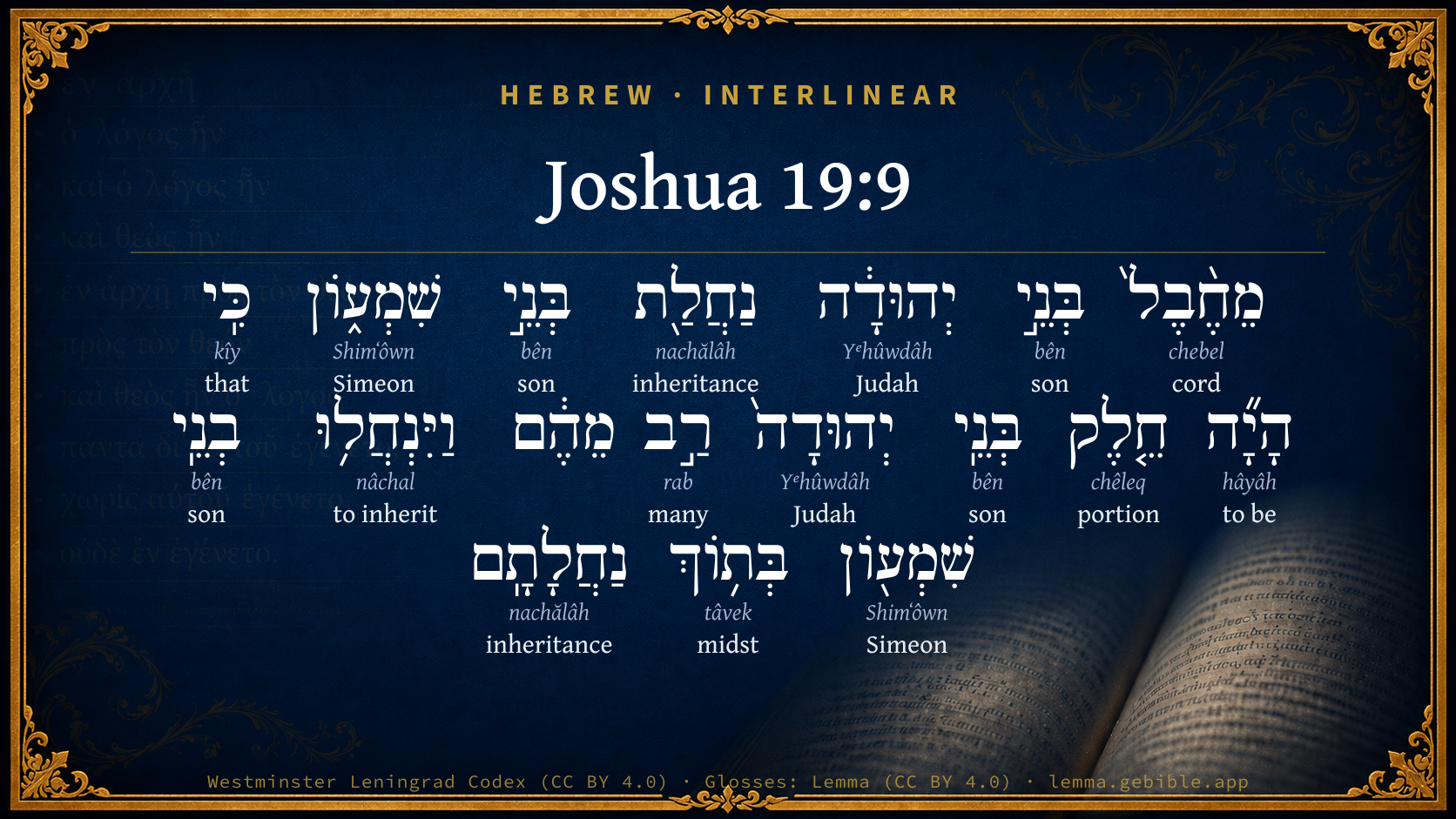
  1. מֵחֶ֨בֶל֙ chebel H2256 “from · cord of” Preposition + Noun, Common, Both, Singular, Construct
  2. בְּנֵ֣י bên H1121 “sons of” Noun, Common, Masculine, Plural, Construct
  3. יְהוּדָ֔ה Yᵉhûwdâh H3063 “Judah” Noun, Proper
  4. נַחֲלַ֖ת nachălâh H5159 “inheritance of” Noun, Common, Feminine, Singular, Construct
  5. בְּנֵ֣י bên H1121 “sons of” Noun, Common, Masculine, Plural, Construct
  6. כִּֽי kîy H3588 “that” Conjunction
  7. הָיָ֞ה hâyâh H1961 “to be” Verb, Qal, Perfect, 3rd Person, Masculine, Singular
  8. חֵ֤לֶק chêleq H2506 “portion of” Noun, Common, Masculine, Singular, Construct
  9. בְּנֵֽי bên H1121 “sons of” Noun, Common, Masculine, Plural, Construct
  10. יְהוּדָה֙ Yᵉhûwdâh H3063 “Judah” Noun, Proper
  11. רַ֣ב rab H7227 “many” Adjective, Adjective, Masculine, Singular, Absolute
  12. וַיִּנְחֲל֥וּ nâchal H5157 “and · to inherit” Conjunction + Verb, Qal, Sequential Imperfect, 3rd Person, Masculine, Plural
  13. בְנֵֽי bên H1121 “sons of” Noun, Common, Masculine, Plural, Construct
  14. שִׁמְע֖וֹן Shimʻôwn H8095 “Simeon” Noun, Proper
  15. בְּת֥וֹךְ tâvek H8432 “in/at · midst of” Preposition + Noun, Common, Masculine, Singular, Construct
  16. נַחֲלָתָֽם nachălâh H5159 “inheritance · their” Noun, Common, Feminine, Singular, Construct + Suffix, Personal, 3rd Person, Masculine, Plural

About this verse

These counts appear in no published source. They are computed here, from the morphology-tagged text and Lemma’s own curated glosses. What Lemma adds →

18
words
11
distinct lemmas
Historical
section

Shared distinctive vocabulary

שִׁמְע֑וֹן Simeon H8095 occurs in 39 verses of the Hebrew Bible. Also found in:

Grammatical profile

  • 2 verbs
  • 13 nouns
  • 1 adjective
  • 1 preposition
  • 1 conjunction

Verb forms

  • הָיָ֞ה Qal · Perfect
  • וַיִּנְחֲל֥וּ Qal · Sequential Imperfect

Repetition

Words recur within this verse — often emphatic in Hebrew:

  • בְּנֵ֣י son H1121 ×4
  • יְהוּדָ֔ה Judah H3063 ×2
  • נַחֲלַ֖ת inheritance H5159 ×2
  • שִׁמְע֑וֹן Simeon H8095 ×2

Hebrew & Septuagint length

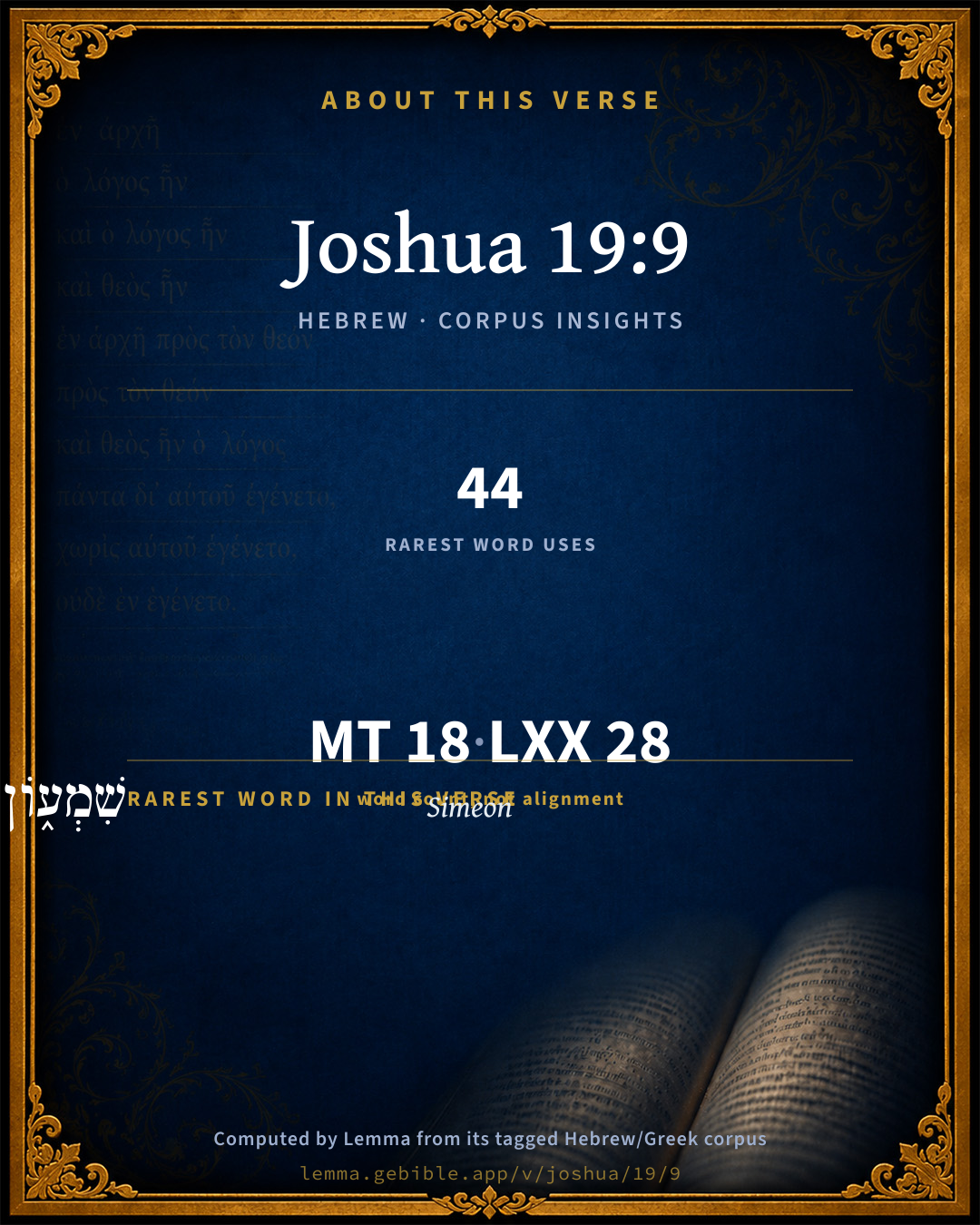
In English translation the verse runs 43 words from the Hebrew and 42 from the Septuagint (LXX English) — closely comparable.

A rough comparison of the two English renderings, which tokenize alike — not a word-level alignment.

Word counts can differ between the Hebrew and the Greek without any difference in meaning — e.g. the Hebrew direct-object marker אֵת has no separate Greek word, and Greek often adds the article ὁ.

In the original languages it is 18 Hebrew tokens and 28 Greek tokens — but the two are counted differently (Hebrew bundles its prefixes and suffixes into one token; the Greek is in lemma form), so that isn’t a like-for-like length.

Cross-references

2

Topical passages linked to Joshua 19:9 in the Treasury of Scripture Knowledge — connected by theme and wording, ordered by reader-vote popularity; previews shown in the World English Bible.

  • 2 Corinthians 8:14–15 but for equality. Your abundance at this present time supplies their lack, that their abundance also may become a supply for your lack; that there may be equality.
  • Exodus 16:18 When they measured it with an omer, he who gathered much had nothing over, and he who gathered little had no lack. They gathered every man according to his eating.

Cross-references courtesy of OpenBible.info (CC BY 4.0).

Hebrew and Greek witnesses Masoretic Hebrew ↔ Greek Septuagint

The same verse in the two great witnesses to the Old Testament, shown verse-for-verse.

These are two independent witnesses, not word-aligned to each other, and the Septuagint is shown in lemma (dictionary) form.

Hebrew Joshua 19:9 Masoretic · Westminster Leningrad Codex

מֵחֶ֨בֶל֙ בְּנֵ֣י יְהוּדָ֔ה נַחֲלַ֖ת בְּנֵ֣י שִׁמְע֑וֹן כִּֽי הָיָ֞ה חֵ֤לֶק בְּנֵֽי יְהוּדָה֙ רַ֣ב מֵהֶ֔ם וַיִּנְחֲל֥וּ בְנֵֽי שִׁמְע֖וֹן בְּת֥וֹךְ נַחֲלָתָֽם

Out of the part of the children of Judah was the inheritance of the children of Simeon; for the portion of the children of Judah was too much for them: therefore the children of Simeon had inheritance in the midst of their inheritance.

World English Bible · Public Domain

Greek LXX Joshua 19:9 Septuagint · lemma form

ἀπό ὁ κλῆρος ιουδα ὁ κληρονομία φυλή υἱός συμεων ὅτι γίγνομαι ὁ μερίς υἱός ιουδα μέγας ὁ αὐτός καί κληρονομέω ὁ υἱός συμεων ἐν μέσος ὁ κλῆρος αὐτός

The inheritance of the tribe of the children of Symeon was a part of the lot of Juda, for the portion of the children of Juda was greater than theirs; and the children of Symeon inherited in the midst of their lot.

LXX2012 (modern English Septuagint) · Public Domain

Hebrew: Westminster Leningrad Codex (CC BY 4.0). Greek: Septuagint (public domain); English from LXX2012 (modern English Septuagint) (Public Domain). How the Septuagint differs from the Hebrew →

Targum (Aramaic paraphrase)

1

The Targum is the ancient Jewish Aramaic paraphrase of the Hebrew Scriptures — an interpretive translation, not the Hebrew text itself. Onkelos (literal) and Pseudo-Jonathan (expansive) render the Torah, and Jonathan the Prophets. Coverage is partial: where no permissively-licensed English translation exists for a verse, only the Aramaic is shown. This is verse-level text, not a word-by-word alignment to the Hebrew.

  1. Targum Jonathan Prophets (Joshua–Malachi)
    מֵעֲדַב בְּנֵי יְהוּדָה אַחְסָנַת בְּנֵי שִׁמְעוֹן אֲרֵי הֲוָה חִילַק בְּנֵי יְהוּדָה סַגִי מִנְהוֹן וְאַחְסִינוּ בְּנֵי שִׁמְעוֹן בְּגוֹ אַחְסַנְתְּהוֹן:

    (no public-domain English translation for this verse)

    Targum Jonathan — Aramaic: “Mikraot Gedolot” (public domain). English: “Sefaria Community Translation” (CC0 1.0 (public-domain dedication)); “London "Chaldee Paraphrase," 1871” (public domain). Text via Sefaria.

Commentary

Notes on Joshua 19:9 from classic Christian and Jewish commentators (each source and its license shown beneath its notes). The classic Christian expositions comment on the surrounding passage and are grouped to its opening verse, so a note may address several verses; the Jewish commentaries on the Tanakh (Rashi and others) are per-verse, so they appear only where the commentator wrote on this verse.

Lemma curates 59 commentaries, every one of them public domain or Creative Commons licensed, each selected and text-cleaned for this edition rather than reprinted as found. About our sources →

Trapp's Complete Commentary

John Trapp

Jos 19:9 Out of the portion of the children of Judah [was] the inheritance of the children of Simeon: for the part of the children of Judah was too much for them: therefore the children of Simeon had their inheritance within the inheritance of them.

Ver. 9. Out of the portion.] See Jos 19:1.

Was too much for them.] More than came to their share, or more than they could man or manage.

Had their inheritance within the inheritance of them.] And so Jacob’s prophecy was fulfilled; {Gen 49:7} an argument of the divinity of the Scriptures.

John Trapp, A Commentary or Exposition upon All the Books of the Old and New Testament (1647–1656) — public domain. Text from a community e-Sword module.

Geneva Bible (1599)

Geneva Bible translators

But this large portion was given them by God’s providence to declare their increase in time to come.

Geneva Bible (1599) marginal notes — public domain. Text via Bolls.life.

John Calvin's Commentaries

9. Out of the portion of the children of Judah, etc The praise of moderation is due to the tribe of Judah for not contending that the abstraction of any part of the inheritance already assigned to them was unjust. They might easily have obtruded the name of God, and asserted that it was only by his authority they had obtained that settlement. But as it is decided by the common consent of all the tribes that more has been given to them than they can possess without loss and injury to the others, they immediately desist from all pretext for disputing the matter. And it is certain that if they had alleged the authority of God, it would have been falsely and wickedly, inasmuch as though their lot had been determined by him in regard to its situation, an error had taken place with regard to its extent, their limits having been fixed by human judgment wider than they ought. Therefore, acknowledging that it would have been wrong to give them what would occasion loss to others, they willingly resign it, and give a welcome reception to their brethren, who must otherwise have remained without inheritance, nay, submit to go shares with them in that which they supposed they had acquired beyond controversy.

John Calvin's Commentaries (1540-1563) — public domain. Text from the Calvin Translation Society English edition (1840s-50s) via the Christian Classics Ethereal Library (ccel.org). Calvin's coverage is partial (roughly two-thirds of the Bible); uncommented books and verses are honest gaps, never fabricated. The 19th-century editor's footnotes and remarks are omitted so the notes are faithfully Calvin's own voice.

The Cambridge Bible for Schools and Colleges

gen. ed. J. J. S. Perowne

9. of the children of Simeon] In this “Negeb” or “land of the south,” Simeon now took up his abode. Like Reuben on the east of Jordan, the tribe was destined to have little influence on the subsequent history, to be divided in Jacob and scattered in Israel (Gen_49:5-7). In the prophecy of Moses he is not even mentioned (Deuteronomy 33), nor are we told what part he took at the time of the division of the kingdom. “As time rolled on, the tribe gradually crossed the imperceptible boundary between civilisation and barbarism, between Palestine and the Desert, and, in ‘the days of Hezekiah’ (1Ch_4:28-43), they wandered forth to the east to seek pasture for their flocks, and ‘smote the tents’ of the pastoral tribes who had ‘dwelt there of old;’ and roved along across the ’Arabah till they arrived at the ‘Mount Seir’—the range of Petra—and ‘smote the rest of the Amalekites, and dwelt there unto this day.’ ” Stanley, Sinai and Palestine, p. 161. “It is startling to find that a tribe professing to be” of the “sons of Israel,” and holding no connection with the Arabs of the district, is still to be found in the country around Petra, literally fulfilling an ancient prediction:—“They of the South (= the Negeb) shall possess the mount of Esau.” See Pusey’s Commentary on Oba_1:19.

The Cambridge Bible for Schools and Colleges (gen. ed. J. J. S. Perowne; Cambridge University Press, 1878–1918) — public domain. Text from a community e-Sword module.

John Gill's Exposition

And the third lot came up for the children of Zebulun,

according to their families,.... Who, though younger than Issachar, has his lot before him, agreeably to the order in which his blessing is predicted, both by Jacob and Moses, Gen 49:13;

and the border of their inheritance was unto Sarid; or "by Sarid", as Masius, who takes this to be the southwest border of Zebulun, being near Carmel; in which he seems to be right.

John Gill's Exposition of the Whole Bible (1746–1763) — public domain (CC PDM 1.0). Text via the HelloAO Bible API.

Haydock's Catholic Bible Commentary

Great. The land measurers, it seems, had been under a mistake, (Menochius) which was corrected by the ancients. Distributive justice was to be observed.

George Leo Haydock (1774–1849), Haydock's Catholic Family Bible and Commentary, 1859 edition — public domain. Excludes Psalms (Douay-Rheims chapter numbering differs from Protestant) and Deuterocanonical books (Catholic canon only).

Whedon's Commentary on the Bible

Daniel D. Whedon

9. Too much for them — This may mean that it was more than Judah could subdue and retain, or that it exceeded their necessities, or that it was too large relatively. It reflects great honour upon Judah that they should, without selfish remonstrances and murmurings, submit to this diminution of their lot. The national feeling must have been yet strong in this patriotic tribe, for States are always tenacious of their boundaries.

Daniel D. Whedon (gen. ed.), Commentary on the Old and New Testaments (1874–1909) — public domain. Text from a community e-Sword module.

The Pulpit Commentary

Therefore the children of Simeon had their inheritance. Of the later history of the children of Simeon we find a little recorded in 1Ch_4:39-42, and some suppose that the event recorded there is a fulfilment of the prophecy in Oba_1:19. Dr. Pusey mentions a tribe still existing in the south, professing to be of the sons of Israel, and holding no connection with the Arabs of the neighbourhood, and supposes them to be the descendants of the five hundred Simeonites who took possession of Mount Seir in the days of Hezekiah. No border seems to have been given of Simeon.

HOMILIES BY W.F. ADENEY Ver. 9. Brotherhood.

I THE IDEA OF BROTHERHOOD MUST BE RECOGNISED IN ORDER THAT TRUE PRINCIPLES OF JUSTICE MAY BE ESTABLISHED. Justice does not imply equality. To deal equally with all is often unjust, since different men have different needs. It would have been unjust to have given equal portions to Judah and Simeon. In the family, justice does not require the treatment of all the children alike, but the treatment of each according to his disposition and requirements. But in order to do this there must be mutual understanding and sympathy Therefore these are necessary for the administration of justice. Rude social equality will not regenerate society. The idea of brotherhood must come first and bring with it the thoughtfulness and sympathy, without which we cannot be just to one another. Note: Providence is often more just than it appears, because it does not aim at establishing a mechanical equality, but studies the individual condition of each man, and acts according to special requirements of special cases which may be entirely unknown to us.

II THE IDEA OF BROTHERHOOD MUST BE REALISED IF MEN WOULD SEE THE PRACTICAL APPLICATION OF PRINCIPLES OF JUSTICE. Judah had too much. Few men are willing to admit that they have too much, and hence they often wrong others and greedily hold what they do not need. Until men feel their brotherhood with others they will not see the measure by which to judge whether or no they have more than their due share of the advantages of life. Selfishness magnifies a man"s needs and deserts, and minimises the requirements and merits of others. To be just we must conquer selfishness with brotherliness.

III THE IDEA OF BROTHERHOOD MUST TAKE POSSESSION OF MEN BEFORE THEY CAN PRACTISE THAT MUTUAL ACCOMMODATION WHICH IS REQUIRED BY JUSTICE. The children of Simeon had their inheritance within the inheritance of the children of Judah. This could only be enjoyed peaceably so long as the two tribes lived on terms of brotherly kindness. Justice will not be obtained under a system of jealous competition in a selfish race for wealth. This leads to the weak and unfortunate losing, and the strong and fortunate gaining, more than is fair. The idea of brotherhood will prevent men from taking unfair advantage of one another, will establish the principle of cooperation in place of that of competition, and will substitute the mutual benefits of the family for the selfish profits of a state of internecine warfare.

IV THE IDEA OF BROTHERHOOD CAN ONLY BE FULLY REALISED UNDER THE INFLUENCE OF CHRISTIANITY. Revolutions which have dispensed with Christianity have boasted of their power to realise this idea, but the attempt to do so has too often led through bloodshed to despotism. Christianity realises it

(1) by pointing to a common fatherhood,

(2) by joining to one brother, Christ,

(3) by exalting brotherly charity to the first rank among the Christian graces. W.F.A. (1Co_13:13)

The Pulpit Commentary (1880–1919), ed. H.D.M. Spence-Jones & Joseph S. Exell — public domain. Text from a community e-Sword module.

Rashi

Rabbi Shlomo Yitzchaki (Rashi)

Was too large for them. It was more than was their due.

Rashi on the Tanakh — English translations: “The Judaica Press complete Tanach with Rashi, translated by A. J. Rosenberg” (CC BY 4.0); “Pentateuch with Rashi's commentary by M. Rosenbaum and A.M. Silbermann, 1929-1934” (public domain); “The Metsudah Tanach series, Lakewood, N.J” (CC BY 4.0); and “The Book of Joshua, Metsudah Publications, 1997” (CC BY 4.0). Text via Sefaria.

Lesson kit

Teaching starters — assembled from the data on this page, not authored interpretation. Every prompt links to the verse data it draws on. Edit before teaching.

Joshua, in the Historical, opens this verse with 18 words (11 distinct Hebrew lemmas). Its most distinctive word is Shimʻôwn (“Simeon”). A historical commentator’s framing appears above. Read the whole chapter for the surrounding context.

Discussion questions

  1. How does “Simeon” (Shimʻôwn) shape what this verse is saying?
  2. How does Genesis 29:33, which shares the word «Simeon», read alongside this verse?
  3. What does the repetition of “son” (4× in this one verse) do in this verse?
  4. These translations render this verse differently; the difference is in the English rendering, not the original. What questions does that raise?
  5. «הָיָ֞ה» is a Qal Perfect verb. How does that grammatical form shape the action described?
  6. Compare how Trapp's Complete Commentary and Geneva Bible (1599) read this verse. Where do they agree or differ?

Things to notice

Reading settings

Reading text

Shown beneath each verse's original-language words.

Old Testament
Old Testament edition

Read the OT as the Masoretic Hebrew (MT) or the Greek Septuagint (LXX).

English shown for the Greek Septuagint (in the Hebrew ↔ Greek comparison).

Comparing translations? Open the Compare panel on any verse page to stack up to four side by side.