
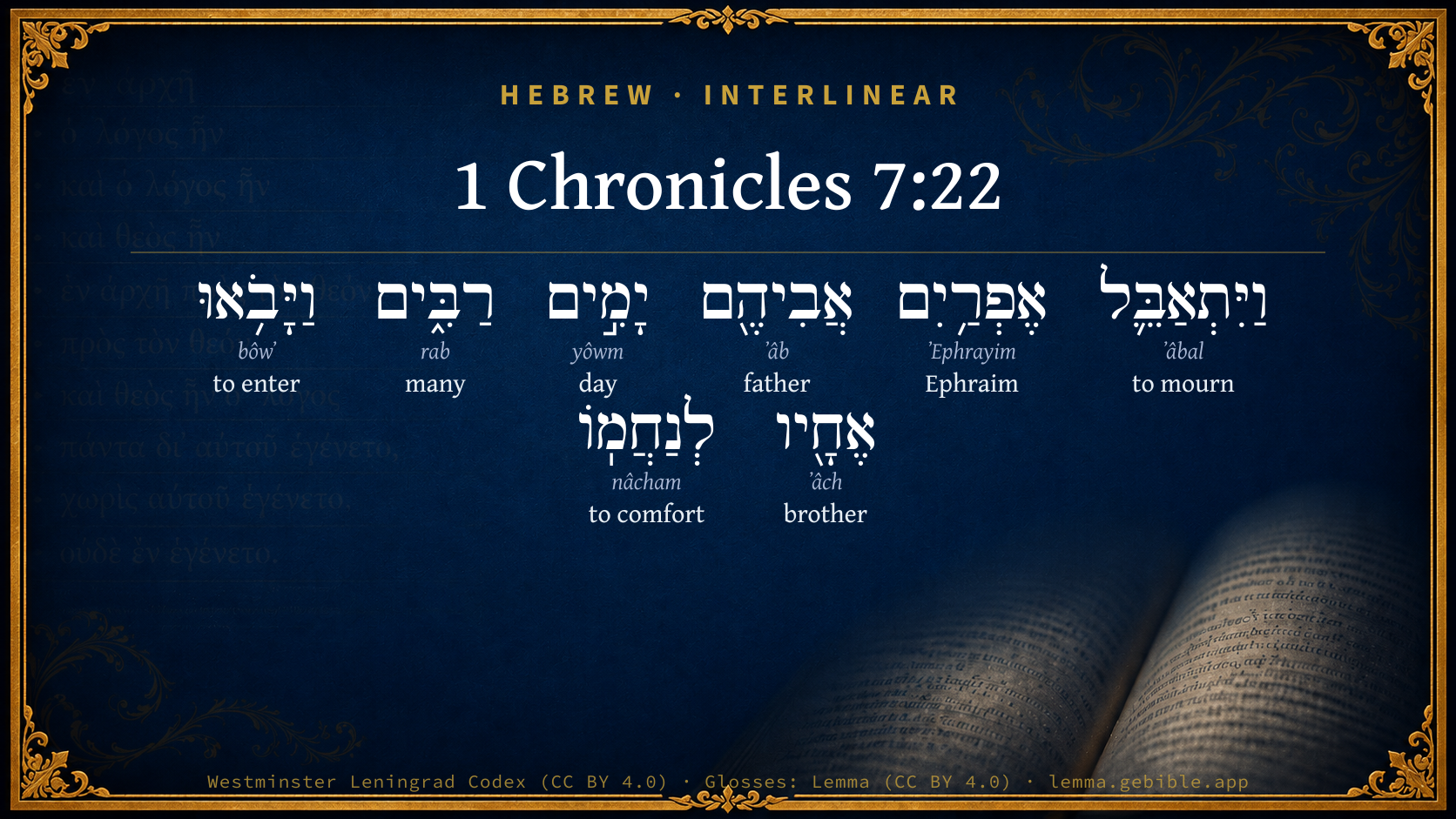
1 Chronicles 7:22

Hebrew (Westminster Leningrad Codex) 1 Chronicles 7:22 appears in the Hebrew Old Testament. The text above is from the Westminster Leningrad Codex. Each word links to its Strong’s number, a concise gloss, and parsing drawn from the Open Scriptures Hebrew Bible morphology. Click any word for its full Brown-Driver-Briggs (BDB) entry.
Download image
Cite this verse

1 Chronicles 7:22 (World English Bible). Public Domain. Lemma interlinear Bible study tool, https://lemma.gebible.app/v/1-chronicles/7/22.

Show BibTeX & RIS
BibTeX
RIS
English Translation
Ephraim their father mourned many days, and his brothers came to comfort him.
World English Bible · Public Domain
Download a study sheet

One document with this verse’s original text, its word-by-word gloss line, the meaning frame, cross-references with their text, attributed commentary, and full source and license credits — printable, and it pastes into notes with its structure intact.

This verse Autodidact and up

Study sheet (.html) Plain text (.txt)

A passage Seminary Student

Up to 50 verses in one chapter. A passage sheet keeps up to 6 commentary sources and 12 cross-references per verse, in the order this page ranks them, and says so on the sheet whenever that leaves anything out. Ask for a single verse and you get the Autodidact verse sheet above.

Everything on this page stays free to read, with no account — the sheet is a download of what is already on screen, not access to it.

Want to remove ads? Support Godless Engineer
Compare translations 3

The same verse in 3 English versions, stacked beneath the original-language interlinear above. Click any original word for its lexicon entry.

Each is an independent rendering of the whole verse — the interlinear is not word-aligned to these translations.

Highlighted words mark where these versions differ — a whole-verse word diff, not a word-by-word alignment.

  • World English Bible Public Domain
    Ephraim their father mourned many days, and his brothers came to comfort him.
  • King James Version Public Domain
    And Ephraim their father mourned many days, and his brethren came to comfort him.
  • unfoldingWord Literal Text CC BY-SA 4.0
    And Ephraim their father mourned many days, and his brothers came to comfort him.

unfoldingWord Literal Text — © unfoldingWord, licensed CC BY-SA 4.0. Word-aligned USFM3 via Door43 (git.door43.org/unfoldingWord/en_ult).

Versions to compare (up to 4)

3 of 4 selected

Show all 18 translations

Every available English version of this verse, each an independent rendering of the whole verse.

  • World English Bible Public Domain
    Ephraim their father mourned many days, and his brothers came to comfort him.
  • Berean Standard Bible Public Domain
    Their father Ephraim mourned for many days, and his relatives came to comfort him.
  • Majority Standard Bible Public Domain
    Their father Ephraim mourned for many days, and his relatives came to comfort him.
  • King James Version Public Domain
    And Ephraim their father mourned many days, and his brethren came to comfort him.
  • American Standard Version (1901) Public Domain
    And Ephraim their father mourned many days, and his brethren came to comfort him.
  • Revised Version (1885) Public Domain
    And Ephraim their father mourned many days, and his brethren came to comfort him.
  • Geneva Bible (1599) Public Domain
    Therefore Ephraim their father mourned many dayes, and his brethren came to comfort him.
  • Douay-Rheims (1899) Public Domain
    And Ephraim their father mourned many days, and his brethren came to comfort him.
  • Young's Literal Translation Public Domain
    And Ephraim their father mourneth many days, and his brethren come in to comfort him,
  • Literal Standard Version CC BY-SA 4.0
    And their father Ephraim mourns many days, and his brothers come to comfort him,
  • Unlocked Literal Bible CC BY-SA 4.0
    Ephraim their father mourned for them many days, and his brothers came to comfort him.
  • unfoldingWord Literal Text CC BY-SA 4.0
    And Ephraim their father mourned many days, and his brothers came to comfort him.
  • Darby Bible Public Domain
    And Ephraim their father mourned many days, and his brethren came to comfort him.
  • World Messianic Bible Public Domain
    Ephraim their father mourned many days, and his brothers came to comfort him.
  • Webster's Bible Public Domain
    And Ephraim their father mourned many days, and his brethren came to comfort him.
  • Free Bible Version CC BY-SA 4.0
    Their father Ephraim mourned for them a long time, and his relatives came to comfort him.
  • Bible in Basic English Public Domain
    And for a long time Ephraim their father went on weeping for them, and his brothers came to give him comfort.
  • JPS Tanakh (1917) Public Domain
    And Ephraim their father mourned many days, and his brethren came to comfort him.

Literal Standard Version (2020), Covenant Press — licensed CC BY-SA 4.0. Text via the HelloAO Bible API (eBible.org). Unlocked Literal Bible (unfoldingWord) — licensed CC BY-SA 4.0. Text via the HelloAO Bible API (eBible.org). unfoldingWord Literal Text — © unfoldingWord, licensed CC BY-SA 4.0. Word-aligned USFM3 via Door43 (git.door43.org/unfoldingWord/en_ult). Free Bible Version, Dr. Jonathan Gallagher — licensed CC BY-SA 4.0. Text via the HelloAO Bible API (eBible.org).

Word by word

More ways to search: Search by grammar → Find every occurrence → Compare this word →

Practice this passage: Drill this verse → Learn its vocabulary →

וַיִּתְאַבֵּ֛ל
ʼâbal
H56
“and · to mourn”
Conjunction + Verb, Hithpael, Sequential Imperfect, 3rd Person, Masculine, Singular
Part of Speech
Conjunction + Verb
Stem
Hithpael
Form
Sequential Imperfect
Person
3rd Person
Gender
Masculine
Number
Singular
Full BDB Definition

Origin: a primitive root

TWOT: 6

to mourn, lament - (Qal) to mourn, lament - of humans - of inanimate objects (figuratively) - of gates - of land - (Hiphil) - to mourn, cause to mourn (figuratively) - (Hithpael) - to mourn - play the mourner
  1. אֶפְרַ֥יִם ʼEphrayim H669 “Ephraim” Noun, Proper
  2. אֲבִיהֶ֖ם ʼâb H1 “father · their” Noun, Common, Masculine, Singular, Construct + Suffix, Personal, 3rd Person, Masculine, Plural
  3. יָמִ֣ים yôwm H3117 “days” Noun, Common, Masculine, Plural, Absolute
  4. רַבִּ֑ים rab H7227 “many” Adjective, Adjective, Masculine, Plural, Absolute
  5. וַיָּבֹ֥אוּ bôwʼ H935 “and · to enter” Conjunction + Verb, Qal, Sequential Imperfect, 3rd Person, Masculine, Plural
  6. אֶחָ֖יו ʼâch H251 “brothers · his” Noun, Common, Masculine, Plural, Construct + Suffix, Personal, 3rd Person, Masculine, Singular
  7. לְנַחֲמֽוֹ nâcham H5162 “to comfort · him” Preposition + Verb, Piel, Infinitive Construct + Suffix, Personal, 3rd Person, Masculine, Singular

About this verse

These counts appear in no published source. They are computed here, from the morphology-tagged text and Lemma’s own curated glosses. What Lemma adds →

8
words
8
distinct lemmas
Historical
section

Shared distinctive vocabulary

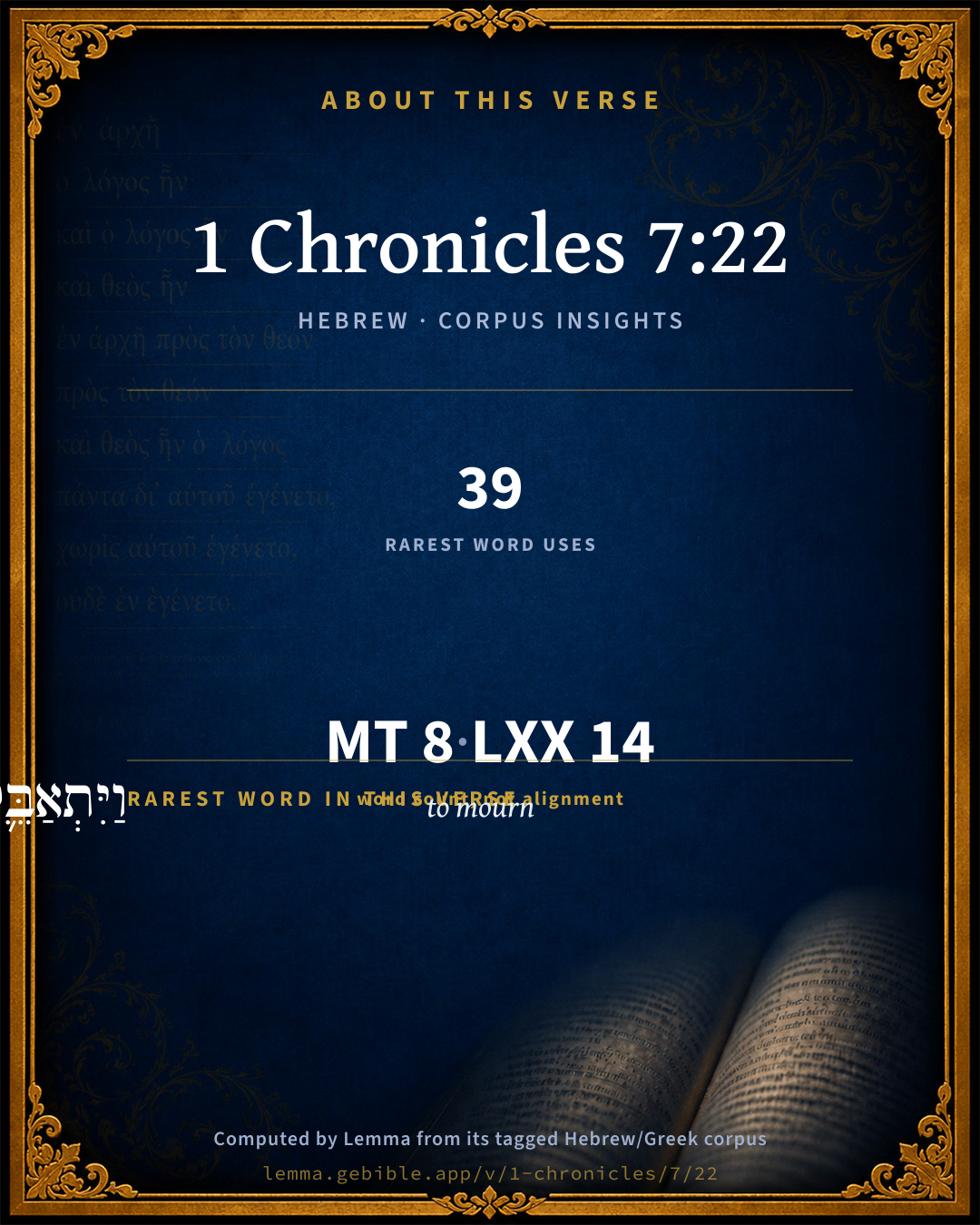
וַיִּתְאַבֵּ֛ל to mourn H56 occurs in 38 verses of the Hebrew Bible. Also found in:

Grammatical profile

  • 3 verbs
  • 4 nouns
  • 1 adjective

Verb forms

  • וַיִּתְאַבֵּ֛ל Hithpael · Sequential Imperfect
  • וַיָּבֹ֥אוּ Qal · Sequential Imperfect
  • לְנַחֲמֽוֹ Piel · Infinitive Construct

Hebrew & Septuagint length

In English translation the verse runs 13 words from the Hebrew and 14 from the Septuagint (LXX English) — closely comparable.

A rough comparison of the two English renderings, which tokenize alike — not a word-level alignment.

Word counts can differ between the Hebrew and the Greek without any difference in meaning — e.g. the Hebrew direct-object marker אֵת has no separate Greek word, and Greek often adds the article ὁ.

In the original languages it is 8 Hebrew tokens and 14 Greek tokens — but the two are counted differently (Hebrew bundles its prefixes and suffixes into one token; the Greek is in lemma form), so that isn’t a like-for-like length.

Cross-references

2

Topical passages linked to 1 Chronicles 7:22 in the Treasury of Scripture Knowledge — connected by theme and wording, ordered by reader-vote popularity; previews shown in the World English Bible.

  • Genesis 37:34 Jacob tore his clothes, and put sackcloth on his loins, and mourned for his son many days.
  • Job 2:11 Now when Job's three friends heard of all this evil that had come on him, they each came from his own place: Eliphaz the Temanite, Bildad the Shuhite, and Zophar the Naamathite, and they made an appointment together to come to sympathize with him and to comfort him.

Cross-references courtesy of OpenBible.info (CC BY 4.0).

Hebrew and Greek witnesses Masoretic Hebrew ↔ Greek Septuagint

The same verse in the two great witnesses to the Old Testament, shown verse-for-verse.

These are two independent witnesses, not word-aligned to each other, and the Septuagint is shown in lemma (dictionary) form.

Hebrew 1 Chronicles 7:22 Masoretic · Westminster Leningrad Codex

וַיִּתְאַבֵּ֛ל אֶפְרַ֥יִם אֲבִיהֶ֖ם יָמִ֣ים רַבִּ֑ים וַיָּבֹ֥אוּ אֶחָ֖יו לְנַחֲמֽוֹ

Ephraim their father mourned many days, and his brothers came to comfort him.

World English Bible · Public Domain

Greek LXX 1 Chronicles 7:22 Septuagint · lemma form

καί πενθέω ἐφράιμ πατήρ αὐτός ἡμέρα πολύς καί ἔρχομαι ἀδελφός αὐτός ὁ παρακαλέω αὐτός

And their father Ephraim mourned many days, and his brethren came to comfort him.

LXX2012 (modern English Septuagint) · Public Domain

Hebrew: Westminster Leningrad Codex (CC BY 4.0). Greek: Septuagint (public domain); English from LXX2012 (modern English Septuagint) (Public Domain). How the Septuagint differs from the Hebrew →

Commentary

Notes on 1 Chronicles 7:22 from classic Christian and Jewish commentators (each source and its license shown beneath its notes). The classic Christian expositions comment on the surrounding passage and are grouped to its opening verse, so a note may address several verses; the Jewish commentaries on the Tanakh (Rashi and others) are per-verse, so they appear only where the commentator wrote on this verse.

Lemma curates 59 commentaries, every one of them public domain or Creative Commons licensed, each selected and text-cleaned for this edition rather than reprinted as found. About our sources →

Trapp's Complete Commentary

John Trapp

1Ch 7:22 And Ephraim their father mourned many days, and his brethren came to comfort him.

Ver. 22. And Ephraim their father.] Who must needs be now a very old man.

Mourned many days.] His grief was the greater, if they went against the Gittites without his consent, as many young men are headlong and headstrong, &c.

And his brethren came to comfort him.] The Benjamites also set upon the men of Gath, and took their city from them. {1Ch 8:13} Atque sic ulti sunt fratres suos Ephraemitas.

John Trapp, A Commentary or Exposition upon All the Books of the Old and New Testament (1647–1656) — public domain. Text from a community e-Sword module.

Tyndale Open Study Notes

Tyndale Open Resources

7:22 The father of Ezer and Elead is recorded as Ephraim, but Ephraim the son of Joseph could not have settled in Canaan after the Exodus. The traditional solution was to imagine an early exodus for the family of Ephraim. Other possibilities are that the name Ephraim is a scribal mistake or that Ephraim referred to the tribe rather than the son of Joseph who bore the name.

Tyndale Open Study Notes — © Tyndale Open Resources, licensed CC BY-SA 4.0. Text via the HelloAO Bible API.

Geneva Bible (1599)

Geneva Bible translators

Or, kinsfolk.

Geneva Bible (1599) marginal notes — public domain. Text via Bolls.life.

Ellicott's Commentary for English Readers

(22-23) This is either what we should call a metaphorical description of the enfeebling of the tribe of Ephraim by the disaster which had befallen two of its chief houses, and of its subsequent recovery owing to the natural increase of its numbers, and the formation of a new and populous clan, that of Beriah; or if this be deemed too bold an interpretation of the archaic record, we have nothing for it but to suppose that the whole account relates to an expedition from Goshen, under two sons of Ephraim, during the lifetime of that patriarch; who, after the death of Ezer and Elead, begat another son, Beriah.

A Bible Commentary for English Readers, edited by Charles John Ellicott (1878–1897) — public domain. Text from a community e-Sword module.

John Gill's Exposition

The son of Asher,.... Which, and his two grandsons born before Jacob went down to Egypt, are here reckoned as in Gen 46:17 only it is here added Malchiel his second grandson:

who is the father of Birzavith; which Jarchi interprets, prince of a city of this name, which signifies pure oil; which it might have from the abundance of olives about it, Asher being a tribe which abounded with them, see Deu 33:24 though some of the Rabbins take it to be the name of a man, whose daughters, they say, as Jarchi observes, were very beautiful, having much oil to anoint with, and were married to kings and priests anointed with oil.

John Gill's Exposition of the Whole Bible (1746–1763) — public domain (CC PDM 1.0). Text via the HelloAO Bible API.

Matthew Poole's English Annotations

Ephraim their father; either,

1. That Ephraim of whom he speaks, 1Ch 7:20, whose sons are here named. But that to many seems hard, especially if these several sons, named 1Ch 7:20,21, be understood successively, so as each man be the son of him who is named next and immediately before him, which seems most probable; for so here are seven successive generations of Ephraim, which it is not likely that Ephraim lived to see; for then he must have been near two hundred years old. Although it is not necessary that the persons here said to be slain should be that generation which was last mentioned; but the particle whom may belong to the other sons of Ephraim of the fourth, or fifth, or sixth generation. Nor is the word whom in the Hebrew text, which runs thus, and the men of Gath slew them, i.e. the sons of Ephraim in the general, as they are expressed in the beginning of 1Ch 7:20, without respect to this or that particular generation. And the relative particle them may be referred not unto the persons last named, but unto some of the other and more remote persons; this being a common observation of Hebricians, that the relative oft belongs to the remoter antecedent. Or,

2. Zabad the father of the three persons and families last named, who might possibly have two names, and be called both Zabad and Ephraim. Or rather, the name of Ephraim may be put patronymically (as the learned speak) for the son and successor of Ephraim; who being now in Ephraim’s stead the head of the tribe, as old Ephraim was in his time, might well be called by the same name. Thus Isaac is put for his son Jacob or Israel, Amo 7:9, and Moses for the sons of Moses, Psa 90:1, and David for his son Rehoboam, 1Ki 12:16, and for Christ, Jer 30:9; Eze 34:23, and (as many think) Abraham for Jacob, Abraham’s grandchild, Act 7:16. And these words,

their father, seem to be added by way of distinction, to show that he meant not this of the old Ephraim, but of another, who was father to the three persons said to be slain, 1Ch 7:21. For if he had understood this of the first Ephraim, having called these the sons of Ephraim, it might seem superfluous and tautological to tell us that Ephraim was their father. His brethren, i.e. his kinsmen, as that word is frequently used.

Matthew Poole's English Annotations on the Holy Bible (1683–1685) — public domain. Text from a community e-Sword/MySword module.

The Pulpit Commentary

HOMILIES BY J.R. THOMSON

Mourning and consolation.

There is much obscurity about this passage, as recording a historical incident. But, though it is not easy to decide who the persons referred to were and at what time they lived, the incident is a witness to the community of human nature, both in the bitterness of the earthly lot and in the consolations with which it abounds. We have here brought before us

I BEREAVEMENT. From the first it has been the fate of men to endure this sorrow, for our days on earth are as a shadow, and death takes away from us all in turn the joys of our hearts, the desire of our eyes, the objects of our hopes. And it is to be observed that the sudden and violent death of our beloved ones is peculiarly distressing. When the young are cut down by wicked hands, in tumult or in war, the shock to survivors is especially painful.

II MOURNING. Lamentation for our dead is natural and right. "Jesus wept" at Lazarus"s grave. There is such a thing as sanctified sorrow. In certain cases, even poignant grief and prolonged mourning are excusable. "The heart knoweth his own bitterness." The parent weeps for the children because they are not.

III SYMPATHY AND CONSOLATION. Those who are near akin or intimate friends are expected to offer their affectionate condolence to the bereaved in the hour of sorrow and desolation. This is the obligation of friendship and its privilege also. Helpful and consolatory is true sympathy; for who would wish to bear his heaviest burden alone? Yet the most profitable ministrations in bereavement are those by which the heart of the bereaved is directed to take refuge in the fatherly wisdom and love of God, and in the tender sympathy of that High Priest who "in all our afflictions.., is afflicted," and who is "touched with the feeling of our infirmities. T.

The Pulpit Commentary (1880–1919), ed. H.D.M. Spence-Jones & Joseph S. Exell — public domain. Text from a community e-Sword module.

Keil & Delitzsch

C. F. Keil & F. Delitzsch

The son of Asher,.... Which, and his two grandsons born before Jacob went down to Egypt, are here reckoned as in Gen 46:17 only it is here added Malchiel his second grandson:

who is the father of Birzavith; which Jarchi interprets, prince of a city of this name, which signifies pure oil; which it might have from the abundance of olives about it, Asher being a tribe which abounded with them, see Deu 33:24 though some of the Rabbins take it to be the name of a man, whose daughters, they say, as Jarchi observes, were very beautiful, having much oil to anoint with, and were married to kings and priests anointed with oil.

Keil & Delitzsch — Biblical Commentary on the Old Testament (1861–1891) — public domain (CC PDM 1.0). Text via the HelloAO Bible API. (Old Testament only.)

Lesson kit

Teaching starters — assembled from the data on this page, not authored interpretation. Every prompt links to the verse data it draws on. Edit before teaching.

1 Chronicles, in the Historical, opens this verse with 8 words (8 distinct Hebrew lemmas). Its most distinctive word is ʼâbal (“to mourn”). A historical commentator’s framing appears above. Read the whole chapter for the surrounding context.

Discussion questions

  1. What does “to mourn” (ʼâbal) contribute to the verse as a whole?
  2. Genesis 37:34 shares the word «to mourn» with this verse. How do the two illuminate each other?
  3. These translations render this verse differently; the difference is in the English rendering, not the original. What questions does that raise?
  4. The verb «וַיִּתְאַבֵּ֛ל» is Hithpael Sequential Imperfect. How does its form color the action?
  5. Reading how Trapp's Complete Commentary and Tyndale Open Study Notes read this verse, where do the two commentators agree and where do they part?

Things to notice

Reading settings

Reading text

Shown beneath each verse's original-language words.

Old Testament
Old Testament edition

Read the OT as the Masoretic Hebrew (MT) or the Greek Septuagint (LXX).

English shown for the Greek Septuagint (in the Hebrew ↔ Greek comparison).

Comparing translations? Open the Compare panel on any verse page to stack up to four side by side.