
Deuteronomy 1:46

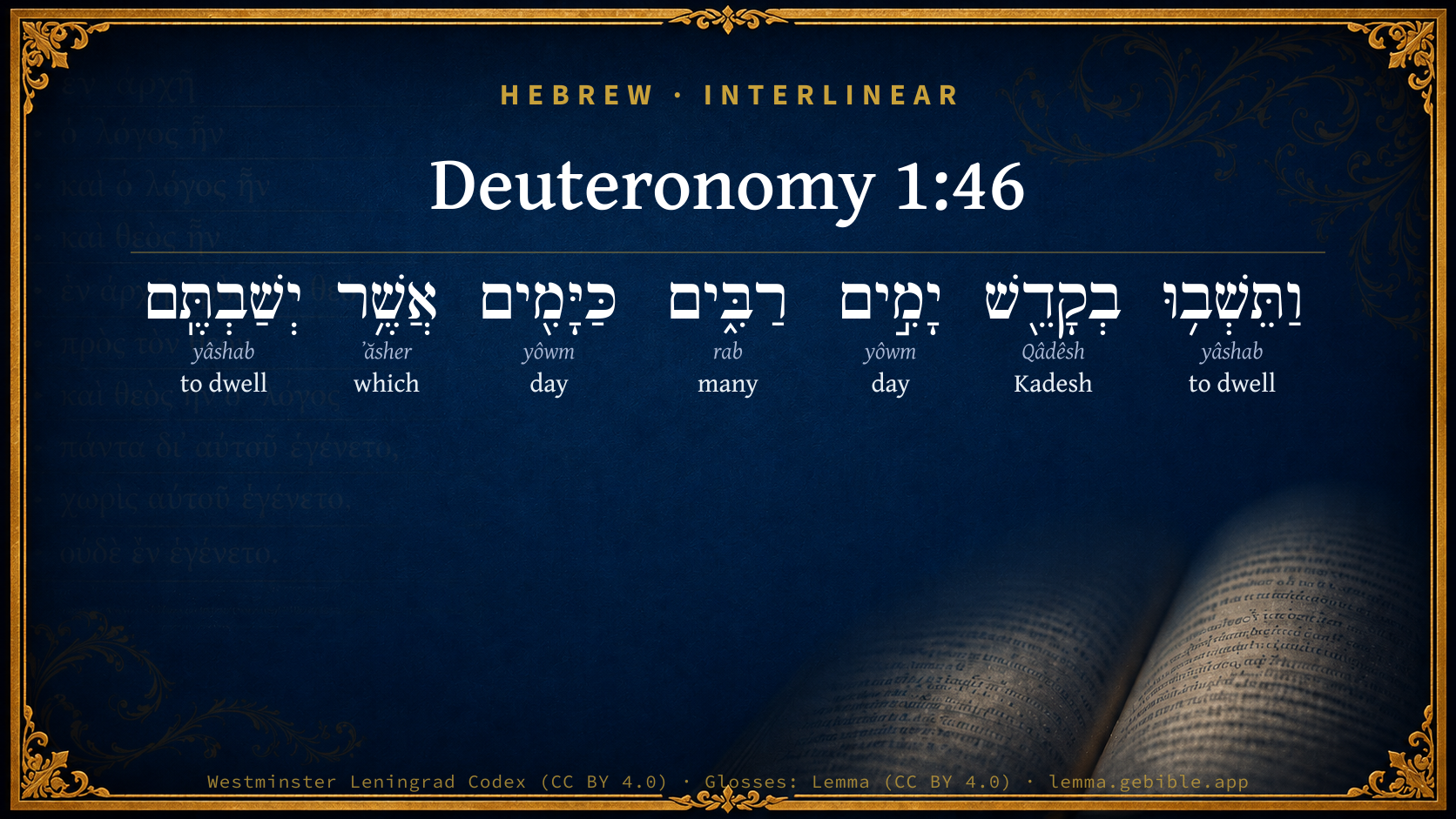
Hebrew (Westminster Leningrad Codex) Deuteronomy 1:46 appears in the Hebrew Old Testament. The text above is from the Westminster Leningrad Codex. Each word links to its Strong’s number, a concise gloss, and parsing drawn from the Open Scriptures Hebrew Bible morphology. Click any word for its full Brown-Driver-Briggs (BDB) entry.
Download image
Cite this verse

Deuteronomy 1:46 (World English Bible). Public Domain. Lemma interlinear Bible study tool, https://lemma.gebible.app/v/deuteronomy/1/46.

Show BibTeX & RIS
BibTeX
RIS
English Translation
So you abode in Kadesh many days, according to the days that you abode [there].
World English Bible · Public Domain
Download a study sheet

One document with this verse’s original text, its word-by-word gloss line, the meaning frame, cross-references with their text, attributed commentary, and full source and license credits — printable, and it pastes into notes with its structure intact.

This verse Autodidact and up

Study sheet (.html) Plain text (.txt)

A passage Seminary Student

Up to 50 verses in one chapter. A passage sheet keeps up to 6 commentary sources and 12 cross-references per verse, in the order this page ranks them, and says so on the sheet whenever that leaves anything out. Ask for a single verse and you get the Autodidact verse sheet above.

Everything on this page stays free to read, with no account — the sheet is a download of what is already on screen, not access to it.

Want to remove ads? Support Godless Engineer
Compare translations 3

The same verse in 3 English versions, stacked beneath the original-language interlinear above. Click any original word for its lexicon entry.

Each is an independent rendering of the whole verse — the interlinear is not word-aligned to these translations.

Highlighted words mark where these versions differ — a whole-verse word diff, not a word-by-word alignment.

  • World English Bible Public Domain
    So you abode in Kadesh many days, according to the days that you abode [there].
  • King James Version Public Domain
    So ye abode in Kadesh many days, according unto the days that ye abode there.
  • unfoldingWord Literal Text CC BY-SA 4.0
    So you stayed in Kadesh many days, according to the days that you stayed.

unfoldingWord Literal Text — © unfoldingWord, licensed CC BY-SA 4.0. Word-aligned USFM3 via Door43 (git.door43.org/unfoldingWord/en_ult).

Versions to compare (up to 4)

3 of 4 selected

Show all 18 translations

Every available English version of this verse, each an independent rendering of the whole verse.

  • World English Bible Public Domain
    So you abode in Kadesh many days, according to the days that you abode [there].
  • Berean Standard Bible Public Domain
    For this reason you stayed in Kadesh for a long time—a very long time.
  • Majority Standard Bible Public Domain
    For this reason you stayed in Kadesh for a long time—a very long time.
  • King James Version Public Domain
    So ye abode in Kadesh many days, according unto the days that ye abode there.
  • American Standard Version (1901) Public Domain
    So ye abode in Kadesh many days, according unto the days that ye abode `there'.
  • Revised Version (1885) Public Domain
    So ye abode in Kadesh many days, according unto the days that ye abode there.
  • Geneva Bible (1599) Public Domain
    So ye abode in Kadesh a long time, according to the time that ye had remained before.
  • Douay-Rheims (1899) Public Domain
    And the Amorrhite that dwelt in the mountains coming out, and meeting you, chased you, as bees do: and made slaughter of you from Seir as far as Horma.
  • Young's Literal Translation Public Domain
    and ye dwell in Kadesh many days, according to the days which ye had dwelt.
  • Literal Standard Version CC BY-SA 4.0
    and you dwell in Kadesh [for] many days, according to the days which you had dwelt.”
  • Unlocked Literal Bible CC BY-SA 4.0
    So you stayed in Kadesh many days, all the days that you stayed there.
  • unfoldingWord Literal Text CC BY-SA 4.0
    So you stayed in Kadesh many days, according to the days that you stayed.
  • Darby Bible Public Domain
    And ye abode in Kadesh many days, according unto the days that ye abode [there].
  • World Messianic Bible Public Domain
    So you stayed in Kadesh many days, according to the days that you remained.
  • Webster's Bible Public Domain
    So ye abode in Kadesh many days, according to the days that ye abode there.
  • Free Bible Version CC BY-SA 4.0
    You stayed there in Kadesh for a long time.
  • Bible in Basic English Public Domain
    So you were kept waiting in Kadesh for a long time.
  • JPS Tanakh (1917) Public Domain
    So ye abode in Kadesh many days, according unto the days that ye abode there.

Literal Standard Version (2020), Covenant Press — licensed CC BY-SA 4.0. Text via the HelloAO Bible API (eBible.org). Unlocked Literal Bible (unfoldingWord) — licensed CC BY-SA 4.0. Text via the HelloAO Bible API (eBible.org). unfoldingWord Literal Text — © unfoldingWord, licensed CC BY-SA 4.0. Word-aligned USFM3 via Door43 (git.door43.org/unfoldingWord/en_ult). Free Bible Version, Dr. Jonathan Gallagher — licensed CC BY-SA 4.0. Text via the HelloAO Bible API (eBible.org).

Word by word

More ways to search: Search by grammar → Find every occurrence → Compare this word →

Practice this passage: Drill this verse → Learn its vocabulary →

About this verse

These counts appear in no published source. They are computed here, from the morphology-tagged text and Lemma’s own curated glosses. What Lemma adds →

7
words
5
distinct lemmas
Pentateuch
section

Notable vocabulary

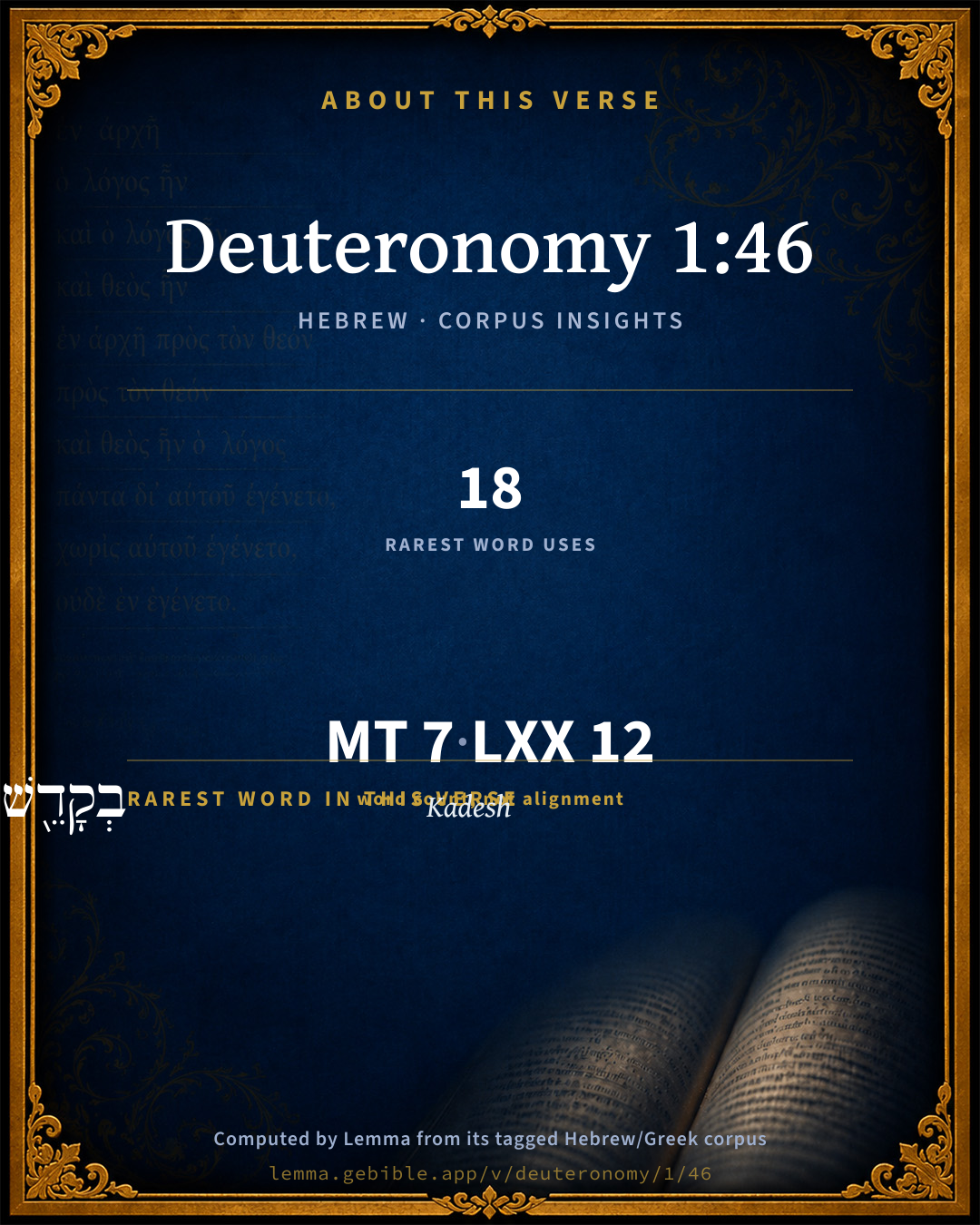
The rarest word here is בְקָדֵ֖שׁ Kadesh H6946 — appearing just 18 times in the whole Hebrew Bible.

Shared distinctive vocabulary

בְקָדֵ֖שׁ Kadesh H6946 occurs in 18 verses of the Hebrew Bible. Also found in:

Grammatical profile

  • 2 verbs
  • 3 nouns
  • 1 adjective
  • 1 particle

Verb forms

  • וַתֵּשְׁב֥וּ Qal · Sequential Imperfect
  • יְשַׁבְתֶּֽם Qal · Perfect

Repetition

Words recur within this verse — often emphatic in Hebrew:

  • וַתֵּשְׁב֥וּ to dwell H3427 ×2
  • יָמִ֣ים day H3117 ×2

Hebrew & Septuagint length

In English translation the verse runs 15 words from the Hebrew and 14 from the Septuagint (LXX English) — closely comparable.

A rough comparison of the two English renderings, which tokenize alike — not a word-level alignment.

Word counts can differ between the Hebrew and the Greek without any difference in meaning — e.g. the Hebrew direct-object marker אֵת has no separate Greek word, and Greek often adds the article ὁ.

In the original languages it is 7 Hebrew tokens and 12 Greek tokens — but the two are counted differently (Hebrew bundles its prefixes and suffixes into one token; the Greek is in lemma form), so that isn’t a like-for-like length.

Cross-references

5

Topical passages linked to Deuteronomy 1:46 in the Treasury of Scripture Knowledge — connected by theme and wording, ordered by reader-vote popularity; previews shown in the World English Bible.

  • Numbers 20:1 The children of Israel, even the whole congregation, came into the wilderness of Zin in the first month: and the people abode in Kadesh; and Miriam died there, and was buried there.
  • Numbers 20:22 They traveled from Kadesh: and the children of Israel, even the whole congregation, came to Mount Hor.
  • Numbers 14:25 Now the Amalekite and the Canaanite dwell in the valley: tomorrow turn you, and get you into the wilderness by the way to the Red Sea.
  • Numbers 14:34 After the number of the days in which you spied out the land, even forty days, for every day a year, shall you bear your iniquities, even forty years, and you shall know my alienation.
  • Judges 11:16–17 but when they came up from Egypt, and Israel went through the wilderness to the Red Sea, and came to Kadesh;

Cross-references courtesy of OpenBible.info (CC BY 4.0).

Hebrew and Greek witnesses Masoretic Hebrew ↔ Greek Septuagint

The same verse in the two great witnesses to the Old Testament, shown verse-for-verse.

These are two independent witnesses, not word-aligned to each other, and the Septuagint is shown in lemma (dictionary) form.

Hebrew Deuteronomy 1:46 Masoretic · Westminster Leningrad Codex

וַתֵּשְׁב֥וּ בְקָדֵ֖שׁ יָמִ֣ים רַבִּ֑ים כַּיָּמִ֖ים אֲשֶׁ֥ר יְשַׁבְתֶּֽם

So you abode in Kadesh many days, according to the days that you abode [there].

World English Bible · Public Domain

Greek LXX Deuteronomy 1:46 Septuagint · lemma form

καί κατα ἐνἧμαι ἐν καδης ἡμέρα πολύς ὅσος ποτέ ἡμέρα κατα ἐνἧμαι

And you⌃ lived in Cades many days, as many days as you⌃ lived there.

LXX2012 (modern English Septuagint) · Public Domain

Hebrew: Westminster Leningrad Codex (CC BY 4.0). Greek: Septuagint (public domain); English from LXX2012 (modern English Septuagint) (Public Domain). How the Septuagint differs from the Hebrew →

Targum (Aramaic paraphrase)

2

The Targum is the ancient Jewish Aramaic paraphrase of the Hebrew Scriptures — an interpretive translation, not the Hebrew text itself. Onkelos (literal) and Pseudo-Jonathan (expansive) render the Torah, and Jonathan the Prophets. Coverage is partial: where no permissively-licensed English translation exists for a verse, only the Aramaic is shown. This is verse-level text, not a word-by-word alignment to the Hebrew.

  1. Targum Onkelos Torah (Genesis–Deuteronomy)
    וִיתֶבְתּוּן בִּרְקָם יוֹמִין סַגִיאִין כְּיוֹמַיָא דִי יְתֶבְתּוּן

    (no public-domain English translation for this verse)

    Targum Onkelos — Aramaic: “Onkelos Genesis” (public domain); “Onkelos Exodus” (public domain); “Onkelos Leviticus” (public domain); “Onkelos Numbers” (public domain); “Onkelos Deuteronomy” (public domain). English: “Sefaria Community Translation” (CC0 1.0 (public-domain dedication)); “J.W. Etheridge. The Targums of Onkelos and Jonathan Ben Uzziel on the Pentateuch. London: Longmans, Green, 1862” (public domain). Text via Sefaria.

  2. Targum Pseudo-Jonathan Torah (Genesis–Deuteronomy)
    וִיתֵיבְתּוּן בִּרְקַם יוֹמִין סַגִּיאִין כְּיוֹמַיָא דִיתֵיבְתּוּן

    So you abode in Rekem many days, according to the days that you abode.

    Targum Pseudo-Jonathan — Aramaic: “Targum Jonathan on Genesis” (public domain); “Targum Jonathan on Exodus” (public domain); “Targum Jonathan on Leviticus” (public domain); “Targum Jonathan on Numbers” (public domain); “Targum Jonathan on Deuteronomy” (public domain). English: “The Targum of Jonathan ben Uzziel, trans. J. W. Etheridge, London, 1862” (public domain). Text via Sefaria.

Commentary

Notes on Deuteronomy 1:46 from classic Christian and Jewish commentators (each source and its license shown beneath its notes). The classic Christian expositions comment on the surrounding passage and are grouped to its opening verse, so a note may address several verses; the Jewish commentaries on the Tanakh (Rashi and others) are per-verse, so they appear only where the commentator wrote on this verse.

Lemma curates 59 commentaries, every one of them public domain or Creative Commons licensed, each selected and text-cleaned for this edition rather than reprinted as found. About our sources →

Trapp's Complete Commentary

John Trapp

Deu 1:46 So ye abode in Kadesh many days, according unto the days that ye abode [there].

Ver. 46. So ye abode in Kadesh many days.] Many indeed; yea, many years. And here it was, or hereabouts, that they received those laws which are recorded, {Num 15:1-41} as also that they stoned him that gathered sticks on the Sabbath day; that Korah and his accomplices perished; that fourteen thousand seven hundred died of the plague; that Aaron’s rod flourished; that Moses, seeing the people fall so fast in the wilderness, wrote Psa 90:1-17, - where he telleth us that the ordinary term of man’s life was reduced to seventy or eighty years, and so made shorter by half than before. All which things are thought to have happened in the last six months of the second year after their coming out of Egypt: the history of those two years only, and of the last of the forty are set forth by Moses: the intercurrent thirty seven years with their events, save only the bare names of their various stations, {Num 33:1-56} being passed over in silence. If men will take liberty to commit sin against God, he will make but a short story of them and their works: Lot, for instance. {Gen 19:36}

John Trapp, A Commentary or Exposition upon All the Books of the Old and New Testament (1647–1656) — public domain. Text from a community e-Sword module.

Jamieson, Fausset & Brown

Robert Jamieson, A. R. Fausset & David Brown

So ye abode at Kadesh many days--That place had been the site of their encampment during the absence of the spies, which lasted forty days, and it is supposed from this verse that they prolonged their stay there after their defeat for a similar period.

Next: Deuteronomy Chapter 2

Jamieson, Fausset & Brown — Commentary Critical and Explanatory on the Whole Bible (1871) — public domain (CC PDM 1.0). Text via the HelloAO Bible API.

Adam Clarke's Commentary

Verse 46. According unto the days that ye abode there.] They had been a long time at this place, see Nu 13:27; Nu 20:1; Nu 20:14; Nu 20:21. And some think that the words mean, "Ye abode as long at Kadesh, when you came to it the second time, as ye did at the first." Or, according to others, "While ye were in that part of the desert, ye encamped at Kadesh."

1. As one grand object of the law of God was to instruct the people in those things which were calculated to promote their peace and insure their prosperity; and as they were apt to lose sight of their spiritual interests, without a due attention to which their secular interest could not be promoted; Moses, not only in this chapter, but through the whole book, calls upon them to recollect their former miserable situation, in which they held neither life nor property but at the will of a merciless tyrant, and the great kindness and power of God manifested in their deliverance from a bondage that was as degrading as it was oppressive. These things properly remembered would lead them to prize their blessings, and duly appreciate the mercy of their Maker.

2. But it was not only this general display of God's kindness, in the grand act of their deliverance from Egypt, that he wished them to keep constantly in view, but also that gracious providence which was manifested in every step they took; which directed all their movements, provided for all their wants, continually showing what they should do, how they should do it, and also the most proper time and place for every act, whether religious or civil. By bringing before them in one point of view the history of almost forty years, in which the strangest and most stupendous occurrences had taken place that had ever been exhibited to the world, he took the readiest way to impress their minds, not only with their deep obligation to God, but also to show them that they were a people on whom their Maker had set his heart to do them good, and that if they feared him they should lack nothing that was good. He lays out also before them a history of their miscarriages and rebellion, and the privations and evils they had suffered in consequence, that this might act as a continual warning, and thus become, in the hands of God, a preventive of crimes.

3. If every Christian were thus to call his past life into review, he would see equal proofs of God's gracious regards to his body and soul; equal proofs of eternal mercy in providing for his deliverance from the galling yoke and oppressive tyranny of sin, as the Israelites had in their deliverance from Egypt; and equal displays of a most gracious providence, that had also been his incessant companion through all the changes and chances of this mortal life, guiding him by its counsel, that he might be at last received into glory. O reader, remember what God has done for thee during thy forty, fifty, c., years! He has nourished, fed, clothed, protected, and saved thee. How often and how powerfully has his Spirit striven with thee! How often and how impressively thou hast heard his voice in his Gospel and in his providences! Remember the good resolutions thou hast made, the ingratitude and disobedience that have marked thy life how his vows are still upon thee, and how his mercy still spares thee! And wilt thou live so as to perish for ever? God forbid! He still waits to be gracious, and rejoices over thee to do thee good. Learn from what is before thee how thou shouldst fear, love, believe in, and obey thy God. The Lamb of God, that taketh away the sin of the world, is still before the throne; and whosoever cometh unto God through him shall in nowise be cast out. He who believes these things with an upright heart will soon be enabled to live a sanctified life.

Adam Clarke's Commentary on the Bible (1810–1826) — public domain. Text from a community e-Sword/MySword module.

Ellicott's Commentary for English Readers

(46) So ye abode in Kadesh many days.—Better, and. In Num_14:25 the command was, “Tomorrow turn you, and get you into the wilderness.” This command was broken by the attack on the Canaanites, made on the morrow after the command. We cannot be certain that the many days spent in Kadesh were spent after the defeat. It may be merely a note of the fact that the time spent in Kadesh was considerable. The mission of the spies alone occupied forty days.

According unto the days that ye abode there.—The Jewish commentator Rashi, quoting from Sêder Olâm, says they in Kadesh, and nineteen in their wanderings.

A Bible Commentary for English Readers, edited by Charles John Ellicott (1878–1897) — public domain. Text from a community e-Sword module.

The Cambridge Bible for Schools and Colleges

gen. ed. J. J. S. Perowne

46. So ye abode in Ḳadesh] So JE, Num_20:1 b, but apparently of a later residence than this.

many days, according unto the days that ye abode there] ‘An example of the “idem per idem” idiom often employed in the Semitic languages, when a writer is either unable or has no occasion to speak explicitly’ (Driver). Cp. Deu_9:25, Deu_29:16 [15]; 1Sa_23:13, etc.

If this verse be from the writer of the rest of this discourse the time implied cannot, in the light of his further statements in Deu_2:1; Deu_2:14, amount to years; for the 2nd of the 40 years was already either wholly or nearly exhausted and these verses state that all the next 38 were spent between Ḳadesh and the Moabite frontier. But as we shall see in the introd. to the next section JE attributes to the people a very long residence in Ḳadesh, in fact the bulk of the 38 years. Probably, therefore, the indefinite statement of this verse is not from the writer of the rest of this discourse, but from an editor aware of the divergent traditions; in further evidence of which observe that he uses the simple Ḳadesh instead of the Ḳadesh-barnea‘ employed in the rest of the discourse.

The Cambridge Bible for Schools and Colleges (gen. ed. J. J. S. Perowne; Cambridge University Press, 1878–1918) — public domain. Text from a community e-Sword module.

John Gill's Exposition

So ye abode in Kadesh many days,.... Yea, some years, as some think:

according to the days that ye abode there; that is, according to Jarchi, as they did in the rest of the journeys or stations; so that as they were thirty eight years in all at several places, they were nineteen years in Kadesh; the same is affirmed in the Jewish chronology (w). Maimonides says (x) they were eighteen years in one place, and it is very probable he means this; but Aben Ezra interprets it otherwise, and takes the sense to be, that they abode as many days here after their return as they did while the land was searching, which were forty days, Num 13:25, but without fixing any determinate time, the meaning may only be, that as they had been many days here before this disaster, so they continued many days after in the same place before they marched onward into the wilderness again.

(w) Seder Olam Rabba, c. 8. p. 24. (x) Moreh Nevochim. par. 3. c. 50.

Next: Deuteronomy Chapter 2

John Gill's Exposition of the Whole Bible (1746–1763) — public domain (CC PDM 1.0). Text via the HelloAO Bible API.

Haydock's Catholic Bible Commentary

Time. Hebrew adds, "according to the days that you abode." All the time that the Hebrews spent in that neighbourhood they remained at Cades-barne. The Rabbins say 38 years; but Moses informs us, that they were so long in coming thence to the torrent of Zared, chap. ii. 14. (Calmet)

George Leo Haydock (1774–1849), Haydock's Catholic Family Bible and Commentary, 1859 edition — public domain. Excludes Psalms (Douay-Rheims chapter numbering differs from Protestant) and Deuterocanonical books (Catholic canon only).

Matthew Poole's English Annotations

i.e. As you abode in Kadesh many, even forty days, until the spies which you sent returned to give you an account; so you also abode there many days, or a long time after, and were not now permitted to make any further progress towards Canaan.

Matthew Poole's English Annotations on the Holy Bible (1683–1685) — public domain. Text from a community e-Sword/MySword module.

Whedon's Commentary on the Bible

Daniel D. Whedon

46. Abode in Kadesh many days — This verse has been variously interpreted. Some understand it to mean that the Israelites remained there after their discomfiture as many days as they had been there before the return of the spies; some, that they abode there as long as they abode in all other stations — that is, half the time of their years of wandering; others, that a portion of the people abode at Kadesh permanently, while Moses and the rest journeyed southward; and the change of the subject to the first person in the next chapter is held to sustain this latter view. From the data that we have, it is impossible to determine how long they abode there. Probably Kadesh was the central point for the whole people, the place of meeting on appointed days. Here the tabernacle may have been kept, and here Moses chiefly dwelt. “Next to Sinai, the most important of all the resting-places of the children of Israel is Kadesh.” — STANLEY’S Sinai and Palestine. “There is something mournfully solemn and emphatic in the words, ‘Ye abode in Kadesh.’ Ye were on the very borders of Canaan, but instead of passing the frontier and entering into the Land of Promise ye abode at Kadesh; and when you moved from it, it was not to go northward into Canaan, but southward in the opposite direction; and after thirty-seven years’ weary wandering ye had only arrived at Kadesh again. Such were the consequences of disobedience.” — Wordsworth.

Daniel D. Whedon (gen. ed.), Commentary on the Old and New Testaments (1874–1909) — public domain. Text from a community e-Sword module.

The Pulpit Commentary

It was unnecessary that Moses should tell the people the precise length of time they abode in Kadesh after this, because that was well known to them; he, therefore, contents himself with saying that they remained there as long as they did remain. (comp. for a similar expression, Deu_9:25) How long they actually remained there cannot be determined, for the expression, many days, is wholly indefinite.

The Pulpit Commentary (1880–1919), ed. H.D.M. Spence-Jones & Joseph S. Exell — public domain. Text from a community e-Sword module.

Rashi

Rabbi Shlomo Yitzchaki (Rashi)

ותשבו בקדש ימים רבים SO YE ABODE IN KADESH MANY DAYS — viz., nineteen years, as it is said here כימים אשר ישבתם, ACCORDING TO THE DAYS THAT YE ABODE, i.e. abode at all the other stations. They (the total years) were thirtyeight years; nineteen of them they spent at Kadesh, and nineteen years they went moving about aimlessly, and then they returned to Kadesh, as it is said, (Numbers 32:13) “And he made them move about in the wilderness”. — Thus have I found in Seder Olam 8.

Rashi on the Tanakh — English translations: “The Judaica Press complete Tanach with Rashi, translated by A. J. Rosenberg” (CC BY 4.0); “Pentateuch with Rashi's commentary by M. Rosenbaum and A.M. Silbermann, 1929-1934” (public domain); “The Metsudah Tanach series, Lakewood, N.J” (CC BY 4.0); and “The Book of Joshua, Metsudah Publications, 1997” (CC BY 4.0). Text via Sefaria.

Lesson kit

Teaching starters — assembled from the data on this page, not authored interpretation. Every prompt links to the verse data it draws on. Edit before teaching.

Deuteronomy, in the Pentateuch, opens this verse with 7 words (5 distinct Hebrew lemmas). Its most distinctive word is Qâdêsh (“Kadesh”). A historical commentator’s framing appears above. Read the whole chapter for the surrounding context.

Discussion questions

  1. The word Qâdêsh carries the sense “Kadesh.” How does it shape the verse?
  2. Genesis 14:7 shares the word «Kadesh» with this verse. How do the two illuminate each other?
  3. “to dwell” occurs 2× in this one verse. What is the effect of the repetition?
  4. These translations render this verse differently. What is at stake in choosing one wording over another?
  5. The verb «וַתֵּשְׁב֥וּ» is Qal Sequential Imperfect. How does its form color the action?
  6. Reading how Trapp's Complete Commentary and Jamieson, Fausset & Brown read this verse, where do the two commentators agree and where do they part?

Things to notice

Reading settings

Reading text

Shown beneath each verse's original-language words.

Old Testament
Old Testament edition

Read the OT as the Masoretic Hebrew (MT) or the Greek Septuagint (LXX).

English shown for the Greek Septuagint (in the Hebrew ↔ Greek comparison).

Comparing translations? Open the Compare panel on any verse page to stack up to four side by side.