
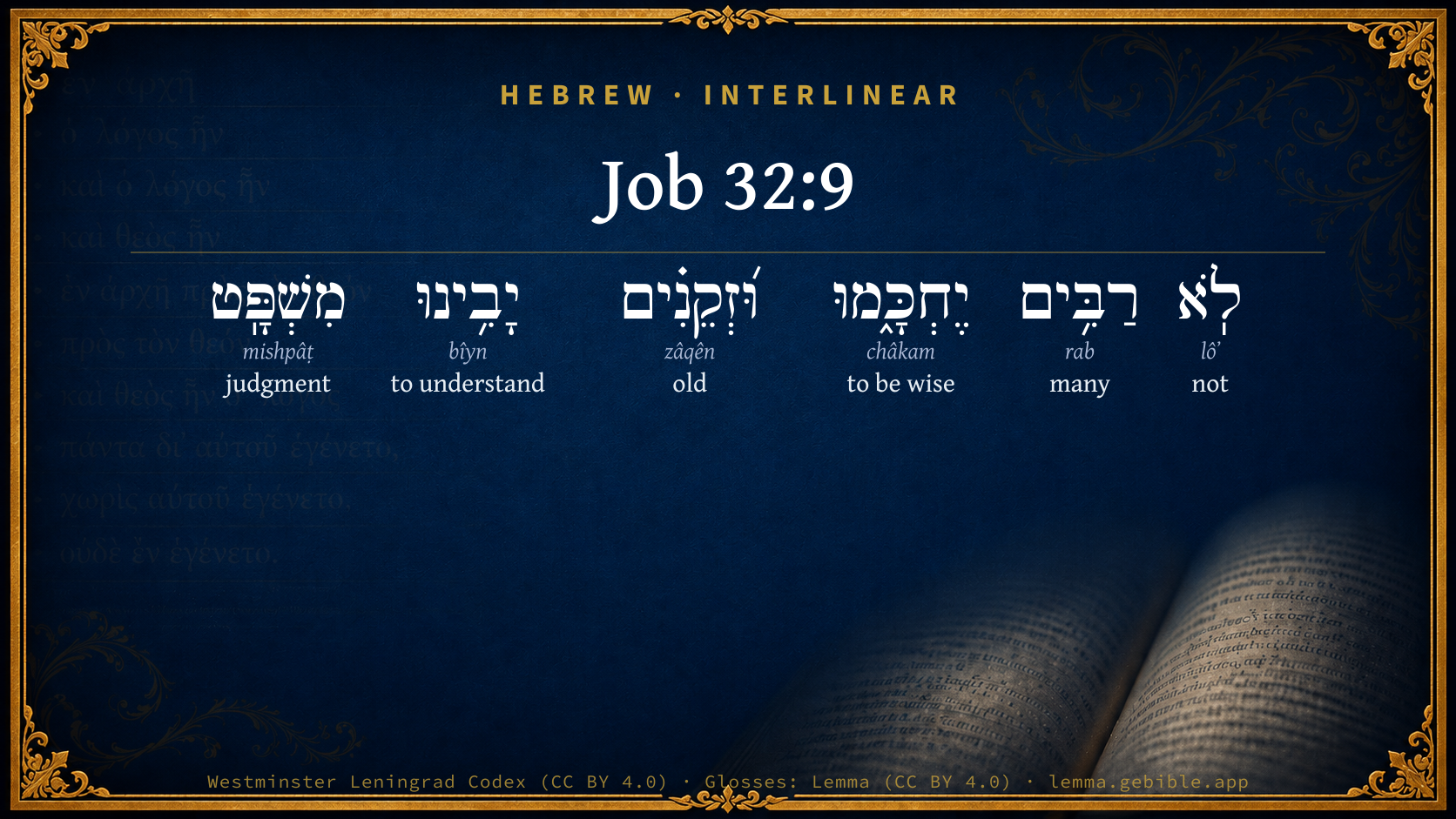
Job 32:9

Hebrew (Westminster Leningrad Codex) Job 32:9 appears in the Hebrew Old Testament. The text above is from the Westminster Leningrad Codex. Each word links to its Strong’s number, a concise gloss, and parsing drawn from the Open Scriptures Hebrew Bible morphology. Click any word for its full Brown-Driver-Briggs (BDB) entry.
Download image
Cite this verse

Job 32:9 (World English Bible). Public Domain. Lemma interlinear Bible study tool, https://lemma.gebible.app/v/job/32/9.

Show BibTeX & RIS
BibTeX
RIS
English Translation
It is not the great who are wise, Nor the aged who understand justice.
World English Bible · Public Domain
Download a study sheet

One document with this verse’s original text, its word-by-word gloss line, the meaning frame, cross-references with their text, attributed commentary, and full source and license credits — printable, and it pastes into notes with its structure intact.

This verse Autodidact and up

Study sheet (.html) Plain text (.txt)

A passage Seminary Student

Up to 50 verses in one chapter. A passage sheet keeps up to 6 commentary sources and 12 cross-references per verse, in the order this page ranks them, and says so on the sheet whenever that leaves anything out. Ask for a single verse and you get the Autodidact verse sheet above.

Everything on this page stays free to read, with no account — the sheet is a download of what is already on screen, not access to it.

Want to remove ads? Support Godless Engineer
Compare translations 3

The same verse in 3 English versions, stacked beneath the original-language interlinear above. Click any original word for its lexicon entry.

Each is an independent rendering of the whole verse — the interlinear is not word-aligned to these translations.

Highlighted words mark where these versions differ — a whole-verse word diff, not a word-by-word alignment.

  • World English Bible Public Domain
    It is not the great who are wise, Nor the aged who understand justice.
  • King James Version Public Domain
    Great men are not always wise: neither do the aged understand judgment.
  • unfoldingWord Literal Text CC BY-SA 4.0
    The great are not wise, and the aged do understand justice.

unfoldingWord Literal Text — © unfoldingWord, licensed CC BY-SA 4.0. Word-aligned USFM3 via Door43 (git.door43.org/unfoldingWord/en_ult).

Versions to compare (up to 4)

3 of 4 selected

Show all 18 translations

Every available English version of this verse, each an independent rendering of the whole verse.

  • World English Bible Public Domain
    It is not the great who are wise, Nor the aged who understand justice.
  • Berean Standard Bible Public Domain
    It is not only the old who are wise, or the elderly who understand justice.
  • Majority Standard Bible Public Domain
    It is not only the old who are wise, or the elderly who understand justice.
  • King James Version Public Domain
    Great men are not always wise: neither do the aged understand judgment.
  • American Standard Version (1901) Public Domain
    It is not the great that are wise, Nor the aged that understand justice.
  • Revised Version (1885) Public Domain
    It is not the great that are wise, nor the aged that understand judgment.
  • Geneva Bible (1599) Public Domain
    Great men are not alway wise, neither doe the aged alway vnderstand iudgement.
  • Douay-Rheims (1899) Public Domain
    They that are aged are not the wise men, neither do the ancients understand judgment.
  • Young's Literal Translation Public Domain
    The multitude are not wise, Nor do the aged understand judgment.
  • Literal Standard Version CC BY-SA 4.0
    The multitude are not wise, || Nor do the aged understand judgment.
  • Unlocked Literal Bible CC BY-SA 4.0
    It is not only the great people who are wise, nor the aged people alone who understand justice.
  • unfoldingWord Literal Text CC BY-SA 4.0
    The great are not wise, and the aged do understand justice.
  • Darby Bible Public Domain
    It is not the great that are wise; neither do the aged understand judgment.
  • World Messianic Bible Public Domain
    It is not the great who are wise, nor the aged who understand justice.
  • Webster's Bible Public Domain
    Great men are not always wise: neither do the aged understand judgment.
  • Free Bible Version CC BY-SA 4.0
    It is not the old who are wise, or the elderly who know what is right.
  • Bible in Basic English Public Domain
    It is not the old who are wise, and those who are full of years have not the knowledge of what is right.
  • JPS Tanakh (1917) Public Domain
    It is not the great that are wise, nor the aged that discern judgment.

Literal Standard Version (2020), Covenant Press — licensed CC BY-SA 4.0. Text via the HelloAO Bible API (eBible.org). Unlocked Literal Bible (unfoldingWord) — licensed CC BY-SA 4.0. Text via the HelloAO Bible API (eBible.org). unfoldingWord Literal Text — © unfoldingWord, licensed CC BY-SA 4.0. Word-aligned USFM3 via Door43 (git.door43.org/unfoldingWord/en_ult). Free Bible Version, Dr. Jonathan Gallagher — licensed CC BY-SA 4.0. Text via the HelloAO Bible API (eBible.org).

Word by word

More ways to search: Search by grammar → Find every occurrence → Compare this word →

Practice this passage: Drill this verse → Learn its vocabulary →

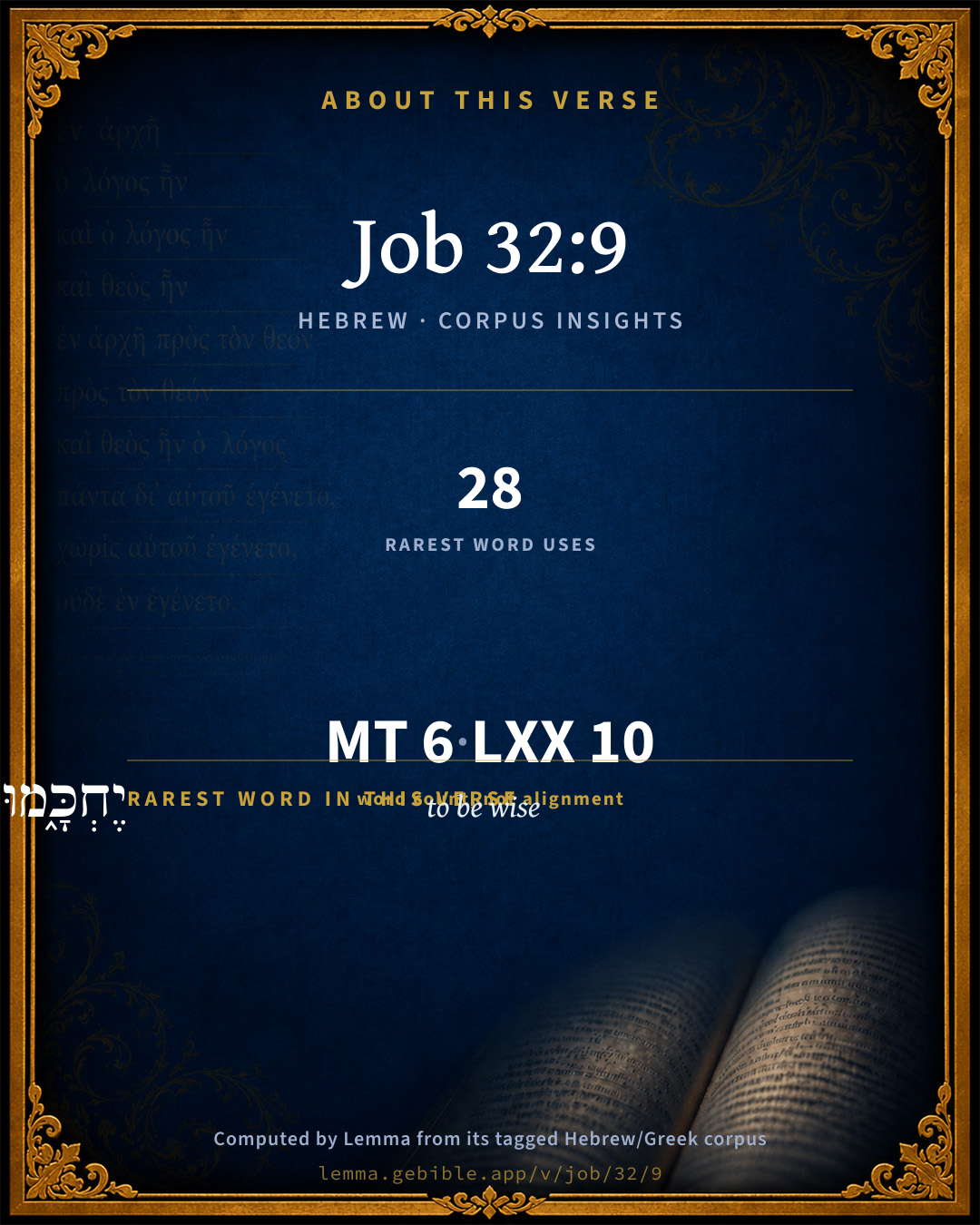
About this verse

These counts appear in no published source. They are computed here, from the morphology-tagged text and Lemma’s own curated glosses. What Lemma adds →

6
words
6
distinct lemmas
Wisdom
section

Shared distinctive vocabulary

יֶחְכָּ֑מוּ to be wise H2449 occurs in 26 verses of the Hebrew Bible. Also found in:

Grammatical profile

  • 2 verbs
  • 1 noun
  • 2 adjectives
  • 1 particle

Verb forms

  • יֶחְכָּ֑מוּ Qal · Imperfect
  • יָבִ֥ינוּ Qal · Imperfect

Hebrew & Septuagint length

In English translation the verse runs 14 words from the Hebrew and 13 from the Septuagint (LXX English) — closely comparable.

A rough comparison of the two English renderings, which tokenize alike — not a word-level alignment.

Word counts can differ between the Hebrew and the Greek without any difference in meaning — e.g. the Hebrew direct-object marker אֵת has no separate Greek word, and Greek often adds the article ὁ.

In the original languages it is 6 Hebrew tokens and 10 Greek tokens — but the two are counted differently (Hebrew bundles its prefixes and suffixes into one token; the Greek is in lemma form), so that isn’t a like-for-like length.

Cross-references

8

Topical passages linked to Job 32:9 in the Treasury of Scripture Knowledge — connected by theme and wording, ordered by reader-vote popularity; previews shown in the World English Bible.

  • Matthew 11:25 At that time, Jesus answered, "I thank you, Father, Lord of heaven and earth, that you hid these things from the wise and understanding, and revealed them to infants.
  • Job 12:20 He removes the speech of those who are trusted, And takes away the understanding of the elders.
  • Ecclesiastes 4:13 Better is a poor and wise youth than an old and foolish king who doesn't know how to receive admonition any more.
  • 1 Corinthians 1:26–27 For you see your calling, brothers, that not many are wise according to the flesh, not many mighty, and not many noble;
  • 1 Corinthians 2:7–8 But we speak God's wisdom in a mystery, the wisdom that has been hidden, which God foreordained before the worlds for our glory,
  • John 7:48 Have any of the rulers believed in him, or of the Pharisees?
  • James 2:6–7 But you have dishonored the poor man. Don't the rich oppress you, and personally drag you before the courts?
  • Jeremiah 5:5 I will get me to the great men, and will speak to them; for they know the way of Yahweh, and the law of their God. But these with one accord have broken the yoke, and burst the bonds.

Cross-references courtesy of OpenBible.info (CC BY 4.0).

Hebrew and Greek witnesses Masoretic Hebrew ↔ Greek Septuagint

The same verse in the two great witnesses to the Old Testament, shown verse-for-verse.

These are two independent witnesses, not word-aligned to each other, and the Septuagint is shown in lemma (dictionary) form.

Hebrew Job 32:9 Masoretic · Westminster Leningrad Codex

לֹֽא רַבִּ֥ים יֶחְכָּ֑מוּ וּ֝זְקֵנִ֗ים יָבִ֥ינוּ מִשְׁפָּֽט

It is not the great who are wise, Nor the aged who understand justice.

World English Bible · Public Domain

Greek LXX Job 32:9 Septuagint · lemma form

οὐ ὁ πολυχρόνιος εἰμί σοφός οὐδέ ὁ γέρων οἶδα κρίμα

The long-lived are not wise as such; neither do the aged know judgment.

LXX2012 (modern English Septuagint) · Public Domain

On this verse, Haydock's Catholic Bible Commentary discusses the Septuagint’s reading. Read the note in Commentary ↓

Hebrew: Westminster Leningrad Codex (CC BY 4.0). Greek: Septuagint (public domain); English from LXX2012 (modern English Septuagint) (Public Domain). How the Septuagint differs from the Hebrew →

Commentary

Notes on Job 32:9 from classic Christian and Jewish commentators (each source and its license shown beneath its notes). The classic Christian expositions comment on the surrounding passage and are grouped to its opening verse, so a note may address several verses; the Jewish commentaries on the Tanakh (Rashi and others) are per-verse, so they appear only where the commentator wrote on this verse.

Lemma curates 59 commentaries, every one of them public domain or Creative Commons licensed, each selected and text-cleaned for this edition rather than reprinted as found. About our sources →

Trapp's Complete Commentary

John Trapp

Job 32:9 Great men are not [always] wise: neither do the aged understand judgment.

Ver. 9. Great men are not always wise] Rabbis are not the grandees of the earth; they who seem to be somewhat, Gal 2:6, and take it ill if they be not so accounted, these are not always wise, or these are none of the wisest. Non sunt sapientes magistri, so Brentius reads it. Our masters ( ut sunt magistri nostri Parisienses) have not engrossed all the wisdom. And why? Spiritus non est alligatus Rabbinorum authoritati, et magistrorum nostrorum capitiis, &c.: the spirit of knowledge, and of the fear of the Lord, is in nowise bound to such, nor are his gifts held captive by any, but freely distributed according to the good pleasure of his will, who worketh all, and in all. Paphnutius was wiser than the whole council; John Wycliffe, than the University of Oxford; Daniel, than all the magicians of Babylon, Patres legendi cum venia. Fathers of reading with favour. Augustine, being oppressed with the authority of the Fathers, saith, he regardeth not Quis, but Quid; who speaketh a thing, but what he speaketh.

Neither do the aged understand judgment] Prudence is not proper to old age; and though knowledge be the daughter of time, it doth not always happen that the most aged are the most learned. Wisdom doth not ever lean upon a staff nor look through spectacles. Experience giveth us to see both old fools and young wise men, some of each sort. When the State of Venice once sent two young men ambassadors to the Emperor Frederick IV, and he, being offended at their age, refused to admit them; they bid him to know, That if the Venetians had valued men by their gravity and well grown beards as the only wise men, they would, doubtless, have sent on their embassy a pair of well bearded goats: for,

Si prolixa facit sapientem barba, quid obstat

Barbatus possit quin caper esse Plato?

John Trapp, A Commentary or Exposition upon All the Books of the Old and New Testament (1647–1656) — public domain. Text from a community e-Sword module.

Joseph Benson's Commentary

Job 32:9-10. Great men are not always wise — That is, men of eminence for age, or learning, or dignity and power, such as Job’s three friends seem to have been; neither do the aged (always) understand judgment — What is just and right; or the judgment of God, and the methods and reasons of his administrations. Therefore I said — Within myself, and I now say it with my mouth; Hearken to me — Thou Job especially, who art more nearly concerned, and thy friends with thee. I also will show my opinion —

I will tell you what I think about this matter.

Joseph Benson's Commentary on the Old and New Testaments (1811–1818) — public domain. Text from a community e-Sword module.

Jamieson, Fausset & Brown

Robert Jamieson, A. R. Fausset & David Brown

Great--rather, "old" (Job 32:6). So Hebrew, in Gen 25:23. "Greater, less" for the older, the younger.

judgment--what is right.

Jamieson, Fausset & Brown — Commentary Critical and Explanatory on the Whole Bible (1871) — public domain (CC PDM 1.0). Text via the HelloAO Bible API.

Adam Clarke's Commentary

Verse 9. Great men are not always wise] This is a true saying, which the experience of every age and every country increasingly verifies. And it is most certain that, in the case before us, the aged did not understand judgment; they had a great many wise and good sayings, which they had collected, but showed neither wisdom nor discretion in applying them.

Adam Clarke's Commentary on the Bible (1810–1826) — public domain. Text from a community e-Sword/MySword module.

Ellicott's Commentary for English Readers

(9) Great men are not always wise.—That is, old men. He had just before said that he was “little in days” (Job_32:6); or it may be used in the sense of number, many, or multitudes. (Comp. what Job himself said, Job_12:2 : “No doubt because ye are a people wisdom will die with you.”)

A Bible Commentary for English Readers, edited by Charles John Ellicott (1878–1897) — public domain. Text from a community e-Sword module.

The Cambridge Bible for Schools and Colleges

gen. ed. J. J. S. Perowne

9. Great men] Or, old men—great in age, as the parallel in the second clause explains; cf. Gen_25:23 (lit. the greater shall serve the less).

The Cambridge Bible for Schools and Colleges (gen. ed. J. J. S. Perowne; Cambridge University Press, 1878–1918) — public domain. Text from a community e-Sword module.

John Gill's Exposition

Great men are not always wise,.... Men of grandeur and dignity, as Job's friends might be, the rich, the honourable, and noble; the apostle is thought to refer to this, at least to express the sentiment contained in it, Co1 1:26; or the great in quantity, the many, the multitude; and therefore are not to be followed in principle or practice; or that are great in years, well stricken in age, have lived long in the world, so some versions (q); or are doctors, teachers of others, masters in Israel, as Nicodemus, and yet ignorant; all these may be wise in natural, civil, and worldly things, though this is not always the case; but not wise and knowing in divine and spiritual things, particularly in those respecting the causes and reasons of God's providential dealings with men, afflicting the righteous, and suffering the wicked to prosper, which is more fully explained in the next clause:

neither do the aged understand judgment; what is right and wrong, the difference between truth and error, and particularly the judgments of God, which are unsearchable, and his ways past finding out; even so to understand them as to observe and acknowledge his sovereignty, wisdom, truth, and faithfulness in them.

(q) Sept. "longaevi", V. L. Mr. Broughton renders it, "as men of not great time may be wise, as the old understand the right."

John Gill's Exposition of the Whole Bible (1746–1763) — public domain (CC PDM 1.0). Text via the HelloAO Bible API.

Albert Barnes' Notes on the Bible

Great men are not always wise - Though wisdom may in general be looked for in them, yet it is not universally true. Great men here denote those who are distinguished for rank, age, authority.

Neither do the aged understand judgment - That is, they do not always understand it. The word judgment here means right, truth. They do not always understand what is the exact truth in regard to the divine administration. This is an apology for what he was about to say, and for the fact that one so young should speak. Of the truth of what he here said there could be no doubt, and hence, there was a propriety that one who was young should also be allowed to express his opinion on important subjects.

Albert Barnes' Notes on the Bible (1834–1885) — public domain. Text from a community e-Sword/MySword module.

Haydock's Catholic Bible Commentary

Aged: Greek: poluchronioi. Septuagint Rabbim, "the Rabbins," (Haydock) the "great ones," placed in authority. These are not always the wisest, as understanding is the gift of God, and not attached to rank. (Calmet)

George Leo Haydock (1774–1849), Haydock's Catholic Family Bible and Commentary, 1859 edition — public domain. Excludes Psalms (Douay-Rheims chapter numbering differs from Protestant) and Deuterocanonical books (Catholic canon only).

Matthew Poole's English Annotations

Great men, i.e. men of eminency for age or learning, or dignity and power, such as Job’s three friends seem to have been.

Judgment; what is just and right; or the judgment of God, and the methods and reasons of his administrations.

Matthew Poole's English Annotations on the Holy Bible (1683–1685) — public domain. Text from a community e-Sword/MySword module.

Whedon's Commentary on the Bible

Daniel D. Whedon

9. Great men are not… wise — Literally, not the great are wise, that is, (according to the Septuagint,) “the great in years.” Old age does not necessarily imply wisdom.

Daniel D. Whedon (gen. ed.), Commentary on the Old and New Testaments (1874–1909) — public domain. Text from a community e-Sword module.

The Pulpit Commentary

Great men are not always wise: neither do the aged (always) understand judgment. Elihu lays down the universal law, before applying it to the particular instance. True wisdom is from God, not from observation and experience. Therefore many aged men are not wise; many experienced men, great in position, versed in affairs, do not possess understanding. It is a trite remark, "With how little wisdom the world is governed!"

The Pulpit Commentary (1880–1919), ed. H.D.M. Spence-Jones & Joseph S. Exell — public domain. Text from a community e-Sword module.

John Wesley's Explanatory Notes

Judgment - What is just and right.

John Wesley, Explanatory Notes Upon the Whole Bible (1754–1765) — public domain. Text via the GEBible commentary corpus.

Lesson kit

Teaching starters — assembled from the data on this page, not authored interpretation. Every prompt links to the verse data it draws on. Edit before teaching.

Job, in the Wisdom, opens this verse with 6 words (6 distinct Hebrew lemmas). Its most distinctive word is châkam (“to be wise”). A historical commentator’s framing appears above. Read the whole chapter for the surrounding context.

Discussion questions

  1. What does “to be wise” (châkam) contribute to the verse as a whole?
  2. How does Exodus 1:10, which shares the word «to be wise», read alongside this verse?
  3. These translations render this verse differently; the difference is in the English rendering, not the original. What questions does that raise?
  4. «יֶחְכָּ֑מוּ» is a Qal Imperfect verb. How does that grammatical form shape the action described?
  5. Compare how Trapp's Complete Commentary and Joseph Benson's Commentary read this verse. Where do they agree or differ?

Things to notice

Reading settings

Reading text

Shown beneath each verse's original-language words.

Old Testament
Old Testament edition

Read the OT as the Masoretic Hebrew (MT) or the Greek Septuagint (LXX).

English shown for the Greek Septuagint (in the Hebrew ↔ Greek comparison).

Comparing translations? Open the Compare panel on any verse page to stack up to four side by side.