
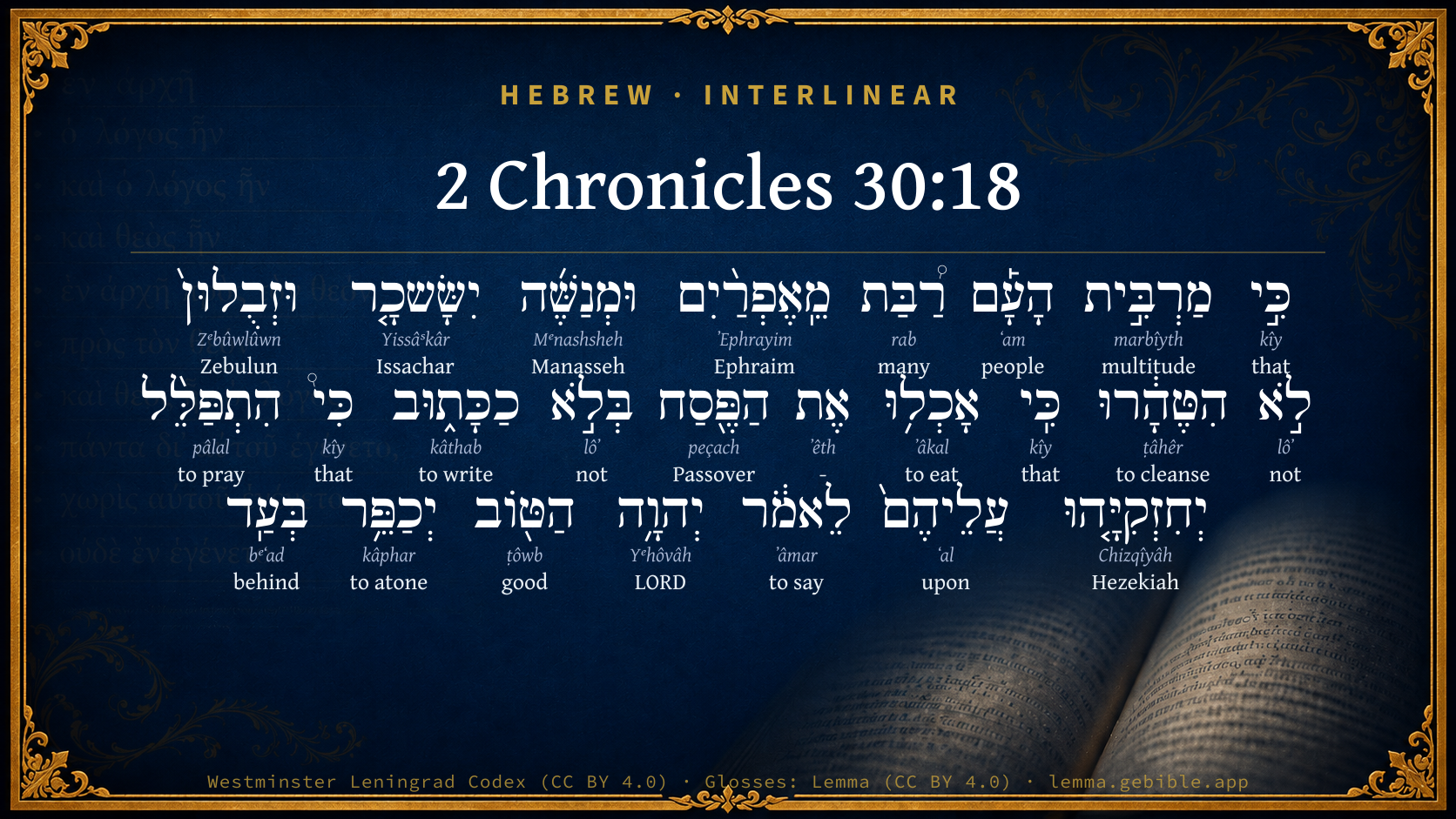
2 Chronicles 30:18

Hebrew (Westminster Leningrad Codex) 2 Chronicles 30:18 appears in the Hebrew Old Testament. The text above is from the Westminster Leningrad Codex. Each word links to its Strong’s number, a concise gloss, and parsing drawn from the Open Scriptures Hebrew Bible morphology. Click any word for its full Brown-Driver-Briggs (BDB) entry.
Download image
Cite this verse

2 Chronicles 30:18 (World English Bible). Public Domain. Lemma interlinear Bible study tool, https://lemma.gebible.app/v/2-chronicles/30/18.

Show BibTeX & RIS
BibTeX
RIS
English Translation
For a multitude of the people, even many of Ephraim and Manasseh, Issachar and Zebulun, had not cleansed themselves, yet did they eat the Passover otherwise than it is written. For Hezekiah had prayed for them, saying, The good Yahweh pardon everyone
World English Bible · Public Domain
Download a study sheet

One document with this verse’s original text, its word-by-word gloss line, the meaning frame, cross-references with their text, attributed commentary, and full source and license credits — printable, and it pastes into notes with its structure intact.

This verse Autodidact and up

Study sheet (.html) Plain text (.txt)

A passage Seminary Student

Up to 50 verses in one chapter. A passage sheet keeps up to 6 commentary sources and 12 cross-references per verse, in the order this page ranks them, and says so on the sheet whenever that leaves anything out. Ask for a single verse and you get the Autodidact verse sheet above.

Everything on this page stays free to read, with no account — the sheet is a download of what is already on screen, not access to it.

Want to remove ads? Support Godless Engineer
Compare translations 3

The same verse in 3 English versions, stacked beneath the original-language interlinear above. Click any original word for its lexicon entry.

Each is an independent rendering of the whole verse — the interlinear is not word-aligned to these translations.

Highlighted words mark where these versions differ — a whole-verse word diff, not a word-by-word alignment.

  • World English Bible Public Domain
    For a multitude of the people, even many of Ephraim and Manasseh, Issachar and Zebulun, had not cleansed themselves, yet did they eat the Passover otherwise than it is written. For Hezekiah had prayed for them, saying, The good Yahweh pardon everyone
  • King James Version Public Domain
    For a multitude of the people, even many of Ephraim, and Manasseh, Issachar, and Zebulun, had not cleansed themselves, yet did they eat the passover otherwise than it was written. But Hezekiah prayed for them, saying, The good LORD pardon every one
  • unfoldingWord Literal Text CC BY-SA 4.0
    For a multitude of the people, many from Ephraim and Manasseh, Issachar and Zebulun, had not purified themselves, but they ate the Passover, against what is written. But Hezekiah prayed for them, saying, “May Yahweh who is good atone for

unfoldingWord Literal Text — © unfoldingWord, licensed CC BY-SA 4.0. Word-aligned USFM3 via Door43 (git.door43.org/unfoldingWord/en_ult).

Versions to compare (up to 4)

3 of 4 selected

Show all 18 translations

Every available English version of this verse, each an independent rendering of the whole verse.

  • World English Bible Public Domain
    For a multitude of the people, even many of Ephraim and Manasseh, Issachar and Zebulun, had not cleansed themselves, yet did they eat the Passover otherwise than it is written. For Hezekiah had prayed for them, saying, The good Yahweh pardon everyone
  • Berean Standard Bible Public Domain
    A large number of the people—many from Ephraim, Manasseh, Issachar, and Zebulun—had not purified themselves, yet they ate the Passover, contrary to what was written. But Hezekiah interceded for them, saying, “May the LORD, who is good, provide atonement for everyone
  • Majority Standard Bible Public Domain
    A large number of the people—many from Ephraim, Manasseh, Issachar, and Zebulun—had not purified themselves, yet they ate the Passover, contrary to what was written. But Hezekiah interceded for them, saying, “May the LORD, who is good, provide atonement for everyone
  • King James Version Public Domain
    For a multitude of the people, even many of Ephraim, and Manasseh, Issachar, and Zebulun, had not cleansed themselves, yet did they eat the passover otherwise than it was written. But Hezekiah prayed for them, saying, The good LORD pardon every one
  • American Standard Version (1901) Public Domain
    For a multitude of the people, even many of Ephraim and Manasseh, Issachar and Zebulun, had not cleansed themselves, yet did they eat the passover otherwise than it is written. For Hezekiah had prayed for them, saying, The good Jehovah pardon every one
  • Revised Version (1885) Public Domain
    For a multitude of the people, even many of Ephraim and Manasseh, Issachar and Zebulun, had not cleansed themselves, yet did they eat the passover otherwise than it is written. For Hezekiah had prayed for them, saying, The good LORD pardon every one
  • Geneva Bible (1599) Public Domain
    For a multitude of the people, euen a multitude of Ephraim, and Manasseh, Issachar and Zebulun had not cleansed themselues, yet did eate the Passeouer, but not as it was written: wherefore Hezekiah prayed for them, saying, The good Lord be mercifull toward him,
  • Douay-Rheims (1899) Public Domain
    Because a great number was not sanctified: and therefore the Levites immolated the phase for them that came not in time to be sanctified to the Lord.
  • Young's Literal Translation Public Domain
    for a multitude of the people, many from Ephraim and Manasseh, Issachar, and Zebulun, have not been cleansed, but have eaten the passover otherwise than it is written; but Hezekiah prayed for them, saying, `Jehovah, who `is' good, doth receive atonement for every one
  • Literal Standard Version CC BY-SA 4.0
    for a multitude of the people, many from Ephraim, and Manasseh, Issachar, and Zebulun, have not been cleansed, but have eaten the Passover otherwise than it is written; but Hezekiah prayed for them, saying, “YHWH, who [is] good, receives atonement for everyone
  • Unlocked Literal Bible CC BY-SA 4.0
    For a great many of the people, many of them from Ephraim and Manasseh, Issachar and Zebulun, had not purified themselves, yet they ate the Passover meal, against the written instructions. For Hezekiah had prayed for them, saying, “May the good Yahweh pardon everyone
  • unfoldingWord Literal Text CC BY-SA 4.0
    For a multitude of the people, many from Ephraim and Manasseh, Issachar and Zebulun, had not purified themselves, but they ate the Passover, against what is written. But Hezekiah prayed for them, saying, “May Yahweh who is good atone for
  • Darby Bible Public Domain
    For a multitude of the people, many of Ephraim and Manasseh, Issachar and Zebulun, had not cleansed themselves, and they ate the passover otherwise than it was written. But Hezekiah prayed for them saying, Jehovah, who is good, forgive every one
  • World Messianic Bible Public Domain
    For a multitude of the people, even many of Ephraim, Manasseh, Issachar, and Zebulun, had not cleansed themselves, yet they ate the Passover other than the way it is written. For Hezekiah had prayed for them, saying, “May the good LORD pardon everyone
  • Webster's Bible Public Domain
    For a multitude of the people, even many of Ephraim, and Manasseh, Issachar, and Zebulun, had not cleansed themselves, yet they ate the passover otherwise than it was written. But Hezekiah prayed for them, saying, The good LORD pardon every one,
  • Free Bible Version CC BY-SA 4.0
    Most of the people, many of those from Ephraim, Manasseh, Issachar, and Zebulun, had not purified themselves. Yet they ate the Passover meal even though this was not what the Law required, for Hezekiah had prayed for them, saying, “May the good Lord forgive everyone
  • Bible in Basic English Public Domain
    For a great number of the people from Ephraim and Manasseh, Issachar and Zebulun, had not made themselves clean, but they took the Passover meal, though not in the right way. For Hezekiah had made prayer for them, saying, May the good Lord have mercy on everyone
  • JPS Tanakh (1917) Public Domain
    For a multitude of the people, even many of Ephraim and Manasseh, Issachar and Zebulun, had not cleansed themselves, yet did they eat the passover otherwise than it is written. For Hezekiah had prayed for them, saying: 'The good LORD pardon

Literal Standard Version (2020), Covenant Press — licensed CC BY-SA 4.0. Text via the HelloAO Bible API (eBible.org). Unlocked Literal Bible (unfoldingWord) — licensed CC BY-SA 4.0. Text via the HelloAO Bible API (eBible.org). unfoldingWord Literal Text — © unfoldingWord, licensed CC BY-SA 4.0. Word-aligned USFM3 via Door43 (git.door43.org/unfoldingWord/en_ult). Free Bible Version, Dr. Jonathan Gallagher — licensed CC BY-SA 4.0. Text via the HelloAO Bible API (eBible.org).

Word by word

More ways to search: Search by grammar → Find every occurrence → Compare this word →

Practice this passage: Drill this verse → Learn its vocabulary →

מַרְבִּ֣ית
marbîyth
H4768
“multitude of”
Noun, Common, Feminine, Singular, Construct
Part of Speech
Noun
Type
Common
Gender
Feminine
Number
Singular
State
Construct
Full BDB Definition

Origin: from H7235

TWOT: 2103d

increase, great number, multitude, greatness - increase - of family - increment, interest, usury - great number (of people) - greatness (of wisdom)
  1. כִּ֣י kîy H3588 “that” Conjunction
  2. הָעָ֡ם ʻam H5971 “the · people” Particle, Definite Article + Noun, Common, Masculine, Singular, Absolute
  3. רַ֠בַּת rab H7227 “many of” Adjective, Adjective, Feminine, Singular, Construct
  4. מֵֽאֶפְרַ֨יִם ʼEphrayim H669 “from · Ephraim” Preposition + Noun, Proper
  5. וּמְנַשֶּׁ֜ה Mᵉnashsheh H4519 “and · Manasseh” Conjunction + Noun, Proper
  6. יִשָּׂשכָ֤ר Yissâˢkâr H3485 “Issachar” Noun, Proper
  7. וּזְבֻלוּן֙ Zᵉbûwlûwn H2074 “and · Zebulun” Conjunction + Noun, Proper
  8. לֹ֣א lôʼ H3808 “not” Particle, Negative
  9. הִטֶּהָ֔רוּ ṭâhêr H2891 “to cleanse” Verb, Hithpael, Perfect, 3rd Person, Common, Plural
  10. כִּֽי kîy H3588 “that” Conjunction
  11. אָכְל֥וּ ʼâkal H398 “to eat” Verb, Qal, Perfect, 3rd Person, Common, Plural
  12. אֶת ʼêth H853 “-” Particle, Direct Object
  13. הַפֶּ֖סַח peçach H6453 “the · Passover” Particle, Definite Article + Noun, Common, Masculine, Singular, Absolute
  14. בְּלֹ֣א lôʼ H3808 “in/at · not” Preposition + Particle, Negative
  15. כַכָּת֑וּב kâthab H3789 “like/as the · written” Preposition, Determined + Verb, Qal, Participle Passive, Masculine, Singular, Absolute
  16. כִּי֩ kîy H3588 “that” Conjunction
  17. הִתְפַּלֵּ֨ל pâlal H6419 “to pray” Verb, Hithpael, Perfect, 3rd Person, Masculine, Singular
  18. יְחִזְקִיָּ֤הוּ Chizqîyâh H2396 “Hezekiah” Noun, Proper
  19. עֲלֵיהֶם֙ ʻal H5921 “upon · them” Preposition + Suffix, Personal, 3rd Person, Masculine, Plural
  20. לֵאמֹ֔ר ʼâmar H559 “to say” Preposition + Verb, Qal, Infinitive Construct
  21. יְהוָ֥ה Yᵉhôvâh H3068 “LORD” Noun, Proper
  22. הַטּ֖וֹב ṭôwb H2896 “the · good” Particle, Definite Article + Adjective, Adjective, Masculine, Singular, Absolute
  23. יְכַפֵּ֥ר kâphar H3722 “to atone” Verb, Piel, Imperfect, 3rd Person, Masculine, Singular
  24. בְּעַֽד bᵉʻad H1157 “behind” Preposition

About this verse

These counts appear in no published source. They are computed here, from the morphology-tagged text and Lemma’s own curated glosses. What Lemma adds →

25
words
22
distinct lemmas
Historical
section

Notable vocabulary

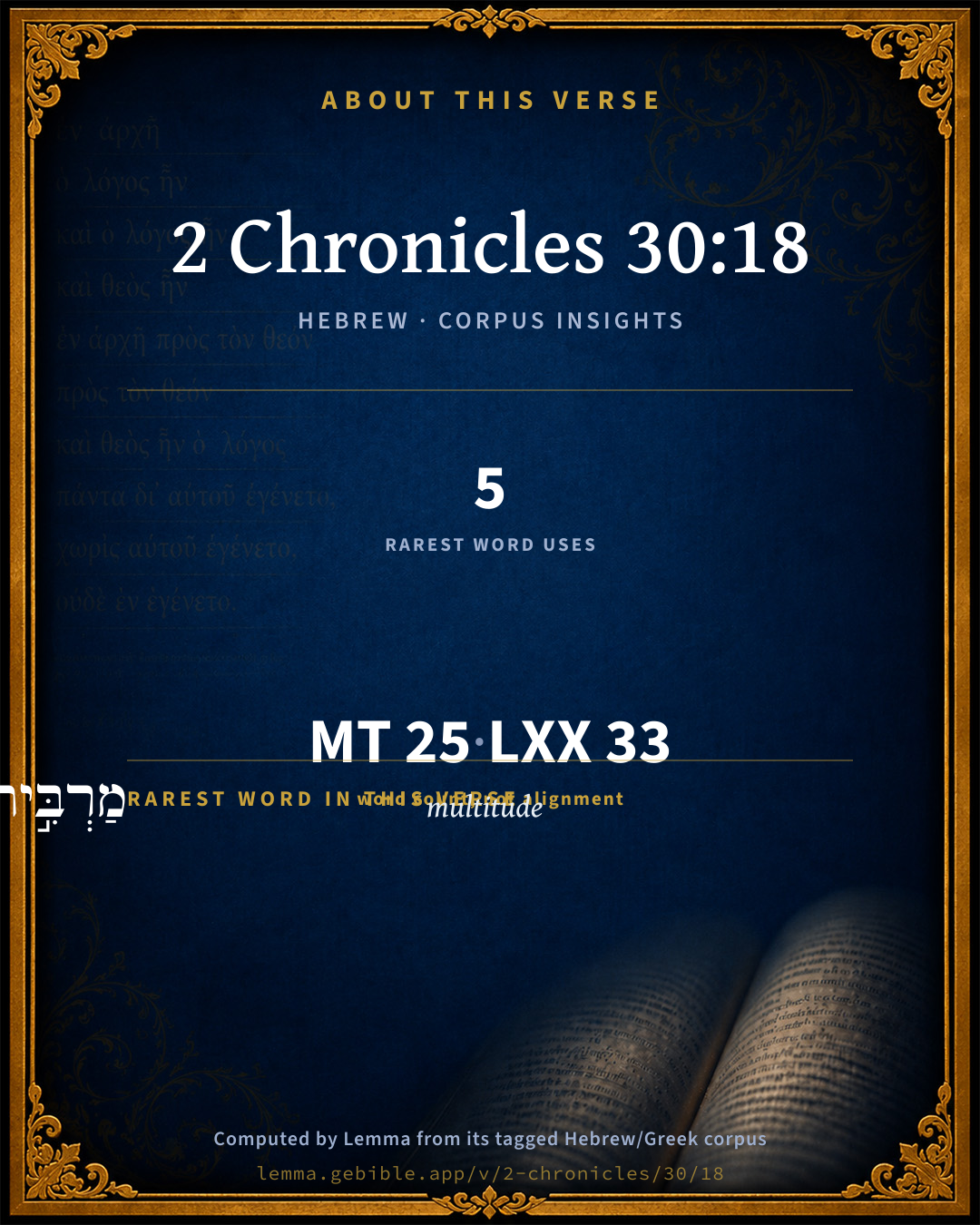
The rarest word here is מַרְבִּ֣ית multitude H4768 — appearing just 5 times in the whole Hebrew Bible.

Shared distinctive vocabulary

מַרְבִּ֣ית multitude H4768 occurs in 5 verses of the Hebrew Bible. Also found in:

Grammatical profile

  • 6 verbs
  • 9 nouns
  • 2 adjectives
  • 2 prepositions
  • 3 conjunctions
  • 3 particles

Verb forms

  • הִטֶּהָ֔רוּ Hithpael · Perfect
  • אָכְל֥וּ Qal · Perfect
  • כַכָּת֑וּב Qal · Participle Passive
  • הִתְפַּלֵּ֨ל Hithpael · Perfect
  • לֵאמֹ֔ר Qal · Infinitive Construct
  • יְכַפֵּ֥ר Piel · Imperfect

Repetition

Words recur within this verse — often emphatic in Hebrew:

  • כִּ֣י that H3588 ×3
  • לֹ֣א not H3808 ×2

Hebrew & Septuagint length

In English translation the verse runs 42 words from the Hebrew and 36 from the Septuagint (LXX English) — closely comparable.

A rough comparison of the two English renderings, which tokenize alike — not a word-level alignment.

Word counts can differ between the Hebrew and the Greek without any difference in meaning — e.g. the Hebrew direct-object marker אֵת has no separate Greek word, and Greek often adds the article ὁ.

In the original languages it is 25 Hebrew tokens and 33 Greek tokens — but the two are counted differently (Hebrew bundles its prefixes and suffixes into one token; the Greek is in lemma form), so that isn’t a like-for-like length.

Cross-references

19

Topical passages linked to 2 Chronicles 30:18 in the Treasury of Scripture Knowledge — connected by theme and wording, ordered by reader-vote popularity; previews shown in the World English Bible.

  • 1 Corinthians 11:28 But let a man examine himself, and so let him eat of the bread, and drink of the cup.
  • James 5:15–16 and the prayer of faith will heal him who is sick, and the Lord will raise him up. If he has committed sins, he will be forgiven.
  • Numbers 9:10–14 "Say to the children of Israel, 'If any man of you or of your generations is unclean by reason of a dead body, or is on a journey far away, he shall still keep the Passover to Yahweh.
  • 2 Chronicles 6:21 Listen you to the petitions of your servant, and of your people Israel, when they shall pray toward this place: yes, hear from your dwelling-place, even from heaven; and when you hear, forgive.
  • Daniel 9:19 Lord, hear; Lord, forgive; Lord, listen and do; don't defer, for your own sake, my God, because your city and your people are called by your name.
  • Genesis 20:7 Now therefore, restore the man's wife. For he is a prophet, and he will pray for you, and you will live. If you don't restore her, know for sure that you will die, you, and all who are yours."
  • Exodus 12:43–51 Yahweh said to Moses and Aaron, "This is the ordinance of the Passover. There shall no foreigner eat of it,
  • Numbers 19:20 But the man who shall be unclean, and shall not purify himself, that soul shall be cut off from the midst of the assembly, because he has defiled the sanctuary of Yahweh: the water for impurity has not been sprinkled on him; he is unclean.
  • 2 Chronicles 30:11 Nevertheless certain men of Asher and Manasseh and of Zebulun humbled themselves, and came to Jerusalem.
  • 2 Chronicles 30:25 All the assembly of Judah, with the priests and the Levites, and all the assembly who came out of Israel, and the foreigners who came out of the land of Israel, and who lived in Judah, rejoiced.
  • Psalms 25:8 Good and upright is Yahweh, Therefore he will instruct sinners in the way.
  • Genesis 20:17 Abraham prayed to God. God healed Abimelech, and his wife, and his maid-servants, and they bore children.
  • Exodus 34:6–9 Yahweh passed by before him, and proclaimed, "Yahweh! Yahweh, a merciful and gracious God, slow to anger, and abundant in loving kindness and truth,
  • Numbers 14:18–20 Yahweh is slow to anger, and abundant in loving kindness, forgiving iniquity and disobedience; and that will by no means clear [the guilty], visiting the iniquity of the fathers on the children, on the third and on the fourth generation.
  • Job 42:8–9 Now therefore, take to yourselves seven bulls and seven rams, and go to my servant Job, and offer up for yourselves a burnt offering; and my servant Job shall pray for you, for I will accept him, that I not deal with you according to your folly. For you have not spoken of me the thing that is right, as my servant Job has."
  • Psalms 86:5 For you, Lord, are good, and ready to forgive; Abundant in loving kindness to all those who call on you.
  • Psalms 119:68 You are good, and do good. Teach me your statutes.
  • 1 John 5:16 If anyone sees his brother sinning a sin not leading to death, he shall ask, and God will give him life for those who sin not leading to death. There is a sin leading to death. I don't say that he should make a request concerning this.
  • Psalms 36:5 Your loving kindness, Yahweh, is in the heavens. Your faithfulness reaches to the skies.

Cross-references courtesy of OpenBible.info (CC BY 4.0).

Hebrew and Greek witnesses Masoretic Hebrew ↔ Greek Septuagint

The same verse in the two great witnesses to the Old Testament, shown verse-for-verse.

These are two independent witnesses, not word-aligned to each other, and the Septuagint is shown in lemma (dictionary) form.

Hebrew 2 Chronicles 30:18 Masoretic · Westminster Leningrad Codex

כִּ֣י מַרְבִּ֣ית הָעָ֡ם רַ֠בַּת מֵֽאֶפְרַ֨יִם וּמְנַשֶּׁ֜ה יִשָּׂשכָ֤ר וּזְבֻלוּן֙ לֹ֣א הִטֶּהָ֔רוּ כִּֽי אָכְל֥וּ אֶת הַפֶּ֖סַח בְּלֹ֣א כַכָּת֑וּב כִּי֩ הִתְפַּלֵּ֨ל יְחִזְקִיָּ֤הוּ עֲלֵיהֶם֙ לֵאמֹ֔ר יְהוָ֥ה הַטּ֖וֹב יְכַפֵּ֥ר בְּעַֽד

For a multitude of the people, even many of Ephraim and Manasseh, Issachar and Zebulun, had not cleansed themselves, yet did they eat the Passover otherwise than it is written. For Hezekiah had prayed for them, saying, The good Yahweh pardon everyone

World English Bible · Public Domain

Greek LXX 2 Chronicles 30:18 Septuagint · lemma form

ὅτι ὁ πολύς ὁ λαός ἀπό ἐφράιμ καί μανασσή καί ισσαχαρ καί ζαβουλων οὐ ἁγνίζω ἀλλά ἐσθίω ὁ φασεκ παρά ὁ γραφή καί προςεὔχομαι εζεκιας περί αὐτός λέγω κύριος ὁ ἀγαθός ἐκἱλάσκομαι ὑπέρ

For the greatest part of the people of Ephraim, and Manasse, and Issachar, and Zabulon, had not purified themselves, but ate the passover contrary to the scripture. On this account also Ezekias prayed concerning them, saying,

LXX2012 (modern English Septuagint) · Public Domain

Hebrew: Westminster Leningrad Codex (CC BY 4.0). Greek: Septuagint (public domain); English from LXX2012 (modern English Septuagint) (Public Domain). How the Septuagint differs from the Hebrew →

Commentary

Notes on 2 Chronicles 30:18 from classic Christian and Jewish commentators (each source and its license shown beneath its notes). The classic Christian expositions comment on the surrounding passage and are grouped to its opening verse, so a note may address several verses; the Jewish commentaries on the Tanakh (Rashi and others) are per-verse, so they appear only where the commentator wrote on this verse.

Lemma curates 59 commentaries, every one of them public domain or Creative Commons licensed, each selected and text-cleaned for this edition rather than reprinted as found. About our sources →

The Cambridge Bible for Schools and Colleges

gen. ed. J. J. S. Perowne

18. of Ephraim etc.] The list of tribes given here does not agree with the list in 2Ch_30:11, but in both cases it is probable that the Chronicler merely wishes by his list to designate men of the Northern Kingdom as opposed to those of the Southern. He could not make the distinction by using the term “Israel” here, for in Chron. “Israel” as a rule is not used in opposition to “Judah”; cp. 2Ch_11:3 (note).

it was written] R.V. it is written i.e. in the Mosaic Law.

But Hezekiah prayed] R.V. For Hezekiah had prayed.

The good Lord pardon] According to the Heb. division 2Ch_30:18 ends with the word “pardon,” in the middle of the clause, as the A.V. (and R.V.) translate it. It is probable, however, that this Heb. division is right, and that it is the order of the words which needs correction. The phrase “the good Lord” (i.e. Jehovah “the good”) has no parallel in Heb. and is open to suspicion, but by a simple transposition we get, The LORD pardon the good. For “the good” cp. 2Ch_19:11.

18, 19. every one that prepareth his heart] Render, even him that setteth his whole heart (cp. R.V. mg.). This clause defines the preceding phrase (“The good”); see last note.

The Cambridge Bible for Schools and Colleges (gen. ed. J. J. S. Perowne; Cambridge University Press, 1878–1918) — public domain. Text from a community e-Sword module.

Trapp's Complete Commentary

John Trapp

2Ch 30:18 For a multitude of the people, [even] many of Ephraim, and Manasseh, Issachar, and Zebulun, had not cleansed themselves, yet did they eat the passover otherwise than it was written. But Hezekiah prayed for them, saying, The good LORD pardon every one

Ver. 18. Many of Ephraim and Manasseh, &c.] Who had been a long while without God, without law, and without a teaching priest; {2Ch 15:3} these came rudely and unreverently to the passover, and some way smarted for it. In the gospel, he that came in without a wedding garment on his back, went not out without fetters on his feet. And "for this cause many are weak and sickly amongst you, and some are fallen asleep," i.e., dead outright. {1Co 11:30}

The good Lord pardon every one.] Iehovah optimus praestet Spiritu suo quod isti temporis importunitate praetermiserunt: the good Lord make us by his Spirit, what, through want of time or means, is wanting to this poor people, and graciously accept their weak but willing services, &c.

John Trapp, A Commentary or Exposition upon All the Books of the Old and New Testament (1647–1656) — public domain. Text from a community e-Sword module.

Joseph Benson's Commentary

2Ch 30:18. A multitude of the people had not cleansed themselves — Either they did not know, after such a long night of ignorance and superstition, what ceremonies were required, in order to their purification, or they had not time to use them. Yet having an eager and pious desire to commemorate their wonderful deliverance out of the Egyptian bondage, they were permitted, in their uncleanness, to eat the passover, lest they should be discouraged if they were denied it, in this their return to the true religion. But Hezekiah prayed for them — It was his zeal that had called them together in such haste, and he would not that they should fare the worse for being straitened for time in their preparation. He therefore thought himself concerned to be an intercessor for those that ate the passover otherwise than it was written. And he had confidence that God was so gracious that he would not, on account of the omission of some prescribed ceremony, be wroth with men whose hearts were upright before him.

Joseph Benson's Commentary on the Old and New Testaments (1811–1818) — public domain. Text from a community e-Sword module.

Geneva Bible (1599)

Geneva Bible translators

He knew that faith and sincerity of heart was more agreeable to God, than the observation of the ceremonies, and therefore he prayed unto God to pardon this fault unto the people which did not offend of malice but of ignorance.

Geneva Bible (1599) marginal notes — public domain. Text via Bolls.life.

Adam Clarke's Commentary

Verse 18. A multitude of the people - had not cleansed themselves] As there were men from Ephraim, Manasseh, Issachar, and Zebulun, they were excusable, because they came from countries that had been wholly devoted to idolatry.

The good Lord pardon every one] "The Lord, who is good, have mercy on this people who err." - T.

Adam Clarke's Commentary on the Bible (1810–1826) — public domain. Text from a community e-Sword/MySword module.

Ellicott's Commentary for English Readers

(18) A multitude.—Marbîth (2chron 96; 1Ch_12:29). Only in the Chronicles in this sense. Else where the term means “increase” of children (1Sa_2:33), or of money, i.e., interest (τόκον, Lev_25:37).

Ephraim . . . Zebulun.—The names indicate a documental source.

Had not cleansed themselves.—As was natural in the case of persons who had long been estranged from the legal religion of Jehovah (hittèhârû, pausal form of hittâharû, Ezr_6:20, occurs here only).

Yet did they eat . . . written.—But ate the Passover in non-accordance with the Scripture—i.e., in illegal fashion, being themselves unclean. (Comp. Num_9:6, seq., according to which unclean persons ‘were bound to abstain from eating the Passover until the fourteenth of the second month.)

But Hezekiah prayed.—For Hezekiah had prayed for them, and therefore their irregularity was condoned,

The good Lord.—Jehovah the good; so only here. (Comp. Psa_25:8.)

Good—i.e., kind, generous; benignus, benevolus.

Pardon every one.—Properly, make atonement on behalf of every one (kipper bĕ ‘ad): Lev_16:6; Lev_16:11. In the sense of forgive the construction is different: Psa_65:4; Eze_16:63.

A Bible Commentary for English Readers, edited by Charles John Ellicott (1878–1897) — public domain. Text from a community e-Sword module.

John Gill's Exposition

That prepareth his heart to seek God, the Lord God of his fathers,.... Who was heartily desirous of worshipping God, and observing his ordinances, which had been enjoined their fathers, and they had kept; though Aben Ezra, as Kimchi observes, refers this to Hezekiah:

whose whole heart he directed, or prepared to seek the Lord, &c. by prayer and supplication for everyone of the said persons:

though he be not cleansed according to the purification of the sanctuary: according to the ceremonial law, which the service of the temple required; since, though they were attended with a ceremonial impurity, had a moral purity, and their hearts were right with God.

John Gill's Exposition of the Whole Bible (1746–1763) — public domain (CC PDM 1.0). Text via the HelloAO Bible API.

Haydock's Catholic Bible Commentary

Ephraim and....Issachar had not been mentioned before, v. 18. H. --- Some indulgence was shewn to the tribes of Israel, which had been so long rebellious, for fear lest they should return no more; and because they had shewn a good will in procuring the Levites to slay the victims for them, as that was rightly judged a more sacred action than to partake of the feast. The law forbade, nevertheless, the unclean to approach to any thing sacred, Lev. xv. 31., and xxii. 4., and Num. ix. 6. C. --- But a dispensation was granted, (M.) as the Passover could not be celebrated in any but the first or the second month. The people had come with such eagerness, that they had not time to acquire the purity required. C. --- They were however truly penitent, and God dispensed with them. W.

George Leo Haydock (1774–1849), Haydock's Catholic Family Bible and Commentary, 1859 edition — public domain. Excludes Psalms (Douay-Rheims chapter numbering differs from Protestant) and Deuterocanonical books (Catholic canon only).

Matthew Poole's English Annotations

Otherwise than it was written: they had so eager a desire to partake of this ordinance, that, rather than neglect it, they would venture upon it with some ceremonial uncleanness upon them.

Matthew Poole's English Annotations on the Holy Bible (1683–1685) — public domain. Text from a community e-Sword/MySword module.

Whedon's Commentary on the Bible

Daniel D. Whedon

18. Many of Ephraim and Manasseh, Issachar and Zebulun, had not cleansed themselves — Being at a distance and unfamiliar with the ceremonial requirements, they had nevertheless responded to Hezekiah’s call, (2Ch_30:11,) and the king decided that in their case an exception should be made, and he accordingly prayed the Lord to pardon the defect. In this prayer of Hezekiah we note that loftier view of worship which discerns, in the pure desire of an humble heart, something better than bondage to the mere letter of the law.

Daniel D. Whedon (gen. ed.), Commentary on the Old and New Testaments (1874–1909) — public domain. Text from a community e-Sword module.

The Pulpit Commentary

So also the original Law of Moses prescribed that the uncleansed must not eat the Passover. (Num_9:6)

The Pulpit Commentary (1880–1919), ed. H.D.M. Spence-Jones & Joseph S. Exell — public domain. Text from a community e-Sword module.

unfoldingWord translationNotes

Door43 World Missions Community

Ephraim and Manasseh, Issachar and Zebulun

These are the names of some of the tribes that lived in the northern part of Israel. See how you translated "Zebulun" in 2 Chronicles 30:10. (See: How to Translate Names)

against the written instructions

To do something "against" instructions means to do something that is not in obedience to the instructions. If needed, the instructions can be stated clearly. AT: "even though the written instructions said that they must purify themselves first" (See: Assumed Knowledge and Implicit Information)

the good Yahweh

The word "good" here is a reminder to the people that Yahweh is kind. AT: "Yahweh, who is good" (See: Distinguishing versus Informing or Reminding)

everyone who sets his heart to seek God

Here "sets his heart" is a metaphor for being determined to do something, and "to seek God" is a metaphor for knowing, worshiping, and obeying him. AT: "everyone who is determined to obey God" or "everyone who truly wants to honor God" (See: Metaphor)

So Yahweh listened to Hezekiah

This implies that Yahweh responded favorably to Hezekiah. AT: "So Yahweh responded favorably to Hezekiah" or "So Yahweh did what Hezekiah asked" (See: Assumed Knowledge and Implicit Information)

healed the people

Here "healed the people" is a metaphor for forgiving the people and not punishing them. AT: "forgave the people" or "did not punish the people" (See: Metaphor)

translationWords

Issachar

written

Hezekiah

pray

good

forgive

cure

unfoldingWord translationNotes — © Distant Shores Media and the Door43 World Missions Community, licensed CC BY-SA 4.0. Source: git.door43.org/Door43/en_tn.

Rashi

Rabbi Shlomo Yitzchaki (Rashi)

for they ate the Passover sacrifice not as it is written not in accordance with halachah, for they ate it in a state of uncleanness, for Hezekiah prayed for them, saying, etc.

Rashi on the Tanakh — English translations: “The Judaica Press complete Tanach with Rashi, translated by A. J. Rosenberg” (CC BY 4.0); “Pentateuch with Rashi's commentary by M. Rosenbaum and A.M. Silbermann, 1929-1934” (public domain); “The Metsudah Tanach series, Lakewood, N.J” (CC BY 4.0); and “The Book of Joshua, Metsudah Publications, 1997” (CC BY 4.0). Text via Sefaria.

Lesson kit

Teaching starters — assembled from the data on this page, not authored interpretation. Every prompt links to the verse data it draws on. Edit before teaching.

2 Chronicles, in the Historical, opens this verse with 25 words (22 distinct Hebrew lemmas). Its most distinctive word is marbîyth (“multitude”). A historical commentator’s framing appears above. Read the whole chapter for the surrounding context.

Discussion questions

  1. What does “multitude” (marbîyth) contribute to the verse as a whole?
  2. Leviticus 25:37 shares the word «multitude» with this verse. How do the two illuminate each other?
  3. “that” occurs 3× in this one verse. What is the effect of the repetition?
  4. These translations render this verse differently; the difference is in the English rendering, not the original. What questions does that raise?
  5. The verb «הִטֶּהָ֔רוּ» is Hithpael Perfect. How does its form color the action?
  6. Reading how The Cambridge Bible for Schools and Colleges and Trapp's Complete Commentary read this verse, where do the two commentators agree and where do they part?

Things to notice

Reading settings

Reading text

Shown beneath each verse's original-language words.

Old Testament
Old Testament edition

Read the OT as the Masoretic Hebrew (MT) or the Greek Septuagint (LXX).

English shown for the Greek Septuagint (in the Hebrew ↔ Greek comparison).

Comparing translations? Open the Compare panel on any verse page to stack up to four side by side.