
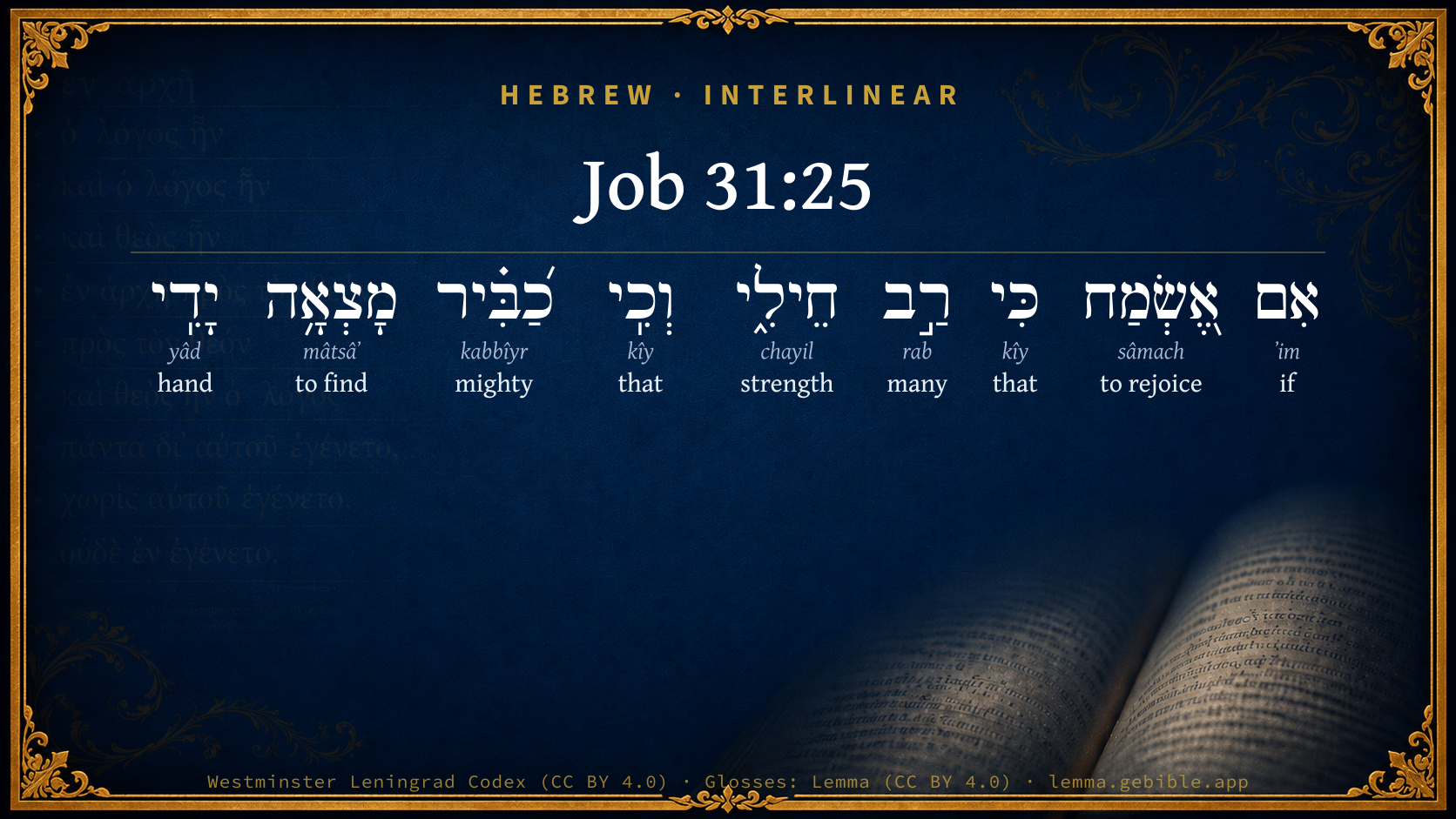
Job 31:25

Hebrew (Westminster Leningrad Codex) Job 31:25 appears in the Hebrew Old Testament. The text above is from the Westminster Leningrad Codex. Each word links to its Strong’s number, a concise gloss, and parsing drawn from the Open Scriptures Hebrew Bible morphology. Click any word for its full Brown-Driver-Briggs (BDB) entry.
Download image
Cite this verse

Job 31:25 (World English Bible). Public Domain. Lemma interlinear Bible study tool, https://lemma.gebible.app/v/job/31/25.

Show BibTeX & RIS
BibTeX
RIS
English Translation
If I have rejoiced because my wealth was great, And because my hand had gotten much;
World English Bible · Public Domain
Download a study sheet

One document with this verse’s original text, its word-by-word gloss line, the meaning frame, cross-references with their text, attributed commentary, and full source and license credits — printable, and it pastes into notes with its structure intact.

This verse Autodidact and up

Study sheet (.html) Plain text (.txt)

A passage Seminary Student

Up to 50 verses in one chapter. A passage sheet keeps up to 6 commentary sources and 12 cross-references per verse, in the order this page ranks them, and says so on the sheet whenever that leaves anything out. Ask for a single verse and you get the Autodidact verse sheet above.

Everything on this page stays free to read, with no account — the sheet is a download of what is already on screen, not access to it.

Want to remove ads? Support Godless Engineer
Compare translations 3

The same verse in 3 English versions, stacked beneath the original-language interlinear above. Click any original word for its lexicon entry.

Each is an independent rendering of the whole verse — the interlinear is not word-aligned to these translations.

Highlighted words mark where these versions differ — a whole-verse word diff, not a word-by-word alignment.

  • World English Bible Public Domain
    If I have rejoiced because my wealth was great, And because my hand had gotten much;
  • King James Version Public Domain
    If I rejoice because my wealth was great, and because mine hand had gotten much;
  • unfoldingWord Literal Text CC BY-SA 4.0
    if I have rejoiced because my wealth great and because my hand had acquired much!

unfoldingWord Literal Text — © unfoldingWord, licensed CC BY-SA 4.0. Word-aligned USFM3 via Door43 (git.door43.org/unfoldingWord/en_ult).

Versions to compare (up to 4)

3 of 4 selected

Show all 18 translations

Every available English version of this verse, each an independent rendering of the whole verse.

  • World English Bible Public Domain
    If I have rejoiced because my wealth was great, And because my hand had gotten much;
  • Berean Standard Bible Public Domain
    if I have rejoiced in my great wealth because my hand had gained so much,
  • Majority Standard Bible Public Domain
    if I have rejoiced in my great wealth because my hand had gained so much,
  • King James Version Public Domain
    If I rejoice because my wealth was great, and because mine hand had gotten much;
  • American Standard Version (1901) Public Domain
    If I have rejoiced because my wealth was great, And because my hand had gotten much;
  • Revised Version (1885) Public Domain
    If I rejoiced because my wealth was great, and because mine hand had gotten much;
  • Geneva Bible (1599) Public Domain
    If I reioyced because my substance was great, or because mine hand had gotten much,
  • Douay-Rheims (1899) Public Domain
    If I have rejoiced over my great riches, and because my hand had gotten much.
  • Young's Literal Translation Public Domain
    If I rejoice because great `is' my wealth, And because abundance hath my hand found,
  • Literal Standard Version CC BY-SA 4.0
    If I rejoice because my wealth [is] great, || And because my hand has found abundance,
  • Unlocked Literal Bible CC BY-SA 4.0
    if I have rejoiced because my wealth was great, because my hand had gotten many possessions, then bring charges against me!
  • unfoldingWord Literal Text CC BY-SA 4.0
    if I have rejoiced because my wealth great and because my hand had acquired much!
  • Darby Bible Public Domain
    If I rejoiced because my wealth was great, and because my hand had gotten much;
  • World Messianic Bible Public Domain
    If I have rejoiced because my wealth was great, and because my hand had gotten much;
  • Webster's Bible Public Domain
    If I have rejoiced because my wealth was great, and because my hand had gained much;
  • Free Bible Version CC BY-SA 4.0
    Have I delighted in being rich, happy at all my wealth I had gained?
  • Bible in Basic English Public Domain
    If I was glad because my wealth was great, and because my hand had got together a great store;
  • JPS Tanakh (1917) Public Domain
    If I rejoiced because my wealth was great, and because my hand had gotten much;

Literal Standard Version (2020), Covenant Press — licensed CC BY-SA 4.0. Text via the HelloAO Bible API (eBible.org). Unlocked Literal Bible (unfoldingWord) — licensed CC BY-SA 4.0. Text via the HelloAO Bible API (eBible.org). unfoldingWord Literal Text — © unfoldingWord, licensed CC BY-SA 4.0. Word-aligned USFM3 via Door43 (git.door43.org/unfoldingWord/en_ult). Free Bible Version, Dr. Jonathan Gallagher — licensed CC BY-SA 4.0. Text via the HelloAO Bible API (eBible.org).

Word by word

More ways to search: Search by grammar → Find every occurrence → Compare this word →

Practice this passage: Drill this verse → Learn its vocabulary →

About this verse

These counts appear in no published source. They are computed here, from the morphology-tagged text and Lemma’s own curated glosses. What Lemma adds →

9
words
8
distinct lemmas
Wisdom
section

Notable vocabulary

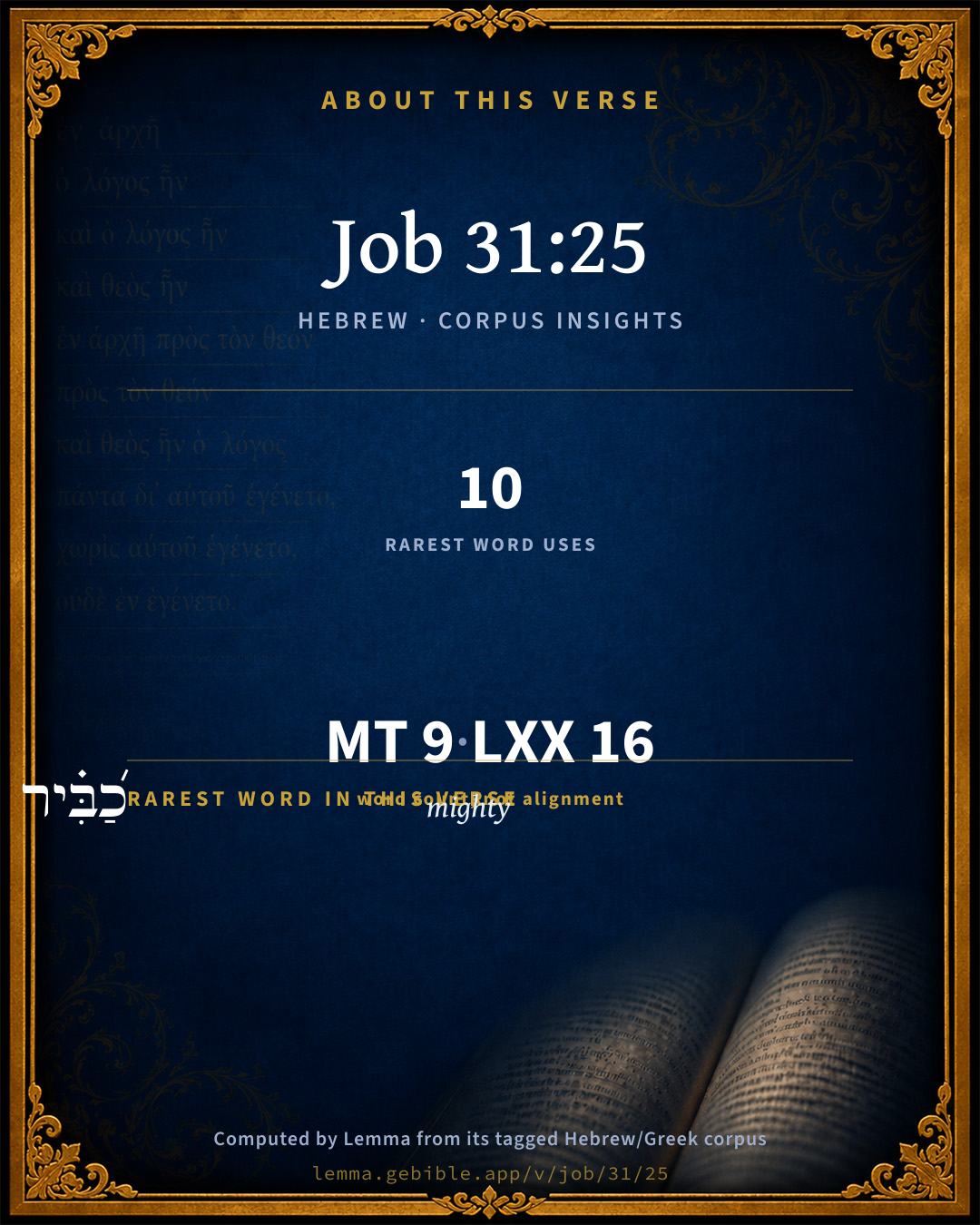
The rarest word here is כַ֝בִּ֗יר mighty H3524 — appearing just 10 times in the whole Hebrew Bible.

Shared distinctive vocabulary

כַ֝בִּ֗יר mighty H3524 occurs in 9 verses of the Hebrew Bible. Also found in:

Grammatical profile

  • 2 verbs
  • 2 nouns
  • 2 adjectives
  • 3 conjunctions

Verb forms

  • אֶ֭שְׂמַח Qal · Imperfect
  • מָצְאָ֥ה Qal · Perfect

Repetition

A word recurs within this verse — often emphatic in Hebrew:

  • כִּי that H3588 ×2

Hebrew & Septuagint length

In English translation the verse runs 16 words from the Hebrew and 20 from the Septuagint (LXX English) — closely comparable.

A rough comparison of the two English renderings, which tokenize alike — not a word-level alignment.

Word counts can differ between the Hebrew and the Greek without any difference in meaning — e.g. the Hebrew direct-object marker אֵת has no separate Greek word, and Greek often adds the article ὁ.

In the original languages it is 9 Hebrew tokens and 16 Greek tokens — but the two are counted differently (Hebrew bundles its prefixes and suffixes into one token; the Greek is in lemma form), so that isn’t a like-for-like length.

Cross-references

13

Topical passages linked to Job 31:25 in the Treasury of Scripture Knowledge — connected by theme and wording, ordered by reader-vote popularity; previews shown in the World English Bible.

  • Psalms 62:10 Don't trust in oppression. Don't become vain in robbery. If riches increase, Don't set your heart on them.
  • Deuteronomy 8:17–18 and [lest] you say in your heart, My power and the might of my hand has gotten me this wealth.
  • Esther 5:11 Haman recounted to them the glory of his riches, and the multitude of his children, and all the things in which the king had promoted him, and how he had advanced him above the princes and servants of the king.
  • Proverbs 23:5 Why do you set your eyes on that which is not? For it certainly sprouts wings like an eagle and flies in the sky.
  • Isaiah 10:13–14 For he has said, By the strength of my hand I have done it, and by my wisdom; for I have understanding: and I have removed the bounds of the peoples, and have robbed their treasures, and like a valiant man I have brought down those who sit [on thrones]:
  • Jeremiah 9:23 Thus says Yahweh, Don't let the wise man glory in his wisdom, neither let the mighty man glory in his might, don't let the rich man glory in his riches;
  • Ezekiel 28:5 by your great wisdom [and] by your traffic have you increased your riches, and your heart is lifted up because of your riches;-
  • Daniel 4:30 The king spoke and said, Is not this great Babylon, which I have built for the royal dwelling-place, by the might of my power and for the glory of my majesty?
  • Hosea 12:8 Ephraim said, "Surely I have become rich, I have found myself wealth. In all my wealth they won't find in me any iniquity that is sin."
  • Habakkuk 1:16 Therefore he sacrifices to his net, and burns incense to his dragnet, because by them his life is luxurious, and his food is good.
  • Luke 12:19 I will tell my soul, "Soul, you have many goods laid up for many years. Take your ease, eat, drink, be merry."'
  • Luke 16:19 "Now there was a certain rich man, and he was clothed in purple and fine linen, living in luxury every day.
  • Luke 16:25 "But Abraham said, 'Son, remember that you, in your lifetime, received your good things, and Lazarus, in like manner, bad things. But now here he is comforted and you are in anguish.

Cross-references courtesy of OpenBible.info (CC BY 4.0).

Hebrew and Greek witnesses Masoretic Hebrew ↔ Greek Septuagint

The same verse in the two great witnesses to the Old Testament, shown verse-for-verse.

These are two independent witnesses, not word-aligned to each other, and the Septuagint is shown in lemma (dictionary) form.

Hebrew Job 31:25 Masoretic · Westminster Leningrad Codex

אִם אֶ֭שְׂמַח כִּי רַ֣ב חֵילִ֑י וְכִֽי כַ֝בִּ֗יר מָצְאָ֥ה יָדִֽי

If I have rejoiced because my wealth was great, And because my hand had gotten much;

World English Bible · Public Domain

Greek LXX Job 31:25 Septuagint · lemma form

εἰ δέ καί εὐφραίνω πολύς πλοῦτος ἐγώ γίγνομαι εἰ δέ καί ἐπί ἀναρίθμητος τίθημι χείρ ἐγώ

and if too I rejoiced when my wealth was abundant, and if too I laid my hand on innumerable treasures:

LXX2012 (modern English Septuagint) · Public Domain

Hebrew: Westminster Leningrad Codex (CC BY 4.0). Greek: Septuagint (public domain); English from LXX2012 (modern English Septuagint) (Public Domain). How the Septuagint differs from the Hebrew →

Commentary

Notes on Job 31:25 from classic Christian and Jewish commentators (each source and its license shown beneath its notes). The classic Christian expositions comment on the surrounding passage and are grouped to its opening verse, so a note may address several verses; the Jewish commentaries on the Tanakh (Rashi and others) are per-verse, so they appear only where the commentator wrote on this verse.

Lemma curates 59 commentaries, every one of them public domain or Creative Commons licensed, each selected and text-cleaned for this edition rather than reprinted as found. About our sources →

Trapp's Complete Commentary

John Trapp

Job 31:25 If I rejoiced because my wealth [was] great, and because mine hand had gotten much;

Ver. 25. If l rejoiced because my wealth was great] Those that trust in it cannot but rejoice in the increase of it; though, in truth, they do rather revel than rejoice; for true joy is a severe thing, saith the philosopher, and must have a better bottom than these bona scabelli, than corn, and wine, and outward substance, Psa 4:7. Job rejoiced not, though the world came tumbling in upon him, as we say. For he knew he was but a wether sheep, upon whom the shepherd had bestowed a bell more than upon the rest of the flock; and therefore he would not cast his noise into the wind, and carry his crest the higher, for outward prosperity. If God should take what he had so graciously given, he would bear it not only patiently, but thankfully and fruitfully, as he did, Job 1:21, suffering, with joy the spoiling of his goods, as having in heaven a more enduring substance, Heb 10:34.

And because mine hand had gotten much] Heb. Had found very much. This he speaketh in the worldling’s language, who ascribe all they have to their own industry and good fortune. God is not in all their thoughts, Per mimesim, verba avarorum imitatur (Lavat.). But Job is of another spirit; and as for this sinful self ascribing, he utterly detesteth and disavoweth it.

John Trapp, A Commentary or Exposition upon All the Books of the Old and New Testament (1647–1656) — public domain. Text from a community e-Sword module.

Joseph Benson's Commentary

Job 31:25. If I have rejoiced because my wealth was great — Esteeming myself happy in the possession of it, though without God’s love and favour; because my hand had gotten much — Ascribing my acquisition of it to my own skill or industry, rather than to God’s goodness and mercy. And these sins Job the rather mentions, partly for his own vindication, lest it should be thought that God took away his property because he had abused it to pride, or luxury, or the oppression of others; and partly for the instruction of mankind in succeeding generations, that they might take notice of the evil of such practices, though by most men they are reputed laudable or harmless, or, at the worst, but light and trivial instances of misconduct.

Joseph Benson's Commentary on the Old and New Testaments (1811–1818) — public domain. Text from a community e-Sword module.

Tyndale Open Study Notes

Tyndale Open Resources

31:25 gloated about my wealth: See Deut 8:17-18; cp. Isa 10:12-14; Dan 4:28-30; Hos 12:8.

Tyndale Open Study Notes — © Tyndale Open Resources, licensed CC BY-SA 4.0. Text via the HelloAO Bible API.

John Gill's Exposition

And mine heart hath been secretly enticed,.... Drawn away by beholding the magnitude of these bodies, the swiftness of their motion, their glorious appearance, and great usefulness to mankind, to entertain a thought of their being deities; and privately to worship them, in secret acts of devotion, as by an honourable esteem of them as such, reverence and affection for them, trust and confidence in them; for, as there is a secret worshipping of the true God, so there is a secret idolatry, idolatry in the heart, and setting up of idols there, as well as worshipping them in dark places, in chambers of imagery, as the Jews did, Eze 8:12;

or my mouth hath kissed my hand; idols used to be kissed by their votaries, in token of their veneration of them, and as expressive of their worship of them; so Baal and Jeroboam's calves were kissed by the worshippers of them, Kg1 19:18. Kissing is used to signify the religious veneration, homage, and worship of a divine Person, the Son of God, Psa 2:12; and such deities especially that were out of the reach of their worshippers, as the sun, moon, and stars were, they used to put their hands to their mouths, and kiss them, in token of their worship; just as persons now, at a distance from each other, pay their civil respects to one another: instances of religious adoration of idols performed in this manner; see Gill on Hos 13:2. Job denies that he had been guilty of such idolatry, either secretly or openly.

John Gill's Exposition of the Whole Bible (1746–1763) — public domain (CC PDM 1.0). Text via the HelloAO Bible API.

Albert Barnes' Notes on the Bible

If I have rejoiced because my wealth was great - That is, if I have rejoiced as if I might now confide in it, or put my trust in it. He had not found his principal joy in his property, nor had he attempted to find in that the happiness which he ought to seek in God.

And because mine hand had gotten much - Margin, found. Prof. Lee translates this, “When as a mighty man my hand prevailed.” But the usual interpretation is given in our translation, and this accords better with the connection. The word found better expresses the sense of the Hebrew than gotten, but the sense is not materially varied.

Albert Barnes' Notes on the Bible (1834–1885) — public domain. Text from a community e-Sword/MySword module.

Matthew Poole's English Annotations

If I rejoiced, to wit, carnally and excessively, esteeming myself happy therein without God’s love and favour; for otherwise it is not only lawful, but a duty and gift of God, moderately and thankfully to rejoice in the good things of this life; of which see Deu 12:7; Ecc 2:24-26; 3:12,13; 5:18,19.

Because mine hand had gotten much; ascribing my wealth to my own wit or industry, rather than to God’s goodness and mercy. And these sins he the rather mentions, partly for his own vindication, lest it should be thought that God took away his estate because he had abused it to pride, or carnal confidence, or luxury, or the oppression of others, &c.; and partly for the instruction of mankind in succeeding generations, that they might take notice of the malignity and odiousness of these practices, which by most men are reputed either laudable or harmless, or at worst but light and trivial miscarriages.

Matthew Poole's English Annotations on the Holy Bible (1683–1685) — public domain. Text from a community e-Sword/MySword module.

The Pulpit Commentary

If I rejoiced because my wealth was great, and because mine hand had gotten much. Job feels that it is wrong even to care greatly for wealth. He seems almost to anticipate the saying of St. Paul, that "covetousness is idolatry"; (Col_3:5) and hence he passes on without pause from this sort of creature-worship to others common in his day (vers. 26, 27). which he likewise disclaims.

The Pulpit Commentary (1880–1919), ed. H.D.M. Spence-Jones & Joseph S. Exell — public domain. Text from a community e-Sword module.

Rashi

Rabbi Shlomo Yitzchaki (Rashi)

If I rejoiced because my wealth I did not behave with joy in the presence of the poor so as not to make them envious of me.

Rashi on the Tanakh — English translations: “The Judaica Press complete Tanach with Rashi, translated by A. J. Rosenberg” (CC BY 4.0); “Pentateuch with Rashi's commentary by M. Rosenbaum and A.M. Silbermann, 1929-1934” (public domain); “The Metsudah Tanach series, Lakewood, N.J” (CC BY 4.0); and “The Book of Joshua, Metsudah Publications, 1997” (CC BY 4.0). Text via Sefaria.

Lesson kit

Teaching starters — assembled from the data on this page, not authored interpretation. Every prompt links to the verse data it draws on. Edit before teaching.

Job, in the Wisdom, opens this verse with 9 words (8 distinct Hebrew lemmas). Its most distinctive word is kabbîyr (“mighty”). A historical commentator’s framing appears above. Read the whole chapter for the surrounding context.

Discussion questions

  1. The word kabbîyr carries the sense “mighty.” How does it shape the verse?
  2. Job 8:2 shares the word «mighty» with this verse. How do the two illuminate each other?
  3. “that” occurs 2× in this one verse. What is the effect of the repetition?
  4. The translations on this page render this verse differently — a whole-verse word diff, not a word-by-word alignment. What might account for the different wordings?
  5. The verb «אֶ֭שְׂמַח» is Qal Imperfect. How does its form color the action?
  6. Reading how Trapp's Complete Commentary and Joseph Benson's Commentary read this verse, where do the two commentators agree and where do they part?

Things to notice

Reading settings

Reading text

Shown beneath each verse's original-language words.

Old Testament
Old Testament edition

Read the OT as the Masoretic Hebrew (MT) or the Greek Septuagint (LXX).

English shown for the Greek Septuagint (in the Hebrew ↔ Greek comparison).

Comparing translations? Open the Compare panel on any verse page to stack up to four side by side.