
Esther 1:20

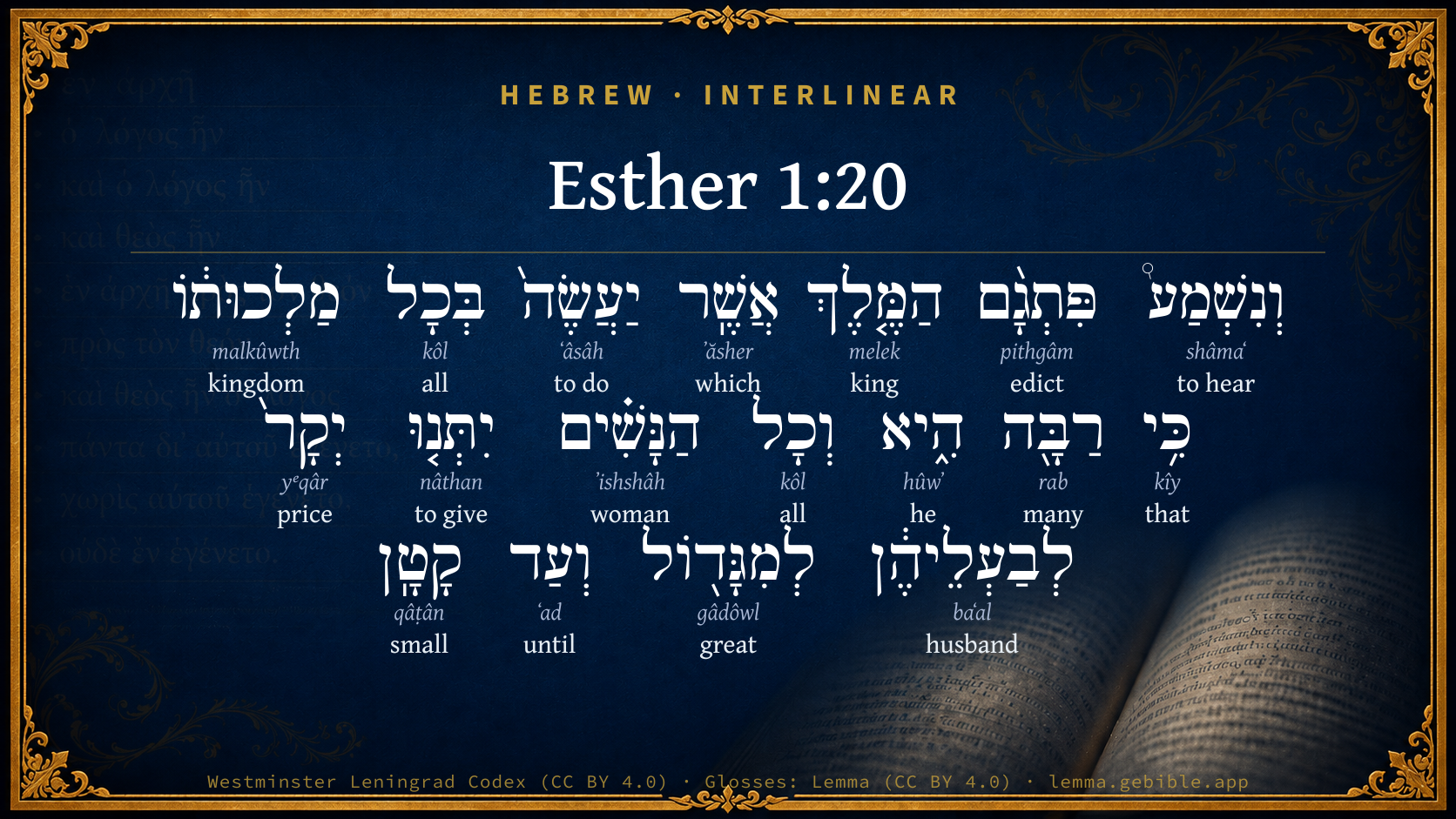
Hebrew (Westminster Leningrad Codex) Esther 1:20 appears in the Hebrew Old Testament. The text above is from the Westminster Leningrad Codex. Each word links to its Strong’s number, a concise gloss, and parsing drawn from the Open Scriptures Hebrew Bible morphology. Click any word for its full Brown-Driver-Briggs (BDB) entry.
Download image
Cite this verse

Esther 1:20 (World English Bible). Public Domain. Lemma interlinear Bible study tool, https://lemma.gebible.app/v/esther/1/20.

Show BibTeX & RIS
BibTeX
RIS
English Translation
When the king's decree which he shall make shall be published throughout all his kingdom (for it is great), all the wives will give to their husbands honor, both to great and small.
World English Bible · Public Domain
Highlights
  • 1 first appearance in the Hebrew Bible
Full analysis ↓
Download a study sheet

One document with this verse’s original text, its word-by-word gloss line, the meaning frame, cross-references with their text, attributed commentary, and full source and license credits — printable, and it pastes into notes with its structure intact.

This verse Autodidact and up

Study sheet (.html) Plain text (.txt)

A passage Seminary Student

Up to 50 verses in one chapter. A passage sheet keeps up to 6 commentary sources and 12 cross-references per verse, in the order this page ranks them, and says so on the sheet whenever that leaves anything out. Ask for a single verse and you get the Autodidact verse sheet above.

Everything on this page stays free to read, with no account — the sheet is a download of what is already on screen, not access to it.

Want to remove ads? Support Godless Engineer
Compare translations 3

The same verse in 3 English versions, stacked beneath the original-language interlinear above. Click any original word for its lexicon entry.

Each is an independent rendering of the whole verse — the interlinear is not word-aligned to these translations.

Highlighted words mark where these versions differ — a whole-verse word diff, not a word-by-word alignment.

  • World English Bible Public Domain
    When the king's decree which he shall make shall be published throughout all his kingdom (for it is great), all the wives will give to their husbands honor, both to great and small.
  • King James Version Public Domain
    And when the king's decree which he shall make shall be published throughout all his empire, (for it is great,) all the wives shall give to their husbands honour, both to great and small.
  • unfoldingWord Literal Text CC BY-SA 4.0
    And the decree of the king will be heard that he will make for all his kingdom, though it is great. Then all the women will give honor to their husbands, from the greatest to the least.”

unfoldingWord Literal Text — © unfoldingWord, licensed CC BY-SA 4.0. Word-aligned USFM3 via Door43 (git.door43.org/unfoldingWord/en_ult).

Versions to compare (up to 4)

3 of 4 selected

Show all 18 translations

Every available English version of this verse, each an independent rendering of the whole verse.

  • World English Bible Public Domain
    When the king's decree which he shall make shall be published throughout all his kingdom (for it is great), all the wives will give to their husbands honor, both to great and small.
  • Berean Standard Bible Public Domain
    The edict the king issues will be heard throughout his vast kingdom—and so all women, from the least to the greatest, will honor their husbands.”
  • Majority Standard Bible Public Domain
    The edict the king issues will be heard throughout his vast kingdom—and so all women, from the least to the greatest, will honor their husbands.”
  • King James Version Public Domain
    And when the king's decree which he shall make shall be published throughout all his empire, (for it is great,) all the wives shall give to their husbands honour, both to great and small.
  • American Standard Version (1901) Public Domain
    And when the king's decree which he shall make shall be published throughout all his kingdom (for it is great), all the wives will give to their husbands honor, both to great and small.
  • Revised Version (1885) Public Domain
    And when the king’s decree which he shall make shall be published throughout all his kingdom, (for it is great,) all the wives shall give to their husbands honour, both to great and small.
  • Geneva Bible (1599) Public Domain
    And when the decree of the King which shalbe made, shalbe published throughout all his kingdome (though it be great) all the women shall giue their husbands honour, both great and small.
  • Douay-Rheims (1899) Public Domain
    And let this be published through all the provinces of thy empire, (which is very wide,) and let all wives, as well of the greater as of the lesser, give honour to their husbands.
  • Young's Literal Translation Public Domain
    and the sentence of the king that he maketh hath been heard in all his kingdom -- for it `is' great -- and all the wives give honour to their husbands, from great even unto small.'
  • Literal Standard Version CC BY-SA 4.0
    and the sentence of the king that he makes has been heard in all his kingdom—for it [is] great—and all the wives give honor to their husbands, from great even to small.”
  • Unlocked Literal Bible CC BY-SA 4.0
    When the king's decree is proclaimed throughout all his vast kingdom, all the wives will honor their husbands, from the greatest to the least significant.”
  • unfoldingWord Literal Text CC BY-SA 4.0
    And the decree of the king will be heard that he will make for all his kingdom, though it is great. Then all the women will give honor to their husbands, from the greatest to the least.”
  • Darby Bible Public Domain
    and when the king's edict which he shall make shall be heard throughout his realm -- for it is great -- all the wives shall give to their husbands honour, from the greatest to the least.
  • World Messianic Bible Public Domain
    When the king’s decree which he shall make is published throughout all his kingdom (for it is great), all the wives will give their husbands honor, both great and small.”
  • Webster's Bible Public Domain
    And when the king's decree which he shall make shall be published throughout all his empire, (for it is great,) all the wives will give to their husbands honor, both to great and small.
  • Free Bible Version CC BY-SA 4.0
    When Your Majesty's decree is proclaimed throughout your vast empire, all wives will respect their husbands, highborn or lowborn.”
  • Bible in Basic English Public Domain
    And when this order, given by the king, is made public through all his kingdom (for it is great), all the wives will give honour to their husbands, great as well as small.
  • JPS Tanakh (1917) Public Domain
    And when the king's decree which he shall make shall be published throughout all his kingdom, great though it be, all the wives will give to their husbands honour, both to great and small.'

Literal Standard Version (2020), Covenant Press — licensed CC BY-SA 4.0. Text via the HelloAO Bible API (eBible.org). Unlocked Literal Bible (unfoldingWord) — licensed CC BY-SA 4.0. Text via the HelloAO Bible API (eBible.org). unfoldingWord Literal Text — © unfoldingWord, licensed CC BY-SA 4.0. Word-aligned USFM3 via Door43 (git.door43.org/unfoldingWord/en_ult). Free Bible Version, Dr. Jonathan Gallagher — licensed CC BY-SA 4.0. Text via the HelloAO Bible API (eBible.org).

Word by word

More ways to search: Search by grammar → Find every occurrence → Compare this word →

Practice this passage: Drill this verse → Learn its vocabulary →

פִּתְגָ֨ם
pithgâm
H6599
“edict of”
Noun, Common, Masculine, Singular, Construct
Part of Speech
Noun
Type
Common
Gender
Masculine
Number
Singular
State
Construct
Full BDB Definition

Origin: of Persian origin

TWOT: 1852

edict, decree
  1. וְנִשְׁמַע֩ shâmaʻ H8085 “and · to hear” Conjunction + Verb, Niphal, Sequential Perfect, 3rd Person, Masculine, Singular
  2. הַמֶּ֤לֶךְ melek H4428 “the · king” Particle, Definite Article + Noun, Common, Masculine, Singular, Absolute
  3. אֲשֶֽׁר ʼăsher H834 “which” Particle, Relative
  4. יַעֲשֶׂה֙ ʻâsâh H6213 “to do” Verb, Qal, Imperfect, 3rd Person, Masculine, Singular
  5. בְּכָל kôl H3605 “in/at · all of” Preposition + Noun, Common, Masculine, Singular, Construct
  6. מַלְכוּת֔וֹ malkûwth H4438 “kingdom · his” Noun, Common, Feminine, Singular, Construct + Suffix, Personal, 3rd Person, Masculine, Singular
  7. כִּ֥י kîy H3588 “that” Conjunction
  8. רַבָּ֖ה rab H7227 “many” Adjective, Adjective, Feminine, Singular, Absolute
  9. הִ֑יא hûwʼ H1931 “he” Pronoun, Personal, 3rd Person, Feminine, Singular
  10. וְכָל kôl H3605 “and · all of” Conjunction + Noun, Common, Masculine, Singular, Construct
  11. הַנָּשִׁ֗ים ʼishshâh H802 “the · women” Particle, Definite Article + Noun, Common, Feminine, Plural, Absolute
  12. יִתְּנ֤וּ nâthan H5414 “to give” Verb, Qal, Imperfect, 3rd Person, Masculine, Plural
  13. יְקָר֙ yᵉqâr H3366 “price” Noun, Common, Masculine, Singular, Absolute
  14. לְבַעְלֵיהֶ֔ן baʻal H1167 “to/for · husbands · their” Preposition + Noun, Common, Masculine, Plural, Construct + Suffix, Personal, 3rd Person, Feminine, Plural
  15. לְמִגָּד֖וֹל gâdôwl H1419 “to/for · from · great” Preposition + Preposition + Adjective, Adjective, Masculine, Singular, Absolute
  16. וְעַד ʻad H5704 “and · until” Conjunction + Preposition
  17. קָטָֽן qâṭân H6996 “small” Adjective, Adjective, Masculine, Singular, Absolute

About this verse

These counts appear in no published source. They are computed here, from the morphology-tagged text and Lemma’s own curated glosses. What Lemma adds →

18
words
17
distinct lemmas
Historical
section

Notable vocabulary

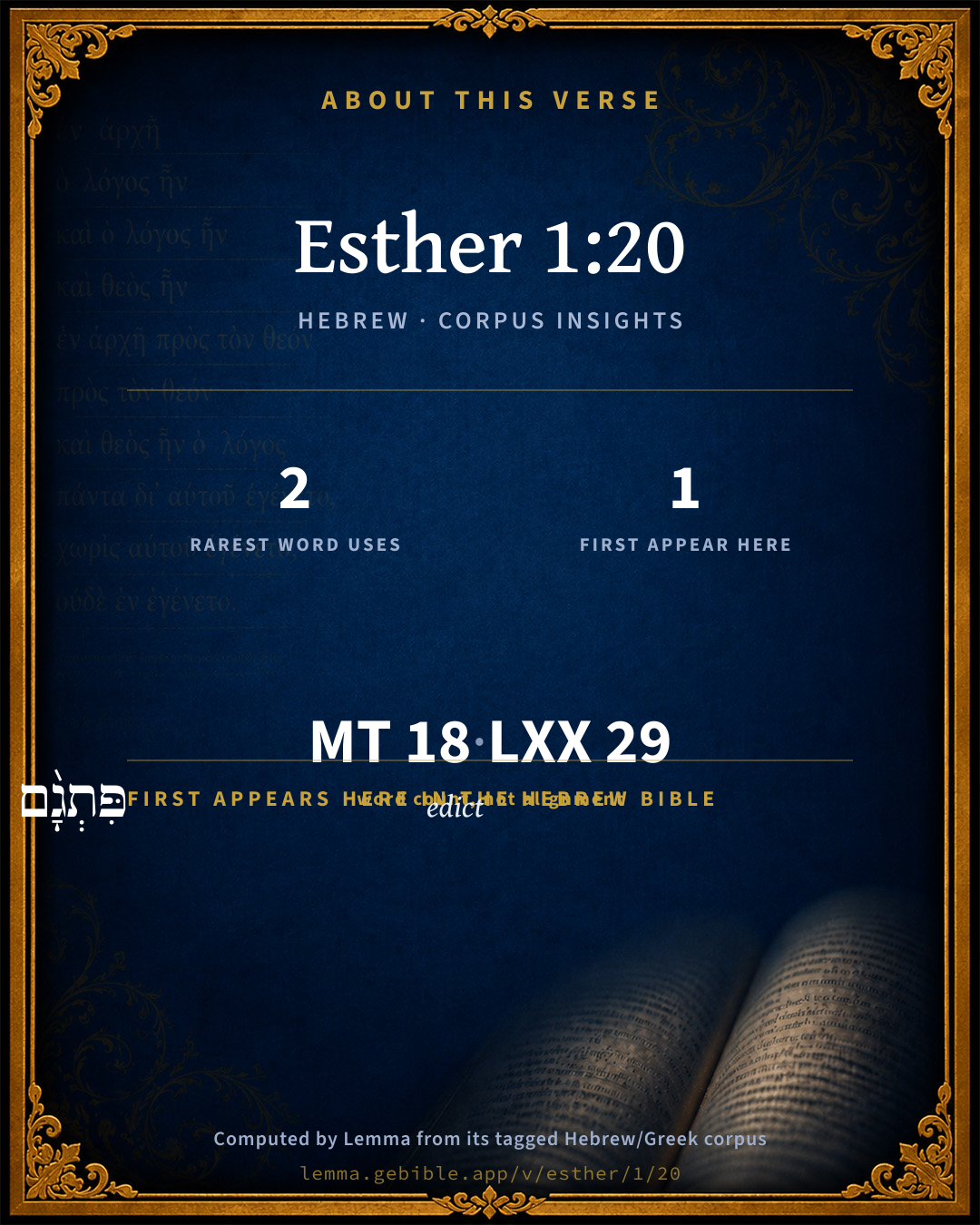
The rarest word here is פִּתְגָ֨ם edict H6599 — appearing just 2 times in the whole Hebrew Bible.

First appearance in Scripture

This word makes its first canonical appearance in the Hebrew Bible here:

  • פִּתְגָ֨ם edict H6599

Shared distinctive vocabulary

פִּתְגָ֨ם edict H6599 occurs in 2 verses of the Hebrew Bible. Also found in:

Grammatical profile

  • 3 verbs
  • 8 nouns
  • 3 adjectives
  • 1 pronoun
  • 1 preposition
  • 1 conjunction
  • 1 particle

Verb forms

  • וְנִשְׁמַע֩ Niphal · Sequential Perfect
  • יַעֲשֶׂה֙ Qal · Imperfect
  • יִתְּנ֤וּ Qal · Imperfect

Repetition

A word recurs within this verse — often emphatic in Hebrew:

  • בְּכָל all H3605 ×2

Hebrew & Septuagint length

In English translation the verse runs 33 words from the Hebrew and 36 from the Septuagint (LXX English) — closely comparable.

A rough comparison of the two English renderings, which tokenize alike — not a word-level alignment.

Word counts can differ between the Hebrew and the Greek without any difference in meaning — e.g. the Hebrew direct-object marker אֵת has no separate Greek word, and Greek often adds the article ὁ.

In the original languages it is 18 Hebrew tokens and 29 Greek tokens — but the two are counted differently (Hebrew bundles its prefixes and suffixes into one token; the Greek is in lemma form), so that isn’t a like-for-like length.

Cross-references

6

Topical passages linked to Esther 1:20 in the Treasury of Scripture Knowledge — connected by theme and wording, ordered by reader-vote popularity; previews shown in the World English Bible.

  • Colossians 3:18 Wives, be in subjection to your husbands, as is fitting in the Lord.
  • Ephesians 5:22 Wives, be subject to your own husbands, as to the Lord.
  • Ephesians 5:33 Nevertheless each of you must also love his own wife even as himself; and let the wife see that she respects her husband.
  • 1 Peter 3:1–7 In like manner, wives, be in subjection to your own husbands; so that, even if any don't obey the Word, they may be won by the behavior of their wives without a word;
  • Deuteronomy 17:13 All the people shall hear, and fear, and do no more presumptuously.
  • Deuteronomy 21:21 All the men of his city shall stone him to death with stones: so shall you put away the evil from the midst of you; and all Israel shall hear, and fear.

Cross-references courtesy of OpenBible.info (CC BY 4.0).

Hebrew and Greek witnesses Masoretic Hebrew ↔ Greek Septuagint

The same verse in the two great witnesses to the Old Testament, shown verse-for-verse.

These are two independent witnesses, not word-aligned to each other, and the Septuagint is shown in lemma (dictionary) form.

Hebrew Esther 1:20 Masoretic · Westminster Leningrad Codex

וְנִשְׁמַע֩ פִּתְגָ֨ם הַמֶּ֤לֶךְ אֲשֶֽׁר יַעֲשֶׂה֙ בְּכָל מַלְכוּת֔וֹ כִּ֥י רַבָּ֖ה הִ֑יא וְכָל הַנָּשִׁ֗ים יִתְּנ֤וּ יְקָר֙ לְבַעְלֵיהֶ֔ן לְמִגָּד֖וֹל וְעַד קָטָֽן

When the king's decree which he shall make shall be published throughout all his kingdom (for it is great), all the wives will give to their husbands honor, both to great and small.

World English Bible · Public Domain

Greek LXX Esther 1:20 Septuagint · lemma form

καί ἀκούω ὁ νόμος ὁ ὑπό ὁ βασιλεύς ὅς ἐάν ποιέω ἐν ὁ βασιλεία αὐτός καί οὕτως πᾶς ὁ γυνή περιτίθημι τιμή ὁ ἀνήρ ἑαυτοῦ ἀπό πτωχός ἕως πλούσιος

And let the law of the king which he shall have made, be widely proclaimed, in his kingdom: and so shall all the women give honor to their husbands, from the poor even to the rich.

LXX2012 (modern English Septuagint) · Public Domain

On this verse, The Cambridge Bible for Schools and Colleges discusses the Septuagint’s reading. Read the note in Commentary ↓

Hebrew: Westminster Leningrad Codex (CC BY 4.0). Greek: Septuagint (public domain); English from LXX2012 (modern English Septuagint) (Public Domain). How the Septuagint differs from the Hebrew →

Commentary

Notes on Esther 1:20 from classic Christian and Jewish commentators (each source and its license shown beneath its notes). The classic Christian expositions comment on the surrounding passage and are grouped to its opening verse, so a note may address several verses; the Jewish commentaries on the Tanakh (Rashi and others) are per-verse, so they appear only where the commentator wrote on this verse.

Lemma curates 59 commentaries, every one of them public domain or Creative Commons licensed, each selected and text-cleaned for this edition rather than reprinted as found. About our sources →

Trapp's Complete Commentary

John Trapp

Est 1:20 And when the king’s decree which he shall make shall be published throughout all his empire, (for it is great,) all the wives shall give to their husbands honour, both to great and small.

Ver. 20. And when the king’s decree that he shall make shall be published] But why should any such thing be published at all, unless the king be ambitious of his own utter dishonour? Is there none wiser than other, but that the king must betray his own nest, tell all the empire that he was drunk, or little better, and did in his drink determine that against his fair queen that he so soon after repented? He should have done in this case as a man doth, that having a secret sore, clappeth on a plaster, and then covereth it with his hand, that it may stick the faster, work the better. Had Ahasuerus been wise, the world had been never the wiser for anything that Vashti had done, &c. But Memucan hath some colour for his bad counsel, a goodly veil to cast over it.

All the wives shall give to their husbands honour] They shall not dare to do otherwise, unless they mean to be likewise divorced. But will terror breed true honour? is soothing right submission? Quem metuunt oderunt, fear makes hatred; and people honour none (to speak properly) but whom they love sincerely. Those lordly husbands that domineer over their wives as if they were their slaves, and carry themselves like lions in their houses, must not look for any great respect there. This man promised himself great matters when he thus said, The wives shall give iittenu in the masculine gender, to signify the wives’ voluntary subjection and obedience; but that he never had, nor any other that took the like course. Those husbands that will be honoured indeed by their wives must give honour to them as to the weaker vessels, as being heirs together of the grace of life, 1Pe 3:7.

John Trapp, A Commentary or Exposition upon All the Books of the Old and New Testament (1647–1656) — public domain. Text from a community e-Sword module.

The Biblical Illustrator

Joseph S. Exell

Est_1:20

All the wives shall give to their husbands honour, both to great and small.

Wives to honour their husbands

All the wives too are included, for they are all to give honour to their husbands, both to the great and small. Well, the great, the really great, will get the honour easily, and could do very well probably without the helpful edict. Where there is real greatness, which, in Christian speech, we may translate into real goodness, it is the wifes joy to render what it is the husbands pride to wear. But the honour is to be given both to the great and small! Ay, theres the rub. If this insurrectionary torch should go through the land, what will become of the small ones?--the selfish, the spiteful, the meddlesome, the rude, the mean, the silly, the helpless, the good-for-nothing? They are all to have honour! As if a decree could really get it, or keep it from them. Wouldnt the better plan be, in that case, and in many a case besides, that the small shall try to grow larger? Let them be ashamed of their littleness, and rise out of it into something like nobleness. Let them love and help their wives, and care for their children, and honour will come as harvest follows sowing. But unless they do something like that, one fears that all the edicts that can be devised and promulgated will leave them as it finds them--small. (A. Raleigh, D. D.)

Love is the law

1. And does not this history teach us that the great law of domestic happiness is love? No Persian decrees are required to execute the mandates of love, nor can any royal commandment make a household happy without it. The true way for all queens to rule is to stoop to conquer. Let their husbands call themselves as much as they please the lords of creation, and let them seem to hold the reins, but it is theirs to tell them how to drive. This is the more excellent way. The dispute about the sphere of the sexes is as unphilosophical as it is unscriptural. It is Gods will that man should be the head and woman the heart of society. If he is its strength, she is its solace. If he is its wisdom, she is its grace and consolation. Domestic strife is always a great evil, but it becomes doubly so when it occurs before company, as happened with the king of Persia, and when professed friends come in and make bad worse. It is then the wound becomes incurable.

2. Let us learn to guard against all excesses, not only in feasting and in the loss of time, but of feeling and passion. How inconsiderate, how rash, how sinful was Herods oath and terrible decree against John the Baptist! And scarcely less wicked were the kings unjust and cruel proceedings against his wife. It was a maxim with General Jackson to take much time to deliberate--to think out the right resolution--but when once the resolution was taken, then to think only of executing it.

3. How emphatic a lesson is here of human vanity! The great monarch of such a vast empire is not able to govern himself. And all the grandeur of half a years feasting is spoiled by the disobedience of his queen. This was the dead fly in his pot of ointment.

4. Alas! that so lovely a place as a garden should have been the scene of such revelry and sinning. A garden is associated with some of our holiest and saddest thoughts. Sin fastened on our race in a garden. It was in a garden the curse was pronounced, and there too the great promise of a Redeemer was given. And it was in a garden the Messiah entered the lists of mortal combat to bruise the old serpents head. Instead, then, of making our gardens the scenes of sinful mirth and dissipation, as did the Persian king, let us make them oratories for pious breathings to heaven--let them give us thoughts of God and of the love and sufferings of His Son Jesus Christ. It is to Him we owe all our pleasures in the creatures and gifts of providence, as well as the hope of eternal life. And so also let the garden be a preacher to us of our frailty. (W. A. Scott, D. D.)

The husband to bear rule in his house

This is truly a Divine appointment, but it is not made in an arbitrary manner, like, for instance, a positive institution of the Jews, which might be this way or that way with equal propriety--the thing deriving its sacred character chiefly from the fact of the appointment. Even a Divine appointment could not make the wife supreme, human nature continuing what it is. For one thing, woman is weaker than man physically, and supremacy goes with strength. All kinds of force have their ultimate source in God, and when He makes man permanently stronger than woman, no doubt He means some corresponding authority to rest where the permanent strength does. No doubt strength may be abused, is most shamefully abused in some instances, by the husband. But the way to prevent the abuse of strength is not, surely, to attempt to transfer its proper responsibilities to weakness? Weakness may be abused as much as strength, and in some ways even more. Again, there are many things of less or more importance which come to require a single ultimate decision. One must say how this thing is to be. Practical action must be taken one way or other. Who shall decide? Is the husband to submit to the wife? He decides with whom God has lodged the responsibility. But the truth is that in a properly regulated, or rather a properly inspired home, the question of authority in its bald form never arises. The husbands rule and the wifes obedience are alike unconscious, and alike easy. The sweet laws of nature, the good laws of God, make them one. This leads us to say, on the other hand, with equal emphasis, that the authority of the husband is clearly a limited authority. Common sense ought to teach a man that there is a large sphere of the practical family life where he ought to leave the wife and mother practically supreme. His interference at all (whatever may be the abstract right) will not help the industry, the order, the peace of the household. But, rising higher, look at the grand fact that the authority of the husband over the wife has, and must have, clear and strong, and altogether impassable limits. (A. Raleigh, D. D.)

Bear rule in his own house.--

Houses should be homes

In his own house--who has a house of his own? The house is a prison until somebody else shares it. The house belongs to all the people that are in it--part to the husband, part to the wife, part to the children, part to the servants, right through all the household line. Develop the notion of partnery, co-responsibility; let every one feel a living interest in the place: then the house shall be built of living stones, pillared with righteousness, roofed with love. It is here that Christianity shines out with unique lustre. Obedience is right for all parties, but the obedience has to be in the Lord; it is to be the obedience of righteousness, a concession to wisdom, a toll paid to honour, which is to be returned in love and gratitude. Christianity has made our houses homes. We owe everything that is socially beneficent to Christianity. (J. Parker,D. D.)

His own house

A man living at a hotel is like a grape-vine in a flower-pot--movable, carried around from place to place, docked at the root and short at the top. Nowhere can a man get real root-room, and spread out his branches till they touch the morning and the evening, but in his own house.

The overruling providence of God

The important thing, in order to our understanding the story, is that we should keep these first links in our hand, and should mark the working of another King. Into the administration of our Lord Jesus Christ no mistake can creep, and so perfect is His grasp that mosaic pavements, golden couches, throngs of noblemen, fawning courtiers, excess of wine, swelling vanity, and a womans firmness, are all, without the slightest knowledge on the part of any actor in the drama, made to bring about a purpose of His, the execution of which is more than four years distant. Had Ahasuerus not been the proud voluptuary he was; had he not made his great feast; had he not in the last day of it let slip or thrown away the reins of sound reason and run his head against a first law of nature; had his vanity taken any other direction than that of wishing to parade the queens beauty; had Vashti been less of a true woman; had the courtiers been honester than they were--then there would have been no vacant place for Esther to fill, and the plot of Haman might have thriven. But we have this song, Surely the wrath of man shall praise Thee: the remainder of wrath shalt Thou restrain. (A. M. Symington, B. A.)

.

The Biblical Illustrator, edited by Joseph S. Exell (c. 1880s–1900s) — public domain. Text from a community e-Sword module.

Joseph Benson's Commentary

Est 1:20-21. All the wives shall give to their husbands honour, &c. — None will dare to disobey, when they hear that the greatness of the queen could not preserve her from such a heavy punishment. The saying pleased the king and the princes — Partly because their own authority and interest were concerned in it; and especially by the singular providence of God, who designed to bring about his own great work by this small occasion.

Joseph Benson's Commentary on the Old and New Testaments (1811–1818) — public domain. Text from a community e-Sword module.

Geneva Bible (1599)

Geneva Bible translators

For he had under him an hundred twenty and seven countries.

Geneva Bible (1599) marginal notes — public domain. Text via Bolls.life.

The Cambridge Bible for Schools and Colleges

gen. ed. J. J. S. Perowne

20. decree] Heb. pithgam, a loan-word from Old Persian patigâma (patigam, to come to, arrive). It occurs in its Aramaic form (pithgâmâ) in Ezr_4:17; Ezr_5:7; Ezr_5:11.

kingdom] The usual translation of the Heb. word. By rendering ‘empire’ (here only in O.T.) the A.V. introduces a distinction which does not exist in the original.

for it is great] In point of fact the Persian rule at this time extended over more than half of the known world. The LXX., however, do not appear to have found the words in their text.

The Cambridge Bible for Schools and Colleges (gen. ed. J. J. S. Perowne; Cambridge University Press, 1878–1918) — public domain. Text from a community e-Sword module.

John Gill's Exposition

And when the king's decree which he shall make shall be published throughout all his empire,.... As it was proper it should, since the report of the queen's deed would be made everywhere:

for it is great; the empire consisting of one hundred and twenty seven provinces, Est 1:1, Aben Ezra and Abendana interpret it, "though" it is great, yet the decree should be published throughout; the latter observes, that this may respect the king's decree; and so the Targum is,"for his decree is great;''it respecting a matter of great importance, and relating to a great personage, and would have great effect on the minds of persons, when it was observed that one so great was treated in this manner: and therefore

all the wives shall give to their husbands honour, both to great and small; speaking respectfully to them, yielding a ready and cheerful obedience to all their commands; which would be done to princes and peasants, to high and low, to every rank of men.

John Gill's Exposition of the Whole Bible (1746–1763) — public domain (CC PDM 1.0). Text via the HelloAO Bible API.

Whedon's Commentary on the Bible

Daniel D. Whedon

20. Both to great and small — The royal example and decree would thus furnish custom and law for all ranks and classes of people in the empire.

Daniel D. Whedon (gen. ed.), Commentary on the Old and New Testaments (1874–1909) — public domain. Text from a community e-Sword module.

The Pulpit Commentary

The king"s decree. The "commandment" of the preceding verse is here given the formal name of pithgam, "decree," which is a Persian word, used also in Ezra. (Ezr_4:17 Ezr_5:7, Ezr_5:11) For it is great . These words seem at first sight superfluous. Perhaps their force is this Let a decree be made, and then, great as the empire is, the lesson will be taught to all: otherwise there will be many to whom it will never penetrate.

The Pulpit Commentary (1880–1919), ed. H.D.M. Spence-Jones & Joseph S. Exell — public domain. Text from a community e-Sword module.

Lesson kit

Teaching starters — assembled from the data on this page, not authored interpretation. Every prompt links to the verse data it draws on. Edit before teaching.

Esther, in the Historical, opens this verse with 18 words (17 distinct Hebrew lemmas). Its most distinctive word is pithgâm (“edict”). A historical commentator’s framing appears above. Read the whole chapter for the surrounding context.

Discussion questions

  1. How does “edict” (pithgâm) shape what this verse is saying?
  2. The word “edict” first appears here in Scripture. What is being introduced at this debut?
  3. Ecclesiastes 8:11 shares the word «edict» with this verse. How do the two illuminate each other?
  4. “all” occurs 2× in this one verse. What is the effect of the repetition?
  5. These translations render this verse differently; the difference is in the English rendering, not the original. What questions does that raise?
  6. The verb «וְנִשְׁמַע֩» is Niphal Sequential Perfect. How does its form color the action?
  7. Reading how Trapp's Complete Commentary and The Biblical Illustrator read this verse, where do the two commentators agree and where do they part?

Things to notice

Reading settings

Reading text

Shown beneath each verse's original-language words.

Old Testament
Old Testament edition

Read the OT as the Masoretic Hebrew (MT) or the Greek Septuagint (LXX).

English shown for the Greek Septuagint (in the Hebrew ↔ Greek comparison).

Comparing translations? Open the Compare panel on any verse page to stack up to four side by side.