Numbers 13:18

Hebrew (Westminster Leningrad Codex) Numbers 13:18 appears in the Hebrew Old Testament. The text above is from the Westminster Leningrad Codex. Each word links to its Strong’s number, a concise gloss, and parsing drawn from the Open Scriptures Hebrew Bible morphology. Click any word for its full Brown-Driver-Briggs (BDB) entry.
Download image
Cite this verse

Numbers 13:18 (World English Bible). Public Domain. Lemma interlinear Bible study tool, https://lemma.gebible.app/v/numbers/13/18.

Show BibTeX & RIS
BibTeX
RIS
English Translation
and see the land, what it is; and the people who dwell therein, whether they are strong or weak, whether they are few or many;
World English Bible · Public Domain
Highlights
  • 1 first appearance in the Hebrew Bible
Full analysis ↓
Download a study sheet

One document with this verse’s original text, its word-by-word gloss line, the meaning frame, cross-references with their text, attributed commentary, and full source and license credits — printable, and it pastes into notes with its structure intact.

This verse Autodidact and up

Study sheet (.html) Plain text (.txt)

A passage Seminary Student

Up to 50 verses in one chapter. A passage sheet keeps up to 6 commentary sources and 12 cross-references per verse, in the order this page ranks them, and says so on the sheet whenever that leaves anything out. Ask for a single verse and you get the Autodidact verse sheet above.

Everything on this page stays free to read, with no account — the sheet is a download of what is already on screen, not access to it.

Want to remove ads? Support Godless Engineer
Compare translations 3

The same verse in 3 English versions, stacked beneath the original-language interlinear above. Click any original word for its lexicon entry.

Each is an independent rendering of the whole verse — the interlinear is not word-aligned to these translations.

Highlighted words mark where these versions differ — a whole-verse word diff, not a word-by-word alignment.

  • World English Bible Public Domain
    and see the land, what it is; and the people who dwell therein, whether they are strong or weak, whether they are few or many;
  • King James Version Public Domain
    And see the land, what it is, and the people that dwelleth therein, whether they be strong or weak, few or many;
  • unfoldingWord Literal Text CC BY-SA 4.0
    And you shall see the land, what it; and the people dwelling upon it, whether it strong or weak, whether it few or many;

unfoldingWord Literal Text — © unfoldingWord, licensed CC BY-SA 4.0. Word-aligned USFM3 via Door43 (git.door43.org/unfoldingWord/en_ult).

Versions to compare (up to 4)

3 of 4 selected

Show all 18 translations

Every available English version of this verse, each an independent rendering of the whole verse.

  • World English Bible Public Domain
    and see the land, what it is; and the people who dwell therein, whether they are strong or weak, whether they are few or many;
  • Berean Standard Bible Public Domain
    See what the land is like and whether its people are strong or weak, few or many.
  • Majority Standard Bible Public Domain
    See what the land is like and whether its people are strong or weak, few or many.
  • King James Version Public Domain
    And see the land, what it is, and the people that dwelleth therein, whether they be strong or weak, few or many;
  • American Standard Version (1901) Public Domain
    and see the land, what it is; and the people that dwell therein, whether they are strong or weak, whether they are few or many;
  • Revised Version (1885) Public Domain
    and see the land, what it is; and the people that dwelleth therein, whether they be strong or weak, whether they be few or many;
  • Geneva Bible (1599) Public Domain
    So Moses sent them to spie out the lande of Canaan, and said vnto them, Go vp this way toward the South, and go vp into the moutaines,
  • Douay-Rheims (1899) Public Domain
    And Moses sent them to view the land of Chanaan, and said to them: Go you up by the south side. And when you shall come to the mountains,
  • Young's Literal Translation Public Domain
    and have seen the land what it `is', and the people which is dwelling on it, whether it `is' strong or feeble; whether it `is' few or many;
  • Literal Standard Version CC BY-SA 4.0
    and have seen the land, what it [is], and the people which is dwelling on it, whether it [is] strong or feeble, [and] whether it [is] few or many;
  • Unlocked Literal Bible CC BY-SA 4.0
    Examine the land to see what it is like. Observe the people who live there, whether they are strong or weak, and whether they are few or many.
  • unfoldingWord Literal Text CC BY-SA 4.0
    And you shall see the land, what it; and the people dwelling upon it, whether it strong or weak, whether it few or many;
  • Darby Bible Public Domain
    and ye shall see the land, what it is; and the people that dwell in it, whether they are strong or weak, few or many;
  • World Messianic Bible Public Domain
    See the land, what it is; and the people who dwell therein, whether they are strong or weak, whether they are few or many;
  • Webster's Bible Public Domain
    And see the land, what it is; and the people that dwell therein, whether they are strong or weak, few or many;
  • Free Bible Version CC BY-SA 4.0
    See what the place looks like, and find out about the people living there—are they strong or weak? Are there many of them or only a few?
  • Bible in Basic English Public Domain
    And see what the land is like; and if the people living in it are strong or feeble, small or great in number;
  • JPS Tanakh (1917) Public Domain
    and see the land, what it is; and the people that dwelleth therein, whether they are strong or weak, whether they are few or many;

Literal Standard Version (2020), Covenant Press — licensed CC BY-SA 4.0. Text via the HelloAO Bible API (eBible.org). Unlocked Literal Bible (unfoldingWord) — licensed CC BY-SA 4.0. Text via the HelloAO Bible API (eBible.org). unfoldingWord Literal Text — © unfoldingWord, licensed CC BY-SA 4.0. Word-aligned USFM3 via Door43 (git.door43.org/unfoldingWord/en_ult). Free Bible Version, Dr. Jonathan Gallagher — licensed CC BY-SA 4.0. Text via the HelloAO Bible API (eBible.org).

Word by word

More ways to search: Search by grammar → Find every occurrence → Compare this word →

Practice this passage: Drill this verse → Learn its vocabulary →

הֲרָפֶ֔ה
râpheh
H7504
“slack”
Particle, Interrogative + Adjective, Adjective, Masculine, Singular, Absolute
Part of Speech
Particle + Adjective
Type
Adjective
Gender
Masculine
Number
Singular
State
Absolute
Full BDB Definition

Origin: from H7503

TWOT: 2198a

slack
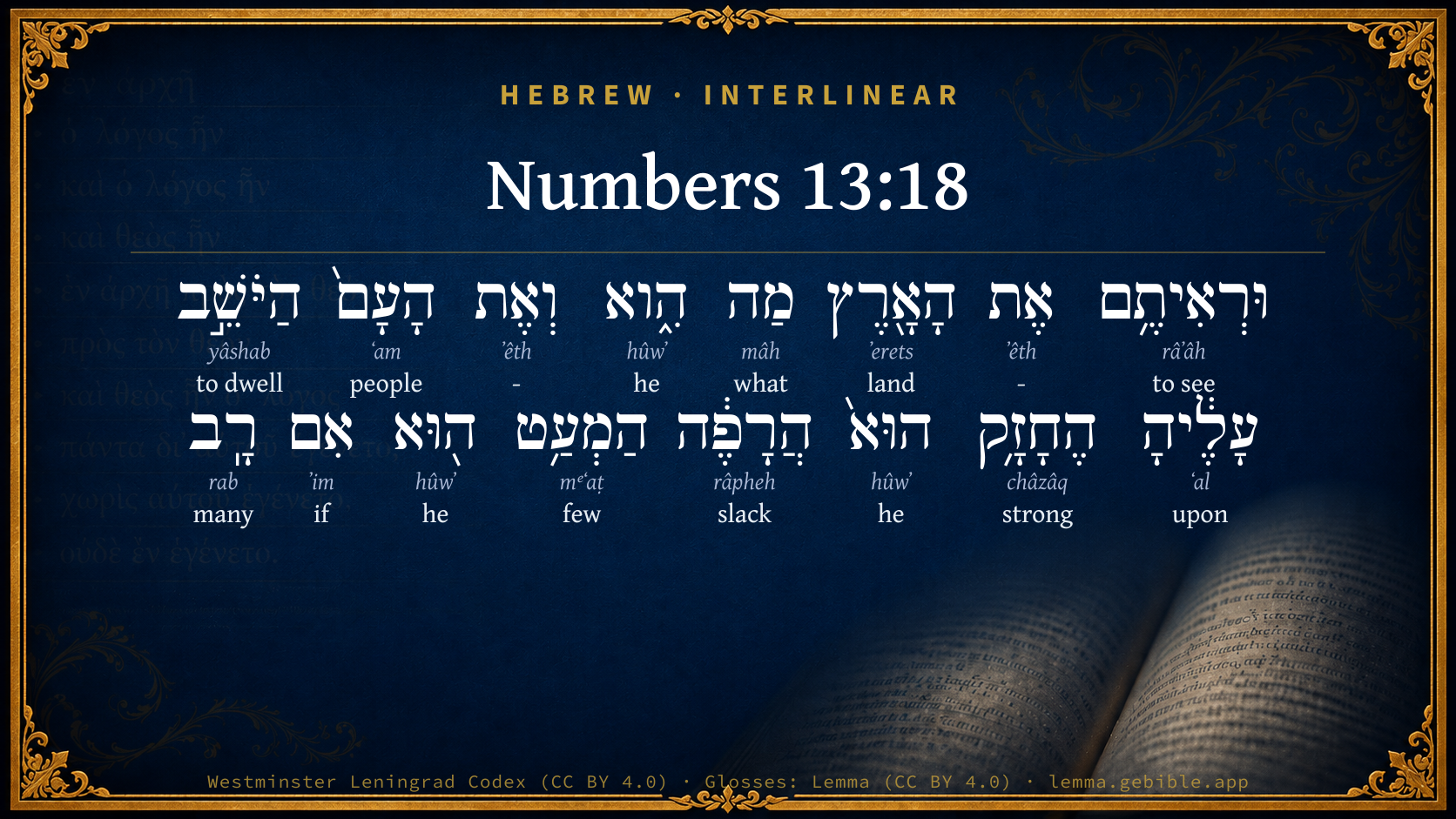
  1. וּרְאִיתֶ֥ם râʼâh H7200 “and · to see” Conjunction + Verb, Qal, Sequential Perfect, 2nd Person, Masculine, Plural
  2. אֶת ʼêth H853 “-” Particle, Direct Object
  3. הָאָ֖רֶץ ʼerets H776 “the · land” Particle, Definite Article + Noun, Common, Both, Singular, Absolute
  4. מַה mâh H4100 “what” Particle, Interrogative
  5. הִ֑וא hûwʼ H1931 “he” Pronoun, Personal, 3rd Person, Feminine, Singular
  6. וְאֶת ʼêth H853 “and · -” Conjunction + Particle, Direct Object
  7. הָעָם֙ ʻam H5971 “the · people” Particle, Definite Article + Noun, Common, Masculine, Singular, Absolute
  8. הַיֹּשֵׁ֣ב yâshab H3427 “the · dwelling” Particle, Definite Article + Verb, Qal, Participle Active, Masculine, Singular, Absolute
  9. עָלֶ֔יהָ ʻal H5921 “upon · her” Preposition + Suffix, Personal, 3rd Person, Feminine, Singular
  10. הֶחָזָ֥ק châzâq H2389 “strong” Particle, Interrogative + Adjective, Adjective, Masculine, Singular, Absolute
  11. הוּא֙ hûwʼ H1931 “he” Pronoun, Personal, 3rd Person, Masculine, Singular
  12. הַמְעַ֥ט mᵉʻaṭ H4592 “few” Particle, Interrogative + Adjective, Adjective, Masculine, Singular, Absolute
  13. ה֖וּא hûwʼ H1931 “he” Pronoun, Personal, 3rd Person, Masculine, Singular
  14. אִם ʼim H518 “if” Conjunction
  15. רָֽב rab H7227 “many” Adjective, Adjective, Masculine, Singular, Absolute

About this verse

These counts appear in no published source. They are computed here, from the morphology-tagged text and Lemma’s own curated glosses. What Lemma adds →

16
words
13
distinct lemmas
Pentateuch
section

Notable vocabulary

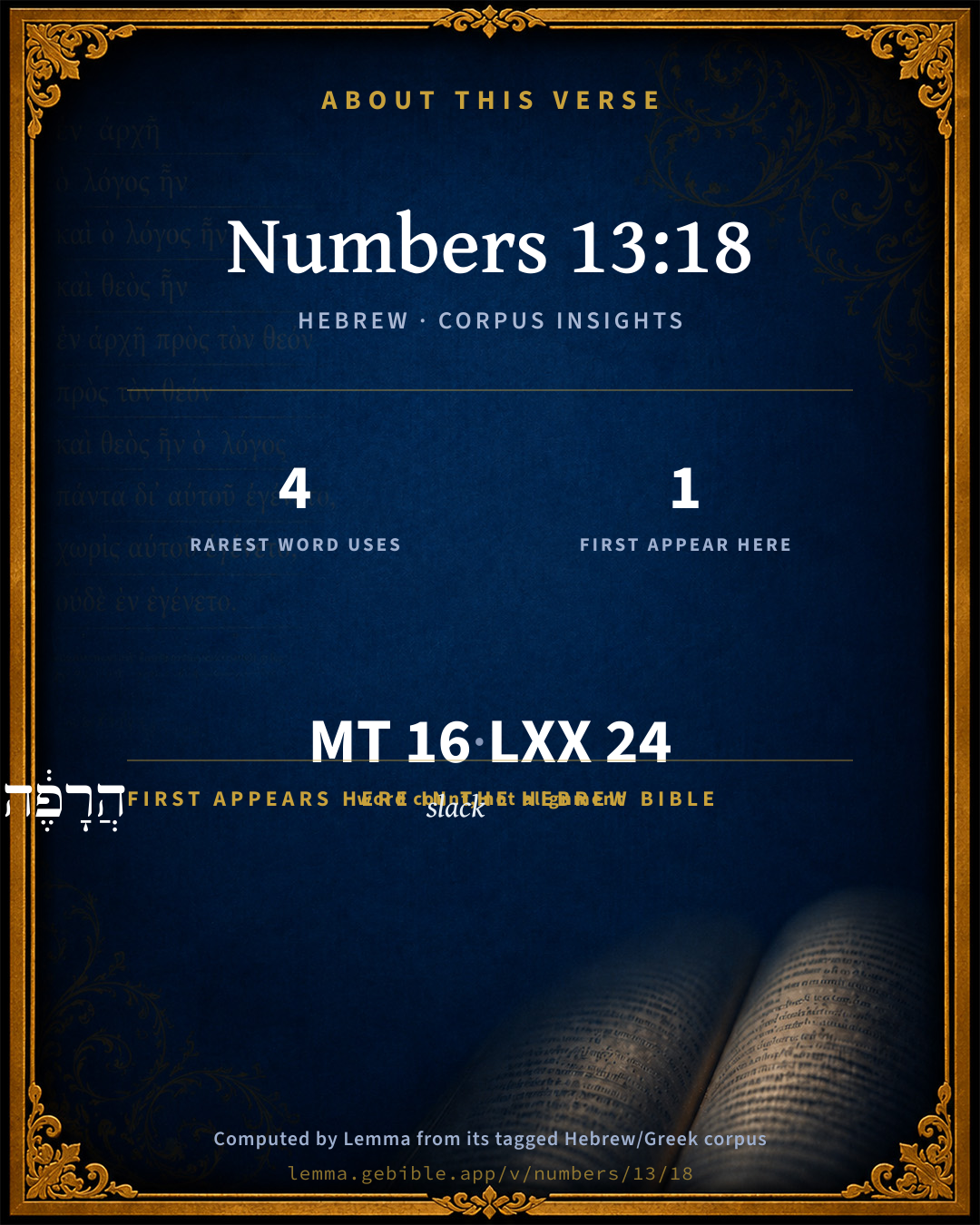
The rarest word here is הֲרָפֶ֔ה slack H7504 — appearing just 4 times in the whole Hebrew Bible.

First appearance in Scripture

This word makes its first canonical appearance in the Hebrew Bible here:

  • הֲרָפֶ֔ה slack H7504

Shared distinctive vocabulary

הֲרָפֶ֔ה slack H7504 occurs in 4 verses of the Hebrew Bible. Also found in:

Grammatical profile

  • 2 verbs
  • 2 nouns
  • 4 adjectives
  • 3 pronouns
  • 1 preposition
  • 1 conjunction
  • 3 particles

Verb forms

  • וּרְאִיתֶ֥ם Qal · Sequential Perfect
  • הַיֹּשֵׁ֣ב Qal · Participle Active

Repetition

A word recurs within this verse — often emphatic in Hebrew:

  • הִ֑וא he H1931 ×3

Hebrew & Septuagint length

In English translation the verse runs 25 words from the Hebrew and 28 from the Septuagint (LXX English) — closely comparable.

A rough comparison of the two English renderings, which tokenize alike — not a word-level alignment.

Word counts can differ between the Hebrew and the Greek without any difference in meaning — e.g. the Hebrew direct-object marker אֵת has no separate Greek word, and Greek often adds the article ὁ.

In the original languages it is 16 Hebrew tokens and 24 Greek tokens — but the two are counted differently (Hebrew bundles its prefixes and suffixes into one token; the Greek is in lemma form), so that isn’t a like-for-like length.

Cross-references

2

Topical passages linked to Numbers 13:18 in the Treasury of Scripture Knowledge — connected by theme and wording, ordered by reader-vote popularity; previews shown in the World English Bible.

  • Exodus 3:8 I have come down to deliver them out of the hand of the Egyptians, and to bring them up out of that land to a good and large land, to a land flowing with milk and honey; to the place of the Canaanite, the Hittite, the Amorite, the Perizzite, the Hivite, and the Jebusite.
  • Ezekiel 34:14 I will feed them with good pasture; and on the mountains of the height of Israel shall their fold be: there shall they lie down in a good fold; and on fat pasture shall they feed on the mountains of Israel.

Cross-references courtesy of OpenBible.info (CC BY 4.0).

Hebrew and Greek witnesses Masoretic Hebrew ↔ Greek Septuagint

The same verse in the two great witnesses to the Old Testament, shown verse-for-verse.

These are two independent witnesses, not word-aligned to each other, and the Septuagint is shown in lemma (dictionary) form.

Hebrew Numbers 13:18 Masoretic · Westminster Leningrad Codex

וּרְאִיתֶ֥ם אֶת הָאָ֖רֶץ מַה הִ֑וא וְאֶת הָעָם֙ הַיֹּשֵׁ֣ב עָלֶ֔יהָ הֶחָזָ֥ק הוּא֙ הֲרָפֶ֔ה הַמְעַ֥ט ה֖וּא אִם רָֽב

and see the land, what it is; and the people who dwell therein, whether they are strong or weak, whether they are few or many;

World English Bible · Public Domain

Greek LXX Numbers 13:18 Septuagint · lemma form

καί ὁράω ὁ γῆ τίς εἰμί καί ὁ λαός ὁ ἐν καταἧμαι ἐπί αὐτός εἰ ἰσχυρός εἰμί ἤ ἀσθενής εἰ ὀλίγος εἰμί ἤ πολύς

And Moses sent them to spy out the land of Chanaan, and said to them, Go up by this wilderness; and you⌃ shall go up to the mountain,

LXX2012 (modern English Septuagint) · Public Domain

Hebrew: Westminster Leningrad Codex (CC BY 4.0). Greek: Septuagint (public domain); English from LXX2012 (modern English Septuagint) (Public Domain). How the Septuagint differs from the Hebrew →

Targum (Aramaic paraphrase)

2

The Targum is the ancient Jewish Aramaic paraphrase of the Hebrew Scriptures — an interpretive translation, not the Hebrew text itself. Onkelos (literal) and Pseudo-Jonathan (expansive) render the Torah, and Jonathan the Prophets. Coverage is partial: where no permissively-licensed English translation exists for a verse, only the Aramaic is shown. This is verse-level text, not a word-by-word alignment to the Hebrew.

  1. Targum Onkelos Torah (Genesis–Deuteronomy)
    וְתֶחֱזוּן יָת אַרְעָא מָה הִיא וְיָת עַמָא דְיָתֵב עֲלַהּ הֲתַקִיף הוּא אִם חֲלָשׁ הַזְעֵר הוּא אִם סַגִי

    (no public-domain English translation for this verse)

    Targum Onkelos — Aramaic: “Onkelos Genesis” (public domain); “Onkelos Exodus” (public domain); “Onkelos Leviticus” (public domain); “Onkelos Numbers” (public domain); “Onkelos Deuteronomy” (public domain). English: “Sefaria Community Translation” (CC0 1.0 (public-domain dedication)); “J.W. Etheridge. The Targums of Onkelos and Jonathan Ben Uzziel on the Pentateuch. London: Longmans, Green, 1862” (public domain). Text via Sefaria.

  2. Targum Pseudo-Jonathan Torah (Genesis–Deuteronomy)
    וְתֵיחֲמוּן יַת אַרְעָא מָה הִיא וְיַת עַמָא דְיָתֵיב עֲלָהּ הֲתַקִיף הוּא אִין חֲלָשׁ הַזְעֵיר הוּא אִין סַגִי

    and survey the country, what it is, and the people who dwell in it; whether they be strong or weak, few or many;

    Targum Pseudo-Jonathan — Aramaic: “Targum Jonathan on Genesis” (public domain); “Targum Jonathan on Exodus” (public domain); “Targum Jonathan on Leviticus” (public domain); “Targum Jonathan on Numbers” (public domain); “Targum Jonathan on Deuteronomy” (public domain). English: “The Targum of Jonathan ben Uzziel, trans. J. W. Etheridge, London, 1862” (public domain). Text via Sefaria.

Commentary

Notes on Numbers 13:18 from classic Christian and Jewish commentators (each source and its license shown beneath its notes). The classic Christian expositions comment on the surrounding passage and are grouped to its opening verse, so a note may address several verses; the Jewish commentaries on the Tanakh (Rashi and others) are per-verse, so they appear only where the commentator wrote on this verse.

Lemma curates 59 commentaries, every one of them public domain or Creative Commons licensed, each selected and text-cleaned for this edition rather than reprinted as found. About our sources →

Trapp's Complete Commentary

John Trapp

Num 13:18 And see the land, what it [is]; and the people that dwelleth therein, whether they [be] strong or weak, few or many;

Ver. 18. See the land.] Two and two likely he sent them, and by several ways: as our Lord also did his seventy disciples.

John Trapp, A Commentary or Exposition upon All the Books of the Old and New Testament (1647–1656) — public domain. Text from a community e-Sword module.

Geneva Bible (1599)

Geneva Bible translators

Or, his country.

Geneva Bible (1599) marginal notes — public domain. Text via Bolls.life.

Adam Clarke's Commentary

Verse 18. See the land, what it is] What sort of a COUNTRY it is; how situated; its natural advantages or disadvantages.

And the people - whether they be strong or weak] Healthy, robust, hardy men; or little, weak, and pusillanimous.

Adam Clarke's Commentary on the Bible (1810–1826) — public domain. Text from a community e-Sword/MySword module.

Ellicott's Commentary for English Readers

(18) And see the land.—Or, inspect the land. The same word is used of the inspection of the leper by the priest in Lev_13:3; Lev_13:5-6; Lev_13:10; Lev_13:13, &c.

A Bible Commentary for English Readers, edited by Charles John Ellicott (1878–1897) — public domain. Text from a community e-Sword module.

John Gill's Exposition

The place was called the brook of Eshcol,.... That is, in later times:

because of the cluster of grapes which the children of Israel cut down from thence; the word "Eschol" signifying a "cluster"; and this cluster was typical of Christ, who may be compared to this, as he is to a cluster of camphire, Sol 1:14; there being in him a "cluster" of all perfections, of all the perfections of deity, the whole fulness of the Godhead dwelling bodily in him; and of all human perfections, he being in all things like unto his people, excepting sin; and there being also a cluster of all the graces and gifts of the Spirit without measure in him, as man; and of all the blessings of grace for his people, as Mediator; and of all the exceeding great and precious promises of the covenant of grace. The "staff", on which this was carried, may denote the ministration of the Gospel, which may seem mean and despicable in itself, but is the means of carrying the name of Christ, and the things of Christ, about in the world; see Act 9:15; and the "two" men which bore it, may signify the prophets of the Old Testament, and the ministers of the New, who both agree and join together in setting forth the person, offices, and grace of Christ. Moreover, this cluster may be an emblem of the Spirit of God, and his grace, and of the rich experience the people of God have of it in this present lift, while travellers in the wilderness, as a taste and earnest of the future glory and happiness in the heavenly Canaan.

John Gill's Exposition of the Whole Bible (1746–1763) — public domain (CC PDM 1.0). Text via the HelloAO Bible API.

Haydock's Catholic Bible Commentary

South side, which is to the north of where you now dwell. Moses enters into several details for the satisfaction of the people, though they had probably a general idea of the country and of its fruitfulness already, having lived not far off. They might not know, however, but that some part of the inhabitants might dwell in tents, instead of towns, as many of the Arabians did.

George Leo Haydock (1774–1849), Haydock's Catholic Family Bible and Commentary, 1859 edition — public domain. Excludes Psalms (Douay-Rheims chapter numbering differs from Protestant) and Deuterocanonical books (Catholic canon only).

Matthew Poole's English Annotations

What it is, both for largeness, and for nature and quality; as is more particularly expressed, Num 13:19,20.

Matthew Poole's English Annotations on the Holy Bible (1683–1685) — public domain. Text from a community e-Sword/MySword module.

Whedon's Commentary on the Bible

Daniel D. Whedon

18. Strong or weak — Before the power of God, who had promised the complete conquest of Canaan, this distinction vanishes; the strong become weak, and the many are as the few. But since only the ultimate fact of conquest was revealed to the faith of Israel, and not the method, it was natural that Moses should proceed to the conflict with all the caution which characterizes the worldly commander who trusts solely in his battalions.

Daniel D. Whedon (gen. ed.), Commentary on the Old and New Testaments (1874–1909) — public domain. Text from a community e-Sword module.

The Pulpit Commentary

Whether they be strong or weak, few or many. It would appear that Moses was guilty of some indiscretion at least in giving these directions. Whether the people were strong or weak, many or few, should have been nothing to the Israelites. It was God that gave them the land; they had only to take possession boldly.

The Pulpit Commentary (1880–1919), ed. H.D.M. Spence-Jones & Joseph S. Exell — public domain. Text from a community e-Sword module.

John Wesley's Explanatory Notes

What it is - Both for largeness, and for nature and quality.

John Wesley, Explanatory Notes Upon the Whole Bible (1754–1765) — public domain. Text via the GEBible commentary corpus.

Rashi

Rabbi Shlomo Yitzchaki (Rashi)

את הארץ מה הוא AND SEE THE LAND; WHAT IT IS — There are countries which rear strong people and there are countries which rear weak people; there are such as produce a large population and there are such as produce a small population (Midrash Tanchuma, Sh'lach 6).

החזק הוא הרפה WHETHER THEY ARE STRONG OR WEAK — He gave them a sign: if they live in open cities they are strong, since they evidently rely on their own strength, but if they live in fortified cities they are weak (Midrash Tanchuma, Sh'lach 6).

Rashi on the Tanakh — English translations: “The Judaica Press complete Tanach with Rashi, translated by A. J. Rosenberg” (CC BY 4.0); “Pentateuch with Rashi's commentary by M. Rosenbaum and A.M. Silbermann, 1929-1934” (public domain); “The Metsudah Tanach series, Lakewood, N.J” (CC BY 4.0); and “The Book of Joshua, Metsudah Publications, 1997” (CC BY 4.0). Text via Sefaria.

Sforno

Rabbi Ovadia Sforno

See what the land is. Is it a land settled with many cities and villages?

And the people living on it. This will determine if it is a good land to live in. Physicians have taught that in choosing a region in which to live one should look at the inhabitants. Are they strong and physically whole, or the opposite? Also, one should look at whether they are many or few, for if they are both many and strong, this indicates that the air of the land and its produce are good, whereas the opposite indicates the opposite.

Sforno on the Tanakh — English translation: “Yalkut, Sifsei Chachomim Chumash, Metsudah Publications, 2009” (CC BY 4.0). Text via Sefaria.

Lesson kit

Teaching starters — assembled from the data on this page, not authored interpretation. Every prompt links to the verse data it draws on. Edit before teaching.

Numbers, in the Pentateuch, opens this verse with 16 words (13 distinct Hebrew lemmas). Its most distinctive word is râpheh (“slack”). A historical commentator’s framing appears above. Read the whole chapter for the surrounding context.

Discussion questions

  1. The word râpheh carries the sense “slack.” How does it shape the verse?
  2. This is the first place “slack” appears in Scripture (first appears here). What does its debut here establish?
  3. How does 2 Samuel 17:2, which shares the word «slack», read alongside this verse?
  4. What does the repetition of “he” (3× in this one verse) do in this verse?
  5. These translations render this verse differently. What is at stake in choosing one wording over another?
  6. «וּרְאִיתֶ֥ם» is a Qal Sequential Perfect verb. How does that grammatical form shape the action described?
  7. Compare how Trapp's Complete Commentary and Geneva Bible (1599) read this verse. Where do they agree or differ?

Things to notice

Reading settings

Reading text

Shown beneath each verse's original-language words.

Old Testament
Old Testament edition

Read the OT as the Masoretic Hebrew (MT) or the Greek Septuagint (LXX).

English shown for the Greek Septuagint (in the Hebrew ↔ Greek comparison).

Comparing translations? Open the Compare panel on any verse page to stack up to four side by side.