
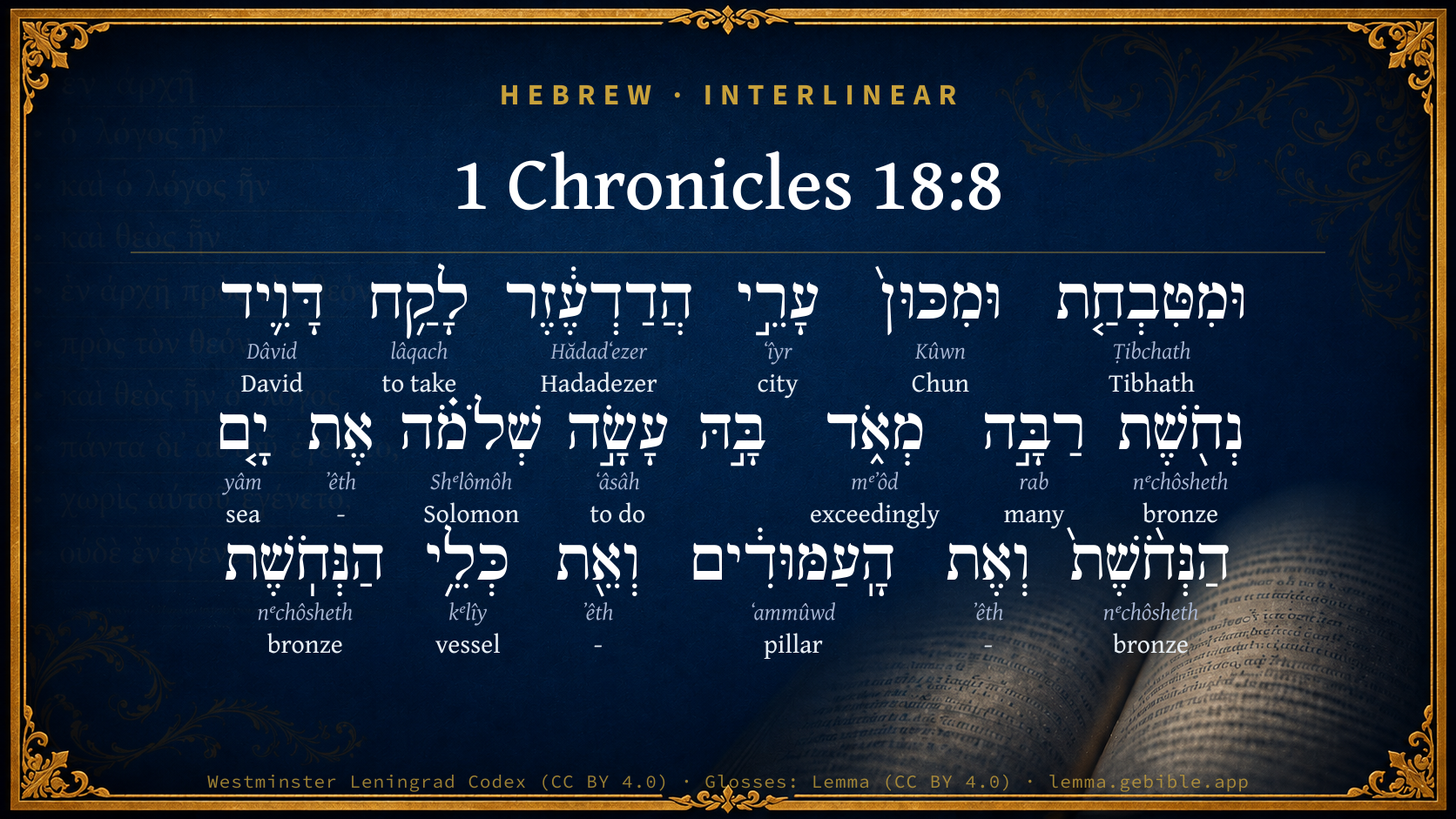
1 Chronicles 18:8

Hebrew (Westminster Leningrad Codex) 1 Chronicles 18:8 appears in the Hebrew Old Testament. The text above is from the Westminster Leningrad Codex. Each word links to its Strong’s number, a concise gloss, and parsing drawn from the Open Scriptures Hebrew Bible morphology. Click any word for its full Brown-Driver-Briggs (BDB) entry.
Download image
Cite this verse

1 Chronicles 18:8 (World English Bible). Public Domain. Lemma interlinear Bible study tool, https://lemma.gebible.app/v/1-chronicles/18/8.

Show BibTeX & RIS
BibTeX
RIS
English Translation
From Tibhath and from Cun, cities of Hadarezer, David took very much brass, with which Solomon made the brazen sea, and the pillars, and the vessels of brass.
World English Bible · Public Domain
Highlights
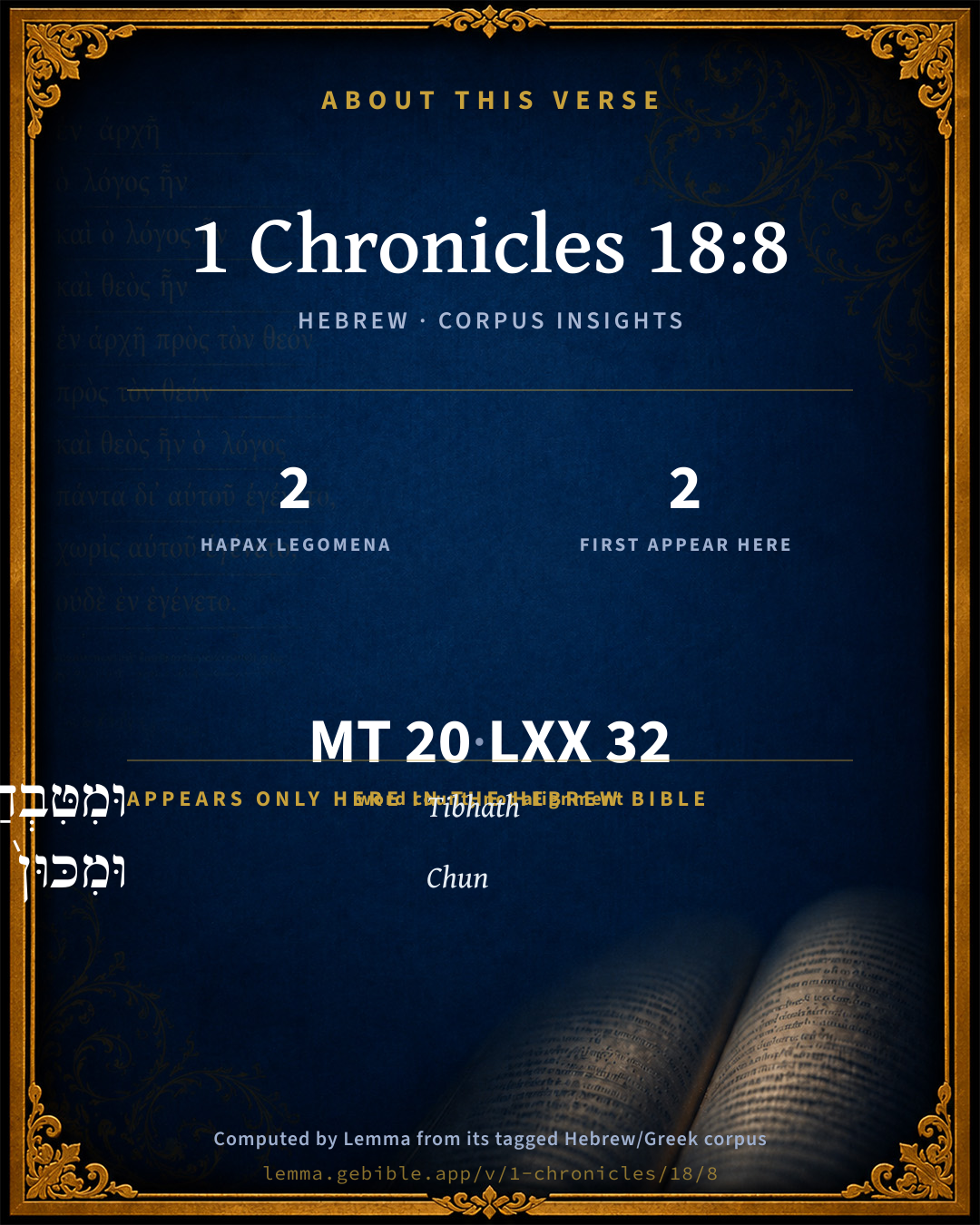
  • 2 hapax legomena — only here in the Hebrew Bible
  • 2 first appearances in the Hebrew Bible
Full analysis ↓
Download a study sheet

One document with this verse’s original text, its word-by-word gloss line, the meaning frame, cross-references with their text, attributed commentary, and full source and license credits — printable, and it pastes into notes with its structure intact.

This verse Autodidact and up

Study sheet (.html) Plain text (.txt)

A passage Seminary Student

Up to 50 verses in one chapter. A passage sheet keeps up to 6 commentary sources and 12 cross-references per verse, in the order this page ranks them, and says so on the sheet whenever that leaves anything out. Ask for a single verse and you get the Autodidact verse sheet above.

Everything on this page stays free to read, with no account — the sheet is a download of what is already on screen, not access to it.

Want to remove ads? Support Godless Engineer
Compare translations 3

The same verse in 3 English versions, stacked beneath the original-language interlinear above. Click any original word for its lexicon entry.

Each is an independent rendering of the whole verse — the interlinear is not word-aligned to these translations.

Highlighted words mark where these versions differ — a whole-verse word diff, not a word-by-word alignment.

  • World English Bible Public Domain
    From Tibhath and from Cun, cities of Hadarezer, David took very much brass, with which Solomon made the brazen sea, and the pillars, and the vessels of brass.
  • King James Version Public Domain
    Likewise from Tibhath, and from Chun, cities of Hadarezer, brought David very much brass, wherewith Solomon made the brazen sea, and the pillars, and the vessels of brass.
  • unfoldingWord Literal Text CC BY-SA 4.0
    And from Tibhath and from Kun, cities of Hadadezer, David took very much bronze. With it, Solomon made the sea of bronze and the pillars and the vessels of bronze.

unfoldingWord Literal Text — © unfoldingWord, licensed CC BY-SA 4.0. Word-aligned USFM3 via Door43 (git.door43.org/unfoldingWord/en_ult).

Versions to compare (up to 4)

3 of 4 selected

Show all 18 translations

Every available English version of this verse, each an independent rendering of the whole verse.

  • World English Bible Public Domain
    From Tibhath and from Cun, cities of Hadarezer, David took very much brass, with which Solomon made the brazen sea, and the pillars, and the vessels of brass.
  • Berean Standard Bible Public Domain
    And from Tibhath and Cun, cities of Hadadezer, David took a large amount of bronze, with which Solomon made the bronze Sea, the pillars, and various bronze articles.
  • Majority Standard Bible Public Domain
    And from Tibhath and Cun, cities of Hadadezer, David took a large amount of bronze, with which Solomon made the bronze Sea, the pillars, and various bronze articles.
  • King James Version Public Domain
    Likewise from Tibhath, and from Chun, cities of Hadarezer, brought David very much brass, wherewith Solomon made the brazen sea, and the pillars, and the vessels of brass.
  • American Standard Version (1901) Public Domain
    And from Tibhath and from Cun, cities of Hadarezer, David took very much brass, wherewith Solomon made the brazen sea, and the pillars, and the vessels of brass.
  • Revised Version (1885) Public Domain
    And from Tibhath and from Cun, cities of Hadarezer, David took very much brass, wherewith Solomon made the brasen sea, and the pillars, and the vessels of brass.
  • Geneva Bible (1599) Public Domain
    And from Tibhath, and from Chun (cities of Hadarezer) brought Dauid exceeding much brasse, wherewith Salomon made the brasen Sea, and the pillars and the vessels of brasse.
  • Douay-Rheims (1899) Public Domain
    Likewise out of Thebath and Chun, cities of Adarezer, he brought very much brass, of which Solomon made the brazen sea, and the pillars, and the vessels of brass.
  • Young's Literal Translation Public Domain
    and from Tibhath, and from Chun, cities of Hadarezer, hath David taken very much brass; with it hath Solomon made the brazen sea, and the pillars, and the vessels of brass.
  • Literal Standard Version CC BY-SA 4.0
    and from Tibhath, and from Chun, cities of Hadarezer, David has taken very much bronze; with it Solomon has made the bronze sea, and the pillars, and the vessels of bronze.
  • Unlocked Literal Bible CC BY-SA 4.0
    From Tebah and Kun, cities of Hadadezer, David took very much bronze. It was with this bronze that Solomon later made the bronze basin called “The Sea,” the pillars, and the bronze equipment.
  • unfoldingWord Literal Text CC BY-SA 4.0
    And from Tibhath and from Kun, cities of Hadadezer, David took very much bronze. With it, Solomon made the sea of bronze and the pillars and the vessels of bronze.
  • Darby Bible Public Domain
    And from Tibhath, and from Chun, cities of Hadarezer, David took very much brass, of which Solomon made the brazen sea, and the pillars, and the vessels of brass.
  • World Messianic Bible Public Domain
    From Tibhath and from Cun, cities of Hadadezer, David took very much bronze, with which Solomon made the bronze sea, the pillars, and the vessels of bronze.
  • Webster's Bible Public Domain
    Likewise from Tibhath, and from Chun, cities of Hadarezer, David brought very much brass, with which Solomon made the brazen sea, and the pillars, and the vessels of brass.
  • Free Bible Version CC BY-SA 4.0
    David also took a large quantity of bronze from Tibhath and from Cun, towns that had belonged to Hadadezer. Solomon used that bronze to make the bronze sea, the columns, and the various bronze objects.
  • Bible in Basic English Public Domain
    And from Tibhath and from Cun, towns of Hadadezer, David took a great store of brass, of which Solomon made the great brass water-vessel and the brass pillars and vessels.
  • JPS Tanakh (1917) Public Domain
    And from Tibhath and from Cun, cities of Hadarezer, David took very much brass, wherewith Solomon made the brazen sea, and the pillars, and the vessels of brass.

Literal Standard Version (2020), Covenant Press — licensed CC BY-SA 4.0. Text via the HelloAO Bible API (eBible.org). Unlocked Literal Bible (unfoldingWord) — licensed CC BY-SA 4.0. Text via the HelloAO Bible API (eBible.org). unfoldingWord Literal Text — © unfoldingWord, licensed CC BY-SA 4.0. Word-aligned USFM3 via Door43 (git.door43.org/unfoldingWord/en_ult). Free Bible Version, Dr. Jonathan Gallagher — licensed CC BY-SA 4.0. Text via the HelloAO Bible API (eBible.org).

Word by word

More ways to search: Search by grammar → Find every occurrence → Compare this word →

Practice this passage: Drill this verse → Learn its vocabulary →

וּמִטִּבְחַ֤ת
Ṭibchath
H2880
“and · from · Tibhath”
Conjunction + Preposition + Noun, Proper
Part of Speech
Conjunction + Preposition + Noun
Type
Proper
Full BDB Definition

Origin: from H2878

TWOT: None

Tibhath = "extension" - a Syrian city of Hadadezer, king of Zobah; also 'Betah'
  1. וּמִכּוּן֙ Kûwn H3560 “and · from · Chun” Conjunction + Preposition + Noun, Proper
  2. עָרֵ֣י ʻîyr H5892 “cities of” Noun, Common, Feminine, Plural, Construct
  3. הֲדַדְעֶ֔זֶר Hădadʻezer H1909 “Hadadezer” Noun, Proper
  4. לָקַ֥ח lâqach H3947 “to take” Verb, Qal, Perfect, 3rd Person, Masculine, Singular
  5. דָּוִ֛יד Dâvid H1732 “David” Noun, Proper
  6. נְחֹ֖שֶׁת nᵉchôsheth H5178 “bronze” Noun, Common, Feminine, Singular, Absolute
  7. רַבָּ֣ה rab H7227 “many” Adjective, Adjective, Feminine, Singular, Absolute
  8. מְאֹ֑ד mᵉʼôd H3966 “exceedingly” Adverb
  9. עָשָׂ֣ה ʻâsâh H6213 “to do” Verb, Qal, Perfect, 3rd Person, Masculine, Singular
  10. שְׁלֹמֹ֗ה Shᵉlômôh H8010 “Solomon” Noun, Proper
  11. אֶת ʼêth H853 “-” Particle, Direct Object
  12. יָ֤ם yâm H3220 “sea of” Noun, Common, Masculine, Singular, Construct
  13. הַנְּחֹ֨שֶׁת֙ nᵉchôsheth H5178 “the · bronze” Particle, Definite Article + Noun, Common, Feminine, Singular, Absolute
  14. וְאֶת ʼêth H853 “and · -” Conjunction + Particle, Direct Object
  15. הָֽעַמּוּדִ֔ים ʻammûwd H5982 “the · pillars” Particle, Definite Article + Noun, Common, Masculine, Plural, Absolute
  16. וְאֵ֖ת ʼêth H853 “and · -” Conjunction + Particle, Direct Object
  17. כְּלֵ֥י kᵉlîy H3627 “vessels of” Noun, Common, Masculine, Plural, Construct
  18. הַנְּחֹֽשֶׁת nᵉchôsheth H5178 “the · bronze” Particle, Definite Article + Noun, Common, Feminine, Singular, Absolute

About this verse

These counts appear in no published source. They are computed here, from the morphology-tagged text and Lemma’s own curated glosses. What Lemma adds →

20
words
15
distinct lemmas
Historical
section

Notable vocabulary

2 hapax legomena — words that appear only here in the entire Hebrew Bible:

  • וּמִטִּבְחַ֤ת Tibhath H2880
  • וּמִכּוּן֙ Chun H3560

First appearance in Scripture

These words make their first canonical appearance in the Hebrew Bible here:

  • וּמִטִּבְחַ֤ת Tibhath H2880
  • וּמִכּוּן֙ Chun H3560

Shared distinctive vocabulary

הֲדַדְעֶ֔זֶר Hadadezer H1909 occurs in 18 verses of the Hebrew Bible. Also found in:

Grammatical profile

  • 2 verbs
  • 12 nouns
  • 1 adjective
  • 1 preposition
  • 1 adverb
  • 3 particles

Verb forms

  • לָקַ֥ח Qal · Perfect
  • עָשָׂ֣ה Qal · Perfect

Repetition

A word recurs within this verse — often emphatic in Hebrew:

  • נְחֹ֖שֶׁת bronze H5178 ×3

Hebrew & Septuagint length

In English translation the verse runs 28 words from the Hebrew and 31 from the Septuagint (LXX English) — closely comparable.

A rough comparison of the two English renderings, which tokenize alike — not a word-level alignment.

Word counts can differ between the Hebrew and the Greek without any difference in meaning — e.g. the Hebrew direct-object marker אֵת has no separate Greek word, and Greek often adds the article ὁ.

In the original languages it is 20 Hebrew tokens and 32 Greek tokens — but the two are counted differently (Hebrew bundles its prefixes and suffixes into one token; the Greek is in lemma form), so that isn’t a like-for-like length.

Cross-references

6

Topical passages linked to 1 Chronicles 18:8 in the Treasury of Scripture Knowledge — connected by theme and wording, ordered by reader-vote popularity; previews shown in the World English Bible.

  • 2 Samuel 8:8 From Betah and from Berothai, cities of Hadadezer, king David took exceeding much brass.
  • 2 Chronicles 4:12–18 the two pillars, and the bowls, and the two capitals which were on the top of the pillars, and the two networks to cover the two bowls of the capitals that were on the top of the pillars,
  • 1 Kings 7:15–47 For he fashioned the two pillars of brass, eighteen cubits high apiece: and a line of twelve cubits compassed either of them about.
  • 1 Chronicles 22:14 Now, behold, in my affliction I have prepared for the house of Yahweh one hundred thousand talents of gold, and one thousand thousand talents of silver, and of brass and iron without weight; for it is in abundance: timber also and stone have I prepared; and you may add to them.
  • 2 Chronicles 4:2–6 Also he made the molten sea of ten cubits from brim to brim, round in compass; and the height of it was five cubits; and a line of thirty cubits compassed it round about.
  • Jeremiah 52:17–23 The pillars of brass that were in the house of Yahweh, and the bases and the brazen sea that were in the house of Yahweh, did the Chaldeans break in pieces, and carried all the brass of them to Babylon.

Cross-references courtesy of OpenBible.info (CC BY 4.0).

Hebrew and Greek witnesses Masoretic Hebrew ↔ Greek Septuagint

The same verse in the two great witnesses to the Old Testament, shown verse-for-verse.

These are two independent witnesses, not word-aligned to each other, and the Septuagint is shown in lemma (dictionary) form.

Hebrew 1 Chronicles 18:8 Masoretic · Westminster Leningrad Codex

וּמִטִּבְחַ֤ת וּמִכּוּן֙ עָרֵ֣י הֲדַדְעֶ֔זֶר לָקַ֥ח דָּוִ֛יד נְחֹ֖שֶׁת רַבָּ֣ה מְאֹ֑ד בָּ֣הּ עָשָׂ֣ה שְׁלֹמֹ֗ה אֶת יָ֤ם הַנְּחֹ֨שֶׁת֙ וְאֶת הָֽעַמּוּדִ֔ים וְאֵ֖ת כְּלֵ֥י הַנְּחֹֽשֶׁת

From Tibhath and from Cun, cities of Hadarezer, David took very much brass, with which Solomon made the brazen sea, and the pillars, and the vessels of brass.

World English Bible · Public Domain

Greek LXX 1 Chronicles 18:8 Septuagint · lemma form

καί ἐκ ὁ μεταβηχας καί ἐκ ὁ ἐκλεκτός πόλις ὁ αδρααζαρ λαμβάνω δαυίδ χαλκός πολύς σφόδρα ἐκ αὐτός ποιέω σαλωμών ὁ θάλασσα ὁ χαλκοῦς καί ὁ στῦλος καί ὁ σκεῦος ὁ χαλκοῦς

And David took out of Matabeth, and out of the chief cities of Adraazar very much brass: of this Solomon made the brazen sea, and the pillars, and the brazen vessels.

LXX2012 (modern English Septuagint) · Public Domain

On this verse, Ellicott's Commentary for English Readers discusses the Septuagint’s reading. Read the note in Commentary ↓

Hebrew: Westminster Leningrad Codex (CC BY 4.0). Greek: Septuagint (public domain); English from LXX2012 (modern English Septuagint) (Public Domain). How the Septuagint differs from the Hebrew →

Commentary

Notes on 1 Chronicles 18:8 from classic Christian and Jewish commentators (each source and its license shown beneath its notes). The classic Christian expositions comment on the surrounding passage and are grouped to its opening verse, so a note may address several verses; the Jewish commentaries on the Tanakh (Rashi and others) are per-verse, so they appear only where the commentator wrote on this verse.

Lemma curates 59 commentaries, every one of them public domain or Creative Commons licensed, each selected and text-cleaned for this edition rather than reprinted as found. About our sources →

Geneva Bible (1599)

Geneva Bible translators

Which in 2 Sam. 8:8, are called Betah and Berothai.

Geneva Bible (1599) marginal notes — public domain. Text via Bolls.life.

Jamieson, Fausset & Brown

Robert Jamieson, A. R. Fausset & David Brown

from Tibhath and from Chun--These places are called Betah and Berothai (Sa2 8:8). Perhaps the one might be the Jewish, the other the Syrian, name of these towns. Neither their situation nor the connection between them is known. The Arabic version makes them to be Emesa (now Hems) and Baal-bek, both of which agree very well with the relative position of Zobah.

Jamieson, Fausset & Brown — Commentary Critical and Explanatory on the Whole Bible (1871) — public domain (CC PDM 1.0). Text via the HelloAO Bible API.

Ellicott's Commentary for English Readers

(8) Tibhath, and . . . Chun.—Two unknown places. The names in Samuel are Betah and Berothai. Tebah occurs as an Aramean name in Gen_22:24, of which “Tibhath” is a feminine form, and “Betah” probably a corruption. Syriac, “Tĕbah” and “Bĕrûthi” in both places. So Arabic of Samuel, “Tâbâh” and “Barûti” (here “Himsa” and “Baalbec,” probably by way of an explanation). The readings of the LXX., “Metebak” (or Masbach) in Samuel, and “Matebeth” here, support Tebah. Vulgate in Samuel, “Bete,” but here “Thebath,” obviously equivalent to Tibhath. “Chun” is doubtless corrupt. All the versions support “Berothai” (LXX., “chosen cities;” comp. Heb., bârôth) except Arabic and Vulg. here.

Much brass.—Copper (as Job_28:2), or bronze (an alloy of copper and tin, which was well known to the ancients). Samuel, “copper in abundance” (harbçh), an older form of expression.

Wherewith Solomon made . . .—Not in the Hebrew of Samuel, though LXX. adds it.

A Bible Commentary for English Readers, edited by Charles John Ellicott (1878–1897) — public domain. Text from a community e-Sword module.

The Cambridge Bible for Schools and Colleges

gen. ed. J. J. S. Perowne

8. Likewise from] R.V. and from.

Tibhath] Cp. Tebah, the name of an Aramæan family, Gen_22:24. Nothing is known certainly of the position of the city; but cp. Sayce, Higher Criticism, p. 317. In 2Sa_8:8 Betah (= Tebah).

Chun] R.V. Cun; 2Sa_8:8, “Berothai.” Nothing is certainly known of a city of either name; but “Berothai” may be the same as “Berothah” (Eze_47:16).

very much brass] Cp. 1Ch_22:14; 1Ch_29:2.

brass] Not the metal generally so called. R.V. (mg. note to Gen_4:22) gives copper as an alternative rendering. The “brass” of the ancients (χαλκός, LXX.) corresponded rather to bronze.

the brasen sea, etc.] Cp. 2Ch_4:11-18.

The Cambridge Bible for Schools and Colleges (gen. ed. J. J. S. Perowne; Cambridge University Press, 1878–1918) — public domain. Text from a community e-Sword module.

Haydock's Catholic Bible Commentary

Chun, called probably Betath, and Berothai, 2 Kings.

George Leo Haydock (1774–1849), Haydock's Catholic Family Bible and Commentary, 1859 edition — public domain. Excludes Psalms (Douay-Rheims chapter numbering differs from Protestant) and Deuterocanonical books (Catholic canon only).

Matthew Poole's English Annotations

Tibhath and Chun; for which, 2Sa 8:8, Betah and Berothai are mentioned. Either therefore they were the same places called by several names, as is usual; or they were four neighbouring places, out of all which the brass was taken, whereof two places having been named there are omitted here, and the other two places there omitted are here remembered.

Matthew Poole's English Annotations on the Holy Bible (1683–1685) — public domain. Text from a community e-Sword/MySword module.

The Pulpit Commentary

Tibhath, and Chun. These names replace Betah and Berothai in the parallel place, in the former case with possibility of orthographic explanation, but not in the latter. The purpose for which David was glad to take their brass is not mentioned in Samuel, but only here. The brazen sea, and the pillars, and the vessels of brass (see 1Ki_7:14-47; 2Ch_4:1-18) In this latter place these subjects will be found treated more fully. This so-called "brazen sea" (tvjGh took the place in Solomon"s temple of (he earlier brazen laver (tvjg rwOYKi) of the Mosaic ritual (Exo_30:17-21; Lev_8:10, Lev_8:11; 1Ki_7:38) It is now called a sea, because of its large size.

The use of the original laver is plainly told, for the priests to wash at it their hands and feet before offering sacrifices. It stood in the court of the tabernacle, between the altar and the door. The ten lavers of Solomon"s temple were used for washing the sacrificial victims themselves. (2Ch_4:6) The brazen sea (which was rather of copper than brass, however) rested upon twelve standing oxen, three turning their faces to each quarter of the heavens. Its height was five cubits, its diameter ten cubits, the thickness of its metal a handbreadth, and its capacity variously given at two thousand baths (1Ki_7:26) or three thousand. (2Ch_4:5) It was removed from its supports of oxen by Ahaz, (2Ki_16:17) and placed on a pedestal of stone. And it was eventually destroyed by the Assyrians. (2Ki_25:13) And the pillars. (For these pillars of the porch, named Jachin and Boaz, (see 1Ki_7:15-22; 2Ch_3:15-17) And the vessels of brass. (For these, see 1Ki_7:40-51; 2Ch_4:16-18)

The Pulpit Commentary (1880–1919), ed. H.D.M. Spence-Jones & Joseph S. Exell — public domain. Text from a community e-Sword module.

Scofield Reference Notes

C. I. Scofield

Tibhath

Called Betah, and Berothai. 2Sa 8:8.

The Scofield Reference Bible (1917 edition), notes by C. I. Scofield — public domain. Text from a community e-Sword module.

Rashi

Rabbi Shlomo Yitzchaki (Rashi)

huge quantities of copper, from which... made, etc. This is what I stated (verse 17:1); since David stated [his intention] to build the House, and the Holy One, blessed be He, said to him, (17:4): “You shall not build... the House,” but your son, he proceeds to tell how he prepared for him to erect the edifice.

Rashi on the Tanakh — English translations: “The Judaica Press complete Tanach with Rashi, translated by A. J. Rosenberg” (CC BY 4.0); “Pentateuch with Rashi's commentary by M. Rosenbaum and A.M. Silbermann, 1929-1934” (public domain); “The Metsudah Tanach series, Lakewood, N.J” (CC BY 4.0); and “The Book of Joshua, Metsudah Publications, 1997” (CC BY 4.0). Text via Sefaria.

Lesson kit

Teaching starters — assembled from the data on this page, not authored interpretation. Every prompt links to the verse data it draws on. Edit before teaching.

1 Chronicles, in the Historical, opens this verse with 20 words (15 distinct Hebrew lemmas). Its most distinctive word is Ṭibchath (“Tibhath”). A historical commentator’s framing appears above. Read the whole chapter for the surrounding context.

Discussion questions

  1. How does “Tibhath” (Ṭibchath) shape what this verse is saying?
  2. This verse holds 2 words here found nowhere else in the Hebrew Bible. What might the rare words draw attention to?
  3. 2 words here appear for the first time in Scripture. What is being introduced at this debut?
  4. 2 Samuel 8:3 shares the word «Hadadezer» with this verse. How do the two illuminate each other?
  5. “bronze” occurs 3× in this one verse. What is the effect of the repetition?
  6. These translations render this verse differently; the difference is in the English rendering, not the original. What questions does that raise?
  7. The verb «לָקַ֥ח» is Qal Perfect. How does its form color the action?
  8. Reading how Geneva Bible (1599) and Jamieson, Fausset & Brown read this verse, where do the two commentators agree and where do they part?

Things to notice

  • 2 words in this verse appear nowhere else in the Hebrew Bible.
  • 2 words make their first canonical appearance in Scripture here.
  • This verse counts 20 Hebrew ↔ 32 Greek words.
  • These translations choose different wording for 13 words in this verse.
  • “bronze” occurs 3× in this single verse.

Reading settings

Reading text

Shown beneath each verse's original-language words.

Old Testament
Old Testament edition

Read the OT as the Masoretic Hebrew (MT) or the Greek Septuagint (LXX).

English shown for the Greek Septuagint (in the Hebrew ↔ Greek comparison).

Comparing translations? Open the Compare panel on any verse page to stack up to four side by side.