
Proverbs 28:20

Hebrew (Westminster Leningrad Codex) Proverbs 28:20 appears in the Hebrew Old Testament. The text above is from the Westminster Leningrad Codex. Each word links to its Strong’s number, a concise gloss, and parsing drawn from the Open Scriptures Hebrew Bible morphology. Click any word for its full Brown-Driver-Briggs (BDB) entry.
Download image
Cite this verse

Proverbs 28:20 (World English Bible). Public Domain. Lemma interlinear Bible study tool, https://lemma.gebible.app/v/proverbs/28/20.

Show BibTeX & RIS
BibTeX
RIS
English Translation
A faithful man is rich with blessings; But one who is eager to be rich will not go unpunished.
World English Bible · Public Domain
Download a study sheet

One document with this verse’s original text, its word-by-word gloss line, the meaning frame, cross-references with their text, attributed commentary, and full source and license credits — printable, and it pastes into notes with its structure intact.

This verse Autodidact and up

Study sheet (.html) Plain text (.txt)

A passage Seminary Student

Up to 50 verses in one chapter. A passage sheet keeps up to 6 commentary sources and 12 cross-references per verse, in the order this page ranks them, and says so on the sheet whenever that leaves anything out. Ask for a single verse and you get the Autodidact verse sheet above.

Everything on this page stays free to read, with no account — the sheet is a download of what is already on screen, not access to it.

Want to remove ads? Support Godless Engineer
Compare translations 3

The same verse in 3 English versions, stacked beneath the original-language interlinear above. Click any original word for its lexicon entry.

Each is an independent rendering of the whole verse — the interlinear is not word-aligned to these translations.

Highlighted words mark where these versions differ — a whole-verse word diff, not a word-by-word alignment.

  • World English Bible Public Domain
    A faithful man is rich with blessings; But one who is eager to be rich will not go unpunished.
  • King James Version Public Domain
    A faithful man shall abound with blessings: but he that maketh haste to be rich shall not be innocent.
  • unfoldingWord Literal Text CC BY-SA 4.0
    A man of faithfulness an abundance of blessings, but one hurrying to become rich will not remain blameless.

unfoldingWord Literal Text — © unfoldingWord, licensed CC BY-SA 4.0. Word-aligned USFM3 via Door43 (git.door43.org/unfoldingWord/en_ult).

Versions to compare (up to 4)

3 of 4 selected

Show all 18 translations

Every available English version of this verse, each an independent rendering of the whole verse.

  • World English Bible Public Domain
    A faithful man is rich with blessings; But one who is eager to be rich will not go unpunished.
  • Berean Standard Bible Public Domain
    A faithful man will abound with blessings, but one eager to be rich will not go unpunished.
  • Majority Standard Bible Public Domain
    A faithful man will abound with blessings, but one eager to be rich will not go unpunished.
  • King James Version Public Domain
    A faithful man shall abound with blessings: but he that maketh haste to be rich shall not be innocent.
  • American Standard Version (1901) Public Domain
    A faithful man shall abound with blessings; But he that maketh haste to be rich shall not be unpunished.
  • Revised Version (1885) Public Domain
    A faithful man shall abound with blessings: but he that maketh haste to be rich shall not be unpunished.
  • Geneva Bible (1599) Public Domain
    A faythfull man shall abound in blessings, and he that maketh haste to be riche, shall not be innocent.
  • Douay-Rheims (1899) Public Domain
    A faithful man shall be much praised: but he that maketh haste to be rich, shall not be innocent.
  • Young's Literal Translation Public Domain
    A stedfast man hath multiplied blessings, And whoso is hasting to be rich is not acquitted.
  • Literal Standard Version CC BY-SA 4.0
    A steadfast man has multiplied blessings, || And whoever is hastening to be rich is not acquitted.
  • Unlocked Literal Bible CC BY-SA 4.0
    A faithful man will have great blessings, but the one who gets rich quickly will not go unpunished.
  • unfoldingWord Literal Text CC BY-SA 4.0
    A man of faithfulness an abundance of blessings, but one hurrying to become rich will not remain blameless.
  • Darby Bible Public Domain
    A faithful man aboundeth with blessings; but he that maketh haste to be rich shall not be innocent.
  • World Messianic Bible Public Domain
    A faithful man is rich with blessings; but one who is eager to be rich will not go unpunished.
  • Webster's Bible Public Domain
    A faithful man shall abound with blessings: but he that maketh haste to be rich shall not be innocent.
  • Free Bible Version CC BY-SA 4.0
    If you're trustworthy, you'll be richly rewarded; but if you try to get rich quick, you won't go unpunished.
  • Bible in Basic English Public Domain
    A man of good faith will have great blessing, but one attempting to get wealth quickly will not go free from punishment.
  • JPS Tanakh (1917) Public Domain
    A faithful man shall abound with blessings; but he that maketh haste to be rich shall not be unpunished.

Literal Standard Version (2020), Covenant Press — licensed CC BY-SA 4.0. Text via the HelloAO Bible API (eBible.org). Unlocked Literal Bible (unfoldingWord) — licensed CC BY-SA 4.0. Text via the HelloAO Bible API (eBible.org). unfoldingWord Literal Text — © unfoldingWord, licensed CC BY-SA 4.0. Word-aligned USFM3 via Door43 (git.door43.org/unfoldingWord/en_ult). Free Bible Version, Dr. Jonathan Gallagher — licensed CC BY-SA 4.0. Text via the HelloAO Bible API (eBible.org).

Word by word

More ways to search: Search by grammar → Find every occurrence → Compare this word →

Practice this passage: Drill this verse → Learn its vocabulary →

וְאָ֥ץ
ʼûwts
H213
“and · pressing”
Conjunction + Verb, Qal, Participle Active, Masculine, Singular, Absolute
Part of Speech
Conjunction + Verb
Stem
Qal
Form
Participle Active
Gender
Masculine
Number
Singular
State
Absolute
Full BDB Definition

Origin: a primitive root

TWOT: 51

to press, be pressed, make haste, urge, be narrow - (Qal) - to press, hasten - to be pressed, confined, narrow - to hasten, make haste - be narrow - (Hiphil) - to urge, insist - to hasten
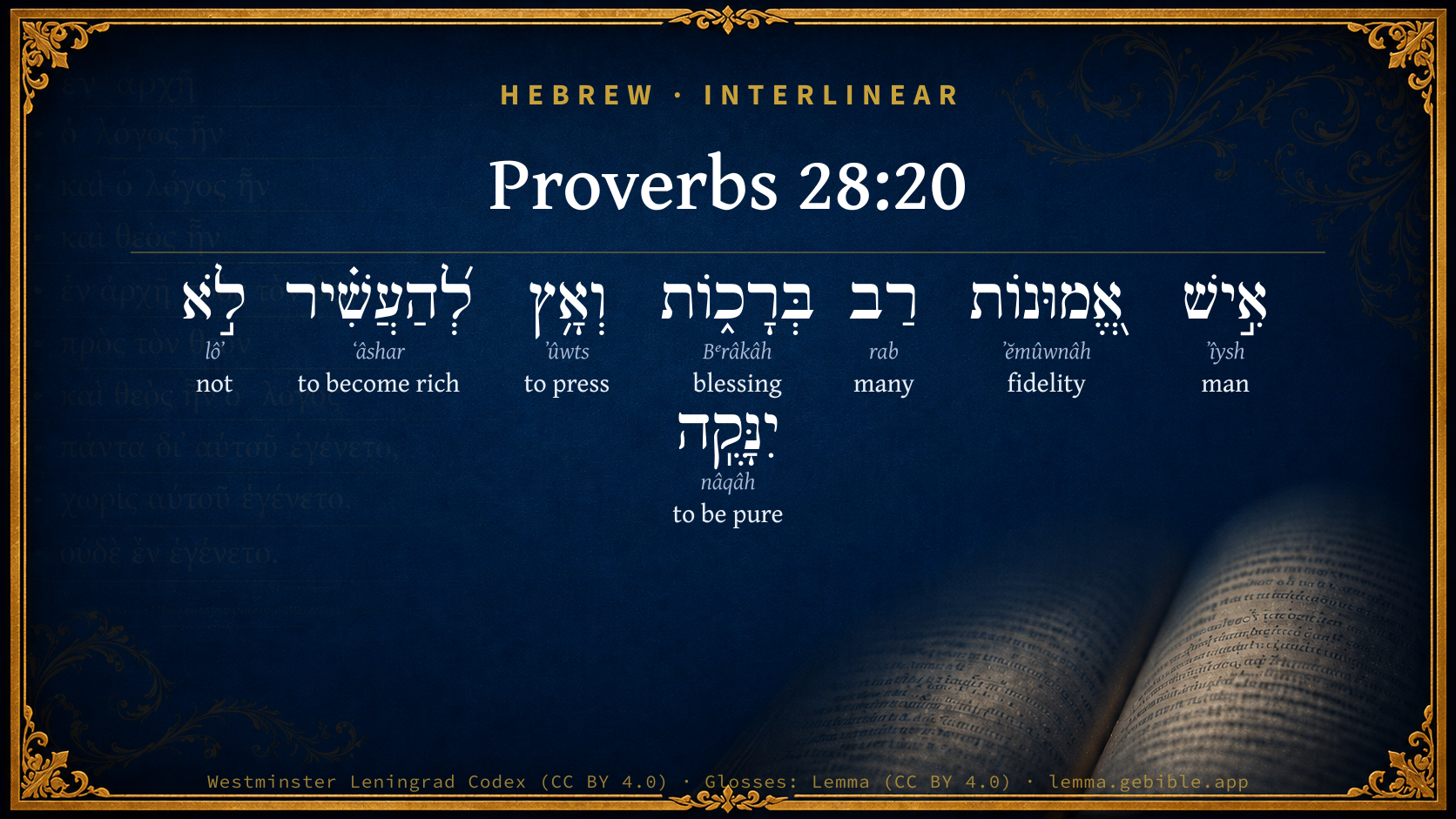
  1. אִ֣ישׁ ʼîysh H376 “man of” Noun, Common, Masculine, Singular, Construct
  2. אֱ֭מוּנוֹת ʼĕmûwnâh H530 “fidelity” Noun, Common, Feminine, Plural, Absolute
  3. רַב rab H7227 “many of” Adjective, Adjective, Masculine, Singular, Construct
  4. בְּרָכ֑וֹת Bᵉrâkâh H1293 “blessings” Noun, Common, Feminine, Plural, Absolute
  5. לְ֝הַעֲשִׁ֗יר ʻâshar H6238 “to become rich” Preposition + Verb, Hiphil, Infinitive Construct
  6. לֹ֣א lôʼ H3808 “not” Particle, Negative
  7. יִנָּקֶֽה nâqâh H5352 “to be pure” Verb, Niphal, Imperfect, 3rd Person, Masculine, Singular

About this verse

These counts appear in no published source. They are computed here, from the morphology-tagged text and Lemma’s own curated glosses. What Lemma adds →

8
words
8
distinct lemmas
Wisdom
section

Notable vocabulary

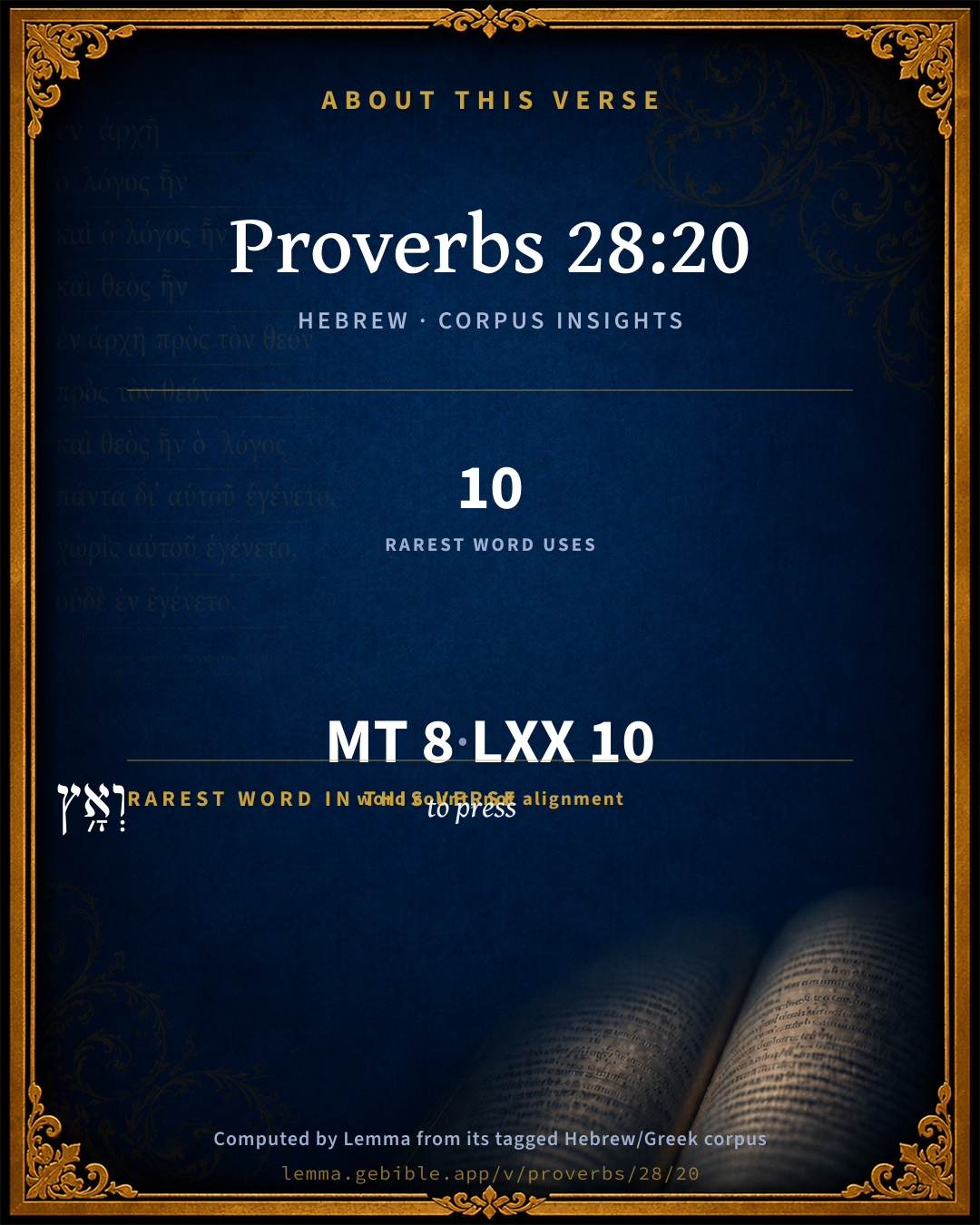
The rarest word here is וְאָ֥ץ to press H213 — appearing just 10 times in the whole Hebrew Bible.

Shared distinctive vocabulary

וְאָ֥ץ to press H213 occurs in 10 verses of the Hebrew Bible. Also found in:

Grammatical profile

  • 3 verbs
  • 3 nouns
  • 1 adjective
  • 1 particle

Verb forms

  • וְאָ֥ץ Qal · Participle Active
  • לְ֝הַעֲשִׁ֗יר Hiphil · Infinitive Construct
  • יִנָּקֶֽה Niphal · Imperfect

Hebrew & Septuagint length

In English translation the verse runs 19 words from the Hebrew and 16 from the Septuagint (LXX English) — closely comparable.

A rough comparison of the two English renderings, which tokenize alike — not a word-level alignment.

Word counts can differ between the Hebrew and the Greek without any difference in meaning — e.g. the Hebrew direct-object marker אֵת has no separate Greek word, and Greek often adds the article ὁ.

In the original languages it is 8 Hebrew tokens and 10 Greek tokens — but the two are counted differently (Hebrew bundles its prefixes and suffixes into one token; the Greek is in lemma form), so that isn’t a like-for-like length.

Cross-references

19

Topical passages linked to Proverbs 28:20 in the Treasury of Scripture Knowledge — connected by theme and wording, ordered by reader-vote popularity; previews shown in the World English Bible.

  • Luke 16:10–12 He who is faithful in a very little is faithful also in much. He who is dishonest in a very little is also dishonest in much.
  • Proverbs 13:11 Wealth gained dishonestly dwindles away, But he who gathers by hand makes it grow.
  • Psalms 112:4–9 Light dawns in the darkness for the upright, Gracious, merciful, and righteous.
  • Proverbs 10:6 Blessings are on the head of the righteous, But violence covers the mouth of the wicked.
  • Revelation 2:10 Don't be afraid of the things which you are about to suffer. Behold, the devil is about to throw some of you into prison, that you may be tested; and you will have oppression for ten days. Be faithful to death, and I will give you the crown of life.
  • Nehemiah 7:2 that I gave my brother Hanani, and Hananiah the governor of the castle, charge over Jerusalem; for he was a faithful man, and feared God above many.
  • Psalms 101:6 My eyes will be on the faithful of the land, That they may dwell with me. He who walks in a perfect way, He will serve me.
  • Proverbs 20:21 An inheritance quickly gained at the beginning, Won't be blessed in the end.
  • Proverbs 28:22 A stingy man hurries after riches, And doesn't know that poverty waits for him.
  • 1 Samuel 22:14 Then Ahimelech answered the king, and said, Who among all your servants is so faithful as David, who is the king's son-in-law, and is taken into your council, and is honorable in your house?
  • 2 Kings 5:20–27 But Gehazi the servant of Elisha the man of God, said, Behold, my master has spared this Naaman the Syrian, in not receiving at his hands that which he brought: as Yahweh lives, I will run after him, and take somewhat of him.
  • Proverbs 20:6 Many men claim to be men of unfailing love, But who can find a faithful man?
  • Luke 12:42 The Lord said, "Who then is the faithful and wise steward, whom his lord will set over his household, to give them their portion of food at the right times?
  • Luke 16:1 He also said to his disciples, "There was a certain rich man who had a manager. An accusation was made to him that this man was wasting his possessions.
  • 1 Corinthians 4:2–5 Here, moreover, it is required of stewards, that they be found faithful.
  • Proverbs 17:5 Whoever mocks the poor reproaches his Maker. He who is glad at calamity shall not be unpunished.
  • Proverbs 23:4 Don't weary yourself to be rich. In your wisdom, show restraint.
  • 1 Timothy 6:9–10 But those who are determined to be rich fall into a temptation and a snare and many foolish and harmful lusts, such as drown men in ruin and destruction.
  • Revelation 2:13 "I know your works and where you dwell, where Satan's throne is. You hold firmly to my name, and didn't deny my faith in the days of Antipas my witness, my faithful one, who was killed among you, where Satan dwells.

Cross-references courtesy of OpenBible.info (CC BY 4.0).

Hebrew and Greek witnesses Masoretic Hebrew ↔ Greek Septuagint

The same verse in the two great witnesses to the Old Testament, shown verse-for-verse.

These are two independent witnesses, not word-aligned to each other, and the Septuagint is shown in lemma (dictionary) form.

Hebrew Proverbs 28:20 Masoretic · Westminster Leningrad Codex

אִ֣ישׁ אֱ֭מוּנוֹת רַב בְּרָכ֑וֹת וְאָ֥ץ לְ֝הַעֲשִׁ֗יר לֹ֣א יִנָּקֶֽה

A faithful man is rich with blessings; But one who is eager to be rich will not go unpunished.

World English Bible · Public Domain

Greek LXX Proverbs 28:20 Septuagint · lemma form

ἀνήρ ἀξιόπιστος πολύς εὐλογέω ὁ δέ κακός οὐ ἀτιμώρητος εἰμί

A man worthy of credit shall be much blessed: but the wicked shall not be unpunished.

LXX2012 (modern English Septuagint) · Public Domain

On this verse, The Cambridge Bible for Schools and Colleges discusses the Septuagint’s reading. Read the note in Commentary ↓

Hebrew: Westminster Leningrad Codex (CC BY 4.0). Greek: Septuagint (public domain); English from LXX2012 (modern English Septuagint) (Public Domain). How the Septuagint differs from the Hebrew →

Commentary

Notes on Proverbs 28:20 from classic Christian and Jewish commentators (each source and its license shown beneath its notes). The classic Christian expositions comment on the surrounding passage and are grouped to its opening verse, so a note may address several verses; the Jewish commentaries on the Tanakh (Rashi and others) are per-verse, so they appear only where the commentator wrote on this verse.

Lemma curates 59 commentaries, every one of them public domain or Creative Commons licensed, each selected and text-cleaned for this edition rather than reprinted as found. About our sources →

Trapp's Complete Commentary

John Trapp

Pro 28:20 A faithful man shall abound with blessings: but he that maketh haste to be rich shall not be innocent.

Ver. 20. A faithful man shall abound in blessings.] God will bless him, and all that bless him. {Gen 12:3} {See Trapp on "Gen 12:3"} Men also shall rise up and call him blessed, saying, as Deu 33:29, "Happy art thou, O Israel; who is like unto thee, O peopIe, saved by the Lord, the shield of thy help," &c. Stars, though we see them sometimes in a puddle, in the bottom of a well, nay, in a stinking ditch, though they reflect there, I say, yet they have their situation in heaven. So God’s faithfal servants, though in a low condition, yet are they fixed in the region of happiness. {Lev 26:1-13 Deu 28:1-14}

But he that maketh haste to be rich shall not be innocent.] Nevessan (a better lawyer than good Christian) was wont to say, He that will not venture his body shall never be valiant; he that will not venture his soul shall never be rich. But let their money perish with them, that, Shimei-like, by seeking their servants, lose their souls; or, Jonaslike, care not to be cast over shipboard, so the ship of their worldly wealth may be in safety. Francis Xaverius counselled John III., King of Portugal, to meditate every day a quarter of an hour on that divine sentence, "What shall it profit a man to win the whole world and lose his own soul?" See 1Ti 6:9, with the note. What a woeful will was that of rich but wretched Hubertus. I yield, said he, my goods to the king, my body to the grave, my soul to the devil?

John Trapp, A Commentary or Exposition upon All the Books of the Old and New Testament (1647–1656) — public domain. Text from a community e-Sword module.

The Biblical Illustrator

Joseph S. Exell

Pro_28:20; Pro_28:22

He that maketh haste to be rich shall not be innocent.

Haste to be rich

Nowhere does the Bible denounce riches. It tells men very plainly what the dangers are. It denounces very strongly the conduct of rich men. But the motive to good conduct, in the Old Testament period, was the promise of secular prosperity--abundance. The Bible asserts that riches are a great blessing; and poverty a great misfortune. It is the method of Gods development and education of the race to bring men up to higher levels by those processes by which men develop larger means, various riches, and the comforts of life, and give to the household broader foundations, ampler powers. It goes against the educated religious feeling of men for one to say that the way of riches was meant to be the way of religion; yet it is true. All barbarous nations are poor. The Bible speaks the sentiment of universal mankind when it regards riches held in the hand of virtue as being an eminent blessing from God.

I. Riches may either be produced or collected. The foundation of all prosperity is production. He increases the riches of a society that applies his reason and skill to the raw material of the globe, or that brings it from inertness to positive service, and gives to matter the power of serving man. He produces wealth. Then comes the man who utilises it; creates it into garments, houses, utensils, etc. The foundation of all value is not what a thing costs in making it, but what is inherent in it of thought and skill. What part of man was used in producing it; and to what part of a man is such properly addressed? The man who produces wealth is the foundation man. It is the law of the production of wealth that a man should render an equivalent for every stage of value. Sudden wealth is not hasty wealth, necessarily.

II. The production of wealth connects itself with benevolence, with sympathy. The man who is developing property, as distinguished from money, is actually increasing the common wealth. It is a sad thing, but in the main true, that the producers of wealth are obliged to eat up the larger part of their product in order to have strength to work. But every man that is developing or producing riches is, at the same time, educating himself in morals, or should be. Patience is a moral quality; another name for self-control. The man who gets wealth legitimately is usually himself built up in inward riches fully as much as he builds up his estate in outward wealth.

III. Haste to be rich is a great danger to men, because it tempts them to employ illegitimate means. Sleights, crafts, disingenuous ways, greed, violations of honesty. Haste runs along the edge of so many dangers, that a mans head must be peculiarly well set on his shoulders, and his brain must be very solid and sober, if he does not topple over into them. A man that is making haste to be rich is tempted to ostentation. But ostentation is expensive, and men are easily tempted to devise schemes to maintain it. Men having sudden wealth are apt to become cruel through indifference to other mens rights. Haste is apt to change into idolatry. (H. W. Beecher.)

The Biblical Illustrator, edited by Joseph S. Exell (c. 1880s–1900s) — public domain. Text from a community e-Sword module.

Tyndale Open Study Notes

Tyndale Open Resources

28:20 quick riches: Wealth must be earned ethically, or it will cause harm and will not last (see 13:11, cp. 10:2; 11:18; 13:22; 21:6).

Tyndale Open Study Notes — © Tyndale Open Resources, licensed CC BY-SA 4.0. Text via the HelloAO Bible API.

Matthew Henry's Commentary

Here, 1. We are directed in the true way to be happy, and that is to be holy and honest. He that is faithful to God and man shall be blessed of the Lord, and he shall abound with blessings of the upper and nether springs. Men shall praise him, and pray for him, and be ready to do him any kindness. He shall abound in doing good, and shall himself be a blessing to the place where he lives. Usefulness shall be the reward of faithfulness, and it is a good reward. 2. We are cautioned against a false and deceitful way to happiness, and that is, right or wrong, raising an estate suddenly. Say not, This is the way to abound with blessings, for he that makes haste to be rich, more haste than good speed, shall not be innocent; and, if he be not, he shall not be blessed of God, but rather bring a curse upon what he has; nor, if he be not innocent, can he long be easy to himself; he shall not be accounted innocent by his neighbours, but shall have their ill will and ill word. He does not say that he cannot be innocent, but there is all the probability in the world that he will not prove so: He that hasteth with his feet sinneth, stumbleth, falleth. Sed quae reverentia legum, quis metus, aut pudor, est unquam properantis avari? - What reverence for law, what fear, what shame, was ever indicated by an avaricious man hasting to be rich?

Matthew Henry's Commentary on the Whole Bible (1708–1710) — public domain (CC PDM 1.0). Text via the HelloAO Bible API.

Jamieson, Fausset & Brown

Robert Jamieson, A. R. Fausset & David Brown

maketh haste . . . rich--implying deceit or fraud (Pro 20:21), and so opposed to "faithful" or reliable.

Jamieson, Fausset & Brown — Commentary Critical and Explanatory on the Whole Bible (1871) — public domain (CC PDM 1.0). Text via the HelloAO Bible API.

Adam Clarke's Commentary

Verse 20. He that maketh haste to be rich] See Pr 13:11; Pr 20:21.

Adam Clarke's Commentary on the Bible (1810–1826) — public domain. Text from a community e-Sword/MySword module.

Ellicott's Commentary for English Readers

(20) A faithful man, who is true to God and man, “shall abound with blessings” from God and man. Comp. Job’s description of his own blameless life and the blessings attending it (Job 29).

A Bible Commentary for English Readers, edited by Charles John Ellicott (1878–1897) — public domain. Text from a community e-Sword module.

The Cambridge Bible for Schools and Colleges

gen. ed. J. J. S. Perowne

20. faithful] i.e., as the second clause shews, one who puts fidelity above gain. Comp. Psa_15:4.

innocent] Rather, unpunished, A.V. marg. and R.V. οὐκ ἀτιμώρητος ἔσται, LXX.

The Cambridge Bible for Schools and Colleges (gen. ed. J. J. S. Perowne; Cambridge University Press, 1878–1918) — public domain. Text from a community e-Sword module.

John Gill's Exposition

A faithful man shall abound with blessings,.... Or, "a man of faithfulness" (u). A very faithful man, that is truly so; that is so in a moral sense; true to his work, makes good his promises, fulfils his contracts, abides by the obligations he lays himself under; is faithful in every trust reposed in him, be it greater or lesser matters, in every station in which it is, and throughout the whole course of his life. Such a man abounds with the blessings and praises of men; all value him, and speak well of him: and with the blessings of divine Providence; he is "much in blessings" (w), as it may be rendered; as in receiving blessings from God, so in giving them to men; such a man is usually charitable and beneficent. And it may be understood of one that is faithful, in a spiritual and evangelic sense; for of such characters are the followers of the Lamb, Rev 17:14. It is in the original, "a man of truths" (x); one that has the truth of grace in him; that knows the grace of God in truth; with whom the truth of the Gospel is; who has learnt it, known it, embraced it, values it, and abides by it; and who has a concern with Christ, who is the truth, who is formed, lives, and dwells in his heart; of whom he has made a good profession, and holds it fast, and whom he cleaves unto. The character of "faithful" belongs both to the true ministers of Christ, who preach the pure Gospel, and the whole of it; who seek not to please men, but God; and not themselves, and their own glory, but the things of Christ, and his glory; and continue to do so in the face of all opposition: and to private Christians, the faithful in Christ Jesus; who truly believe in him, stand by his truths, abide by his ordinances, and are faithful to one another, and continue so till death: these abound with the blessings of the covenant of grace, with all spiritual blessings in Christ, with the fulness of the blessing of the Gospel of Christ; they have an abundance of grace in them, given them in conversion, faith, hope, love, humility, and many other graces, in the exercise of which they are made to abound; and they have an abundance of blessings of grace bestowed on them, pardon of sin, a justifying righteousness, adoption, meetness for and right unto eternal life; they have Christ, and all things along with him; so that they may be truly said to have all things, and abound;

but he that maketh haste to be rich shall not be innocent; he that is over anxious, and immoderately desirous of being rich, and pursues every method of obtaining his desires, with all his might and main; that labours night and day for it; though he takes no criminal nor unlawful methods, properly so called, nor does he do anything injurious to others, yet he is not innocent; that too much anxiety in him is criminal; nor is he free from covetousness; see Pro 23:4; and if he uses any unjust and unlawful means to acquire wealth, and resolves to be rich, right or wrong, "per fas, per nefas", he shall not be innocent, neither before God nor men: so the Targum renders it,

"he that runs into iniquity, that he may be rich;''

and indeed when a man hastily, or in a short time, becomes rich, though he cannot be directly charged with fraud and injustice, yet he is not innocent in the minds of men, or free from their suspicious and jealousies of him. A man that makes haste to be rich is opposed to him that is faithful and true to his word and contracts, and is the same that Juvenal (y) calls "avarus properans"; see Ti1 6:9.

(u) "vir fidelitatum", Vatablus, Merceras, Piscator, Gejerus, Michaelis. (w) "multus benedictionibus", Montanus, Vatablus, Baynus, Michaeiis. (x) "Vir veritatum", Montanus. (y) Satyr. 14. v. 178.

John Gill's Exposition of the Whole Bible (1746–1763) — public domain (CC PDM 1.0). Text via the HelloAO Bible API.

Albert Barnes' Notes on the Bible

Not the possession of wealth, nor even the acquisition of it, is evil, but the eager haste of covetousness.

Shall not be innocent - Better, as in the margin, in contrast with the many “blessings” of the “faithful.”

Albert Barnes' Notes on the Bible (1834–1885) — public domain. Text from a community e-Sword/MySword module.

Haydock's Catholic Bible Commentary

Innocent. Unpunished, if he employ fraud, ver. 22., and chap. xiii. 21.

George Leo Haydock (1774–1849), Haydock's Catholic Family Bible and Commentary, 1859 edition — public domain. Excludes Psalms (Douay-Rheims chapter numbering differs from Protestant) and Deuterocanonical books (Catholic canon only).

Matthew Poole's English Annotations

A faithful man, Heb. a man of truth, or truths, who deals truly and justly in all his bargains and transactions with men.

That maketh haste; more than God alloweth him; that taketh the nearest and readiest way to riches, whether it be right or wrong; that is unfaithful and unjust in his dealings.

Shall not be innocent; shall not obtain the blessings which he seeks, but shall bring curses and miseries upon him instead of them.

Matthew Poole's English Annotations on the Holy Bible (1683–1685) — public domain. Text from a community e-Sword/MySword module.

Whedon's Commentary on the Bible

Daniel D. Whedon

20. A faithful man — Trusty. Literally, a man of fidelities.

But he that maketh haste to be rich — Is unduly urgent, and hence open to temptation: cupidity oftentimes leads to fraud and occasionally to violence.

Not be innocent — Not be held innocent, but be punished. Compare Pro_13:11; Pro_20:21; Pro_21:5; Pro_23:4; 1Ti_6:9.

Daniel D. Whedon (gen. ed.), Commentary on the Old and New Testaments (1874–1909) — public domain. Text from a community e-Sword module.

The Pulpit Commentary

A faithful man shall abound with blessings. "Faithful," as in Pro_20:6, one on whom one can depend, honest and upright. Septuagint, axiopistov . The blessings signified are such as come from God and man. Men will utter his name with praise and benediction, (comp. Job_29:8, etc.) and God will show his approval by sending material prosperity. He that maketh haste to be rich shall not be innocent. (comp. ver. 22, and note there; Pro_13:11 Pro_20:21 Pro_21:5) One who is only anxious to become quickly rich, and is unscrupulous as to means, cannot be "a faithful man," and therefore cannot be blessed. Instead of "innocent," many expositors render "unpunished", (as Pro_17:5) which better contrasts with the blessings mentioned in the first hemistich, though the two ideas are coordinate. On this haste of covetousness, Juvenal writes ("Sat.," 14:173)"Inde fere scelerum causae; nec plura venena Miscuit aut ferro grassatur saepius ullum Humanae mentis vitium, quam saeva cupido Immodici census; nam dives qui fieri vult, Et cito vult fieri. Sed quae reverentia legum, Quis metus aut pudor est unquam properantis avari? The Septuagint waters down the gnome, "But the wicked shall not be unpunished.

Vers. 20, 22 (and Ver. 8). Wealth or faithfulness? a sermon to young men.

What shall the young man set before him as his goal when he stands face to face with active life? Shall he make up his mind to be rich, or shall he resolve that, whatever his circumstances may be, he will be counted among those who are faithful to their trust? Shall he fix his mind upon and find his heritage in a large estate or in an honourable and a useful life? Let such an inquirer consider

I THE GRAVE DOUBT ABOUT WEALTH. To have sufficiency of money for a comfortable home, for education, for the furtherance of the cause of God, and for the relief of human want, this is certainly a very desirable thing. He who is facing the future may honestly desire to attain it, and he who has won it may well give God hearty thanks for the goodness which has placed this blessing in his power. But the mere acquisition of wealth, on which so many set their hearts, to which they devote their lives, and for which they sacrifice the best and highest things of all, ensures nothing at all of that which is valuable to a man who uses his reason and cares for his character. For who can be sure:

1. How it will be gained. There are temptations on every hand to gain money dishonestly or, if not fraudulently, by questionable means; by taking advantage of the weak and struggling in a way which, if it be not positively unjust, is inconsiderate and unkind. Of those who "make haste to be rich," how very large a proportion fail to "be innocent" (Ver. 20)! They either deviate from the straight line of perfect equity, or they wander into ways of rank injustice and shameful wrong. Who shall say whether the next aspirant will not be counted in their number? And what does it profit a man to gain a fortune and to lose his integrity?

2. How long it will stay. He "considereth not that poverty shall come upon him." Few things are less certain than the duration of wealth. Who that has reached middle life has not frequently known of those that were supposed to be beyond the reach of misfortune being suddenly reduced or positively beggared? (see Pro_23:5)

3. How much it will do for its possessor. "He that hasteth... hath an evil eye;" so far is he from being satisfied with his fortune, and from looking graciously and generously upon all his neighbours, rich and poor, that he looks enviously upon those that are wealthier than himself, proudly upon those that are less successful, and grudgingly upon those that are poor, lest they should want his aid and diminish his store.

4. Whither it will go. If dishonestly obtained, it is likely enough that wealth will soon meet with the penalty it deserves, and pass to another holder. It may go to him that will "pity the poor," or it may get into the hands of "the fool," who will squander it in some kind of folly. (Ecc_2:18, Ecc_2:19, Ecc_2:21) There is, then, an utter uncertainty about riches. It may be that God has not intended a man to be rich, but to be happy in a very humble station; (Pro_30:9) and a pertinacious endeavour to secure what God has not placed within reach must end in a wretched failure and a badly bruised spirit. To such as these the strong words of Paul are applicable. (1Ti_6:9, 1Ti_6:10)

II THE CERTAINTY ABOUT FAITHFULNESS. "A faithful man shall abound with blessings." And there is no room for questioning it. Let a man be faithful to his convictions; let him be to God, his Father and his Saviour, what he knows in his heart he should be; let him be true and upright in all his relations with his fellow men, and he will be regulating his life by a sovereign principle which will "abound with blessings." It will:

1. Build up a strong and noble character.

2. Establish an honourable reputation and win the confidence of men.

3. Secure as large a measure of peace and of happiness as is the lot of disciplined humanity.

4. Dispense much good of many kinds to those around, both in public and in domestic life.

5. Lead down to a peaceful end, and on to a glorious future. What wise man would endanger the loss of these priceless blessings for the uncertain and transient good of worldly wealth? C.

"A faithful man.

I HIS CHARACTER. Nothing can be more grand than fidelity. When found in a man it is an image of the eternal constancy of God; it is like that Divine righteousness which the psalmist compared to the "everlasting hills so firm, so enduring, so changeless. It would be well if this grand Old Testament grace were more prized and cultivated in the Christian Church. Let us consider it in some of its manifold aspects. What is the character of the faithful man?

1. He is true to himself. This fidelity must lie at the root of his fidelity to others. The faithful man must act out honestly what he feels to be demanded by his own inkier convictions.

2. He is true to his God. The man of God is faithful as well as trustful. Thus his faith has the two sides of passive submission and active loyalty. The primary duty to God must be observed before the secondary duty to man can be kept.

3. Are is true to his friend. This does not merely mean that he keeps his pledges. It also involves his regarding the welfare of his friend and coming to his aid in the hour of need, danger, and helpful service.

4. He is true to his word one who "sweareth to his own hurt and changeth not." It is nothing that we keep our promises when they run along the lines of our own inclinations. The test is that they are equally honoured when they involve self-sacrifice.

5. He is true when unobserved. Faithful service is the opposite of eye service. The faithful man will do well, though he never expects to be called to account. Faithful work is that which never meets the eye, and yet is as well wrought as the most conspicuous work.

6. He is true in face of danger. Here is the test of fidelity. The faithful servant of Christ is one who will not forsake his Lord when persecution threatens him. The martyr is "faithful unto death". (Rev_2:10)

II HIS FRUITFULNESS. He "abounds with blessings." He is like Abraham, "the father of the faithful," who was both blessed himself and a blessing to others. (Gen_12:2)

1. He is a recipient of abundant blessings. It is a happy thing to be faithful even though fidelity be met with misunderstanding or persecution.

(1) Fidelity is itself a blessing. This grace is its own reward. To have grace to live a strong, true, noble life is to be one of God"s blessed sons, though no further reward be anticipated.

(2) Fidelity brings many earthly blessings. It may not secure worldly wealth, though generally integrity is a safer road to success in life than the crooked paths of dishonour. But it will secure peace, and in the long run it is likely to be recognized and rewarded with well-merited honour. To be accounted a faithful servant is to be crowned with better than Olympian garlands.

(3) Fidelity will be rewarded with heavenly favour. This is just the chief of Divine approvals singled out by Christ for his servants, "Well done, good and faithful servant". (Mat_25:21)

2. He is a source of abundant blessings. One true, faithful soul what a tower of strength! what a treasury of help! what a haven of refuge! He is rich indeed who has a faithful friend. The faithful man can be relied on to help in time of need, when the faithless man, who perhaps is much stronger, deserts his trusting friend. Christ is faithful, (2Th_3:3) and as such is a source of abundant blessings to his people. His fidelity is the ground of our faith.

The Pulpit Commentary (1880–1919), ed. H.D.M. Spence-Jones & Joseph S. Exell — public domain. Text from a community e-Sword module.

John Wesley's Explanatory Notes

Faithful - Who deals truly and justly in all his transactions.

John Wesley, Explanatory Notes Upon the Whole Bible (1754–1765) — public domain. Text via the GEBible commentary corpus.

Keil & Delitzsch

C. F. Keil & F. Delitzsch

To this proverb of the cultivation of the land as the sure source of support, the next following stands related, its contents being cognate:

20 A strong, upright man is enriched with blessings;

But he that hastens to become rich remains not unpunished.

אישׁ אמוּנים, Pro 20:6, as well as אמוּנות 'א, denotes a man bonae fidei; but the former expression refers the description to a constancy and certainty in the relations of favour and of friendship, here to rectitude or integrity in walk and conduct; the plur. refers to the all-sidedness and the ceaselessness of the activity. בּרכות is related, as at Pro 10:6 : the idea comprehends blessings on the side of God and of man, thus benedictio rei and benedictio voti. On the contrary, he who, without being careful as to the means, is in haste to become rich, remains not only unblessed, but also is not guiltless, and thus not without punishment; also this לא ינּקה (e.g., Pro 6:29), frequently met in the Mishle, is, like ברכות, the union of two ideas, for generally the bibl. mode of conception and language comprehends in one, sin, guilt, and punishment.

Keil & Delitzsch — Biblical Commentary on the Old Testament (1861–1891) — public domain (CC PDM 1.0). Text via the HelloAO Bible API. (Old Testament only.)

Bridges on Proverbs

Charles Bridges

The study of the contrast shews the definite meaning of the terms. A faithful man is opposed, not to the rich, but — mark the careful accuracy — to him that hasteth to be rich. A man may be rich by the blessing of God.†1 He hasteth to be rich by his own covetousness. (1Ti 6:10 .) He may be rich, and yet faithful. He hasteth to be rich at the expense of faithfulness.†2 The faithful man makes no loud profession. But he bears to be looked at, even in the veriest trifles. (Luk 16:10 .) He is true to his word. He fulfills his engagements. He has only one principle — "unto the Lord;" under his eye; in his presence; "to his glory."†3 Try his principle by a worldly bait. He will prefer his conscience to his interest. He would rather be poor by Providence, than rich by sin. This is the "man of faithfulness. Who shall find him?"†4 But when you have found him, mark his abounding blessing; blessings covering his head;†5 blessings for both worlds.†6 Is there not infinitely more promise in the ways of God, than in the ways of sin? Be the path ever so tried and perplexed, only let it be a straight path,†7 and the Lord’s sunshine will cheer it. ’In the hand of God’ — saith a wise man — ’is the prosperity of man.’†8

But the man who has no faith, can only walk in a crooked path. He leaps over every bound of principle. He hasteth to be rich. He cannot wait for God in the path of Christian diligence. The promise does not run fast enough for him. He becomes rich too soon; he scarcely knows or cares by what means; by any means, rather than lose his grasp. Yet all this haste is only to his own ruin. Instead of abounding with blessings, he shall not be innocent. Jacob, as a faithful man, was paid with full wages for his work. Though his master dealt hardly, God dealt bountifully with him. He abounded with blessings; while Laban, hasting to be rich, was impoverished. (Gen 31:7-9 .) ’I will study more’ — said good Bp. Hall — ’how to give account of my little, than how to make it more.’

Hard indeed, if not impossible, is it to hold fast innocency in this path of temptation.†9 ’Yet how does the Scripture combat the vice of covetousness? Not by asserting, that gold is only earth, exhibiting itself under a particular modification, and therefore not worth seeking; but by telling us, that "covetousness is idolatry," that "the love of money is the root of all evil;" that it has occasioned in some even the "shipwreck of their faith," and is always, in whomsoever it obtains, an abomination?’†10 Even if no criminal means be resorted to, yet the immoderate desire, the perseverance in every track of Mammon, the laboring night and day for the grand object, the delight and confidence in the acquisition (Job 31:25 ) — all prove the idolatrous heart (Job 31:24, Job 31:28 ), and will not go unpunished. "They that will be rich — that haste to be rich — fall into temptation and a snare, and into many foolish and hurtful lusts, that drown men in destruction and perdition. But thou, O man of God, flee these things." (1Ti 6:9-11 .)

Footnotes:

†1 Pro 10:22. Gen 24:35 . 1Ki 3:13 .

†2 Pro 28:22. Pro 19:2 ; Pro 20:14 . Even the heathen moralists could see this —

OudeiV eplouthse tacewV dikaioV wn. (). Menander.

. . . . . ’Nam dives qui fieri vult,

Et cito vult fieri; sed quæ reverentia legum?

Quis metus, aut pudor est unquam properantis avari?’ Juv. Sat. 14. 176-178.

†3 Col 3:23. 1Co 10:31 .

†4 Heb. Pro 20:6 . Mat 24:45 .

†5 Pro 10:6.

†6 Psa 37:37; Psa 112:1-10 . Isa 33:15-16 .

†7 Pro 4:26-27. Heb 12:13 .

†8 Sir 10:5.

†9 2Ki 5:25-27 . Compare Pro 13:11 ; Pro 20:21 ; Pro 21:6 .

†10 Cowper’s cursory Remarks on Carrocioli. Works. Southey’s Ed. vii. 273.

Charles Bridges, An Exposition of the Book of Proverbs (1846) — public domain. Text from a community e-Sword module.

Rashi

Rabbi Shlomo Yitzchaki (Rashi)

A trustworthy man who gives his tithes faithfully, for there is no witness to the matter, but the Holy One, blessed be He, sees and lavishes blessings upon him.

but he who hastens to become rich He hastens the time to become rich from the belongings of the poor.

Rashi on the Tanakh — English translations: “The Judaica Press complete Tanach with Rashi, translated by A. J. Rosenberg” (CC BY 4.0); “Pentateuch with Rashi's commentary by M. Rosenbaum and A.M. Silbermann, 1929-1934” (public domain); “The Metsudah Tanach series, Lakewood, N.J” (CC BY 4.0); and “The Book of Joshua, Metsudah Publications, 1997” (CC BY 4.0). Text via Sefaria.

Lesson kit

Teaching starters — assembled from the data on this page, not authored interpretation. Every prompt links to the verse data it draws on. Edit before teaching.

Proverbs, in the Wisdom, opens this verse with 8 words (8 distinct Hebrew lemmas). Its most distinctive word is ʼûwts (“to press”). A historical commentator’s framing appears above. Read the whole chapter for the surrounding context.

Discussion questions

  1. The word ʼûwts carries the sense “to press.” How does it shape the verse?
  2. How does Genesis 19:15, which shares the word «to press», read alongside this verse?
  3. These translations render this verse differently; the difference is in the English rendering, not the original. What questions does that raise?
  4. «וְאָ֥ץ» is a Qal Participle Active verb. How does that grammatical form shape the action described?
  5. Compare how Trapp's Complete Commentary and The Biblical Illustrator read this verse. Where do they agree or differ?

Things to notice

Reading settings

Reading text

Shown beneath each verse's original-language words.

Old Testament
Old Testament edition

Read the OT as the Masoretic Hebrew (MT) or the Greek Septuagint (LXX).

English shown for the Greek Septuagint (in the Hebrew ↔ Greek comparison).

Comparing translations? Open the Compare panel on any verse page to stack up to four side by side.