
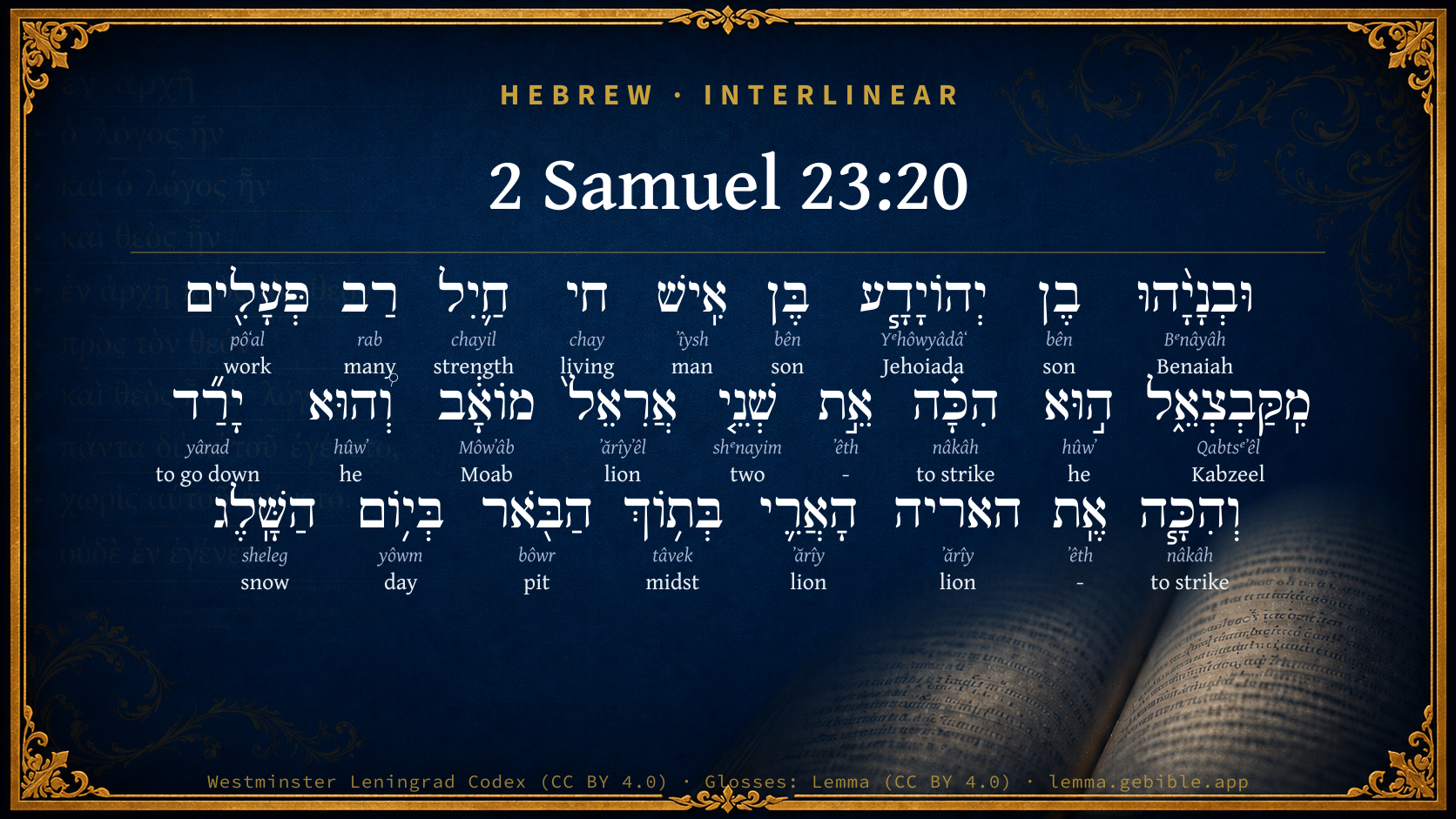
2 Samuel 23:20

Hebrew (Westminster Leningrad Codex) 2 Samuel 23:20 appears in the Hebrew Old Testament. The text above is from the Westminster Leningrad Codex. Each word links to its Strong’s number, a concise gloss, and parsing drawn from the Open Scriptures Hebrew Bible morphology. Click any word for its full Brown-Driver-Briggs (BDB) entry.
Download image
Cite this verse

2 Samuel 23:20 (World English Bible). Public Domain. Lemma interlinear Bible study tool, https://lemma.gebible.app/v/2-samuel/23/20.

Show BibTeX & RIS
BibTeX
RIS
English Translation
Benaiah the son of Jehoiada, the son of a valiant man of Kabzeel, who had done mighty deeds, he killed the two [sons of] Ariel of Moab: he went down also and killed a lion in the midst of a pit in time of snow.
World English Bible · Public Domain
Highlights
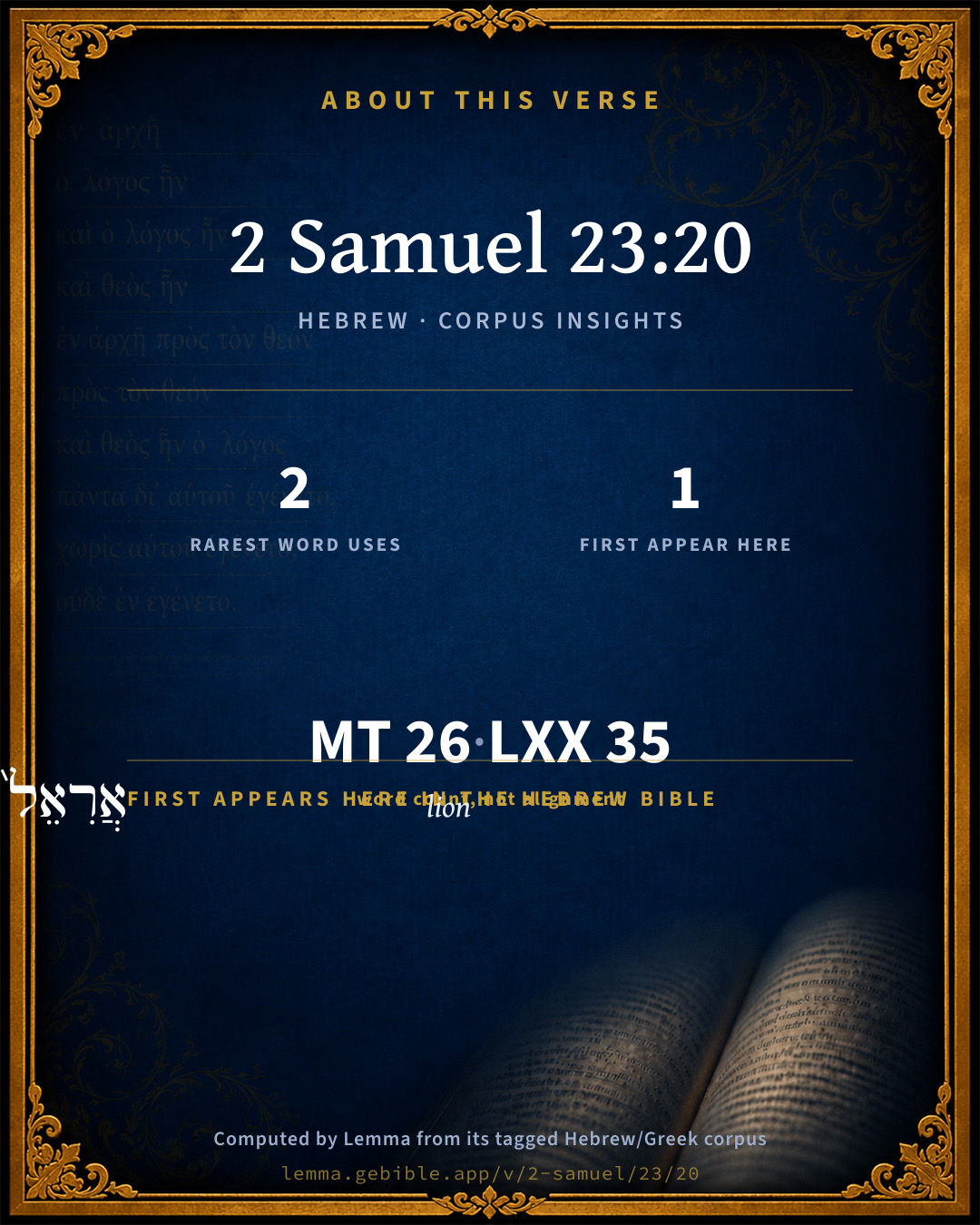
  • 1 first appearance in the Hebrew Bible
Full analysis ↓
Download a study sheet

One document with this verse’s original text, its word-by-word gloss line, the meaning frame, cross-references with their text, attributed commentary, and full source and license credits — printable, and it pastes into notes with its structure intact.

This verse Autodidact and up

Study sheet (.html) Plain text (.txt)

A passage Seminary Student

Up to 50 verses in one chapter. A passage sheet keeps up to 6 commentary sources and 12 cross-references per verse, in the order this page ranks them, and says so on the sheet whenever that leaves anything out. Ask for a single verse and you get the Autodidact verse sheet above.

Everything on this page stays free to read, with no account — the sheet is a download of what is already on screen, not access to it.

Want to remove ads? Support Godless Engineer
Compare translations 3

The same verse in 3 English versions, stacked beneath the original-language interlinear above. Click any original word for its lexicon entry.

Each is an independent rendering of the whole verse — the interlinear is not word-aligned to these translations.

Highlighted words mark where these versions differ — a whole-verse word diff, not a word-by-word alignment.

  • World English Bible Public Domain
    Benaiah the son of Jehoiada, the son of a valiant man of Kabzeel, who had done mighty deeds, he killed the two [sons of] Ariel of Moab: he went down also and killed a lion in the midst of a pit in time of snow.
  • King James Version Public Domain
    And Benaiah the son of Jehoiada, the son of a valiant man, of Kabzeel, who had done many acts, he slew two lionlike men of Moab: he went down also and slew a lion in the midst of a pit in time of snow:
  • unfoldingWord Literal Text CC BY-SA 4.0
    And Benaiah, the son of Jehoiada, a son of a man of valor, many deeds, from Kabzeel. He, he struck the two Ariel of Moab. And he, he went down and struck a lion in the midst of the pit on a day of snow.

unfoldingWord Literal Text — © unfoldingWord, licensed CC BY-SA 4.0. Word-aligned USFM3 via Door43 (git.door43.org/unfoldingWord/en_ult).

Versions to compare (up to 4)

3 of 4 selected

Show all 18 translations

Every available English version of this verse, each an independent rendering of the whole verse.

  • World English Bible Public Domain
    Benaiah the son of Jehoiada, the son of a valiant man of Kabzeel, who had done mighty deeds, he killed the two [sons of] Ariel of Moab: he went down also and killed a lion in the midst of a pit in time of snow.
  • Berean Standard Bible Public Domain
    And Benaiah son of Jehoiada was a man of valor from Kabzeel, a man of many exploits. He struck down two champions of Moab, and on a snowy day he went down into a pit and killed a lion.
  • Majority Standard Bible Public Domain
    And Benaiah son of Jehoiada was a man of valor from Kabzeel, a man of many exploits. He struck down two champions of Moab, and on a snowy day he went down into a pit and killed a lion.
  • King James Version Public Domain
    And Benaiah the son of Jehoiada, the son of a valiant man, of Kabzeel, who had done many acts, he slew two lionlike men of Moab: he went down also and slew a lion in the midst of a pit in time of snow:
  • American Standard Version (1901) Public Domain
    And Benaiah the son of Jehoiada, the son of a valiant man of Kabzeel, who had done mighty deeds, he slew the two `sons of' Ariel of Moab: he went down also and slew a lion in the midst of a pit in time of snow.
  • Revised Version (1885) Public Domain
    And Benaiah the son of Jehoiada, the son of a valiant man of Kabzeel, who had done mighty deeds, he slew the two sons of Ariel of Moab: he went down also and slew a lion in the midst of a pit in time of snow:
  • Geneva Bible (1599) Public Domain
    And Benaiah the sonne of Iehoiada the sonne of a valiant man, which had done many actes, and was of Kabzeel, slewe two strong men of Moab: he went downe also, and slewe a lyon in the middes of a pit in the time of snowe.
  • Douay-Rheims (1899) Public Domain
    And Banaias the son of Joiada a most valiant man, of great deeds, of Cabseel: he slew the two lions of Moab, and he went down, and slew a lion in the midst of a pit, in the time of snow.
  • Young's Literal Translation Public Domain
    And Benaiah son of Jehoiada (son of a man of valour, great in deeds from Kabzeel), he hath smitten two lion-like men of Moab, and he hath gone down and smitten the lion in the midst of the pit in a day of snow.
  • Literal Standard Version CC BY-SA 4.0
    And Benaiah son of Jehoiada (son of a man of valor, great in deeds from Kabzeel), has struck two lion-like men of Moab, and he has gone down and struck the lion in the midst of the pit in a day of snow.
  • Unlocked Literal Bible CC BY-SA 4.0
    Benaiah from Kabzeel was the son of Jehoiada; he was a strong man who did mighty feats. He killed the two sons of Ariel of Moab. He also went down into a pit and killed a lion while it was snowing.
  • unfoldingWord Literal Text CC BY-SA 4.0
    And Benaiah, the son of Jehoiada, a son of a man of valor, many deeds, from Kabzeel. He, he struck the two Ariel of Moab. And he, he went down and struck a lion in the midst of the pit on a day of snow.
  • Darby Bible Public Domain
    And Benaiah the son of Jehoiada, son of a valiant man, great in exploits, of Kabzeel: he it was that smote two lions of Moab; and he went down and smote a lion in the midst of a pit on a snowy day.
  • World Messianic Bible Public Domain
    Benaiah the son of Jehoiada, the son of a valiant man of Kabzeel, who had done mighty deeds, killed the two sons of Ariel of Moab. He also went down and killed a lion in the middle of a pit in a time of snow.
  • Webster's Bible Public Domain
    And Benaiah the son of Jehoiada, the son of a valiant man, of Kabzeel, who had done many acts, he slew two lion-like men of Moab: he went down also and slew a lion in the midst of a pit in time of snow:
  • Free Bible Version CC BY-SA 4.0
    Benaiah, son of Jehoiada, a strong warrior from Kabzeel, did many amazing things. He killed two sons of Ariel of Moab. He also went after a lion into a pit in the snow and killed it.
  • Bible in Basic English Public Domain
    And Benaiah the son of Jehoiada, a fighting man of Kabzeel, had done great acts; he put to death the two sons of Ariel of Moab: he went down into a hole and put a lion to death in time of snow:
  • JPS Tanakh (1917) Public Domain
    And Benaiah the son of Jehoiada, the son of a valiant man of Kabzeel, who had done mighty deeds, he smote the two altar-hearths of Moab; he went down also and slew a lion in the midst of a pit in time of snow;

Literal Standard Version (2020), Covenant Press — licensed CC BY-SA 4.0. Text via the HelloAO Bible API (eBible.org). Unlocked Literal Bible (unfoldingWord) — licensed CC BY-SA 4.0. Text via the HelloAO Bible API (eBible.org). unfoldingWord Literal Text — © unfoldingWord, licensed CC BY-SA 4.0. Word-aligned USFM3 via Door43 (git.door43.org/unfoldingWord/en_ult). Free Bible Version, Dr. Jonathan Gallagher — licensed CC BY-SA 4.0. Text via the HelloAO Bible API (eBible.org).

Word by word

More ways to search: Search by grammar → Find every occurrence → Compare this word →

Practice this passage: Drill this verse → Learn its vocabulary →

אֲרִאֵל֙
ʼărîyʼêl
H739
“lion”
Noun, Proper
Part of Speech
Noun
Type
Proper
Full BDB Definition

Origin: from H738 and H410

TWOT: 159a

meaning uncertain - (CLBL) possibly lion-like - (BDB) possibly two sons of Ariel of Moab
  1. וּבְנָיָ֨הוּ Bᵉnâyâh H1141 “and · Benaiah” Conjunction + Noun, Proper
  2. בֶן bên H1121 “son of” Noun, Common, Masculine, Singular, Construct
  3. יְהוֹיָדָ֧ע Yᵉhôwyâdâʻ H3077 “Jehoiada” Noun, Proper
  4. בֶּן bên H1121 “son of” Noun, Common, Masculine, Singular, Construct
  5. אִֽישׁ ʼîysh H376 “man of” Noun, Common, Masculine, Singular, Construct
  6. חי chay H2416 “living” Adjective, Adjective, Masculine, Singular, Absolute
  7. חַ֛יִל chayil H2428 “strength” Noun, Common, Masculine, Singular, Absolute
  8. רַב rab H7227 “many of” Adjective, Adjective, Masculine, Singular, Construct
  9. פְּעָלִ֖ים pôʻal H6467 “works” Noun, Common, Masculine, Plural, Absolute
  10. מִֽקַּבְצְאֵ֑ל Qabtsᵉʼêl H6909 “from · Kabzeel” Preposition + Noun, Proper
  11. ה֣וּא hûwʼ H1931 “he” Pronoun, Personal, 3rd Person, Masculine, Singular
  12. הִכָּ֗ה nâkâh H5221 “to strike” Verb, Hiphil, Perfect, 3rd Person, Masculine, Singular
  13. אֵ֣ת ʼêth H853 “-” Particle, Direct Object
  14. שְׁנֵ֤י shᵉnayim H8147 “two” Adjective, Cardinal number, Masculine, Dual, Construct
  15. מוֹאָ֔ב Môwʼâb H4124 “Moab” Noun, Proper
  16. וְ֠הוּא hûwʼ H1931 “and · he” Conjunction + Pronoun, Personal, 3rd Person, Masculine, Singular
  17. יָרַ֞ד yârad H3381 “to go down” Verb, Qal, Perfect, 3rd Person, Masculine, Singular
  18. וְהִכָּ֧ה nâkâh H5221 “and · to strike” Conjunction + Verb, Hiphil, Perfect, 3rd Person, Masculine, Singular
  19. אֶֽת ʼêth H853 “-” Particle, Direct Object
  20. האריה ʼărîy H738 “the · lion” Particle, Definite Article + Noun, Common, Masculine, Singular, Absolute
  21. הָאֲרִ֛י ʼărîy H738 “the · lion” Particle, Definite Article + Noun, Common, Masculine, Singular, Absolute
  22. בְּת֥וֹךְ tâvek H8432 “in/at · midst of” Preposition + Noun, Common, Masculine, Singular, Construct
  23. הַבֹּ֖אר bôwr H953 “the · pit” Particle, Definite Article + Noun, Common, Masculine, Singular, Absolute
  24. בְּי֥וֹם yôwm H3117 “in/at · day of” Preposition + Noun, Common, Masculine, Singular, Construct
  25. הַשָּֽׁלֶג sheleg H7950 “the · snow” Particle, Definite Article + Noun, Common, Masculine, Singular, Absolute

About this verse

These counts appear in no published source. They are computed here, from the morphology-tagged text and Lemma’s own curated glosses. What Lemma adds →

26
words
21
distinct lemmas
Historical
section

Notable vocabulary

The rarest word here is אֲרִאֵל֙ lion H739 — appearing just 2 times in the whole Hebrew Bible.

First appearance in Scripture

This word makes its first canonical appearance in the Hebrew Bible here:

  • אֲרִאֵל֙ lion H739

Shared distinctive vocabulary

אֲרִאֵל֙ lion H739 occurs in 2 verses of the Hebrew Bible. Also found in:

Grammatical profile

  • 3 verbs
  • 16 nouns
  • 3 adjectives
  • 2 pronouns
  • 2 particles

Verb forms

  • הִכָּ֗ה Hiphil · Perfect
  • יָרַ֞ד Qal · Perfect
  • וְהִכָּ֧ה Hiphil · Perfect

Repetition

Words recur within this verse — often emphatic in Hebrew:

  • בֶן son H1121 ×2
  • הִכָּ֗ה to strike H5221 ×2
  • האריה lion H738 ×2
  • ה֣וּא he H1931 ×2

Hebrew & Septuagint length

In English translation the verse runs 45 words from the Hebrew and 42 from the Septuagint (LXX English) — closely comparable.

A rough comparison of the two English renderings, which tokenize alike — not a word-level alignment.

Word counts can differ between the Hebrew and the Greek without any difference in meaning — e.g. the Hebrew direct-object marker אֵת has no separate Greek word, and Greek often adds the article ὁ.

In the original languages it is 26 Hebrew tokens and 35 Greek tokens — but the two are counted differently (Hebrew bundles its prefixes and suffixes into one token; the Greek is in lemma form), so that isn’t a like-for-like length.

Cross-references

15

Topical passages linked to 2 Samuel 23:20 in the Treasury of Scripture Knowledge — connected by theme and wording, ordered by reader-vote popularity; previews shown in the World English Bible.

  • Joshua 15:21 The uttermost cities of the tribe of the children of Judah toward the border of Edom in the South were Kabzeel, and Eder, and Jagur,
  • 2 Samuel 8:18 and Benaiah the son of Jehoiada [was over] the Cherethites and the Pelethites; and David's sons were chief ministers.
  • 2 Samuel 20:23 Now Joab was over all the host of Israel; and Benaiah the son of Jehoiada was over the Cherethites and over the Pelethites;
  • 1 Chronicles 11:22–24 Benaiah the son of Jehoiada, the son of a valiant man of Kabzeel, who had done mighty deeds, he killed the two [sons of] Ariel of Moab: he went down also and killed a lion in the midst of a pit in time of snow.
  • Exodus 15:15 Then the chiefs of Edom were dismayed. Trembling takes hold of the mighty men of Moab. All the inhabitants of Canaan are melted away.
  • Judges 14:5–6 Then went Samson down, and his father and his mother, to Timnah, and came to the vineyards of Timnah: and, behold, a young lion roared against him.
  • 1 Samuel 17:34–37 David said to Saul, Your servant was keeping his father's sheep; and when there came a lion, or a bear, and took a lamb out of the flock,
  • 1 Kings 1:8 But Zadok the priest, and Benaiah the son of Jehoiada, and Nathan the prophet, and Shimei, and Rei, and the mighty men who belonged to David, were not with Adonijah.
  • 1 Kings 1:26 But he hasn't called me, even me your servant, and Zadok the priest, and Benaiah the son of Jehoiada, and your servant Solomon.
  • 1 Kings 1:38 So Zadok the priest, and Nathan the prophet, and Benaiah the son of Jehoiada, and the Cherethites and the Pelethites, went down, and caused Solomon to ride on king David's mule, and brought him to Gihon.
  • 1 Kings 2:29–35 It was told king Solomon, Joab is fled to the Tent of Yahweh, and, behold, he is by the altar. Then Solomon sent Benaiah the son of Jehoiada, saying, Go, fall on him.
  • 1 Kings 2:46 So the king commanded Benaiah the son of Jehoiada; and he went out, and fell on him, so that he died. The kingdom was established in the hand of Solomon.
  • 2 Samuel 1:23 Saul and Jonathan were lovely and pleasant in their lives, In their death they were not divided: They were swifter than eagles, They were stronger than lions.
  • 1 Chronicles 12:8 Of the Gadites there separated themselves to David to the stronghold in the wilderness, mighty men of valor, men trained for war, that could handle shield and spear; whose faces were like the faces of lions, and they were as swift as the roes on the mountains;
  • 1 Chronicles 27:5–6 The third captain of the host for the third month was Benaiah, the son of Jehoiada the priest, chief: and in his division were twenty-four thousand.

Cross-references courtesy of OpenBible.info (CC BY 4.0).

Hebrew and Greek witnesses Masoretic Hebrew ↔ Greek Septuagint

The same verse in the two great witnesses to the Old Testament, shown verse-for-verse.

These are two independent witnesses, not word-aligned to each other, and the Septuagint is shown in lemma (dictionary) form.

Hebrew 2 Samuel 23:20 Masoretic · Westminster Leningrad Codex

וּבְנָיָ֨הוּ בֶן יְהוֹיָדָ֧ע בֶּן אִֽישׁ חי חַ֛יִל רַב פְּעָלִ֖ים מִֽקַּבְצְאֵ֑ל ה֣וּא הִכָּ֗ה אֵ֣ת שְׁנֵ֤י אֲרִאֵל֙ מוֹאָ֔ב וְ֠הוּא יָרַ֞ד וְהִכָּ֧ה אֶֽת האריה הָאֲרִ֛י בְּת֥וֹךְ הַבֹּ֖אר בְּי֥וֹם הַשָּֽׁלֶג

Benaiah the son of Jehoiada, the son of a valiant man of Kabzeel, who had done mighty deeds, he killed the two [sons of] Ariel of Moab: he went down also and killed a lion in the midst of a pit in time of snow.

World English Bible · Public Domain

Greek LXX 2 Samuel 23:20 Septuagint · lemma form

καί βαναιας υἱός ιωδαε ἀνήρ αὐτός πολλοστός ἔργον ἀπό καβεσεηλ καί αὐτός πατάσσω ὁ δύο υἱός αριηλ ὁ μωαβ καί αὐτός καταβαίνω καί πατάσσω ὁ λέων ἐν μέσος ὁ λάκκος ἐν ὁ ἡμέρα ὁ χιών

And Banaeas the son of Jodae, he was abundant in mighty deeds, from Cabeseel, and he struck the two sons of Ariel of Moab: and he went down and struck a lion in the midst of a pit on a snowy day.

LXX2012 (modern English Septuagint) · Public Domain

On this verse, Haydock's Catholic Bible Commentary discusses the Septuagint’s reading. Read the note in Commentary ↓

Hebrew: Westminster Leningrad Codex (CC BY 4.0). Greek: Septuagint (public domain); English from LXX2012 (modern English Septuagint) (Public Domain). How the Septuagint differs from the Hebrew →

Targum (Aramaic paraphrase)

1

The Targum is the ancient Jewish Aramaic paraphrase of the Hebrew Scriptures — an interpretive translation, not the Hebrew text itself. Onkelos (literal) and Pseudo-Jonathan (expansive) render the Torah, and Jonathan the Prophets. Coverage is partial: where no permissively-licensed English translation exists for a verse, only the Aramaic is shown. This is verse-level text, not a word-by-word alignment to the Hebrew.

  1. Targum Jonathan Prophets (Joshua–Malachi)
    וּבְנָיָהוּ בַר יְהוֹיָדָע בַּר גְבַר דָחֵיל חֶטְאִין דִילֵיהּ עוֹבָדִין מִקַבְּצְאֵל הוּא קְטַל יַת תְּרֵין רַבְרְבֵי מוֹאָב וְהוּא נְחַת וּקְטַל יַת אַרְיָא בְּגוֹ גוֹבָא בְּיוֹמָא דְתַלְגָא:

    (no public-domain English translation for this verse)

    Targum Jonathan — Aramaic: “Mikraot Gedolot” (public domain). English: “Sefaria Community Translation” (CC0 1.0 (public-domain dedication)); “London "Chaldee Paraphrase," 1871” (public domain). Text via Sefaria.

Commentary

Notes on 2 Samuel 23:20 from classic Christian and Jewish commentators (each source and its license shown beneath its notes). The classic Christian expositions comment on the surrounding passage and are grouped to its opening verse, so a note may address several verses; the Jewish commentaries on the Tanakh (Rashi and others) are per-verse, so they appear only where the commentator wrote on this verse.

Lemma curates 59 commentaries, every one of them public domain or Creative Commons licensed, each selected and text-cleaned for this edition rather than reprinted as found. About our sources →

Trapp's Complete Commentary

John Trapp

2Sa 23:20 And Benaiah the son of Jehoiada, the son of a valiant man, of Kabzeel, who had done many acts, he slew two lionlike men of Moab: he went down also and slew a lion in the midst of a pit in time of snow:

Ver. 20. The son of a valiant man.] Fortes creantur fortibus et bonis. {a}

He slew two lion-like men.] Heb., Two Ariels of Moab, perhaps they were brothers, but coeur-de-lions certainly, {b} Or, He took two strong forts, called Ariel, both, - as Vatablus.

And slew a lion.] Which feared the people with his roaring. This was not rashness or ostentation, but magnanimity.

{a} Horat.

{b} Valentissimos., Trem.

John Trapp, A Commentary or Exposition upon All the Books of the Old and New Testament (1647–1656) — public domain. Text from a community e-Sword module.

The Biblical Illustrator

Joseph S. Exell

2Sa_23:20

He went down also and slew a lion in the midst of a pit in time of snow.

A lion in the snow

Perhaps, like me, you have at times found yourself wondering how it was that Palestine was chosen to be the land of She Bible? There is a reason, if we did but know it. Perhaps because, so far as I know the world, there is no other country which for climate and other things is so much of a world in itself. For instance, we read of a man who slew a lion in time of snow. Now we dont often think of lions and snow in the same place, but the Holy Land was a place where you could get all sorts of weather and all sorts of beasts. The fact is, the old Book was written for all the world; and, live where you like, you find it speaking of something which you see every day. Whoever reads the Bible should, however, use his imagination. For instance, in this story, as we read, we must think Of that old quarry, and how it would look when the snow was falling. Was the hero of the tale a farmer, and had he gone out to look after the stock, and did he see, to his horror, the footprints of a large beast? The marks on the snow are like those of a cats feet, but very much larger. We can hear him say, Theres a lion down there! He has gone for shelter. Wont he be hungry? When the snow-storm is over, he will have my calves or sheep. No, he wont! if I am the man I ought to be, there shall be a dead lion or a dead man in five minutes; so he went down and slew the great cat that would have otherwise robbed his flock or his family.

I. God always did like courage, especially the sort that is not afraid of great odds. He who always waits to count his enemies will never wear the Victoria Cross. If you are the only Christian in She shop, theres a chance for you to distinguish yourself. When I was a lad, elections were much rougher than they are nowadays. You could get your head broken without any trouble. A man I knew was electioneering, and strayed into the wrong committee-room. However, he found out his mistake in time, and pulled off his ribbon, put it in his mouth, and swallowed it. That is what some fellows do with their religion when they are in the midst of Gods foes.

II. Difficulties and dangers which give the chance of promotion. If you will follow this man to other parts of the Bible, you will find him at the head of four-and twenty thousand men. Now David did not make men captains because their fathers before them were officers; they had to rise by merit; and King Davids greater Son,. the Prince of Peace, lifts privates into captains when they have shown their mettle. They tell a tale in Lancashire of an Oldham man enlisting with the distinct understanding that he was to he an officer; but next morning, when he woke from his drunken slumbers, he found himself a full private. I am afraid if he ever got a stripe it was only one of many, and they were on his back and not on his arm! Distinguish yourself, and ignominy cannot claim you. The higher you get up the hill the less crowding you will find. When a collection is taken, and some one drops in a piece of gold, it may be hidden by penny pieces while in the box, but when counting begins they will soon see. This man Benaiah little dreamed that three thousand years after he killed the lion somebody would think it worth his while to talk of what happened that snowy day. The fact is, we are making history every day, and it is for ourselves to settle whether it is to be sheen or shade. (T. Champness.)

Benaiah

Benaiah went down also and slew a lion in the midst of the pit in the time of snow. That is a man worth looking at! It is a snow day; think of it. It is difficult to be brave on a day like that. But that was the day when Benaiah, the son of Jehoiada, the son of a valiant man of Kabzeel, who had done many mighty acts, went and did another. Did it ever occur to you that that man was wonderfully like another Benaiah? Did you ever think he was wonderfully like the Lord Jesus Christ, who, on one of the dullest and darkest days that ever the world saw, went down into the pit, and encountered, face to face, the devourer and the destroyer of men. And He had nobody to encourage and nobody to cheer. All His disciples forsook Him and fled; and single, unaided, and alone, He went down into the pit, and slew the lion, the dragon, the devourer. He fought and He won. There is a lion-like strength of evil in every one of us, and we are not saved till our foot is upon its neck, and its power is broken. With some, the lion is out, ranging and roaring, as that lion might be supposed to have been before this snowy day when he fell into the pit. No, the big work is to be done yet. Go down into the pit; go down into the deeps of your own fallen nature, the depths of Satan in you; go down there quick, in the strength of Benaiah, and win that fight, or you are not saved yet. None of us, old or young, ignorant or learned, has a right to feel safe until he has done Benaiahs deed, and gone down into the depths of sin that are in himself with the lamp of God and the sword of God, and stabbed to the heart the life of sin that is in the very deep places of his soul. What does Benaiah mean? Benaiah means, literally, the man whom God built. There is something in a name, after all The man whom God built from the protoplasm upward and onward, the God-built, God-strengthened, God-nerved, God-sustained man. May God grant that all of us shall have that pedigree! Born not of blood, nor of the will of the flesh, nor of man, but born of God. Born again! Spiritual men, whose foundations God hath laid in Christ Jesus; and out of whom God is making strong, stalwart, heroic, spiritual, men, because He has built them and founded them on the Eternal Rock of His own dear Son. (J. McNeill.)

Possible achievement of a man plus God

The Rev. F. B. Meyer had been shown a wonderful collection of chrysanthemums. The horticulturist said to him, And all these glorious blooms come from a common field daisy. In response to Mr. Meyers questions, the expert told how, by long processes of patient cultivation pursued through a number of years, the simple wild-flower had become a triumph of scientific development. I see, he said, the chrysanthemum is a field-daisy, plus a man. Yes, said the gardener, that is it. And, said Mr. Meyer, with impressive intensity, A Christian is a man plus God--God in Christ, who came to give us life, abundantly.

Possibility of great achievements

There is a wonderful power in honest work to develop latent energies and reveal a man to himself. I suppose, in most cases, nobody is half so much surprised at a great mans greatest deed as he is himself. They say that, there is dormant electric energy enough to make a thunderstorm in a few rain drops, and there is dormant spiritual force enough in the weakest of us to flush into beneficent light, and peal notes of awaking into many a deaf ear. (A. Malaren, D. D.)

Enterprise essential to success

Success is the reward of endeavour not of accident. Rufus Cheats, when someone remarked that great achievements often resulted from chance, thundered out, Nonsense! as well talk of dropping the alphabet and picking up the Iliad.

The Biblical Illustrator, edited by Joseph S. Exell (c. 1880s–1900s) — public domain. Text from a community e-Sword module.

Joseph Benson's Commentary

2Sa 23:20. Who had done many acts — As Abishai also had done, who had succoured David, when a giant thought to have killed him. But their greatest acts only are here mentioned. He slew two lion-like men of Moab — The Hebrew word אראל, ariel, signifies a lion of God, that is, a great lion. And it was the name among the Moabites for a very valiant man. Such a one at this day is called assedollabi, a lion of God, among the Arabians. He slew a lion in the midst of a pit — By going down into which he had put himself under a necessity of killing or being killed. In time of snow — This is mentioned to magnify the action, because then lions are fiercer both for want of prey, and from the sharpness of their appetite in cold seasons.

Joseph Benson's Commentary on the Old and New Testaments (1811–1818) — public domain. Text from a community e-Sword module.

Geneva Bible (1599)

Geneva Bible translators

Or, Jesse

Geneva Bible (1599) marginal notes — public domain. Text via Bolls.life.

Adam Clarke's Commentary

Verse 20. Two lion-like men of Moab] Some think that two real lions are meant; some that they were two savage gigantic men; others, that two fortresses are meant. The words שני אראל מואב sheney ariel Moab may signify, as the Targum has rendered it, ית תרין רברבי מואב yath terein rabrebey Moab, "The two princes of Moab."

Adam Clarke's Commentary on the Bible (1810–1826) — public domain. Text from a community e-Sword/MySword module.

Ellicott's Commentary for English Readers

(20) Benaiah.—He was the general of the third division of the army (1Ch_27:5-6). This probably included the Cherethites and Pelethites, since he was also their commander (2Sa_8:18; 2Sa_20:23). In consequence of his faithfulness to Solomon in the rebellion of Adonijah, he was finally made commander-in-chief (1Ki_1:8; 1Ki_1:26; 1Ki_1:32; 1Ki_2:25; 1Ki_2:29-35; 1Ki_4:4). His father Jehoiada is called “a chief priest “in 1Ch_27:5, and in 1Ch_12:27 mention is made of a “Jehoiada the leader of the Aaronites,” who came to David at Hebron, and who may have been the same person.

Kabzeel.—A town on the extreme south of Judah, on the border of Edom (Jos_15:21).

Lion-like men.—Literally, lion of God, an expression used among Arabs and Persians of great warriors.

Slew a lion.—Comp. 1Sa_17:34-37. It is not said with what weapons he slew him, but the act was evidently a great feat of valour.

A Bible Commentary for English Readers, edited by Charles John Ellicott (1878–1897) — public domain. Text from a community e-Sword module.

The Cambridge Bible for Schools and Colleges

gen. ed. J. J. S. Perowne

20. Benaiah the son of Jehoiada] Commander of the body-guard (ch. 2Sa_8:18, 2Sa_20:23), and general of the third division of the army (1Ch_27:5-6). He was an active supporter of Solomon against Adonijah, and was rewarded by being made commander-in-chief in place of Joab. See 1Ki_1:8; 1Ki_1:26; 1Ki_1:32 ff., 1Ki_2:25-35; 1Ki_2:46; 1Ki_4:4. His father Jehoiada was “the chief priest” (1Ch_27:5), that is, probably, the high priest’s deputy, and leader of the “Aaronites,” i.e. priests, who joined David at Hebron (1Ch_12:27).

the son of a valiant man] Better, a valiant man.

Kabzeel] A town in the extreme south of Judah towards the border of Edom (Jos_15:21), reoccupied after the Captivity and called Jekabzeel. Its exact site is unknown.

two lion-like men of Moab] Ariel, translated lion-like man, means lion of God, a title applied by the Arabs and Persians to celebrated warriors. The Sept. reads “the two sons of Ariel,” and it has been conjectured that Ariel was a title of the Moabite king; but 1Ch_11:22 supports the reading of the Heb. text. The exploit may have been an incident in the Moabite war recorded in ch. 2Sa_8:2.

a lion, &c.] The lion had probably been driven by the severity of the winter into the neighbourhood of some village, to the terror of the inhabitants.

The Cambridge Bible for Schools and Colleges (gen. ed. J. J. S. Perowne; Cambridge University Press, 1878–1918) — public domain. Text from a community e-Sword module.

John Gill's Exposition

And Benaiah the son of Jehoiada, the son of a valiant man of Kabzeel,.... A city in the tribe of Judah, Jos 15:21; the father of this man was a man of great vivacity, valour, and strength, so that it was like father like son. Procopius Gazaeus says Benaiah was David's brother's son, and a grandson of Jesse:

who had done many acts; which may refer either to the father of Benaiah or to Benaiah himself; and indeed the Syriac and Arabic versions refer the preceding character, "a valiant man", not to the father, but the son:

he slew two lionlike men of Moab; two princes of Moab, as the Targum, or two giants of Moab, as the Syriac and Arabic versions; men who were comparable to lions for their strength and courage; for this is not to be understood of two strong towers of Moab, as Ben Gersom, which were defended by valiant men like lions, or which had the form of lions engraved on them: nor of Moabitish altars, as Gussetius (f), the altar of the Lord, being called by this name of Ariel, the word used; but of men of uncommon valour and fortitude:

he went down also, and slew a lion in the midst of a pit in time of snow; not Joab, Kg1 2:34, as is the tradition (g), but a real lion, the strongest among the beasts; and that in a pit where he could not keep his distance, and turn himself, and take all advantage, and from whence he could not make his escape; and which indeed might quicken his resolution, when he must fight or die; and on a snowy day, when lions are said to have the greatest strength, as in cold weather, or however are fiercer for want of food; and when Benaiah might be benumbed in his hands and feet with cold. Josephus (h) represents the case thus, that the lion fell into a pit, where was much snow, and was covered with it, and making a hideous roaring, Benaiah went down and slew him; but rather it was what others say, that this lion very much infested the places adjacent, and did much harm; and therefore, for the good of the country, and to rid them of it, took this opportunity, and slew it; which one would think was not one of the best reasons that might offer; it seems best therefore what Bochart (i) conjectures, that Benaiah went into a cave, for so the word used may signify, to shelter himself a while from the cold, when a lion, being in it for the same reason, attacked him, and he fought with it and slew it; or rather it may be an hollow place, a valley that lay between Acra and Zion, where Benaiah, hearing a lion roar, went down and slew it (k).

(f) Ebr. Comment p. 95. (g) Hieron. Trad. Heb. in 2 Reg. fol. 80. C. (h) Ut supra. (Antiqu. l. 7. c. 12. sect. 4.) (i) Hierozoic. par. 1. l. 3. c. 4. col. 758. (k) See the Universal History, vol. 4. p. 227.

John Gill's Exposition of the Whole Bible (1746–1763) — public domain (CC PDM 1.0). Text via the HelloAO Bible API.

Albert Barnes' Notes on the Bible

Benaiah the son of Jehoiada - He commanded the Cherethites and Pelethites all through David’s reign 2Sa 8:18; 2Sa 20:23, and took a prominent part in supporting Solomon against Adonijah when David was dying, and was rewarded by being made captain of the host in the room of Joab 1Ki 1:8, 1Ki 1:26, 1Ki 1:32-40; 1Ki 2:25-35; 1Ki 4:4. It is possible that Jehoiada his father is the same as Jehoiada 1Ch 12:27, leader of the Aaronites, since “Benaiah the son of Jehoiada” is called a “chief priest” 1Ch 27:5.

Two lion-like men - The Hebrew word אריאל 'ărı̂y'êl, means literally “lion of God,” and is interpreted to mean “an eminent hero.” Instances occur among Arabs and Persians of the surname “lion of God” being given to great warriors. Hence, it is supposed that the same custom prevailed among the Moabites. But the Vulgate has “two lions of Moab,” which seems to be borne out by the next sentence.

Slew a lion ... - Rather, THE lion, one of those described above as “a lion of God,” if the Vulgate Version is right. Apparently in a severe winter a lion had come up from its usual haunts to some village in search of food, and taken possession of the tank or cistern to the terror of the inhabitants, and Benaiah attacked it boldly and killed it.

Albert Barnes' Notes on the Bible (1834–1885) — public domain. Text from a community e-Sword/MySword module.

Haydock's Catholic Bible Commentary

Banaias. The v at the end of this man’s name, is wanting in Paralipomenon. It serves to distinguish him more from one of the Thirty, who was the 11th captain in waiting on the king; (1 Paralipomenon xxvii. 14,) whereas this was the third, (1 Paralipomenon v.) and one of great renown, 3 Kings i. 32. --- Lions. Hebrew ari, "a lion;" and el, "god," designate people "of extraordinary valour." (Kennicott) --- Hence the Arabians give the title to Ali, the son-in-law of Mahammed. (Bochart, Anim. iii. 1. --- These two were noblemen, (Chaldean) giants, (Josephus) or fortresses; (Vatable) namely, Areopolis, which is divided into two parts by the Arnon. (Calmet) --- Some suppose that he slew three real lions. The last, being in such a confined situation, enhanced his merit. (Cajetan) (Menochius) --- The Alexandrian copy of the Septuagint has a great omission of the words between slew, occasioned by the word recurring twice; as also ver. 21. Dr. Milles attributes the omission of the famous text 1 John v. 7, to a similar case; Greek: marturountis, being found in the subsequent verse. "Proclivi admodum errore, quod norunt, quibus cum veteribus membranis res est." 2nd edition. --- "A source of frequent mistakes, as all know who have consulted old manuscripts."

George Leo Haydock (1774–1849), Haydock's Catholic Family Bible and Commentary, 1859 edition — public domain. Excludes Psalms (Douay-Rheims chapter numbering differs from Protestant) and Deuterocanonical books (Catholic canon only).

Matthew Poole's English Annotations

Of Kabzeel; a place in Judah, Jos 15:21.

Who had done many acts: this may belong either to Benaiah, or to his father, to note that Benaiah was a son becoming such a father.

Two lionlike men, for courage and strength. Or, lions of God, i.e. great and strong lions. Or, two gigantic persons; and therefore both so called, as being either equal in might, or brethren by birth.

In the midst of a pit; where he put himself under a necessity, either of killing, or being killed.

In time of snow; when lions are most fierce, both from the sharpness of their appetite in cold seasons, and from want of provisions, cattle being then shut up, and fed at home.

Matthew Poole's English Annotations on the Holy Bible (1683–1685) — public domain. Text from a community e-Sword/MySword module.

Whedon's Commentary on the Bible

Daniel D. Whedon

20. Kabzeel — In the south of Judah. Jos_15:21.

Who had done — The who refers to the valiant man of Kabzeel, Benaiah’s ancestor. The margin is more literal, great of acts.

Two lionlike men — Fierce, bold, and terrible champions, whom few would dare molest.

In the midst of a pit in time of snow — An unusually heavy fall of snow had probably driven the lion into the neighbourhood of human habitations, and it had taken refuge in a pit, or, rather, cistern.

Daniel D. Whedon (gen. ed.), Commentary on the Old and New Testaments (1874–1909) — public domain. Text from a community e-Sword module.

The Pulpit Commentary

Benaiah the son of Jehoiada. He was a very important person throughout David"s reign, being the commander of the body guard", (2Sa_8:18) and general of the third brigade of twenty-four thousand men. (1Ch_27:5) The meaning of the description given of him there is disputed; but probably it should be translated, "Benaiah the son of Jehoiada the priest, as head," that is, of the brigade. He was thus the son of the Jehoiada who was leader of the house of Aaron, and whose coming to Hebron with three thousand seven hundred martial priests did so much to make David king of all Israel. (1Ch_12:27) Subsequently he took the side of Solomon against Adonijah, and was rewarded by being made commander-in-chief, in place of Joab. (1Ki_2:35) Kabzeel. An unidentified place in the south of Judah, on the Edomite border, (Jos_15:21) called Jekabzeel in Neh_11:25. Two lionlike men of Moab. The Septuagint reads, "the two sons of Ariel of Moab." which the Revised Version adopts. "Ariel" means "lion of God," and is a name given to Jerusalem in Isa_29:1, Isa_29:2. The Syriac supports the Authorized Version in understanding by the term "heroes," or "champions;" but the use of poetical language in a prosaic catalogue is so strange that the Septuagint is probably right. If so, Ariel is the proper name of the King of Moab and the achievement took place in the war recorded in 2Sa_8:2. A lion. This achievement would be as gratefully remembered as the killing of a man eating tiger by the natives in India. A lion, driven by the cold from the forests, had made its lair in a dry tank near some town, and thence preyed upon the inhabitants as they went in and out of the city. And Benaiah had pity upon them, and came to the rescue, and went down into the pit, and, at the risk of his life, slew the lion.

The Pulpit Commentary (1880–1919), ed. H.D.M. Spence-Jones & Joseph S. Exell — public domain. Text from a community e-Sword module.

unfoldingWord translationNotes

Door43 World Missions Community

Kabzeel

This is the name of a city. (See: How to Translate Names)

Jehoiada

This is the name of a man. See how you translated this in 2 Samuel 8:18.

Ariel

This is the name of a man.

translationWords

Benaiah

Moab

pit

lions

Egypt

spear

staff

unfoldingWord translationNotes — © Distant Shores Media and the Door43 World Missions Community, licensed CC BY-SA 4.0. Source: git.door43.org/Door43/en_tn.

Rashi

Rabbi Shlomo Yitzchaki (Rashi)

The two Moabite giants. [Yonoson translates:] "The two Moabite giants." And our Rabbis said, There was no one like him not during the first [Beis] Mikdosh nor during the second [Beis] Mikdosh.

Moabite giants. Because Shlomo who built it came from Rus the Moabite.

Rashi on the Tanakh — English translations: “The Judaica Press complete Tanach with Rashi, translated by A. J. Rosenberg” (CC BY 4.0); “Pentateuch with Rashi's commentary by M. Rosenbaum and A.M. Silbermann, 1929-1934” (public domain); “The Metsudah Tanach series, Lakewood, N.J” (CC BY 4.0); and “The Book of Joshua, Metsudah Publications, 1997” (CC BY 4.0). Text via Sefaria.

Lesson kit

Teaching starters — assembled from the data on this page, not authored interpretation. Every prompt links to the verse data it draws on. Edit before teaching.

2 Samuel, in the Historical, opens this verse with 26 words (21 distinct Hebrew lemmas). Its most distinctive word is ʼărîyʼêl (“lion”). A historical commentator’s framing appears above. Read the whole chapter for the surrounding context.

Discussion questions

  1. How does “lion” (ʼărîyʼêl) shape what this verse is saying?
  2. The word “lion” first appears here in Scripture. What is being introduced at this debut?
  3. 1 Chronicles 11:22 shares the word «lion» with this verse. How do the two illuminate each other?
  4. “son” occurs 2× in this one verse. What is the effect of the repetition?
  5. These translations render this verse differently; the difference is in the English rendering, not the original. What questions does that raise?
  6. The verb «הִכָּ֗ה» is Hiphil Perfect. How does its form color the action?
  7. Reading how Trapp's Complete Commentary and The Biblical Illustrator read this verse, where do the two commentators agree and where do they part?

Things to notice

Reading settings

Reading text

Shown beneath each verse's original-language words.

Old Testament
Old Testament edition

Read the OT as the Masoretic Hebrew (MT) or the Greek Septuagint (LXX).

English shown for the Greek Septuagint (in the Hebrew ↔ Greek comparison).

Comparing translations? Open the Compare panel on any verse page to stack up to four side by side.