
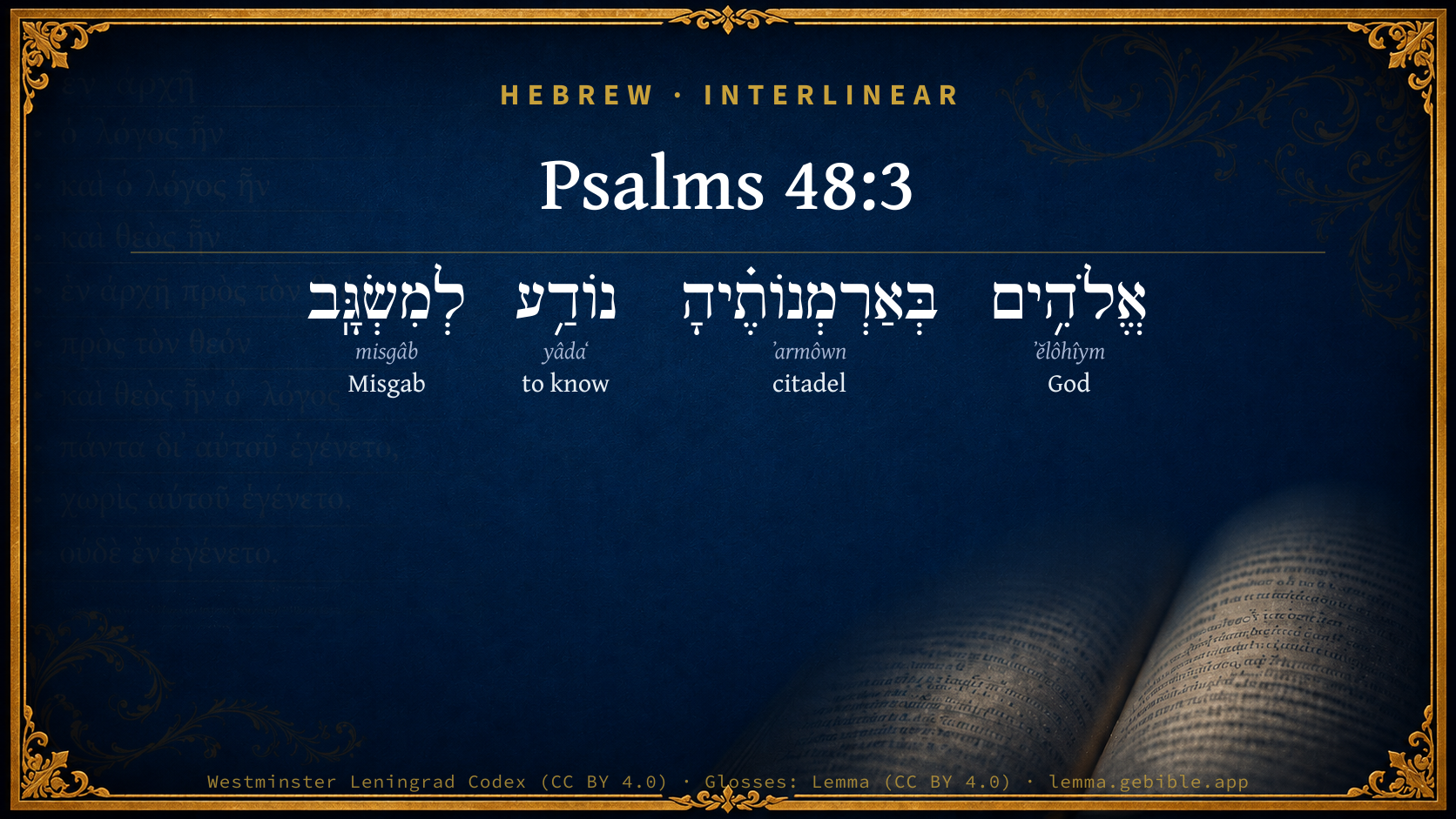
Psalms 48:3

Hebrew (Westminster Leningrad Codex) Psalms 48:3 appears in the Hebrew Old Testament. The text above is from the Westminster Leningrad Codex. Each word links to its Strong’s number, a concise gloss, and parsing drawn from the Open Scriptures Hebrew Bible morphology. Click any word for its full Brown-Driver-Briggs (BDB) entry.
Download image
Cite this verse

Psalms 48:3 (World English Bible). Public Domain. Lemma interlinear Bible study tool, https://lemma.gebible.app/v/psalms/48/3.

Show BibTeX & RIS
BibTeX
RIS
English Translation
God has shown himself in her citadels as a refuge.
World English Bible · Public Domain
Download a study sheet

One document with this verse’s original text, its word-by-word gloss line, the meaning frame, cross-references with their text, attributed commentary, and full source and license credits — printable, and it pastes into notes with its structure intact.

This verse Autodidact and up

Study sheet (.html) Plain text (.txt)

A passage Seminary Student

Up to 50 verses in one chapter. A passage sheet keeps up to 6 commentary sources and 12 cross-references per verse, in the order this page ranks them, and says so on the sheet whenever that leaves anything out. Ask for a single verse and you get the Autodidact verse sheet above.

Everything on this page stays free to read, with no account — the sheet is a download of what is already on screen, not access to it.

Want to remove ads? Support Godless Engineer
Compare translations 3

The same verse in 3 English versions, stacked beneath the original-language interlinear above. Click any original word for its lexicon entry.

Each is an independent rendering of the whole verse — the interlinear is not word-aligned to these translations.

Highlighted words mark where these versions differ — a whole-verse word diff, not a word-by-word alignment.

  • World English Bible Public Domain
    God has shown himself in her citadels as a refuge.
  • King James Version Public Domain
    God is known in her palaces for a refuge.
  • unfoldingWord Literal Text CC BY-SA 4.0
    God in her citadels. He is known as a stronghold.

unfoldingWord Literal Text — © unfoldingWord, licensed CC BY-SA 4.0. Word-aligned USFM3 via Door43 (git.door43.org/unfoldingWord/en_ult).

Versions to compare (up to 4)

3 of 4 selected

Show all 18 translations

Every available English version of this verse, each an independent rendering of the whole verse.

  • World English Bible Public Domain
    God has shown himself in her citadels as a refuge.
  • Berean Standard Bible Public Domain
    God is in her citadels; He has shown Himself to be a fortress.
  • Majority Standard Bible Public Domain
    God is in her citadels; He has shown Himself to be a fortress.
  • King James Version Public Domain
    God is known in her palaces for a refuge.
  • American Standard Version (1901) Public Domain
    God hath made himself known in her palaces for a refuge.
  • Revised Version (1885) Public Domain
    God hath made himself known in her palaces for a refuge.
  • Geneva Bible (1599) Public Domain
    In the palaces thereof God is knowen for a refuge.
  • Douay-Rheims (1899) Public Domain
    With the joy of the whole earth is mount Sion founded, on the sides of the north, the city of the great king.
  • Young's Literal Translation Public Domain
    God in her high places is known for a tower.
  • Literal Standard Version CC BY-SA 4.0
    God is known for a tower in her high places.
  • Unlocked Literal Bible CC BY-SA 4.0
    God has made himself known in her palaces as a refuge.
  • unfoldingWord Literal Text CC BY-SA 4.0
    God in her citadels. He is known as a stronghold.
  • Darby Bible Public Domain
    God is known in her palaces as a high fortress.
  • World Messianic Bible Public Domain
    God has shown himself in her citadels as a refuge.
  • Webster's Bible Public Domain
    \\48:2\\Beautiful for situation, the joy of the whole earth, is mount Zion, on the sides of the north, the city of the great King.
  • Free Bible Version CC BY-SA 4.0
    God himself is in the city's fortresses; he is recognized as its defender.
  • Bible in Basic English Public Domain
    In its buildings God is seen to be a high tower.
  • JPS Tanakh (1917) Public Domain
    (48-4) God in her palaces hath made Himself known for a stronghold.

Literal Standard Version (2020), Covenant Press — licensed CC BY-SA 4.0. Text via the HelloAO Bible API (eBible.org). Unlocked Literal Bible (unfoldingWord) — licensed CC BY-SA 4.0. Text via the HelloAO Bible API (eBible.org). unfoldingWord Literal Text — © unfoldingWord, licensed CC BY-SA 4.0. Word-aligned USFM3 via Door43 (git.door43.org/unfoldingWord/en_ult). Free Bible Version, Dr. Jonathan Gallagher — licensed CC BY-SA 4.0. Text via the HelloAO Bible API (eBible.org).

Word by word

More ways to search: Search by grammar → Find every occurrence → Compare this word →

Practice this passage: Drill this verse → Learn its vocabulary →

About this verse

These counts appear in no published source. They are computed here, from the morphology-tagged text and Lemma’s own curated glosses. What Lemma adds →

4
words
4
distinct lemmas
Wisdom
section

Notable vocabulary

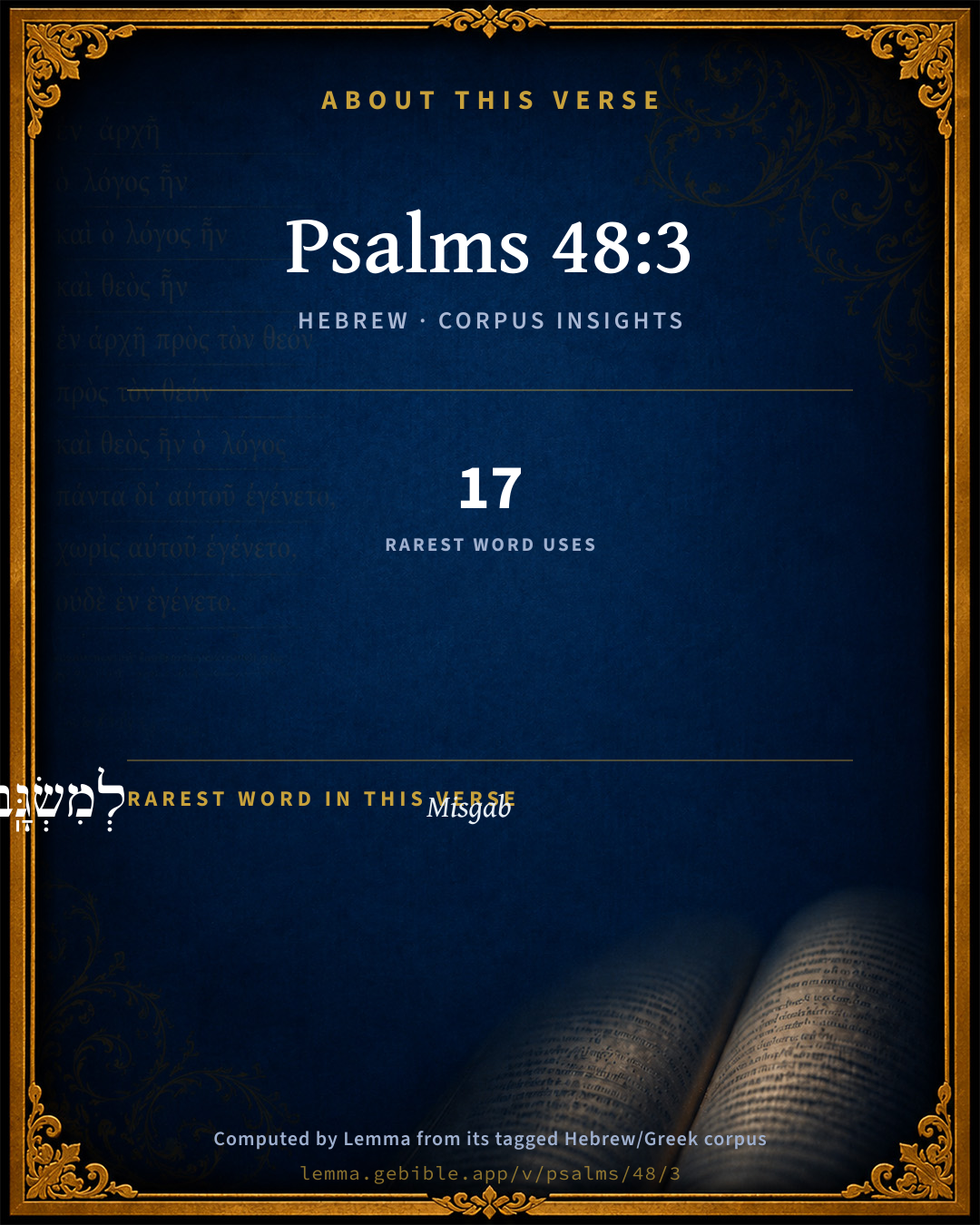
The rarest word here is לְמִשְׂגָּֽב Misgab H4869 — appearing just 17 times in the whole Hebrew Bible.

Shared distinctive vocabulary

לְמִשְׂגָּֽב Misgab H4869 occurs in 16 verses of the Hebrew Bible. Also found in:

Grammatical profile

  • 1 verb
  • 3 nouns

Verb forms

  • נוֹדַ֥ע Niphal · Perfect

Hebrew & Septuagint length

In English translation the verse runs 10 words from the Hebrew and 12 from the Septuagint (LXX English) — closely comparable.

A rough comparison of the two English renderings, which tokenize alike — not a word-level alignment.

Word counts can differ between the Hebrew and the Greek without any difference in meaning — e.g. the Hebrew direct-object marker אֵת has no separate Greek word, and Greek often adds the article ὁ.

Cross-references

9

Topical passages linked to Psalms 48:3 in the Treasury of Scripture Knowledge — connected by theme and wording, ordered by reader-vote popularity; previews shown in the World English Bible.

  • Zechariah 2:4–5 and said to him, "Run, speak to this young man, saying, 'Jerusalem will be inhabited as villages without walls, because of the multitude of men and cattle in it.
  • Psalms 46:7 Yahweh of Hosts is with us. The God of Jacob is our refuge. Selah.
  • Psalms 125:1 Those who trust in Yahweh are as Mount Zion, Which can't be moved, but remains forever.
  • Isaiah 37:33–36 Therefore thus says Yahweh concerning the king of Assyria, He shall not come to this city, nor shoot an arrow there, neither shall he come before it with shield, nor cast up a mound against it.
  • Psalms 76:1–5 In Judah, God is known. His name is great in Israel.
  • Isaiah 4:5–6 Yahweh will create over the whole habitation of Mount Zion, and over her assemblies, a cloud and smoke by day, and the shining of a flaming fire by night; for over all the glory will be a canopy.
  • 2 Chronicles 12:7 When Yahweh saw that they humbled themselves, the word of Yahweh came to Shemaiah, saying, They have humbled themselves: I will not destroy them; but I will grant them some deliverance, and my wrath shall not be poured out on Jerusalem by the hand of Shishak.
  • 2 Chronicles 14:9–15 There came out against them Zerah the Ethiopian with an army of a million troops, and three hundred chariots; and he came to Mareshah.
  • 2 Chronicles 20:1–37 It happened after this, that the children of Moab, and the children of Ammon, and with them some of the Ammonites, came against Jehoshaphat to battle.

Cross-references courtesy of OpenBible.info (CC BY 4.0).

Hebrew and Greek witnesses Masoretic Hebrew ↔ Greek Septuagint

The same verse in the two great witnesses to the Old Testament, shown verse-for-verse.

You’re reading Greek Psalm 47 (Hebrew Psalm 48). The Septuagint counts the superscription, so verse numbers can differ from the Hebrew — chapter-level alignment, not verse-by-verse. Numbering follows Rahlfs.

These are two independent witnesses, not word-aligned to each other, and the Septuagint is shown in lemma (dictionary) form.

Hebrew Psalms 48:3 Masoretic · Westminster Leningrad Codex

אֱלֹהִ֥ים בְּאַרְמְנוֹתֶ֗יהָ נוֹדַ֥ע לְמִשְׂגָּֽב

God has shown himself in her citadels as a refuge.

World English Bible · Public Domain

Greek LXX Greek Psalm 47:3 Septuagint · lemma form

εὖ ῥίζα ἀγαλλίαμα πᾶς ὁ γῆ ὄρος σιων ὁ πλευρόν ὁ βορέας ὁ πόλις ὁ βασιλεύς ὁ μέγας

God is known in her palaces, when he undertakes to help her.

LXX2012 (modern English Septuagint) · Public Domain

Hebrew: Westminster Leningrad Codex (CC BY 4.0). Greek: Septuagint (public domain); English from LXX2012 (modern English Septuagint) (Public Domain). How the Septuagint differs from the Hebrew →

Commentary

Notes on Psalms 48:3 from classic Christian and Jewish commentators (each source and its license shown beneath its notes). The classic Christian expositions comment on the surrounding passage and are grouped to its opening verse, so a note may address several verses; the Jewish commentaries on the Tanakh (Rashi and others) are per-verse, so they appear only where the commentator wrote on this verse.

Lemma curates 59 commentaries, every one of them public domain or Creative Commons licensed, each selected and text-cleaned for this edition rather than reprinted as found. About our sources →

The Cambridge Bible for Schools and Colleges

gen. ed. J. J. S. Perowne

3. More exactly:

God hath made himself known in her palaces for a high fortress.

This verse is commonly connected with Psa_48:1-2. But Psa_48:1-2 describe the relation of Zion to Jehovah generally, while Psa_48:3 first alludes to the recent deliverance, which is further described in Psa_48:4 ff.

in her palaces] The stately palaces of Zion which the Assyrians threatened to plunder and destroy. Cp. Psa_48:13; Mic_5:5. High fortress (A.V. refuge) is the same word as that in Psa_46:7; Psa_46:11.

3–8. Jehovah’s revelation of Himself as Zion’s protector in the recent discomfiture of her enemies.

The Cambridge Bible for Schools and Colleges (gen. ed. J. J. S. Perowne; Cambridge University Press, 1878–1918) — public domain. Text from a community e-Sword module.

Trapp's Complete Commentary

John Trapp

Psa 48:3 God is known in her palaces for a refuge.

Ver. 3. God is known in her palaces for a refuge] As the city was an ornament to the whole country, so was God to the city, as being a common refuge to both; and as having his holy temple there, not a professed sanctuary for impiety, as Florus spitefully styled it, but far better deserving than Numa’s new temple in Rome did, to be called πιστοως και ειρηνης ιερον, the sacrary of faith and peace, where the true God was truly worshipped, and found to be a very present help in trouble, the best bulwark.

John Trapp, A Commentary or Exposition upon All the Books of the Old and New Testament (1647–1656) — public domain. Text from a community e-Sword module.

The Biblical Illustrator

Joseph S. Exell

Psa_48:3

God is known in her palaces for a refuge.

The secret of national greatness

It is not the nation makes the people, but the people make the nation. On the rulers depends the nations prosperity. When God is honoured in the palace He will be worshipped in the cottage. When Atheists make laws, sedition will be the offspring.

I. Influence always descends. It is like the rain and dew. The less follow the great. Great power, great wealthy, great minds always lead.

II. The great affect the great. The kings of the earth saw and were troubled. Palace religion is more displayed than that of the cottage. God has His own work for the insignificant, but the great have also their higher sphere.

III. National religion is national preservation. The kings hasted away. Their hostility was vain in the presence of Him who was the Refuge of the palace. (Homilist.)

God known as a refuge

Even false worship argues a constitutional capacity for the true.

I. The conception of God is the greatest thing in man. In proportion as it is lost or distorted, human dignity decays, and the race sinks nearer the level of inferior creatures. The mould on which he was made is the cause of mans original greatness; but when he ceases to lay himself habitually back upon his origin, his being shrinks down again into the dimensions of a lower species.

II. God is. This is the first proposition in the inspired confession of faith (Heb_11:6). An atheist may reason against the existence of God, and a worldly man may keep God out of all his thoughts, but neither the one nor the other can blot God out of being. Although we practically banish God out of our little spot of time, He will meet us when we enter His great eternity.

III. God is known. Observe Pauls method in reasoning with the Athenians regarding the altar which they had dedicated to the unknown God, and the cognate argument which he addressed to the idolaters at Lystra (Act_14:15-17; Act_17:22-29). This is an inspired recognition of natural religion. The revelation which has been imprinted on earth and sky does not go far enough for the necessities of the fallen; but it is true as far as it goes. Men ought both to perceive its meaning and trust in its truth.

IV. God is known in her. God is known, may be taken as the motto of natural, God is known in her, as the motto of revealed religion. Wherever Christ is admitted King into a believing heart, there are the thrones of the house of David, there the temple stands, and thence sweet incense rises morning and evening to Heaven. Wherever many such believers are congregated, there is the city of the great King; wherever there are believing men and women, there is a peopled Jerusalem; and of that city it is the distinction still that God is known in her.

V. God is known in her palaces. The psalm commemorates a revival in high places (2Ch_17:1-19; 2Ch_18:1-34; 2Ch_19:1-11; 2Ch_20:1-37.). When grace was poured into the heart of the king, all ranks felt the benefit. The human skull, where the material organ of thought resides, has been called the palace of the soul. The princely spirit that dwells beneath that stately dome counts and keeps the whole world its tributary. In a princely way this king of the creatures has caught and tamed the powers of nature, and yoked them to his chariot. At the door of that regal residence a Stranger stands and knocks. Hear His voice, If any man open, I will come in. This is God our Saviour. When He is admitted, God will be known in that palace; for, He that hath seen Me, hath seen the Father. Not Christ in heaven, but Christ in you, is the hope of glory.

VI. God is known in her palaces for a refuge. The idea, the existence, the knowledge of God, whether among rich or poor, become for us all or nothing, according as we recognize Him as our refuge, or fear Him as our foe. For poor, blind, guilty, dying creatures, such as we are, there are only two ways open--we must either flee from God, or flee to Him. To those no good can happen, to these no evil. One thing is needful; and this is the meaning of a Gospel ministry, Be ye reconciled to God. Make Him your refuge, and you will find the way is open, the welcome prepared; all things will work together for your good. (W. Arnot.)

The Biblical Illustrator, edited by Joseph S. Exell (c. 1880s–1900s) — public domain. Text from a community e-Sword module.

Joseph Benson's Commentary

Psa 48:3. God is known — To his people, by sensible and long experience; in her palaces — In the habitations of the city, and not only in the cottages, or meaner dwellings, but in the palaces: the princes and great men have recourse to God, and seek help from him. Possibly he may point at the king’s palace and the temple, which was the palace of the King of heaven; which two palaces God did in a singular manner protect, and, by protecting them, protected the whole city and people. For a refuge — Under whose shadow his people are more safe and secure than other cities are with their great rivers and impregnable fortifications. “Thus the great Founder of the church is also her protector and defender. The dependance of the new Jerusalem, like that of the old, is not in man, or in the arm of flesh, but in God, who resideth in the midst of her. For, surely, unless he kept the city, the watchmen in the towers would wake but in vain.” — Horne.

Joseph Benson's Commentary on the Old and New Testaments (1811–1818) — public domain. Text from a community e-Sword module.

J. A. Alexander on Psalms

Joseph Addison Alexander

4. (Psa 48:3). God in her palaces is known for a refuge. In this, his chosen seat, he has revealed himself already, as the protector of his people. See below, on Psa 76:2 (1).

Joseph Addison Alexander, The Psalms Translated and Explained (1850) — public domain. Text from a community e-Sword module.

Tyndale Open Study Notes

Tyndale Open Resources

48:3 God dwells in Zion to protect it from all enemies (see 46:5).

Tyndale Open Study Notes — © Tyndale Open Resources, licensed CC BY-SA 4.0. Text via the HelloAO Bible API.

Geneva Bible (1599)

Geneva Bible translators

Except God were the defense thereof, neither situation nor munition could prevail.

Geneva Bible (1599) marginal notes — public domain. Text via Bolls.life.

Jamieson, Fausset & Brown

Robert Jamieson, A. R. Fausset & David Brown

palaces--literally, "citadels."

refuge-- (Psa 9:10; Psa 18:3). He was so known in them because they enjoyed His presence.

Jamieson, Fausset & Brown — Commentary Critical and Explanatory on the Whole Bible (1871) — public domain (CC PDM 1.0). Text via the HelloAO Bible API.

Adam Clarke's Commentary

Verse 3. God is known in her palaces for a refuge.] All those who worship there in spirit and truth, find God for their refuge. But the words may be understood: God is known for the defence of her palaces; and with this view of the subject agree the three following verses.

Adam Clarke's Commentary on the Bible (1810–1826) — public domain. Text from a community e-Sword/MySword module.

John Calvin's Commentaries

3. God in her palaces is known for a defense Here the sacred poet again brings forward, for the purpose of setting forth the dignity of the city of Jerusalem, the protection which God afforded it; as we have seen in Psalm 46:5,

“God is in the midst of her: she shall not be moved: God shall help her, and that right early.”

He expressly makes mention of palaces for the sake of contrast — to teach the Jews, that although the holy city was fortified by strong towers, and had within it magnificent houses, and such as resembled fortresses, yet its continued safety was owing to the power and aid of God alone. By these words, the people of God are taught, that although they dwell in strongholds and palaces, they must, nevertheless, be carefully on their guard, that this magnificence or loftiness may not shroud or conceal from their view the power of God; and that they be not like worldly men, who, resting satisfied with riches and earthly means of help, set no value whatever upon having God for their guardian and protector. Worldly wealth, from our natural perverseness, tends to dazzle our eyes, and to make us forget God, and, therefore, we ought to meditate with special attention upon this doctrine, That whatever we possess, which seems worthy of being prized, must not be permitted to obscure the knowledge of the power and grace of God; but that, on the contrary, the glory of God ought always clearly to shine forth in all the gifts with which he may be pleased to bless and adorn us; so that we may account ourselves rich and happy in him, and no where else.

John Calvin's Commentaries (1540-1563) — public domain. Text from the Calvin Translation Society English edition (1840s-50s) via the Christian Classics Ethereal Library (ccel.org). Calvin's coverage is partial (roughly two-thirds of the Bible); uncommented books and verses are honest gaps, never fabricated. The 19th-century editor's footnotes and remarks are omitted so the notes are faithfully Calvin's own voice.

Ellicott's Commentary for English Readers

(3) Refuge.—See Note, Psa_46:1. Prominence should be given to the idea of security from height. We might render, “God among her castles is known as a high and secure tower.”

A Bible Commentary for English Readers, edited by Charles John Ellicott (1878–1897) — public domain. Text from a community e-Sword module.

John Gill's Exposition

God is known in her palaces for a refuge. As there were palaces in Jerusalem; see Psa 48:13; so there are in the church of Christ; every place in it is a palace fit for a king; and everyone that has truly a name and a place there are kings and priests unto God: and here God is a "refuge" both for saints and sinners to fly unto; See Gill on Psa 46:1; and is "known" to be so; the ministers of the Gospel being here appointed to direct and encourage souls to flee to Christ for refuge, who is the hope set before them in the everlasting Gospel, preached by them to lay hold upon; and all that do flee to him know, by experience, that he is a refuge for them; and as all the people of God do in every time of distress, and when all refuge fails them elsewhere.

; and is "known" to be so; the ministers of the Gospel being here appointed to direct and encourage souls to flee to Christ for refuge, who is the hope set before them in the everlasting Gospel, preached by them to lay hold upon; and all that do flee to him know, by experience, that he is a refuge for them; and as all the people of God do in every time of distress, and when all refuge fails them elsewhere.

Psalms 48:4

psa 48:4

psa 48:4

psa 48:4For, lo, the kings were assembled,.... As the princes of the Philistines to seek for David, when in the strong hold of Zion, Sa2 5:17; as the Ethiopians in the time of Asa, Ch2 14:9; and the Moabites and Ammonites in the times of Jehoshaphat, Ch2 20:1; and the kings of Syria and Israel in the times of Ahaz, Isa 7:1; and Sennacherib with his princes, who, in his esteem, were kings, in the times of Hezekiah, Kg2 18:17; which are instances of the kings, of the nations' gathering together against Zion, the city of Jerusalem, and people of the Jews, who were typical of the church of Christ; and that without success, and to their own confusion and destruction; though this seems to refer to the latter day of the Gospel dispensation, when all the kings of the earth, Pagan, Papal, and Mahometan, will be gathered together at the instigation of Satan, to the battle of the great day of the Lord God Almighty, in a place called Armageddon, where they will be defeated by Christ the King of kings, Rev 16:13. Jarchi and Kimchi interpret the passage of Gog and Magog gathering together to fight against Jerusalem, with which compare Rev 20:8;

they passed by together; either to the battle, as Jarchi explains it; or they passed by Jerusalem, the city of our God, the church, without entering into it, or doing it any harm.

John Gill's Exposition of the Whole Bible (1746–1763) — public domain (CC PDM 1.0). Text via the HelloAO Bible API.

Albert Barnes' Notes on the Bible

God is known in her palaces - The word rendered “palaces” here means properly a fortress, castle, or palace, so called from its height, from a verb, ארם 'âram, meaning to elevate, to lift up. It may be applied to any fortified place, and would be particularly applicable to a royal residence, as a castle or stronghold. The word “known” here means that it was well understood, or that the point had been fully tested and determined that God had chosen those abodes as his special residence - as the place where he might be found.

For a refuge - See the notes at Psa 46:1. That is, there was safety or security in the God who had chosen Jerusalem as his special abode.

Albert Barnes' Notes on the Bible (1834–1885) — public domain. Text from a community e-Sword/MySword module.

Matthew Poole's English Annotations

God is known to his people by sensible and long experience, and to all neighbouring nations by their own observation.

In her palaces, i. e in the habitations, or to the inhabitants of that city. Possibly he may here point at the king’s palace and the temple, which was the palace of the King of heaven; which two palaces God did in a singular manner protect, and by protecting them he protected the whole city and people.

For a refuge; under whose shadow we are more safe and secure, than other cities are with their great rivers and impregnable fortifications.

Matthew Poole's English Annotations on the Holy Bible (1683–1685) — public domain. Text from a community e-Sword/MySword module.

The Treasury of David

Charles H. Spurgeon

Ver. 3. God is known in her palaces for a refuge. We worship no unknown God. We know him as our refuge in distress, we delight in him as such, and run to him in every time of need. We know nothing else as our refuge. Though we are made kings, and our houses are palaces, yet we have no confidence in ourselves, but trust in the Lord Protector, whose well known power is our bulwark.

None.

Ver. 3.

1. God is a refuge in his church. The church is a city of refuge, but the refuge is not in its church, but its God.

1. For sinners from wrath.

2. For saints from trials and fears.

2. God is there known as such, known to thousands, not known as such elsewhere. "They that know thy name, "etc.

Psalms 48:4*

Charles H. Spurgeon's The Treasury of David (1869–1885) — public domain. Psalms only. Text from a community e-Sword/MySword module.

The Pulpit Commentary

God is known in her palaces for a Refuge; or, in her castles. The palaces of the king and his chief nobles are, no doubt, intended.

The Pulpit Commentary (1880–1919), ed. H.D.M. Spence-Jones & Joseph S. Exell — public domain. Text from a community e-Sword module.

John Wesley's Explanatory Notes

Known - By long experience. Palaces - Possibly he may point at the king's palace and the temple, which was the palace of the king of heaven; which two palaces God did in a singular manner protect, and by protecting them, protected the whole city and people.

John Wesley, Explanatory Notes Upon the Whole Bible (1754–1765) — public domain. Text via the GEBible commentary corpus.

Rashi

Rabbi Shlomo Yitzchaki (Rashi)

The fairest of branches Heb. יפר נוף, a city that is a fair branch; an expression of the branches (נוף) of a tree. Another explanation: A fair bride, for in the coastal cities they call a bride ninfe (nymphe in Greek) (R. H. 26a). Menachem (p. 124) associated it with (Josh. 17:11) “the three regions (הנפת)” (i. e., there [on Joshua] he explains that it means regions; as Rashi explains there: contree in French, a region. In this manner, Rashi explains in Joshua 11:3,) but Dunash (p. 34) defined it as an expression of a branch of a tree, and Mt. Zion was called “the fairest of branches” because it is (near—Shem Ephraim) the Mount of Olives.

the joy of the entire earth Now what is its joy? The north side, angles in French, angle, corner. Redak (Shorashim) also defines it as corners, and so in Ezekiel (46:21). The northern side of the altar [was] where sin offerings and guilt offerings were slaughtered, and whoever was grieved because of the sins he had committed would bring a sin offering or a guilt offering, and he would be forgiven. He would then emerge happy, and the sacrifices would benefit the entire world.

Rashi on the Tanakh — English translations: “The Judaica Press complete Tanach with Rashi, translated by A. J. Rosenberg” (CC BY 4.0); “Pentateuch with Rashi's commentary by M. Rosenbaum and A.M. Silbermann, 1929-1934” (public domain); “The Metsudah Tanach series, Lakewood, N.J” (CC BY 4.0); and “The Book of Joshua, Metsudah Publications, 1997” (CC BY 4.0). Text via Sefaria.

Lesson kit

Teaching starters — assembled from the data on this page, not authored interpretation. Every prompt links to the verse data it draws on. Edit before teaching.

Psalms, in the Wisdom, opens this verse with 4 words (4 distinct Hebrew lemmas). Its most distinctive word is misgâb (“Misgab”). A historical commentator’s framing appears above. Read the whole chapter for the surrounding context.

Discussion questions

  1. The word misgâb carries the sense “Misgab.” How does it shape the verse?
  2. How does 2 Samuel 22:3, which shares the word «Misgab», read alongside this verse?
  3. The translations on this page render this verse differently — a whole-verse word diff, not a word-by-word alignment. What might account for the different wordings?
  4. «נוֹדַ֥ע» is a Niphal Perfect verb. How does that grammatical form shape the action described?
  5. Compare how The Cambridge Bible for Schools and Colleges and Trapp's Complete Commentary read this verse. Where do they agree or differ?

Things to notice

Reading settings

Reading text

Shown beneath each verse's original-language words.

Old Testament
Old Testament edition

Read the OT as the Masoretic Hebrew (MT) or the Greek Septuagint (LXX).

English shown for the Greek Septuagint (in the Hebrew ↔ Greek comparison).

Comparing translations? Open the Compare panel on any verse page to stack up to four side by side.