
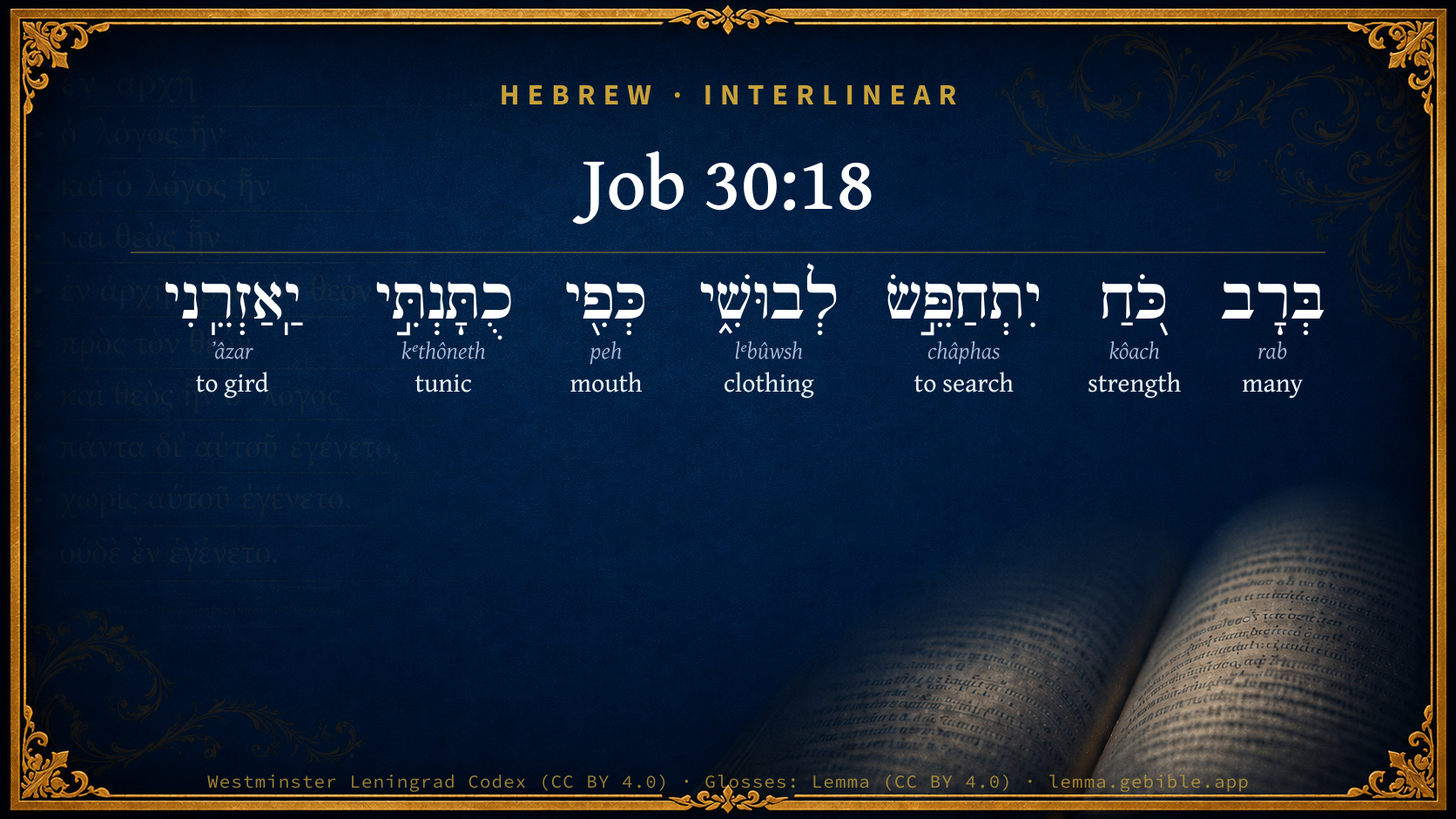
Job 30:18

Hebrew (Westminster Leningrad Codex) Job 30:18 appears in the Hebrew Old Testament. The text above is from the Westminster Leningrad Codex. Each word links to its Strong’s number, a concise gloss, and parsing drawn from the Open Scriptures Hebrew Bible morphology. Click any word for its full Brown-Driver-Briggs (BDB) entry.
Download image
Cite this verse

Job 30:18 (World English Bible). Public Domain. Lemma interlinear Bible study tool, https://lemma.gebible.app/v/job/30/18.

Show BibTeX & RIS
BibTeX
RIS
English Translation
By great force is my garment disfigured. It binds me about as the collar of my coat.
World English Bible · Public Domain
Download a study sheet

One document with this verse’s original text, its word-by-word gloss line, the meaning frame, cross-references with their text, attributed commentary, and full source and license credits — printable, and it pastes into notes with its structure intact.

This verse Autodidact and up

Study sheet (.html) Plain text (.txt)

A passage Seminary Student

Up to 50 verses in one chapter. A passage sheet keeps up to 6 commentary sources and 12 cross-references per verse, in the order this page ranks them, and says so on the sheet whenever that leaves anything out. Ask for a single verse and you get the Autodidact verse sheet above.

Everything on this page stays free to read, with no account — the sheet is a download of what is already on screen, not access to it.

Want to remove ads? Support Godless Engineer
Compare translations 3

The same verse in 3 English versions, stacked beneath the original-language interlinear above. Click any original word for its lexicon entry.

Each is an independent rendering of the whole verse — the interlinear is not word-aligned to these translations.

Highlighted words mark where these versions differ — a whole-verse word diff, not a word-by-word alignment.

  • World English Bible Public Domain
    By great force is my garment disfigured. It binds me about as the collar of my coat.
  • King James Version Public Domain
    By the great force of my disease is my garment changed: it bindeth me about as the collar of my coat.
  • unfoldingWord Literal Text CC BY-SA 4.0
    By great force my clothing is changed; it binds me like the collar of my tunic.

unfoldingWord Literal Text — © unfoldingWord, licensed CC BY-SA 4.0. Word-aligned USFM3 via Door43 (git.door43.org/unfoldingWord/en_ult).

Versions to compare (up to 4)

3 of 4 selected

Show all 18 translations

Every available English version of this verse, each an independent rendering of the whole verse.

  • World English Bible Public Domain
    By great force is my garment disfigured. It binds me about as the collar of my coat.
  • Berean Standard Bible Public Domain
    With great force He grasps my garment; He seizes me by the collar of my tunic.
  • Majority Standard Bible Public Domain
    With great force He grasps my garment; He seizes me by the collar of my tunic.
  • King James Version Public Domain
    By the great force of my disease is my garment changed: it bindeth me about as the collar of my coat.
  • American Standard Version (1901) Public Domain
    By `God's' great force is my garment disfigured; It bindeth me about as the collar of my coat.
  • Revised Version (1885) Public Domain
    By the great force of my disease is my garment disfigured: it bindeth me about as the collar of my coat.
  • Geneva Bible (1599) Public Domain
    For the great vehemencie is my garment changed, which compasseth me about as the colar of my coate.
  • Douay-Rheims (1899) Public Domain
    With the multitude of them my garment is consumed, and they have girded me about, as with the collar of my coat.
  • Young's Literal Translation Public Domain
    By the abundance of power, Is my clothing changed, As the mouth of my coat it doth gird me.
  • Literal Standard Version CC BY-SA 4.0
    By the abundance of power, || Is my clothing changed, || As the mouth of my coat it girds me.
  • Unlocked Literal Bible CC BY-SA 4.0
    God's great force has seized my clothing; it wraps around me like the collar of my tunic.
  • unfoldingWord Literal Text CC BY-SA 4.0
    By great force my clothing is changed; it binds me like the collar of my tunic.
  • Darby Bible Public Domain
    By their great force they have become my raiment; they bind me about as the collar of my coat.
  • World Messianic Bible Public Domain
    My garment is disfigured by great force. It binds me about as the collar of my tunic.
  • Webster's Bible Public Domain
    By the great force of my disease is my garment changed: it bindeth me about as the collar of my coat.
  • Free Bible Version CC BY-SA 4.0
    God grabs me roughly by my clothes; he pulls me by the collar of my shirt.
  • Bible in Basic English Public Domain
    With great force he takes a grip of my clothing, pulling me by the neck of my coat.
  • JPS Tanakh (1917) Public Domain
    By the great force of my disease is my garment disfigured; it bindeth me about as the collar of my coat.

Literal Standard Version (2020), Covenant Press — licensed CC BY-SA 4.0. Text via the HelloAO Bible API (eBible.org). Unlocked Literal Bible (unfoldingWord) — licensed CC BY-SA 4.0. Text via the HelloAO Bible API (eBible.org). unfoldingWord Literal Text — © unfoldingWord, licensed CC BY-SA 4.0. Word-aligned USFM3 via Door43 (git.door43.org/unfoldingWord/en_ult). Free Bible Version, Dr. Jonathan Gallagher — licensed CC BY-SA 4.0. Text via the HelloAO Bible API (eBible.org).

Word by word

More ways to search: Search by grammar → Find every occurrence → Compare this word →

Practice this passage: Drill this verse → Learn its vocabulary →

יַֽאַזְרֵֽנִי
ʼâzar
H247
“to gird · me”
Verb, Qal, Imperfect, 3rd Person, Masculine, Singular + Suffix, Personal, 1st Person, Common, Singular
Part of Speech
Verb
Stem
Qal
Form
Imperfect
Person
3rd Person
Gender
Masculine
Number
Singular
Full BDB Definition

Origin: a primitive root

TWOT: 59

gird, encompass, equip, clothe - (Qal) to gird, gird on (metaphorical of strength) - (Niphal) be girded - (Piel) hold close, clasp - (Hithpael) gird oneself (for war)
  1. בְּרָב rab H7227 “in/at · many of” Preposition + Noun, Common, Masculine, Singular, Construct
  2. כֹּ֭חַ kôach H3581 “strength” Noun, Common, Masculine, Singular, Absolute
  3. יִתְחַפֵּ֣שׂ châphas H2664 “to search” Verb, Hithpael, Imperfect, 3rd Person, Masculine, Singular
  4. לְבוּשִׁ֑י lᵉbûwsh H3830 “clothing · my” Noun, Common, Masculine, Singular, Construct + Suffix, Personal, 1st Person, Common, Singular
  5. כְּפִ֖י peh H6310 “like/as · mouth of” Preposition + Noun, Common, Masculine, Singular, Construct
  6. כֻתָּנְתִּ֣י kᵉthôneth H3801 “tunic · my” Noun, Common, Feminine, Singular, Construct + Suffix, Personal, 1st Person, Common, Singular

About this verse

These counts appear in no published source. They are computed here, from the morphology-tagged text and Lemma’s own curated glosses. What Lemma adds →

7
words
7
distinct lemmas
Wisdom
section

Notable vocabulary

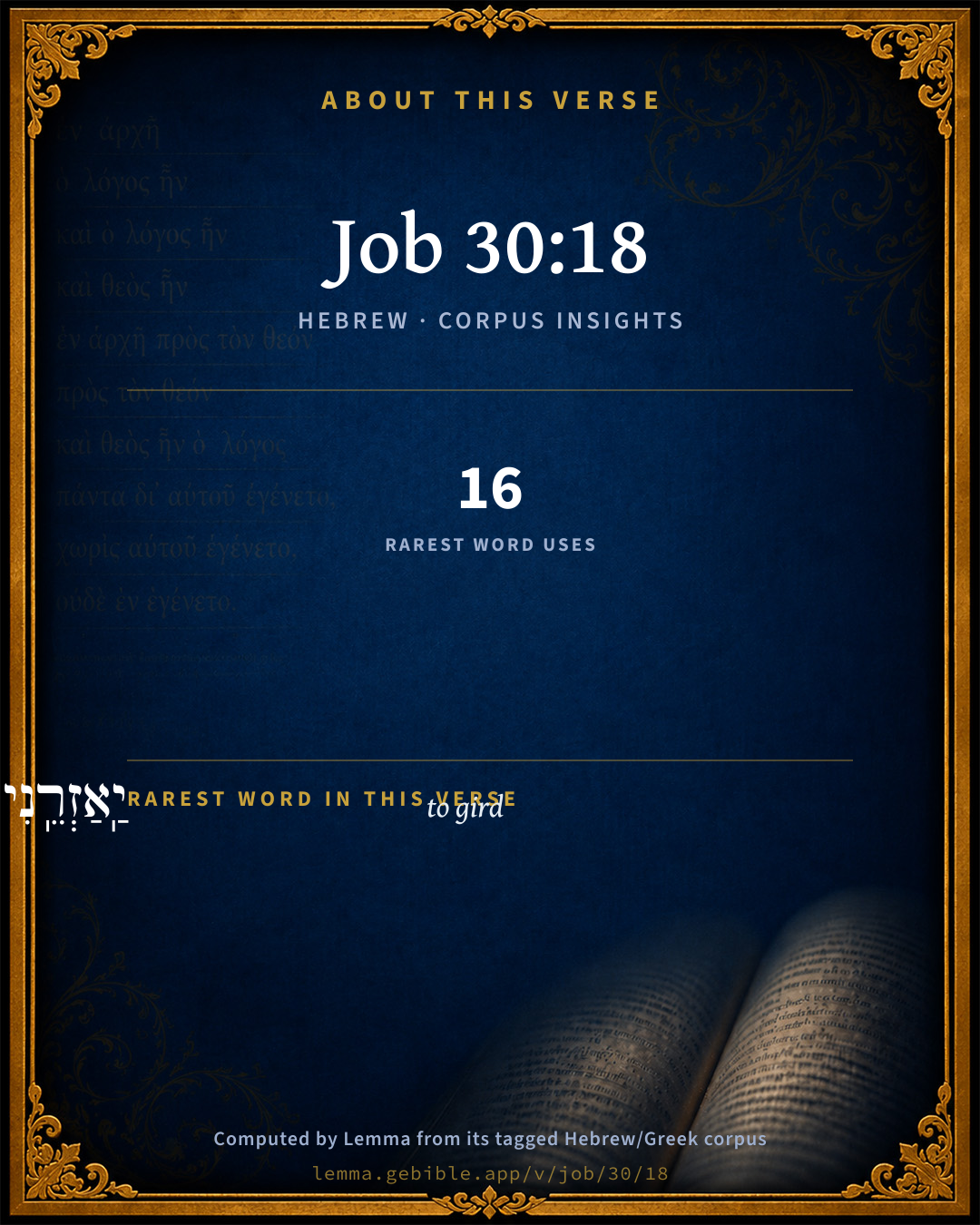
The rarest word here is יַֽאַזְרֵֽנִי to gird H247 — appearing just 16 times in the whole Hebrew Bible.

Shared distinctive vocabulary

יַֽאַזְרֵֽנִי to gird H247 occurs in 15 verses of the Hebrew Bible. Also found in:

Grammatical profile

  • 2 verbs
  • 5 nouns

Verb forms

  • יִתְחַפֵּ֣שׂ Hithpael · Imperfect
  • יַֽאַזְרֵֽנִי Qal · Imperfect

Hebrew & Septuagint length

In English translation the verse runs 17 words from the Hebrew and 21 from the Septuagint (LXX English) — closely comparable.

A rough comparison of the two English renderings, which tokenize alike — not a word-level alignment.

Word counts can differ between the Hebrew and the Greek without any difference in meaning — e.g. the Hebrew direct-object marker אֵת has no separate Greek word, and Greek often adds the article ὁ.

Cross-references

5

Topical passages linked to Job 30:18 in the Treasury of Scripture Knowledge — connected by theme and wording, ordered by reader-vote popularity; previews shown in the World English Bible.

  • Job 2:7 So Satan went forth from the presence of Yahweh, and struck Job with painful sores from the sole of his foot to his head.
  • Job 7:5 My flesh is clothed with worms and clods of dust. My skin closes up, and breaks out afresh.
  • Job 19:20 My bones stick to my skin and to my flesh. I have escaped by the skin of my teeth.
  • Psalms 38:5 My wounds are loathsome and corrupt, Because of my foolishness.
  • Isaiah 1:5–6 Why should you be beaten more, That you revolt more and more? The whole head is sick, And the whole heart faint.

Cross-references courtesy of OpenBible.info (CC BY 4.0).

Hebrew and Greek witnesses Masoretic Hebrew ↔ Greek Septuagint

The same verse in the two great witnesses to the Old Testament, shown verse-for-verse.

These are two independent witnesses, not word-aligned to each other, and the Septuagint is shown in lemma (dictionary) form.

Hebrew Job 30:18 Masoretic · Westminster Leningrad Codex

בְּרָב כֹּ֭חַ יִתְחַפֵּ֣שׂ לְבוּשִׁ֑י כְּפִ֖י כֻתָּנְתִּ֣י יַֽאַזְרֵֽנִי

By great force is my garment disfigured. It binds me about as the collar of my coat.

World English Bible · Public Domain

Greek LXX Job 30:18 Septuagint · lemma form

ἐν πολύς ἰσχύς ἐπιλαμβάνω ἐγώ ὁ στολή ὥσπερ ὁ περιστόμιον ὁ χιτών ἐγώ περιἔχω ἐγώ

With great force my disease has taken hold of my garment: it has compassed me as the collar of my coat.

LXX2012 (modern English Septuagint) · Public Domain

On this verse, Albert Barnes' Notes on the Bible discusses the Septuagint’s reading. Read the note in Commentary ↓

Hebrew: Westminster Leningrad Codex (CC BY 4.0). Greek: Septuagint (public domain); English from LXX2012 (modern English Septuagint) (Public Domain). How the Septuagint differs from the Hebrew →

Commentary

Notes on Job 30:18 from classic Christian and Jewish commentators (each source and its license shown beneath its notes). The classic Christian expositions comment on the surrounding passage and are grouped to its opening verse, so a note may address several verses; the Jewish commentaries on the Tanakh (Rashi and others) are per-verse, so they appear only where the commentator wrote on this verse.

Lemma curates 59 commentaries, every one of them public domain or Creative Commons licensed, each selected and text-cleaned for this edition rather than reprinted as found. About our sources →

Trapp's Complete Commentary

John Trapp

Job 30:18 By the great force [of my disease] is my garment changed: it bindeth me about as the collar of my coat.

Ver. 18. By the great force of my disease is my garment changed] sc. Sudore, cruore, sanie, sanguine, By the matter that my disease forceth outward in boils and botches, is my garment (which once was decoris et magistratus insigne, the ensign of my authority) utterly stained and spoiled, loathsome to myself, and noisome to others, Totum cruentum et sordidatum (Merc.). Every one (say some chemists) hath his own balsam within him; his own bane it is sure he hath. Physicians hold that in every two years there is such store of ill humours and excrements engendered in the body, that a vessel of one hundred ounces will scarce contain them. Now if these, by God’s appointment (for he is the great centurion, Mat 8:9, who hath all diseases at his beck and call), break outward, what an ulcerous leper and lazar must that man needs be! This was Job’s case, and Munster’s, who called his sores Gemmas, et preciosa Dei ornamenta, God’s gems and jewels, wherewith he decketh those whom he loveth; and King Philip’s, of Spain, who, besides many other diseases, had ingentem puris ex ulceribus redundantiam, quae binas indies scutellas divite paedore impleret, abundance of filthy matter issuing out of his sores, insomuch as that no change of clothes, or art of physicians, could keep him from being devoured by lice and vermin thereby engendered (Carol. Scriban. Instit. Princip. cap. 20).

It bindeth me about as the collar of my coat] It is become so stiff and starky, that it wrings me and hurts me, as an uneasy collar girds and gripes a man’s neck; as the edge of my coat it girds me, so Broughton readeth it. Beza rendereth this latter part of the verse thus: He (God) compasseth me about as the collar of my coat. Piscator, the whole thus: By the greatness of his (God’s) strength (which he putteth forth in scourging me with diseases), my garment changeth itself (putteth upon, as it were, another garment of scabs and scurf), as the mouth of my coat, he (God) girdeth me; i.e. Morbo premit corpus meum, he pincheth my body with diseases. But the former reading is better.

John Trapp, A Commentary or Exposition upon All the Books of the Old and New Testament (1647–1656) — public domain. Text from a community e-Sword module.

Joseph Benson's Commentary

Job 30:18-19. By the great force of my disease, &c. — The words, of my disease, are not in the Hebrew, neither do they seem to be rightly supplied, but rather to obscure the sense of the clause, which, without any supplement, is literally rendered, With great force my garment is changed, for so this verb יתחפשׁ, jithchappesh, is used, 1Ki 22:30. Thus the sense is, I cannot shift or put off my garment without great difficulty; the reason whereof is given in the following words: It bindeth me about as the collar of my coat — It cleaveth fast to me, being glued by that purulent matter which issues from my sores. He seems to allude to the fashion of the eastern outward garments, which were all of a piece, and had a strait mouth at the top, which was brought over the head and fastened close about the neck. Some, however, understand the clause figuratively, thus: By the great force, that is, the power of God, is my garment changed, that is, my condition is wholly altered; it bindeth me about, &c. — I am straitly bound in on every side with my sorrows and afflictions, as it were, with a collar; every part of me, from head to foot, is, as it were, wrapped round with pains; and all my limbs are, in a manner, bound with them. He hath cast me into the mire, &c. — I am reduced to the lowest and filthiest condition possible. Houbigant, who thinks that the idea here is taken from a man struggling with another, laying hold on his garment, and casting him into the mire, renders these two verses, With great force he layeth hold on my garment, and infolds me by the collar of my robe: He hath cast me into the mire, &c.

Joseph Benson's Commentary on the Old and New Testaments (1811–1818) — public domain. Text from a community e-Sword module.

Tyndale Open Study Notes

Tyndale Open Resources

30:18 God grabs . . . the collar of my coat: The Hebrew in this verse is difficult to translate; it could mean that Job feels like he is in a chokehold and is about to be thrown into the mud (cp. 30:19).

Tyndale Open Study Notes — © Tyndale Open Resources, licensed CC BY-SA 4.0. Text via the HelloAO Bible API.

Jamieson, Fausset & Brown

Robert Jamieson, A. R. Fausset & David Brown

of my disease--rather, "of God" (Job 23:6).

garment changed--from a robe of honor to one of mourning, literally (Job 2:8; Joh 3:6) and metaphorically [UMBREIT]. Or rather, as SCHUTTENS, following up Job 30:17, My outer garment is changed into affliction; that is, affliction has become my outer garment; it also bindeth me fast round (my throat) as the collar of the inner coat; that is, it is both my inner and outer garment. Observe the distinction between the inner and outer garments. The latter refers to his afflictions from without (Job 30:1-13); the former his personal afflictions (Job 30:14-23). UMBREIT makes "God" subject to "bindeth," as in Job 30:19.

Jamieson, Fausset & Brown — Commentary Critical and Explanatory on the Whole Bible (1871) — public domain (CC PDM 1.0). Text via the HelloAO Bible API.

Adam Clarke's Commentary

Verse 18. Is my garment changed] There seem to be here plain allusions to the effect of his cruel disease; the whole body being enveloped with a kind of elephantine hide, formed by innumerable incrustations from the ulcerated surface.

It bindeth me about] There is now a new kind of covering to my body, formed by the effects of this disease; and it is not a garment which I can cast off; it is as closely attached to me as the collar of my coat. Or, my disease seizes me as a strong armed man; it has throttled me, and cast me in the mud. This is probably an allusion to two persons struggling: the stronger seizes the other by the throat, brings him down, and treads him in the dirt.

Adam Clarke's Commentary on the Bible (1810–1826) — public domain. Text from a community e-Sword/MySword module.

Ellicott's Commentary for English Readers

(18) My garment changed.—Some render “By His (i.e., God’s) great power the garment (of my skin) is disfigured;” and others, “With great effort must my garment be changed because of the sores to which it clings? It bindeth me about as closely as the collar of my coat.”

A Bible Commentary for English Readers, edited by Charles John Ellicott (1878–1897) — public domain. Text from a community e-Sword module.

The Cambridge Bible for Schools and Colleges

gen. ed. J. J. S. Perowne

18. The verse is obscure.

the great force of my disease] Or, by his great power; i. e. God’s power, put forth in Job’s afflictions.

my garment changed] lit. disguised or disfigured.

it bindeth me] The meaning may be: it clingeth to me like the neck of my inner garment. The reference is supposed to be to his emaciated condition; his outer garment hangs on him disfigured, clinging to him like the neck or opening of the close-fitting inner tunic. The connexion and the phrase “by His great power,” i. e. the power that causes intolerable agonies, might suggest that the reference in the verse is to Job’s writhing under his pains till the clothes are twisted tightly about him.

The Cambridge Bible for Schools and Colleges (gen. ed. J. J. S. Perowne; Cambridge University Press, 1878–1918) — public domain. Text from a community e-Sword module.

John Gill's Exposition

By the great force of my disease is my garment changed,.... Either the colour of it, through the purulent matter from his ulcers running down upon it, or penetrating through it; or by reason of it he was obliged to shift himself, and to have a change of raiment very frequently; or the supplement, "of my disease", may be left out, and the sense be, with great force, through main strength, and with much difficulty, his garment was changed, was got off from him, sticking so close to him, and another put on:

it bindeth me about as the collar of my coat; his disease encompassed him about on all sides as the collar or edge of his coat encompassed his neck, and cleaved as close, and was as tight unto him as that, and threatened him perhaps with a suffocation or strangling; see Job 7:15; the allusion is to garments used in the eastern countries, which were only open at top and bottom; at the top there was a hole to put the head through when put on, and a binding about it, and a button to it, or some such thing, which kept it tight about the neck; see Exo 28:32.

John Gill's Exposition of the Whole Bible (1746–1763) — public domain (CC PDM 1.0). Text via the HelloAO Bible API.

Albert Barnes' Notes on the Bible

By the great force of my disease - The words “of my disease” are not in the Hebrew. The usual interpretation of the passage is, that in consequence of the foul and offensive nature of his malady, his garment had become discolored or defiled - changed from being white and clear to filthiness and offensiveness. Some have understood it as referring to the skin, and as denoting that it was so affected with the leprosy, that he could scarcely be recognized. Umbreit supposes it to mean, “Through the omnipotence of God has my white robe of honor been changed into a narrow garment of grief” - trauerkleid. Dr. Good renders it, “From the abundance of the acrimony;” that is, of the fierce or acrimonious humor, “it is changed into a garment for me.” Coverdale, “With all their power have they changed my garment, and girded me therewith, as it were with a coat.” Prof. Lee, “With much violence doth my clothing bind me.”

According to Schultens, it means, “My affliction puts itself on in the form of my clothing;” and the whole passage, that without and within, from the head to the feet, he was entirely diseased. His affliction was his outer garment, and it was his inner garment - his mantle and his tunic. The Hebrew is difficult. The phrase rendered “by the great force,” means, literally, “by the multitude of strength” - and may refer to the strength of disease, or to the strength of God, or to the force with which his garment girded him. The word rendered “is changed” - יתחפשׂ yitchâphaś, is from חפשׂ châphaś, to seek, to search after in the Qal; in the Hithpael, the form used here, to let oneself be sought; to hide oneself; to disguise one’s self; 1Ki 20:38. According to this, it would mean that his garment was disquised; that is, its appearance was changed by the force of his disease. Gesenius. Jerome renders it, “In their multitude, my garment is consumed; the Septuagint, “With great force he took hold of my garment.” Of these various interpretations, it is impossible to determine which is the correct one. The prevailing interpretation seems to be, that by the strength of his disease his garment was changed in its appearance, so as to become offensive, and yet this is a somewhat feeble sense to give to the passage. Perhaps the explanation of Schultens is the best, “By the greatness of power, pain or disease has become my garment; it girds me about like the mouth of my tunic.” He has shown, by a great variety of instances, that it is common in Arabic poetry to compare pain, sickness, anxiety, etc., to clothing.

It bindeth me about as the collar of my coat - The collar of my tunic, or under garment. This was made like a shirt, to be gathered around the neck, and the idea is, that his disease fitted close to him, and was gathered close around him.

Albert Barnes' Notes on the Bible (1834–1885) — public domain. Text from a community e-Sword/MySword module.

Haydock's Catholic Bible Commentary

Coat. The worms are so numerous, (Menochius) or my enemies pour upon me. (Calmet) --- Septuagint, "with great power He (God; Protestants, my disease) has seized me by the garment." Theodotion adds, "He has taken hold of me like the collar of my tunic:" (Haydock) which corresponds with our shirt, and had an opening at the top. (Calmet)

George Leo Haydock (1774–1849), Haydock's Catholic Family Bible and Commentary, 1859 edition — public domain. Excludes Psalms (Douay-Rheims chapter numbering differs from Protestant) and Deuterocanonical books (Catholic canon only).

Matthew Poole's English Annotations

My disease is so strong and prevalent, that it breaks forth every where in my body, in such plenty of purulent and filthy matter, that it infects and discolours my very garments. Others, By the great power of God

my garment is changed. In both these translations the words, of disease, and of God, are not in the Hebrew text, but are supplied by the translators. But the words are by some not untruly nor unfitly rendered thus, without any supplement, With great force my garment is changed; for so this verb is used, 1Ki 22:30. So the sense is, I cannot shift or put off my garment without great strength and difficulty; the reason whereof is rendered in the following words.

It bindeth me about; it cleaveth fast to me, being glued by that filthy matter issuing from my sores.

As the collar of my coat; as my collar girdeth in and cleaveth to my neck. He alludes to the fashion of the Eastern outward garments, which were seamless, and all of a piece, and had a straight mouth at the top, which was brought over the head, and contracted and fastened close about the neck.

Matthew Poole's English Annotations on the Holy Bible (1683–1685) — public domain. Text from a community e-Sword/MySword module.

Whedon's Commentary on the Bible

Daniel D. Whedon

18. Garment changed — Figuratively, for skin which by “great (divine) power” is marred, disfigured so that he could scarcely be recognized; “the whole body being enveloped with a kind of elephantine hide formed by innumerable incrustations from the ulcerated surface.” — Clarke. Of a madman a Persian poet says, He was clothed as with a vest, with the wounds of ulceration. (Sir W. Jones, 1:224.)

Coat — Tunic; a closely fitting undergarment resembling in form and use a shirt, and made either of wool, cotton, or linen.

Daniel D. Whedon (gen. ed.), Commentary on the Old and New Testaments (1874–1909) — public domain. Text from a community e-Sword module.

The Pulpit Commentary

By the great force of my disease is my garment changed; or, disfigured. The purulent discharge from his ulcers disfigured and made filthy his garment, which stiffened as the discharge dried, and clung to his frame. It bindeth me about as the collar of my coat. The whole garment clung to his body as closely as it is usual for a mall"s collar, or "neck-hole" (Professor Lee), to cling about his throat.

The Pulpit Commentary (1880–1919), ed. H.D.M. Spence-Jones & Joseph S. Exell — public domain. Text from a community e-Sword module.

unfoldingWord translationNotes

Door43 World Missions Community

God's great force has seized my clothing

Job speaks of God using his force as if God's force were actually doing something. Here "God's ... force" stands for "God." AT: "God has seized my clothing by his great force" (See: Metonymy)

God's great force has seized my clothing

The image of God's force seizing Job is a metaphor. Possible meanings are 1) it represents Job's pain. AT: "My pain feels like God has grabbed my clothing tightly" or 2) it represents God's causing Job's many problems. AT: "It is as though by his great force God has grabbed me by my clothes" (See: Metaphor)

it wraps around me like the collar of my tunic

The image of God's force wrapping around Job is a metaphor. Possible meanings are 1) it represents Job's pain. AT: "he wraps the collar of my tunic tightly around me" or 2) it represents God's causing Job's many problems. AT: "It is as though he grabs me by the collar of my tunic" (See: Metaphor)

He has thrown me into the mud

Job says that God has humiliated him. AT: "It is as though he has thrown me in the mud" or "He has humiliated me, like a person thrown in the mud" (See: Metaphor)

I have become like dust and ashes

This represents Job's feeling of being worthless. AT: "I have become as worthless as dust and ashes" (See: Simile)

translationWords

seize

unfoldingWord translationNotes — © Distant Shores Media and the Door43 World Missions Community, licensed CC BY-SA 4.0. Source: git.door43.org/Door43/en_tn.

Rashi

Rabbi Shlomo Yitzchaki (Rashi)

is my garment changed My “garment” changes, layer after layer. When a person removes his garments and puts on other garments different from the first ones, he calls these בִּגְדֵי חֹפֶשׁ, like (I Kings 22:30), “I will disguise myself (התחפש) and go into battle.” This is translated into Aramaic by the word אשתני, I will change.

like the opening of my shirt it girds me Like the opening of my shirt, which girds and encompasses my neck, so do my garments gird me all around.

Rashi on the Tanakh — English translations: “The Judaica Press complete Tanach with Rashi, translated by A. J. Rosenberg” (CC BY 4.0); “Pentateuch with Rashi's commentary by M. Rosenbaum and A.M. Silbermann, 1929-1934” (public domain); “The Metsudah Tanach series, Lakewood, N.J” (CC BY 4.0); and “The Book of Joshua, Metsudah Publications, 1997” (CC BY 4.0). Text via Sefaria.

Lesson kit

Teaching starters — assembled from the data on this page, not authored interpretation. Every prompt links to the verse data it draws on. Edit before teaching.

Job, in the Wisdom, opens this verse with 7 words (7 distinct Hebrew lemmas). Its most distinctive word is ʼâzar (“to gird”). A historical commentator’s framing appears above. Read the whole chapter for the surrounding context.

Discussion questions

  1. The word ʼâzar carries the sense “to gird.” How does it shape the verse?
  2. How does 1 Samuel 2:4, which shares the word «to gird», read alongside this verse?
  3. These translations render this verse differently. What is at stake in choosing one wording over another?
  4. «יִתְחַפֵּ֣שׂ» is a Hithpael Imperfect verb. How does that grammatical form shape the action described?
  5. Compare how Trapp's Complete Commentary and Joseph Benson's Commentary read this verse. Where do they agree or differ?

Things to notice

Reading settings

Reading text

Shown beneath each verse's original-language words.

Old Testament
Old Testament edition

Read the OT as the Masoretic Hebrew (MT) or the Greek Septuagint (LXX).

English shown for the Greek Septuagint (in the Hebrew ↔ Greek comparison).

Comparing translations? Open the Compare panel on any verse page to stack up to four side by side.