
Judges 8:30

Hebrew (Westminster Leningrad Codex) Judges 8:30 appears in the Hebrew Old Testament. The text above is from the Westminster Leningrad Codex. Each word links to its Strong’s number, a concise gloss, and parsing drawn from the Open Scriptures Hebrew Bible morphology. Click any word for its full Brown-Driver-Briggs (BDB) entry.
Download image
Cite this verse

Judges 8:30 (World English Bible). Public Domain. Lemma interlinear Bible study tool, https://lemma.gebible.app/v/judges/8/30.

Show BibTeX & RIS
BibTeX
RIS
English Translation
Gideon had seventy sons conceived from his body; for he had many wives.
World English Bible · Public Domain
Download a study sheet

One document with this verse’s original text, its word-by-word gloss line, the meaning frame, cross-references with their text, attributed commentary, and full source and license credits — printable, and it pastes into notes with its structure intact.

This verse Autodidact and up

Study sheet (.html) Plain text (.txt)

A passage Seminary Student

Up to 50 verses in one chapter. A passage sheet keeps up to 6 commentary sources and 12 cross-references per verse, in the order this page ranks them, and says so on the sheet whenever that leaves anything out. Ask for a single verse and you get the Autodidact verse sheet above.

Everything on this page stays free to read, with no account — the sheet is a download of what is already on screen, not access to it.

Want to remove ads? Support Godless Engineer
Compare translations 3

The same verse in 3 English versions, stacked beneath the original-language interlinear above. Click any original word for its lexicon entry.

Each is an independent rendering of the whole verse — the interlinear is not word-aligned to these translations.

Highlighted words mark where these versions differ — a whole-verse word diff, not a word-by-word alignment.

  • World English Bible Public Domain
    Gideon had seventy sons conceived from his body; for he had many wives.
  • King James Version Public Domain
    And Gideon had threescore and ten sons of his body begotten: for he had many wives.
  • unfoldingWord Literal Text CC BY-SA 4.0
    Now to Gideon were 70 sons coming from his thigh, for many wives were to him.

unfoldingWord Literal Text — © unfoldingWord, licensed CC BY-SA 4.0. Word-aligned USFM3 via Door43 (git.door43.org/unfoldingWord/en_ult).

Versions to compare (up to 4)

3 of 4 selected

Show all 18 translations

Every available English version of this verse, each an independent rendering of the whole verse.

  • World English Bible Public Domain
    Gideon had seventy sons conceived from his body; for he had many wives.
  • Berean Standard Bible Public Domain
    Gideon had seventy sons of his own, since he had many wives.
  • Majority Standard Bible Public Domain
    Gideon had seventy sons of his own, since he had many wives.
  • King James Version Public Domain
    And Gideon had threescore and ten sons of his body begotten: for he had many wives.
  • American Standard Version (1901) Public Domain
    And Gideon had threescore and ten sons of his body begotten; for he had many wives.
  • Revised Version (1885) Public Domain
    And Gideon had threescore and ten sons of his body begotten: for he had many wives.
  • Geneva Bible (1599) Public Domain
    And Gideon had seuentie sonnes begotten of his body: for he had many wiues.
  • Douay-Rheims (1899) Public Domain
    And he had seventy sons, who came out of his thigh, for he had many wives.
  • Young's Literal Translation Public Domain
    and to Gideon there have been seventy sons, coming out of his loin, for he had many wives;
  • Literal Standard Version CC BY-SA 4.0
    and there have been seventy sons of Gideon, coming out of his loin, for he had many wives;
  • Unlocked Literal Bible CC BY-SA 4.0
    Gideon had seventy sons who were his descendants, for he had many wives.
  • unfoldingWord Literal Text CC BY-SA 4.0
    Now to Gideon were 70 sons coming from his thigh, for many wives were to him.
  • Darby Bible Public Domain
    Now Gideon had seventy sons, his own offspring, for he had many wives.
  • World Messianic Bible Public Domain
    Gideon had seventy sons conceived from his body, for he had many wives.
  • Webster's Bible Public Domain
    And Gideon had seventy sons of his body begotten: for he had many wives.
  • Free Bible Version CC BY-SA 4.0
    Gideon had seventy sons, all his own, because he had many wives.
  • Bible in Basic English Public Domain
    Gideon had seventy sons, the offspring of his body; for he had a number of wives.
  • JPS Tanakh (1917) Public Domain
    And Gideon had threescore and ten sons of his body begotten; for he had many wives.

Literal Standard Version (2020), Covenant Press — licensed CC BY-SA 4.0. Text via the HelloAO Bible API (eBible.org). Unlocked Literal Bible (unfoldingWord) — licensed CC BY-SA 4.0. Text via the HelloAO Bible API (eBible.org). unfoldingWord Literal Text — © unfoldingWord, licensed CC BY-SA 4.0. Word-aligned USFM3 via Door43 (git.door43.org/unfoldingWord/en_ult). Free Bible Version, Dr. Jonathan Gallagher — licensed CC BY-SA 4.0. Text via the HelloAO Bible API (eBible.org).

Word by word

More ways to search: Search by grammar → Find every occurrence → Compare this word →

Practice this passage: Drill this verse → Learn its vocabulary →

יְרֵכ֑וֹ
yârêk
H3409
“thigh · his”
Noun, Common, Feminine, Singular, Construct + Suffix, Personal, 3rd Person, Masculine, Singular
Part of Speech
Noun
Type
Common
Gender
Feminine
Number
Singular
State
Construct
Full BDB Definition

Origin: from an unused root meaning to be soft

TWOT: 916a

thigh, side, loin, base - thigh - outside of thigh (where sword was worn) - loins (as the seat of procreative power) - side (flank) (of object) - base
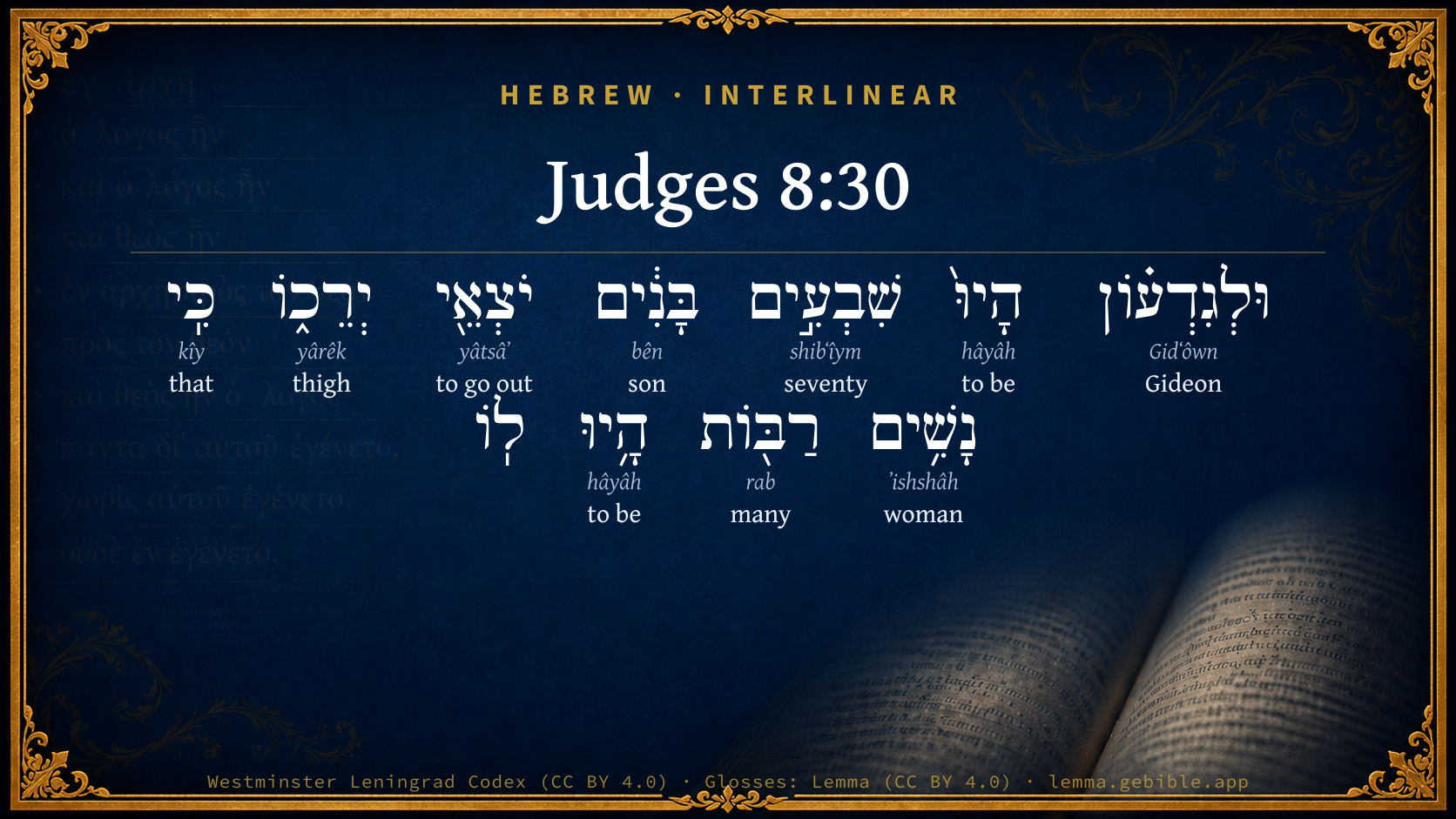
  1. וּלְגִדְע֗וֹן Gidʻôwn H1439 “and · to/for · Gideon” Conjunction + Preposition + Noun, Proper
  2. הָיוּ֙ hâyâh H1961 “to be” Verb, Qal, Perfect, 3rd Person, Common, Plural
  3. שִׁבְעִ֣ים shibʻîym H7657 “seventy” Adjective, Cardinal number, Both, Plural, Absolute
  4. בָּנִ֔ים bên H1121 “sons” Noun, Common, Masculine, Plural, Absolute
  5. יֹצְאֵ֖י yâtsâʼ H3318 “going out” Verb, Qal, Participle Active, Masculine, Plural, Construct
  6. כִּֽי kîy H3588 “that” Conjunction
  7. נָשִׁ֥ים ʼishshâh H802 “women” Noun, Common, Feminine, Plural, Absolute
  8. רַבּ֖וֹת rab H7227 “many” Adjective, Adjective, Feminine, Plural, Absolute
  9. הָ֥יוּ hâyâh H1961 “to be” Verb, Qal, Perfect, 3rd Person, Common, Plural

About this verse

These counts appear in no published source. They are computed here, from the morphology-tagged text and Lemma’s own curated glosses. What Lemma adds →

11
words
9
distinct lemmas
Historical
section

Shared distinctive vocabulary

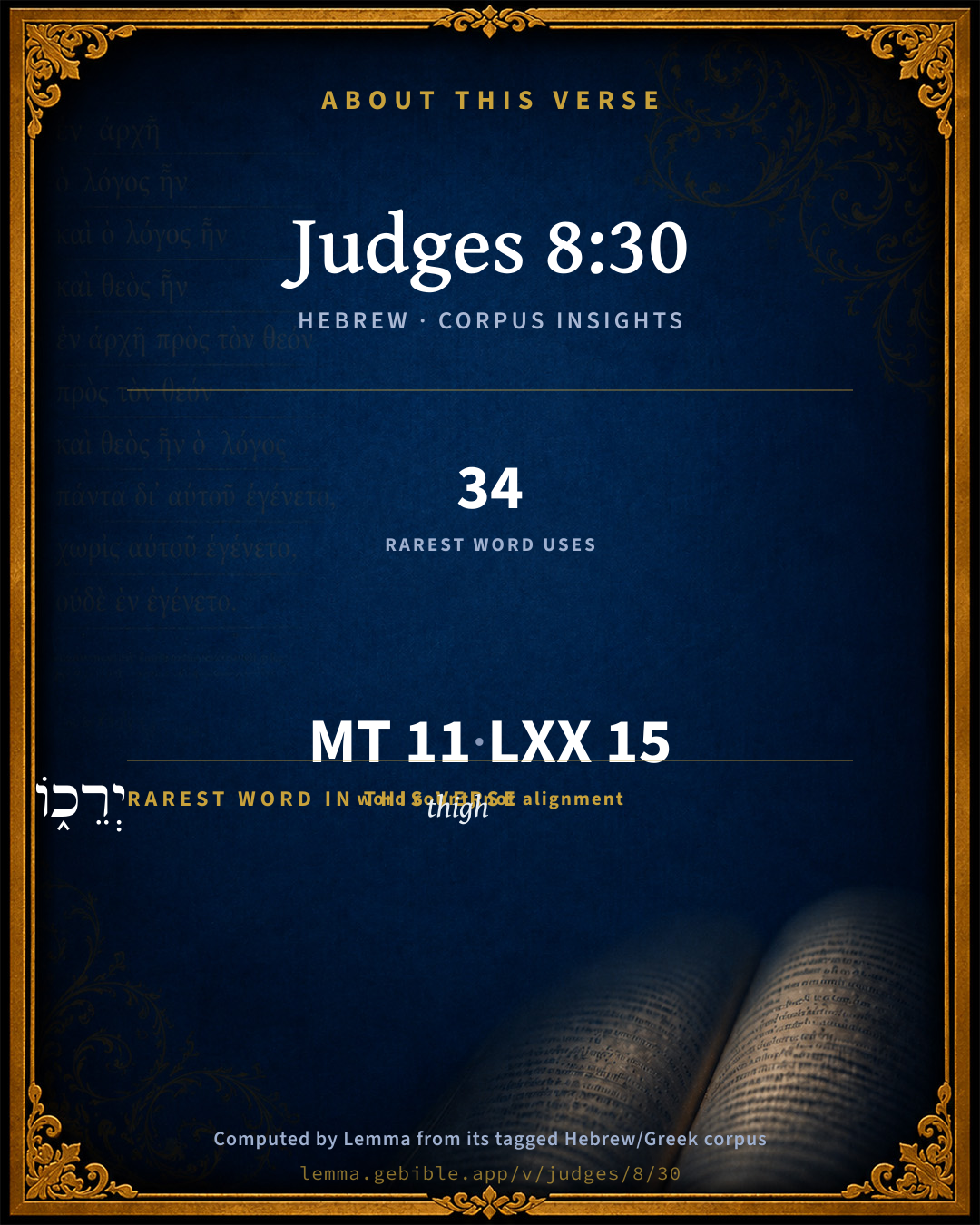
יְרֵכ֑וֹ thigh H3409 occurs in 32 verses of the Hebrew Bible. Also found in:

Grammatical profile

  • 3 verbs
  • 4 nouns
  • 2 adjectives
  • 1 preposition
  • 1 conjunction

Verb forms

  • הָיוּ֙ Qal · Perfect
  • יֹצְאֵ֖י Qal · Participle Active
  • הָ֥יוּ Qal · Perfect

Repetition

A word recurs within this verse — often emphatic in Hebrew:

  • הָיוּ֙ to be H1961 ×2

Hebrew & Septuagint length

In English translation the verse runs 13 words from the Hebrew and 14 from the Septuagint (LXX English) — closely comparable.

A rough comparison of the two English renderings, which tokenize alike — not a word-level alignment.

Word counts can differ between the Hebrew and the Greek without any difference in meaning — e.g. the Hebrew direct-object marker אֵת has no separate Greek word, and Greek often adds the article ὁ.

In the original languages it is 11 Hebrew tokens and 15 Greek tokens — but the two are counted differently (Hebrew bundles its prefixes and suffixes into one token; the Greek is in lemma form), so that isn’t a like-for-like length.

Cross-references

17

Topical passages linked to Judges 8:30 in the Treasury of Scripture Knowledge — connected by theme and wording, ordered by reader-vote popularity; previews shown in the World English Bible.

  • Judges 9:2 Please speak in the ears of all the men of Shechem, Whether is better for you, that all the sons of Jerubbaal, who are seventy persons, rule over you, or that one rule over you? Remember also that I am your bone and your flesh.
  • Judges 9:5 He went to his father's house at Ophrah, and killed his brothers the sons of Jerubbaal, being seventy persons, on one stone: but Jotham the youngest son of Jerubbaal was left; for he hid himself.
  • Deuteronomy 17:17 Neither shall he multiply wives to himself, that his heart not turn away: neither shall he greatly multiply to himself silver and gold.
  • 1 Kings 11:3 He had seven hundred wives, princesses, and three hundred concubines; and his wives turned away his heart.
  • Genesis 2:24 Therefore a man will leave his father and his mother, and will join with his wife, and they will be one flesh.
  • Genesis 7:7 Noah went into the ark with his sons, his wife, and his sons' wives, because of the waters of the flood.
  • Genesis 46:26 All the souls who came with Jacob into Egypt, who were his direct descendants, besides Jacob's sons' wives, all the souls were sixty-six.
  • Exodus 1:5 All the souls who came out of the Jacob's body were seventy souls, and Joseph was in Egypt already.
  • Judges 10:4 He had thirty sons who rode on thirty donkey colts, and they had thirty cities, which are called Havvoth Jair to this day, which are in the land of Gilead.
  • Judges 12:9 He had thirty sons; and thirty daughters he sent abroad, and thirty daughters he brought in from abroad for his sons. He judged Israel seven years.
  • Judges 12:14 He had forty sons and thirty sons' sons, who rode on seventy donkey colts: and he judged Israel eight years.
  • 2 Samuel 3:2–5 To David were sons born in Hebron: and his firstborn was Amnon, of Ahinoam the Jezreelitess;
  • 2 Samuel 5:13–16 David took him more concubines and wives out of Jerusalem, after he was come from Hebron; and there were yet sons and daughters born to David.
  • 2 Kings 10:1 Now Ahab had seventy sons in Samaria. Jehu wrote letters, and sent to Samaria, to the rulers of Jezreel, even the elders, and to those who brought up [the sons of] Ahab, saying,
  • Malachi 2:15 Did he not make one, although he had the residue of the Spirit? Why one? He sought a godly seed. Therefore take heed to your spirit, and let none deal treacherously against the wife of his youth.
  • Matthew 19:5–8 and said, 'For this cause a man shall leave his father and mother, and shall join to his wife; and the two shall become one flesh?'
  • Ephesians 5:31–33 "For this cause a man will leave his father and mother, and will be joined to his wife. The two will become one flesh."

Cross-references courtesy of OpenBible.info (CC BY 4.0).

Hebrew and Greek witnesses Masoretic Hebrew ↔ Greek Septuagint

The same verse in the two great witnesses to the Old Testament, shown verse-for-verse.

These are two independent witnesses, not word-aligned to each other, and the Septuagint is shown in lemma (dictionary) form.

Hebrew Judges 8:30 Masoretic · Westminster Leningrad Codex

וּלְגִדְע֗וֹן הָיוּ֙ שִׁבְעִ֣ים בָּנִ֔ים יֹצְאֵ֖י יְרֵכ֑וֹ כִּֽי נָשִׁ֥ים רַבּ֖וֹת הָ֥יוּ לֽוֹ

Gideon had seventy sons conceived from his body; for he had many wives.

World English Bible · Public Domain

Greek LXX Judges 8:30 Septuagint · lemma form

καί ὁ γεδεων εἰμί ἑβδομήκοντα υἱός ἐκπορεύομαι ἐκ μηρός αὐτός ὅτι γυνή πολύς εἰμί αὐτός

And Gedeon had seventy sons begotten of his body, for he had many wives.

LXX2012 (modern English Septuagint) · Public Domain

Hebrew: Westminster Leningrad Codex (CC BY 4.0). Greek: Septuagint (public domain); English from LXX2012 (modern English Septuagint) (Public Domain). How the Septuagint differs from the Hebrew →

Targum (Aramaic paraphrase)

1

The Targum is the ancient Jewish Aramaic paraphrase of the Hebrew Scriptures — an interpretive translation, not the Hebrew text itself. Onkelos (literal) and Pseudo-Jonathan (expansive) render the Torah, and Jonathan the Prophets. Coverage is partial: where no permissively-licensed English translation exists for a verse, only the Aramaic is shown. This is verse-level text, not a word-by-word alignment to the Hebrew.

  1. Targum Jonathan Prophets (Joshua–Malachi)
    וּלְגִדְעוֹן הֲווֹ שַׁבְעִין בְּנִין נַפְקֵי יַרְכֵיהּ אֲרֵי נְשִׁין סַגִיאִין הֲוָאָה לֵיהּ:

    (no public-domain English translation for this verse)

    Targum Jonathan — Aramaic: “Mikraot Gedolot” (public domain). English: “Sefaria Community Translation” (CC0 1.0 (public-domain dedication)); “London "Chaldee Paraphrase," 1871” (public domain). Text via Sefaria.

Commentary

Notes on Judges 8:30 from classic Christian and Jewish commentators (each source and its license shown beneath its notes). The classic Christian expositions comment on the surrounding passage and are grouped to its opening verse, so a note may address several verses; the Jewish commentaries on the Tanakh (Rashi and others) are per-verse, so they appear only where the commentator wrote on this verse.

Lemma curates 59 commentaries, every one of them public domain or Creative Commons licensed, each selected and text-cleaned for this edition rather than reprinted as found. About our sources →

Trapp's Complete Commentary

John Trapp

Jdg 8:30 And Gideon had threescore and ten sons of his body begotten: for he had many wives.

Ver. 30. Of his body begotten.] Heb., Going out of his thigh, in which there are veins, say anatomists, that go along to the genitals, and convey thither the matter for the seed of generation. Hence that expression of Abraham to his servant, {Gen 24:2} "Put thine hand under my thigh," out of which is to come the Messiah, "and swear," &c. So Gen 47:29; Gen 46:26.

John Trapp, A Commentary or Exposition upon All the Books of the Old and New Testament (1647–1656) — public domain. Text from a community e-Sword module.

Geneva Bible (1599)

Geneva Bible translators

Hebrew, which came out of his thigh.

Geneva Bible (1599) marginal notes — public domain. Text via Bolls.life.

Ellicott's Commentary for English Readers

(30) Threescore and ten sons.—According to Oriental fashion, no account is taken of his daughters.

He had many wives.—It is clear that Gideon was a king in all but name. This is the most magnificent, but the least honourable, period of his career. In Deu_17:17 it had been said of the future king, “Neither shall he multiply wives to himself. . . . neither shall he greatly multiply to himself silver and gold.” Polygamy was only adopted on a large scale by rulers (Jdg_10:4; Jdg_12:9).

A Bible Commentary for English Readers, edited by Charles John Ellicott (1878–1897) — public domain. Text from a community e-Sword module.

The Cambridge Bible for Schools and Colleges

gen. ed. J. J. S. Perowne

30. of his body begotten] Only again in Gen_46:26 (‘which came out of his loins’) and Exo_1:5 P, cf. Gen_35:11 P. The more sons a man had, the greater his importance, cf. Jdg_10:4, Jdg_12:9.

The Cambridge Bible for Schools and Colleges (gen. ed. J. J. S. Perowne; Cambridge University Press, 1878–1918) — public domain. Text from a community e-Sword module.

John Gill's Exposition

And his concubine that was in Shechem,.... Which was not an harlot, but a secondary or half wife; such were generally taken from handmaids, and of the meaner sort, and were not in such esteem as proper wives, had not the management of household affairs, only a share in the bed, and their children did not inherit. This concubine of Gideon's seems not to have been taken into his house at all, but lived at Shechem, perhaps in her father's house, and here Gideon met with her when he went to Shechem as a judge to try causes; her name, according to Josephus (l), was Druma:

she also bare him a son; as his other wives did; perhaps all the children he had were sons, and this was one over and above the seventy, and not to be reckoned into that number:

whose name he called Abimelech: which signifies, "my father a king"; which he gave him either in memory of the offer made him to be king of Israel, or through foresight of what this son of his would be; or he might be moved to it by the mother from pride and vanity, and which name might afterwards inspire the young man to be made a king, as he was; and the account given of his name is because of the narrative of him in the following chapter.

(l) Antiqu. l. 5. c. 7. sect. 1.

John Gill's Exposition of the Whole Bible (1746–1763) — public domain (CC PDM 1.0). Text via the HelloAO Bible API.

Whedon's Commentary on the Bible

Daniel D. Whedon

30. Many wives — So to the crime of sacrilege he added that of polygamy.

Daniel D. Whedon (gen. ed.), Commentary on the Old and New Testaments (1874–1909) — public domain. Text from a community e-Sword module.

The Pulpit Commentary

Vers. 30-32. Gideon had threescore and ten sons, etc. This notice helps us to fill up the picture of Gideon"s state after the Midianitish victory, lie had indeed nobly refused the kingdom, as a Pericles would have refused to be tyrant of Athena But he did not return to poverty and obscurity, as L. Q. Cincinnatus, in the Roman legend, returned to his plough after his victory over the Volsciana He was judge over Israel for forty years, with a household and a harem like a great prince, living in his paternal city, with the ephod set up there, himself the centre round which the powers of Church and State gathered; directing the affairs of his country, both civil and ecclesiastical, with eminent success, so that the country was at peace for forty years (a peace as long as that which followed the battle of Water-leo), and the detestable Baal-worship was effectually suppressed. And having lived in wealth and honour, he died in peace, and was buried in the sepulchre of his father at Ophrah in a good old age. He remains to us as one of the most remarkable characters of the Old Testament, not indeed without faults and blemishes, and not wholly unspoiled by prosperity, but still a great man, and an eminent servant of God.

The Pulpit Commentary (1880–1919), ed. H.D.M. Spence-Jones & Joseph S. Exell — public domain. Text from a community e-Sword module.

Lesson kit

Teaching starters — assembled from the data on this page, not authored interpretation. Every prompt links to the verse data it draws on. Edit before teaching.

Judges, in the Historical, opens this verse with 11 words (9 distinct Hebrew lemmas). Its most distinctive word is yârêk (“thigh”). A historical commentator’s framing appears above. Read the whole chapter for the surrounding context.

Discussion questions

  1. The word yârêk carries the sense “thigh.” How does it shape the verse?
  2. How does Genesis 24:2, which shares the word «thigh», read alongside this verse?
  3. What does the repetition of “to be” (2× in this one verse) do in this verse?
  4. These translations render this verse differently. What is at stake in choosing one wording over another?
  5. «הָיוּ֙» is a Qal Perfect verb. How does that grammatical form shape the action described?
  6. Compare how Trapp's Complete Commentary and Geneva Bible (1599) read this verse. Where do they agree or differ?

Things to notice

Reading settings

Reading text

Shown beneath each verse's original-language words.

Old Testament
Old Testament edition

Read the OT as the Masoretic Hebrew (MT) or the Greek Septuagint (LXX).

English shown for the Greek Septuagint (in the Hebrew ↔ Greek comparison).

Comparing translations? Open the Compare panel on any verse page to stack up to four side by side.