Numbers 20:15

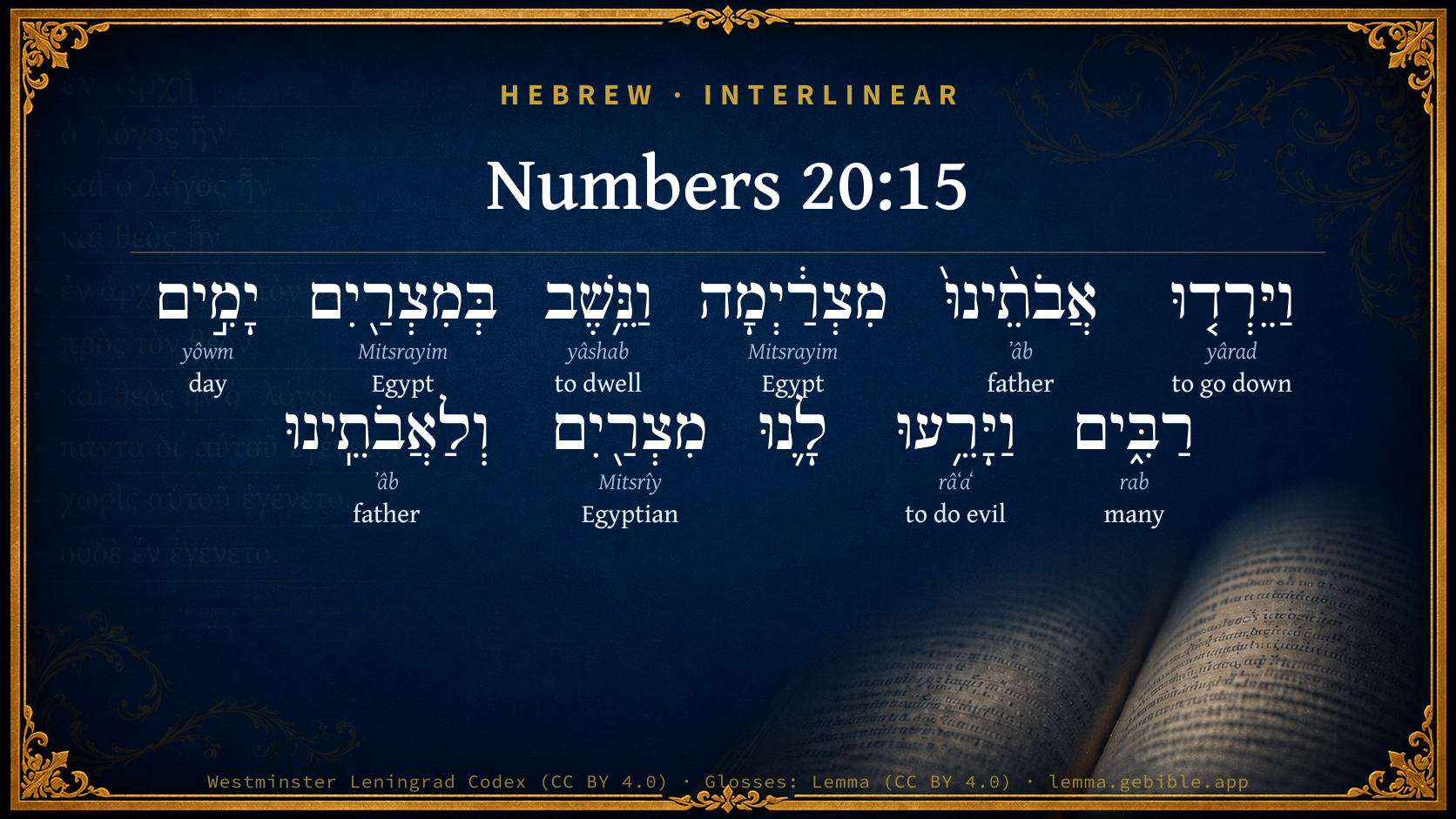
Hebrew (Westminster Leningrad Codex) Numbers 20:15 appears in the Hebrew Old Testament. The text above is from the Westminster Leningrad Codex. Each word links to its Strong’s number, a concise gloss, and parsing drawn from the Open Scriptures Hebrew Bible morphology. Click any word for its full Brown-Driver-Briggs (BDB) entry.
Download image
Cite this verse

Numbers 20:15 (World English Bible). Public Domain. Lemma interlinear Bible study tool, https://lemma.gebible.app/v/numbers/20/15.

Show BibTeX & RIS
BibTeX
RIS
English Translation
how our fathers went down into Egypt, and we lived in Egypt a long time; and the Egyptians dealt ill with us, and our fathers:
World English Bible · Public Domain
Download a study sheet

One document with this verse’s original text, its word-by-word gloss line, the meaning frame, cross-references with their text, attributed commentary, and full source and license credits — printable, and it pastes into notes with its structure intact.

This verse Autodidact and up

Study sheet (.html) Plain text (.txt)

A passage Seminary Student

Up to 50 verses in one chapter. A passage sheet keeps up to 6 commentary sources and 12 cross-references per verse, in the order this page ranks them, and says so on the sheet whenever that leaves anything out. Ask for a single verse and you get the Autodidact verse sheet above.

Everything on this page stays free to read, with no account — the sheet is a download of what is already on screen, not access to it.

Want to remove ads? Support Godless Engineer
Compare translations 3

The same verse in 3 English versions, stacked beneath the original-language interlinear above. Click any original word for its lexicon entry.

Each is an independent rendering of the whole verse — the interlinear is not word-aligned to these translations.

Highlighted words mark where these versions differ — a whole-verse word diff, not a word-by-word alignment.

  • World English Bible Public Domain
    how our fathers went down into Egypt, and we lived in Egypt a long time; and the Egyptians dealt ill with us, and our fathers:
  • King James Version Public Domain
    How our fathers went down into Egypt, and we have dwelt in Egypt a long time; and the Egyptians vexed us, and our fathers:
  • unfoldingWord Literal Text CC BY-SA 4.0
    And our fathers went down to Egypt, and we dwelled in Egypt many days, and the Egyptians did evil to us and to our fathers.

unfoldingWord Literal Text — © unfoldingWord, licensed CC BY-SA 4.0. Word-aligned USFM3 via Door43 (git.door43.org/unfoldingWord/en_ult).

Versions to compare (up to 4)

3 of 4 selected

Show all 18 translations

Every available English version of this verse, each an independent rendering of the whole verse.

  • World English Bible Public Domain
    how our fathers went down into Egypt, and we lived in Egypt a long time; and the Egyptians dealt ill with us, and our fathers:
  • Berean Standard Bible Public Domain
    how our fathers went down to Egypt, where we lived many years. The Egyptians mistreated us and our fathers,
  • Majority Standard Bible Public Domain
    how our fathers went down to Egypt, where we lived many years. The Egyptians mistreated us and our fathers,
  • King James Version Public Domain
    How our fathers went down into Egypt, and we have dwelt in Egypt a long time; and the Egyptians vexed us, and our fathers:
  • American Standard Version (1901) Public Domain
    how our fathers went down into Egypt, and we dwelt in Egypt a long time; and the Egyptians dealt ill with us, and our fathers:
  • Revised Version (1885) Public Domain
    how our fathers went down into Egypt, and we dwelt in Egypt a long time; and the Egyptians evil entreated us, and our fathers:
  • Geneva Bible (1599) Public Domain
    How our fathers went downe into Egypt, and we dwelt in Egypt a long time, where the Egyptians handled vs euill and our fathers.
  • Douay-Rheims (1899) Public Domain
    In what manner our fathers went down into Egypt, and there we dwelt a long time, and the Egyptians afflicted us and our fathers.
  • Young's Literal Translation Public Domain
    that our fathers go down to Egypt, and we dwell in Egypt many days, and the Egyptians do evil to us and to our fathers;
  • Literal Standard Version CC BY-SA 4.0
    that our fathers go down to Egypt, and we dwell in Egypt [for] many days, and the Egyptians do evil to us and to our fathers;
  • Unlocked Literal Bible CC BY-SA 4.0
    You know that our ancestors went down to Egypt and lived in Egypt a long time. The Egyptians treated us harshly and also our ancestors.
  • unfoldingWord Literal Text CC BY-SA 4.0
    And our fathers went down to Egypt, and we dwelled in Egypt many days, and the Egyptians did evil to us and to our fathers.
  • Darby Bible Public Domain
    how our fathers went down to Egypt, and we dwelt in Egypt a long time, and the Egyptians evil entreated us and our fathers;
  • World Messianic Bible Public Domain
    how our fathers went down into Egypt, and we lived in Egypt a long time. The Egyptians mistreated us and our fathers.
  • Webster's Bible Public Domain
    How our fathers went down into Egypt, and we have dwelt in Egypt a long time; and the Egyptians afflicted us, and our fathers:
  • Free Bible Version CC BY-SA 4.0
    Our forefathers went to Egypt and we lived there for a long time. The Egyptians treated us and our forefathers badly,
  • Bible in Basic English Public Domain
    How our fathers went down into Egypt, and we were living in Egypt for a long time; and the Egyptians were cruel to us and to our fathers:
  • JPS Tanakh (1917) Public Domain
    how our fathers went down into Egypt, and we dwelt in Egypt a long time; and the Egyptians dealt ill with us, and our fathers;

Literal Standard Version (2020), Covenant Press — licensed CC BY-SA 4.0. Text via the HelloAO Bible API (eBible.org). Unlocked Literal Bible (unfoldingWord) — licensed CC BY-SA 4.0. Text via the HelloAO Bible API (eBible.org). unfoldingWord Literal Text — © unfoldingWord, licensed CC BY-SA 4.0. Word-aligned USFM3 via Door43 (git.door43.org/unfoldingWord/en_ult). Free Bible Version, Dr. Jonathan Gallagher — licensed CC BY-SA 4.0. Text via the HelloAO Bible API (eBible.org).

Word by word

More ways to search: Search by grammar → Find every occurrence → Compare this word →

Practice this passage: Drill this verse → Learn its vocabulary →

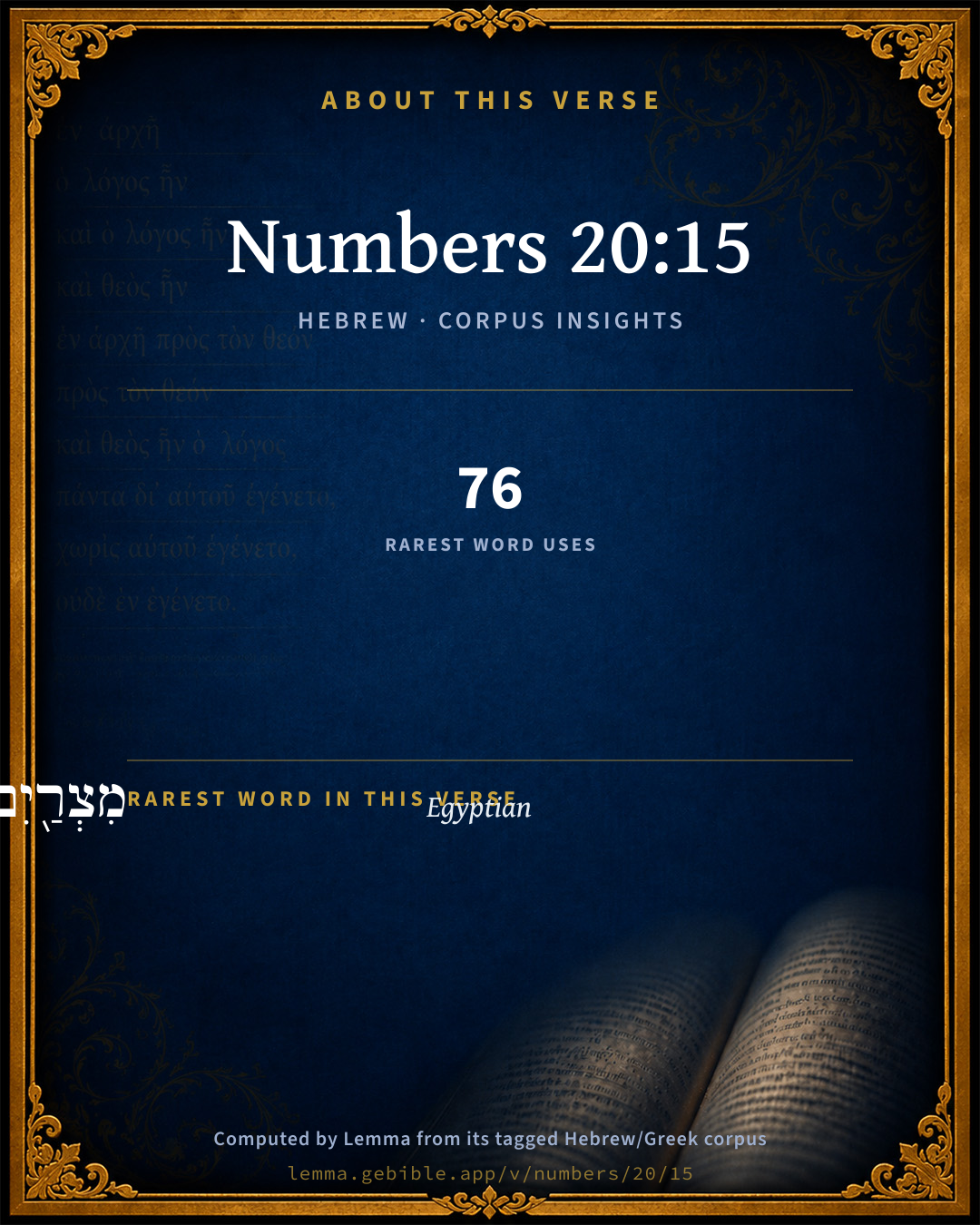
מִצְרַ֖יִם
Mitsrîy
H4713
“Egyptian”
Noun, Proper
Part of Speech
Noun
Type
Proper
Full BDB Definition

Origin: from H4714

TWOT: None

Egyptian = see Egypte " double straits" - Egyptian - an inhabitant or citizen of Egypt - an Egyptian - the Egyptian
  1. וַיֵּרְד֤וּ yârad H3381 “and · to go down” Conjunction + Verb, Qal, Sequential Imperfect, 3rd Person, Masculine, Plural
  2. אֲבֹתֵ֨ינוּ֙ ʼâb H1 “fathers · our” Noun, Common, Masculine, Plural, Construct + Suffix, Personal, 1st Person, Common, Plural
  3. מִצְרַ֔יְמָה Mitsrayim H4714 “Egypt · toward” Noun, Proper + Suffix, Demonstrative
  4. וַנֵּ֥שֶׁב yâshab H3427 “and · to dwell” Conjunction + Verb, Qal, Sequential Imperfect, 1st Person, Common, Plural
  5. בְּמִצְרַ֖יִם Mitsrayim H4714 “in/at · Egypt” Preposition + Noun, Proper
  6. יָמִ֣ים yôwm H3117 “days” Noun, Common, Masculine, Plural, Absolute
  7. רַבִּ֑ים rab H7227 “many” Adjective, Adjective, Masculine, Plural, Absolute
  8. וַיָּרֵ֥עוּ râʻaʻ H7489 “and · to do evil” Conjunction + Verb, Hiphil, Sequential Imperfect, 3rd Person, Masculine, Plural
  9. וְלַאֲבֹתֵֽינוּ ʼâb H1 “and · to/for · fathers · our” Conjunction + Preposition + Noun, Common, Masculine, Plural, Construct + Suffix, Personal, 1st Person, Common, Plural

About this verse

These counts appear in no published source. They are computed here, from the morphology-tagged text and Lemma’s own curated glosses. What Lemma adds →

11
words
8
distinct lemmas
Pentateuch
section

Grammatical profile

  • 3 verbs
  • 6 nouns
  • 1 adjective
  • 1 preposition

Verb forms

  • וַיֵּרְד֤וּ Qal · Sequential Imperfect
  • וַנֵּ֥שֶׁב Qal · Sequential Imperfect
  • וַיָּרֵ֥עוּ Hiphil · Sequential Imperfect

Repetition

Words recur within this verse — often emphatic in Hebrew:

  • אֲבֹתֵ֨ינוּ֙ father H1 ×2
  • מִצְרַ֔יְמָה Egypt H4714 ×2

Hebrew & Septuagint length

In English translation the verse runs 25 words from the Hebrew and 23 from the Septuagint (LXX English) — closely comparable.

A rough comparison of the two English renderings, which tokenize alike — not a word-level alignment.

Word counts can differ between the Hebrew and the Greek without any difference in meaning — e.g. the Hebrew direct-object marker אֵת has no separate Greek word, and Greek often adds the article ὁ.

Cross-references

12

Topical passages linked to Numbers 20:15 in the Treasury of Scripture Knowledge — connected by theme and wording, ordered by reader-vote popularity; previews shown in the World English Bible.

  • Genesis 46:6 They took their cattle, and their goods, which they had gotten in the land of Canaan, and came into Egypt-- Jacob, and all his seed with him,
  • Exodus 12:40 Now the time that the children of Israel lived in Egypt was four hundred thirty years.
  • Deuteronomy 26:6 The Egyptians dealt ill with us, and afflicted us, and laid on us hard bondage:
  • Genesis 15:13 He said to Abram, "Know for sure that your seed will live as foreigners in a land that is not theirs, and will serve them. They will afflict them four hundred years.
  • Acts 7:15 Jacob went down into Egypt, and he died, himself and our fathers,
  • Exodus 1:11–14 Therefore they set taskmasters over them to afflict them with their burdens. They built storage cities for Pharaoh: Pithom and Raamses.
  • Exodus 1:16 and he said, "When you perform the duty of a midwife to the Hebrew women, and see them on the birth stool; if it is a son, then you shall kill him; but if it is a daughter, then she shall live."
  • Exodus 1:22 Pharaoh charged all his people, saying, "You shall cast every son who is born into the river, and every daughter you shall save alive."
  • Exodus 5:14 The officers of the children of Israel, whom Pharaoh's taskmasters had set over them, were beaten, and demanded, "Why haven't you fulfilled your quota both yesterday and today, in making brick as before?"
  • Numbers 11:5 We remember the fish, which we ate in Egypt for nothing; the cucumbers, and the melons, and the leeks, and the onions, and the garlic:
  • Numbers 16:13 is it a small thing that you have brought us up out of a land flowing with milk and honey, to kill us in the wilderness, but you must needs make yourself also a prince over us?
  • Acts 7:19 The same took advantage of our race, and mistreated our fathers, and forced them to throw out their babies, so that they wouldn't stay alive.

Cross-references courtesy of OpenBible.info (CC BY 4.0).

Hebrew and Greek witnesses Masoretic Hebrew ↔ Greek Septuagint

The same verse in the two great witnesses to the Old Testament, shown verse-for-verse.

These are two independent witnesses, not word-aligned to each other, and the Septuagint is shown in lemma (dictionary) form.

Hebrew Numbers 20:15 Masoretic · Westminster Leningrad Codex

וַיֵּרְד֤וּ אֲבֹתֵ֨ינוּ֙ מִצְרַ֔יְמָה וַנֵּ֥שֶׁב בְּמִצְרַ֖יִם יָמִ֣ים רַבִּ֑ים וַיָּרֵ֥עוּ לָ֛נוּ מִצְרַ֖יִם וְלַאֲבֹתֵֽינוּ

how our fathers went down into Egypt, and we lived in Egypt a long time; and the Egyptians dealt ill with us, and our fathers:

World English Bible · Public Domain

Greek LXX Numbers 20:15 Septuagint · lemma form

καί καταβαίνω ὁ πατήρ ἐγώ εἰς αἴγυπτος καί παραοἰκέω ἐν αἴγυπτος ἡμέρα πολύς καί κακόω ἐγώ ὁ αἰγύπτιος καί ὁ πατήρ ἐγώ

And how our fathers went down into Egypt, and we sojourned in Egypt many days, and the Egyptians afflicted us and our fathers.

LXX2012 (modern English Septuagint) · Public Domain

Hebrew: Westminster Leningrad Codex (CC BY 4.0). Greek: Septuagint (public domain); English from LXX2012 (modern English Septuagint) (Public Domain). How the Septuagint differs from the Hebrew →

Targum (Aramaic paraphrase)

2

The Targum is the ancient Jewish Aramaic paraphrase of the Hebrew Scriptures — an interpretive translation, not the Hebrew text itself. Onkelos (literal) and Pseudo-Jonathan (expansive) render the Torah, and Jonathan the Prophets. Coverage is partial: where no permissively-licensed English translation exists for a verse, only the Aramaic is shown. This is verse-level text, not a word-by-word alignment to the Hebrew.

  1. Targum Onkelos Torah (Genesis–Deuteronomy)
    וּנְחָתוּ אֲבָהָתָנָא לְמִצְרַיִם וִיתֵיבְנָא בְמִצְרַיִם יוֹמִין סַגִיאִין וְאַבְאִישׁוּ לָנָא מִצְרָאֵי וְלַאֲבָהָתָנָא

    (no public-domain English translation for this verse)

    Targum Onkelos — Aramaic: “Onkelos Genesis” (public domain); “Onkelos Exodus” (public domain); “Onkelos Leviticus” (public domain); “Onkelos Numbers” (public domain); “Onkelos Deuteronomy” (public domain). English: “Sefaria Community Translation” (CC0 1.0 (public-domain dedication)); “J.W. Etheridge. The Targums of Onkelos and Jonathan Ben Uzziel on the Pentateuch. London: Longmans, Green, 1862” (public domain). Text via Sefaria.

  2. Targum Pseudo-Jonathan Torah (Genesis–Deuteronomy)
    וּנְחָתוּ אַבְהָתָן לְמִצְרַיִם וִיתֵיבְנָא בְמִצְרַיִם יוֹמִין סַגִיאִין וְאַבְאִישׁוּ לָנָא מִצְרָאֵי וּלְאַבְהָתָנָא

    that our fathers went down into Mizraim and dwelt in Mizraim many days, and the Mizraee afflicted us and our fathers.

    Targum Pseudo-Jonathan — Aramaic: “Targum Jonathan on Genesis” (public domain); “Targum Jonathan on Exodus” (public domain); “Targum Jonathan on Leviticus” (public domain); “Targum Jonathan on Numbers” (public domain); “Targum Jonathan on Deuteronomy” (public domain). English: “The Targum of Jonathan ben Uzziel, trans. J. W. Etheridge, London, 1862” (public domain). Text via Sefaria.

Commentary

Notes on Numbers 20:15 from classic Christian and Jewish commentators (each source and its license shown beneath its notes). The classic Christian expositions comment on the surrounding passage and are grouped to its opening verse, so a note may address several verses; the Jewish commentaries on the Tanakh (Rashi and others) are per-verse, so they appear only where the commentator wrote on this verse.

Lemma curates 59 commentaries, every one of them public domain or Creative Commons licensed, each selected and text-cleaned for this edition rather than reprinted as found. About our sources →

Ellicott's Commentary for English Readers

(15) Vexed us.—Better, dealt ill with.

A Bible Commentary for English Readers, edited by Charles John Ellicott (1878–1897) — public domain. Text from a community e-Sword module.

John Gill's Exposition

And when we cried unto the Lord,.... By reason of their bondage, and to be delivered from it, Exo 2:24,

he heard our voice; their prayer to him, as the Targum of Jonathan, for help and deliverance, Exo 2:24,

and sent an angel, and hath brought us forth out of Egypt; one of the ministering angels, as the same Targum, and so Aben Ezra; though he observes that some interpret it of Moses, as do Jarchi, Ben Gersom, and Ben Melech, which is not likely; since Moses is the person that sent this message to the king of Edom, who would not easily understand it of him, if so he meant; nor would the mention of it be of any consequence and avail with him; whereas to understand it of some divine and heavenly agent, sent by the Lord on so important an affair, might make it the more remarkable, and to be regarded by him: and indeed no other is meant than the Angel of God's presence, who appeared to Moses in the bush, and sent him to Pharaoh to demand the dismission of the children of Israel; and who, by him, wrought the wonders in Egypt, and brought Israel from thence, and went before them in a pillar of cloud and fire:

and, behold, we are in Kadesh, a city in the uttermost of thy border; not that they were properly in the city, but near it, for they dwelt in tents in the wilderness; nor would that, or anyone city, hold so large a number as they consisted of.

John Gill's Exposition of the Whole Bible (1746–1763) — public domain (CC PDM 1.0). Text via the HelloAO Bible API.

Whedon's Commentary on the Bible

Daniel D. Whedon

15. Vexed us — Oppressed us. The message is designed to awaken sympathy and to allay the old grudge cherished by Esau toward his artful brother Jacob.

Daniel D. Whedon (gen. ed.), Commentary on the Old and New Testaments (1874–1909) — public domain. Text from a community e-Sword module.

Rashi

Rabbi Shlomo Yitzchaki (Rashi)

וירעו לנו AND [THE EGYPTIANS] DID EVIL TO US — we have borne many adversities.

ולאבתינו [THEY DID EVIL TO US] AND TO OUR FATHERS — From here we may learn that the patriarchs grieve in their graves when punishment comes upon Israel (cf. Midrash Tanchuma, Chukat 12).

Rashi on the Tanakh — English translations: “The Judaica Press complete Tanach with Rashi, translated by A. J. Rosenberg” (CC BY 4.0); “Pentateuch with Rashi's commentary by M. Rosenbaum and A.M. Silbermann, 1929-1934” (public domain); “The Metsudah Tanach series, Lakewood, N.J” (CC BY 4.0); and “The Book of Joshua, Metsudah Publications, 1997” (CC BY 4.0). Text via Sefaria.

Lesson kit

Teaching starters — assembled from the data on this page, not authored interpretation. Every prompt links to the verse data it draws on. Edit before teaching.

Numbers, in the Pentateuch, opens this verse with 11 words (8 distinct Hebrew lemmas). Its most distinctive word is Mitsrîy (“Egyptian”). A historical commentator’s framing appears above. Read the whole chapter for the surrounding context.

Discussion questions

  1. The word Mitsrîy carries the sense “Egyptian.” How does it shape the verse?
  2. Genesis 46:6 shares this passage’s theme. How do the two illuminate each other?
  3. “father” occurs 2× in this one verse. What is the effect of the repetition?
  4. These translations render this verse differently; the difference is in the English rendering, not the original. What questions does that raise?
  5. The verb «וַיֵּרְד֤וּ» is Qal Sequential Imperfect. How does its form color the action?
  6. Reading how Ellicott's Commentary for English Readers and John Gill's Exposition read this verse, where do the two commentators agree and where do they part?

Things to notice

Reading settings

Reading text

Shown beneath each verse's original-language words.

Old Testament
Old Testament edition

Read the OT as the Masoretic Hebrew (MT) or the Greek Septuagint (LXX).

English shown for the Greek Septuagint (in the Hebrew ↔ Greek comparison).

Comparing translations? Open the Compare panel on any verse page to stack up to four side by side.