
1 Kings 18:25

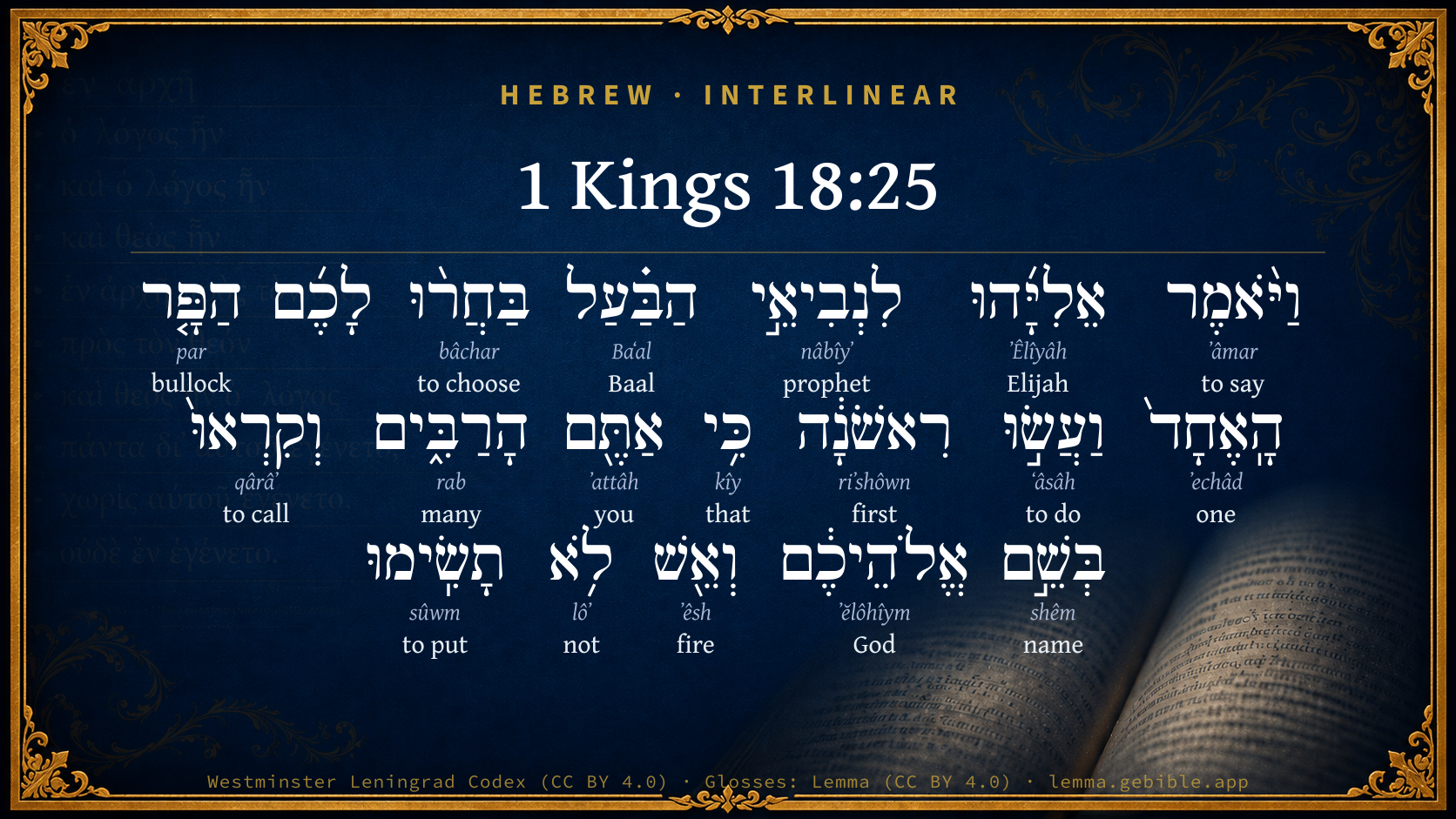
Hebrew (Westminster Leningrad Codex) 1 Kings 18:25 appears in the Hebrew Old Testament. The text above is from the Westminster Leningrad Codex. Each word links to its Strong’s number, a concise gloss, and parsing drawn from the Open Scriptures Hebrew Bible morphology. Click any word for its full Brown-Driver-Briggs (BDB) entry.
Download image
Cite this verse

1 Kings 18:25 (World English Bible). Public Domain. Lemma interlinear Bible study tool, https://lemma.gebible.app/v/1-kings/18/25.

Show BibTeX & RIS
BibTeX
RIS
English Translation
Elijah said to the prophets of Baal, "Choose one bull for yourselves, and dress it first; for you are many; and call on the name of your god, but put no fire under it."
World English Bible · Public Domain
Download a study sheet

One document with this verse’s original text, its word-by-word gloss line, the meaning frame, cross-references with their text, attributed commentary, and full source and license credits — printable, and it pastes into notes with its structure intact.

This verse Autodidact and up

Study sheet (.html) Plain text (.txt)

A passage Seminary Student

Up to 50 verses in one chapter. A passage sheet keeps up to 6 commentary sources and 12 cross-references per verse, in the order this page ranks them, and says so on the sheet whenever that leaves anything out. Ask for a single verse and you get the Autodidact verse sheet above.

Everything on this page stays free to read, with no account — the sheet is a download of what is already on screen, not access to it.

Want to remove ads? Support Godless Engineer
Compare translations 3

The same verse in 3 English versions, stacked beneath the original-language interlinear above. Click any original word for its lexicon entry.

Each is an independent rendering of the whole verse — the interlinear is not word-aligned to these translations.

Highlighted words mark where these versions differ — a whole-verse word diff, not a word-by-word alignment.

  • World English Bible Public Domain
    Elijah said to the prophets of Baal, "Choose one bull for yourselves, and dress it first; for you are many; and call on the name of your god, but put no fire under it."
  • King James Version Public Domain
    And Elijah said unto the prophets of Baal, Choose you one bullock for yourselves, and dress it first; for ye are many; and call on the name of your gods, but put no fire under.
  • unfoldingWord Literal Text CC BY-SA 4.0
    And Elijah said to the prophets of Baal, “Choose for yourselves one bull, and prepare first, for you are many. And call on the name of your god, but you shall not set a fire.”

unfoldingWord Literal Text — © unfoldingWord, licensed CC BY-SA 4.0. Word-aligned USFM3 via Door43 (git.door43.org/unfoldingWord/en_ult).

Versions to compare (up to 4)

3 of 4 selected

Show all 18 translations

Every available English version of this verse, each an independent rendering of the whole verse.

  • World English Bible Public Domain
    Elijah said to the prophets of Baal, "Choose one bull for yourselves, and dress it first; for you are many; and call on the name of your god, but put no fire under it."
  • Berean Standard Bible Public Domain
    Then Elijah said to the prophets of Baal, “Since you are so numerous, choose for yourselves one bull and prepare it first. Then call on the name of your god, but do not light the fire.”
  • Majority Standard Bible Public Domain
    Then Elijah said to the prophets of Baal, “Since you are so numerous, choose for yourselves one bull and prepare it first. Then call on the name of your god, but do not light the fire.”
  • King James Version Public Domain
    And Elijah said unto the prophets of Baal, Choose you one bullock for yourselves, and dress it first; for ye are many; and call on the name of your gods, but put no fire under.
  • American Standard Version (1901) Public Domain
    And Elijah said unto the prophets of Baal, Choose you one bullock for yourselves, and dress it first; for ye are many; and call on the name of your god, but put no fire under.
  • Revised Version (1885) Public Domain
    And Elijah said unto the prophets of Baal, Choose you one bullock for yourselves, and dress it first; for ye are many; and call on the name of your god, but put no fire under.
  • Geneva Bible (1599) Public Domain
    And Eliiah said vnto the prophets of Baal, Chuse you a bullocke, and prepare him first, (for ye are many) and call on the name of your gods, but put no fire vnder.
  • Douay-Rheims (1899) Public Domain
    Then Elias said to the prophets of Baal: Choose you one bullock and dress it first, because you are many: and call on the names of your gods, but put no fire under.
  • Young's Literal Translation Public Domain
    And Elijah saith to the prophets of Baal, `Choose for you the one bullock, and prepare first, for ye `are' the multitude, and call ye in the name of your god, and place no fire.'
  • Literal Standard Version CC BY-SA 4.0
    And Elijah says to the prophets of Ba‘al, “Choose one bullock for yourselves, and prepare [it] first, for you [are] the multitude, and call in the name of your god, and place no fire.”
  • Unlocked Literal Bible CC BY-SA 4.0
    So Elijah said to the prophets of Baal, “Choose one bull for yourselves and prepare it first, for you are many people. Then call on the name of your god, but put no fire under the bull.”
  • unfoldingWord Literal Text CC BY-SA 4.0
    And Elijah said to the prophets of Baal, “Choose for yourselves one bull, and prepare first, for you are many. And call on the name of your god, but you shall not set a fire.”
  • Darby Bible Public Domain
    And Elijah said to the prophets of Baal, Choose one bullock for yourselves, and sacrifice it first; for ye are the many; and call on the name of your god, but put no fire.
  • World Messianic Bible Public Domain
    Elijah said to the prophets of Baal, “Choose one bull for yourselves, and dress it first, for you are many; and call on the name of your god, but put no fire under it.”
  • Webster's Bible Public Domain
    And Elijah said to the prophets of Baal, Choose you one bullock for yourselves, and dress it first; for ye are many; and call on the name of your gods, but put no fire under.
  • Free Bible Version CC BY-SA 4.0
    Elijah said to the prophets of Baal, “You choose one of the bulls and prepare it first, because there are so many of you. Call on your god by name, but don't light the fire.”
  • Bible in Basic English Public Domain
    Then Elijah said to the prophets of Baal, Take one ox for yourselves and get it ready first, for there are more of you; and make your prayers to your god, but put no fire under.
  • JPS Tanakh (1917) Public Domain
    And Elijah said unto the prophets of Baal: 'Choose you one bullock for yourselves, and dress it first; for ye are many; and call on the name of your god, but put no fire under.'

Literal Standard Version (2020), Covenant Press — licensed CC BY-SA 4.0. Text via the HelloAO Bible API (eBible.org). Unlocked Literal Bible (unfoldingWord) — licensed CC BY-SA 4.0. Text via the HelloAO Bible API (eBible.org). unfoldingWord Literal Text — © unfoldingWord, licensed CC BY-SA 4.0. Word-aligned USFM3 via Door43 (git.door43.org/unfoldingWord/en_ult). Free Bible Version, Dr. Jonathan Gallagher — licensed CC BY-SA 4.0. Text via the HelloAO Bible API (eBible.org).

Word by word

More ways to search: Search by grammar → Find every occurrence → Compare this word →

Practice this passage: Drill this verse → Learn its vocabulary →

אֵלִיָּ֜הוּ
ʼÊlîyâh
H452
“Elijah”
Noun, Proper
Part of Speech
Noun
Type
Proper
Full BDB Definition

Origin: from H410 and H3050

TWOT: None

Elijah or Eliah = "my God is Jehovah" or " Yah(u) is God" - the great prophet of the reign of Ahab - Benjamite son of Jeroham - a son of Elam with foreign wife during exile - a son of Harim, and priest, with foreign wife during exile
  1. וַיֹּ֨אמֶר ʼâmar H559 “and · to say” Conjunction + Verb, Qal, Sequential Imperfect, 3rd Person, Masculine, Singular
  2. לִנְבִיאֵ֣י nâbîyʼ H5030 “to/for · prophets of” Preposition + Noun, Common, Masculine, Plural, Construct
  3. הַבַּ֗עַל Baʻal H1168 “the · Baal” Particle, Definite Article + Noun, Proper
  4. בַּחֲר֨וּ bâchar H977 “choose” Verb, Qal, Imperative, 2nd Person, Masculine, Plural
  5. הַפָּ֤ר par H6499 “the · bullock” Particle, Definite Article + Noun, Common, Masculine, Singular, Absolute
  6. הָֽאֶחָד֙ ʼechâd H259 “the · one” Particle, Definite Article + Adjective, Cardinal number, Masculine, Singular, Absolute
  7. וַעֲשׂ֣וּ ʻâsâh H6213 “and · do” Conjunction + Verb, Qal, Imperative, 2nd Person, Masculine, Plural
  8. רִאשֹׁנָ֔ה riʼshôwn H7223 “first” Adjective, Adjective, Feminine, Singular, Absolute
  9. כִּ֥י kîy H3588 “that” Conjunction
  10. אַתֶּ֖ם ʼattâh H859 “you” Pronoun, Personal, 2nd Person, Masculine, Plural
  11. הָרַבִּ֑ים rab H7227 “the · many” Particle, Definite Article + Adjective, Adjective, Masculine, Plural, Absolute
  12. וְקִרְאוּ֙ qârâʼ H7121 “and · call” Conjunction + Verb, Qal, Imperative, 2nd Person, Masculine, Plural
  13. בְּשֵׁ֣ם shêm H8034 “in/at · name of” Preposition + Noun, Common, Masculine, Singular, Construct
  14. אֱלֹהֵיכֶ֔ם ʼĕlôhîym H430 “God(s) · your” Noun, Common, Masculine, Plural, Construct + Suffix, Personal, 2nd Person, Masculine, Plural
  15. וְאֵ֖שׁ ʼêsh H784 “and · fire” Conjunction + Noun, Common, Both, Singular, Absolute
  16. לֹ֥א lôʼ H3808 “not” Particle, Negative
  17. תָשִֽׂימוּ sûwm H7760 “to put” Verb, Qal, Imperfect, 2nd Person, Masculine, Plural

About this verse

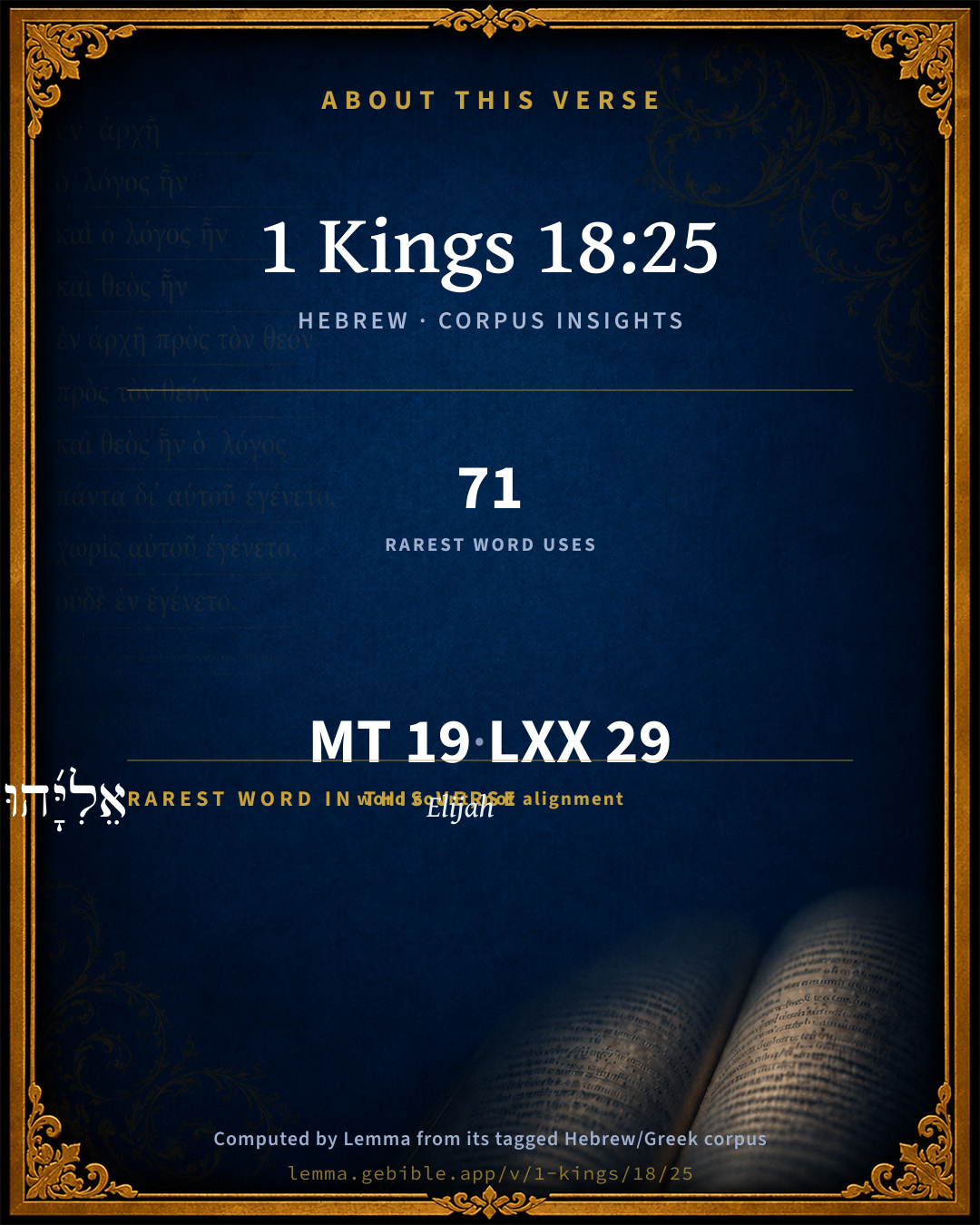
These counts appear in no published source. They are computed here, from the morphology-tagged text and Lemma’s own curated glosses. What Lemma adds →

19
words
18
distinct lemmas
Historical
section

Grammatical profile

  • 5 verbs
  • 7 nouns
  • 3 adjectives
  • 1 pronoun
  • 1 preposition
  • 1 conjunction
  • 1 particle

Verb forms

  • וַיֹּ֨אמֶר Qal · Sequential Imperfect
  • בַּחֲר֨וּ Qal · Imperative
  • וַעֲשׂ֣וּ Qal · Imperative
  • וְקִרְאוּ֙ Qal · Imperative
  • תָשִֽׂימוּ Qal · Imperfect

Hebrew & Septuagint length

In English translation the verse runs 34 words from the Hebrew and 34 from the Septuagint (LXX English) — the same length.

A rough comparison of the two English renderings, which tokenize alike — not a word-level alignment.

Word counts can differ between the Hebrew and the Greek without any difference in meaning — e.g. the Hebrew direct-object marker אֵת has no separate Greek word, and Greek often adds the article ὁ.

In the original languages it is 19 Hebrew tokens and 29 Greek tokens — but the two are counted differently (Hebrew bundles its prefixes and suffixes into one token; the Greek is in lemma form), so that isn’t a like-for-like length.

Hebrew and Greek witnesses Masoretic Hebrew ↔ Greek Septuagint

The same verse in the two great witnesses to the Old Testament, shown verse-for-verse.

These are two independent witnesses, not word-aligned to each other, and the Septuagint is shown in lemma (dictionary) form.

Hebrew 1 Kings 18:25 Masoretic · Westminster Leningrad Codex

וַיֹּ֨אמֶר אֵלִיָּ֜הוּ לִנְבִיאֵ֣י הַבַּ֗עַל בַּחֲר֨וּ לָכֶ֜ם הַפָּ֤ר הָֽאֶחָד֙ וַעֲשׂ֣וּ רִאשֹׁנָ֔ה כִּ֥י אַתֶּ֖ם הָרַבִּ֑ים וְקִרְאוּ֙ בְּשֵׁ֣ם אֱלֹהֵיכֶ֔ם וְאֵ֖שׁ לֹ֥א תָשִֽׂימוּ

Elijah said to the prophets of Baal, "Choose one bull for yourselves, and dress it first; for you are many; and call on the name of your god, but put no fire under it."

World English Bible · Public Domain

Greek LXX 1 Kings 18:25 Septuagint · lemma form

καί εἶπον ηλιου ὁ προφήτης ὁ αἰσχύνη ἐκλέγω ἑαυτοῦ ὁ μόσχος ὁ εἷς καί ποιέω πρῶτος ὅτι πολύς σύ καί ἐπικαλέω ἐν ὄνομα θεός σύ καί πῦρ μή ἐπιτίθημι

And Eliu said to the prophets of shame, Choose to yourselves one calf, and dress it first, for you⌃ are many; and call you⌃ on the name of your god; but apply no fire.

LXX2012 (modern English Septuagint) · Public Domain

On this verse, The Cambridge Bible for Schools and Colleges discusses the Septuagint’s reading. Read the note in Commentary ↓

Hebrew: Westminster Leningrad Codex (CC BY 4.0). Greek: Septuagint (public domain); English from LXX2012 (modern English Septuagint) (Public Domain). How the Septuagint differs from the Hebrew →

Targum (Aramaic paraphrase)

1

The Targum is the ancient Jewish Aramaic paraphrase of the Hebrew Scriptures — an interpretive translation, not the Hebrew text itself. Onkelos (literal) and Pseudo-Jonathan (expansive) render the Torah, and Jonathan the Prophets. Coverage is partial: where no permissively-licensed English translation exists for a verse, only the Aramaic is shown. This is verse-level text, not a word-by-word alignment to the Hebrew.

  1. Targum Jonathan Prophets (Joshua–Malachi)
    וַאֲמַר אֵלִיָהוּ לִנְבִיֵי בַעֲלָא בְחָרוּ לְכוֹן תּוֹרָא חָד וַעֲבִידוּ קֳדָמֵיתָא אֲרֵי אַתּוּן סַגִיאִין וּקְרוֹ בְּשׁוּם טַעֲוַתְכוֹן וְאֶשְׁתָּא לָא תְשַׁווּן:

    (no public-domain English translation for this verse)

    Targum Jonathan — Aramaic: “Mikraot Gedolot” (public domain). English: “Sefaria Community Translation” (CC0 1.0 (public-domain dedication)); “London "Chaldee Paraphrase," 1871” (public domain). Text via Sefaria.

Commentary

Notes on 1 Kings 18:25 from classic Christian and Jewish commentators (each source and its license shown beneath its notes). The classic Christian expositions comment on the surrounding passage and are grouped to its opening verse, so a note may address several verses; the Jewish commentaries on the Tanakh (Rashi and others) are per-verse, so they appear only where the commentator wrote on this verse.

Lemma curates 59 commentaries, every one of them public domain or Creative Commons licensed, each selected and text-cleaned for this edition rather than reprinted as found. About our sources →

Trapp's Complete Commentary

John Trapp

1Ki 18:25 And Elijah said unto the prophets of Baal, Choose you one bullock for yourselves, and dress [it] first; for ye [are] many; and call on the name of your gods, but put no fire [under].

Ver. 25. Choose you one bullock for yourselves, and dress it first.] All privileges and advantages are granted them, lest it should be pretended that their god was sullen, and therefore silent.

John Trapp, A Commentary or Exposition upon All the Books of the Old and New Testament (1647–1656) — public domain. Text from a community e-Sword module.

Joseph Benson's Commentary

1Ki 18:25. Choose ye one bullock for yourselves, and dress it first — I give you the precedence, because I am single, and you are many. It was wise in Elijah to put them upon sacrificing first; because, if he had offered first and God had answered by fire, Baal’s priests would have desisted from making the trial on their part; and because the disappointment of the priests of Baal, of which he was well assured, would prepare the way for the people’s attention to his words, and cause them to entertain his success with more affection; and this coming last would leave the greater impression upon their hearts. And this they accepted, because they might think that if Baal answered them first, which they presumed he would, the people would be so confirmed and heightened in their opinion of Baal, that they might murder Elijah before he came to his experiment.

Joseph Benson's Commentary on the Old and New Testaments (1811–1818) — public domain. Text from a community e-Sword module.

MacLaren's Expositions of Holy Scripture

Alexander MacLaren

1 Kings

THE TRIAL BY FIRE

1Ki 18:25 - 1Ki 18:39.

The place, the purpose, and the actors in this scene, make it among the grandest in history. A nation, with its king, has come together, at the bidding of one man, to settle no less a question than whom they shall worship. There, on the slope of Carmel, with the brassy heaven gleaming hard and dry above them, and the yellow, burnt-up plain of Jezreel at their feet, the expectant people stand. The assembly was a singular proof of Elijah’s ascendency; for Ahab’s bluster had sunk, cowed in his presence, and he had meekly done the prophet’s bidding in summoning ‘all Israel’ and the eight hundred and fifty Baal and Asherah prophets, for an unexplained purpose. The false priests would come unwillingly; but they came.

Then Elijah takes the command, and, though utterly alone, towers above the crowd in the courage of his undaunted confidence in his message. His words have the ring of authority as he rebukes indecision, and calls for a clear adhesion to Baal or Jehovah. If the people had answered, the trial by fire would have been needless. But their silence shows that they waver, and therefore he makes his proposal to them.

Note that the priests are not consulted, nor is Ahab. The former would have had some excuse for shirking the sharp issue; but the people’s assent forced them to accept the ordeal,-reluctantly enough, no doubt.

I. The vain cries to a deaf God. It is strange that one of the parties to the test has power to determine its conditions, especially as Elijah’s prophetic authority was one of the things in dispute; but it is a sign of the magnetic power which one bold man with absolute confidence in his own convictions exercises over men. The Baal prophets are given every advantage in priority of action. Error is best unmasked by being allowed free opportunity to do its best; for the more favourable the circumstances of trial, the more signal the defeat. God’s servants must never be suspected of unfair tricks in their controversy with error. They can afford to let it try first. Notice the substitution of ‘your god,’ in the Revised Version, for ‘your gods’ in the Authorised Version. That is obviously right; for the only question was about one god,-namely, Baal.

So, in the early morning, with all the people gazing at them, the Baal priests or prophets begin their attempt. It was easy to prepare the sacrifice, and lay it on the altar,-though, no doubt, it was done sullenly, with foreboding of the coming exposure. The whole account of the wild invocations of the priests may suggest some of the characteristics of idolatry, and touch our hearts with pity, as well as with the sense of its absurdity, which animated Elijah’s mockery.

Note, then, the vivid picture, in 1Ki 18:27, of the long hours of vain crying. On the one hand, we hear the wild chorus echoing among the rocks; on the other, we feel the dead silence in the heavens.

The monotonous and almost mechanical repetition of the invocation, prolonged till the syllables have no meaning to the yelling crowd, is characteristic of the frenzied excitement so common in idolatry. To call such howlings prayer, degrades the name. They are the very opposite of that sacred communion of a believing soul with the God whom it knows, trusts, and beseeches with submission. Neither knowledge nor trust is in these shrieks, which seek to propitiate the stern god by repeating his name as a kind of charm. Heathenism has no true prayer. Wild cries and passionate desires, flung upwards to an unloved god, are not prayer; and that solace and anchor of the troubled soul is wanting in all the dreary lands given up to idolatry.

The melancholy persistence of the unanswered cries may stand as a symbol of the tragic obstinacy with which their devotees cling to their vain gods,-a rebuke to us with a more enlightened faith. The silence, which was the only answer, is put in strong contrast with the continuous roar of the four hundred and fifty,-so long and loud the hoarse cries here, so unmoved the stillness in the careless heaven. That, too, is typical of heathenism, which is sad with unavailing cries and ignorant of answers to any. As the day wore on, and the voices grew hoarse, and hope declined, more violent bodily exercise was resorted to, and the shouting crowd danced {or, perhaps, as the margin says, ‘limped,’-a picturesque and contemptuous word for the grotesque contortions around the altar}, as if that might bring the answer. That again is a feature common to all heathenism. No wonder that Elijah’s scorn broke forth vehemently at such a sight. Noon was the hour of the sun’s greatest power, and, since Baal was probably a solar deity, it was the hour when, if ever, he would spare one of his abundant fiery beams to light the pyre. So Elijah’s taunts came just when they were most biting, and none can say that they were undeserved. His fiery zeal and his naturally stern character broke out in the bitter irony with which he imagines a variety of undignified positions for Baal.

Sarcasm is not the highest weapon, and the ‘spirit of Elijah’ is not the spirit of Jesus; but the exposure of the absurdity of idolatry is legitimate, and even ridicule may have its place in pricking wind-distended bladders. A man throttling a serpent may be excused using anything that comes handy for the purpose. But, at the same time, the right attitude for us as Christians in the presence of that awful fact of idolatry, is neither contempt nor scientific curiosity, but pity deep as Christ’s, and earnest resolve to help our darkened brethren. The taunts stirred to fiercer excitement and more extravagant acts, as ridicule is wont to do, and therein proves itself an unreliable instrument of controversy. Laughing at a man generally makes him more obstinate. The priests answered Elijah by savagely gashing their half-naked bodies with knives and lances,-a ready way to make blood come, but not to bring fire. The frenzy became wilder as the day declined, and at last, covered with blood, hoarse with shouting, panting with their gymnastics, they ‘prophesied,’ having wrought themselves into that state of excitement in which incoherent rhapsodies burst from their lips. What a scene to call worship! That is what millions of men are ready to practise to-day. And all the while there is no voice, no answer, no care for them, in the pitiless sky. The very genius of idolatry is set before us in that tumultuous crowd on Carmel.

II. The sacrifice of faith and the answer by fire. We pass from a scene of wild commotion into an atmosphere of sacred calm in 1Ki 18:30. The contrast is striking. The fiery fervours of the day are past, and the sun is sinking behind the top of Carmel, and there is much to do before it sets. Elijah with his own hands, as would appear, repairs a ruined altar among the woods. Probably it had been erected for secret worship of Jehovah by some faithful amid the national apostasy, when access to Jerusalem was forbidden them, and had been destroyed by Ahab in his crusade against Jehovah worshippers. The selection of the twelve stones was symbolical of the unbroken unity of the nation, and was Elijah’s protest against the very existence of the Northern kingdom, and its assumption of the name of ‘Israel’ The writer explains what was meant, when he reminds us that Israel was the name given to Jacob, and therefore, as he would have us infer, was the common property of all his descendants. Judah was a part of Israel, and Israel should be an undivided whole, uniting in all its tribes in bringing offerings to Jehovah.

It was a daring thing to do before Ahab’s face; but the weak king was, for the time, subjugated by the imperious will and courage of Elijah. The building of the altar, with its mute witness to God’s purpose, would touch some hearts in the gazing, silent crowd. The next step was, of course, meant to make the miracle more conspicuous by drenching everything with water, probably brought, even in that drought, from the perennial fountain near at hand. Perhaps, too, the number of barrels was intended, again, as symbolical of the twelve tribes.

One can fancy the wonder and eagerness of the people, and the dark frowns of the baffled and exhausted Baal priests, as they gradually came out of their frenzy, and knew that they had lost their opportunity. The tranquil though earnest prayer of the prophet is in sharpest contrast with the meaningless bellowings to Baal. Note in it the solemn invocation. The great Name, which all listening to him had deposed from rule over them, is set in the front; and the ancestral worship, as well as the divine gifts and dealings with the patriarchs, is pleaded with God as the reason for His answer now. The name of ‘Israel’ instead of the more common ‘Jacob,’ has the same force as in 1Ki 18:31.

Note the substance of the petitions. The deepest desire of a truly devout soul is that God would make His name known. Zeal for God’s honour and love for men who have gone astray from Him, conspire to make that the head and front of His true servant’s prayers. It is God, not his own credit, about which Elijah thinks first. For himself, all that he desires is to be known as an obedient servant, and as not having done anything at the bidding of his own will or judgment, but in accordance with the all-commanding Voice.

Clearly we must suppose that in all the ordering of this sublime trial by fire, Elijah had been acting ‘at Thy word,’ even though we have no other record of the fact. He had no right to expect an answer unless he had been bidden to propose the test. God will honour the drafts which He bids us draw on Him; but to suspend our own or other people’s faith in Him, on the issue of some experiment whether He will answer prayers, is not faith, but rash presumption, unless it is in obedience to a distinct command. Elijah had such a command, and therefore he could ask God to vindicate his action, and to prove that he was God’s servant. His last petition is beautiful, both in its consciousness of power with God and recognition of his place as a prophet, and in its lowly subordination of all personal aims to the restoration of Israel to the true worship. He asks, with reiteration which is earnestness and faith, and therefore the sharpest contrast to the mechanical repetition by Baal’s priests, that God would hear him; but his sole object in that prayer is, not that his name may be exalted as a prophet, or that any good may come to him, but that the blinded eyes may be opened, and the hearts, that have been so sadly led astray, be brought back to the worship of their fathers’ God.

The whole brief prayer, in its calm confidence; its adoring recognition of the name and past dealings of Jehovah as the ground of trust; its throbbing of earnest desire for the manifestation of His character before men; its consciousness of personal relation to God, which humbles rather than puffs up; its beseeching for an answer, and its closing petition, which comes round again to its first, that men may know God, and fasten their hearts on Him,-may well stand as a pattern of prayer for us.

The short prayer of faith does in a moment what all the long day of crying could not do. The language in which the answer is described emulates the rapidity of the swift tongues of fire which licked up sacrifice, altar, and water. They were the tokens of acceptance, reminding of the consuming of the first sacrifices in the Tabernacle, and, like them, inaugurating a new beginning of the worship of God. The burning of the altar, as well as of the sacrifice, expressed the acceptance of the people whom it, by its twelve stones, symbolised. And the people, on their part, were-for the time, at all events-swept away by the miracle, and by the force of the prophet’s example and authority. Short-lived their faith may have been, as certainly it was superficial; but the fire had for the time melted their hearts, and set them flowing in the ancient channels of devotion. The faith that is founded on miracle may be deepened into something better; but unless it is, it speedily dies away. The faith that is due to the influence of some strong personality may lead on to an independent faith, based on personal experience; but, unless it does, it too will perish.

We may find a modern reproduction of the test of Carmel in the impotence of all other schemes and methods of social and spiritual reformation and the power of the Gospel. In it and its effects God answers by fire. Let the opposers, who are so glib in demonstrating the failure of Christianity, do the same with their enchantments, if they can.

Alexander MacLaren, Expositions of Holy Scripture (1904–1910) — public domain. Text from a community e-Sword module.

Adam Clarke's Commentary

Verse 25. For ye are many] And therefore shall have the preference, and the advantage of being first in your application to the deity.

Adam Clarke's Commentary on the Bible (1810–1826) — public domain. Text from a community e-Sword/MySword module.

The Cambridge Bible for Schools and Colleges

gen. ed. J. J. S. Perowne

25. the prophets of Baal] Here, as above in 1Ki_18:19, the LXX., instead of ‘Baal’ has τῆς αἰσχύνης. See note there. The pomp and splendour of the priests of Baal glittering no doubt with gorgeous vestments (cf. 2Ki_10:22) would shew the more because of the rough shaggy garb of the Tishbite, whose congenial abode was the mountain tops or the fastnesses of Gilead.

The Cambridge Bible for Schools and Colleges (gen. ed. J. J. S. Perowne; Cambridge University Press, 1878–1918) — public domain. Text from a community e-Sword module.

John Gill's Exposition

And it came to pass at noon,.... When they had been from the time of the morning sacrifice until now invoking their deity to no purpose:

that Elijah mocked them; he jeered and bantered them:

and said, cry aloud; your god does not hear you; perhaps, if you raise your voice higher, he may;

for he is a god; according to your esteem of him, and, if so, he surely may hear you: unless

either he is talking; with others about matters of moment and importance, who are waiting on him with their applications to him; or he is in meditation; in a deep study upon some things difficult to be resolved:

or he is pursuing; his studies, or his pleasures, or his enemies, to overtake them; or he is employed on business (t):

or he is in a journey; gone to visit his friends, or some parts of his dominions; so Homer (u) represents Jupiter gone to pay a visit to the Ethiopians, and as yesterday gone to a feast, and all the gods following him, from whence he would not return until twelve days; and in like manner Lucian (w) speaks of the gods, mocking at them:

or, peradventure he sleepeth, and must be awaked; with a loud crying to him: it being now noon, Abarbinel thinks this refers to a custom of sleeping after dinner; Homer (x) also speaks of the sleep of the gods, and which used to be at noon; and therefore the worshippers of Baal ceased then to call upon him; and it is said (y), the Heathens feared to go into the temples of their gods at noon, lest they should disturb them; but such is not the true God, the God of Israel, he neither slumbers nor sleeps, Psa 121:4.

(t) David de Pomis Lexic. fol. 211. 1. (u) Iliad. ver. 1. 423. (w) Jupiter Tragoedus. (x) Ut supra, (Iliad. ver. 1. 423.) in fine, & Iliad. 2. ver. 1, 2. (y) Meurs. Auctuar. Philol. c. 6. apud Quistorp. in loc.

John Gill's Exposition of the Whole Bible (1746–1763) — public domain (CC PDM 1.0). Text via the HelloAO Bible API.

Albert Barnes' Notes on the Bible

Elijah gives precedence in everything to the Baal-priests, to take away all ground for cavil in case of failure. It is his object to make an impression on king and people; and he feels rightly that the impression will depend greatly on the contrast between their inability and the power given to him.

Albert Barnes' Notes on the Bible (1834–1885) — public domain. Text from a community e-Sword/MySword module.

Matthew Poole's English Annotations

Ye are many, and I am willing to give you the precedency. This he did, partly because if he had first offered, and God had answered by fire, as he knew that he would do, Baal’s priests would have been discouraged, and upon some excuse (which would easily be accepted in regard of the king’s authority, and the favour which they had with the people) would have desisted from making the trial on their part; and partly because the disappointment of the priests of Baal, of which he was well assured, would notably prepare the way for the people’s more diligent attention unto his words and actions, and cause them to entertain the prophet’s good success with more admiration and affection; and this coming last, would leave the greater impression and relish upon their hearts. And this they accepted, be cause they might think, that if Baal did answer them first, which they presumed he would, the people would be so confirmed and heightened in their opinion of Baal, that they by the king’s assistance might murder Elijah before he came to his experiment.

Matthew Poole's English Annotations on the Holy Bible (1683–1685) — public domain. Text from a community e-Sword/MySword module.

The Pulpit Commentary

And Elijah said unto the prophets of Baal, Choose you one bullock for yourselves, and dress or offer, as in ver. 23 it first; for ye are many Heb. the many. Every pre-eminence and advantage which he gives to them will make his triumph, when it comes, all the greater. It is quite possible that he meant again to hint at their immense superiority in point of numbers. But no doubt he was only too glad to find a reason for their taking the lead. "He is anxious that their inability shall be fully manifested before he shows his own power" (Rawlinson). Whether the idea was also present in his mind that they "could prepare their victim in a much shorter time than he could prepare his" (ib.) is by no means so certain; and call on the name of your gods or god, i.e. , Baal, but put no fire under. The repetition (cf. ver. 24) shows that the ordeal was proposed separately to the people and the prophets.

Vers. 25-29.

The Failure.

When the appeal of Elijah to the people had gained their applause, he had the prophets of Baal at his command. The test he had proposed was so fair that they could not reasonably object to it, and the voice of the people rendered it impossible for them to evade the trial. The prophet of the Lord accordingly pressed the matter home upon his adversaries in the words of the text. They were obliged to proceed to the trial which ended in their discomfiture.

I THEIR PRAYER WAS EARNEST.

1. They began early.

(1) Everything seems to have been in readiness soon after daybreak; so that almost as soon as their Apollo looked out of the eyelids of the morning the cry arose, "O Baal, hear us!

(2) Worshippers of Jehovah should not be less zealous. The early morning was chosen by His devoted servants (see Gen_19:27 Gen_22:8; Exo_24:4; Job_1:5; Psa_5:3 Psa_59:16 Psa_88:13; Mar_1:35) Such exercises will be a noble preparation for the day.

2. They persisted.

(1) They continued their supplications until noon. As the sun rolled upwards in the heavens their hopes rose. As it neared the zenith they felt it was now or never and 850 voices in full chorus cried, "O Baal, hear us!

(2) Even when the noon point was turned and their god was sinking in the west, still they urged their suit, adding to their entreaties frantic gestures and mingling their own blood with their sacrifice.

(3) Idolatry is essentially cruel, and in this contrasts strongly with the service of Jehovah (see Lev_19:28; Deu_14:1) The cruel penances of Rome are kindred to those of Baal"s servants. "The devil is a murderer." Of bodies. Of souls.

(4) Persistency should mark the servants of God. Jacob wrestled all night with the angel at Penuel, and at daybreak prevailed. The parable of the importunate widow was given to impress this lesson. We should ask until we receive.

(5) How blessedly has persistency been rewarded! Ministers have seen this; parents; Sunday school teachers; tract distributors.

II BUT IT WAS MISDIRECTED.

1. Their god was contemptible.

(1) He was destitute of the attributes they ascribed to him. The sun, though a glorious body, is but matter. It has no more intelligence than a flint. How the intellects as well as the eyes of men are dazzled with splendour!

(2) How different is the true God! He is a Spirit invisible omniscient omnipresent omnipotent holy just good. He claims, and should receive, the homage of all our faculties.

2. Their worship, therefore, was ridiculous.

(1) So Elijah thought when he stung them with mockery. "He is a god!" (awh yk) he is a supreme god l Here is a fine stroke of irony. This weapon of rhetoric was used by our Lord" Art thou a master in Israel and knowest not these things?

(2) "He is talking." He is so stunned with the thunder of his own voice and with the voices of his associates in the pantheon that he cannot hear the ordinary voices of mortals. Therefore "cry aloud." Or he is (jy meditating" (margin) in a brown study, in a reverie and must be roused.

(3) "Or he is pursuing," or "hath a pursuit." He is so engaged with some other matter that he cannot hear your feeble voice. What sort of god is yours?

(4) "Or he is in a journey so far away that your prayer will be useless unless you can cry aloud.

(5) "Or peradventure he sleepeth and must be awaked." You must first raise a clamour about his ears to arouse him, or you pray in vain. How doubtful must be the success of any worship paid to such a god!

3. Ridicule was righteously applied.

(1) It should never be substituted for reason, as too often it is. It is a favourite weapon with sceptics who are at a loss for an argument.

(2) But where reason is wasted upon stupidity then it is fitting. Elijah was silent from sunrise till noon, when the experiment had a fair trial and failed. Then he rallied the idolaters with a ridicule that was full of argument.

(3) When evening set in they gave up the contest in despair. There is an evening coming in which all contests with Jehovah shall so terminate. J.A.M.

The Pulpit Commentary (1880–1919), ed. H.D.M. Spence-Jones & Joseph S. Exell — public domain. Text from a community e-Sword module.

John Wesley's Explanatory Notes

Dress it first - And I am willing to give you the precedency. This he did, because if he had first offered, and God had answered by fire, Baal's priests would have desisted from making the trial on their part; and because the disappointment of the priests of Baal, of which he was well assured, would prepare the way for the people's attention to his words, and cause them to entertain his success with more affection; and this coming last would leave the greater impression upon their hearts. And this they accepted, because they might think, that if Baal answered them first, which they presumed he would, the people would be so confirmed and heightened in their opinion of Baal, that they might murder Elijah before he came to his experiment.

John Wesley, Explanatory Notes Upon the Whole Bible (1754–1765) — public domain. Text via the GEBible commentary corpus.

unfoldingWord translationNotes

Door43 World Missions Community

prepare it

"make it ready to be sacrificed"

you are many people

Here the word "you" is plural. (See: Forms of You)

They took the bull

"The prophets of Baal took the bull"

the bull that was given to them

This can be stated in active form. AT: "the bull that someone gave them" (See: Active or Passive)

But there was no voice, nor anyone who answered

These two phrases share similar meanings and emphasize that there was no one to respond to the prayers of the false prophets. The word "voice" represents someone speaking. AT: "But Baal did not say or do anything" (See: Parallelism and Synecdoche)

translationWords

Elijah

prophet

Baal

cow

name

false god

voice

altar

unfoldingWord translationNotes — © Distant Shores Media and the Door43 World Missions Community, licensed CC BY-SA 4.0. Source: git.door43.org/Door43/en_tn.

Lesson kit

Teaching starters — assembled from the data on this page, not authored interpretation. Every prompt links to the verse data it draws on. Edit before teaching.

1 Kings, in the Historical, opens this verse with 19 words (18 distinct Hebrew lemmas). Its most distinctive word is ʼÊlîyâh (“Elijah”). A historical commentator’s framing appears above. Read the whole chapter for the surrounding context.

Discussion questions

  1. The word ʼÊlîyâh carries the sense “Elijah.” How does it shape the verse?
  2. The translations on this page render this verse differently — a whole-verse word diff, not a word-by-word alignment. What might account for the different wordings?
  3. «וַיֹּ֨אמֶר» is a Qal Sequential Imperfect verb. How does that grammatical form shape the action described?
  4. Compare how Trapp's Complete Commentary and Joseph Benson's Commentary read this verse. Where do they agree or differ?

Things to notice

Reading settings

Reading text

Shown beneath each verse's original-language words.

Old Testament
Old Testament edition

Read the OT as the Masoretic Hebrew (MT) or the Greek Septuagint (LXX).

English shown for the Greek Septuagint (in the Hebrew ↔ Greek comparison).

Comparing translations? Open the Compare panel on any verse page to stack up to four side by side.