Genesis 37:34

Hebrew (Westminster Leningrad Codex) Genesis 37:34 appears in the Hebrew Old Testament. The text above is from the Westminster Leningrad Codex. Each word links to its Strong’s number, a concise gloss, and parsing drawn from the Open Scriptures Hebrew Bible morphology. Click any word for its full Brown-Driver-Briggs (BDB) entry.
Download image
Cite this verse

Genesis 37:34 (World English Bible). Public Domain. Lemma interlinear Bible study tool, https://lemma.gebible.app/v/genesis/37/34.

Show BibTeX & RIS
BibTeX
RIS
English Translation
Jacob tore his clothes, and put sackcloth on his loins, and mourned for his son many days.
World English Bible · Public Domain
Highlights Full analysis ↓
Download a study sheet

One document with this verse’s original text, its word-by-word gloss line, the meaning frame, cross-references with their text, attributed commentary, and full source and license credits — printable, and it pastes into notes with its structure intact.

This verse Autodidact and up

Study sheet (.html) Plain text (.txt)

A passage Seminary Student

Up to 50 verses in one chapter. A passage sheet keeps up to 6 commentary sources and 12 cross-references per verse, in the order this page ranks them, and says so on the sheet whenever that leaves anything out. Ask for a single verse and you get the Autodidact verse sheet above.

Everything on this page stays free to read, with no account — the sheet is a download of what is already on screen, not access to it.

Want to remove ads? Support Godless Engineer
Compare translations 3

The same verse in 3 English versions, stacked beneath the original-language interlinear above. Click any original word for its lexicon entry.

Each is an independent rendering of the whole verse — the interlinear is not word-aligned to these translations.

Highlighted words mark where these versions differ — a whole-verse word diff, not a word-by-word alignment.

  • World English Bible Public Domain
    Jacob tore his clothes, and put sackcloth on his loins, and mourned for his son many days.
  • King James Version Public Domain
    And Jacob rent his clothes, and put sackcloth upon his loins, and mourned for his son many days.
  • unfoldingWord Literal Text CC BY-SA 4.0
    Then Jacob tore his clothes and put sackcloth on his loins, and he mourned for his son many days.

unfoldingWord Literal Text — © unfoldingWord, licensed CC BY-SA 4.0. Word-aligned USFM3 via Door43 (git.door43.org/unfoldingWord/en_ult).

Versions to compare (up to 4)

3 of 4 selected

Show all 18 translations

Every available English version of this verse, each an independent rendering of the whole verse.

  • World English Bible Public Domain
    Jacob tore his clothes, and put sackcloth on his loins, and mourned for his son many days.
  • Berean Standard Bible Public Domain
    Then Jacob tore his clothes, put sackcloth around his waist, and mourned for his son many days.
  • Majority Standard Bible Public Domain
    Then Jacob tore his clothes, put sackcloth around his waist, and mourned for his son many days.
  • King James Version Public Domain
    And Jacob rent his clothes, and put sackcloth upon his loins, and mourned for his son many days.
  • American Standard Version (1901) Public Domain
    And Jacob rent his garments, and put sackcloth upon his loins, and mourned for his son many days.
  • Revised Version (1885) Public Domain
    And Jacob rent his garments, and put sackcloth upon his loins, and mourned for his son many days.
  • Geneva Bible (1599) Public Domain
    And Iaakob rent his clothes, and put sackecloth about his loynes, and sorowed for his sonne a long season.
  • Douay-Rheims (1899) Public Domain
    And tearing his garments, he put an sackcloth, mourning for his son a long time.
  • Young's Literal Translation Public Domain
    And Jacob rendeth his raiment, and putteth sackcloth on his loins, and becometh a mourner for his son many days,
  • Literal Standard Version CC BY-SA 4.0
    And Jacob tears his raiment, and puts sackcloth on his loins, and becomes a mourner for his son many days,
  • Unlocked Literal Bible CC BY-SA 4.0
    Jacob tore his garments and put sackcloth upon his loins. He mourned for his son many days.
  • unfoldingWord Literal Text CC BY-SA 4.0
    Then Jacob tore his clothes and put sackcloth on his loins, and he mourned for his son many days.
  • Darby Bible Public Domain
    And Jacob rent his clothes, and put sackcloth on his loins, and mourned for his son many days.
  • World Messianic Bible Public Domain
    Jacob tore his clothes, and put sackcloth on his waist, and mourned for his son many days.
  • Webster's Bible Public Domain
    And Jacob rent his clothes, and put sackcloth on his loins, and mourned for his son many days.
  • Free Bible Version CC BY-SA 4.0
    Jacob tore his clothes in grief and dressed in sackcloth. He mourned the death of his son for a long time.
  • Bible in Basic English Public Domain
    Then Jacob, giving signs of grief, put on haircloth, and went on weeping for his son day after day.
  • JPS Tanakh (1917) Public Domain
    And Jacob rent his garments, and put sackcloth upon his loins, and mourned for his son many days.

Literal Standard Version (2020), Covenant Press — licensed CC BY-SA 4.0. Text via the HelloAO Bible API (eBible.org). Unlocked Literal Bible (unfoldingWord) — licensed CC BY-SA 4.0. Text via the HelloAO Bible API (eBible.org). unfoldingWord Literal Text — © unfoldingWord, licensed CC BY-SA 4.0. Word-aligned USFM3 via Door43 (git.door43.org/unfoldingWord/en_ult). Free Bible Version, Dr. Jonathan Gallagher — licensed CC BY-SA 4.0. Text via the HelloAO Bible API (eBible.org).

Word by word

More ways to search: Search by grammar → Find every occurrence → Compare this word →

Practice this passage: Drill this verse → Learn its vocabulary →

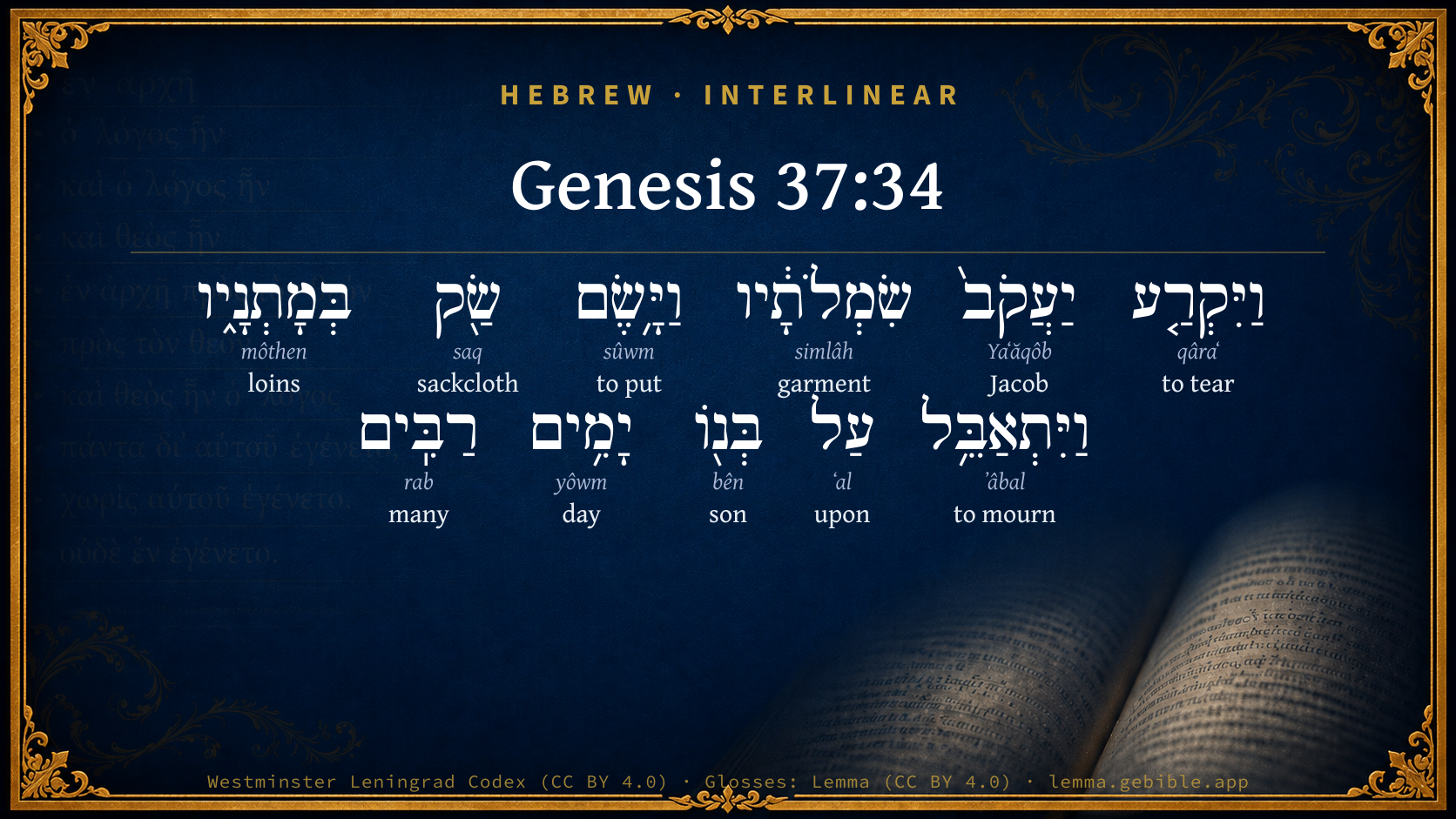
שִׂמְלֹתָ֔יו
simlâh
H8071
“garments · his”
Noun, Common, Feminine, Plural, Construct + Suffix, Personal, 3rd Person, Masculine, Singular
Part of Speech
Noun
Type
Common
Gender
Feminine
Number
Plural
State
Construct
Full BDB Definition

Origin: perhaps by permutation for the fem. of H5566 (through the idea of a cover assuming the shape of the object beneath)

TWOT: 2270a

wrapper, mantle, covering garment, garments, clothes, raiment, a cloth
  1. וַיִּקְרַ֤ע qâraʻ H7167 “and · to tear” Conjunction + Verb, Qal, Sequential Imperfect, 3rd Person, Masculine, Singular
  2. יַעֲקֹב֙ Yaʻăqôb H3290 “Jacob” Noun, Proper
  3. וַיָּ֥שֶׂם sûwm H7760 “and · to put” Conjunction + Verb, Qal, Sequential Imperfect, 3rd Person, Masculine, Singular
  4. שַׂ֖ק saq H8242 “sackcloth” Noun, Common, Masculine, Singular, Absolute
  5. בְּמָתְנָ֑יו môthen H4975 “in/at · loins · his” Preposition + Noun, Common, Masculine, Dual, Construct + Suffix, Personal, 3rd Person, Masculine, Singular
  6. וַיִּתְאַבֵּ֥ל ʼâbal H56 “and · to mourn” Conjunction + Verb, Hithpael, Sequential Imperfect, 3rd Person, Masculine, Singular
  7. עַל ʻal H5921 “upon” Preposition
  8. בְּנ֖וֹ bên H1121 “son · his” Noun, Common, Masculine, Singular, Construct + Suffix, Personal, 3rd Person, Masculine, Singular
  9. יָמִ֥ים yôwm H3117 “days” Noun, Common, Masculine, Plural, Absolute
  10. רַבִּֽים rab H7227 “many” Adjective, Adjective, Masculine, Plural, Absolute

About this verse

These counts appear in no published source. They are computed here, from the morphology-tagged text and Lemma’s own curated glosses. What Lemma adds →

11
words
11
distinct lemmas
Pentateuch
section

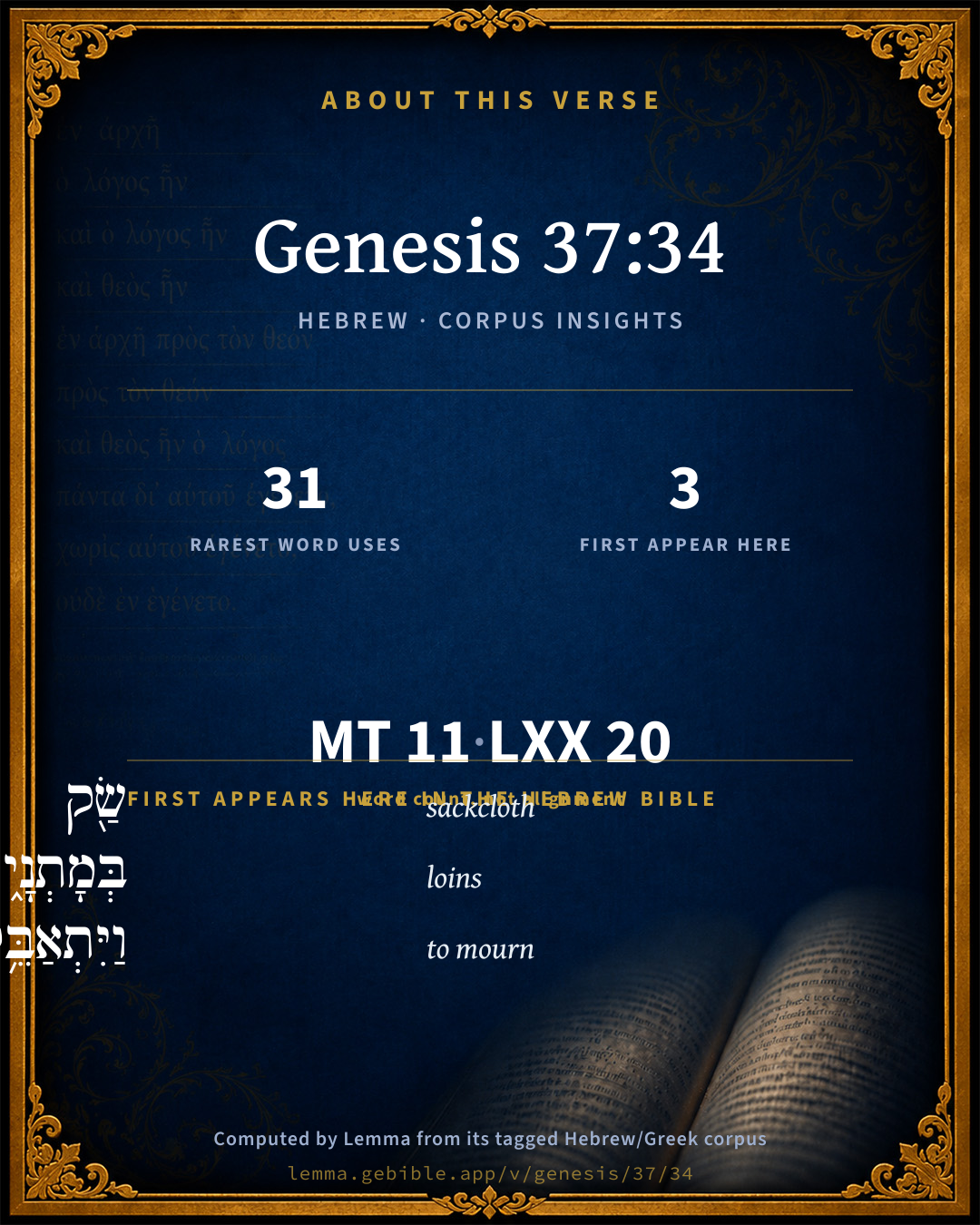
First appearance in Scripture

These words make their first canonical appearance in the Hebrew Bible here:

  • שַׂ֖ק sackcloth H8242
  • בְּמָתְנָ֑יו loins H4975
  • וַיִּתְאַבֵּ֥ל to mourn H56

Shared distinctive vocabulary

שִׂמְלֹתָ֔יו garment H8071 occurs in 28 verses of the Hebrew Bible. Also found in:

Grammatical profile

  • 3 verbs
  • 6 nouns
  • 1 adjective
  • 1 preposition

Verb forms

  • וַיִּקְרַ֤ע Qal · Sequential Imperfect
  • וַיָּ֥שֶׂם Qal · Sequential Imperfect
  • וַיִּתְאַבֵּ֥ל Hithpael · Sequential Imperfect

Hebrew & Septuagint length

In English translation the verse runs 17 words from the Hebrew and 38 from the Septuagint (LXX English) — the Septuagint runs noticeably longer here. See the side-by-side →

A rough comparison of the two English renderings, which tokenize alike — not a word-level alignment.

Word counts can differ between the Hebrew and the Greek without any difference in meaning — e.g. the Hebrew direct-object marker אֵת has no separate Greek word, and Greek often adds the article ὁ.

In the original languages it is 11 Hebrew tokens and 20 Greek tokens — but the two are counted differently (Hebrew bundles its prefixes and suffixes into one token; the Greek is in lemma form), so that isn’t a like-for-like length.

Cross-references

24

Topical passages linked to Genesis 37:34 in the Treasury of Scripture Knowledge — connected by theme and wording, ordered by reader-vote popularity; previews shown in the World English Bible.

  • Genesis 37:29 Reuben returned to the pit; and saw that Joseph wasn't in the pit; and he tore his clothes.
  • 2 Samuel 3:31 David said to Joab, and to all the people who were with him, Tear your clothes, and gird you with sackcloth, and mourn before Abner. King David followed the bier.
  • Joshua 7:6 Joshua tore his clothes, and fell to the earth on his face before the ark of Yahweh until the evening, he and the elders of Israel; and they put dust on their heads.
  • 2 Samuel 1:11 Then David took hold on his clothes, and tore them; and likewise all the men who were with him:
  • 1 Kings 20:31 His servants said to him, See now, we have heard that the kings of the house of Israel are merciful kings: let us, we pray you, put sackcloth on our loins, and ropes on our heads, and go out to the king of Israel: peradventure he will save your life.
  • 1 Kings 21:27 It happened, when Ahab heard those words, that he tore his clothes, and put sackcloth on his flesh, and fasted, and lay in sackcloth, and went softly.
  • 2 Kings 19:1 It happened, when king Hezekiah heard it, that he tore his clothes, and covered himself with sackcloth, and went into the house of Yahweh.
  • 1 Chronicles 21:16 David lifted up his eyes, and saw the angel of Yahweh standing between earth and the sky, having a drawn sword in his hand stretched out over Jerusalem. Then David and the elders, clothed in sackcloth, fell on their faces.
  • Ezra 9:3–5 When I heard this thing, I tore my garment and my robe, and plucked off the hair of my head and of my beard, and sat down confounded.
  • Nehemiah 9:1 Now in the twenty-fourth day of this month the children of Israel were assembled with fasting, and with sackcloth, and earth on them.
  • Esther 4:1–3 Now when Mordecai knew all that was done, Mordecai tore his clothes, and put on sackcloth with ashes, and went out into the midst of the city, and cried with a loud and a bitter cry;
  • Job 1:20 Then Job arose, and tore his robe, and shaved his head, and fell down on the ground, and worshiped.
  • Job 2:12 When they lifted up their eyes from a distance, and didn't recognize him, they raised their voices, and wept; and they each tore his robe, and sprinkled dust on their heads toward the sky.
  • Psalms 69:11 When I made sackcloth my clothing, I became a byword to them.
  • Isaiah 22:12–13 In that day did the Lord, Yahweh of Hosts, call to weeping, and to mourning, and to baldness, and to girding with sackcloth:
  • Isaiah 32:11 Tremble, you women who are at ease; be troubled, you careless ones; strip yourselves, and make yourselves naked, and gird [sackcloth] on your loins.
  • Isaiah 36:22–37:2 Then came Eliakim the son of Hilkiah, who was over the household, and Shebna the scribe, and Joah, the son of Asaph, the recorder, to Hezekiah with their clothes torn, and told him the words of Rabshakeh.
  • Jeremiah 36:24 They were not afraid, nor tore their garments, neither the king, nor any of his servants who heard all these words.
  • Joel 2:13 Tear your heart, and not your garments, And turn to Yahweh, your God; For he is gracious and merciful, Slow to anger, and abundant in loving kindness, And relents from sending calamity.
  • Jonah 3:5–8 The people of Nineveh believed God; and they proclaimed a fast, and put on sackcloth, from the greatest of them even to the least of them.
  • Matthew 11:21 "Woe to you, Chorazin! Woe to you, Bethsaida! For if the mighty works had been done in Tyre and Sidon which were done in you, they would have repented long ago in sackcloth and ashes.
  • Matthew 26:65 Then the high priest tore his clothing, saying, "He has spoken blasphemy! Why do we need any more witnesses? Behold, now you have heard his blasphemy.
  • Acts 14:14 But when the apostles, Barnabas and Paul, heard of it, they tore their clothes, and sprang into the multitude, crying out,
  • Revelation 11:3 I will give power to my two witnesses, and they will prophesy one thousand two hundred sixty days, clothed in sackcloth."

Cross-references courtesy of OpenBible.info (CC BY 4.0).

Hebrew and Greek witnesses Masoretic Hebrew ↔ Greek Septuagint

The same verse in the two great witnesses to the Old Testament, shown verse-for-verse.

Here the Septuagint runs noticeably longer than the Hebrew — LXX2012 (modern English Septuagint) 38 words vs World English Bible 17. A rough length comparison of the two English translations, not a word-level alignment — read both below.

These are two independent witnesses, not word-aligned to each other, and the Septuagint is shown in lemma (dictionary) form.

Hebrew Genesis 37:34 Masoretic · Westminster Leningrad Codex

וַיִּקְרַ֤ע יַעֲקֹב֙ שִׂמְלֹתָ֔יו וַיָּ֥שֶׂם שַׂ֖ק בְּמָתְנָ֑יו וַיִּתְאַבֵּ֥ל עַל בְּנ֖וֹ יָמִ֥ים רַבִּֽים

Jacob tore his clothes, and put sackcloth on his loins, and mourned for his son many days.

World English Bible · Public Domain

Greek LXX Genesis 37:34 Septuagint · lemma form

διαῥήγνυμι δέ ἰακώβ ὁ ἱμάτιον αὐτός καί ἐπιτίθημι σάκκος ἐπί ὁ ὀσφύς αὐτός καί πενθέω ὁ υἱός αὐτός ἡμέρα πολύς

And all his sons and his daughters gathered themselves together, and came to comfort him; but he would not be comforted, saying, I will go down to my son mourning to Hades; and his father wept for him.

LXX2012 (modern English Septuagint) · Public Domain

Hebrew: Westminster Leningrad Codex (CC BY 4.0). Greek: Septuagint (public domain); English from LXX2012 (modern English Septuagint) (Public Domain). How the Septuagint differs from the Hebrew →

Targum (Aramaic paraphrase)

2

The Targum is the ancient Jewish Aramaic paraphrase of the Hebrew Scriptures — an interpretive translation, not the Hebrew text itself. Onkelos (literal) and Pseudo-Jonathan (expansive) render the Torah, and Jonathan the Prophets. Coverage is partial: where no permissively-licensed English translation exists for a verse, only the Aramaic is shown. This is verse-level text, not a word-by-word alignment to the Hebrew.

  1. Targum Onkelos Torah (Genesis–Deuteronomy)
    וּבְזַע יַעֲקֹב לְבוּשׁוֹהִי וַאֲסַר שַׂקָא בְּחַרְצֵהּ וְאִתְאַבַּל עַל בְּרֵהּ יוֹמִין סַגִיאִין

    (no public-domain English translation for this verse)

    Targum Onkelos — Aramaic: “Onkelos Genesis” (public domain); “Onkelos Exodus” (public domain); “Onkelos Leviticus” (public domain); “Onkelos Numbers” (public domain); “Onkelos Deuteronomy” (public domain). English: “Sefaria Community Translation” (CC0 1.0 (public-domain dedication)); “J.W. Etheridge. The Targums of Onkelos and Jonathan Ben Uzziel on the Pentateuch. London: Longmans, Green, 1862” (public domain). Text via Sefaria.

  2. Targum Pseudo-Jonathan Torah (Genesis–Deuteronomy)
    וּבְזַע יַעֲקב לְבוּשׁוֹי וַאֲסַר שַקָא בְּחַרְצוֹי וְאִתְאַבֵּל עַל בְּרֵיהּ יוֹמִין סַגִיאִין

    And Jakob rent his clothes, and wrapped sackcloth on his loins, and mourned for his son many days.

    Targum Pseudo-Jonathan — Aramaic: “Targum Jonathan on Genesis” (public domain); “Targum Jonathan on Exodus” (public domain); “Targum Jonathan on Leviticus” (public domain); “Targum Jonathan on Numbers” (public domain); “Targum Jonathan on Deuteronomy” (public domain). English: “The Targum of Jonathan ben Uzziel, trans. J. W. Etheridge, London, 1862” (public domain). Text via Sefaria.

Commentary

Notes on Genesis 37:34 from classic Christian and Jewish commentators (each source and its license shown beneath its notes). The classic Christian expositions comment on the surrounding passage and are grouped to its opening verse, so a note may address several verses; the Jewish commentaries on the Tanakh (Rashi and others) are per-verse, so they appear only where the commentator wrote on this verse.

Lemma curates 59 commentaries, every one of them public domain or Creative Commons licensed, each selected and text-cleaned for this edition rather than reprinted as found. About our sources →

Trapp's Complete Commentary

John Trapp

Gen 37:34 And Jacob rent his clothes, and put sackcloth upon his loins, and mourned for his son many days.

Ver. 34. Mourned for his son many days.] Puerilitas est periculorum pelagus. Few live to be old, for one evil beast or another that devours them: as for one apple that hangs till it falls, many are cudgelled down or gathered off the tree. We should learn to bury children and friends, while yet alive; by acting their death to ourselves aforehand.

John Trapp, A Commentary or Exposition upon All the Books of the Old and New Testament (1647–1656) — public domain. Text from a community e-Sword module.

Tyndale Open Study Notes

Tyndale Open Resources

37:34-35 Jacob tore his clothes and dressed himself in burlap: These were signs of great distress and mourning (see 44:13; Job 1:20; 16:15). Jacob was devastated and refused to be comforted. The treachery thus affected everyone in his family.

Tyndale Open Study Notes — © Tyndale Open Resources, licensed CC BY-SA 4.0. Text via the HelloAO Bible API.

Jamieson, Fausset & Brown

Robert Jamieson, A. R. Fausset & David Brown

Jacob rent his clothes, and put sackcloth upon his loins--the common signs of Oriental mourning. A rent is made in the skirt more or less long according to the afflicted feelings of the mourner, and a coarse rough piece of black sackcloth or camel's hair cloth is wound round the waist.

Jamieson, Fausset & Brown — Commentary Critical and Explanatory on the Whole Bible (1871) — public domain (CC PDM 1.0). Text via the HelloAO Bible API.

Ellicott's Commentary for English Readers

(34) Many days.—Jacob mourned for Joseph not merely during the usual period, but so long as to move even the hearts of those who had wronged him. For not only his daughters, but “all his sons rose up to comfort him.” Probably he had several daughters by Leah and the two handmaidens, Dinah alone having been mentioned by name, because two of her brothers forfeited the birthright by the cruelty with which they avenged her wrong. We learn how long and intense Jacob’s sorrow was from Gen_45:26-28. His daughters are mentioned also in Gen_46:7.

A Bible Commentary for English Readers, edited by Charles John Ellicott (1878–1897) — public domain. Text from a community e-Sword module.

The Cambridge Bible for Schools and Colleges

gen. ed. J. J. S. Perowne

34. rent his garments, &c.] Jacob mourned with the mourning rites of the Israelites. The rent clothes, the sackcloth, and the ashes, denote the exact opposite of festal array, new garments, soft raiment, and ointment.

For “sackcloth” in mourning, see 1Ki_21:27; 2Ki_6:30.

The Cambridge Bible for Schools and Colleges (gen. ed. J. J. S. Perowne; Cambridge University Press, 1878–1918) — public domain. Text from a community e-Sword module.

John Gill's Exposition

And all his sons and all his daughters rose up to comfort him,.... His sons must act a most hypocritical part in this affair; and as for his daughters, it is not easy to say who they were, since he had but one daughter that we read of, whose name was Dinah: the Targum of Jonathan calls them his sons wives; but it is a question whether any of his sons were as yet married, since the eldest of them was not more than twenty four years of age; and much less can their daughters be supposed to be meant, as they are by some. It is the opinion of the Jews, that Jacob had a twin daughter born to him with each of his sons; these his sons and daughters came together, or singly, to condole his loss, to sympathize with him, and speak a word of comfort to him, and entreat him not to give way to excessive grief and sorrow:

but he refused to be comforted; to attend to anything that might serve to alleviate his mind, and to abstain from outward mourning, and the tokens of it; he chose not to be interrupted in it:

and he said, for I will go down into the grave unto my son, mourning; the meaning is, not that he would by any means hasten his own death, or go down to his son in the grave, strictly and literally taken; since, according to his apprehension of his son's death he could have no grave, being torn to pieces by a wild beast; but either that he should go into the state of the dead, where his son was, mourning all along till he carne thither; or rather that he would go mourning all his days "for his son" (e), as some render it, till he came to the grave; nor would he, nor should he receive any comfort more in this world:

thus his father wept for him; in this manner, with such circumstances as before related, and he only; for as for his brethren they hated him, and were glad they had got rid of him; or, "and his father", &c. (f); his father Isaac, as the Targum of Jonathan, he wept for his son Jacob on account of his trouble and distress; as well as for his grandson Joseph; and so many Jewish writers (g) interpret it; and indeed Isaac was alive at this time, and lived twelve years after; but the former sense seems best.

(e) "propter filium suum", Grotius, Quistorpius; so Jarchi and Abendana. (f) "et flevit", Pagninus, Montanus, &c. (g) Jarchi, Aben Ezra, and Abendana, in loc.

John Gill's Exposition of the Whole Bible (1746–1763) — public domain (CC PDM 1.0). Text via the HelloAO Bible API.

Haydock's Catholic Bible Commentary

Sack-cloth, or hair-cloth, cilicio. These garments were made very close, like a sack, of the hair taken from the goats of Cilicia, which grew long, rough, and of a dark colour. The poorest people used them: Usum in Castrorum & miseris velamina nautis, (Vir.[Virgil,?] Geor. 3.); and the Ascetics, or monks, afterwards chose them for the sake of mortification and humility. (Calmet) --- Jacob was the first, mentioned in Scripture, who put them on, and the Israelites imitated him in their mourning. --- Long time; twenty-three years, till he heard of his son being still alive. (Menochius)

George Leo Haydock (1774–1849), Haydock's Catholic Family Bible and Commentary, 1859 edition — public domain. Excludes Psalms (Douay-Rheims chapter numbering differs from Protestant) and Deuterocanonical books (Catholic canon only).

Matthew Poole's English Annotations

Sackcloth, i.e. a coarse and mournful habit. This is the first example of that kind, but afterwards was in common use upon these occasions. See 2Sa 3:31; 1Ki 20:31; 21:27, &c.

Matthew Poole's English Annotations on the Holy Bible (1683–1685) — public domain. Text from a community e-Sword/MySword module.

The Pulpit Commentary

And Jacob rent his clothes, and put sackcloth upon his loins, qc (cf. sakov, el, frog, saccus), the usual dress of mourners (2Sa_3:31; Neh_9:1; Est_4:1) was a coarse, thick haircloth, of which corn sacks were also made, (Gen_42:25) and which in cases of extreme mental distress was worn next the skin (1Ki_21:27) and mourned for his son many days. Though twenty-two years elapsed before Jacob again beheld his son, and though doubtless the old man"s grief for the premature and, violent death, as he imagined, of Rachel s child was little abated by the lapse, of time, yet the expression "many days" may only be employed to mark the intensity of Jacob"s sorrow, which continued longer than the customary mournings of the period.

The Pulpit Commentary (1880–1919), ed. H.D.M. Spence-Jones & Joseph S. Exell — public domain. Text from a community e-Sword module.

unfoldingWord translationNotes

Door43 World Missions Community

Jacob tore his garments

This is an act of deep distress and grief. This can be written more clearly. AT: "Jacob was so grieved that he tore his garments" (See: Assumed Knowledge and Implicit Information)

put sackcloth upon his loins

Here "loins" refers to the middle part of the body or the waist. AT: "put on sackcloth" (See: Assumed Knowledge and Implicit Information)

rose up

Here the childrens' coming to their father is spoke of as "rising up." AT: "came to him" (See: Metaphor)

but he refused to be comforted

This can be stated in active form. AT: "but he would not let them comfort him" (See: Active or Passive)

Indeed I will go down to Sheol mourning

The means that he be mourning from now until when he dies. AT: "Indeed when I die and go down to Sheol I will still be mourning" (See: Assumed Knowledge and Implicit Information)

The Midianites sold him

"The Midianites sold Joseph"

the captain of the bodyguard

"the leader of the soldiers who guarded the king"

translationWords

sackcloth

loins

Hades

Midian

Egypt

Potiphar

Pharaoh

unfoldingWord translationNotes — © Distant Shores Media and the Door43 World Missions Community, licensed CC BY-SA 4.0. Source: git.door43.org/Door43/en_tn.

Rashi

Rabbi Shlomo Yitzchaki (Rashi)

ימים רבים MANY DAYS — twenty-two years (Genesis Rabbah 84:20) — from the time he left him until Jacob went down to Egypt. For it is said, (v. 2) “Joseph was seventeen years old” (when all these events happened), and he was thirty years old when he stood before Pharaoh; seven years of plenty and two years of famine had passed by the time Jacob came to Egypt — making in all 22 years. These correspond to the 22 years during which Jacob had not practised the duty of honouring his parents (that is, the period during which he did not reside with them and attend to their needs) (Megillah 17a): viz., the twenty years he stayed in Laban’s house and the two years on the journey when he was returning from Laban’s house — one and a half year at Succoth and six months at Bethel. This is what he meant when he said to Laban (31:41) “These twenty years that I have been in thy house are לי” — they are for me — the responsibility for them lies upon me (לי being taken as עלי) and at sometimes I shall be punished for a period equal to them.

Rashi on the Tanakh — English translations: “The Judaica Press complete Tanach with Rashi, translated by A. J. Rosenberg” (CC BY 4.0); “Pentateuch with Rashi's commentary by M. Rosenbaum and A.M. Silbermann, 1929-1934” (public domain); “The Metsudah Tanach series, Lakewood, N.J” (CC BY 4.0); and “The Book of Joshua, Metsudah Publications, 1997” (CC BY 4.0). Text via Sefaria.

Radak

Rabbi David Kimhi (Radak)

ויקרע יעקב, he mourned him excessively because he had loved him so inordinately. Besides, he blamed himself partially for his fate for having sent him on what turned out to have been a dangerous mission.

Radak on the Tanakh — English translations: “Sefaria Community Translation” (CC0 1.0 (public-domain dedication)); “Eliyahu Munk, HaChut Hameshulash” (CC BY 4.0); “Rabbi Mike Feuer, Jerusalem Anthology” (CC BY 4.0); and “R. David Kimhi on the first book of Psalms, Translated by R.G. Finch, London, 1919” (public domain). Text via Sefaria.

Lesson kit

Teaching starters — assembled from the data on this page, not authored interpretation. Every prompt links to the verse data it draws on. Edit before teaching.

Genesis, in the Pentateuch, opens this verse with 11 words (11 distinct Hebrew lemmas). Its most distinctive word is simlâh (“garment”). The Greek Septuagint runs longer here. A historical commentator’s framing appears above. Read the whole chapter for the surrounding context.

Discussion questions

  1. How does “garment” (simlâh) shape what this verse is saying?
  2. 3 words make their first appearance in Scripture here. What does this debut establish?
  3. How does Genesis 9:23, which shares the word «garment», read alongside this verse?
  4. The Septuagint runs longer here than the Hebrew. What might account for the difference?
  5. These translations render this verse differently; the difference is in the English rendering, not the original. What questions does that raise?
  6. «וַיִּקְרַ֤ע» is a Qal Sequential Imperfect verb. How does that grammatical form shape the action described?
  7. Compare how Trapp's Complete Commentary and Tyndale Open Study Notes read this verse. Where do they agree or differ?

Things to notice

Reading settings

Reading text

Shown beneath each verse's original-language words.

Old Testament
Old Testament edition

Read the OT as the Masoretic Hebrew (MT) or the Greek Septuagint (LXX).

English shown for the Greek Septuagint (in the Hebrew ↔ Greek comparison).

Comparing translations? Open the Compare panel on any verse page to stack up to four side by side.