1 Chronicles 28:5

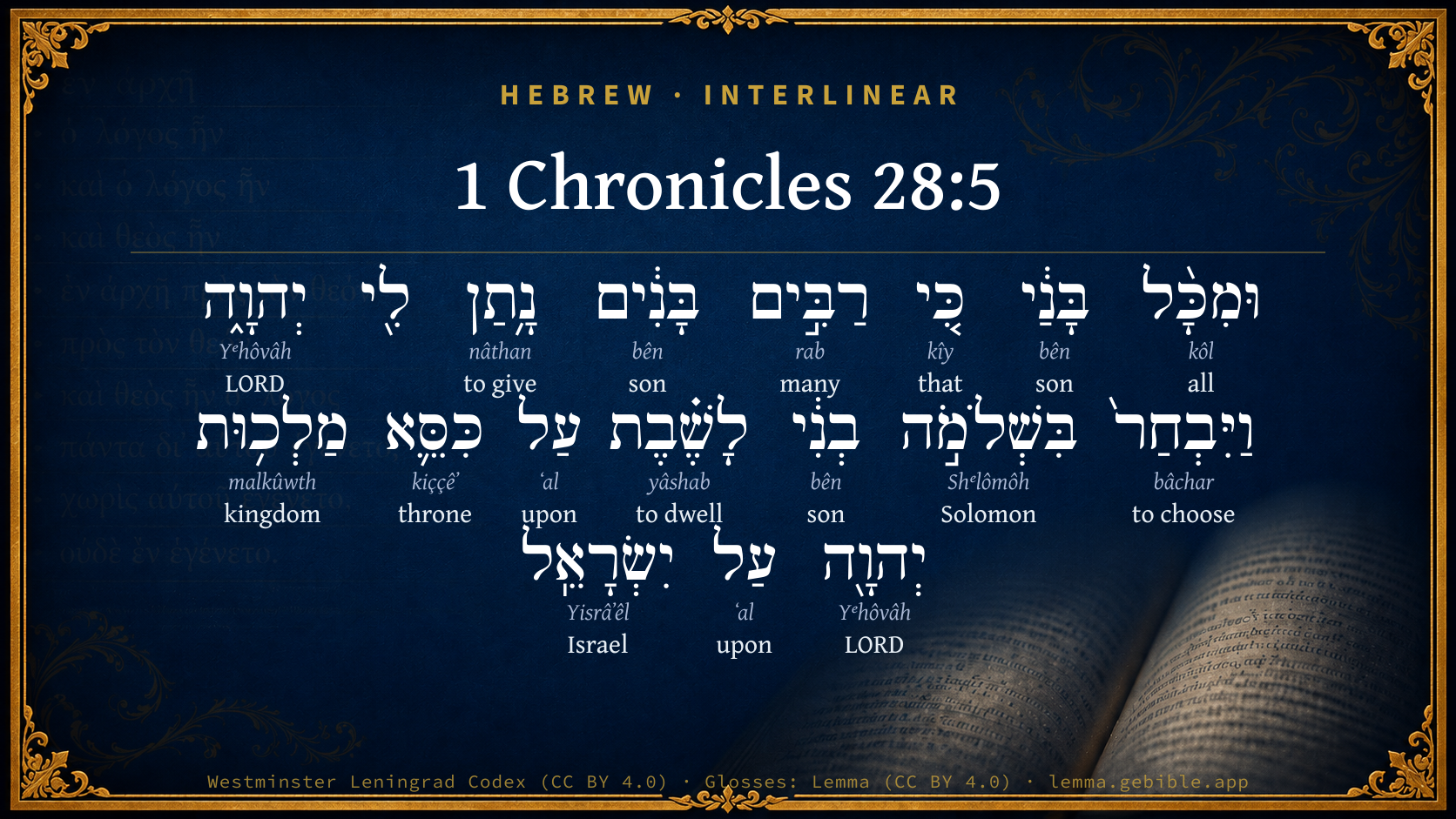
Hebrew (Westminster Leningrad Codex) 1 Chronicles 28:5 appears in the Hebrew Old Testament. The text above is from the Westminster Leningrad Codex. Each word links to its Strong’s number, a concise gloss, and parsing drawn from the Open Scriptures Hebrew Bible morphology. Click any word for its full Brown-Driver-Briggs (BDB) entry.
Download image
Cite this verse

1 Chronicles 28:5 (World English Bible). Public Domain. Lemma interlinear Bible study tool, https://lemma.gebible.app/v/1-chronicles/28/5.

Show BibTeX & RIS
BibTeX
RIS
English Translation
Of all my sons (for Yahweh has given me many sons), he has chosen Solomon my son to sit on the throne of the kingdom of Yahweh over Israel.
World English Bible · Public Domain
Download a study sheet

One document with this verse’s original text, its word-by-word gloss line, the meaning frame, cross-references with their text, attributed commentary, and full source and license credits — printable, and it pastes into notes with its structure intact.

This verse Autodidact and up

Study sheet (.html) Plain text (.txt)

A passage Seminary Student

Up to 50 verses in one chapter. A passage sheet keeps up to 6 commentary sources and 12 cross-references per verse, in the order this page ranks them, and says so on the sheet whenever that leaves anything out. Ask for a single verse and you get the Autodidact verse sheet above.

Everything on this page stays free to read, with no account — the sheet is a download of what is already on screen, not access to it.

Want to remove ads? Support Godless Engineer
Compare translations 3

The same verse in 3 English versions, stacked beneath the original-language interlinear above. Click any original word for its lexicon entry.

Each is an independent rendering of the whole verse — the interlinear is not word-aligned to these translations.

Highlighted words mark where these versions differ — a whole-verse word diff, not a word-by-word alignment.

  • World English Bible Public Domain
    Of all my sons (for Yahweh has given me many sons), he has chosen Solomon my son to sit on the throne of the kingdom of Yahweh over Israel.
  • King James Version Public Domain
    And of all my sons, (for the LORD hath given me many sons,) he hath chosen Solomon my son to sit upon the throne of the kingdom of the LORD over Israel.
  • unfoldingWord Literal Text CC BY-SA 4.0
    And from all of my sons—for Yahweh has given many sons to me—he then chose Solomon my son to sit on the throne of the kingdom of Yahweh over Israel.

unfoldingWord Literal Text — © unfoldingWord, licensed CC BY-SA 4.0. Word-aligned USFM3 via Door43 (git.door43.org/unfoldingWord/en_ult).

Versions to compare (up to 4)

3 of 4 selected

Show all 18 translations

Every available English version of this verse, each an independent rendering of the whole verse.

  • World English Bible Public Domain
    Of all my sons (for Yahweh has given me many sons), he has chosen Solomon my son to sit on the throne of the kingdom of Yahweh over Israel.
  • Berean Standard Bible Public Domain
    And of all my sons—for the LORD has given me many sons—He has chosen Solomon my son to sit on the throne of the kingdom of the LORD over Israel.
  • Majority Standard Bible Public Domain
    And of all my sons—for the LORD has given me many sons—He has chosen Solomon my son to sit on the throne of the kingdom of the LORD over Israel.
  • King James Version Public Domain
    And of all my sons, (for the LORD hath given me many sons,) he hath chosen Solomon my son to sit upon the throne of the kingdom of the LORD over Israel.
  • American Standard Version (1901) Public Domain
    And of all my sons (for Jehovah hath given me many sons), he hath chosen Solomon my son to sit upon the throne of the kingdom of Jehovah over Israel.
  • Revised Version (1885) Public Domain
    And of all my sons, (for the LORD hath given me many sons,) he hath chosen Solomon my son to sit upon the throne of the kingdom of the LORD over Israel.
  • Geneva Bible (1599) Public Domain
    So of all my sonnes (for the Lord hath giuen me many sonnes) he hath euen chosen Salomon my sonne to sit vpon the throne of the kingdome of the Lord ouer Israel.
  • Douay-Rheims (1899) Public Domain
    And among my sons (for the Lord hath given me many sons) he hath chosen Solomon my son, to sit upon the throne of the kingdom of the Lord over Israel.
  • Young's Literal Translation Public Domain
    and out of all my sons -- for many sons hath Jehovah given to me -- He also fixeth on Solomon my son, to sit on the throne of the kingdom of Jehovah over Israel,
  • Literal Standard Version CC BY-SA 4.0
    and out of all my sons—for YHWH has given many sons to me—He also fixes on my son Solomon, to sit on the throne of the kingdom of YHWH over Israel,
  • Unlocked Literal Bible CC BY-SA 4.0
    From the many sons whom Yahweh has given me, he chose Solomon, my son, to sit on the throne of the kingdom of Yahweh, over Israel.
  • unfoldingWord Literal Text CC BY-SA 4.0
    And from all of my sons—for Yahweh has given many sons to me—he then chose Solomon my son to sit on the throne of the kingdom of Yahweh over Israel.
  • Darby Bible Public Domain
    and of all my sons, (for Jehovah has given me many sons,) he has chosen Solomon my son to sit upon the throne of the kingdom of Jehovah over Israel.
  • World Messianic Bible Public Domain
    Of all my sons (for the LORD has given me many sons), he has chosen Solomon my son to sit on the throne of the LORD’s kingdom over Israel.
  • Webster's Bible Public Domain
    And of all my sons, (for the LORD hath given me many sons,) he hath chosen Solomon my son to sit upon the throne of the kingdom of the LORD over Israel.
  • Free Bible Version CC BY-SA 4.0
    From all my sons (for the Lord gave me many) the Lord has chosen Solomon my child to sit on the throne and to rule over the Lord's kingdom Israel.
  • Bible in Basic English Public Domain
    And of all my sons (for the Lord has given me a great number of sons) he has made selection of Solomon to take his place on the seat of the kingdom of the Lord over Israel.
  • JPS Tanakh (1917) Public Domain
    and of all my sons — for the LORD hath given me many sons — He hath chosen Solomon my son to sit upon the throne of the kingdom of the LORD over Israel.

Literal Standard Version (2020), Covenant Press — licensed CC BY-SA 4.0. Text via the HelloAO Bible API (eBible.org). Unlocked Literal Bible (unfoldingWord) — licensed CC BY-SA 4.0. Text via the HelloAO Bible API (eBible.org). unfoldingWord Literal Text — © unfoldingWord, licensed CC BY-SA 4.0. Word-aligned USFM3 via Door43 (git.door43.org/unfoldingWord/en_ult). Free Bible Version, Dr. Jonathan Gallagher — licensed CC BY-SA 4.0. Text via the HelloAO Bible API (eBible.org).

Word by word

More ways to search: Search by grammar → Find every occurrence → Compare this word →

Practice this passage: Drill this verse → Learn its vocabulary →

מַלְכ֥וּת
malkûwth
H4438
“kingdom of”
Noun, Common, Feminine, Singular, Construct
Part of Speech
Noun
Type
Common
Gender
Feminine
Number
Singular
State
Construct
Full BDB Definition

Origin: from H4427

TWOT: 1199e

royalty, royal power, reign, kingdom, sovereign power - royal power, dominion - reign - kingdom, realm
  1. וּמִכָּ֨ל kôl H3605 “and · from · all of” Conjunction + Preposition + Noun, Common, Masculine, Singular, Construct
  2. בָּנַ֔י bên H1121 “sons · my” Noun, Common, Masculine, Plural, Construct + Suffix, Personal, 1st Person, Common, Singular
  3. כִּ֚י kîy H3588 “that” Conjunction
  4. רַבִּ֣ים rab H7227 “many” Adjective, Adjective, Masculine, Plural, Absolute
  5. בָּנִ֔ים bên H1121 “sons” Noun, Common, Masculine, Plural, Absolute
  6. נָ֥תַן nâthan H5414 “to give” Verb, Qal, Perfect, 3rd Person, Masculine, Singular
  7. יְהוָ֑ה Yᵉhôvâh H3068 “LORD” Noun, Proper
  8. וַיִּבְחַר֙ bâchar H977 “and · to choose” Conjunction + Verb, Qal, Sequential Imperfect, 3rd Person, Masculine, Singular
  9. בִּשְׁלֹמֹ֣ה Shᵉlômôh H8010 “in/at · Solomon” Preposition + Noun, Proper
  10. בְנִ֔י bên H1121 “son · my” Noun, Common, Masculine, Singular, Construct + Suffix, Personal, 1st Person, Common, Singular
  11. לָשֶׁ֗בֶת yâshab H3427 “to dwell” Preposition + Verb, Qal, Infinitive Construct
  12. עַל ʻal H5921 “upon” Preposition
  13. כִּסֵּ֛א kiççêʼ H3678 “throne of” Noun, Common, Masculine, Singular, Construct
  14. יְהוָ֖ה Yᵉhôvâh H3068 “LORD” Noun, Proper
  15. עַל ʻal H5921 “upon” Preposition
  16. יִשְׂרָאֵֽל Yisrâʼêl H3478 “Israel” Noun, Proper

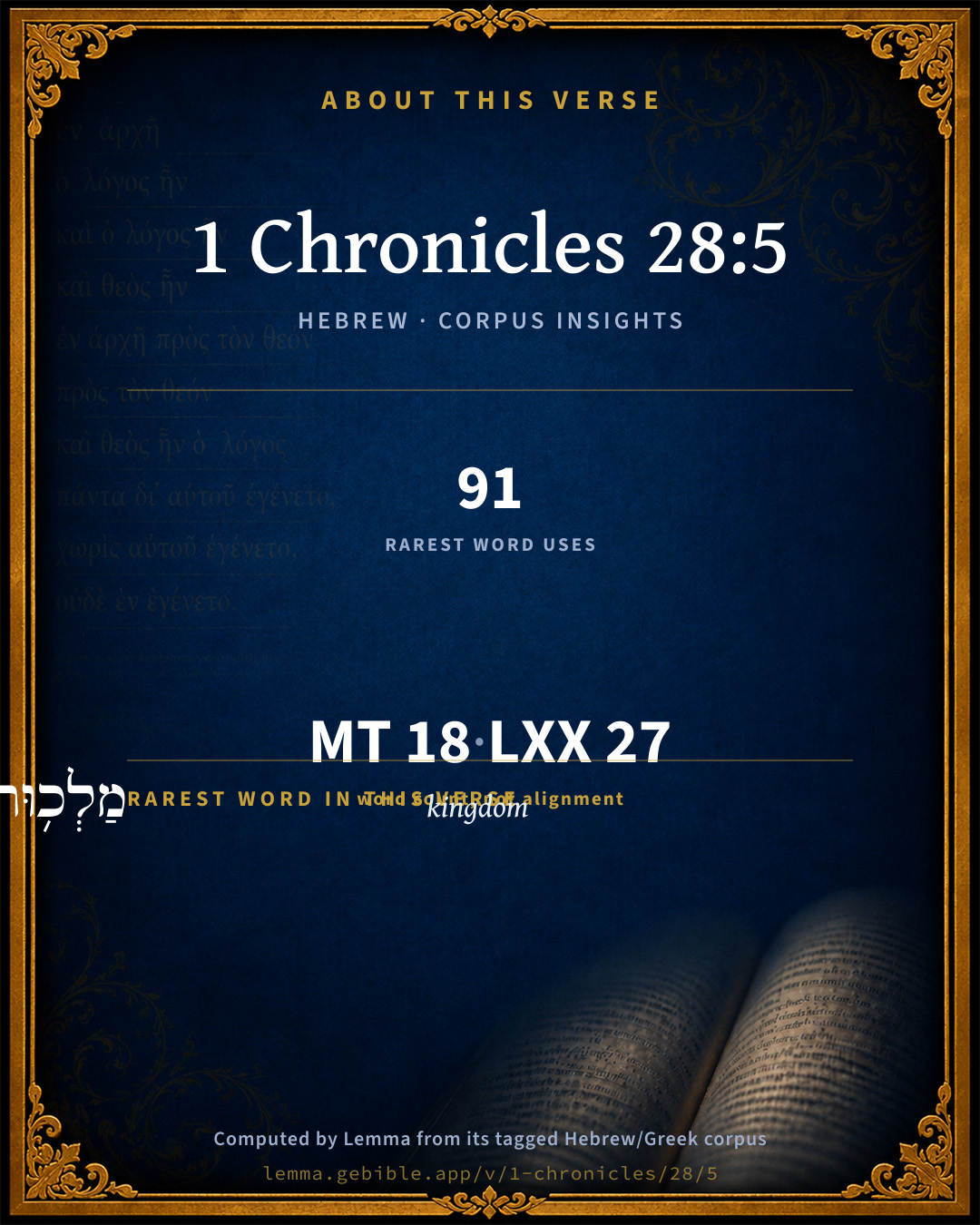
About this verse

These counts appear in no published source. They are computed here, from the morphology-tagged text and Lemma’s own curated glosses. What Lemma adds →

18
words
13
distinct lemmas
Historical
section

Grammatical profile

  • 3 verbs
  • 10 nouns
  • 1 adjective
  • 3 prepositions
  • 1 conjunction

Verb forms

  • נָ֥תַן Qal · Perfect
  • וַיִּבְחַר֙ Qal · Sequential Imperfect
  • לָשֶׁ֗בֶת Qal · Infinitive Construct

Repetition

Words recur within this verse — often emphatic in Hebrew:

  • בָּנַ֔י son H1121 ×3
  • יְהוָ֑ה LORD H3068 ×2
  • עַל upon H5921 ×2

Hebrew & Septuagint length

In English translation the verse runs 29 words from the Hebrew and 33 from the Septuagint (LXX English) — closely comparable.

A rough comparison of the two English renderings, which tokenize alike — not a word-level alignment.

Word counts can differ between the Hebrew and the Greek without any difference in meaning — e.g. the Hebrew direct-object marker אֵת has no separate Greek word, and Greek often adds the article ὁ.

In the original languages it is 18 Hebrew tokens and 27 Greek tokens — but the two are counted differently (Hebrew bundles its prefixes and suffixes into one token; the Greek is in lemma form), so that isn’t a like-for-like length.

Cross-references

10

Topical passages linked to 1 Chronicles 28:5 in the Treasury of Scripture Knowledge — connected by theme and wording, ordered by reader-vote popularity; previews shown in the World English Bible.

  • 1 Chronicles 3:1–9 Now these were the sons of David, who were born to him in Hebron: the firstborn, Amnon, of Ahinoam the Jezreelitess; the second, Daniel, of Abigail the Carmelitess;
  • 1 Chronicles 23:1 Now David was old and full of days; and he made Solomon his son king over Israel.
  • 1 Chronicles 22:9–10 Behold, a son shall be born to you, who shall be a man of rest; and I will give him rest from all his enemies round about; for his name shall be Solomon, and I will give peace and quietness to Israel in his days:
  • 1 Chronicles 14:3–7 David took more wives at Jerusalem; and David became the father of more sons and daughters.
  • 1 Chronicles 17:14 but I will settle him in my house and in my kingdom forever; and his throne shall be established forever.
  • 1 Chronicles 29:1 David the king said to all the assembly, Solomon my son, whom alone God has chosen, is yet young and tender, and the work is great; for the palace is not for man, but for Yahweh God.
  • 1 Chronicles 29:23 Then Solomon sat on the throne of Yahweh as king instead of David his father, and prospered; and all Israel obeyed him.
  • 2 Chronicles 1:8–9 Solomon said to God, You have shown great loving kindness to David my father, and have made me king in his place.
  • Psalms 72:1–20 God, give the king your justice; Your righteousness to the royal son.
  • Isaiah 9:6–7 For to us a child is born, to us a son is given; and the government shall be on his shoulder: and his name shall be called Wonderful, Counselor, Mighty God, Everlasting Father, Prince of Peace.

Cross-references courtesy of OpenBible.info (CC BY 4.0).

Hebrew and Greek witnesses Masoretic Hebrew ↔ Greek Septuagint

The same verse in the two great witnesses to the Old Testament, shown verse-for-verse.

These are two independent witnesses, not word-aligned to each other, and the Septuagint is shown in lemma (dictionary) form.

Hebrew 1 Chronicles 28:5 Masoretic · Westminster Leningrad Codex

וּמִכָּ֨ל בָּנַ֔י כִּ֚י רַבִּ֣ים בָּנִ֔ים נָ֥תַן לִ֖י יְהוָ֑ה וַיִּבְחַר֙ בִּשְׁלֹמֹ֣ה בְנִ֔י לָשֶׁ֗בֶת עַל כִּסֵּ֛א מַלְכ֥וּת יְהוָ֖ה עַל יִשְׂרָאֵֽל

Of all my sons (for Yahweh has given me many sons), he has chosen Solomon my son to sit on the throne of the kingdom of Yahweh over Israel.

World English Bible · Public Domain

Greek LXX 1 Chronicles 28:5 Septuagint · lemma form

καί ἀπό πᾶς ὁ υἱός ἐγώ ὅτι πολύς υἱός δίδωμι ἐγώ κύριος ἐκλέγω ἐν σαλωμών ὁ υἱός ἐγώ καταἵζω αὐτός ἐπί θρόνος βασιλεία κύριος ἐπί ὁ ἰσραήλ

And of all my sons, (for the Lord has given me many sons,) he has chosen Solomon my son, to set him on the throne of the kingdom of the Lord over Israel.

LXX2012 (modern English Septuagint) · Public Domain

Hebrew: Westminster Leningrad Codex (CC BY 4.0). Greek: Septuagint (public domain); English from LXX2012 (modern English Septuagint) (Public Domain). How the Septuagint differs from the Hebrew →

Commentary

Notes on 1 Chronicles 28:5 from classic Christian and Jewish commentators (each source and its license shown beneath its notes). The classic Christian expositions comment on the surrounding passage and are grouped to its opening verse, so a note may address several verses; the Jewish commentaries on the Tanakh (Rashi and others) are per-verse, so they appear only where the commentator wrote on this verse.

Lemma curates 59 commentaries, every one of them public domain or Creative Commons licensed, each selected and text-cleaned for this edition rather than reprinted as found. About our sources →

Trapp's Complete Commentary

John Trapp

1Ch 28:5 And of all my sons, (for the LORD hath given me many sons,) he hath chosen Solomon my son to sit upon the throne of the kingdom of the LORD over Israel.

Ver. 5. For the Lord hath given me many sorts.] Nineteen we read of {1Ch 3:1-9}

John Trapp, A Commentary or Exposition upon All the Books of the Old and New Testament (1647–1656) — public domain. Text from a community e-Sword module.

Ellicott's Commentary for English Readers

(5) Many sons.—See 1Ch_3:1-9, where nineteen are mentioned by name, “besides the sons of the concubines, and Tamar their sister.”

He hath chosen.—Heb., then he chose, the construction being changed after the parenthesis.

Solomon my son.—The son who has the best right to the name. (Comp. 1Ch_22:10.)

The throne of the kingdom of the Lord.—This expression is unique in the Old Testament. (Comp. 1Ch_29:23; 1Ch_17:14.) It brings out into strong relief the idea that the Israelite monarchy was only a vicegerency; not David nor Solomon, but Jehovah being the true and only King. (Comp. Gideon’s reply to the offer of the crown, Jdg_8:23; 1Sa_8:7; 1Sa_12:12.)

A Bible Commentary for English Readers, edited by Charles John Ellicott (1878–1897) — public domain. Text from a community e-Sword module.

The Cambridge Bible for Schools and Colleges

gen. ed. J. J. S. Perowne

5. many sons] Cp. 1Ch_3:1-9.

he hath chosen Solomon] The earlier histories (Samuel, Kings) do not say that God chose Solomon as David’s successor; but compare 2Sa_12:24-25; 1Ki_1:11-14.

the throne of the kingdom of the Lord] Cp. 1Ch_29:23, the throne of the Lord. The Chronicler speaks as one who regards the king as the deputy of the Lord.

The Cambridge Bible for Schools and Colleges (gen. ed. J. J. S. Perowne; Cambridge University Press, 1878–1918) — public domain. Text from a community e-Sword module.

John Gill's Exposition

And of all my sons, for the Lord hath given me many sons,.... Whose names, and the order of their birth, may be read in Ch1 3:1.

he hath chosen Solomon my son to sit upon the throne of the kingdom of the Lord over Israel; to be his successor in it: this he says to observe to them, that this was not merely his own will and choice, nor the fruit and effect of a fond affection to Solomon; nor was it barely in pursuance of a promise made to Bathsheba, she had obtained of him; but it was according to the will and appointment of God, and therefore to be the more regarded.

John Gill's Exposition of the Whole Bible (1746–1763) — public domain (CC PDM 1.0). Text via the HelloAO Bible API.

Haydock's Catholic Bible Commentary

My son, by the mouth of Nathan, 2 Kings vii. 13. (Menochius) --- Solomon was a figure of Christ, and his dignity was predicted, chap. xvii. 11., and 3 Kings i. 13. (Calmet)

George Leo Haydock (1774–1849), Haydock's Catholic Family Bible and Commentary, 1859 edition — public domain. Excludes Psalms (Douay-Rheims chapter numbering differs from Protestant) and Deuterocanonical books (Catholic canon only).

Matthew Poole's English Annotations

It is not my fancy or fond affection, but God’s express will, that Solomon should be preferred before his elder brethren; and therefore all of you are obliged to submit to him, and accept of him as your king by Divine appointment.

Matthew Poole's English Annotations on the Holy Bible (1683–1685) — public domain. Text from a community e-Sword/MySword module.

Keil & Delitzsch

C. F. Keil & F. Delitzsch

And of all my sons, for the Lord hath given me many sons,.... Whose names, and the order of their birth, may be read in Ch1 3:1.

he hath chosen Solomon my son to sit upon the throne of the kingdom of the Lord over Israel; to be his successor in it: this he says to observe to them, that this was not merely his own will and choice, nor the fruit and effect of a fond affection to Solomon; nor was it barely in pursuance of a promise made to Bathsheba, she had obtained of him; but it was according to the will and appointment of God, and therefore to be the more regarded.

Keil & Delitzsch — Biblical Commentary on the Old Testament (1861–1891) — public domain (CC PDM 1.0). Text via the HelloAO Bible API. (Old Testament only.)

Lesson kit

Teaching starters — assembled from the data on this page, not authored interpretation. Every prompt links to the verse data it draws on. Edit before teaching.

1 Chronicles, in the Historical, opens this verse with 18 words (13 distinct Hebrew lemmas). Its most distinctive word is malkûwth (“kingdom”). A historical commentator’s framing appears above. Read the whole chapter for the surrounding context.

Discussion questions

  1. How does “kingdom” (malkûwth) shape what this verse is saying?
  2. 1 Chronicles 3:1–9 shares this passage’s theme. How do the two illuminate each other?
  3. “son” occurs 3× in this one verse. What is the effect of the repetition?
  4. These translations render this verse differently; the difference is in the English rendering, not the original. What questions does that raise?
  5. The verb «נָ֥תַן» is Qal Perfect. How does its form color the action?
  6. Reading how Trapp's Complete Commentary and Ellicott's Commentary for English Readers read this verse, where do the two commentators agree and where do they part?

Things to notice

Reading settings

Reading text

Shown beneath each verse's original-language words.

Old Testament
Old Testament edition

Read the OT as the Masoretic Hebrew (MT) or the Greek Septuagint (LXX).

English shown for the Greek Septuagint (in the Hebrew ↔ Greek comparison).

Comparing translations? Open the Compare panel on any verse page to stack up to four side by side.