
Job 11:19

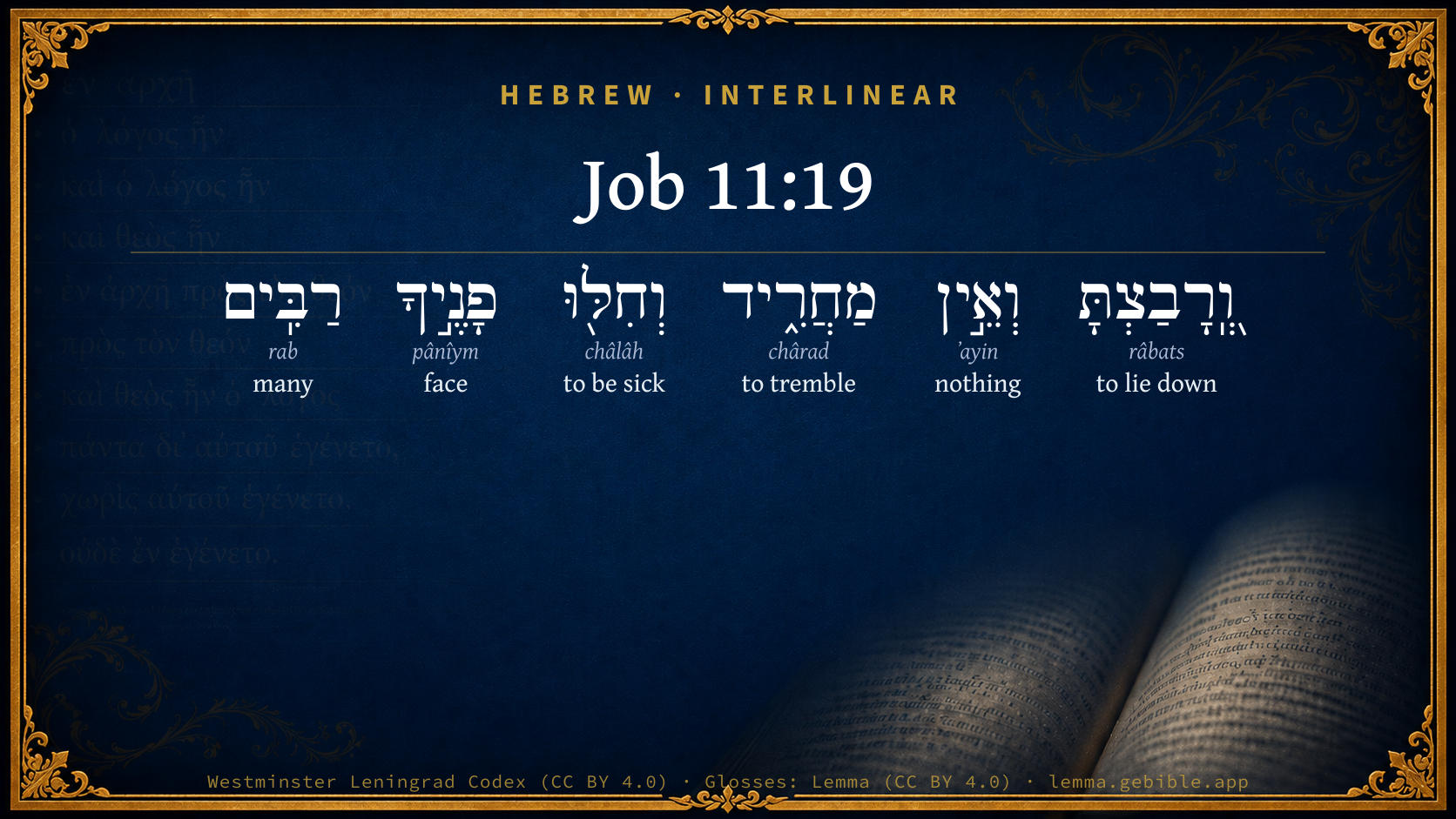
Hebrew (Westminster Leningrad Codex) Job 11:19 appears in the Hebrew Old Testament. The text above is from the Westminster Leningrad Codex. Each word links to its Strong’s number, a concise gloss, and parsing drawn from the Open Scriptures Hebrew Bible morphology. Click any word for its full Brown-Driver-Briggs (BDB) entry.
Download image
Cite this verse

Job 11:19 (World English Bible). Public Domain. Lemma interlinear Bible study tool, https://lemma.gebible.app/v/job/11/19.

Show BibTeX & RIS
BibTeX
RIS
English Translation
Also you shall lie down, and none shall make you afraid; Yes, many shall court your favor.
World English Bible · Public Domain
Download a study sheet

One document with this verse’s original text, its word-by-word gloss line, the meaning frame, cross-references with their text, attributed commentary, and full source and license credits — printable, and it pastes into notes with its structure intact.

This verse Autodidact and up

Study sheet (.html) Plain text (.txt)

A passage Seminary Student

Up to 50 verses in one chapter. A passage sheet keeps up to 6 commentary sources and 12 cross-references per verse, in the order this page ranks them, and says so on the sheet whenever that leaves anything out. Ask for a single verse and you get the Autodidact verse sheet above.

Everything on this page stays free to read, with no account — the sheet is a download of what is already on screen, not access to it.

Want to remove ads? Support Godless Engineer
Compare translations 3

The same verse in 3 English versions, stacked beneath the original-language interlinear above. Click any original word for its lexicon entry.

Each is an independent rendering of the whole verse — the interlinear is not word-aligned to these translations.

Highlighted words mark where these versions differ — a whole-verse word diff, not a word-by-word alignment.

  • World English Bible Public Domain
    Also you shall lie down, and none shall make you afraid; Yes, many shall court your favor.
  • King James Version Public Domain
    Also thou shalt lie down, and none shall make thee afraid; yea, many shall make suit unto thee.
  • unfoldingWord Literal Text CC BY-SA 4.0
    Yes, you will recline and no one making afraid, and many will stroke your face.

unfoldingWord Literal Text — © unfoldingWord, licensed CC BY-SA 4.0. Word-aligned USFM3 via Door43 (git.door43.org/unfoldingWord/en_ult).

Versions to compare (up to 4)

3 of 4 selected

Show all 18 translations

Every available English version of this verse, each an independent rendering of the whole verse.

  • World English Bible Public Domain
    Also you shall lie down, and none shall make you afraid; Yes, many shall court your favor.
  • Berean Standard Bible Public Domain
    You will lie down without fear, and many will court your favor.
  • Majority Standard Bible Public Domain
    You will lie down without fear, and many will court your favor.
  • King James Version Public Domain
    Also thou shalt lie down, and none shall make thee afraid; yea, many shall make suit unto thee.
  • American Standard Version (1901) Public Domain
    Also thou shalt lie down, and none shall make thee afraid; Yea, many shall make suit unto thee.
  • Revised Version (1885) Public Domain
    Also thou shalt lie down, and none shall make thee afraid; yea, many shall make suit unto thee.
  • Geneva Bible (1599) Public Domain
    For when thou takest thy rest, none shall make thee afraide: yea, many shall make sute vnto thee.
  • Douay-Rheims (1899) Public Domain
    Thou shalt rest, and there shall be none to make thee afraid: and many shall entreat thy face.
  • Young's Literal Translation Public Domain
    And thou hast rested, And none is causing trembling, And many have entreated thy face;
  • Literal Standard Version CC BY-SA 4.0
    And you have rested, || And none is causing trembling, || And many have begged [at] your face;
  • Unlocked Literal Bible CC BY-SA 4.0
    Also you would lie down in rest, and none would make you afraid; indeed, many would seek your favor.
  • unfoldingWord Literal Text CC BY-SA 4.0
    Yes, you will recline and no one making afraid, and many will stroke your face.
  • Darby Bible Public Domain
    Yea, thou shalt lie down, and none shall make thee afraid; and many shall seek thy favour.
  • World Messianic Bible Public Domain
    Also you will lie down, and no one will make you afraid. Yes, many will court your favor.
  • Webster's Bible Public Domain
    Also thou shalt lie down, and none shall make thee afraid; yes, many shall make suit to thee.
  • Free Bible Version CC BY-SA 4.0
    You will lie down to sleep with no one to frighten you, and many will come asking for your favor.
  • Bible in Basic English Public Domain
    Sleeping with no fear of danger; and men will be desiring to have grace in your eyes;
  • JPS Tanakh (1917) Public Domain
    Also thou shalt lie down, and none shall make thee afraid; yea, many shall make suit unto thee.

Literal Standard Version (2020), Covenant Press — licensed CC BY-SA 4.0. Text via the HelloAO Bible API (eBible.org). Unlocked Literal Bible (unfoldingWord) — licensed CC BY-SA 4.0. Text via the HelloAO Bible API (eBible.org). unfoldingWord Literal Text — © unfoldingWord, licensed CC BY-SA 4.0. Word-aligned USFM3 via Door43 (git.door43.org/unfoldingWord/en_ult). Free Bible Version, Dr. Jonathan Gallagher — licensed CC BY-SA 4.0. Text via the HelloAO Bible API (eBible.org).

Word by word

More ways to search: Search by grammar → Find every occurrence → Compare this word →

Practice this passage: Drill this verse → Learn its vocabulary →

About this verse

These counts appear in no published source. They are computed here, from the morphology-tagged text and Lemma’s own curated glosses. What Lemma adds →

6
words
6
distinct lemmas
Wisdom
section

Shared distinctive vocabulary

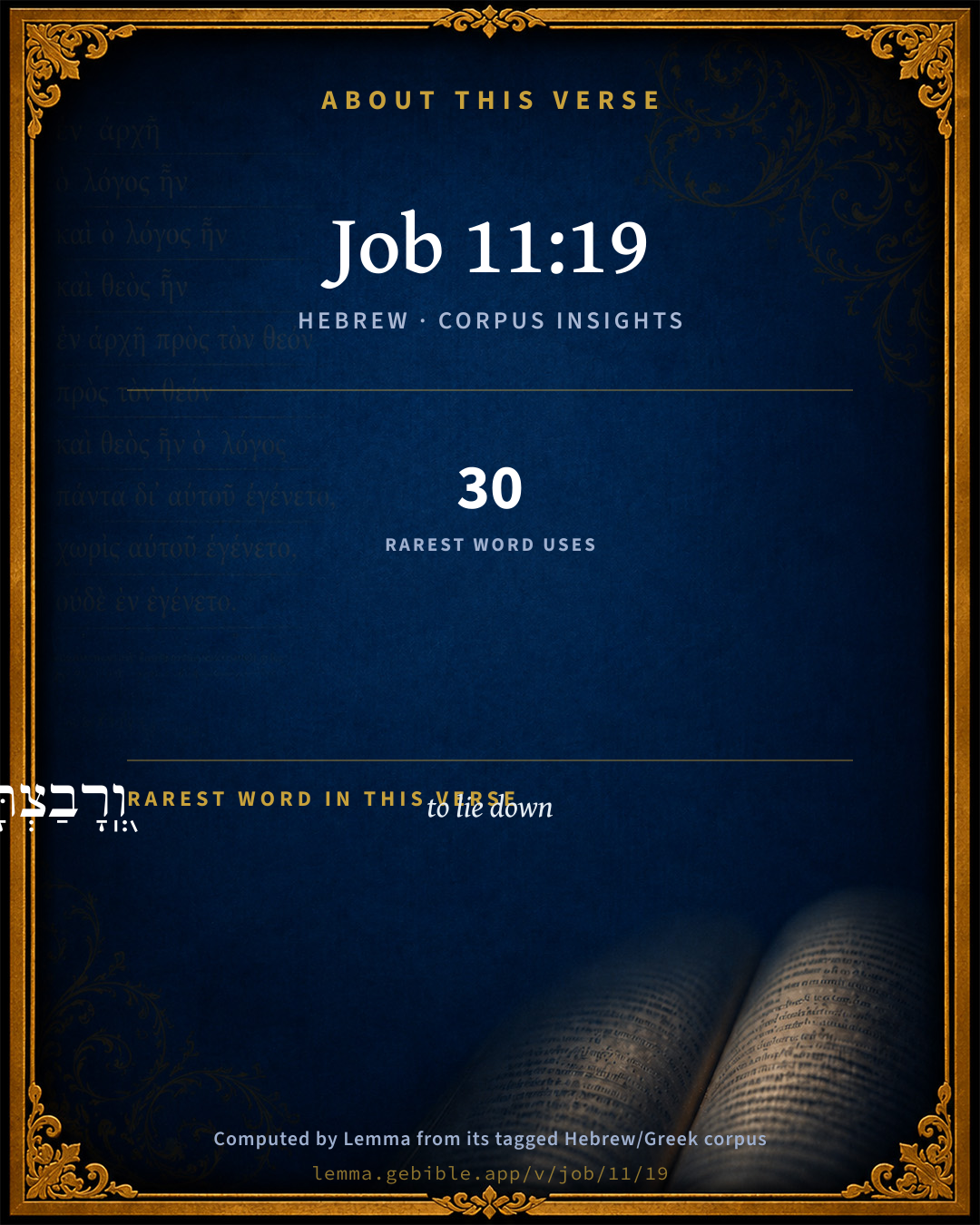
וְֽ֭רָבַצְתָּ to lie down H7257 occurs in 30 verses of the Hebrew Bible. Also found in:

Grammatical profile

  • 3 verbs
  • 1 noun
  • 1 adjective
  • 1 particle

Verb forms

  • וְֽ֭רָבַצְתָּ Qal · Sequential Perfect
  • מַחֲרִ֑יד Hiphil · Participle Active
  • וְחִלּ֖וּ Piel · Sequential Perfect

Hebrew & Septuagint length

In English translation the verse runs 17 words from the Hebrew and 25 from the Septuagint (LXX English) — the Septuagint runs noticeably longer here. See the side-by-side →

A rough comparison of the two English renderings, which tokenize alike — not a word-level alignment.

Word counts can differ between the Hebrew and the Greek without any difference in meaning — e.g. the Hebrew direct-object marker אֵת has no separate Greek word, and Greek often adds the article ὁ.

Cross-references

8

Topical passages linked to Job 11:19 in the Treasury of Scripture Knowledge — connected by theme and wording, ordered by reader-vote popularity; previews shown in the World English Bible.

  • Isaiah 60:14 The sons of those who afflicted you shall come bending to you; and all those who despised you shall bow themselves down at the soles of your feet; and they shall call you The city of Yahweh, The Zion of the Holy One of Israel.
  • Leviticus 26:6 "'I will give peace in the land, and you shall lie down, and no one will make you afraid; and I will remove evil animals out of the land, neither shall the sword go through your land.
  • Psalms 45:12 The daughter of Tyre comes with a gift. The rich among the people entreat your favor.
  • Isaiah 45:14 Thus says Yahweh: "The labor of Egypt, and the merchandise of Ethiopia, and the Sabeans, men of stature, shall come over to you, and they shall be yours. They shall go after you. In chains they shall come over; and they shall fall down to you. They shall make supplication to you: 'Surely God is in you; and there is none else, there is no other god.
  • Job 42:8–9 Now therefore, take to yourselves seven bulls and seven rams, and go to my servant Job, and offer up for yourselves a burnt offering; and my servant Job shall pray for you, for I will accept him, that I not deal with you according to your folly. For you have not spoken of me the thing that is right, as my servant Job has."
  • Proverbs 19:6 Many will entreat the favor of a ruler, And everyone is a friend to a man who gives gifts.
  • Revelation 3:9 Behold, I give of the synagogue of Satan, of those who say they are Jews, and they are not, but lie. Behold, I will make them to come and worship before your feet, and to know that I have loved you.
  • Genesis 26:26–31 Then Abimelech went to him from Gerar, and Ahuzzath his friend, and Phicol the captain of his host.

Cross-references courtesy of OpenBible.info (CC BY 4.0).

Hebrew and Greek witnesses Masoretic Hebrew ↔ Greek Septuagint

The same verse in the two great witnesses to the Old Testament, shown verse-for-verse.

Here the Septuagint runs noticeably longer than the Hebrew — LXX2012 (modern English Septuagint) 25 words vs World English Bible 17. A rough length comparison of the two English translations, not a word-level alignment — read both below.

These are two independent witnesses, not word-aligned to each other, and the Septuagint is shown in lemma (dictionary) form.

Hebrew Job 11:19 Masoretic · Westminster Leningrad Codex

וְֽ֭רָבַצְתָּ וְאֵ֣ין מַחֲרִ֑יד וְחִלּ֖וּ פָנֶ֣יךָ רַבִּֽים

Also you shall lie down, and none shall make you afraid; Yes, many shall court your favor.

World English Bible · Public Domain

Greek LXX Job 11:19 Septuagint · lemma form

ἡσυχάζω γάρ καί οὐ εἰμί ὁ πολεμέω σύ μεταβάλλω δέ πολύς σύ δέω

For you shall be at ease, and there shall be no one to fight against you; and many shall charge, and make supplication to you.

LXX2012 (modern English Septuagint) · Public Domain

Hebrew: Westminster Leningrad Codex (CC BY 4.0). Greek: Septuagint (public domain); English from LXX2012 (modern English Septuagint) (Public Domain). How the Septuagint differs from the Hebrew →

Commentary

Notes on Job 11:19 from classic Christian and Jewish commentators (each source and its license shown beneath its notes). The classic Christian expositions comment on the surrounding passage and are grouped to its opening verse, so a note may address several verses; the Jewish commentaries on the Tanakh (Rashi and others) are per-verse, so they appear only where the commentator wrote on this verse.

Lemma curates 59 commentaries, every one of them public domain or Creative Commons licensed, each selected and text-cleaned for this edition rather than reprinted as found. About our sources →

The Cambridge Bible for Schools and Colleges

gen. ed. J. J. S. Perowne

19. make suit unto thee] The phrase means literally: shall stroke thy face, i. e. supplicate or flatter thee. Pro_19:6; Psa_45:12.

The picture which Zophar draws of Job’s restored prosperity is beautiful. (1) Trouble shall be forgotten, or remembered as waters that are passed away; and the memory of a past trouble that cannot recur but makes the present happiness greater (Job_11:16). (2) And the future shall rise brighter than noon, or, it may be, shall increase towards brightness more than the noon does, shewing an ever-growing clearness; and if it be at any time clouded, as in any life however clear there are clouds, the darkness shall only be a lesser light like that of the morning; or as the words may mean, the darkness shall only be like the fixed changes of nature and shall give place like the night to a fair and hopeful morning (Job_11:17). (3) Thus restored to the fixed order of a life with God he shall be trustful because there is hope, and he shall look about, surveying all things, and finding nothing to dread shall lie down in confidence (Job_11:18); and when lain down he shall rest peacefully. (4) And his security and prosperity shall draw to him the homage of many, who (as before) shall seek his favour (Job_11:19).

The Cambridge Bible for Schools and Colleges (gen. ed. J. J. S. Perowne; Cambridge University Press, 1878–1918) — public domain. Text from a community e-Sword module.

Trapp's Complete Commentary

John Trapp

Job 11:19 Also thou shalt lie down, and none shall make [thee] afraid; yea, many shall make suit unto thee.

Ver. 19. Thou shalt lie down, and none shall make thee afraid] Thou shalt walk about the world like a conqueror, being ever under a double guard, the peace of God within thee, Php 4:7, and the power of God without thee, 1Pe 1:5, neither shall any enemy come upon thee in the night to fright and to disturb thee, which is a great mercy. It is not long since we of this nation did eat the bread of our souls in peril of our lives, neither could we rest in our beds for the sound of the trumpet, the alarm of war. Destruction upon destruction was cried, &c., Jer 4:19-20. Should this ever be forgotten?

Yea, many shall make suit unto thee] Heb. Shall entreat thy face; yea, they shall tire thee out with their entreaties. Many seek the ruler’s favour, Pro 29:26, he is even thronged with suitors, so that he cannot be without a master of requests. Hence the poet Orpheus feigneth that Litae , or supplications and petitions, are Jove’s daughters; and that they are ever attending at his throne, ου γαρ ατιμοι ικεσιου Zηνος κουραι λιται (Orph. in Arg.). Here then Zophar promiseth Job, that upon his return to God he shall be as great a man as ever; and that many, yea, that his very enemies, shall not only not molest him, but fear his power, and beg his favour, Jer 30:17. And whereas once it was, This is Job whom no man seeketh after, then the rich among the people shall entreat thy favour, Psa 45:12, and all that despised thee shall bow themselves down at the soles of thy feet, Isa 60:14; Isa 45:14 Rev 3:9 Pro 19:6. Lo, this is the honour God putteth upon holiness: "Holy and reverend is his name"; and therefore reverend because holy, Psa 111:9 : so also is ours, Isa 43:4. Howbeit we have cause to complain, that in these last and worst times, as the Turks count all fools to be saints, so men with us account all saints to be fools; and not a few turn to unholiness, lest they should be despised, Omnes quodammodo mali esse coguntur, ne viles habeantur (Sal.).

John Trapp, A Commentary or Exposition upon All the Books of the Old and New Testament (1647–1656) — public domain. Text from a community e-Sword module.

Jamieson, Fausset & Brown

Robert Jamieson, A. R. Fausset & David Brown

(Psa 4:8; Pro 3:24; Isa 14:30); oriental images of prosperity.

make suit--literally, "stroke thy face," "caress thee" (Pro 19:6).

Jamieson, Fausset & Brown — Commentary Critical and Explanatory on the Whole Bible (1871) — public domain (CC PDM 1.0). Text via the HelloAO Bible API.

John Gill's Exposition

Also thou shall lie down, and none shall make thee afraid,.... Either lie down on his bed, as before, or by his flocks, and where they lie down, and none should disturb him or them; not thieves and robbers, such as the Chaldeans and Sabeans had been to him, nor lions, bears, and wolves;

yea, many shall make suit unto thee; make their supplications, present their requests and petitions for relief under necessitous circumstances, or for protection from the injuries and insults of others; as the poor and needy, the widow and fatherless, had done to him in times past, when in his prosperity, and when he was a friend unto them, and the father of them; see Pro 19:6; or, "the great ones (z) shall make suit to thee"; to have his favour and friendship, his counsel and advice, his company and conversation; he should be applied unto and courted by men of all sorts, which would be no small honour to him; see Psa 45:12.

(z) "magnates", Vatablus, Bolducius.

John Gill's Exposition of the Whole Bible (1746–1763) — public domain (CC PDM 1.0). Text via the HelloAO Bible API.

Albert Barnes' Notes on the Bible

Many shall make suit unto thee - Many shall come in a suppliant manner to ask counsel and advice. The meaning is, that he would be a man of distinction, to whom many would look for counsel. This was evidently an honor highly valued in the East, and one on which Job had formerly pridcd himself; see Job 29:7-13.

Albert Barnes' Notes on the Bible (1834–1885) — public domain. Text from a community e-Sword/MySword module.

Haydock's Catholic Bible Commentary

Face. Luther translates "shall flatter thee." The Dutch version, which is taken from Luther’s, has mistaken a letter, and rendered "shall flee before thee," which shews the danger of translating without recurring to the originals. (Amama)

George Leo Haydock (1774–1849), Haydock's Catholic Family Bible and Commentary, 1859 edition — public domain. Excludes Psalms (Douay-Rheims chapter numbering differs from Protestant) and Deuterocanonical books (Catholic canon only).

Matthew Poole's English Annotations

Desiring thy favour and friendship, because of thy great power, and riches, and eminent felicity: see Gen 26:26, &c.

Matthew Poole's English Annotations on the Holy Bible (1683–1685) — public domain. Text from a community e-Sword/MySword module.

Whedon's Commentary on the Bible

Daniel D. Whedon

19. Lie down — The image is Oriental, and is derived from flocks or herds in a state of repose. (Psa_23:2.)

Make suit unto thee — Literally, stroke thy face, that is, caress thee; (Pro_19:6;) hence, to entreat the favour of one. It is commonly used of the worship of God, and besides, only of the respect paid to men high in position.

Daniel D. Whedon (gen. ed.), Commentary on the Old and New Testaments (1874–1909) — public domain. Text from a community e-Sword module.

The Pulpit Commentary

Also thou shalt lie down, and none shall make thee afraid; i.e. there shall be no more raids on the part of Sabeans (Job_1:15) or Chaldeans (Job_1:17) to affright and injure thee. Yea, many shall make suit unto thee. On the contrary, thy aid shall be invoked, thy interference on their behalf prayed for, by many.

The Pulpit Commentary (1880–1919), ed. H.D.M. Spence-Jones & Joseph S. Exell — public domain. Text from a community e-Sword module.

Lesson kit

Teaching starters — assembled from the data on this page, not authored interpretation. Every prompt links to the verse data it draws on. Edit before teaching.

Job, in the Wisdom, opens this verse with 6 words (6 distinct Hebrew lemmas). Its most distinctive word is râbats (“to lie down”). The Greek Septuagint runs longer here. A historical commentator’s framing appears above. Read the whole chapter for the surrounding context.

Discussion questions

  1. What does “to lie down” (râbats) contribute to the verse as a whole?
  2. How does Genesis 4:7, which shares the word «to lie down», read alongside this verse?
  3. The Septuagint runs longer here than the Hebrew. What might account for the difference?
  4. These translations render this verse differently. What is at stake in choosing one wording over another?
  5. «וְֽ֭רָבַצְתָּ» is a Qal Sequential Perfect verb. How does that grammatical form shape the action described?
  6. Compare how The Cambridge Bible for Schools and Colleges and Trapp's Complete Commentary read this verse. Where do they agree or differ?

Things to notice

Reading settings

Reading text

Shown beneath each verse's original-language words.

Old Testament
Old Testament edition

Read the OT as the Masoretic Hebrew (MT) or the Greek Septuagint (LXX).

English shown for the Greek Septuagint (in the Hebrew ↔ Greek comparison).

Comparing translations? Open the Compare panel on any verse page to stack up to four side by side.