Joshua 22:3

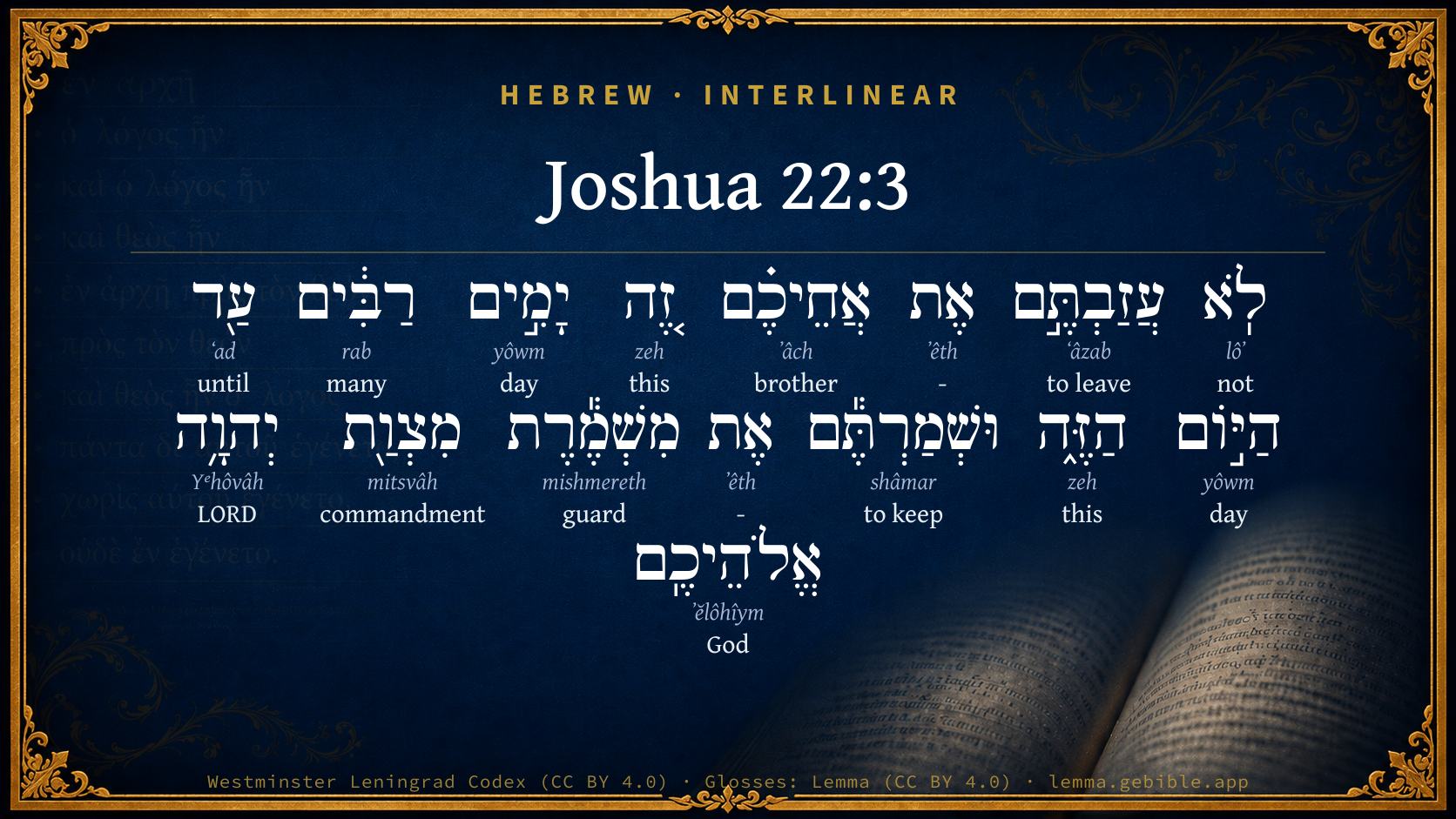
Hebrew (Westminster Leningrad Codex) Joshua 22:3 appears in the Hebrew Old Testament. The text above is from the Westminster Leningrad Codex. Each word links to its Strong’s number, a concise gloss, and parsing drawn from the Open Scriptures Hebrew Bible morphology. Click any word for its full Brown-Driver-Briggs (BDB) entry.
Download image
Cite this verse

Joshua 22:3 (World English Bible). Public Domain. Lemma interlinear Bible study tool, https://lemma.gebible.app/v/joshua/22/3.

Show BibTeX & RIS
BibTeX
RIS
English Translation
you have not left your brothers these many days to this day, but have kept the charge of the commandment of Yahweh your God.
World English Bible · Public Domain
Download a study sheet

One document with this verse’s original text, its word-by-word gloss line, the meaning frame, cross-references with their text, attributed commentary, and full source and license credits — printable, and it pastes into notes with its structure intact.

This verse Autodidact and up

Study sheet (.html) Plain text (.txt)

A passage Seminary Student

Up to 50 verses in one chapter. A passage sheet keeps up to 6 commentary sources and 12 cross-references per verse, in the order this page ranks them, and says so on the sheet whenever that leaves anything out. Ask for a single verse and you get the Autodidact verse sheet above.

Everything on this page stays free to read, with no account — the sheet is a download of what is already on screen, not access to it.

Want to remove ads? Support Godless Engineer
Compare translations 3

The same verse in 3 English versions, stacked beneath the original-language interlinear above. Click any original word for its lexicon entry.

Each is an independent rendering of the whole verse — the interlinear is not word-aligned to these translations.

Highlighted words mark where these versions differ — a whole-verse word diff, not a word-by-word alignment.

  • World English Bible Public Domain
    you have not left your brothers these many days to this day, but have kept the charge of the commandment of Yahweh your God.
  • King James Version Public Domain
    Ye have not left your brethren these many days unto this day, but have kept the charge of the commandment of the LORD your God.
  • unfoldingWord Literal Text CC BY-SA 4.0
    You have not forsaken your brothers these many days, to this day. But you have kept the keeping of the commandments of Yahweh your God.

unfoldingWord Literal Text — © unfoldingWord, licensed CC BY-SA 4.0. Word-aligned USFM3 via Door43 (git.door43.org/unfoldingWord/en_ult).

Versions to compare (up to 4)

3 of 4 selected

Show all 18 translations

Every available English version of this verse, each an independent rendering of the whole verse.

  • World English Bible Public Domain
    you have not left your brothers these many days to this day, but have kept the charge of the commandment of Yahweh your God.
  • Berean Standard Bible Public Domain
    All this time you have not deserted your brothers, up to this very day, but have kept the charge given you by the LORD your God.
  • Majority Standard Bible Public Domain
    All this time you have not deserted your brothers, up to this very day, but have kept the charge given you by the LORD your God.
  • King James Version Public Domain
    Ye have not left your brethren these many days unto this day, but have kept the charge of the commandment of the LORD your God.
  • American Standard Version (1901) Public Domain
    ye have not left your brethren these many days unto this day, but have kept the charge of the commandment of Jehovah your God.
  • Revised Version (1885) Public Domain
    ye have not left your brethren these many days unto this day, but have kept the charge of the commandment of the LORD your God.
  • Geneva Bible (1599) Public Domain
    You haue not forsaken your brethren this long season vnto this day, but haue diligently kept the commandement of the Lord your God.
  • Douay-Rheims (1899) Public Domain
    Neither have you left your brethren this long time, until this present day, keeping the commandment of the Lord your God.
  • Young's Literal Translation Public Domain
    ye have not left your brethren these many days unto this day, and have kept the charge -- the command of Jehovah your God.
  • Literal Standard Version CC BY-SA 4.0
    you have not left your brothers these many days to this day, and have kept the charge—the command of your God YHWH.
  • Unlocked Literal Bible CC BY-SA 4.0
    You have not deserted your brothers these many days, down to this present day, and you have fulfilled the duties required by the commandments of Yahweh your God.
  • unfoldingWord Literal Text CC BY-SA 4.0
    You have not forsaken your brothers these many days, to this day. But you have kept the keeping of the commandments of Yahweh your God.
  • Darby Bible Public Domain
    Ye have not left your brethren these many days unto this day, and ye have kept the charge of the commandment of Jehovah your God.
  • World Messianic Bible Public Domain
    You have not left your brothers these many days to this day, but have performed the duty of the commandment of the LORD your God.
  • Webster's Bible Public Domain
    Ye have not left your brethren these many days to this day, but have kept the charge of the commandment of the LORD your God.
  • Free Bible Version CC BY-SA 4.0
    You have never abandoned your brothers all this time, right up to the present day. You have carefully followed what the Lord your God ordered you to do.
  • Bible in Basic English Public Domain
    You have now been with your brothers for a long time; till this day you have been doing the orders of the Lord your God.
  • JPS Tanakh (1917) Public Domain
    ye have not left your brethren these many days unto this day, but have kept the charge of the commandment of the LORD your God.

Literal Standard Version (2020), Covenant Press — licensed CC BY-SA 4.0. Text via the HelloAO Bible API (eBible.org). Unlocked Literal Bible (unfoldingWord) — licensed CC BY-SA 4.0. Text via the HelloAO Bible API (eBible.org). unfoldingWord Literal Text — © unfoldingWord, licensed CC BY-SA 4.0. Word-aligned USFM3 via Door43 (git.door43.org/unfoldingWord/en_ult). Free Bible Version, Dr. Jonathan Gallagher — licensed CC BY-SA 4.0. Text via the HelloAO Bible API (eBible.org).

Word by word

More ways to search: Search by grammar → Find every occurrence → Compare this word →

Practice this passage: Drill this verse → Learn its vocabulary →

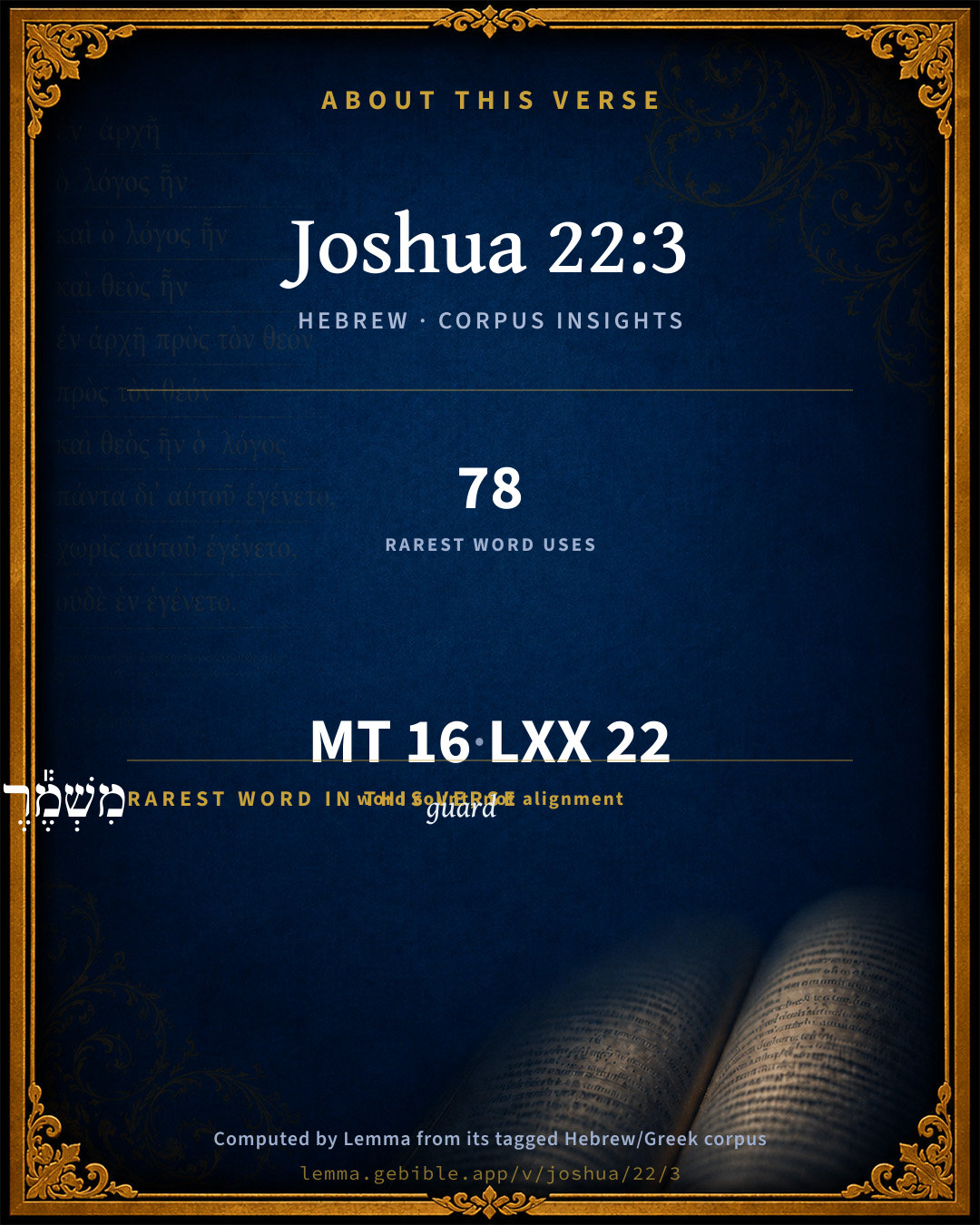
מִשְׁמֶ֕רֶת
mishmereth
H4931
“guard of”
Noun, Common, Feminine, Singular, Construct
Part of Speech
Noun
Type
Common
Gender
Feminine
Number
Singular
State
Construct
Full BDB Definition

Origin: from H4929

TWOT: 2414g

guard, charge, function, obligation, service, watch - guard, watch, house of detention or confinement - keeping, preserving - charge, injunction - office, function (ceremonial)
  1. לֹֽא lôʼ H3808 “not” Particle, Negative
  2. עֲזַבְתֶּ֣ם ʻâzab H5800 “to leave” Verb, Qal, Perfect, 2nd Person, Masculine, Plural
  3. אֶת ʼêth H853 “-” Particle, Direct Object
  4. אֲחֵיכֶ֗ם ʼâch H251 “brothers · your” Noun, Common, Masculine, Plural, Construct + Suffix, Personal, 2nd Person, Masculine, Plural
  5. זֶ֚ה zeh H2088 “this” Pronoun, Demonstrative, Masculine, Singular
  6. יָמִ֣ים yôwm H3117 “days” Noun, Common, Masculine, Plural, Absolute
  7. רַבִּ֔ים rab H7227 “many” Adjective, Adjective, Masculine, Plural, Absolute
  8. עַ֖ד ʻad H5704 “until” Preposition
  9. הַיּ֣וֹם yôwm H3117 “the · day” Particle, Definite Article + Noun, Common, Masculine, Singular, Absolute
  10. הַזֶּ֑ה zeh H2088 “the · this” Particle, Definite Article + Pronoun, Demonstrative, Masculine, Singular
  11. וּשְׁמַרְתֶּ֕ם shâmar H8104 “and · to keep” Conjunction + Verb, Qal, Perfect, 2nd Person, Masculine, Plural
  12. אֶת ʼêth H853 “-” Particle, Direct Object
  13. מִצְוַ֖ת mitsvâh H4687 “commandment of” Noun, Common, Feminine, Singular, Construct
  14. יְהוָ֥ה Yᵉhôvâh H3068 “LORD” Noun, Proper
  15. אֱלֹהֵיכֶֽם ʼĕlôhîym H430 “God(s) · your” Noun, Common, Masculine, Plural, Construct + Suffix, Personal, 2nd Person, Masculine, Plural

About this verse

These counts appear in no published source. They are computed here, from the morphology-tagged text and Lemma’s own curated glosses. What Lemma adds →

16
words
13
distinct lemmas
Historical
section

Grammatical profile

  • 2 verbs
  • 7 nouns
  • 1 adjective
  • 2 pronouns
  • 1 preposition
  • 3 particles

Verb forms

  • עֲזַבְתֶּ֣ם Qal · Perfect
  • וּשְׁמַרְתֶּ֕ם Qal · Perfect

Repetition

Words recur within this verse — often emphatic in Hebrew:

  • יָמִ֣ים day H3117 ×2
  • זֶ֚ה this H2088 ×2

Hebrew & Septuagint length

In English translation the verse runs 24 words from the Hebrew and 22 from the Septuagint (LXX English) — closely comparable.

A rough comparison of the two English renderings, which tokenize alike — not a word-level alignment.

Word counts can differ between the Hebrew and the Greek without any difference in meaning — e.g. the Hebrew direct-object marker אֵת has no separate Greek word, and Greek often adds the article ὁ.

In the original languages it is 16 Hebrew tokens and 22 Greek tokens — but the two are counted differently (Hebrew bundles its prefixes and suffixes into one token; the Greek is in lemma form), so that isn’t a like-for-like length.

Cross-references

1

Topical passages linked to Joshua 22:3 in the Treasury of Scripture Knowledge — connected by theme and wording, ordered by reader-vote popularity; previews shown in the World English Bible.

  • Philippians 1:23–27 But I am in a dilemma between the two, having the desire to depart and be with Christ, which is far better.

Cross-references courtesy of OpenBible.info (CC BY 4.0).

Hebrew and Greek witnesses Masoretic Hebrew ↔ Greek Septuagint

The same verse in the two great witnesses to the Old Testament, shown verse-for-verse.

These are two independent witnesses, not word-aligned to each other, and the Septuagint is shown in lemma (dictionary) form.

Hebrew Joshua 22:3 Masoretic · Westminster Leningrad Codex

לֹֽא עֲזַבְתֶּ֣ם אֶת אֲחֵיכֶ֗ם זֶ֚ה יָמִ֣ים רַבִּ֔ים עַ֖ד הַיּ֣וֹם הַזֶּ֑ה וּשְׁמַרְתֶּ֕ם אֶת מִשְׁמֶ֕רֶת מִצְוַ֖ת יְהוָ֥ה אֱלֹהֵיכֶֽם

you have not left your brothers these many days to this day, but have kept the charge of the commandment of Yahweh your God.

World English Bible · Public Domain

Greek LXX Joshua 22:3 Septuagint · lemma form

οὐ ἐν καταλείπω ὁ ἀδελφός σύ οὗτος ὁ ἡμέρα καί πολύς ἕως ὁ σήμερον ἡμέρα φυλάσσω ὁ ἐντολή κύριος ὁ θεός σύ

You⌃ have not deserted your brethren these many days: until this day you⌃ have kept the commandment of the Lord your God.

LXX2012 (modern English Septuagint) · Public Domain

Hebrew: Westminster Leningrad Codex (CC BY 4.0). Greek: Septuagint (public domain); English from LXX2012 (modern English Septuagint) (Public Domain). How the Septuagint differs from the Hebrew →

Targum (Aramaic paraphrase)

1

The Targum is the ancient Jewish Aramaic paraphrase of the Hebrew Scriptures — an interpretive translation, not the Hebrew text itself. Onkelos (literal) and Pseudo-Jonathan (expansive) render the Torah, and Jonathan the Prophets. Coverage is partial: where no permissively-licensed English translation exists for a verse, only the Aramaic is shown. This is verse-level text, not a word-by-word alignment to the Hebrew.

  1. Targum Jonathan Prophets (Joshua–Malachi)
    לָא שְׁבַקְתּוּן יַת אֲחוּכוֹן דְנַן יוֹמִין סַגִיאִין עַד יוֹמָא הָדֵין וּנְטַרְתּוּן יַת מַטְרַת תַּפְקֵידְתָּא מֵמְרָא דַייָ אֱלָהָכוֹן:

    (no public-domain English translation for this verse)

    Targum Jonathan — Aramaic: “Mikraot Gedolot” (public domain). English: “Sefaria Community Translation” (CC0 1.0 (public-domain dedication)); “London "Chaldee Paraphrase," 1871” (public domain). Text via Sefaria.

Commentary

Notes on Joshua 22:3 from classic Christian and Jewish commentators (each source and its license shown beneath its notes). The classic Christian expositions comment on the surrounding passage and are grouped to its opening verse, so a note may address several verses; the Jewish commentaries on the Tanakh (Rashi and others) are per-verse, so they appear only where the commentator wrote on this verse.

Lemma curates 59 commentaries, every one of them public domain or Creative Commons licensed, each selected and text-cleaned for this edition rather than reprinted as found. About our sources →

Trapp's Complete Commentary

John Trapp

Jos 22:3 Ye have not left your brethren these many days unto this day, but have kept the charge of the commandment of the LORD your God.

Ver. 3. Ye have not left your brethren these many days.] Seven years at least; some say more, even twice seven: which long absence from their own families, friends, and estates, left in a land so lately conquered, and that upon such a difficult and dangerous undertaking, was an undoubted evidence of their singular constancy and fidelity toward their brethren.

John Trapp, A Commentary or Exposition upon All the Books of the Old and New Testament (1647–1656) — public domain. Text from a community e-Sword module.

Jamieson, Fausset & Brown

Robert Jamieson, A. R. Fausset & David Brown

Ye have not left your brethren these many days unto this day--for the space of seven years.

Jamieson, Fausset & Brown — Commentary Critical and Explanatory on the Whole Bible (1871) — public domain (CC PDM 1.0). Text via the HelloAO Bible API.

The Cambridge Bible for Schools and Colleges

gen. ed. J. J. S. Perowne

3. the charge of the commandment] They had kept their obligations to Moses, to Joshua, and to Jehovah.

The Cambridge Bible for Schools and Colleges (gen. ed. J. J. S. Perowne; Cambridge University Press, 1878–1918) — public domain. Text from a community e-Sword module.

John Gill's Exposition

And now the Lord your God hath given rest unto your brethren,

as he promised them,.... As in Jos 21:44; see Deu 12:9,

therefore now return ye, and get ye unto your tents; not their military tents in the army, from which they now came to Joshua, but their houses, as the Greek version, and their cities, as the Targum; they having been so long used to tents in the wilderness, and during the wars in Canaan, this was a familiar word for their dwellings:

and unto the land of your possession, which Moses the servant of the Lord gave you, on the other side Jordan; before his death, on condition of doing what they now had done; even the land of Gilead and Bashan, beyond Jordan.

John Gill's Exposition of the Whole Bible (1746–1763) — public domain (CC PDM 1.0). Text via the HelloAO Bible API.

Matthew Poole's English Annotations

These many days, i.e. for divers years together, so long as the war lasted. See Jos 11:18; 14:10.

Matthew Poole's English Annotations on the Holy Bible (1683–1685) — public domain. Text from a community e-Sword/MySword module.

Whedon's Commentary on the Bible

Daniel D. Whedon

3. Ye have not left your brethren — Ye have not permanently abandoned them during seven years of war. It is not to be supposed that in the long intervals between the military campaigns they had not been permitted to visit on furloughs their families only a few miles distant beyond the Jordan. Such frequent permissions to visit their homes had kept them from murmuring at the long delay in the division of Canaan. For the provision made for the protection of their homes, and the maintenance of their families during their absence, see Jos_1:14, note.

Daniel D. Whedon (gen. ed.), Commentary on the Old and New Testaments (1874–1909) — public domain. Text from a community e-Sword module.

The Pulpit Commentary

Many days (see note on ver. 1). The expression in the original implies more, a great many days, the usual expression for a period of considerable length. Thus the military service of these tribes must under any circumstances have been a prolonged and arduous one, and they well deserved the encomiums which Joshua here lavishes upon them. It is a remarkable and almost inexplicable fact, that while the sojourn in the wilderness is represented as one long catalogue of murmurings, not one single complaint (unless we may call the gentle expostulation of the tribe of Joseph, in Jos 17, a complaint) disturbs the peace of the tribes while Joshua led them. This remarkable consistency of the narrative throughout, so great a contrast to what precedes and what follows, and felt to be so by the writer, (Jos_24:31) is of itself no small pledge of the trustworthiness of the whole. A collector at random from various narratives, themselves to a considerable extent fictitious, could hardly have managed to cull portions which would form a harmonious whole. A writer who was inventing his details would hardly have thought of making his history so great a contrast to the rest of the history of Israel, save with the idea of exalting the character of his hero. But there is no attempt to set Joshua above Moses, or any other Jewish leader. In fact, it is an argument for the early composition of the hook that there is no reference, not even an allusion, to any later events in the history of Israel. Why there was this marked difference between Israel under Joshua, and Israel at any other time, is a question somewhat difficult to determine. Yet we may believe that it was the evidence of visible success. While the Israelites were wandering in the wilderness, they felt keenly, as men accustomed to a civilised and settled life, the inconveniences of a nomad existence. By their mingled impatience and cowardice they had forfeited their claim to God"s protection. Even the observance of their feasts, and still further the rite of initiation into the covenant itself, were in abeyance. (see notes on Jos_5:2-8) So uncertain, humanly speaking, was their future, that it was as difficult a task, and one the successful accomplishment of which was above unassisted human powers, for Moses to keep them together in the wilderness, as it was for Joshua to lead them to victory in the promised land. And it is one of the commonest of Christian experiences, both in the history of individuals and of the Christian Church, that times of prosperity are times of content and outward satisfaction. It is the times of adversity that try men"s faith and patience. As long as the Israelitish Church was subduing kingdoms, winning splendid victories, experiencing the encouragement derivable from God"s sensible presence and intervention, there was no discontent, discouragement, or wavering. But the trials of the long wandering, as well as those incident to the quiet, unostentatious discharge of duty, were fatal to their faith and patience. Can theirs be said to be a singular history? Kept the charge. The words in the original have reference to the punctual discharge of a duty entrusted to a person to fulfil. It may be rendered, "kept the observance of the commandment." This commandment, as we have before seen, was given in Nu 32. (see also Jos_1:12-18)

The Pulpit Commentary (1880–1919), ed. H.D.M. Spence-Jones & Joseph S. Exell — public domain. Text from a community e-Sword module.

Lesson kit

Teaching starters — assembled from the data on this page, not authored interpretation. Every prompt links to the verse data it draws on. Edit before teaching.

Joshua, in the Historical, opens this verse with 16 words (13 distinct Hebrew lemmas). Its most distinctive word is mishmereth (“guard”). A historical commentator’s framing appears above. Read the whole chapter for the surrounding context.

Discussion questions

  1. What does “guard” (mishmereth) contribute to the verse as a whole?
  2. How does Philippians 1:23–27, which shares this passage’s theme, read alongside this verse?
  3. What does the repetition of “day” (2× in this one verse) do in this verse?
  4. The translations on this page render this verse differently — a whole-verse word diff, not a word-by-word alignment. What might account for the different wordings?
  5. «עֲזַבְתֶּ֣ם» is a Qal Perfect verb. How does that grammatical form shape the action described?
  6. Compare how Trapp's Complete Commentary and Jamieson, Fausset & Brown read this verse. Where do they agree or differ?

Things to notice

Reading settings

Reading text

Shown beneath each verse's original-language words.

Old Testament
Old Testament edition

Read the OT as the Masoretic Hebrew (MT) or the Greek Septuagint (LXX).

English shown for the Greek Septuagint (in the Hebrew ↔ Greek comparison).

Comparing translations? Open the Compare panel on any verse page to stack up to four side by side.