Genesis 18:20

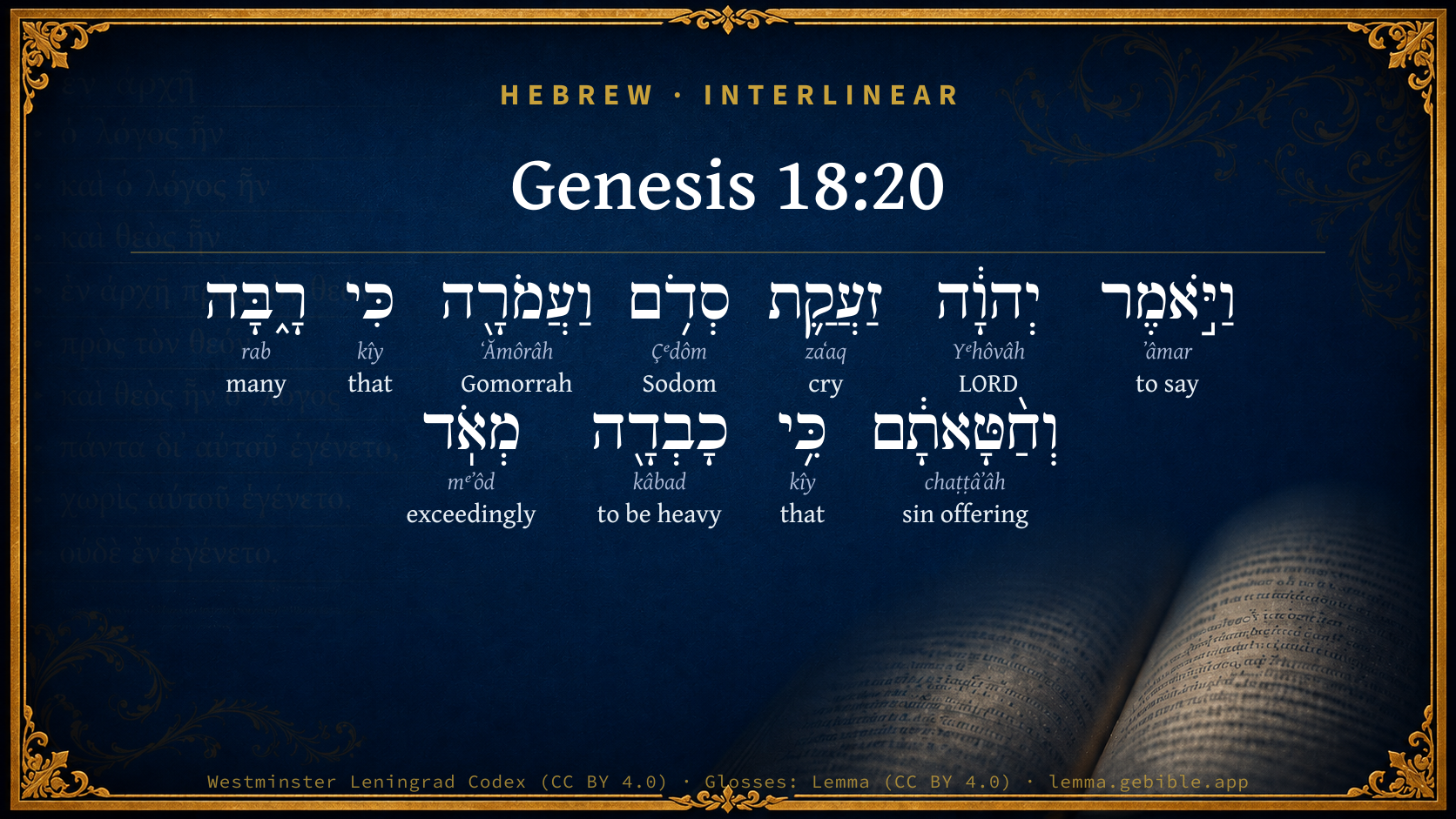
Hebrew (Westminster Leningrad Codex) Genesis 18:20 appears in the Hebrew Old Testament. The text above is from the Westminster Leningrad Codex. Each word links to its Strong’s number, a concise gloss, and parsing drawn from the Open Scriptures Hebrew Bible morphology. Click any word for its full Brown-Driver-Briggs (BDB) entry.
Download image
Cite this verse

Genesis 18:20 (World English Bible). Public Domain. Lemma interlinear Bible study tool, https://lemma.gebible.app/v/genesis/18/20.

Show BibTeX & RIS
BibTeX
RIS
English Translation
Yahweh said, "Because the cry of Sodom and Gomorrah is great, and because their sin is very grievous,
World English Bible · Public Domain
Highlights
  • 1 first appearance in the Hebrew Bible
Full analysis ↓
Download a study sheet

One document with this verse’s original text, its word-by-word gloss line, the meaning frame, cross-references with their text, attributed commentary, and full source and license credits — printable, and it pastes into notes with its structure intact.

This verse Autodidact and up

Study sheet (.html) Plain text (.txt)

A passage Seminary Student

Up to 50 verses in one chapter. A passage sheet keeps up to 6 commentary sources and 12 cross-references per verse, in the order this page ranks them, and says so on the sheet whenever that leaves anything out. Ask for a single verse and you get the Autodidact verse sheet above.

Everything on this page stays free to read, with no account — the sheet is a download of what is already on screen, not access to it.

Want to remove ads? Support Godless Engineer
Compare translations 3

The same verse in 3 English versions, stacked beneath the original-language interlinear above. Click any original word for its lexicon entry.

Each is an independent rendering of the whole verse — the interlinear is not word-aligned to these translations.

Highlighted words mark where these versions differ — a whole-verse word diff, not a word-by-word alignment.

  • World English Bible Public Domain
    Yahweh said, "Because the cry of Sodom and Gomorrah is great, and because their sin is very grievous,
  • King James Version Public Domain
    And the LORD said, Because the cry of Sodom and Gomorrah is great, and because their sin is very grievous;
  • unfoldingWord Literal Text CC BY-SA 4.0
    Then Yahweh said, “Because the outcry of Sodom and Gomorrah is great, and because their sin is very grievous,

unfoldingWord Literal Text — © unfoldingWord, licensed CC BY-SA 4.0. Word-aligned USFM3 via Door43 (git.door43.org/unfoldingWord/en_ult).

Versions to compare (up to 4)

3 of 4 selected

Show all 18 translations

Every available English version of this verse, each an independent rendering of the whole verse.

  • World English Bible Public Domain
    Yahweh said, "Because the cry of Sodom and Gomorrah is great, and because their sin is very grievous,
  • Berean Standard Bible Public Domain
    Then the LORD said, “The outcry against Sodom and Gomorrah is great. Because their sin is so grievous,
  • Majority Standard Bible Public Domain
    Then the LORD said, “The outcry against Sodom and Gomorrah is great. Because their sin is so grievous,
  • King James Version Public Domain
    And the LORD said, Because the cry of Sodom and Gomorrah is great, and because their sin is very grievous;
  • American Standard Version (1901) Public Domain
    And Jehovah said, Because the cry of Sodom and Gomorrah is great, and because their sin is very grievous;
  • Revised Version (1885) Public Domain
    And the LORD said, Because the cry of Sodom and Gomorrah is great, and because their sin is very grievous;
  • Geneva Bible (1599) Public Domain
    Then the Lord saide, Because the crie of Sodom and Gomorah is great, and because their sinne is exceeding grieuous,
  • Douay-Rheims (1899) Public Domain
    For I know that he will command his children, and his household after him to keep the way of the Lord, and do judgment and justice: that for Abraham's sake the Lord may bring to effect all the things he hath spoken unto him.
  • Young's Literal Translation Public Domain
    And Jehovah saith, `The cry of Sodom and Gomorrah -- because great; and their sin -- because exceeding grievous:
  • Literal Standard Version CC BY-SA 4.0
    And YHWH says, “The cry of Sodom and Gomorrah—because great; and their sin—because exceedingly grievous:
  • Unlocked Literal Bible CC BY-SA 4.0
    Then Yahweh said, “Because the outcry against Sodom and Gomorrah is so great, and because their sin is so serious,
  • unfoldingWord Literal Text CC BY-SA 4.0
    Then Yahweh said, “Because the outcry of Sodom and Gomorrah is great, and because their sin is very grievous,
  • Darby Bible Public Domain
    And Jehovah said, Because the cry of Sodom and Gomorrah is great and their sin is very grievous,
  • World Messianic Bible Public Domain
    The LORD said, “Because the cry of Sodom and Gomorrah is great, and because their sin is very grievous,
  • Webster's Bible Public Domain
    And the LORD said, Because the cry of Sodom and Gomorrah is great, and because their sin is very grievous;
  • Free Bible Version CC BY-SA 4.0
    Then the Lord said, “There are many complaints made against Sodom and Gomorrah because they sin so blatantly.
  • Bible in Basic English Public Domain
    And the Lord said, Because the outcry against Sodom and Gomorrah is very great, and their sin is very evil,
  • JPS Tanakh (1917) Public Domain
    And the LORD said: 'Verily, the cry of Sodom and Gomorrah is great, and, verily, their sin is exceeding grievous.

Literal Standard Version (2020), Covenant Press — licensed CC BY-SA 4.0. Text via the HelloAO Bible API (eBible.org). Unlocked Literal Bible (unfoldingWord) — licensed CC BY-SA 4.0. Text via the HelloAO Bible API (eBible.org). unfoldingWord Literal Text — © unfoldingWord, licensed CC BY-SA 4.0. Word-aligned USFM3 via Door43 (git.door43.org/unfoldingWord/en_ult). Free Bible Version, Dr. Jonathan Gallagher — licensed CC BY-SA 4.0. Text via the HelloAO Bible API (eBible.org).

Word by word

More ways to search: Search by grammar → Find every occurrence → Compare this word →

Practice this passage: Drill this verse → Learn its vocabulary →

About this verse

These counts appear in no published source. They are computed here, from the morphology-tagged text and Lemma’s own curated glosses. What Lemma adds →

11
words
10
distinct lemmas
Pentateuch
section

Notable vocabulary

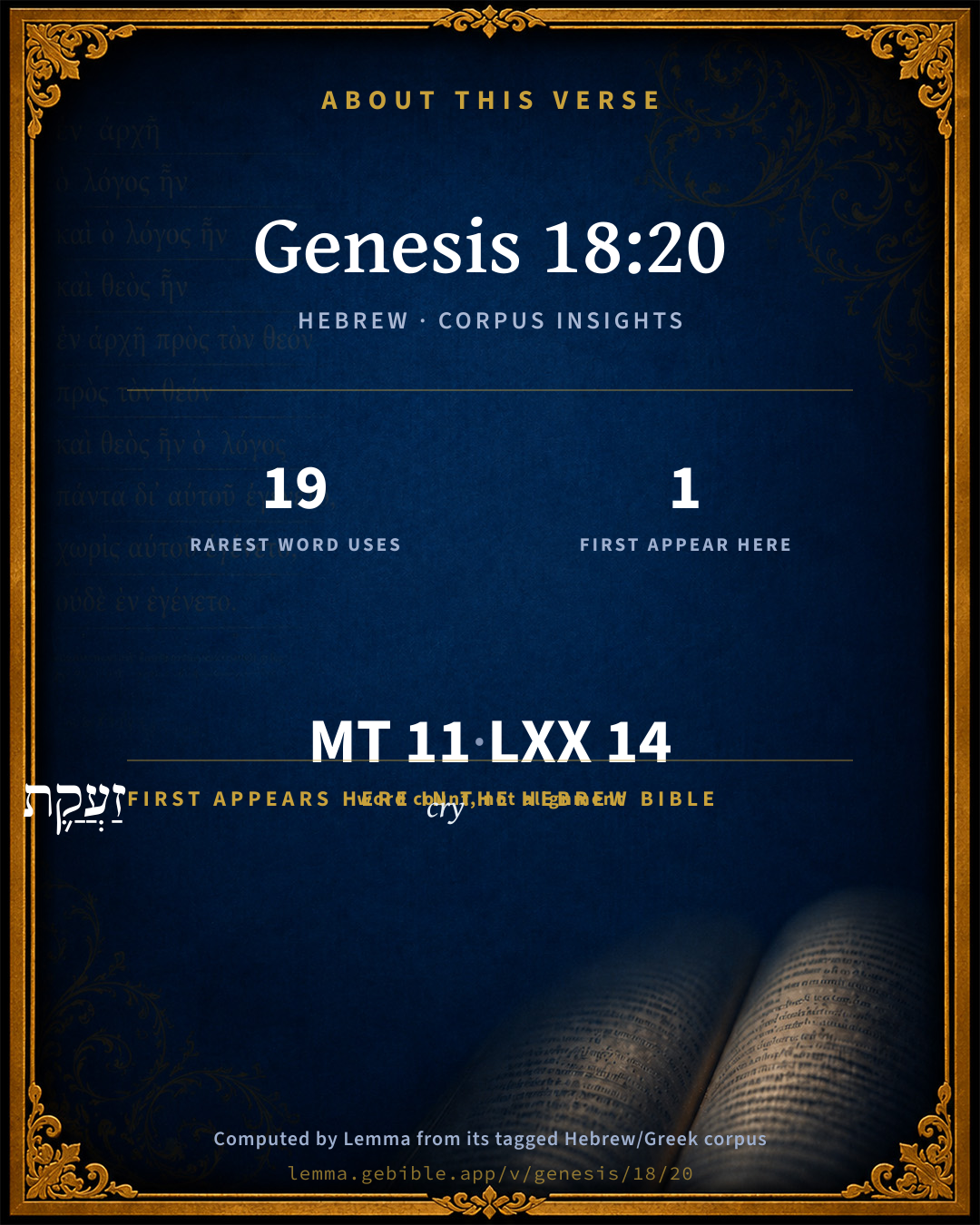
The rarest word here is זַעֲקַ֛ת cry H2201 — appearing just 19 times in the whole Hebrew Bible.

First appearance in Scripture

This word makes its first canonical appearance in the Hebrew Bible here:

  • זַעֲקַ֛ת cry H2201

Shared distinctive vocabulary

זַעֲקַ֛ת cry H2201 occurs in 19 verses of the Hebrew Bible. Also found in:

Grammatical profile

  • 3 verbs
  • 5 nouns
  • 2 conjunctions
  • 1 adverb

Verb forms

  • וַיֹּ֣אמֶר Qal · Sequential Imperfect
  • רָ֑בָּה Qal · Perfect
  • כָבְדָ֖ה Qal · Perfect

Repetition

A word recurs within this verse — often emphatic in Hebrew:

  • כִּי that H3588 ×2

Hebrew & Septuagint length

In English translation the verse runs 18 words from the Hebrew and 21 from the Septuagint (LXX English) — closely comparable.

A rough comparison of the two English renderings, which tokenize alike — not a word-level alignment.

Word counts can differ between the Hebrew and the Greek without any difference in meaning — e.g. the Hebrew direct-object marker אֵת has no separate Greek word, and Greek often adds the article ὁ.

In the original languages it is 11 Hebrew tokens and 14 Greek tokens — but the two are counted differently (Hebrew bundles its prefixes and suffixes into one token; the Greek is in lemma form), so that isn’t a like-for-like length.

Cross-references

8

Topical passages linked to Genesis 18:20 in the Treasury of Scripture Knowledge — connected by theme and wording, ordered by reader-vote popularity; previews shown in the World English Bible.

  • Genesis 19:13 for we will destroy this place, because the cry of them is grown great before Yahweh. Yahweh has sent us to destroy it."
  • Isaiah 3:9 The look of their faces testify against them. They parade their sin like Sodom. They don't hide it. Woe to their soul! For they have brought disaster upon themselves.
  • Ezekiel 16:49–50 Behold, this was the iniquity of your sister Sodom: pride, fullness of bread, and prosperous ease was in her and in her daughters; neither did she strengthen the hand of the poor and needy.
  • Genesis 4:10 Yahweh said, "What have you done? The voice of your brother's blood cries to me from the ground.
  • Genesis 13:13 Now the men of Sodom were exceedingly wicked and sinners against Yahweh.
  • James 5:4 Behold, the wages of the laborers who mowed your fields, which you have kept back by fraud, cry out, and the cries of those who reaped have entered into the ears of the Lord of Hosts.
  • Isaiah 5:7 For the vineyard of Yahweh of Hosts is the house of Israel, And the men of Judah his pleasant plant: And he looked for justice, but, behold, oppression; For righteousness, but, behold, a cry of distress.
  • Jeremiah 14:7 Though our iniquities testify against us, work you for your name's sake, Yahweh; for our backslidings are many; we have sinned against you.

Cross-references courtesy of OpenBible.info (CC BY 4.0).

Hebrew and Greek witnesses Masoretic Hebrew ↔ Greek Septuagint

The same verse in the two great witnesses to the Old Testament, shown verse-for-verse.

These are two independent witnesses, not word-aligned to each other, and the Septuagint is shown in lemma (dictionary) form.

Hebrew Genesis 18:20 Masoretic · Westminster Leningrad Codex

וַיֹּ֣אמֶר יְהוָ֔ה זַעֲקַ֛ת סְדֹ֥ם וַעֲמֹרָ֖ה כִּי רָ֑בָּה וְחַ֨טָּאתָ֔ם כִּ֥י כָבְדָ֖ה מְאֹֽד

Yahweh said, "Because the cry of Sodom and Gomorrah is great, and because their sin is very grievous,

World English Bible · Public Domain

Greek LXX Genesis 18:20 Septuagint · lemma form

εἶπον δέ κύριος κραυγή σοδομα καί γομορρα πληθύνω καί ὁ ἁμαρτία αὐτός μέγας σφόδρα

And the Lord said, The cry of Sodom and Gomorrha has been increased towards me, and their sins are very great.

LXX2012 (modern English Septuagint) · Public Domain

On this verse, The Preacher's Complete Homiletical Commentary discusses the Septuagint’s reading. Read the note in Commentary ↓

Hebrew: Westminster Leningrad Codex (CC BY 4.0). Greek: Septuagint (public domain); English from LXX2012 (modern English Septuagint) (Public Domain). How the Septuagint differs from the Hebrew →

Targum (Aramaic paraphrase)

2

The Targum is the ancient Jewish Aramaic paraphrase of the Hebrew Scriptures — an interpretive translation, not the Hebrew text itself. Onkelos (literal) and Pseudo-Jonathan (expansive) render the Torah, and Jonathan the Prophets. Coverage is partial: where no permissively-licensed English translation exists for a verse, only the Aramaic is shown. This is verse-level text, not a word-by-word alignment to the Hebrew.

  1. Targum Onkelos Torah (Genesis–Deuteronomy)
    וַאֲמַר יְיָ קְבֵלַת סְדוֹם וַעֲמוֹרָה אֲרֵי סְגִיאַת וְחוֹבָתְהוֹן אֲרֵי תְקִיפַת לַחֲדָא

    (no public-domain English translation for this verse)

    Targum Onkelos — Aramaic: “Onkelos Genesis” (public domain); “Onkelos Exodus” (public domain); “Onkelos Leviticus” (public domain); “Onkelos Numbers” (public domain); “Onkelos Deuteronomy” (public domain). English: “Sefaria Community Translation” (CC0 1.0 (public-domain dedication)); “J.W. Etheridge. The Targums of Onkelos and Jonathan Ben Uzziel on the Pentateuch. London: Longmans, Green, 1862” (public domain). Text via Sefaria.

  2. Targum Pseudo-Jonathan Torah (Genesis–Deuteronomy)
    וַאֲמַר יְיָ לְמַלְאֲכֵי שֵׁירוּתָא קְבֵילַת סְדוֹם וַעֲמוֹרָה דְאַנִיסִין מִסְכְּנִין וְגַזְרִין דְכָל דְיָהִיב פִּתָּא לְעַנְיָא יֵיקַד בְּנוּרָא אֲרוּם סַגִיאַת וְחוֹבַתְהוֹן אֲרוּם תַּקִיפַת לַחֲדָא

    And the Lord said to the ministering angels, The cry of Sedom and Amorah, because they oppress the poor, and decree that whosoever giveth a morsel to the needy shall be burned with fire, is therefore great, and their guilt exceedingly weighty.

    Targum Pseudo-Jonathan — Aramaic: “Targum Jonathan on Genesis” (public domain); “Targum Jonathan on Exodus” (public domain); “Targum Jonathan on Leviticus” (public domain); “Targum Jonathan on Numbers” (public domain); “Targum Jonathan on Deuteronomy” (public domain). English: “The Targum of Jonathan ben Uzziel, trans. J. W. Etheridge, London, 1862” (public domain). Text via Sefaria.

Commentary

Notes on Genesis 18:20 from classic Christian and Jewish commentators (each source and its license shown beneath its notes). The classic Christian expositions comment on the surrounding passage and are grouped to its opening verse, so a note may address several verses; the Jewish commentaries on the Tanakh (Rashi and others) are per-verse, so they appear only where the commentator wrote on this verse.

Lemma curates 59 commentaries, every one of them public domain or Creative Commons licensed, each selected and text-cleaned for this edition rather than reprinted as found. About our sources →

Trapp's Complete Commentary

John Trapp

Gen 18:20 And the LORD said, Because the cry of Sodom and Gomorrah is great, and because their sin is very grievous;

Ver. 20. Because their sin is very grievous.] Or, very heavy; such as the very ground groans under; the axle of the earth is ready to break under it. Sin is a burden to God. {Amo 2:13} It was so to Christ; he fell to the ground when he was in his agony. It was so to the angels, who sunk into hell under it. It was so to Korah and his company; the earth could not bear them. It was so to the Sodomites; they were so clogged with this excrement of naughtiness, {a} as St James calleth it, {Jas 1:21} that God came from heaven to give their land a vomit.

{a} η περισσεια κακιας

John Trapp, A Commentary or Exposition upon All the Books of the Old and New Testament (1647–1656) — public domain. Text from a community e-Sword module.

The Biblical Illustrator

Joseph S. Exell

Gen_18:20

Because the cry of Sodom and Gomorrah is great, and because their sin is very grievous

Gods judgment on Sodom

I.

The vale of Sodom was a region blooming and smiling in all the riches of nature; ON EVERY HAND THERE WAS SOMETHING TO RAISE THE THOUGHTS TO THE CREATOR. But amidst all this, what was man? His wickedness was so aggravated and extreme, that the region itself was doomed to perish with its inhabitants. Sin still infects the fair field of nature, and it is this which spoils the beauty of the scene. If all the sin in the world could become a visible thing, it would blast and overpower in our view all the beauty of nature. The sin of Sodom was so aggravated that its cry went up to heaven, and the righteous Governor was obliged to manifest Himself.

II. It is impossible not to be struck with THE CALMNESS AND QUIETNESS WITH WHICH THE WORK OF VENGEANCE PROCEEDED. Three persons came on a friendly visit to Abraham. They accepted his hospitality; spoke with him on a matter of complacent interest--the renewed assurance of his posterity. Then the men rose up from thence and looked toward Sodom. We are left in the dark as to one circumstance here. Only two of the persons went on to Sodom, leaving Abraham to converse with the Almighty. The third disappears from our view--unless he was a manifestation of the Divine Being Himself, and the same that Abraham conversed with in that solemn character.

III. Notice WHAT VALUE THE LORD MUST SET ON THE RIGHTEOUS, when for the sake of ten such men He would have spared Sodom. Only one righteous man dwelt in Sodom, and he was saved.

IV. THE PRECISE MANNER OF THE FEARFUL CATASTROPHE IS BEYOND OUR CONJECTURE. It would seem that an earthquake either accompanied or followed it, but the fire from heaven is intimated as the grand chief agent of the destruction. The people of Sodom had no time for speculations; there was just time for terror and conscience and despair. Yet our Lord says there is a still greater guilt, a more awful destruction even than theirs. The man that lives and dies rejecting Him had better have been exposed to the rain of fire and brimstone and gone down in the gulf of the vale of Siddim. (Y. Foster.)

Lessons from Sodom

I. Notice FIRST THE WORDS OF GOD WHICH INTRODUCE THIS HISTORY. Because the cry of Sodom and Gomorrah is great, &c. Behind this human manner of speaking what a lesson if; here! The judgments of God from time to time overtake guilty nations and guilty men; but, huge and overwhelming catastrophes as these often are, there is nothing hasty, blind, precipitate about them. He is evermore the same God who, when the cry of Sodom and Gomorrah waxed great, is described as going down to see and inquire whether they had done altogether according to the cry of it.

II. In Gods assurance to Abraham that if there are fifty, forty, thirty, twenty, or even ten righteous men found in the city He will not destroy it, we may recognize a very important law of His government of the world: this, namely,--THAT IT IS NOT THE PRESENCE OF EVIL BUT THE ABSENCE OF GOOD WHICH BRINGS THE LONG-SUFFERING OF GOD TO AN END. However corrupt any fellowship of men may he, however far gone in evil, yet so long as there is a sound, healthy kernel in it of righteous men, that is, of men who love and fear God and will witness for God, there is always hope.

III. This promise of God, I will not destroy it for tens sake, SHOWS US WHAT RIGHTEOUS MEN, LOVERS AND DOERS OF THE TRUTH, ARE. They are as the lightning conductors, drawing aside the fiery bolts of His vengeance, which would else have long since scorched, shattered, and consumed a guilty world. Oftentimes, it may be, they are little accounted of among men, being indeed the hidden ones of God crying in their secret places for the things which are done against the words of Gods lips. The world may pass them, may know nothing of them, yet it is for their sakes that the world is endured and continues unto this day,

IV. Does not this remind us of one duty on behalf of others which we might effectually fulfil if a larger measure of grace dwelt in our hearts?--I MEAN THE DUTY OF PRAYER AND INTERCESSION FOR OTHERS. Prayer for others is never lost, is never in vain; often by it we may draw down blessing upon others, but always and without fail it will return in blessing on ourselves. (Archbishop Trench.)

Sodom

I. SODOMS SINFULNESS. Her sins were committed amidst an unbounded flush of prosperity; they were committed amidst scenes of much natural loveliness, Nature being outraged before the eye of her most beautiful forms: and they were committed not only in opposition to Natures silent, but to Gods spoken, warnings.

II. SODOMS WARNINGS. One was given by the entrance of Lot within its gates; another was given by the advent of Chedorlaomer and the invaders from the east. Abraham and Melchizedek cast their sublime and awful shadows from the Kings Dale southward upon Gomorrahs walls; but the sinners within felt not the hallowing sense of their presence, trembled not at the steps of their majesty.

III. SODOMS INTERCESSOR. Abrahams prayer shows--

1. The confidence that existed between himself and God.

2. It shows Gods personal knowledge of evil.

3. It shows Gods reluctance to punish.

4. It gives proof of the tremendous guilt of Sodom.

IV. This terrible catastrophe lies in A BYE-PATH OF THE DIVINE PROCEDURE; it did not relate immediately to the general course of the patriarchal dispensation; and yet what an awful aside did the fall of these cities utter. It must have struck Abraham with a new sense of the evil of sin and of the holiness and justice of God. (G. Gilfillan.)

I. THEY ARE PRECEDED BY A LONG HISTORY OF WICKEDNESS.

1. The shedding of innocent blood (Gen_4:10; Job_16:18).

2. The peculiar sin of Sodom.

3. The oppression of the people of God.

4. Withholding the hire of the labourer (Jam_5:4).

Gods judgments on nations

II. THEY ARE MANIFESTLY RIGHTEOUS.

1. They proceed slowly.

2. They are only inflicted when the reasons of them have been made evident.

3. They are self-vindicating. (T. H. Leale.)

The depravity of Sodom

We have to speak, then, of Sodoms sinfulness. Delicacy may seem to repel us from such a subject altogether, but there is a false as well as a true delicacy, which, by passing by sin in silence, gives it an amnesty, and suggests the thought of its repetition. Had the sin of Sodom been confined to that people, and had it been rooted out with the guilty cities, it would almost have been sacrilege against human nature to dig it up from the slush of the sea of death, and expose it to the world. But alas I it still exists even in Christian nations, and requires still to be denounced. Had there been but one prevalent evil practice in Sodom, there is something so disgusting, and at the same time comparatively so rare, in the sin which bears the name of the city, that it might have been as well, perhaps, to have passed it over in silence. But it is evident that the peculiar iniquity of Sodom was only the climax and consummation of the general depravity of the place. This is clear, both from the general principles of human nature, and from certain distinct declarations in the Word of God. We are told that pride, fulness of bread, and abundance of idleness, were the sins, or rather were sins producing the flagrant and fatal sin of Sodom; and no doubt along with these every species of excess and licentiousness abounded, so that the city formed, with the exception of Lot and his family, one blot on the face of the earth; and we can conceive of a visitor shuddering with horror, as, passing through it at eventide in haste, he in this street hears cries, faint and half-sincere, of Father, force me not I and in another, finds men and women staggering in their vomit; and in a third, hears men cursing Jehovah, and cursing Lot, and cursing Abraham; and in a fourth, sees obscene dances; and in a fifth, beholds many plunging into the fires of an idol-sacrifice. All this, and more than this, which dares not even be shadowed out in expression, might have been seen in this fearful city, running over as a great caldron of iniquity, and coming to a point in that sin for which its inhabitants are set forth for an example, suffering the vengeance of eternal fire. It added to the aggravation of these sins, that they were committed amidst an unbounded flush of prosperity; that they were committed amidst scenes of much natural loveliness, nature being outraged before the eye of her most beautiful forms; and that they were committed not only in opposition to natures silent, but to Gods uttered protest. (G. Gilfillan.)

Sodom and its sin

Sodom itself stood not only in the alluvium of a river bed, but on a main highway for land carriage between Babylon and Egypt. The natural consequences of such a position followed fast. When Ezekiel in his analysis of its decline calls fulness of bread, comes without toil to a population so favourably situated. Wealth flowed in. With wealth easily acquired came abundance of idleness; and with leisure and wealth came luxury, their daughter. Then followed pride, the insolence of the pampered; at last, self-indulgence and shameless licence. Possibly the time had not yet arrived for the cultivation of those adornments which lend dignity to wealth, and serve even to veil the deformity of dissolute manners; of letters, I mean, and of the arts. Possibly the race was not endowed by nature with such gifts. At any rate, we detect no signs of such a degree of culture or refinement as has always accompanied civilization among Aryan peoples. The early civilization of the Hamitic tribes seems to have been of a vulgar material type, and to have fallen a speedy prey to vice and corruption. How far that corruption had gone in the case of Sodom is only too apparent on the face of the narrative. Disgusting and unnatural lust has been the plague-spot of heathenism in other times, as well as of at least one Moslem race in our own. But it never carried itself with such effrontery, or showed its vileness so openly, as in the town which has given it a name. Wherever it has appeared, it has marked a stage of social degradation ripe for destruction. Four hundred years after Sodom, other Canaanite tribes in Palestine had become infected with it, till the land was ready, in the strong words of Leviticus, to spue them out. Its prevalence in Greece when St. Paul wrote his letter to the Church of Rome showed how near Greece was to its fall. What it means in the case of the Turk, we are seeing to-day with our eyes. Unnatural vice fills the cup of iniquity to overflowing. It sends up a cry to heaven that the righteous Judge must answer. (J. O.Dykes, D. D.)

The Biblical Illustrator, edited by Joseph S. Exell (c. 1880s–1900s) — public domain. Text from a community e-Sword module.

The Preacher's Complete Homiletical Commentary

Joseph S. Exell (gen. ed.)

CRITICAL NOTES.—

Gen_18:21. Whether they have done altogether according to the cry of it.] Heb. Whether they have made completeness, or filled up the measure of their sins. And if not, I will know.] Onk. “But if they repent I will not take vengeance.”

Gen_18:22. Stood yet.] Heb. And LXX. have, Was standing yet. Onk. “Stood in prayer before the Lord.”

MAIN HOMILETICS OF THE PARAGRAPH.—Gen_18:20-22

GOD’S JUDGMENTS ON NATIONS

Though every man must give an account for himself to God at the last day, yet Providence does visit judgment upon nations, as such, in this world. Nations have no existence in the future life, and therefore must be punished in this life. Hence religious minds read some awful lessons in human history. They see the punishments of Divine justice visited upon communities of sinners. We have here God’s threatening of judgment upon a wicked nation; a threatening which was as sure as doom; for they had exhausted the Divine forbearance, and there was no more space for repentance. God’s judgments upon nations have the same general characteristics as this one upon Sodom and Gomorrah.

I. They are preceded by a long history of wickedness. God’s retribution does not fall until the harvest of sin is ripe. The wickedness of this people had grown so great as to become proverbial. (Isa_1:9.) A community must have existed for some time before it can give rise to proverbs. This way of referring to a nation’s moral character shows that it has been long established in evil ways. These cities were notorious for sins of the worst type. These are mentioned in the Bible as sins which bring down the judgments of God upon nations.

1. The shedding of innocent blood. (Gen_4:10; Job_16:18.) This is the highest crime against man. The blood of the innocent appeals to heaven for vengeance. God hears their cry, and by terrible judgments requires their blood of guilty nations.

2. The peculiar sin of Sodom. The vilest form of sensuality derives its name from this wicked city. There are sins of the flesh so heinous that they degrade men below the level of the brute.

3. The oppression of the people of God. (Exo_3:7.) God regards this sin as specially directed against Himself. To fail in duty, or to go wrong, are sins against God; but to afflict His people is directly to affront the Majesty of God. The same principle is to be observed in the case of those who, by the calamities of human life, are in an especial manner thrown upon the care and kindness of God. The oppression of widows and orphans is regarded in Scripture as a crime which calls for immediate judgment, the very tenderness of God urging Him to inflict it.

4. Withholding the hire of the labourer. (Jas_5:4.) Sins committed against society differ much in their consequences to individual men. The labourer who works for day wages suffers a grievous wrong when these are withheld. To rob him of the means by which he lives lies very near to crimes directed against his life. The judgments of God, sooner or later, overtake nations who have a bad eminence in such sins as these.

II. They are manifestly righteous. The judgments of God upon sinful communities of men are so conducted that the justice of them may appear.

1. They proceed slowly. The feet of vengeance travel with slow and measured steps. Though the punishment may be just in itself, and the sinful deserve no more time, yet it is delayed in order that God’s ways with men might appear to be right. When we intend acts of love and kindness, there is a propriety in our haste to do them. But in acts of punishment—of righteous judgment—all haste is unseemly. Mercy will rejoice over judgment as long as it possibly can. God is slow to punish. Judgment is His strange work. He endures even the vessels of wrath with much long-suffering. Men have time to see that the signal examples of Divine retribution which history furnishes are just and right.

2. They are only inflicted when the reasons of them have been made evident. God is represented as making careful inquiry. (Gen_18:21.) Such language is evidently accommodated to our human weakness, but the intent of it is to impress the thought upon our minds, that God will not visit iniquity until it is fully proven.

3. They are self-vindicating. Sodom and Gomorrah are represented as crying to God for vengeance. (Gen_18:20.) There are some sins which more than others loudly call to Heaven for punishment. Their just recompense thus approves itself to the conscience of humanity.

SUGGESTIVE COMMENTS ON THE VERSES

Gen_18:20. God regards the sins of nations as such, and bears with them until they cry out for vengeance. They put a strain upon the Divine endurance until they become “very grievous,” and sparing mercy can hold out no longer.

The sins which destroy nations are those which strike at the very foundations of social order, purity, and safety—lawlessness, corruption in family life, general insecurity amidst the wreck of just institutions. Such sins are among those which “are open beforehand, going before to judgment.”

History reads us this awful lesson, that the fall of great nations has been brought about by their own corruptions.

Every sin makes a moral demand for punishment, and has a voice of crimination against the sinner. Sins, however, are more especially said to cry when they are peculiarly heinous, flagrant, aggravated, and calculated to provoke the wrath of God; and such were now the sins of Sodom and Gomorrah, which two cities are doubtless mentioned for their pre-eminence in crime, though it is clear from Deu_29:22-24 that several other cities in the immediate vicinity were involved in the same destruction.—(Bush.)

Because their sin is very grievous. Or, very heavy; such as the very ground groans under; the axle-tree of the earth is ready to break under it. Sin is a burden to God. (Amo_2:13.) It was so to Christ; He fell to the ground when He was in His agony. It was so to the angels who sank into hell under it. It was so to Korah and his company—the earth could not bear them. It was so to the Sodomites—they were so clogged with this superfluity of naughtiness, as St. James calleth it (Gen_1:21), that God came from heaven to give their land a vomit.—(Trapp.)

“Because the cry of Sodom and Gomorrah is great, and because their sin is very grievous.” The ways of God are not governed by caprice—the result of mere will. They approve themselves to the reason of mankind.

Gen_18:21. Every great judgment upon wicked nations is a special visitation of God.

There is a certain measure of sins—a capacity of iniquity—which wicked nations must fill before God’s great judgments come upon them.

God is represented as a just judge who has no prepossessions in regard to the case, but is determined to make an exact and careful scrutiny.

The sins of nations require time to develop into a full-grown body, but it is a body prepared for death (Jas_1:15).

These verses (20, 21), probably, are to be taken as retrospective; as being a parenthetical explanation of the whole scene, which might have been given at the outset, but is now incidentally thrown in: “The Lord had said, I will go down now and see”—speaking after the manner of men, to mark the perfect equity of His procedure, as not condemning hastily, or without inquiry. This had been His purpose in coming down to earth at all on this occasion. In the execution of this purpose, He had visited Abraham. And now, sending on to Sodom the angels who accompanied Him, and who were appointed to save Lot, He Himself remains behind.—(Candlish.)

God keeps open the door of repentance to the very last, so that the worst of characters may have no cause to complain of injustice.

Descent here is, of course, but figuratively ascribed to God. There could be no change of place with Him who is everywhere present; nor can examination be necessary to the eye of Omniscience. The language merely represents God as employing those means of investigation which are necessary to man to declare that all the acts of His vengeance are in perfect conformity to justice, and that He never punishes without the clearest reason. And surely, if anything can show unwillingness to punish, or a desire to see everything in the most favourable light, or an anxiety like that of a tender parent to cleave to the last hope that his child is not irrecoverably lost, we have it in these words. It is speaking of God, indeed, according to the manner of men, but it implies that He would look into the whole case; that He would be slow before He came to the resolution to inflict vengeance to the uttermost; that He would institute a careful inquiry, to see whether what He knew to be bad was incurably bad. In a word, it implies that if there was any possibility, consistently with justice, of sparing that devoted city, He stood ready, in heart and mind, to do it. If we rightly apprehend the drift of the whole narrative, Gen_18:20-21 are inserted by way of parenthesis, in order to acquaint the reader with the main design for which the Lord, with His two accompanying angels, had descended and made this visit to Abraham. On any other interpretation it is not easy to understand the propriety of the expression, Gen_18:21, “I will go down,” when He had actually “come down” already.—(Bush.)

God’s actions, both of mercy and judgment, are proofs of His complete knowledge of men. It is not a blind or irresponsible, but an all-seeing and rational Power that governs the world of nature and of man.

Gen_18:22. Angels are God’s ministers for mercy and for judgment. They are sent forth to deliver the righteous, and to visit judgment upon the wicked.

Abraham stood yet before the Lord. And without such to stand and pray, the world could not stand: they bear up the pillars of it. Oh, the price with God, and profit to men, of praying persons! God will yield something to such when most of all enraged or resolved (Mat_24:20). Lot was saved for Abraham’s sake when all the rest perished.—(Trapp.)

The Preacher's Complete Homiletical Commentary (gen. ed. Joseph S. Exell; Funk & Wagnalls, c. 1892) — public domain (pre-1929). A full-Bible homiletical/sermon-outline anthology covering 65 of 66 books (2 John is absent from the source module). Text from a community e-Sword module.

Tyndale Open Study Notes

Tyndale Open Resources

18:20-21 The omniscient God was cautious in his judgment: He knew the sins of Sodom and Gomorrah, but this close scrutiny communicated God’s justice in human terms—he would not destroy the people of the plain unless he was absolutely sure they were wicked.

18:20 a great outcry: See Ezek 16:49-50.

Tyndale Open Study Notes — © Tyndale Open Resources, licensed CC BY-SA 4.0. Text via the HelloAO Bible API.

Adam Clarke's Commentary

Verse 20. Because the cry of Sodom and Gomorrah] See Clarke on Ge 13:13.

Adam Clarke's Commentary on the Bible (1810–1826) — public domain. Text from a community e-Sword/MySword module.

John Calvin's Commentaries

20. The cry of Sodom. The Lord here begins more clearly to explain to Abraham his counsel concerning the destruction of the five cities; although he only names Sodom and Gomorrah, which were much more famous than the rest. But before he makes mention of punishment, he brings forward their iniquities, to teach Abraham that they justly deserved to be destroyed: otherwise the history would not tend to instruction. But when we perceive that the anger of God is provoked by the sin of man, we are inspired with a dread of sinning. In saying that the “cry was great,” he indicates the grievousness of their crimes, because, although the wicked may promise themselves impunity, by concealing their evils, and although these evils may be silently and quietly borne by men; yet their sin will necessarily sound aloud in the ears of God. Therefore this phrase signifies, that all our deeds, even those of which we think the memory to be buried, are presented before the bar of God, and that they, even of themselves, demand vengeance, although there should be none to accuse.

John Calvin's Commentaries (1540-1563) — public domain. Text from the Calvin Translation Society English edition (1840s-50s) via the Christian Classics Ethereal Library (ccel.org). Calvin's coverage is partial (roughly two-thirds of the Bible); uncommented books and verses are honest gaps, never fabricated. The 19th-century editor's footnotes and remarks are omitted so the notes are faithfully Calvin's own voice.

The Cambridge Bible for Schools and Colleges

gen. ed. J. J. S. Perowne

20. Because … because] Better, as marg., Verily … verily.

the cry of Sodom and Gomorrah] See Gen_19:13. (1) Either, this is the complaint concerning Sodom and Gomorrah going up to Heaven. The genitive “of” is then objective, like “the report of Tyre” (Isa_23:5), “the spoil of thine enemies” (Deu_20:14). (2) Or, it is the cry by the cities, which are personified, and which make their loud complaint against the inhabitants. The genitive then is subjective. See Gen_4:10.

their sin is very grievous] Cf. Gen_13:13; Eze_16:49-50.

The Cambridge Bible for Schools and Colleges (gen. ed. J. J. S. Perowne; Cambridge University Press, 1878–1918) — public domain. Text from a community e-Sword module.

John Gill's Exposition

And the Lord said,.... The Targum of Jonathan adds, to the ministering angels, the two angels that were with him in the likeness of men; or to Abraham, at least in his hearing, by which he understood that Sodom and other cities were about to be destroyed for their sins:

because the cry of Sodom and Gomorrah is great; either of Lot in it, whose righteous soul was vexed with the filthy conversation of the wicked, and cried to heaven against them; or of the inhabitants that were oppressed by others, either in their bodies, being forced to submit to their unnatural usage of them, or in their estates, of which they wronged them; particularly the cry of the poor among them, whom they suffered to starve, though there were fulness of bread in the midst of them, see Eze 16:49; the Jews (b) say, they appointed false judges, who oppressed all strangers that came to Sodom, and made a law, that whoever relieved a poor person should be burnt with fire: or the cry of their sins, which were many and great, and openly and impudently committed; the cry of which came into the ears of the Lord of hosts, and called for vengeance. Those two cities, which perhaps were the greatest and the most remarkable for their sins, are put for all the five cities of the plain, called Pentapolis.

And because their sin is very grievous; attended with very aggravated circumstances, they enjoyed great plenty of good things; and were not to be bore with, being so exceeding sinful, and so publicly and audaciously committed, especially that sin so frequent among them, which has its name from Sodom, see Gen 13:13.

(b) Pirke Eliezer, c. 25.

John Gill's Exposition of the Whole Bible (1746–1763) — public domain (CC PDM 1.0). Text via the HelloAO Bible API.

Matthew Poole's English Annotations

Sins are said to cry when they are gross, and manifest, and impudent, and such as highly provoke God to anger. He names only these two cities, as being the most eminent in state, and exemplary in wickedness; but under them he includes the rest, as appears by the story.

Matthew Poole's English Annotations on the Holy Bible (1683–1685) — public domain. Text from a community e-Sword/MySword module.

Whedon's Commentary on the Bible

Daniel D. Whedon

20. The cry of Sodom — The cry of the sins and abominations of Sodom, which went up to God, like the voice of Abel’s blood (Gen_4:10) demanding punishment.

Daniel D. Whedon (gen. ed.), Commentary on the Old and New Testaments (1874–1909) — public domain. Text from a community e-Sword module.

The Pulpit Commentary

And the Lord said, Because the cry of Sodom and Gomorrah is great. Literally, the cry of Sodom and Gomorrah, (cf. Gen_4:10) because it is (not, it is indeed, Baumgarten, Keil) multiplied; the place of emphasis being conceded to the subject of discourse, viz., the cry of Sodom s wickedness. And because their sin is very great. Literally, and their sin, because it is heavy, i.e. abundant and heinous.

The Pulpit Commentary (1880–1919), ed. H.D.M. Spence-Jones & Joseph S. Exell — public domain. Text from a community e-Sword module.

Keil & Delitzsch

C. F. Keil & F. Delitzsch

"The cry of Sodom and Gomorrah, yea it is great; and their sin, yea it is very grievous." The cry is the appeal for vengeance or punishment, which ascends to heaven (Gen 4:10). The כּי serves to give emphasis to the assertion, and is placed in the middle of the sentence to give the greater prominence to the leading thought (cf. Ewald, 330).

Keil & Delitzsch — Biblical Commentary on the Old Testament (1861–1891) — public domain (CC PDM 1.0). Text via the HelloAO Bible API. (Old Testament only.)

unfoldingWord translationNotes

Door43 World Missions Community

the outcry against Sodom and Gomorrah is so great

This can be reworded so that the abstract noun "outcry" is expressed as the verb "accuse." AT: "so many people have been accusing the people of Sodom and Gomorrah of doing evil things" (See: Abstract Nouns)

their sin is so serious

"they have sinned so much"

I will now go down there

"I will now go down to Sodom and Gomorrah"

go down there and see

"go down there to find out" or "go down there to decide"

see the outcry ... that has come to me

Yahweh speaks as if he knew about this matter because he had heard the cries and accusations coming from the people who had suffered. This can be reworded so that the abstract noun "outcry" is expressed as the verb "accuse." AT: "as wicked as those who are accusing them say that they are" (See: Abstract Nouns)

If not

"If they are not as wicked as the outcry suggests"

translationWords

Yahweh

Sodom

Gomorrah

sin

evil

unfoldingWord translationNotes — © Distant Shores Media and the Door43 World Missions Community, licensed CC BY-SA 4.0. Source: git.door43.org/Door43/en_tn.

Rashi

Rabbi Shlomo Yitzchaki (Rashi)

'ויאמר ה AND THE LORD SAID to Abraham, thus doing what he had said — that He would not conceal the matter from him.

כי רבה BECAUSE IT IS GREAT — Wherever רבה elsewhere occurs in Scripture the accent is on the last syllable — on the ב — because it is to be translated by “great” (adj.) or “becoming great” (participle), but this, here, has the accent on the first syllable — on the ר — because it is to be translated by “has already become great” (perf.), just as I have explained (15:17) “And it came to pass, that, when the sun had gone down (בָּאָה)” and (Ruth 1:15) “Behold, thy sister-in-law has gone back (שָׁבָה)”.

Rashi on the Tanakh — English translations: “The Judaica Press complete Tanach with Rashi, translated by A. J. Rosenberg” (CC BY 4.0); “Pentateuch with Rashi's commentary by M. Rosenbaum and A.M. Silbermann, 1929-1934” (public domain); “The Metsudah Tanach series, Lakewood, N.J” (CC BY 4.0); and “The Book of Joshua, Metsudah Publications, 1997” (CC BY 4.0). Text via Sefaria.

Ramban (Nachmanides)

Rabbi Moshe ben Nachman (Ramban / Nachmanides)

AND THE ETERNAL SAID, THE CRY OF SODOM AND GOMORRAH. Rashi comments: “And the Eternal said to Abraham, thus doing what He had said, i.e., that He would not conceal the matter from him,”And Rabbi Abraham ibn Ezra said that the verse, And the men turned from there, was inserted in the middle of the account, actually took place before our present verse for it was after the angels had walked toward Sodom that G-d said to Abraham, The cry of Sodom and Gomorrah… However, Verse 22 was entered later in the account in order to let us know the time of G-d’s word to Abraham — the cry of Sodom and Gomorrah, etc. — was when they came to Sodom. in order to let us know that at the time the angels arrived in Sodom, then G-d said to Abraham: The cry of Sodom and Gomorrah is great.The opinion of all commentators is likewise that G-d was speaking with Abraham. Now according to this, the correct interpretation of the verse, And the men turned from there, is that when G-d said to Abraham after the men journeyed from him, The cry of Sodom and Gomorrah is great, Abraham stood in prayer and supplication before Him to forgive them and to give him permission to speak. And he prolonged his prayer until the men came to Sodom, and then Abraham drew near and said, Wilt Thou also sweep away the righteous with the wicked? Or the explanation may be that Scripture itself returns to clarify the expression, Abraham stood yet before the Eternal,. as meaning that Abraham drew near and said, Wilt Thou also sweep away the righteous with the wicked? Thus he prolonged his supplication before Him, saying each time, “Let not the anger of the Eternal blaze,” and directing the intent of his mind each time towards prophecy until he heard an answer to his words direct from the Holy One, blessed be He. They continued in this manner the entire day [until, as the verse says], the Eternal finished speaking with Abraham, and the two angels came to Sodom.

THE CRY OF SODOM AND GOMORRAH. This is the cry of the oppressed, crying out and begging for help from the arm of their wickedness. It would have been proper for Scripture to say, “The cry of Sodom and Gomorrah I heard because it is great” or “The cry of Sodom and Gomorrah is great and their sin is very heavy.” But the purport of the verse is to state that “I will go down and see the cry of Sodom and Gomorrah and their sin which have become very great. If they have all sinned, I will bring the law to bear down on them, and if not, I will know who are the sinners.”Concerning the matter of “going down and seeing,” Rashi said by way of derash: “This teaches that judges are not to give decisions in cases involving capital punishment except after having carefully looked into the matter.”According to the simple meaning of Scripture, the explanation is as follows: Since the Holy One, blessed be He, wished to reveal to Abraham the matter of Sodom and to inform him that there was none among them who did good, He said to him “Because it is great, the cry of Sodom and Gomorrah will I go down to see, meaning I have come to judge. If they have sinned, I will make an end of them, and if not, I shall know what I shall do to them: Then will I visit their transgression with the rod, and their iniquity with strokes.” He thus informed him that their judgment was not yet complete for now He will visit their sin and judge them. This is like the verse: The Eternal looketh from heaven upon the children of men, to see if there were any man of understanding, that did seek after G-d. They are all corrupt; they are together become impure., 14:2-3.Now Rabbi Abraham ibn Ezra said concerning this [“going down and seeing”] a mystery [i.e., a mysterious explanation], pleasing himself with foreign offspring. I shall now intimate to you the opinion of those who received the truth. Our Rabbis have exposited from the verse, For behold, the Eternal cometh forth out of His place, and will come down, and tread upon the high places of the earth: “He cometh forth and goeth from attribute to attribute; He cometh forth from the attribute of mercy, and goeth to the attribute of justice.” We interpret this matter similarly. And the Eternal said in His heart, “The cry of Sodom and Gomorrah, because it is great, I will go down from the attribute of mercy to the attribute of justice, and I will see in mercy if they have done according to the cry of it which is come unto Me through the attribute of justice, and if so, punishment; and if not, I will know and I will show mercy,” just as in the verse, And G-d knew. (I will know) bespeaks Divine mercy. Now after Scripture tells of the knowledge of the Most High, it returns to the first matter and relates the story of how the men who glanced towards Sodom with the intention of going there and whom Abraham sent away arrived there. And Abraham, from the moment they left him until they arrived there, still stood before the Eternal for He called him and told him that the angels were those messengers who would destroy the place, as He had said. It was not necessary for Scripture to explain when Abraham stood before Him for from the moment He said, Shall I conceal it from Abraham, it is known that He told him.

Ramban (Nachmanides) on the Tanakh — English translation: “Commentary on the Torah by Ramban (Nachmanides). Translated and annotated by Charles B. Chavel. New York, Shilo Pub. House, 1971-1976” (CC BY 4.0). Text via Sefaria.

Radak

Rabbi David Kimhi (Radak)

'ויאמר ה' זעקת סדם ועמורה וגו, G’d means to say that the reason he now appeared to Avraham was to inform him that He had heard the outcry concerning Sodom, etc. The same applied to the five kings who were involved in the war with Kedorleomer in chapter 14 were all killed together with their population when Sodom was overturned. They were what the Torah referred to in 19,28 as the ארץ הככר. Moses also referred to this overturning of Sodom and Amora in Deut. 29,22 mentioning 4 towns, seeing that Tzoar was saved at the request of Lot. Also in Hoseah 11,8 the cities of Adma and Tzvoyim are singled out by the prophet, although the largest of the cities were Sodom and Amora. Sodom was the principal city, and the perversions committed in all of these cities were presumably dreamt up by the citizens of Sodom. The prophet Ezekiel 16,53 specifically refers to the other cities of that valley as Sodom’s satellites.

זעקת, the souls of the people who had been tortured by the inhabitants of these cities reached the heavenly court. The primary complaint was violence committed against these people. There were other, lesser crimes committed by these people also. However, the decision to destroy these cities was sealed on account of the violence perpetrated, just as the deluge was brought about by that crime. This was essentially a repeat of what happened on a global scale at the time of the deluge.

וחטאתם, this refers to the sin of violence, taking the law into one’s own hands. The outcry that had reached the heavenly spheres was extremely severe. As the prophet Ezekiel said: “they did not support the poor and the weak.” The poor cry out to heaven on account of their hunger, and they do not have any one who stretches out their hand to support them.

Radak on the Tanakh — English translations: “Sefaria Community Translation” (CC0 1.0 (public-domain dedication)); “Eliyahu Munk, HaChut Hameshulash” (CC BY 4.0); “Rabbi Mike Feuer, Jerusalem Anthology” (CC BY 4.0); and “R. David Kimhi on the first book of Psalms, Translated by R.G. Finch, London, 1919” (public domain). Text via Sefaria.

Lesson kit

Teaching starters — assembled from the data on this page, not authored interpretation. Every prompt links to the verse data it draws on. Edit before teaching.

Genesis, in the Pentateuch, opens this verse with 11 words (10 distinct Hebrew lemmas). Its most distinctive word is zaʻaq (“cry”). A historical commentator’s framing appears above. Read the whole chapter for the surrounding context.

Discussion questions

  1. The word zaʻaq carries the sense “cry.” How does it shape the verse?
  2. This is the first place “cry” appears in Scripture (first appears here). What does its debut here establish?
  3. How does Nehemiah 5:6, which shares the word «cry», read alongside this verse?
  4. What does the repetition of “that” (2× in this one verse) do in this verse?
  5. These translations render this verse differently; the difference is in the English rendering, not the original. What questions does that raise?
  6. «וַיֹּ֣אמֶר» is a Qal Sequential Imperfect verb. How does that grammatical form shape the action described?
  7. Compare how Trapp's Complete Commentary and The Biblical Illustrator read this verse. Where do they agree or differ?

Things to notice

Reading settings

Reading text

Shown beneath each verse's original-language words.

Old Testament
Old Testament edition

Read the OT as the Masoretic Hebrew (MT) or the Greek Septuagint (LXX).

English shown for the Greek Septuagint (in the Hebrew ↔ Greek comparison).

Comparing translations? Open the Compare panel on any verse page to stack up to four side by side.