
Deuteronomy 2:10

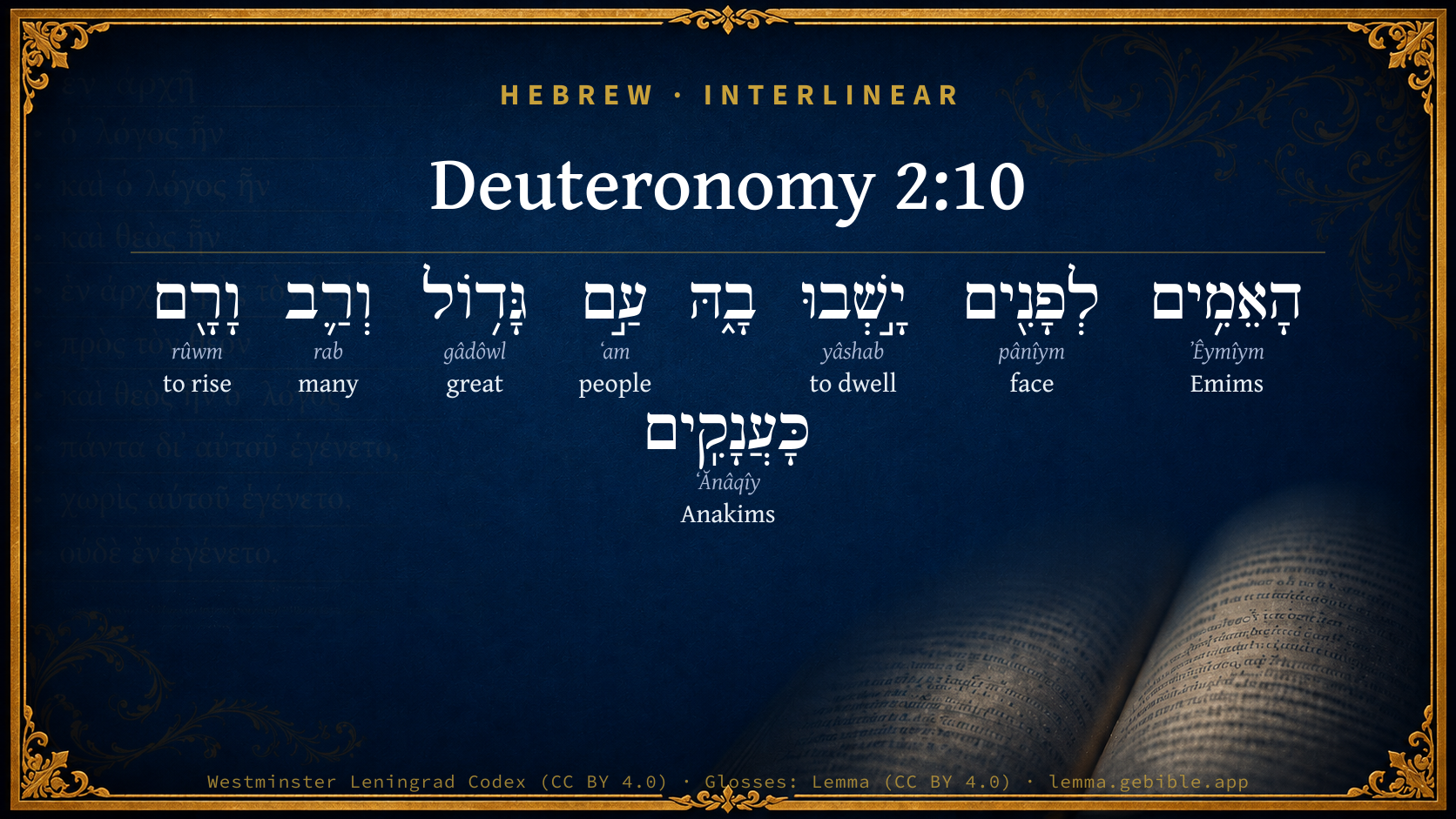
Hebrew (Westminster Leningrad Codex) Deuteronomy 2:10 appears in the Hebrew Old Testament. The text above is from the Westminster Leningrad Codex. Each word links to its Strong’s number, a concise gloss, and parsing drawn from the Open Scriptures Hebrew Bible morphology. Click any word for its full Brown-Driver-Briggs (BDB) entry.
Download image
Cite this verse

Deuteronomy 2:10 (World English Bible). Public Domain. Lemma interlinear Bible study tool, https://lemma.gebible.app/v/deuteronomy/2/10.

Show BibTeX & RIS
BibTeX
RIS
English Translation
(The Emim lived therein before, a people great, and many, and tall, as the Anakim:
World English Bible · Public Domain
Download a study sheet

One document with this verse’s original text, its word-by-word gloss line, the meaning frame, cross-references with their text, attributed commentary, and full source and license credits — printable, and it pastes into notes with its structure intact.

This verse Autodidact and up

Study sheet (.html) Plain text (.txt)

A passage Seminary Student

Up to 50 verses in one chapter. A passage sheet keeps up to 6 commentary sources and 12 cross-references per verse, in the order this page ranks them, and says so on the sheet whenever that leaves anything out. Ask for a single verse and you get the Autodidact verse sheet above.

Everything on this page stays free to read, with no account — the sheet is a download of what is already on screen, not access to it.

Want to remove ads? Support Godless Engineer
Compare translations 3

The same verse in 3 English versions, stacked beneath the original-language interlinear above. Click any original word for its lexicon entry.

Each is an independent rendering of the whole verse — the interlinear is not word-aligned to these translations.

Highlighted words mark where these versions differ — a whole-verse word diff, not a word-by-word alignment.

  • World English Bible Public Domain
    (The Emim lived therein before, a people great, and many, and tall, as the Anakim:
  • King James Version Public Domain
    The Emims dwelt therein in times past, a people great, and many, and tall, as the Anakims;
  • unfoldingWord Literal Text CC BY-SA 4.0
    (The Emites lived there previously, a people great and numerous and tall as the Anakites.

unfoldingWord Literal Text — © unfoldingWord, licensed CC BY-SA 4.0. Word-aligned USFM3 via Door43 (git.door43.org/unfoldingWord/en_ult).

Versions to compare (up to 4)

3 of 4 selected

Show all 18 translations

Every available English version of this verse, each an independent rendering of the whole verse.

  • World English Bible Public Domain
    (The Emim lived therein before, a people great, and many, and tall, as the Anakim:
  • Berean Standard Bible Public Domain
    (The Emites used to live there, a people great and many, as tall as the Anakites.
  • Majority Standard Bible Public Domain
    (The Emites used to live there, a people great and many, as tall as the Anakites.
  • King James Version Public Domain
    The Emims dwelt therein in times past, a people great, and many, and tall, as the Anakims;
  • American Standard Version (1901) Public Domain
    (The Emim dwelt therein aforetime, a people great, and many, and tall, as the Anakim:
  • Revised Version (1885) Public Domain
    (The Emim dwelt therein aforetime, a people great, and many, and tall, as the Anakim:
  • Geneva Bible (1599) Public Domain
    The Emims dwelt therein in times past, a people great and many, and tall, as the Anakims.
  • Douay-Rheims (1899) Public Domain
    The Emims first were the inhabitants thereof, a people great, and strong, and so tall, that like the race of the Enacims,
  • Young's Literal Translation Public Domain
    `The Emim formerly have dwelt in it, a people great, and numerous, and tall, as the Anakim;
  • Literal Standard Version CC BY-SA 4.0
    The Emim have formerly dwelt in it, a people great, and numerous, and tall as the Anakim;
  • Unlocked Literal Bible CC BY-SA 4.0
    (The Emites lived there previously, a people as great, as many, and as tall as the Anakim;
  • unfoldingWord Literal Text CC BY-SA 4.0
    (The Emites lived there previously, a people great and numerous and tall as the Anakites.
  • Darby Bible Public Domain
    (The Emim dwelt therein in times past, a people great, and many, and tall as the Anakim.
  • World Messianic Bible Public Domain
    (The Emim lived there before, a great and numerous people, and tall as the Anakim.
  • Webster's Bible Public Domain
    (The Emims dwelt in it in times past, a people great, and many, and tall as the Anakims;
  • Free Bible Version CC BY-SA 4.0
    (A strong and numerous people called the Emim once lived there. They were as tall as the Anakim,
  • Bible in Basic English Public Domain
    (In the past the Emim were living there; a great people, equal in numbers to the Anakim and as tall;
  • JPS Tanakh (1917) Public Domain
    The Emim dwelt therein aforetime, a people great, and many, and tall, as the Anakim;

Literal Standard Version (2020), Covenant Press — licensed CC BY-SA 4.0. Text via the HelloAO Bible API (eBible.org). Unlocked Literal Bible (unfoldingWord) — licensed CC BY-SA 4.0. Text via the HelloAO Bible API (eBible.org). unfoldingWord Literal Text — © unfoldingWord, licensed CC BY-SA 4.0. Word-aligned USFM3 via Door43 (git.door43.org/unfoldingWord/en_ult). Free Bible Version, Dr. Jonathan Gallagher — licensed CC BY-SA 4.0. Text via the HelloAO Bible API (eBible.org).

Word by word

More ways to search: Search by grammar → Find every occurrence → Compare this word →

Practice this passage: Drill this verse → Learn its vocabulary →

About this verse

These counts appear in no published source. They are computed here, from the morphology-tagged text and Lemma’s own curated glosses. What Lemma adds →

9
words
8
distinct lemmas
Pentateuch
section

Notable vocabulary

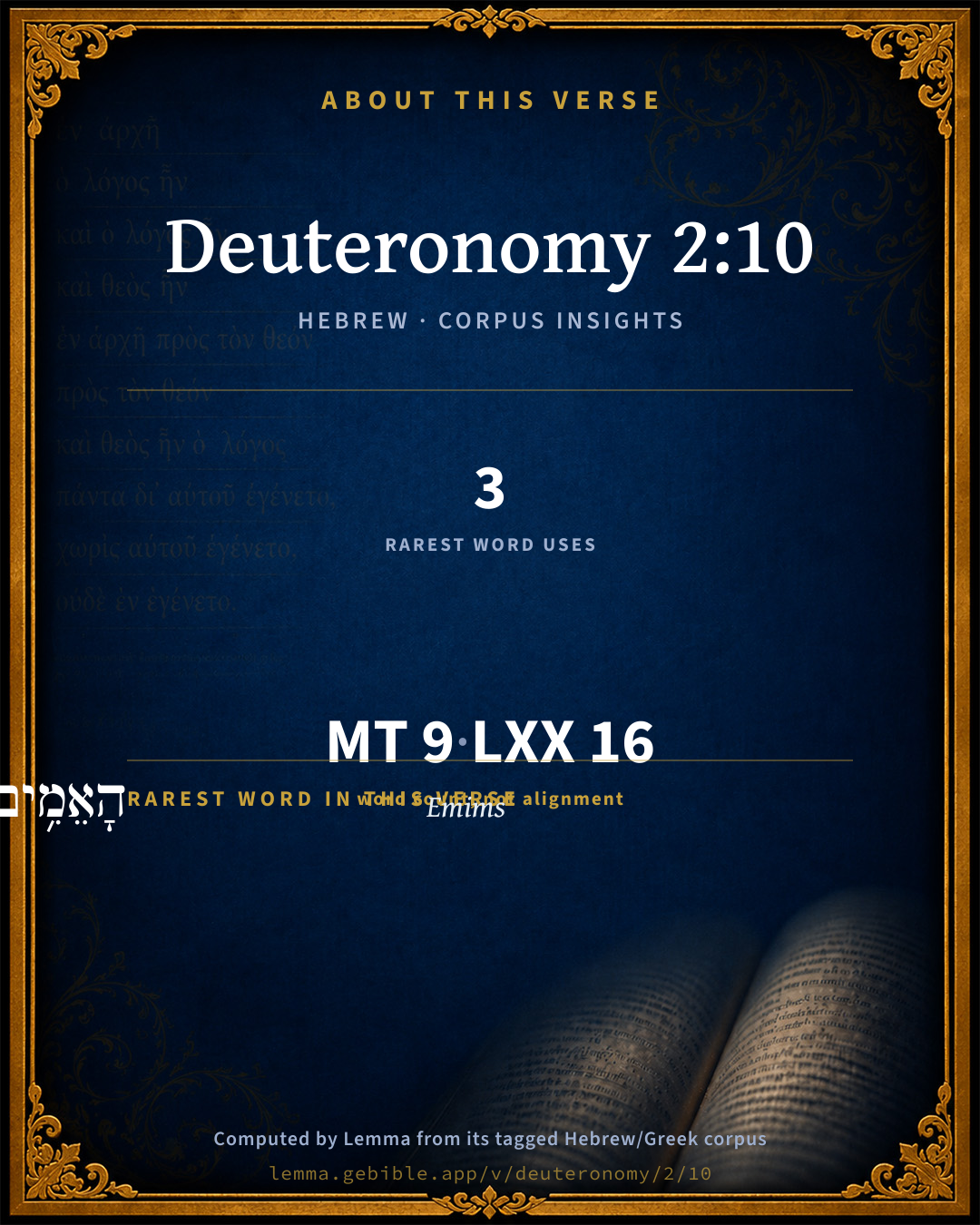
The rarest word here is הָאֵמִ֥ים Emims H368 — appearing just 3 times in the whole Hebrew Bible.

Shared distinctive vocabulary

הָאֵמִ֥ים Emims H368 occurs in 3 verses of the Hebrew Bible. Also found in:

Grammatical profile

  • 2 verbs
  • 4 nouns
  • 2 adjectives
  • 1 preposition

Verb forms

  • יָ֣שְׁבוּ Qal · Perfect
  • וָרָ֖ם Qal · Participle Active

Hebrew & Septuagint length

In English translation the verse runs 15 words from the Hebrew and 16 from the Septuagint (LXX English) — closely comparable.

A rough comparison of the two English renderings, which tokenize alike — not a word-level alignment.

Word counts can differ between the Hebrew and the Greek without any difference in meaning — e.g. the Hebrew direct-object marker אֵת has no separate Greek word, and Greek often adds the article ὁ.

In the original languages it is 9 Hebrew tokens and 16 Greek tokens — but the two are counted differently (Hebrew bundles its prefixes and suffixes into one token; the Greek is in lemma form), so that isn’t a like-for-like length.

Cross-references

3

Topical passages linked to Deuteronomy 2:10 in the Treasury of Scripture Knowledge — connected by theme and wording, ordered by reader-vote popularity; previews shown in the World English Bible.

  • Genesis 14:5 In the fourteenth year Chedorlaomer came, and the kings who were with him, and struck the Rephaim in Ashteroth Karnaim, and the Zuzim in Ham, and the Emim in Shaveh-kiriathaim,
  • Numbers 13:22 They went up by the South, and came to Hebron; and Ahiman, Sheshai, and Talmai, the children of Anak, were there. (Now Hebron was built seven years before Zoan in Egypt.)
  • Deuteronomy 2:11 these also are accounted Rephaim, as the Anakim; but the Moabites call them Emim.

Cross-references courtesy of OpenBible.info (CC BY 4.0).

Hebrew and Greek witnesses Masoretic Hebrew ↔ Greek Septuagint

The same verse in the two great witnesses to the Old Testament, shown verse-for-verse.

These are two independent witnesses, not word-aligned to each other, and the Septuagint is shown in lemma (dictionary) form.

Hebrew Deuteronomy 2:10 Masoretic · Westminster Leningrad Codex

הָאֵמִ֥ים לְפָנִ֖ים יָ֣שְׁבוּ בָ֑הּ עַ֣ם גָּד֥וֹל וְרַ֛ב וָרָ֖ם כָּעֲנָקִֽים

(The Emim lived therein before, a people great, and many, and tall, as the Anakim:

World English Bible · Public Domain

Greek LXX Deuteronomy 2:10 Septuagint · lemma form

ὁ ομμιν πρότερος κατα ἐνἧμαι ἐπί αὐτός ἔθνος μέγας καί πολύς καί ἰσχύω ὥσπερ ὁ ενακιμ

Formerly the Ommin lived in it, a great and numerous nation and powerful, like the Enakim.

LXX2012 (modern English Septuagint) · Public Domain

Hebrew: Westminster Leningrad Codex (CC BY 4.0). Greek: Septuagint (public domain); English from LXX2012 (modern English Septuagint) (Public Domain). How the Septuagint differs from the Hebrew →

Targum (Aramaic paraphrase)

2

The Targum is the ancient Jewish Aramaic paraphrase of the Hebrew Scriptures — an interpretive translation, not the Hebrew text itself. Onkelos (literal) and Pseudo-Jonathan (expansive) render the Torah, and Jonathan the Prophets. Coverage is partial: where no permissively-licensed English translation exists for a verse, only the Aramaic is shown. This is verse-level text, not a word-by-word alignment to the Hebrew.

  1. Targum Onkelos Torah (Genesis–Deuteronomy)
    אֵימְתָנֵי מִלְקַדְמִין יְתִיבוּ בַהּ עַם רַב וְסַגִי וְתַקִיף כְּגִבָּרַיָא

    (no public-domain English translation for this verse)

    Targum Onkelos — Aramaic: “Onkelos Genesis” (public domain); “Onkelos Exodus” (public domain); “Onkelos Leviticus” (public domain); “Onkelos Numbers” (public domain); “Onkelos Deuteronomy” (public domain). English: “Sefaria Community Translation” (CC0 1.0 (public-domain dedication)); “J.W. Etheridge. The Targums of Onkelos and Jonathan Ben Uzziel on the Pentateuch. London: Longmans, Green, 1862” (public domain). Text via Sefaria.

  2. Targum Pseudo-Jonathan Torah (Genesis–Deuteronomy)
    אֵימְתָנַיָא מִן לְקַדְמִין יָתִיבוּ בָּהּ עַם רַב וְסַגִי וְחָסִין הֵי כְּגִנְבָּרַיָא

    The Emthanaia dwelt in it of old, a people great and many, and mighty as the giants.

    Targum Pseudo-Jonathan — Aramaic: “Targum Jonathan on Genesis” (public domain); “Targum Jonathan on Exodus” (public domain); “Targum Jonathan on Leviticus” (public domain); “Targum Jonathan on Numbers” (public domain); “Targum Jonathan on Deuteronomy” (public domain). English: “The Targum of Jonathan ben Uzziel, trans. J. W. Etheridge, London, 1862” (public domain). Text via Sefaria.

Commentary

Notes on Deuteronomy 2:10 from classic Christian and Jewish commentators (each source and its license shown beneath its notes). The classic Christian expositions comment on the surrounding passage and are grouped to its opening verse, so a note may address several verses; the Jewish commentaries on the Tanakh (Rashi and others) are per-verse, so they appear only where the commentator wrote on this verse.

Lemma curates 59 commentaries, every one of them public domain or Creative Commons licensed, each selected and text-cleaned for this edition rather than reprinted as found. About our sources →

Ellicott's Commentary for English Readers

(10-12) These three verses which follow should be read parenthetically.

The Emims.—See Gen_14:5-6, for the first mention of Rephaim, Zuzim, Emim, and Horim. (The termination im is plural in Hebrew, and, like cherubim, does not need the additional s.) These tribes were flourishing in the time of Abraham, but were conquered before the exodus.

The children of Esau succeeded them.—A partial mixture of the two races resulted in this case, and from their union sprang the Amalekites, Israel’s inveterate foes (Gen_36:12; Gen_36:22).

As Israel did unto the land of his possession.—On the east of Jordan in Moses’ lifetime, as well as on the west of Jordan under Joshua. It is not necessary, therefore, to make the parenthesis (Deu_2:10-12) editorial, though it forms no essential part of Moses’ speech.

A Bible Commentary for English Readers, edited by Charles John Ellicott (1878–1897) — public domain. Text from a community e-Sword module.

Trapp's Complete Commentary

John Trapp

Deu 2:10 The Emims dwelt therein in times past, a people great, and many, and tall, as the Anakims;

Ver. 10. Many and tall are the Anakims.] And if God cast out those Emims, or terrible ones, before the Moabites, will he not much more cast out these Anakims before the Israelites? Nihil unquam ei negasse credendum est, quem ad vituli hortatur esum. {a}

{a} Jerome.

John Trapp, A Commentary or Exposition upon All the Books of the Old and New Testament (1647–1656) — public domain. Text from a community e-Sword module.

Joseph Benson's Commentary

Deu 2:10-12. The Emims — Men terrible for stature and strength, as their very name imports, whose expulsion by the Moabites is here noted as a great encouragement to the Israelites, for whose sake he would much more drive out the wicked and accursed Canaanites. Which the Lord gave —

The past tense is here put for the future, will give, after the manner of the prophets.

Joseph Benson's Commentary on the Old and New Testaments (1811–1818) — public domain. Text from a community e-Sword module.

Tyndale Open Study Notes

Tyndale Open Resources

2:10 The Emites were also located at Shaveh-kiriathaim (Gen 14:5), perhaps ten miles east of the Dead Sea’s north end.

Tyndale Open Study Notes — © Tyndale Open Resources, licensed CC BY-SA 4.0. Text via the HelloAO Bible API.

Geneva Bible (1599)

Geneva Bible translators

Signifying that as these giants were driven out for their sins: so the wicked when their sins are ripe, cannot avoid God’s plagues.

Geneva Bible (1599) marginal notes — public domain. Text via Bolls.life.

Adam Clarke's Commentary

Verse 10. The Emims dwelt therein] Calmet supposes that these people were destroyed in the war made against them by Chedorlaomer and his allies, Ge 14:5. Lot possessed their country after the destruction of Sodom and Gomorrha. They are generally esteemed as giants; probably they were a hardy, fierce, and terrible people, who lived, like the wandering Arabs, on the plunder of others. This was sufficient to gain them the appellation of giants, or men of prodigious stature. See next verse.

Adam Clarke's Commentary on the Bible (1810–1826) — public domain. Text from a community e-Sword/MySword module.

The Cambridge Bible for Schools and Colleges

gen. ed. J. J. S. Perowne

10. The Emim] Only here and Gen_14:5 which places the Emîm in Shaweh-Ḳiriathaim, probably the plain of the present Ḳureiyât, N. of Arnon. Whether the name is of an actual people or of mythical formation like Repha’îm, Nephilîm, etc. as if from ’emah, fear, or Ar. ’iyam ‘serpent’ (Schwally, ZATW, xviii. 135 f.), is uncertain.

10–12. An archaeological note, rightly put in brackets by R.V., written after the settlement in W. Palestine, as is clear from the end of Deu_2:12. This of course does not in itself prove that the note is by a later hand than the rest of the discourse.

The Cambridge Bible for Schools and Colleges (gen. ed. J. J. S. Perowne; Cambridge University Press, 1878–1918) — public domain. Text from a community e-Sword module.

John Gill's Exposition

The Emims dwelt there in time past,.... We read of them as early as the times of Chedorlaomer, Gen 14:5 when their dwelling was in Kirjathaim, a city which Sihon king of the Amorites took from the Moabites, and which being taken from him, was with others given to the tribe of Reuben, Num 32:37. These are by some thought to be the same with the Yemim which Anah found and met with in the wilderness, and defeated, which we render "mules", Gen 36:24. They had their name from the fear and terror they put men into because of their gigantic stature and great strength, as follows: it is probable they were the descendants of Ham:

a people great and many, and tall as the Anakims; who were very numerous, of a very bulky size of body, and of high stature, like the giants the spies had seen at Hebron, the sons of Anak, a noted giant there, Num 13:22.

John Gill's Exposition of the Whole Bible (1746–1763) — public domain (CC PDM 1.0). Text via the HelloAO Bible API.

Albert Barnes' Notes on the Bible

For the Emims, Horims, and Anakims, see the marginal references. These verses are either parenthetical or the insertion of a later hand.

Albert Barnes' Notes on the Bible (1834–1885) — public domain. Text from a community e-Sword/MySword module.

Haydock's Catholic Bible Commentary

Emim signifies "the terrible," or "men of cubits or length." See Numbers xiii. 33. They had been probably ruined in the war of Chodorlahomor, (Genesis xiv. 5,) a little before the birth of Moab. (Calmet) --- But those few who remained, were sufficient to strike the beholders with terror, as they were not inferior to the other giants who were known, since the deluge, of the race of Enac, or of Rapha. (Haydock)

George Leo Haydock (1774–1849), Haydock's Catholic Family Bible and Commentary, 1859 edition — public domain. Excludes Psalms (Douay-Rheims chapter numbering differs from Protestant) and Deuterocanonical books (Catholic canon only).

Matthew Poole's English Annotations

Emims; men terrible for stature and strength, as their very name imports; see Gen 14:5; whose expulsion by the Moabites is here noted as a great encouragement to the Israelites, for whose sake he would much more drive out the wicked and accursed Canaanites.

Matthew Poole's English Annotations on the Holy Bible (1683–1685) — public domain. Text from a community e-Sword/MySword module.

Whedon's Commentary on the Bible

Daniel D. Whedon

10-12. These verses are parenthetical. Deu_2:9 connects with Deu_2:13.

Emim — Hebrew, the terrible ones. See Gen_14:5.

Which also were accounted giants — Hebrew, Rephaim. For the Rephaim see Gen_14:5. They seem to have been a people of large stature. They included the Emim, Anakim, and Zummim.

Horim — Or Horites; dwellers in caves. See Gen_14:6.

As Israel did unto the land of his possession — Keil renders this passage, As Israel has done to the land of his possession, and makes it refer to the land east of the Jordan — Gilead and Bashan, which was already conquered and given to the tribes of Reuben, Gad, and the half tribe of Manasseh. Others view the passage from 10 to 12 as parenthetical, and an explanatory addition by a later hand. “They contain exactly such matter as a modern editor might have given in explanatory footnotes, but which a Jewish reviser, if duly authorized, would feel warranted in writing along with his text.” — Speaker’s Commentary. It is, on the whole, most probable that these verses are a parenthetical statement by Moses. There is every reason to believe that he was familiar with the history of the tribes here mentioned.

Daniel D. Whedon (gen. ed.), Commentary on the Old and New Testaments (1874–1909) — public domain. Text from a community e-Sword module.

The Pulpit Commentary

Vers. 10-12. The mention of the Moabites gives occasion to the author to introduce some notices of the ancient inhabitants of Edom and Moab. In Moab dwelt, in the earlier times, the Emim, a giant race, potent and numerous, like the "Anakim. They were also, like the "Anakim reckoned among the Rephaim, but were by the Moabites called Emim. The word Emim means frightful, and was given to these men probably because of their huge stature and fierce aspect. Anakims . (see Deu_1:28) Rephaim seems to have been a generic name of these gigantic Canaanitish tribes. (see Gen_14:5 Gen_15:20) The Horim appear from the name (from dwOj, a cave) to have been a Troglodyte race, inhabiting the caves which abound in the Edomite range, and with whom, perhaps, originated the conception which was at a later period carried out in the marvelous rock city of Petra. Of their own origin nothing is known. As Israel did or has done unto the land of his possession. This cannot be regarded as uttered proleptically; it must either be the insertion of a later age, or it must refer to the conquest which had actually been made before this by the Israelites of the land to the east of the Jordan. and which is, in Deu_3:20, described as the possession which the Lord had given to the two tribes and a half to whom it had been assigned. The latter is the preferable supposition.

Vers. 10-13, 20-24. The Emims, Horims, Zamzummins, etc.

If these verses are part of the context of the original speech, and not a later insertion, they must be viewed as scraps of history introduced to encourage the Israelites in their work of conquest, and to dispel their apprehensions by showing what had been done by others. They suggest

I THAT THE PRESENT MAY LEARN FROM THE PAST. History, sacred and secular, is a powerful influence in forming the characters of the living race. The brave deeds, the conquests, the self-sacrificing endurances of those who have lived before us, are of use to rouse from apathy, and to inspire with courage and enthusiasm. The early conquests of the gospel help us to believe in its power to overcome existing oppositions.

II THAT THE CHURCH MAY LEARN FROM THE WORLD. The holy nation is here incited by pointing to what other peoples have done in pursuit of their secular ambitions. If the Moabites could drive out the Emims, "a people great, and many, and tall, as the Anakims" (ver. 10), and if the Edomites and Ammonites could do the like in their respective districts, why should Israel fear the enemies to be encountered in his? We may learn much from men of the world from the boldness of their plans, their ingenuity in surmounting difficulties, their admirable perseverance, their self-denial in working out their ends, etc. Were the Church half as diligent, wise, and determined in the prosecution of her work, as they are in making the schemes which they adopt succeed, it would be the inauguration of a day of splendid spiritual successes.

III THAT THE DESPONDING MAY LEARN FROM THE SUCCESSFUL. It is something to feel that we are not the first who have had to face giants. What has been done once can be done again, and it is a great matter to be able to point to cases in which the very difficulties we are contending with have been successfully surmounted. J.O.

The Pulpit Commentary (1880–1919), ed. H.D.M. Spence-Jones & Joseph S. Exell — public domain. Text from a community e-Sword module.

John Wesley's Explanatory Notes

The Emims - Men terrible for stature and strength, as their very name imparts, whose expulsion by the Moabites is here noted as a great encouragement to the Israelites, for whose sake he would much more drive out the wicked and accursed Canaanites.

John Wesley, Explanatory Notes Upon the Whole Bible (1754–1765) — public domain. Text via the GEBible commentary corpus.

unfoldingWord translationNotes

Door43 World Missions Community

General Information:

The writer begins to give background information about the people of the land. These words are not part of Moses' speech to the Israelites. (See: Background Information)

The Emites lived ... call them the Emim

These words give background information about the Emite people, who had lived in the land before the Moabites. Your language may have a special way to mark background information. (See: Background Information)

Emites ... Rephaim

These are names of people groups that were considered giants. (See: How to Translate Names)

Anakim

These are descendants of the Anak people who were very large and fierce. See how you translated this in Deuteronomy 1:28.

translationWords

Moab

unfoldingWord translationNotes — © Distant Shores Media and the Door43 World Missions Community, licensed CC BY-SA 4.0. Source: git.door43.org/Door43/en_tn.

Rashi

Rabbi Shlomo Yitzchaki (Rashi)

האמים לפנים וגו׳ THE EMIM [ABODE THERE] FORMERLY — You might think that this is the land of the Rephaim which I gave (promised) to Abraham (Genesis 15:20), because the Emim who are Rephaim, dwelt there formerly (and they are one of the seven clans whose land you were to possess), but this is not that land, because those Rephaim I drove out from before the children of Lot and settled these in their stead (cf. Rashi on 3:13).

Rashi on the Tanakh — English translations: “The Judaica Press complete Tanach with Rashi, translated by A. J. Rosenberg” (CC BY 4.0); “Pentateuch with Rashi's commentary by M. Rosenbaum and A.M. Silbermann, 1929-1934” (public domain); “The Metsudah Tanach series, Lakewood, N.J” (CC BY 4.0); and “The Book of Joshua, Metsudah Publications, 1997” (CC BY 4.0). Text via Sefaria.

Ramban (Nachmanides)

Rabbi Moshe ben Nachman (Ramban / Nachmanides)

THE EMIM ABODE THEREIN FORMERLY etc. “You [Moses] might think that this is the land of the Rephaim which I gave to Abraham because the Emim, who are Rephaim, dwelled there formerly, but this [the land of the Moabites] is not the land [that I promised to Abraham], because I drove out those Rephaim from before the children of Lot and settled them in place of the Rephaim. Those Emim were considered Rephaim, (giants).” This is interpreted by Rashi to mean: “The Emim who formerly lived in the lands of Ammon and Moab were accounted as Rephaim, that is, the Anakim, (giants). But those lands of Ammon and Moab were not the land of the Rephaim which I promised to Abraham.” Therefore Moses was not to wage war against the lands of Ammon and Moab. like Anakim (giants) who are called Rephaim [from the root raphoh — weak] because the hands of everyone who sees them become ‘weak.’ Emim [from the root eimah — fear] are so called because their ‘dread’ lays upon people.” This is Rashi’s language. And similarly he wrote [further, in connection with the land of Ammon of which Scripture states], That also is accounted a land of Rephaim: “because the Rephaim dwelled there formerly, but that [land] is not what I gave to Abraham.”But I wonder at the words of the Rabbi! Why should Scripture explain to us concerning the land of Ammon and Moab that it is not the land of Rephaim which He gave to Abraham? Was it to state that it was not due to Israel and was not part of the land which G-d swore to their fathers to give them? [That could not be the reason! On the contrary,] Scripture states only, because I have given it unto the children of Lot for a possession meaning that, although it was part of Abraham’s inheritance, the Holy One, blessed be He, gave it to the children of Lot for Abraham’s sake. As Rashi himself wrote: “[The lands of] two nations [from among the ten nations originally given to Abraham — Genesis 15:19-21], I gave to the children of Lot [Ammon and Moab] as a reward because Lot went with Abraham to Egypt and kept silent concerning what Abraham said about his wife, ‘she is my sister.’” Moreover, the Rabbi himself wrote with reference to Esau: “[The lands of] ten nations, 15:19-21: the Kenite, and the Kenizzite, and the Kadmonite; and the Hittite, and the Perizzite, and the Rephaim; and the Amorite, and the Canaanite, and the Girgashite, and the Jebusite. I gave to Abraham. Seven of them will be yours. [Concerning the lands of] the Kenite, and the Kenizzite, and the Kadmonite — which are Ammon and Moab, and Mount Seir — one [i.e., Mount Seir] belongs to Esau, and two of them to the children of Lot.” And if so, the lands of Ammon and Moab, and Mount Seir were certainly of the inheritance of Abraham; why then did the Holy One, blessed be He, say to Moses that he should not think that this [land of Ammon and Moab] is the land of Rephaim which was given to Abraham? What difference is there between [the lands of] the Kenite, and the Kenizzite, and the Kadmonite [which were promised to Abraham but given to the children of Lot and Esau], and [the land of] the Rephaim [which was also promised to Abraham]? the land of Rephaim promised to Abraham? Moreover, the expression Rephaim dwelled there ‘l’phanim’ (of old) indicates that it belongs to them because they dwelled there before anyone else, as in the verse ‘l’phanim’ (of old) Thou didst lay the foundation of the earth [thus raising another question on Rashi’s assertion: If the Rephaim lived there “of old,” why was this land given to the children of Lot]?But the interpretation of the verses is the opposite of the Rabbi’s [Rashi’s] words. It was because the Holy One, blessed be He, said to Moses, Be not at enmity with Moab etc. because I have given Ar unto the children of Lot for a possession, Scripture tells that the land was indeed due to the seed of Abraham except that He gave it to the children of Lot. Scripture further says that in that land there dwelled of old a people great, and many, and tall, as the Anakim, and, therefore, the Moabites called them ‘Emim’ because of the great “dread” which they cast upon those who saw them. Now G-d, in honor of Abraham, performed a miracle for the children of Lot. They defeated [the Emim] and drove them from before them; it is therefore not proper to take from them by force the land which G-d gave them through a miracle. ‘Yeichashvu’ [They were also ‘yeichashvu’ Rephaim] is an expression of importance and esteem, similar to the following: he was despised, and we did not ‘chashavnuhu’ (esteem him); who shall not ‘yachshovu’ (regard) silver?;, 13:17. for how little is he ‘nechshav’ (esteemed)?, 2:22. and so many others. And in the language of the Sages we find the expression adam chashuv (an esteemed person). This is why Scripture placed the statements in proximity to [the verse that discussed the lands of Ammon and Moab, the children of Lot]. And in Seir the Horim abode formerly. It declares that for the same reason He stated [for restraining Israel from attacking] Moab, He likewise withheld them [Israel] from attacking the land of Seir. Because formerly it also belonged to the Horim, and it was part of the gift to Abraham — for the Horite is identical with the Hivite, and they [the Hivites] were of the children of Canaan, as it is said, Esau took his wives of the daughters of ‘Canaan’ etc. and Oholibamah the daughter of Anah, the daughter of Zibeon ‘the Hivite’ and Zibeon was of the sons of Seir ‘the Horite,’ the inhabitants of the land., Verse 20. So, also, wherever the inheritance of Israel is mentioned, the Hivite is always included with the Canaanite among the seven nations, because the Hivite is enumerated as the sixth son among the children of Canaan. You will also see this in the narrative of the war of Amraphel which he fought against the kings of Sodom, Gomorrah, Admah, Zebaiim, and Zoar, 14:8-9. who were Canaanite kings. They [Amraphel and his associates] smote ‘the Rephaiim’ in Ashteroth-karnaim, Verse 5. and ‘the Horite’ in their mountain, Seir, Verse 6. for the Horite and the Rephaim belonged to the Canaanite kings.It is possible that [the Horite] was called Hivite [from the term chivi — a snake] because he was like a serpent in the way., 49:17. He was also called the Horite from the noun ‘chor’ (the hole of) the asp. For names [like Horite, Hivite] preserve the meaning and change letters, like Zerach (Zerah) means “shining.” and Tzochar (Zohar), and Zerach both are names for the same son of Simeon. of the expression: and ‘tzochar’ (white) wool; ‘tzchoroth’ (white) asses, and Tzochar (from the words “shining” and “white”) both refer to the same person although the letters in the names interchange. [and in the case of the Horite and Hivite, the names were chosen to suggest the treacherous, snake-like nature of the people]. They also assign new names to praise [someone]. Thus the name Ya’akov (Jacob), an expression of guile or of deviousness, 32:29 [Jacob’s name changed to Israel]. was changed to Israel [from the word sar (prince)] and they called him Yeshurun (Jeshurun) from the expression whole-hearted ‘v’yashar’ (and upright). Thus Scripture is stating that the Horites [whose land was] given to Abraham dwelled formerly in Seir, and the children of Esau who are of the seed of Abraham succeeded them and dwelled in their stead by a miraculous event. The Horites were a populous nation in their land and the children of Esau came to dwell there and overpowered them just as Israel did to the remaining nations [in the land that was] promised to Abraham, that G-d gave them in His great power. Thus G-d divided [the lands of] all these [ten] nations among the seed of Abraham — one to Esau, and the balance to Israel who was the firstborn son. It is therefore not proper to steal from Esau what G-d caused him to inherit, since G-d would be angry with anyone who would forcibly take from him [Esau] the inheritance that He, blessed be He, caused him to inherit, just as He would be wroth with him who would forcibly take the Land from Israel after He caused him [Israel] to inherit it, just as it says, As for all Mine evil neighbors, that touch the inheritance which I have caused My people Israel to inherit. This is the sense of the expression mentioned here, as Israel ‘did’ unto the Land of his inheritance, when it was not yet done! [But the meaning thereof is as explained: that just as G-d would be wroth with him who would rob Israel of his inheritance after He will have given it to him, in the same way, He does not give Israel the right to take the land of Esau after having given it to him.]Similarly He further said with reference to [the land of] the children of Ammon that it is of the land of the Rephaim [which G-d gave to Abraham] for that, too, belonged first to the Rephaim. The Ammonites called them Zamzummim, from the expression ‘z’mamo (his evil scheme) do not further, except that [the letters zayin and mem] are doubled [in the name “Zamzummim”], which thus indicates “the people from whom nothing is withheld which they purpose to do.”

Ramban (Nachmanides) on the Tanakh — English translation: “Commentary on the Torah by Ramban (Nachmanides). Translated and annotated by Charles B. Chavel. New York, Shilo Pub. House, 1971-1976” (CC BY 4.0). Text via Sefaria.

Lesson kit

Teaching starters — assembled from the data on this page, not authored interpretation. Every prompt links to the verse data it draws on. Edit before teaching.

Deuteronomy, in the Pentateuch, opens this verse with 9 words (8 distinct Hebrew lemmas). Its most distinctive word is ʼÊymîym (“Emims”). A historical commentator’s framing appears above. Read the whole chapter for the surrounding context.

Discussion questions

  1. How does “Emims” (ʼÊymîym) shape what this verse is saying?
  2. Genesis 14:5 shares the word «Emims» with this verse. How do the two illuminate each other?
  3. These translations render this verse differently. What is at stake in choosing one wording over another?
  4. The verb «יָ֣שְׁבוּ» is Qal Perfect. How does its form color the action?
  5. Reading how Ellicott's Commentary for English Readers and Trapp's Complete Commentary read this verse, where do the two commentators agree and where do they part?

Things to notice

Reading settings

Reading text

Shown beneath each verse's original-language words.

Old Testament
Old Testament edition

Read the OT as the Masoretic Hebrew (MT) or the Greek Septuagint (LXX).

English shown for the Greek Septuagint (in the Hebrew ↔ Greek comparison).

Comparing translations? Open the Compare panel on any verse page to stack up to four side by side.