
Amos 7:4

Hebrew (Westminster Leningrad Codex) Amos 7:4 appears in the Hebrew Old Testament. The text above is from the Westminster Leningrad Codex. Each word links to its Strong’s number, a concise gloss, and parsing drawn from the Open Scriptures Hebrew Bible morphology. Click any word for its full Brown-Driver-Briggs (BDB) entry.
Download image
Cite this verse

Amos 7:4 (World English Bible). Public Domain. Lemma interlinear Bible study tool, https://lemma.gebible.app/v/amos/7/4.

Show BibTeX & RIS
BibTeX
RIS
English Translation
Thus the Lord Yahweh showed me and, behold, the Lord Yahweh called for judgment by fire; and it dried up the great deep, and would have devoured the land.
World English Bible · Public Domain
Download a study sheet

One document with this verse’s original text, its word-by-word gloss line, the meaning frame, cross-references with their text, attributed commentary, and full source and license credits — printable, and it pastes into notes with its structure intact.

This verse Autodidact and up

Study sheet (.html) Plain text (.txt)

A passage Seminary Student

Up to 50 verses in one chapter. A passage sheet keeps up to 6 commentary sources and 12 cross-references per verse, in the order this page ranks them, and says so on the sheet whenever that leaves anything out. Ask for a single verse and you get the Autodidact verse sheet above.

Everything on this page stays free to read, with no account — the sheet is a download of what is already on screen, not access to it.

Want to remove ads? Support Godless Engineer
Compare translations 3

The same verse in 3 English versions, stacked beneath the original-language interlinear above. Click any original word for its lexicon entry.

Each is an independent rendering of the whole verse — the interlinear is not word-aligned to these translations.

Highlighted words mark where these versions differ — a whole-verse word diff, not a word-by-word alignment.

  • World English Bible Public Domain
    Thus the Lord Yahweh showed me and, behold, the Lord Yahweh called for judgment by fire; and it dried up the great deep, and would have devoured the land.
  • King James Version Public Domain
    Thus hath the Lord GOD shewed unto me: and, behold, the Lord GOD called to contend by fire, and it devoured the great deep, and did eat up a part.
  • unfoldingWord Literal Text CC BY-SA 4.0
    This is what the Lord Yahweh showed me: Behold, the Lord Yahweh called on fire to judge. It dried the vast, deep water under the earth and would have devoured the land, also.

unfoldingWord Literal Text — © unfoldingWord, licensed CC BY-SA 4.0. Word-aligned USFM3 via Door43 (git.door43.org/unfoldingWord/en_ult).

Versions to compare (up to 4)

3 of 4 selected

Show all 18 translations

Every available English version of this verse, each an independent rendering of the whole verse.

  • World English Bible Public Domain
    Thus the Lord Yahweh showed me and, behold, the Lord Yahweh called for judgment by fire; and it dried up the great deep, and would have devoured the land.
  • Berean Standard Bible Public Domain
    This is what the Lord GOD showed me: The Lord GOD was calling for judgment by fire. It consumed the great deep and devoured the land.
  • Majority Standard Bible Public Domain
    This is what the Lord GOD showed me: The Lord GOD was calling for judgment by fire. It consumed the great deep and devoured the land.
  • King James Version Public Domain
    Thus hath the Lord GOD shewed unto me: and, behold, the Lord GOD called to contend by fire, and it devoured the great deep, and did eat up a part.
  • American Standard Version (1901) Public Domain
    Thus the Lord Jehovah showed me: and, behold, the Lord Jehovah called to content by fire; and it devoured the great deep, and would have eaten up the land.
  • Revised Version (1885) Public Domain
    Thus the Lord GOD shewed me: and, behold, the Lord GOD called to contend by fire; and it devoured the great deep, and would have eaten up the land.
  • Geneva Bible (1599) Public Domain
    Thus also hath the Lord God shewed vnto me, and behold, the Lord God called to iudgement by fire, and it deuoured the great deepe, and did eate vp a part.
  • Douay-Rheims (1899) Public Domain
    These things the Lord God shewed to me: and behold the Lord called for judgment unto fire, and it devoured the great deep, and ate up a part at the same time.
  • Young's Literal Translation Public Domain
    Thus hath the Lord Jehovah shewed me, and lo, the Lord Jehovah is calling to contend by fire, and it consumeth the great deep, yea, it hath consumed the portion, and I say:
  • Literal Standard Version CC BY-SA 4.0
    Thus has Lord YHWH showed me, and behold, Lord YHWH is calling to contend by the fire, and it consumes the great deep, indeed, it has consumed the portion, and I say,
  • Unlocked Literal Bible CC BY-SA 4.0
    This is what the Lord Yahweh showed me: Look, the Lord Yahweh called on fire to judge. It dried the vast, deep water under the earth and would have devoured the land, also.
  • unfoldingWord Literal Text CC BY-SA 4.0
    This is what the Lord Yahweh showed me: Behold, the Lord Yahweh called on fire to judge. It dried the vast, deep water under the earth and would have devoured the land, also.
  • Darby Bible Public Domain
    Thus did the Lord Jehovah shew unto me; and behold, the Lord Jehovah called to contend by fire; and it devoured the great deep, and ate up the inheritance.
  • World Messianic Bible Public Domain
    Thus the Lord GOD showed me: behold, the Lord GOD called for judgment by fire; and it dried up the great deep, and would have devoured the land.
  • Webster's Bible Public Domain
    Thus hath the Lord GOD shown to me: and behold, the Lord GOD called to contend by fire, and it devoured the great deep, and did eat up a part.
  • Free Bible Version CC BY-SA 4.0
    This is what the Lord God showed me. I saw that the Lord God was calling for a judgment of fire. The fire burned up the depths of the sea and destroyed the farmland.
  • Bible in Basic English Public Domain
    This is what the Lord let me see: and I saw that the Lord God sent for a great fire to be the instrument of his punishment; and, after burning up the great deep, it was about to put an end to the Lord's heritage.
  • JPS Tanakh (1917) Public Domain
    Thus the Lord GOD showed me; and, behold, the Lord GOD called to contend by fire; and it devoured the great deep, and would have eaten up the land.

Literal Standard Version (2020), Covenant Press — licensed CC BY-SA 4.0. Text via the HelloAO Bible API (eBible.org). Unlocked Literal Bible (unfoldingWord) — licensed CC BY-SA 4.0. Text via the HelloAO Bible API (eBible.org). unfoldingWord Literal Text — © unfoldingWord, licensed CC BY-SA 4.0. Word-aligned USFM3 via Door43 (git.door43.org/unfoldingWord/en_ult). Free Bible Version, Dr. Jonathan Gallagher — licensed CC BY-SA 4.0. Text via the HelloAO Bible API (eBible.org).

Word by word

More ways to search: Search by grammar → Find every occurrence → Compare this word →

Practice this passage: Drill this verse → Learn its vocabulary →

תְּה֣וֹם
tᵉhôwm
H8415
“deep”
Noun, Common, Both, Singular, Absolute
Part of Speech
Noun
Type
Common
Gender
Both
Number
Singular
State
Absolute
Full BDB Definition

Origin: from H1949

TWOT: 2495a

deep, depths, deep places, abyss, the deep, sea - deep (of subterranean waters) - deep, sea, abysses (of sea) - primeval ocean, deep - deep, depth (of river) - abyss, the grave
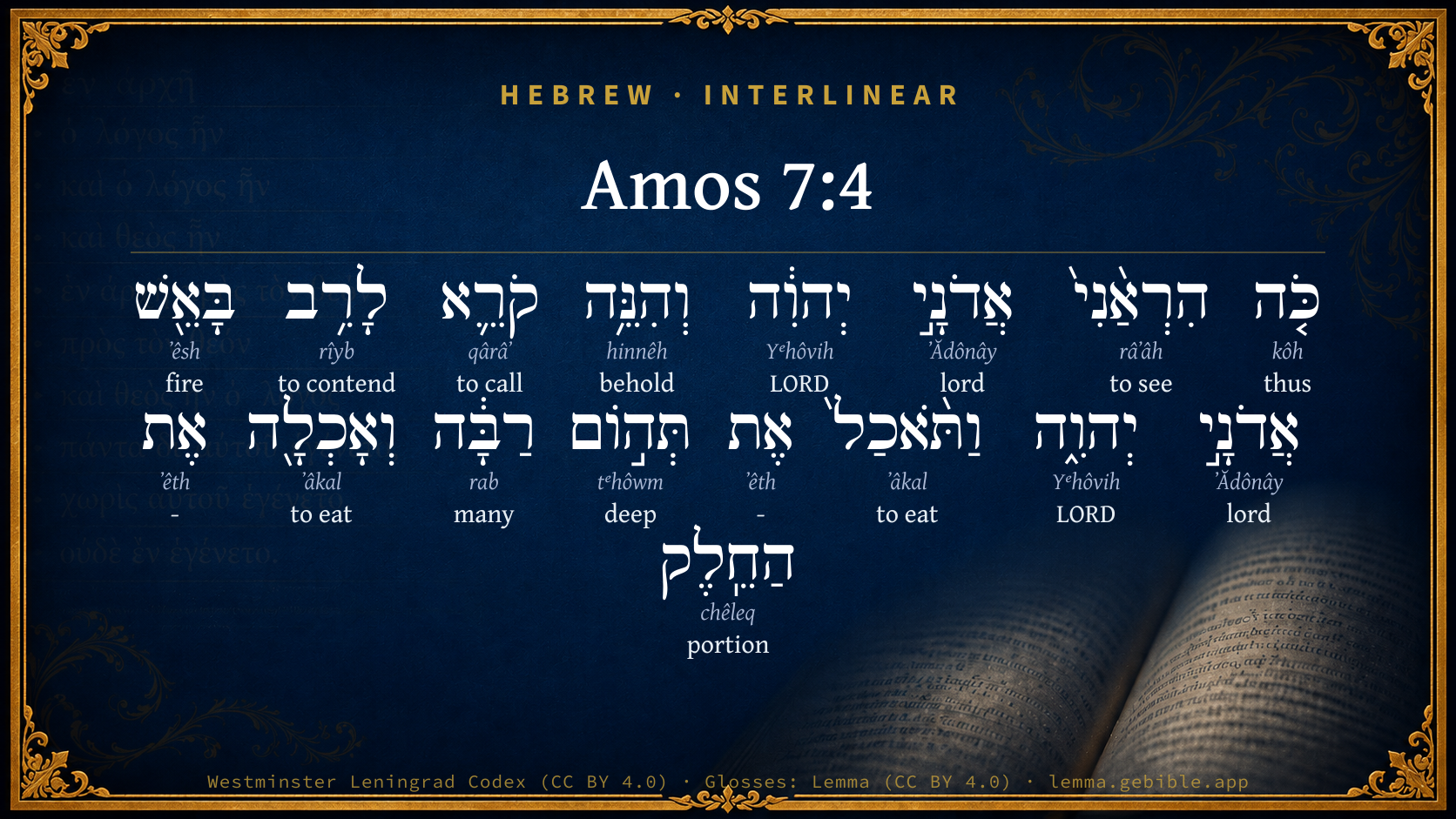
  1. כֹּ֤ה kôh H3541 “thus” Adverb
  2. הִרְאַ֨נִי֙ râʼâh H7200 “to see · me” Verb, Hiphil, Perfect, 3rd Person, Masculine, Singular + Suffix, Personal, 1st Person, Common, Singular
  3. אֲדֹנָ֣י ʼĂdônây H136 “Lord · my” Noun, Common, Masculine, Plural, Construct + Suffix, Personal, 1st Person, Common, Singular
  4. יְהוִ֔ה Yᵉhôvih H3069 “LORD” Noun, Proper
  5. וְהִנֵּ֥ה hinnêh H2009 “and · behold” Conjunction + Particle, Demonstrative
  6. קֹרֵ֛א qârâʼ H7121 “calling” Verb, Qal, Participle Active, Masculine, Singular, Absolute
  7. לָרִ֥ב rîyb H7378 “to contend” Preposition + Verb, Qal, Infinitive Construct
  8. בָּאֵ֖שׁ ʼêsh H784 “in/at the · fire” Preposition, Determined + Noun, Common, Both, Singular, Absolute
  9. אֲדֹנָ֣י ʼĂdônây H136 “Lord · my” Noun, Common, Masculine, Plural, Construct + Suffix, Personal, 1st Person, Common, Singular
  10. יְהוִ֑ה Yᵉhôvih H3069 “LORD” Noun, Proper
  11. וַתֹּ֨אכַל֙ ʼâkal H398 “and · to eat” Conjunction + Verb, Qal, Sequential Imperfect, 3rd Person, Feminine, Singular
  12. אֶת ʼêth H853 “-” Particle, Direct Object
  13. רַבָּ֔ה rab H7227 “many” Adjective, Adjective, Feminine, Singular, Absolute
  14. וְאָכְלָ֖ה ʼâkal H398 “and · to eat” Conjunction + Verb, Qal, Sequential Perfect, 3rd Person, Feminine, Singular
  15. אֶת ʼêth H853 “-” Particle, Direct Object
  16. הַחֵֽלֶק chêleq H2506 “the · portion” Particle, Definite Article + Noun, Common, Masculine, Singular, Absolute

About this verse

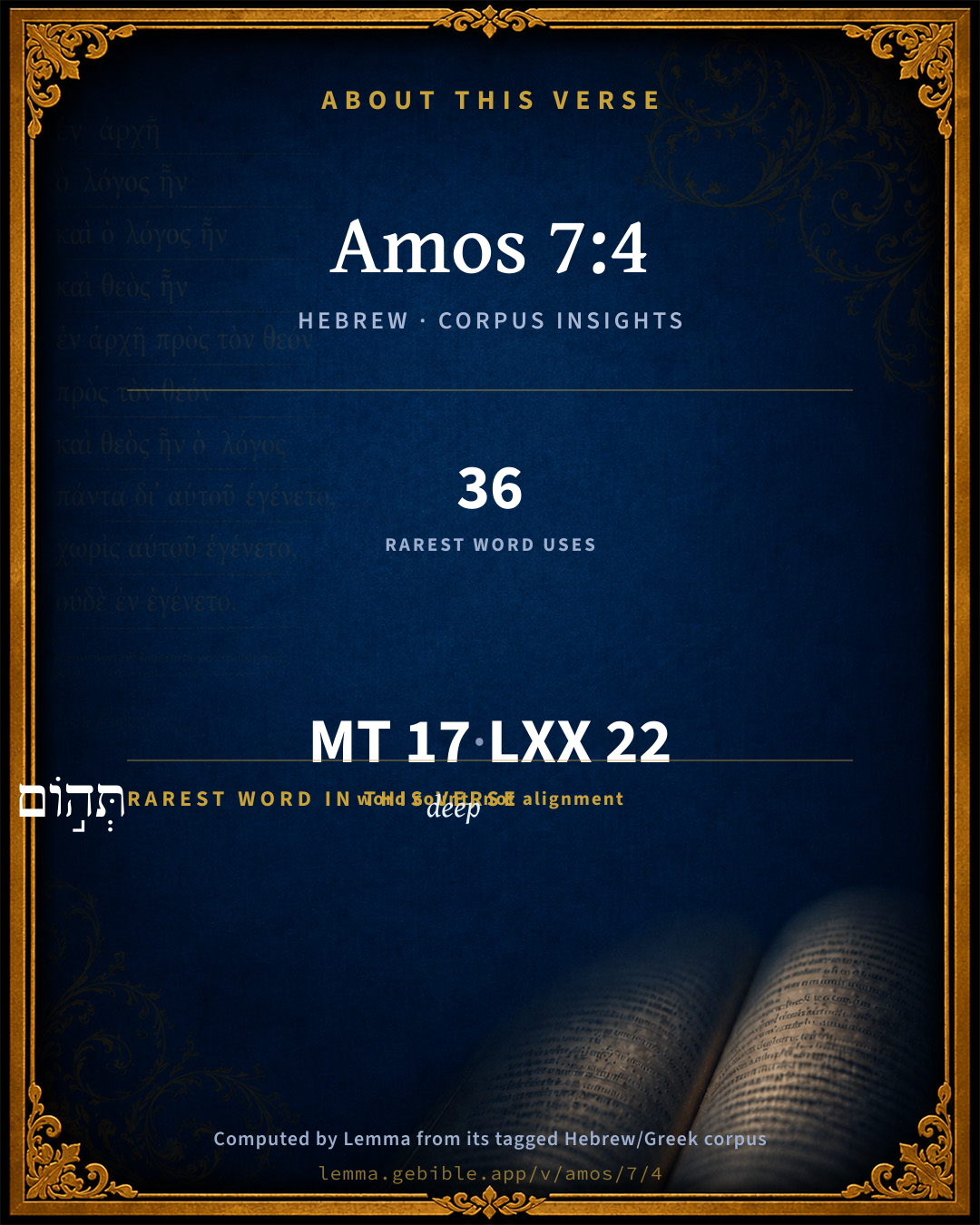
These counts appear in no published source. They are computed here, from the morphology-tagged text and Lemma’s own curated glosses. What Lemma adds →

17
words
13
distinct lemmas
Prophets
section

Shared distinctive vocabulary

תְּה֣וֹם deep H8415 occurs in 35 verses of the Hebrew Bible. Also found in:

Grammatical profile

  • 5 verbs
  • 7 nouns
  • 1 adjective
  • 1 adverb
  • 3 particles

Verb forms

  • הִרְאַ֨נִי֙ Hiphil · Perfect
  • קֹרֵ֛א Qal · Participle Active
  • לָרִ֥ב Qal · Infinitive Construct
  • וַתֹּ֨אכַל֙ Qal · Sequential Imperfect
  • וְאָכְלָ֖ה Qal · Sequential Perfect

Repetition

Words recur within this verse — often emphatic in Hebrew:

  • אֲדֹנָ֣י lord H136 ×2
  • יְהוִ֔ה LORD H3069 ×2
  • וַתֹּ֨אכַל֙ to eat H398 ×2

Hebrew & Septuagint length

In English translation the verse runs 29 words from the Hebrew and 26 from the Septuagint (LXX English) — closely comparable.

A rough comparison of the two English renderings, which tokenize alike — not a word-level alignment.

Word counts can differ between the Hebrew and the Greek without any difference in meaning — e.g. the Hebrew direct-object marker אֵת has no separate Greek word, and Greek often adds the article ὁ.

In the original languages it is 17 Hebrew tokens and 22 Greek tokens — but the two are counted differently (Hebrew bundles its prefixes and suffixes into one token; the Greek is in lemma form), so that isn’t a like-for-like length.

Cross-references

19

Topical passages linked to Amos 7:4 in the Treasury of Scripture Knowledge — connected by theme and wording, ordered by reader-vote popularity; previews shown in the World English Bible.

  • Isaiah 66:15–16 For, behold, Yahweh will come with fire, and his chariots shall be like the whirlwind; to render his anger with fierceness, and his rebuke with flames of fire.
  • Amos 7:1 Thus the Lord Yahweh showed me: and, behold, he formed locusts in the beginning of the shooting up of the latter growth; and, behold, it was the latter growth after the king's harvest.
  • Exodus 9:23–24 Moses stretched forth his rod toward the heavens, and Yahweh sent thunder, hail, and lightning flashed down to the earth. Yahweh rained hail on the land of Egypt.
  • Leviticus 10:2 And fire came forth from before Yahweh, and devoured them, and they died before Yahweh.
  • Numbers 16:35 Fire came forth from Yahweh, and devoured the two hundred fifty men who offered the incense.
  • Deuteronomy 32:22 For a fire is kindled in my anger, Burns to the lowest Sheol, Devours the earth with its increase, Sets on fire the foundations of the mountains.
  • Isaiah 27:4 Wrath is not in me: would that the briers and thorns were against me in battle! I would march on them, I would burn them together.
  • Jeremiah 4:4 Circumcise yourselves to Yahweh, and take away the foreskins of your heart, you men of Judah and inhabitants of Jerusalem; lest my wrath go forth like fire, and burn so that none can quench it, because of the evil of your doings.
  • Jeremiah 21:12 House of David, thus says Yahweh, Execute justice in the morning, and deliver him who is robbed out of the hand of the oppressor, lest my wrath go forth like fire, and burn so that none can quench it, because of the evil of your doings.
  • Joel 2:30 I will show wonders in the heavens and in the earth: Blood, fire, and pillars of smoke.
  • Amos 1:4 But I will send a fire into the house of Hazael, And it will devour the palaces of Ben Hadad.
  • Amos 1:7 But I will send a fire on the wall of Gaza, And it will devour its palaces.
  • Amos 4:11 "I have overthrown some of you, As when God overthrew Sodom and Gomorrah, And you were like a burning stick plucked out of the fire; Yet you haven't returned to me," says Yahweh.
  • Amos 5:6 Seek Yahweh, and you will live; Lest he break out like fire in the house of Joseph, And it devour, and there be no one to quench it in Bethel.
  • Amos 7:7 Thus he showed me and, behold, the Lord stood beside a wall made by a plumb line, with a plumb line in his hand.
  • Micah 1:4 The mountains melt under him, And the valleys split apart, Like wax before the fire, Like waters that are poured down a steep place.
  • Nahum 1:6 Who can stand before his indignation? Who can endure the fierceness of his anger? His wrath is poured out like fire, and the rocks are broken apart by him.
  • Hebrews 1:7 Of the angels he says, "Who makes his angels winds, And his servants a flame of fire."
  • Revelation 4:1 After these things I looked and saw a door opened in heaven, and the first voice that I heard, like a trumpet speaking with me, was one saying, "Come up here, and I will show you the things which must happen after this."

Cross-references courtesy of OpenBible.info (CC BY 4.0).

Hebrew and Greek witnesses Masoretic Hebrew ↔ Greek Septuagint

The same verse in the two great witnesses to the Old Testament, shown verse-for-verse.

These are two independent witnesses, not word-aligned to each other, and the Septuagint is shown in lemma (dictionary) form.

Hebrew Amos 7:4 Masoretic · Westminster Leningrad Codex

כֹּ֤ה הִרְאַ֨נִי֙ אֲדֹנָ֣י יְהוִ֔ה וְהִנֵּ֥ה קֹרֵ֛א לָרִ֥ב בָּאֵ֖שׁ אֲדֹנָ֣י יְהוִ֑ה וַתֹּ֨אכַל֙ אֶת תְּה֣וֹם רַבָּ֔ה וְאָכְלָ֖ה אֶת הַחֵֽלֶק

Thus the Lord Yahweh showed me and, behold, the Lord Yahweh called for judgment by fire; and it dried up the great deep, and would have devoured the land.

World English Bible · Public Domain

Greek LXX Amos 7:4 Septuagint · lemma form

οὕτως δεικνύω ἐγώ κύριος καί ἰδού καλέω ὁ δίκη ἐν πῦρ κύριος καί καταἐσθίω ὁ ἄβυσσος ὁ πολύς καί καταἐσθίω ὁ μερίς

Thus has the Lord showed me; and, behold, the Lord called for judgment by fire, and it devoured the great deep, and devoured the Lord's portion.

LXX2012 (modern English Septuagint) · Public Domain

On this verse, The Pulpit Commentary discusses the Septuagint’s reading. Read the note in Commentary ↓

Hebrew: Westminster Leningrad Codex (CC BY 4.0). Greek: Septuagint (public domain); English from LXX2012 (modern English Septuagint) (Public Domain). How the Septuagint differs from the Hebrew →

Targum (Aramaic paraphrase)

1

The Targum is the ancient Jewish Aramaic paraphrase of the Hebrew Scriptures — an interpretive translation, not the Hebrew text itself. Onkelos (literal) and Pseudo-Jonathan (expansive) render the Torah, and Jonathan the Prophets. Coverage is partial: where no permissively-licensed English translation exists for a verse, only the Aramaic is shown. This is verse-level text, not a word-by-word alignment to the Hebrew.

  1. Targum Jonathan Prophets (Joshua–Malachi)
    כִּדְנַן אַחְזְיַנַי יְיָ אֱלֹהִים וְהָא עֲתִיד לְמִדַן בְּאֶשְׁתָּא יְיָ אֱלֹהִים וַאֲכָלַת יַת תְּהוֹם רַבָּא וְשַׁצִיאַת יַת אַחְסַנְתָּא:

    (no public-domain English translation for this verse)

    Targum Jonathan — Aramaic: “Mikraot Gedolot” (public domain). English: “Sefaria Community Translation” (CC0 1.0 (public-domain dedication)); “London "Chaldee Paraphrase," 1871” (public domain). Text via Sefaria.

Commentary

Notes on Amos 7:4 from classic Christian and Jewish commentators (each source and its license shown beneath its notes). The classic Christian expositions comment on the surrounding passage and are grouped to its opening verse, so a note may address several verses; the Jewish commentaries on the Tanakh (Rashi and others) are per-verse, so they appear only where the commentator wrote on this verse.

Lemma curates 59 commentaries, every one of them public domain or Creative Commons licensed, each selected and text-cleaned for this edition rather than reprinted as found. About our sources →

Trapp's Complete Commentary

John Trapp

Amo 7:4 Thus hath the Lord GOD shewed unto me: and, behold, the Lord GOD called to contend by fire, and it devoured the great deep, and did eat up a part.

Ver. 4. And, behold, the Lord God] Whose asterisk, or starry note, this "behold" is, saith Tarnovius, stirring up to attention. Another compareth it to a hand in the margin of a book, pointing to some notable thing. Another, to the sounding of a trumpet before some proclamation; or to the ringing of a bell before the sermon of some famous preacher.

The Lord God called to contend by fire] That is, by parching heat and drought, causing dearth, as Joe 1:19. For which purpose God called his angels, those ministering spirits, that execute his judgments upon the wicked (as they did once upon Sodom), to contend for him (a metaphor from civil courts), to plead for him by fire, to destroy the perverse Israelites by fire and brimstone, Isa 66:16 Eze 38:22, as they had done Sodom and Gomorrah (so some interpret it according to the letter); or by the woe of war, compared to fire, Isa 26:11, as being a misery which all words (however wide) want compass to express; or, by immoderate heat and drought, as before; so great, that

it devoured the great deep] as that fire of the Lord in Elijah’s time licked up the water that was in the trench, 1Ki 18:38. See Isa 51:10.

And did eat up a part] Or, it devoured also the field: not only the waters in and under the earth, that serve to make it fruitful, but a part of the earth itself; which was altogether above and against the common course of nature. Some render it, and did eat up that part, or that field, sc. that mentioned Amo 7:1, the king’s field; that as the king had chiefly offended, so he should be principally punished. Others interpret it by Amo 4:7, "One piece was rained upon, and the piece whereon it rained not withered."

John Trapp, A Commentary or Exposition upon All the Books of the Old and New Testament (1647–1656) — public domain. Text from a community e-Sword module.

Joseph Benson's Commentary

Amo 7:4-6. The Lord God called to contend by fire, &c. — This represented a sorer judgment than the former, and, in the opinion of some expositors, denoted the invasion of Tiglath-pileser, who carried a great part of Israel away captive, 2Ki 15:29, and so was properly represented by a raging fire, which consumed the sea by turning it into vapours, and then devoured a great part of the land. Then said I, O Lord God, cease, I beseech thee, &c. — Here the prophet observes, that upon this judgment being represented to him in his vision, he made supplication to God as he had done before, and that God hearkened to him in this instance also, and promised that this judgment should not be executed, or should have a stop put to it.

Joseph Benson's Commentary on the Old and New Testaments (1811–1818) — public domain. Text from a community e-Sword module.

Keil & Delitzsch

C. F. Keil & F. Delitzsch

The Devouring Fire. - Amo 7:4. "Thus the Lord Jehovah showed me: and, behold, the Lord Jehovah called to punish with fire; and it devoured the great flood, and devoured the portion. Amo 7:5. And I said, Lord Jehovah, leave off, I pray: how can Jacob stand? for it is small. Amo 7:6. Jehovah repented of this; this also shall not take place, said the Lord Jehovah." That the all-devouring fire represents a much severer judgment than that depicted under the figure of the locusts, is generally acknowledged, and needs no proof. But the more precise meaning of this judgment is open to dispute, and depends upon the explanation of the fourth verse. The object to קרא is לריב בּאשׁ, and ריב is to be taken as an infinitive, as in Isa 3:13 : He called to strive (i.e., to judge or punish) with fire. There is no necessity to supply ministros suos here. The expression is a concise one, for "He called to the fire to punish with fire" (for the expression and the fact, compare Isa 66:16). This fire devoured the great flood. Tehōm rabbâh is used in Gen 7:11 and Isa 51:10, etc., to denote the unfathomable ocean; and in Gen 1:2 tehōm is the term applied to the immense flood which surrounded and covered the globe at the beginning of the creation. ואכלה, as distinguished from ותּאכל, signifies an action in progress, or still incomplete (Hitzig). The meaning therefore is, "it also devoured (began to devour) 'eth-hachēleq;" i.e., not the field, for a field does not form at all a fitting antithesis to the ocean; and still less "the land," for chēleq never bears this meaning; but the inheritance or portion, namely, that of Jehovah (Deu 32:9), i.e., Israel. Consequently tehōm rabbâh cannot, of course, signify the ocean as such. For the idea of the fire falling upon the ocean, and consuming it, and then beginning to consume the land of Israel, by which the ocean was bounded (Hitzig), would be too monstrous; nor is it justified by the simple remark, that "it was as if the last great conflagration (Pe2 3:10) had begun" (Schmieder). As the fire is to earthly fire, but the fire of the wrath of God, and therefore a figurative representation of the judgment of destruction; and as hachēleq (the portion) is not the land of Israel, but according to Deuteronomy (l.c.) Israel, or the people of Jehovah; so tehōm rabbâh is not the ocean, but the heathen world, the great sea of nations, in their rebellion against the kingdom of God. The world of nature in a state of agitation is a frequent symbol in the Scriptures for the agitated heathen world (e.g., Psa 46:3; Psa 93:3-4). On the latter passage, Delitzsch has the following apt remark: "The stormy sea is a figurative representation of the whole heathen world, in its estrangement from God, and enmity against Him, or the human race outside the true church of God; and the rivers are figurative representations of the kingdoms of the world, e.g., the Nile of the Egyptian (Jer 46:7-8), the Euphrates of the Assyrian (Isa 8:7-8), or more precisely still, the arrow-swift Tigris of the Assyrian, and the winding Euphrates of the Babylonian (Isa 27:1)." This symbolism lies at the foundation of the vision seen by the prophet. The world of nations, in its rebellion against Jehovah, the Lord and King of the world, appears as a great flood, like the chaos at the beginning of the creation, or the flood which poured out its waves upon the globe in the time of Noah. Upon this flood of nations does fire from the Lord fall down and consume them; and after consuming them, it begins to devour the inheritance of Jehovah, the nation of Israel also. The prophet then prays to the Lord to spare it, because Jacob would inevitably perish in this conflagration; and the Lord gives the promise that "this shall not take place," so that Israel is plucked like a firebrand out of the fire (Amo 4:11).

If we inquire now into the historical bearing of these two visions, so much is priori clear, - namely, that both of them not only indicate judgments already past, but also refer to the future, since no fire had hitherto burned upon the surface of the globe, which had consumed the world of nations and threatened to annihilate Israel. If therefore there is an element of truth in the explanation given by Grotius to the first vision, "After the fields had been shorn by Benhadad (Kg2 13:3), and after the damage which was then sustained, the condition of Israel began to flourish once more during the reign of Jeroboam the son of Joash, as we see from Kg2 14:15," according to which the locusts would refer to the invasion on the part of the Assyrians in the time of Pul; this application is much too limited, neither exhausting the contents of the first vision, nor suiting in the smallest degree the figure of the fire. The "mowing of the king" (Amo 7:1) denotes rather all the judgments which the Lord had hitherto poured out upon Israel, embracing everything that the prophet mentions in Amo 4:6-10. The locusts are a figurative representation of the judgments that still await the covenant nation, and will destroy it even to a small remnant, which will be saved through the prayers of the righteous. The vision of the fire has a similar scope, embracing all the past and all the future; but this also indicates the judgments that fall upon the heathen world, and will only receive its ultimate fulfilment in the destruction of everything that is ungodly upon the face of the earth, when the Lord comes in fire to strive with all flesh (Isa 66:15-16), and to burn up the earth and all that is therein, on the day of judgment and perdition of ungodly men (Pe2 3:7, Pe2 3:10-13). The removal of the two judgments, however, by Jehovah in consequence of the intercession of the prophet, shows that these judgments are not intended to effect the utter annihilation of the nation of God, but simply its refinement and the rooting out of the sinners from the midst of it, and that, in consequence of the sparing mercy of God, a holy remnant of the nation of God will be left. The next two visions refer simply to the judgment which awaits the kingdom of the ten tribes in the immediate future.

Keil & Delitzsch — Biblical Commentary on the Old Testament (1861–1891) — public domain (CC PDM 1.0). Text via the HelloAO Bible API. (Old Testament only.)

Tyndale Open Study Notes

Tyndale Open Resources

7:4 This fire symbolizes oppressive heat and drought. • depths of the sea: Although the Hebrew word properly indicates the sea, Amos probably did not suppose that the Mediterranean would disappear. More likely, this is a poetic reference to large bodies of fresh water (such as the Kinnereth Sea/Sea of Galilee) that Israel could use to irrigate its fields.

Tyndale Open Study Notes — © Tyndale Open Resources, licensed CC BY-SA 4.0. Text via the HelloAO Bible API.

Geneva Bible (1599)

Geneva Bible translators

Meaning, that God’s indignation was inflamed against the stubbornness of this people.

Geneva Bible (1599) marginal notes — public domain. Text via Bolls.life.

Jamieson, Fausset & Brown

Robert Jamieson, A. R. Fausset & David Brown

called to contend--that is with Israel judicially (Job 9:3; Isa 66:16; Eze 38:22). He ordered to come at His call the infliction of punishment by "fire" on Israel, that is, drought (compare Amo 4:6-11), [MAURER]. Rather, war (Num 21:28), namely, Tiglath-pileser [GROTIUS].

devoured the . . . deep--that is a great part of Israel, whom he carried away. Waters are the symbol for many people (Rev 17:15).

did eat up a part--namely, all the land (compare Amo 4:7) of Israel east of Jordan (Ch1 5:26; Isa 9:1). This was a worse judgment than the previous one: the locusts ate up the grass: the fire not only affects the surface of the ground, but burns up the very roots and reaches even to the deep.

Jamieson, Fausset & Brown — Commentary Critical and Explanatory on the Whole Bible (1871) — public domain (CC PDM 1.0). Text via the HelloAO Bible API.

Adam Clarke's Commentary

Verse 4. The Lord God called to contend by fire] Permitted war, both civil and foreign, to harass the land, after the death of Jeroboam the second. These wars would have totally destroyed it, had not the prophet interceded.

It devoured the great deep, and did eat up a part.] We are here to understand the partially destructive wars which afterwards took place; for the Lord causes all these things to pass before the eyes of Amos in the vision of prophecy; and intimates that, at the intercession of his prophets, total ruin should be prevented.

Adam Clarke's Commentary on the Bible (1810–1826) — public domain. Text from a community e-Sword/MySword module.

John Calvin's Commentaries

The Prophet shows that God had not once only spared the people, but that when he was again prepared for vengeance, he still willingly deferred it, that, if possible, the people might willingly recover themselves: but as all were unhealable, this forbearance of God produced no fruit. Now as to the words of the Prophet, we see that a heavier punishment is designated by the similitude of fire, than by what he said before when he spoke of locusts. We stated that by locusts is to be understood ordinarily a moderate punishment, one not so dreadful at first sight. For though the want and famine introduced by locusts, when they consume all kinds of fruit, are most grievous evils; yet fire sometimes strikes people with much greater dread. Hence the Prophet shows by mentioning fire, that God had become very indignant, having seen that the people had hardened themselves and could not be reformed by common and usual remedies. The Lord’s usual mode of proceeding, as he declares everywhere in Scriptures is this: At first he tries to find whether men are capable of being healed, and applies not the most grievous punishment, but such as may be endured; but when he perceives in sinners hardness and obstinacy, he doubles and trebles the punishment, yea, as he says by Moses, he increases his judgments sevenfold (Deuteronomy 28:25.) Such then was the manner which Amos now records; for God at first created the locusts, and then he kindled a fire, which consumed the great deep, and devoured their possession.

The point, denoting a participial form in the word here used, shows that they are mistaken who render יוצר, iutsar, creation, of which we have spoken before; for the point here corresponds with that in יוצר, iutsar, . In both places the Lord shows himself to be the author of punishment, which is wont to be ascribed to chance; for men imagine that evils proceed from something else rather than from God. Hence it was necessary for this to be distinctly expressed, as the Prophet does also, when he says that locusts had been created by God, and that fire had been kindled by him.

God then called to contend by fire. It was not without a design that the Prophet uses the verb רוב, rub, which yet expositors have not duly weighed. For he indirectly condemns the hardness of the people, inasmuch as the Lord had already not only chastised the vices of the people, but had also contended with men depraved and obstinate: as when no justice can be obtained, a litigation becomes necessary; so the Prophet says here, that God was coming prepared with fire, to contend with the stubbornness of the people. The great deep, he says, was consumed by this fire. Hence what I have already said becomes more evident, — that a more dreadful punishment is here described than in the first vision. The locusts devoured the grass only but the fire penetrates into the utmost deep; it consumes and destroys not only the surface of the earth, but burns up the very roots, yea, it descends to the center and consumes the whole earth. They who render חלק, chelak, a part, do not sufficiently attend to the design of the Prophet, for he concludes that the surface of the earth had been laid waste, because the very gulfs had not escaped the burning. And when the fire reaches to the very bowels of the earth, how could their possession stand, which was also exposed to the heat of the sun? We see how the earth is burnt up by heat, when the sun is scorching at Midsummer. We now perceive the Prophet’s design.

John Calvin's Commentaries (1540-1563) — public domain. Text from the Calvin Translation Society English edition (1840s-50s) via the Christian Classics Ethereal Library (ccel.org). Calvin's coverage is partial (roughly two-thirds of the Bible); uncommented books and verses are honest gaps, never fabricated. The 19th-century editor's footnotes and remarks are omitted so the notes are faithfully Calvin's own voice.

Ellicott's Commentary for English Readers

(4) Fire.—The poetical description of a yet more terrible calamity. God announces His intention of judging, i.e., punishing by fire (the word in E.V., “contend,” is to be understood in this sense). For “a portion” read the portion. The image is that of a prairie fire, that should eat up the later grass spared by the locusts. The consuming of the “great deep” is a strong hyperbole, and can scarcely refer to the “heathen world,” as Keil maintains. The meaning rather appears to be that not only the solitary remnant of pasture, but the deepest springs of moisture, will be scorched up in the blaze. The same word for “deep” (tehôm) is used in Gen_1:2; Gen_7:11; Gen_8:2. (Comp. the Assyrian tihamtu.)

A Bible Commentary for English Readers, edited by Charles John Ellicott (1878–1897) — public domain. Text from a community e-Sword module.

The Cambridge Bible for Schools and Colleges

gen. ed. J. J. S. Perowne

4–6. The second vision. The devouring fire.

called to contend by fire] Jehovah arraigns His people: and fire is the agent which he summons against them (cf. to dispute, or litigate, with fire, Isa_66:16). For the idea of Jehovah’s contending (in a forensic sense) with His people, comp. Isa_3:13; Jer_2:9; Hos_4:1; Mic_6:2 (where the corresponding substantive is rendered controversy); and for calleth, comp. on Amo_7:8.

and it devoured the great deep, and would have devoured the portion] The imagery is suggested, no doubt, by the conflagrations which, in the East, break out in field and forest during the dry season (Joe_1:19-20), and spread with alarming rapidity (comp. Psa_83:14, Isa_9:18; and see Thomson, The Land and the Book, ii. 291–293). So fierce was the flame thus kindled that it even dried up the ‘great deep’ (Gen_7:11), the subterranean waters upon which the Hebrews imagined the earth to rest (Gen_1:7; Exo_20:4; Psa_24:2), and whence they supposed all its springs and fountains to have their supply; when these were exhausted, “it seemed as if the solid framework of the land, described with very apt pathos as the Portion (i.e. the portion [Mic_2:3, &c.] assigned by God to His people), would be the next to disappear” (G. A. Smith, p. 111). The judgement is thus a more severe one than that of the locusts.

The Cambridge Bible for Schools and Colleges (gen. ed. J. J. S. Perowne; Cambridge University Press, 1878–1918) — public domain. Text from a community e-Sword module.

John Gill's Exposition

Thus hath the Lord showed unto me,.... Another vision after this manner:

and, behold, the Lord God called to contend by fire; gave out that he would have a controversy with his people Israel, and proclaimed the time when he would try the cause with them, and that by fire: or he called his family, as Jarchi; that is, his angels, as Kimchi, to cause fire to descend upon Israel, as upon Sodom and Gomorrah; so other Rabbins Kimchi mentions: or, as he interprets it, the scorching heat of the sun, like fire that restrained the rain, dried up the plants, and lessened the waters of the river, and so brought on a general drought, and in consequence famine: or rather a foreign army, involving them in war, burning their cities and towns; see Amo 1:4;

and it devoured the great deep; it seemed, as if it did; as the fire from heaven, in Elijah's time, licked up the water in the trench, Kg1 18:38; so this, coming at God's command, seemed to dry up the whole ocean; by which may be meant the multitude of people, nations, and kingdoms, subdued by the Assyrians; see Rev 17:15;

and did eat up a part; a part of a field, as Jarchi and Aben Ezra; of the king's field, Amo 7:1; as Kimchi; showing, as he observes, that the reigning king was a bad king, and that this was for his sin: or rather a part of the land of Israel; and so refers, as is generally thought, to Tiglathpileser's invasion of the land, who carried captive a part of it, Kg2 15:29.

John Gill's Exposition of the Whole Bible (1746–1763) — public domain (CC PDM 1.0). Text via the HelloAO Bible API.

Albert Barnes' Notes on the Bible

God called to contend by fire - that is, He “called” His people to maintain their cause with Him “by fire,” as He says, “I will plead” in judgment “with him” (Gog) “with” (that is,” by”) pestilence and blood” Eze 38:22; and, “by fire and by His sword will the Lord plead with all flesh” Isa 66:16; and, “The Lord standeth up to plead and standeth to judge the people” Isa 3:13. Man, by rebellion, challenges God’s Omnipotence. He will have none of Him; he will find his own happiness for himself, apart from God and in defiance of Him and His laws; he plumes himself on his success, and accounts his strength or wealth or prosperity the test of the wisdom of his policy. God, sooner or later, accepts the challenge. He brings things to the issue, which man had chosen. He “enters into judgment” (Isa 3:14, etc.) with him. If man escapes with impunity, then he had chosen well, in rejecting God and choosing his own ways. If not, what folly and misery was his short-sighted choice; short-lived in its gain; its loss, eternal! “Fire” stands as the symbol and summary of God’s most terrible judgments. It spares nothing, leaves nothing, not even the outward form of what it destroys. Here it is plainly a symbol, since it destroys “the sea” also, which shall be destroyed only by the fire of the Day of Judgment, when “the elements shall melt with fervent heat, the earth also and the works that are therein shall be burned up” 2Pe 3:10. The sea is called the “great deep,” only in the most solemn language, as the history of the creation or the flood, the Psalms and poetical books. Here it is used, in order to mark the extent of the desolation represented in the vision.

And did eat up a part - Rather literally, “The portion,” that is, probably the definite “portion” foreappointed by God to captivity and desolation. This probably our English Version meant by “a part.” For although God calls Himself “the Portion” of Israel Deu 32:9; Jer 10:16; Zec 2:12, and of those who are His (Psa 16:5; Psa 73:26, etc; Jer 10:16), and reciprocally He calls the people “the Lord’s portion Jer 12:10, and the land, the portion Mic 2:4 of God’s people; yet the land is nowhere called absolutely “the portion,” nor was the country of the ten tribes specially “the portion,” given by God. Rather God exhibits in vision to the prophet, the ocean burned up, and “the portion” of Israel, upon which His judgments were first to fall. To this Amos points, as “the portion.” God knew “the portion,” which Tiglath-Pileser would destroy, and when he came and had carried captive the east and north of Israel, the pious in Israel would recognize the second, more desolating scourge, foretold by Amos; they would own that it was at the prayer of the prophet that it was stayed and went no further, and would await what remained.

Albert Barnes' Notes on the Bible (1834–1885) — public domain. Text from a community e-Sword/MySword module.

Haydock's Catholic Bible Commentary

Part of the land, if the prophet had not interposed; (ver. 6.; Calmet) or rather civil wars desolated a great part of the kingdom, before the Lord was appeased. (Haydock) --- The fire foreshewed the captivity of the two tribes, 4 Kings xxiv. (Worthington)

George Leo Haydock (1774–1849), Haydock's Catholic Family Bible and Commentary, 1859 edition — public domain. Excludes Psalms (Douay-Rheims chapter numbering differs from Protestant) and Deuterocanonical books (Catholic canon only).

Matthew Poole's English Annotations

Thus hath the Lord God showed, in vision or hieroglyphic: see Amo 7:1.

And, behold: see Amo 7:1.

Called to contend by fire; declared he would judge as by fire: literally, say some, God would from heaven by fire punish. Others say metaphorically, by drought which should scorch up all fruits of the earth, and dry up fountains and rivers. Or else by very sore, wasting, and irresistible judgments, that like fire should consume all, hereby denoting the Assyrian rage.

It devoured; eat up, i.e. visionally, or in the emblem.

The great deep; not literally, but, as the other, Amo 7:2, in hieroglyphic; so it appeared to Amos.

And did eat up a part of the land too; it seemed to seize on the earth: now this in vision awakens the prophet, as before, to pray earnestly.

Matthew Poole's English Annotations on the Holy Bible (1683–1685) — public domain. Text from a community e-Sword/MySword module.

Whedon's Commentary on the Bible

Daniel D. Whedon

4-6. The devouring fire — A second vision, presenting essentially the same truth as the first.

Called to contend by fire — Called the fire to contend with it. Instead of the locusts Jehovah selected the fire as the agency through which to execute judgment. For representations of Jehovah as entering into judicial controversy with his people see Hos_4:1; Mic_6:2; Isa_3:13-15. The imagery was suggested probably by conflagrations or by excessive summer heat accompanied by drought (see on Joe_1:20).

The great deep — The deep subterranean waters upon which the earth was thought to rest, and which was thought to supply the water for springs and rivers (Gen_7:11; Psa_24:2, etc.). The fire or heat was so intense that the water dried up. The language is hyperbolical.

And did eat up — Better, R.V., “and would have eaten up.”

A part — R.V., “the land”; literally, the portion, the portion set apart for human habitation. The expression cannot be restricted to the land of Israel; it means the land as distinguished from the great deep. The land was about to be devoured, when the prophet interceded once more.

Cease — Not “forgive” (Amo_7:2). The provocation was too great; Amos felt that he did not dare ask for pardon; but perchance Jehovah might avert the final doom. And again Jehovah graciously granted the petition. The description is poetical but not allegorical. The imagery in the two visions was selected because plagues of locusts and disastrous conflagrations were familiar to the people.

Daniel D. Whedon (gen. ed.), Commentary on the Old and New Testaments (1874–1909) — public domain. Text from a community e-Sword module.

The Pulpit Commentary

Vers. 4-6. The second vision devouring fire, represents a more severe judgment than the preceding one, involving greater consequences, but still one which was again modified by the prayers of the righteous prophet.

Called to contend by fire; Septuaguint, ekalese thkhn en puri , "called for judgment by fire;" Vulgate, vocabat judicium ad ignem. God called the people to try their cause with him by sending fire as a punishment among them; (comp. Isa_66:16 Eze_38:22) and in the vision the fire is represented as so vehement that it devoured the great deep, drank up the very ocean itself; (Gen_7:11 Isa_51:10) or the subterranean fountains and springs, as Gen_49:25. And did eat up a part; thda kuriou (Septuagint). This version takes eth-hacheleq as the "inheritance" or "portion" of the Lord, i.e. the land of Israel; (Jer_12:10) but Canaan is nowhere called absolutely "the portion;" nor were the ten tribes specially so designated. Rather, the portion (not a part) is that part of the land and people which was marked out for judgment. The particular calamity alluded to is the second invasion of Tigiath-Pileser II, when he conquered Gilead and the northern part of the kingdom, and carried some of the people captive to Assyria. (2Ki_15:29)

Vers. 4-6. The vision of consuming fire.

The prophet"s vision goes on, and the situation in it becomes more critical. One woe is averted only for a worse to take its place. The Divine avenging hosts remain in battleline. They return to the attack with renewed vigour. For the fusillade is substituted the booming of the great guns. Escaping as by the skin of their teeth from the wasting locust, incorrigible Israel are met in the prophet"s eye by the devouring fire. In connection with this second scene in the panoramic vision notice

I GOD CONTENDING BY FIRE. Again and again is it so in Scripture.

It is the most destructive element in nature. It destroys all comfort, inflicting intense pain. It destroys all life, no animal or vegetable organism being capable of enduring it. It destroys the very form of organic matter, reducing it to its original elements. It destroys with unparalleled rapidity and thoroughness almost anything it attacks.

It is the element used and to be used by God in bringing about the greatest catastrophes. It was in the fire shower from heaven that Sodom was overwhelmed. (Gen_19:24) Fire "very grievous" was mingled with the plague of hail which smote the land of Egypt. (Exo_9:24) It was the fire of the Lord that burnt up complaining Israel at Taberah, and also Korah and his company in their gainsaying. (Num_11:1 Num_26:10) By fire from heaven were Ahaziah"s two captains and their fifties consumed before Elijah. (2Ki_1:10-12) It was by bringing down fire that James and John proposed to destroy the inhospitable Samaritans Luk_9:54). And it is in a lake burning with fire that the beast, the false prophet, and all the finally impenitent shall be overwhelmed at last.

It is in Scripture a frequent emblem of active power. God the Father in wrath, (Deu_4:24 Deu_9:3) God the Son in judgment, (2Th_1:8) God the Holy Ghost in grace, are each so figured. (Luk_3:16) Indwelling sin is fire; (1Co_7:9 2Co_11:29) the busy mischief-making tongue is fire; (Jam_3:6) God"s Word is a fire; (Jer_23:29) his ministers are "burning ones" (seraphim); spiritual life is fire; (Luk_12:49) affliction is fire; (1Co_3:13 1Pe_4:12) and the misery of the finally lost is fire. (Mar_9:44) A God contending by fire is a God putting forth the extreme of destructive energy.

II JUDGMENT DRINKING UP THE GREAT DEEP. As the fire is figurative, so probably is the "deep." It is the heathen world. God"s judgment which includes this is:

1. Discriminating. "The deep." The sweltering, restless sea is a fit symbol of the wicked in their unrest of heart and rebellion against God. (Isa_57:20 Psa_46:3) These are the natural prey of the eagles of judgment. They deserve it, provoke it, and are its characteristic objects. The righteous may suffer sometimes with the wicked, but the ungodly cannot escape.

2. Extensive. "The great deep." Not merely "wells," which are individuals, (2Pe_2:7) nor "rivers," which are nations, (Isa_8:7 Jer_46:7, Jer_46:8) nor "seas," which are races, (Psa_65:7 Isa_17:12) but "the great deep," or rebellious humanity in its entire extent, shall be contended with and destroyed. When the last word has been spoken God"s argument against sin will be overwhelming; and all the ground covered by sin will have been covered also by judgment.

III JUDGMENT EATING UP "THE PORTION" DOOMED. "Probably the definite portion foreappointed by God to captivity and desolation" (Pusey).

God"s acts are coextensive with his decrees. His plan has reference to all events, and these in turn exactly embody his plan. He had devoted beforehand a definite number to judgment; and all these, and these only, would it eat up in the day of its falling. No tares escape, nor is any wheat burned. "The Lord knoweth them that are his.

To be nominally God"s people establishes no special relation to him. Outward relations, if they have not inward relations to which they correspond, are nothing. Mere names and semblances leave unchanged the underlying realities which God regards, and to which his dealings are adjusted. A hollow profession is simply unbelief plus hypocrisy.

God"s judgments on his professing people are not for annihilation, but for weeding out. The "portion" was not all Israel. (Isa_10:20-22 Isa_37:31, Isa_37:32) After it had been devoured, a remnant would remain. Judgments are the gardener"s knife; they prune out the worthless branches, but leave the tree. Exposure to the wind is not for destruction of the wheat, but for the scattering of the chaff. In the track of the fire is to be found all that is fireproof.

IV THE LEGITIMATE MEASURE OF ASKING IN PRAYER. (Ver. 5.) It seems a forlorn hope to offer such prayer. Yet here it is done by a man under the guidance of God"s Spirit. In imitation of him:

We may ask anything that is innocent. It may not be promised. No one else may have received it. It may be a thing utterly unlikely to be done. It may be what God is threatening not to do. Yet it is legitimate matter of prayer, and we need not despair of it. God cannot do less than he promises, but he may do more; and, as a matter of fact, he does much for which no explicit promise is to be found.

We may ask any amount that can be enjoyed. God"s is no niggard heart or hand. He has exhaustless store. He loves to see us filled and thoroughly furnished. Hence he giveth liberally, satisfies with his mercy, gives all we can receive, and more than we can ask or think. Economy in asking where there is infinity to draw on is modesty run mad.

We may ask it up till the last moment. White, in the nature of things, answer is possible, request may be made. Who knows whether evil may not be averted until it has actually fallen? Besieged cities have been saved even after the garrison had thrown open the gates, and battles won after the ranks of the victors had begun to break. With God all things are possible, and by prayer he is always moved. Till the moment of death we may pray for life, for salvation till the moment of destruction.

Having received, we may ask again and again. "Men ought always to pray." Prayer has reference to returning wants, and is normally a habit of soul. As often as we hunger we eat, and, on the same principle, as often as we need we pray. Continued prayer is matter of necessity, a command of God, and an instinct of the soul. "In everything by prayer and supplication," etc. Half a century later the mercy of God"s dealings appeared. After ravaging the greater portion of the land, the Assyrians unaccountably withdrew, and left the capital untouched. The connection between Amos"s prayer and the unwonted slackness of Tiglath-Pileser belongs to that region into which sense cannot penetrate, but which is air patent to the eye of faith.

V THE MERCIFUL ASPECT OF GOD"S THREATS. (Ver. 6.) The perseverance of the prophet"s prayer is justified by the event. God"s threat is not executed. Judgment is arrested on the way. Does God, then, change? No; but circumstances do, and with them his adjusted mode of action. The unexecuted threat is not unmeaning nor unnecessary.

It forewarns of the coming evil. When the black clouds rise we know the storm is brewing. So when God speaks we know he is going to act and how. A threat is a conditional prophecy. It tells us exactly what, in given circumstances, we may expect. Knowledge of the evil coming is a prerequisite to any measure of precaution.

It thereby often turns from the path in which the evil lies. All actions have their proper issues, and whatever changes the one changes the other. God"s judgments are directed against us as transgressors in a certain way. If we cease so to transgress the reason for them is gone, and they will not be sent. The knowledge of these two tarts operates as a powerful incentive to reformation, and so a means to the arrest of impending judgment. We face a different way when we adequately realize that we thereby face a different end.

1. It displays God"s character in a most art, active aspect. He warns before he strikes. He warns that he may not need to strike at all. His threats are the merciful heralds of his judgments, offering terms of peace before the stern hour of intervention arrives. "Except ye repent, ye shall all likewise perish." A threat like that is only a promise in disguise. It speaks of a gracious heart which "wills not that any should perish, but that all should come to repentance."

The Pulpit Commentary (1880–1919), ed. H.D.M. Spence-Jones & Joseph S. Exell — public domain. Text from a community e-Sword module.

John Wesley's Explanatory Notes

Shewed - In vision. Called - Commanded fire from heaven. A part - Of the land too.

John Wesley, Explanatory Notes Upon the Whole Bible (1754–1765) — public domain. Text via the GEBible commentary corpus.

unfoldingWord translationNotes

Door43 World Missions Community

Look

The writer is telling the reader that something surprising is about to happen. Your language may have a way of doing this.

the Lord Yahweh called on fire to judge

"the Lord Yahweh used burning fire to punish the people"

how will Jacob survive? For he is so small.

Here "Jacob" represents his descendants the Israelites. See how you translated this in Amos 7:2. AT: "how will the Israelites survive? We are so small and weak!" (See: Metonymy)

translationWords

Lord Yahweh

judge

earth

devour

unfoldingWord translationNotes — © Distant Shores Media and the Door43 World Missions Community, licensed CC BY-SA 4.0. Source: git.door43.org/Door43/en_tn.

Rashi

Rabbi Shlomo Yitzchaki (Rashi)

showed me—another retribution to bring upon them.

and behold... calls—His household to contend with them by the retribution of the kindling of fire.

the field Heb. הַחֵלֶק, the parcel of land.

Rashi on the Tanakh — English translations: “The Judaica Press complete Tanach with Rashi, translated by A. J. Rosenberg” (CC BY 4.0); “Pentateuch with Rashi's commentary by M. Rosenbaum and A.M. Silbermann, 1929-1934” (public domain); “The Metsudah Tanach series, Lakewood, N.J” (CC BY 4.0); and “The Book of Joshua, Metsudah Publications, 1997” (CC BY 4.0). Text via Sefaria.

Lesson kit

Teaching starters — assembled from the data on this page, not authored interpretation. Every prompt links to the verse data it draws on. Edit before teaching.

Amos, in the Prophets, opens this verse with 17 words (13 distinct Hebrew lemmas). Its most distinctive word is tᵉhôwm (“deep”). A historical commentator’s framing appears above. Read the whole chapter for the surrounding context.

Discussion questions

  1. How does “deep” (tᵉhôwm) shape what this verse is saying?
  2. How does Genesis 1:2, which shares the word «deep», read alongside this verse?
  3. What does the repetition of “lord” (2× in this one verse) do in this verse?
  4. The translations on this page render this verse differently — a whole-verse word diff, not a word-by-word alignment. What might account for the different wordings?
  5. «הִרְאַ֨נִי֙» is a Hiphil Perfect verb. How does that grammatical form shape the action described?
  6. Compare how Trapp's Complete Commentary and Joseph Benson's Commentary read this verse. Where do they agree or differ?

Things to notice

Reading settings

Reading text

Shown beneath each verse's original-language words.

Old Testament
Old Testament edition

Read the OT as the Masoretic Hebrew (MT) or the Greek Septuagint (LXX).

English shown for the Greek Septuagint (in the Hebrew ↔ Greek comparison).

Comparing translations? Open the Compare panel on any verse page to stack up to four side by side.