
2 Chronicles 32:4

Hebrew (Westminster Leningrad Codex) 2 Chronicles 32:4 appears in the Hebrew Old Testament. The text above is from the Westminster Leningrad Codex. Each word links to its Strong’s number, a concise gloss, and parsing drawn from the Open Scriptures Hebrew Bible morphology. Click any word for its full Brown-Driver-Briggs (BDB) entry.
Download image
Cite this verse

2 Chronicles 32:4 (World English Bible). Public Domain. Lemma interlinear Bible study tool, https://lemma.gebible.app/v/2-chronicles/32/4.

Show BibTeX & RIS
BibTeX
RIS
English Translation
So there was gathered much people together, and they stopped all the springs, and the brook that flowed through the midst of the land, saying, Why should the kings of Assyria come, and find much water?
World English Bible · Public Domain
Download a study sheet

One document with this verse’s original text, its word-by-word gloss line, the meaning frame, cross-references with their text, attributed commentary, and full source and license credits — printable, and it pastes into notes with its structure intact.

This verse Autodidact and up

Study sheet (.html) Plain text (.txt)

A passage Seminary Student

Up to 50 verses in one chapter. A passage sheet keeps up to 6 commentary sources and 12 cross-references per verse, in the order this page ranks them, and says so on the sheet whenever that leaves anything out. Ask for a single verse and you get the Autodidact verse sheet above.

Everything on this page stays free to read, with no account — the sheet is a download of what is already on screen, not access to it.

Want to remove ads? Support Godless Engineer
Compare translations 3

The same verse in 3 English versions, stacked beneath the original-language interlinear above. Click any original word for its lexicon entry.

Each is an independent rendering of the whole verse — the interlinear is not word-aligned to these translations.

Highlighted words mark where these versions differ — a whole-verse word diff, not a word-by-word alignment.

  • World English Bible Public Domain
    So there was gathered much people together, and they stopped all the springs, and the brook that flowed through the midst of the land, saying, Why should the kings of Assyria come, and find much water?
  • King James Version Public Domain
    So there was gathered much people together, who stopped all the fountains, and the brook that ran through the midst of the land, saying, Why should the kings of Assyria come, and find much water?
  • unfoldingWord Literal Text CC BY-SA 4.0
    And many people gathered, and they stopped up all the springs and the stream that was flowing in the midst of the land, saying, “Why should the kings of Assyria come and find many waters?”

unfoldingWord Literal Text — © unfoldingWord, licensed CC BY-SA 4.0. Word-aligned USFM3 via Door43 (git.door43.org/unfoldingWord/en_ult).

Versions to compare (up to 4)

3 of 4 selected

Show all 18 translations

Every available English version of this verse, each an independent rendering of the whole verse.

  • World English Bible Public Domain
    So there was gathered much people together, and they stopped all the springs, and the brook that flowed through the midst of the land, saying, Why should the kings of Assyria come, and find much water?
  • Berean Standard Bible Public Domain
    Many people assembled and stopped up all the springs and the stream that flowed through the land. “Why should the kings of Assyria come and find plenty of water?” they said.
  • Majority Standard Bible Public Domain
    Many people assembled and stopped up all the springs and the stream that flowed through the land. “Why should the kings of Assyria come and find plenty of water?” they said.
  • King James Version Public Domain
    So there was gathered much people together, who stopped all the fountains, and the brook that ran through the midst of the land, saying, Why should the kings of Assyria come, and find much water?
  • American Standard Version (1901) Public Domain
    So there was gathered much people together, and they stopped all the fountains, and the brook that flowed through the midst of the land, saying, Why should the kings of Assyria come, and find much water?
  • Revised Version (1885) Public Domain
    So there was gathered much people together, and they stopped all the fountains, and the brook that flowed through the midst of the land, saying, Why should the kings of Assyria come and find much water?
  • Geneva Bible (1599) Public Domain
    So many of the people assembled themselues, and stopt all the fountaines, and the riuer that ranne through the middes of the countrey, saying, Why should the Kings of Asshur come, and finde much water?
  • Douay-Rheims (1899) Public Domain
    He gathered together a very great multitude, and they stopped up all the springs, and the brook, that ran through the midst of the land, saying: Lest the kings of the Assyrians should come, and And abundance of water.
  • Young's Literal Translation Public Domain
    and much people are gathered, and they stop all the fountains and the brook that is rushing into the midst of the land, saying, `Why do the kings of Asshur come, and have found much water?'
  • Literal Standard Version CC BY-SA 4.0
    and many people are gathered, and they stop all the fountains and the brook that is rushing into the midst of the land, saying, “Why do the kings of Asshur come, and have found much water?”
  • Unlocked Literal Bible CC BY-SA 4.0
    So many people gathered together and stopped up all the springs and the stream that was flowing through the middle of the land. They said, “Why should the kings of Assyria come and find a lot of water?”
  • unfoldingWord Literal Text CC BY-SA 4.0
    And many people gathered, and they stopped up all the springs and the stream that was flowing in the midst of the land, saying, “Why should the kings of Assyria come and find many waters?”
  • Darby Bible Public Domain
    And there was gathered together much people, and they stopped all the fountains, and the torrent that flows through the midst of the land, saying, Why should the kings of Assyria come and find much water?
  • World Messianic Bible Public Domain
    Then many people gathered together and they stopped all the springs and the brook that flowed through the middle of the land, saying, “Why should the kings of Assyria come, and find abundant water?”
  • Webster's Bible Public Domain
    So there were assembled many people, who stopped all the fountains, and the brook that ran through the midst of the land, saying, Why should the kings of Assyria come, and find much water?
  • Free Bible Version CC BY-SA 4.0
    They directed a large group of workers to block all the springs as well as the stream flowing nearby. “Why should the kings of Assyria come here and find plenty of water?” they asked.
  • Bible in Basic English Public Domain
    So they got together a great number of people, and had all the water-springs and the stream flowing through the land stopped up, saying, Why let the kings of Assyria come and have much water?
  • JPS Tanakh (1917) Public Domain
    So there was gathered much people together, and they stopped all the fountains, and the brook that flowed through the midst of the land, saying: 'Why should the kings of Assyria come, and find much water?'

Literal Standard Version (2020), Covenant Press — licensed CC BY-SA 4.0. Text via the HelloAO Bible API (eBible.org). Unlocked Literal Bible (unfoldingWord) — licensed CC BY-SA 4.0. Text via the HelloAO Bible API (eBible.org). unfoldingWord Literal Text — © unfoldingWord, licensed CC BY-SA 4.0. Word-aligned USFM3 via Door43 (git.door43.org/unfoldingWord/en_ult). Free Bible Version, Dr. Jonathan Gallagher — licensed CC BY-SA 4.0. Text via the HelloAO Bible API (eBible.org).

Word by word

More ways to search: Search by grammar → Find every occurrence → Compare this word →

Practice this passage: Drill this verse → Learn its vocabulary →

וַֽיִּסְתְּמוּ֙
çâtham
H5640
“and · to stop up”
Conjunction + Verb, Qal, Sequential Imperfect, 3rd Person, Masculine, Plural
Part of Speech
Conjunction + Verb
Stem
Qal
Form
Sequential Imperfect
Person
3rd Person
Gender
Masculine
Number
Plural
Full BDB Definition

Origin: a primitive root

TWOT: 1550

to stop up, shut up, keep close - (Qal) - to stop up - to shut up, keep close - secret (participle) - (Niphal) to be stopped up - (Piel) to stop up
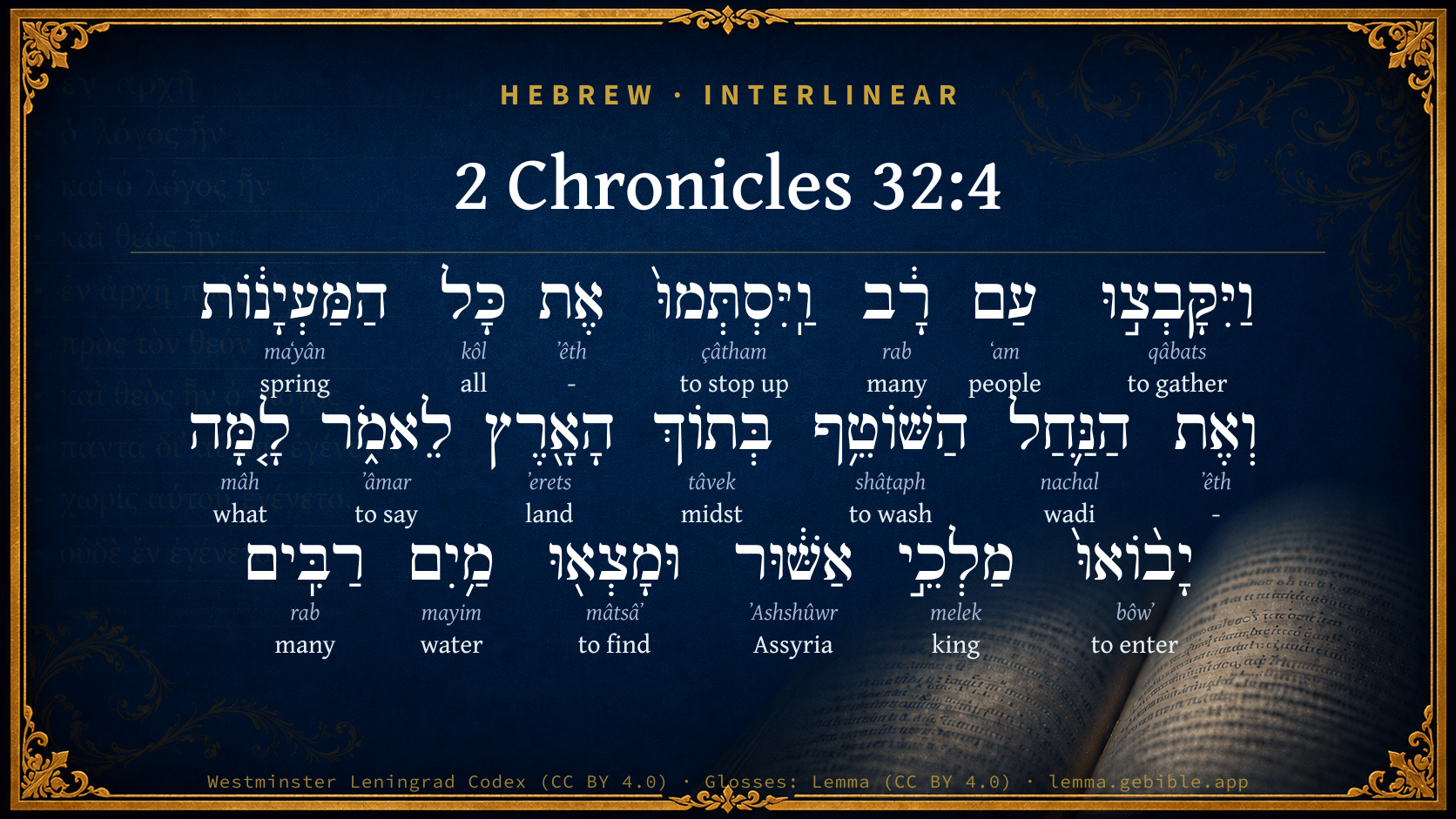
  1. וַיִּקָּבְצ֣וּ qâbats H6908 “and · to gather” Conjunction + Verb, Niphal, Sequential Imperfect, 3rd Person, Masculine, Plural
  2. עַם ʻam H5971 “people” Noun, Common, Masculine, Singular, Absolute
  3. רָ֔ב rab H7227 “many” Adjective, Adjective, Masculine, Singular, Absolute
  4. אֶת ʼêth H853 “-” Particle, Direct Object
  5. כָּל kôl H3605 “all of” Noun, Common, Masculine, Singular, Construct
  6. הַמַּעְיָנ֔וֹת maʻyân H4599 “the · springs” Particle, Definite Article + Noun, Common, Masculine, Plural, Absolute
  7. וְאֶת ʼêth H853 “and · -” Conjunction + Particle, Direct Object
  8. הַנַּ֛חַל nachal H5158 “the · wadi” Particle, Definite Article + Noun, Common, Masculine, Singular, Absolute
  9. הַשּׁוֹטֵ֥ף shâṭaph H7857 “the · washing” Particle, Definite Article + Verb, Qal, Participle Active, Masculine, Singular, Absolute
  10. בְּתוֹךְ tâvek H8432 “in/at · midst of” Preposition + Noun, Common, Masculine, Singular, Construct
  11. הָאָ֖רֶץ ʼerets H776 “the · land” Particle, Definite Article + Noun, Common, Both, Singular, Absolute
  12. לֵאמֹ֑ר ʼâmar H559 “to say” Preposition + Verb, Qal, Infinitive Construct
  13. לָ֤מָּה mâh H4100 “to/for · what” Preposition + Particle, Interrogative
  14. יָב֨וֹאוּ֙ bôwʼ H935 “to enter” Verb, Qal, Imperfect, 3rd Person, Masculine, Plural
  15. מַלְכֵ֣י melek H4428 “kings of” Noun, Common, Masculine, Plural, Construct
  16. אַשּׁ֔וּר ʼAshshûwr H804 “Assyria” Noun, Proper
  17. וּמָצְא֖וּ mâtsâʼ H4672 “and · to find” Conjunction + Verb, Qal, Sequential Perfect, 3rd Person, Common, Plural
  18. מַ֥יִם mayim H4325 “water(s)” Noun, Common, Masculine, Plural, Absolute
  19. רַבִּֽים rab H7227 “many” Adjective, Adjective, Masculine, Plural, Absolute

About this verse

These counts appear in no published source. They are computed here, from the morphology-tagged text and Lemma’s own curated glosses. What Lemma adds →

20
words
18
distinct lemmas
Historical
section

Notable vocabulary

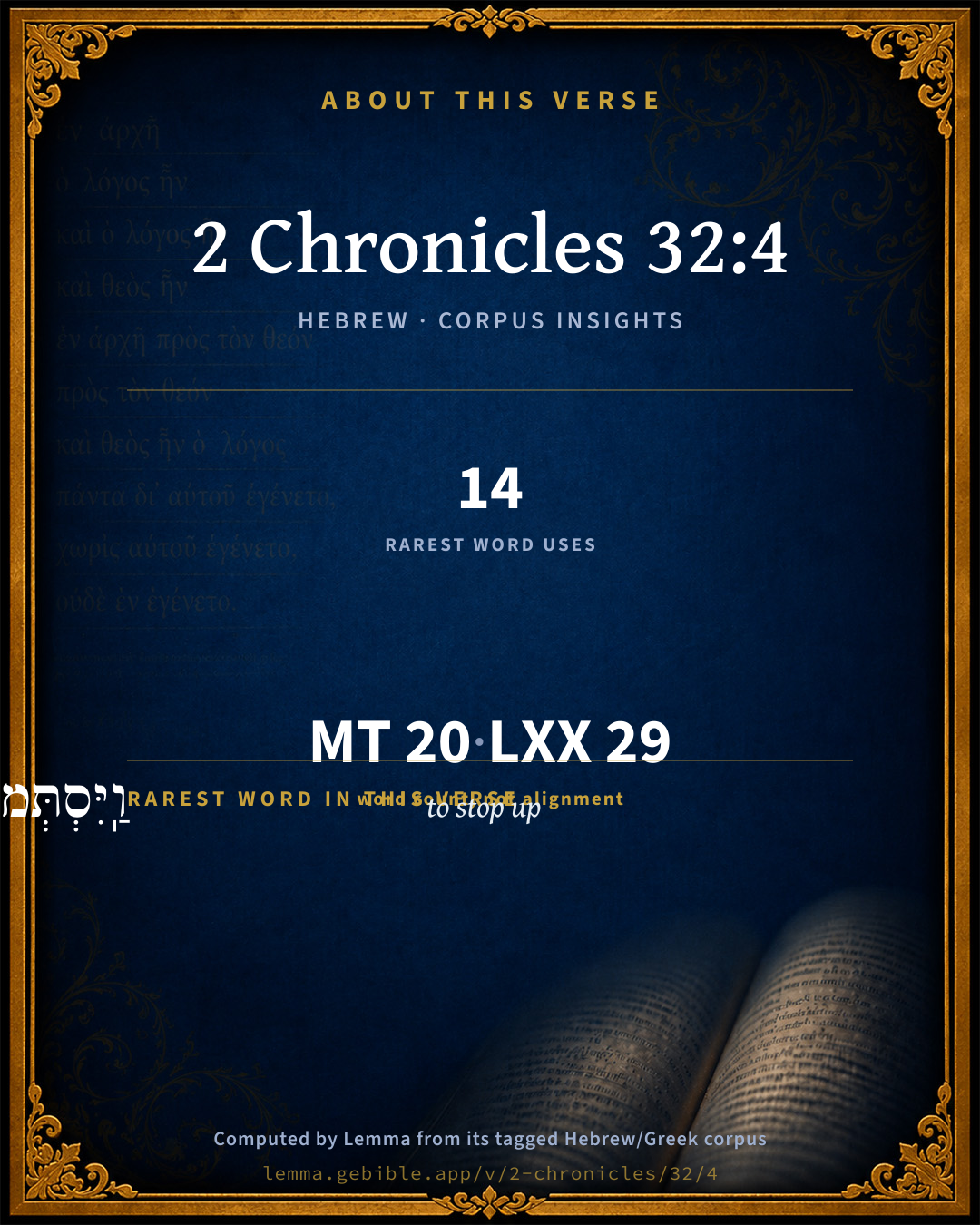
The rarest word here is וַֽיִּסְתְּמוּ֙ to stop up H5640 — appearing just 14 times in the whole Hebrew Bible.

Shared distinctive vocabulary

וַֽיִּסְתְּמוּ֙ to stop up H5640 occurs in 14 verses of the Hebrew Bible. Also found in:

Grammatical profile

  • 6 verbs
  • 9 nouns
  • 2 adjectives
  • 3 particles

Verb forms

  • וַיִּקָּבְצ֣וּ Niphal · Sequential Imperfect
  • וַֽיִּסְתְּמוּ֙ Qal · Sequential Imperfect
  • הַשּׁוֹטֵ֥ף Qal · Participle Active
  • לֵאמֹ֑ר Qal · Infinitive Construct
  • יָב֨וֹאוּ֙ Qal · Imperfect
  • וּמָצְא֖וּ Qal · Sequential Perfect

Repetition

A word recurs within this verse — often emphatic in Hebrew:

  • רָ֔ב many H7227 ×2

Hebrew & Septuagint length

In English translation the verse runs 36 words from the Hebrew and 33 from the Septuagint (LXX English) — closely comparable.

A rough comparison of the two English renderings, which tokenize alike — not a word-level alignment.

Word counts can differ between the Hebrew and the Greek without any difference in meaning — e.g. the Hebrew direct-object marker אֵת has no separate Greek word, and Greek often adds the article ὁ.

In the original languages it is 20 Hebrew tokens and 29 Greek tokens — but the two are counted differently (Hebrew bundles its prefixes and suffixes into one token; the Greek is in lemma form), so that isn’t a like-for-like length.

Cross-references

11

Topical passages linked to 2 Chronicles 32:4 in the Treasury of Scripture Knowledge — connected by theme and wording, ordered by reader-vote popularity; previews shown in the World English Bible.

  • 2 Chronicles 32:30 This same Hezekiah also stopped the upper spring of the waters of Gihon, and brought them straight down on the west side of the city of David. Hezekiah prospered in all his works.
  • 1 Kings 3:9 Give your servant therefore an understanding heart to judge your people, that I may discern between good and evil; for who is able to judge this your great people?
  • 1 Kings 3:16–17 Then there came two women who were prostitutes, to the king, and stood before him.
  • 1 Kings 19:21 He returned from following him, and took the yoke of oxen, and killed them, and boiled their flesh with the instruments of the oxen, and gave to the people, and they ate. Then he arose, and went after Elijah, and ministered to him.
  • 2 Kings 18:9 It happened in the fourth year of king Hezekiah, which was the seventh year of Hoshea son of Elah king of Israel, that Shalmaneser king of Assyria came up against Samaria, and besieged it.
  • 2 Kings 18:13 Now in the fourteenth year of king Hezekiah did Sennacherib king of Assyria come up against all the fortified cities of Judah, and took them.
  • 2 Kings 19:17 Of a truth, Yahweh, the kings of Assyria have laid waste the nations and their lands,
  • 2 Kings 20:20 Now the rest of the acts of Hezekiah, and all his might, and how he made the pool, and the conduit, and brought water into the city, aren't they written in the book of the chronicles of the kings of Judah?
  • 2 Chronicles 30:14 They arose and took away the altars that were in Jerusalem, and all the altars for incense took they away, and cast them into the brook Kidron.
  • 2 Chronicles 32:1 After these things, and this faithfulness, Sennacherib king of Assyria came, and entered into Judah, and encamped against the fortified cities, and thought to win them for himself.
  • Isaiah 10:8 For he says, Aren't my princes all of them kings?

Cross-references courtesy of OpenBible.info (CC BY 4.0).

Hebrew and Greek witnesses Masoretic Hebrew ↔ Greek Septuagint

The same verse in the two great witnesses to the Old Testament, shown verse-for-verse.

These are two independent witnesses, not word-aligned to each other, and the Septuagint is shown in lemma (dictionary) form.

Hebrew 2 Chronicles 32:4 Masoretic · Westminster Leningrad Codex

וַיִּקָּבְצ֣וּ עַם רָ֔ב וַֽיִּסְתְּמוּ֙ אֶת כָּל הַמַּעְיָנ֔וֹת וְאֶת הַנַּ֛חַל הַשּׁוֹטֵ֥ף בְּתוֹךְ הָאָ֖רֶץ לֵאמֹ֑ר לָ֤מָּה יָב֨וֹאוּ֙ מַלְכֵ֣י אַשּׁ֔וּר וּמָצְא֖וּ מַ֥יִם רַבִּֽים

So there was gathered much people together, and they stopped all the springs, and the brook that flowed through the midst of the land, saying, Why should the kings of Assyria come, and find much water?

World English Bible · Public Domain

Greek LXX 2 Chronicles 32:4 Septuagint · lemma form

καί συνἄγω λαός πολύς καί ἐνφράσσω ὁ ὕδωρ ὁ πηγή καί ὁ ποταμός ὁ διαὁρίζω διά ὁ πόλις λέγω μή ἔρχομαι βασιλεύς ασσουρ καί εὑρίσκω ὕδωρ πολύς καί καταἰσχύω

And he collected many people, and stopped the wells of water, and the river that flowed through the city, saying, Lest the king of Assyria come, and find much water, and strengthen himself.

LXX2012 (modern English Septuagint) · Public Domain

On this verse, Jamieson, Fausset & Brown discusses the Septuagint’s reading. Read the note in Commentary ↓

Hebrew: Westminster Leningrad Codex (CC BY 4.0). Greek: Septuagint (public domain); English from LXX2012 (modern English Septuagint) (Public Domain). How the Septuagint differs from the Hebrew →

Commentary

Notes on 2 Chronicles 32:4 from classic Christian and Jewish commentators (each source and its license shown beneath its notes). The classic Christian expositions comment on the surrounding passage and are grouped to its opening verse, so a note may address several verses; the Jewish commentaries on the Tanakh (Rashi and others) are per-verse, so they appear only where the commentator wrote on this verse.

Lemma curates 59 commentaries, every one of them public domain or Creative Commons licensed, each selected and text-cleaned for this edition rather than reprinted as found. About our sources →

Trapp's Complete Commentary

John Trapp

2Ch 32:4 So there was gathered much people together, who stopped all the fountains, and the brook that ran through the midst of the land, saying, Why should the kings of Assyria come, and find much water?

Ver. 4. And the brook.] Called Gihon. {2Ch 32:30} This was one of those rivers the waters whereof made glad the city of God. See 1Ki 1:33.

Come and find much water.] Take we like care that Satan, when he cometh to assault us, find not much matter. "Mortify therefore your earthly members, fornication, … and covetousness." {Col 3:5}

John Trapp, A Commentary or Exposition upon All the Books of the Old and New Testament (1647–1656) — public domain. Text from a community e-Sword module.

The Biblical Illustrator

Joseph S. Exell

2Ch_32:4

Why should the kings of Assyria come, and find much water?

Stopping the fountains

Nothing was more thought of in ancient times in order to add to the greatness of a city than an abundant water supply. It was one of the greatest glories of old Rome that it had never-failing aqueducts, and the same thing was true of Jerusalem in still earlier times. In all the hard sieges the city endured there never was any failure of the water supply. The Jews had chiefly to thank Hezekiah for this. He was both most brave and wise--this old-time Judean king. He turned his attention first of all to the water supply of the country north of Jerusalem, by the route along which the invading hosts must come. There was the upper watercourse of Gihon, not far from the holy city. The springs were abundant there and their fresh waters united to form a brook which ran strongly down the valley. Hezekiahs engineers saw what was to be done, at once to cripple the enemy and greatly to benefit the Jews. The springs should be drawn from their natural outlet to pour their waters into a capacious subterranean aqueduct built strongly and leading the current into vast reservoirs in Jerusalem cut in the rock far below the foundations of the temple, between the walls of Jerusalem proper and the city of David. So it is said by the inspired chronicler that Hezekiah stopped the fountains, that is, he covered them up after diverting the water, so that the Assyrians might not find them, and he brought the stream by aqueduct straight down to the west side of the city of David. For why should the kings of Assyria come and find much water?

I. We are justified in thinking of ourselves in our character as the servants of God in the Christian life, as typified by the people of God in olden time, the jews; and the king of assyria for us is the evil one himself with all his hateful hosts. He has ever desired to avail himself of the springs of our human life, to sustain and aid him in his assaults upon our souls. The springs of human life are many and various.

1. There are our intellectual faculties, the mind with all its marvellous power of imagination and memory, the intelligence which reasons out things, and by sheer force of resistless logic discerns the true from the false.

2. There is the will, that strange forceful energy which drives our powers and faculties in this way or in that, compelling them to work its bidding, a will so often, alas! set against the Divine will and purpose which called us into being.

3. There are our affections, the emotional side of our nature, working sometimes quite independently of reason, persuading us to this or that course of action because the present inclination outweighs every other consideration.

II. These springs of our human life are full of vigour and send forth a full stream of effective energy. It is no wonder that the enemy of souls desires to appropriate them to his own purpose.

1. He would use the mind to set reason against faith, to be wise in its own conceits, to refuse to accept anything that is not made plain to it.

2. He would use our wills to perform his own purposes against the Most High. He says to us, You are free agents, to do as you please. You shall not surely die if you eat of the forbidden fruit.

3. Once more there is the emotional side of our nature, our affections. We feel that these have relation especially to the pleasures of life, the happiness of love and of sell-indulgence in natural desires of many sorts. The devil would use these for his own purposes, as of old the kings of Assyria would eagerly have used the springs of Gihon. Cunningly does he urge it on the human soul, Why has God given you passions and natural desires of all sorts if you are not meant to gratify them?

III. Now that wise king Hezekiah in the olden time, when he perceived that the abundant springs of Gihon were likely to help his enemy to the grievous discomfiture of the people of God, set to work at once to cover the springs, having diverted the channel that the water might flow by subterranean conduits into the holy city. The first great thought he had was to hinder the Assyrian from availing himself of those precious springs. And that may well read to us a lesson of the exceeding profitableness of covering our minds and wills and affections from the evil one.

1. Our intellectual powers should be covered that the enemy of souls may not use them to our discomfiture.

2. The will is likewise one of those springs of life which Satan especially seeks to find and to avail himself of. We cover it from him by subjecting ourselves to a higher will through the principle of obedience.

3. Then there are those choice springs of life which we call the affections. We must set restraint upon our natural desires in all sorts of ways, by remembering that our nature has been perverted by original sin; its lusts and appetites are in rebellion against their lawful master the will, and they are sure to lead us into mischief unless strongly repressed by loyalty to the teachings of God.

IV. Hezekiah was not content to stop the fountains of Gihon that his enemy might not find abundant water in that dry and dusty country; with a master stroke of policy he built a great subterranean conduit, and carried all the fresh sweet water from its source in the valley to enormous rock-hewn reservoirs which he constructed in jerusalem. One who did not know what the king had done might come to that place where once the waters of Gihon had flowed so freely, and lament the dry wady and filled-up wells. And so the world often looks upon the lives of earnest Christians, thinking how much they are losing through their scruples; the intellectual powers restrained within the dull limits of orthodoxy, the will subjected to what seems like a servile obedience to old-time traditions, the affections not allowed any strong vigorous license to brighten the sadness of this present world. It is only those who do not comprehend the real truth who can talk so however.

1. The mental powers which here would not be prostituted to taking interest in those subjects of human research which blasphemed Gods truth, and ridiculed the faith of the ages; subjects which under the specious disguise of realism delved unblushingly into vice and shameful immoralities, and declared it was the part of true wisdom to know the evil as well as the good--these shall find splendid exercise and joyous development ever more and more in the eternal truths of the universe, in the mysteries of the Divine Being, in the secrets of Divine love which are inexhaustible, and which overflow with supremest delights.

2. The will which here refused to assert its independence of the known laws of the Creator, shall in the holy city find full range for all its craving after freedom.

3. The affections which here resisted the drawings of sensuality and of worldliness, being willing to surrender the loves of this present world for the love of God, shall in the city which is on high find the rapture of heart joy, the bliss of satisfied affection surging back upon the soul from the very being of God Himself. (Arthur Ritchie.)

The Biblical Illustrator, edited by Joseph S. Exell (c. 1880s–1900s) — public domain. Text from a community e-Sword module.

Jamieson, Fausset & Brown

Robert Jamieson, A. R. Fausset & David Brown

So there was gathered much people . . . who stopped all the fountains, and the brook that ran through the midst of the land--"Where these various fountains were, we have now no positive means of ascertaining; though En-rogel, and the spring now called the Virgin's Fount, may well be numbered among them. JOSEPHUS mentions the existence of various fountains without the city, but does not mention any of them in this connection but Siloam. 'The brook,' however, is located with sufficient precision to enable us to trace it very definitely. We are told that it 'ran through the midst of the land.' Now a stream running through either the Kedron or Hinnom Valley, could, in no proper sense, be said to run through the midst of the land, but one flowing through the true Gihon valley, and separating Akra and Zion from Bezetha, Moriah, and Ophel, as a stream once, doubtless, did, could, with peculiar propriety, be said to run through the midst of the land on which the [Holy] City was built. And that this is the correct meaning of the phrase is not only apparent from the force of circumstances, but is positively so declared in the Septuagint, where, moreover, it is called a 'river,' which, at least, implies a much larger stream than the Kedron, and comports well with the marginal reading, where it is said to overflow through the midst of the land. Previous to the interference of man, there was, no doubt, a very copious stream that gushed forth in the upper portion of that shallow, basin-like concavity north of Damascus Gate, which is unquestionably the upper extremity of the Gihon valley, and pursuing its meandering course through this valley, entered the Tyropœon at its great southern curve, down which it flowed into the valley of the Kedron" [BARCLAY, City of the Great King].

Jamieson, Fausset & Brown — Commentary Critical and Explanatory on the Whole Bible (1871) — public domain (CC PDM 1.0). Text via the HelloAO Bible API.

Adam Clarke's Commentary

Verse 4. Stopped all the fountains] This was prudently done, for without water how could an immense army subsist in an arid country? No doubt the Assyrian army suffered much through this, as a Christian army did eighteen hundred years after this. When the crusaders came, in A.D. 1099, to besiege Jerusalem, the people of the city stopped up the wells, so that the Christian army was reduced to the greatest necessities and distress.

Adam Clarke's Commentary on the Bible (1810–1826) — public domain. Text from a community e-Sword/MySword module.

Ellicott's Commentary for English Readers

(4) The fountains.—Ma‘yânôth. 2Ch_32:3 has “springs” (‘ayânôth).

The brook.—Nàchal. “The wâdy.” The Gihon is meant, a watercourse in the Valley of Hinnom, supplied with water by the springs which Hezekiah closed in and diverted. See Note on 2Ch_32:30, and 2Ki_20:20; comp. Sir_48:17, “Hezekiah fortified his city, and brought into their midst the Gog” (LXX., Vat.), or, “into its midst water” (LXX., Alex.).

That ran.—That was flowing over (Isa_30:28; Isa_8:8). The overflow of the springs formed the stream.

The kings of Assyria.—A vague rhetorical plural, as in 2Ch_28:16.

A Bible Commentary for English Readers, edited by Charles John Ellicott (1878–1897) — public domain. Text from a community e-Sword module.

The Cambridge Bible for Schools and Colleges

gen. ed. J. J. S. Perowne

4. who stopt] R.V. and they stopped.

the brook that ran] R.V. the brook that flowed. The Heb. verb means “flow with strong stream” (as a flood). We naturally look for such a brook either east of Jerusalem in the valley of Kidron or south in the valley of the son of Hinnom, but no perennial stream runs in either valley now. Possibly the waters which fed such a brook in the Chronicler’s day now lose themselves (owing to physical changes in the configuration of the country) in the soil.

The Cambridge Bible for Schools and Colleges (gen. ed. J. J. S. Perowne; Cambridge University Press, 1878–1918) — public domain. Text from a community e-Sword module.

John Gill's Exposition

Also he strengthened himself,.... In the Lord his God, and fortified his city, and put it in the best manner of defence he could:

and built up all the wall that was broken; which was broken from the gate of Ephraim to the corner gate by Joash king of Israel; and though it might have been repaired by Uzziah, it might again be broken down in the times of Ahaz, by Pekah, king of Israel, or some other enemy, see Ch2 25:3.

and raised it up to the towers; from the corner tower to the tower of the gate of Ephraim, which, as before observed, had been broken down:

and another wall without; a second wall, either all around the city, or at such a part of it which was weakest; Josephus (z) says the city of Jerusalem had three walls about it:

and repaired Millo in the city of David; a wall on the north side of the city:

and made darts and shields in abundance; darts to cast from the walls of the city, to annoy the enemy with, and shields to defend them from those of the enemy.

(z) De Bello Jud. l. 5. c. 4. sect. 3.

John Gill's Exposition of the Whole Bible (1746–1763) — public domain (CC PDM 1.0). Text via the HelloAO Bible API.

Albert Barnes' Notes on the Bible

The “brook” intended is probably not the Kidron, but the natural water-course of the Gihon, which ran down the Tyropoeon valley (compare the 1Ki 1:3 note).

Albert Barnes' Notes on the Bible (1834–1885) — public domain. Text from a community e-Sword/MySword module.

Haydock's Catholic Bible Commentary

Land, Cedron, on the east; (C.; M.) or it may be the Gihon, which supplies Siloe, v. 30. T.

George Leo Haydock (1774–1849), Haydock's Catholic Family Bible and Commentary, 1859 edition — public domain. Excludes Psalms (Douay-Rheims chapter numbering differs from Protestant) and Deuterocanonical books (Catholic canon only).

Matthew Poole's English Annotations

Which was a scarce commodity in this country, and the want of it might much annoy the Assyrian army.

Matthew Poole's English Annotations on the Holy Bible (1683–1685) — public domain. Text from a community e-Sword/MySword module.

Whedon's Commentary on the Bible

Daniel D. Whedon

4. The brook that ran through the midst of the land is probably the Gihon, and the work wrought on it identical with what is more fully described in 2Ch_32:30. See also 2Ki_20:20, note.

Daniel D. Whedon (gen. ed.), Commentary on the Old and New Testaments (1874–1909) — public domain. Text from a community e-Sword module.

The Pulpit Commentary

The brook that ran through the midst of the land. Compare the Septuagint, which has it, "through the midst of the city; " and compare foregoing verse and note; and see again above reference to Courier"s "Handbook" at length.

The Pulpit Commentary (1880–1919), ed. H.D.M. Spence-Jones & Joseph S. Exell — public domain. Text from a community e-Sword module.

Lesson kit

Teaching starters — assembled from the data on this page, not authored interpretation. Every prompt links to the verse data it draws on. Edit before teaching.

2 Chronicles, in the Historical, opens this verse with 20 words (18 distinct Hebrew lemmas). Its most distinctive word is çâtham (“to stop up”). A historical commentator’s framing appears above. Read the whole chapter for the surrounding context.

Discussion questions

  1. What does “to stop up” (çâtham) contribute to the verse as a whole?
  2. How does Genesis 26:15, which shares the word «to stop up», read alongside this verse?
  3. What does the repetition of “many” (2× in this one verse) do in this verse?
  4. These translations render this verse differently. What is at stake in choosing one wording over another?
  5. «וַיִּקָּבְצ֣וּ» is a Niphal Sequential Imperfect verb. How does that grammatical form shape the action described?
  6. Compare how Trapp's Complete Commentary and The Biblical Illustrator read this verse. Where do they agree or differ?

Things to notice

Reading settings

Reading text

Shown beneath each verse's original-language words.

Old Testament
Old Testament edition

Read the OT as the Masoretic Hebrew (MT) or the Greek Septuagint (LXX).

English shown for the Greek Septuagint (in the Hebrew ↔ Greek comparison).

Comparing translations? Open the Compare panel on any verse page to stack up to four side by side.