
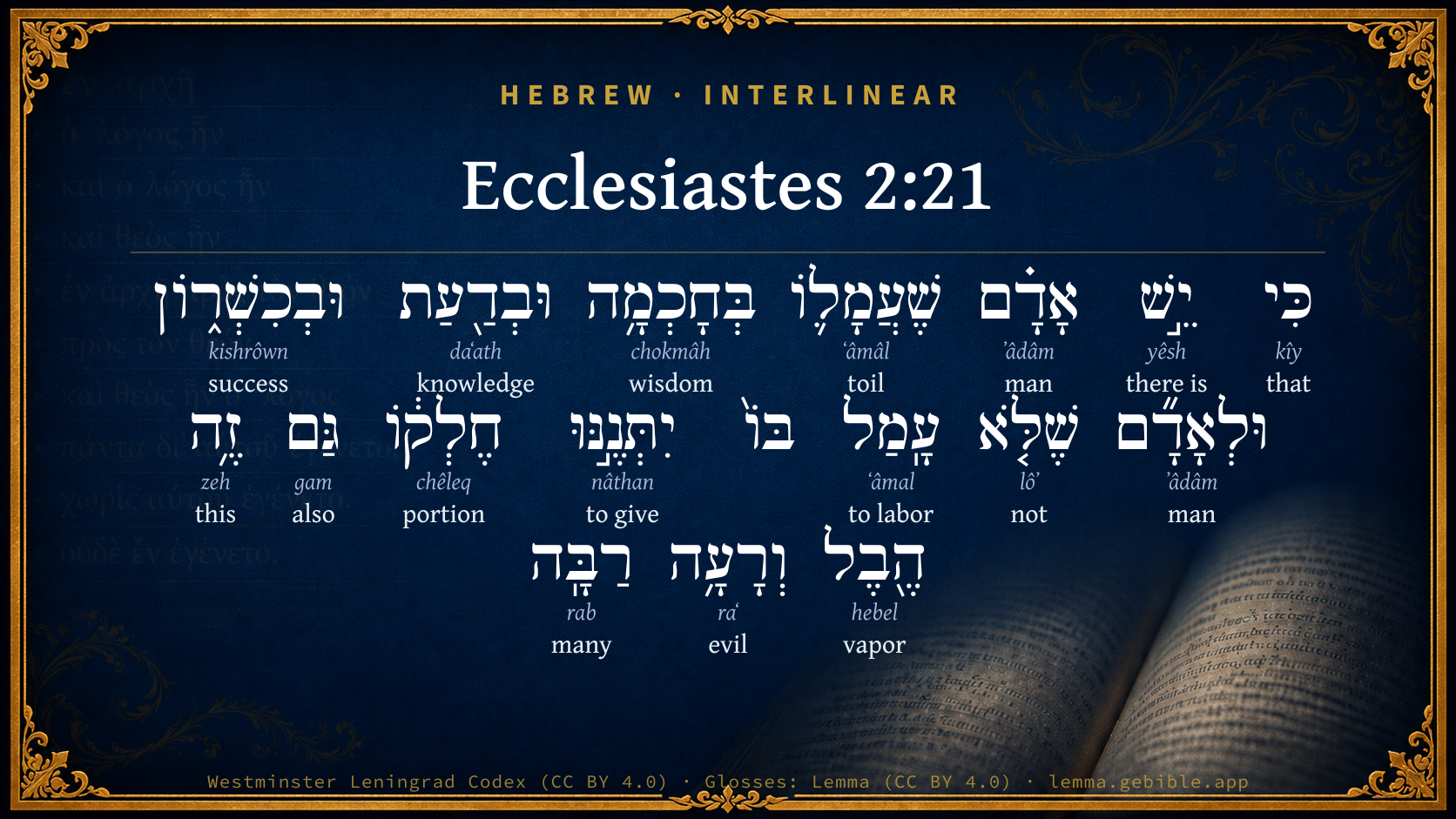
Ecclesiastes 2:21

Hebrew (Westminster Leningrad Codex) Ecclesiastes 2:21 appears in the Hebrew Old Testament. The text above is from the Westminster Leningrad Codex. Each word links to its Strong’s number, a concise gloss, and parsing drawn from the Open Scriptures Hebrew Bible morphology. Click any word for its full Brown-Driver-Briggs (BDB) entry.
Download image
Cite this verse

Ecclesiastes 2:21 (World English Bible). Public Domain. Lemma interlinear Bible study tool, https://lemma.gebible.app/v/ecclesiastes/2/21.

Show BibTeX & RIS
BibTeX
RIS
English Translation
For there is a man whose labor is with wisdom, with knowledge, and with skillfulness; yet he shall leave it for his portion to a man who has not labored for it. This also is vanity and a great evil.
World English Bible · Public Domain
Highlights
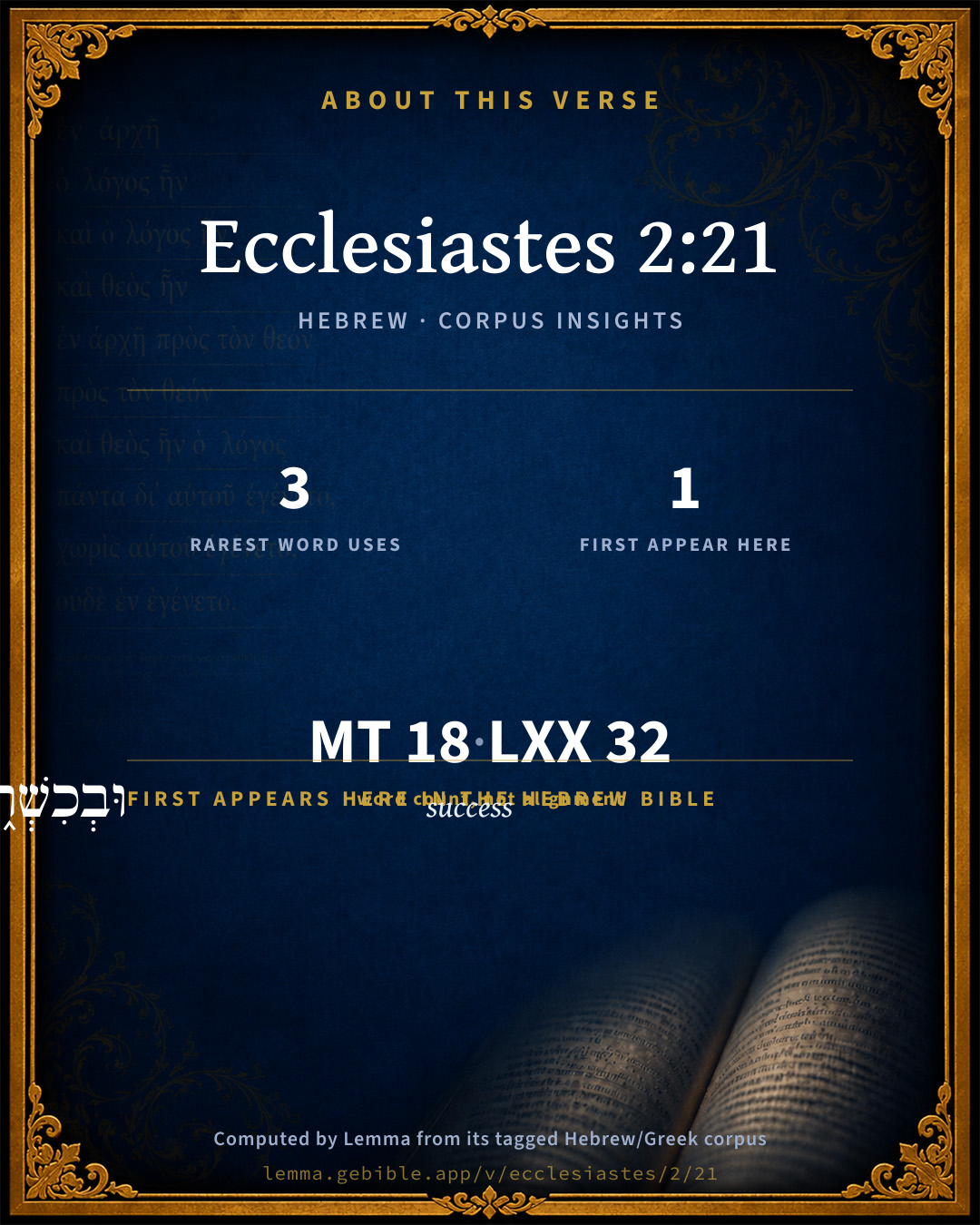
  • 1 first appearance in the Hebrew Bible
Full analysis ↓
Download a study sheet

One document with this verse’s original text, its word-by-word gloss line, the meaning frame, cross-references with their text, attributed commentary, and full source and license credits — printable, and it pastes into notes with its structure intact.

This verse Autodidact and up

Study sheet (.html) Plain text (.txt)

A passage Seminary Student

Up to 50 verses in one chapter. A passage sheet keeps up to 6 commentary sources and 12 cross-references per verse, in the order this page ranks them, and says so on the sheet whenever that leaves anything out. Ask for a single verse and you get the Autodidact verse sheet above.

Everything on this page stays free to read, with no account — the sheet is a download of what is already on screen, not access to it.

Want to remove ads? Support Godless Engineer
Compare translations 3

The same verse in 3 English versions, stacked beneath the original-language interlinear above. Click any original word for its lexicon entry.

Each is an independent rendering of the whole verse — the interlinear is not word-aligned to these translations.

Highlighted words mark where these versions differ — a whole-verse word diff, not a word-by-word alignment.

  • World English Bible Public Domain
    For there is a man whose labor is with wisdom, with knowledge, and with skillfulness; yet he shall leave it for his portion to a man who has not labored for it. This also is vanity and a great evil.
  • King James Version Public Domain
    For there is a man whose labour is in wisdom, and in knowledge, and in equity; yet to a man that hath not laboured therein shall he leave it for his portion. This also is vanity and a great evil.
  • unfoldingWord Literal Text CC BY-SA 4.0
    For there is a person whose toil with wisdom and with knowledge and with skill, but to a person who has not toiled for it, he will give it his portion. This also vapor and a great misfortune.

unfoldingWord Literal Text — © unfoldingWord, licensed CC BY-SA 4.0. Word-aligned USFM3 via Door43 (git.door43.org/unfoldingWord/en_ult).

Versions to compare (up to 4)

3 of 4 selected

Show all 18 translations

Every available English version of this verse, each an independent rendering of the whole verse.

  • World English Bible Public Domain
    For there is a man whose labor is with wisdom, with knowledge, and with skillfulness; yet he shall leave it for his portion to a man who has not labored for it. This also is vanity and a great evil.
  • Berean Standard Bible Public Domain
    When there is a man who has labored with wisdom, knowledge, and skill, and he must give his portion to a man who has not worked for it, this too is futile and a great evil.
  • Majority Standard Bible Public Domain
    When there is a man who has labored with wisdom, knowledge, and skill, and he must give his portion to a man who has not worked for it, this too is futile and a great evil.
  • King James Version Public Domain
    For there is a man whose labour is in wisdom, and in knowledge, and in equity; yet to a man that hath not laboured therein shall he leave it for his portion. This also is vanity and a great evil.
  • American Standard Version (1901) Public Domain
    For there is a man whose labor is with wisdom, and with knowledge, and with skilfulness; yet to a man that hath not labored therein shall he leave it for his portion. This also is vanity and a great evil.
  • Revised Version (1885) Public Domain
    For there is a man whose labour is with wisdom, and with knowledge, and with skilfulness; yet to a man that hath not laboured therein shall he leave it for his portion. This also is vanity and a great evil.
  • Geneva Bible (1599) Public Domain
    For there is a man whose trauaile is in wisdome, and in knowledge and in equitie: yet to a man that hath not trauailed herein, shall he giue his portion: this also is vanitie and a great griefe.
  • Douay-Rheims (1899) Public Domain
    For when a man laboureth in wisdom, and knowledge, and carefulness, he leaveth what he hath gotten to an idle man: so this also is vanity, and a great evil.
  • Young's Literal Translation Public Domain
    For there is a man whose labour `is' in wisdom, and in knowledge, and in equity, and to a man who hath not laboured therein he giveth it -- his portion! Even this `is' vanity and a great evil.
  • Literal Standard Version CC BY-SA 4.0
    For there is a man whose labor [is] in wisdom, and in knowledge, and in equity, and to a man who has not labored therein he gives it—his portion! Even this [is] vanity and a great evil.
  • Unlocked Literal Bible CC BY-SA 4.0
    For there might be someone who works with wisdom, with knowledge, and skill, but he will leave everything he has to a man who has not made any of it. This also is vapor and a great tragedy.
  • unfoldingWord Literal Text CC BY-SA 4.0
    For there is a person whose toil with wisdom and with knowledge and with skill, but to a person who has not toiled for it, he will give it his portion. This also vapor and a great misfortune.
  • Darby Bible Public Domain
    For there is a man whose labour hath been with wisdom, and with knowledge, and with skill, and who leaveth it to a man that hath not laboured therein, to be his portion. This also is vanity and a great evil.
  • World Messianic Bible Public Domain
    For there is a man whose labor is with wisdom, with knowledge, and with skillfulness; yet he shall leave it for his portion to a man who has not labored for it. This also is vanity and a great evil.
  • Webster's Bible Public Domain
    For there is a man whose labor is in wisdom, and in knowledge, and in equity; yet to a man that hath not labored in it, shall he leave it for his portion. This also is vanity and a great evil.
  • Free Bible Version CC BY-SA 4.0
    For you can work wisely, knowledgably, and with skill—and who benefits? Someone who hasn't worked for it! This is both frustrating and totally unjust!
  • Bible in Basic English Public Domain
    Because there is a man whose work has been done with wisdom, with knowledge, and with an expert hand; but one who has done nothing for it will have it for his heritage. This again is to no purpose and a great evil.
  • JPS Tanakh (1917) Public Domain
    For there is a man whose labour is with wisdom, and with knowledge, and with skill; yet to a man that hath not laboured therein shall he leave it for his portion. This also is vanity and a great evil.

Literal Standard Version (2020), Covenant Press — licensed CC BY-SA 4.0. Text via the HelloAO Bible API (eBible.org). Unlocked Literal Bible (unfoldingWord) — licensed CC BY-SA 4.0. Text via the HelloAO Bible API (eBible.org). unfoldingWord Literal Text — © unfoldingWord, licensed CC BY-SA 4.0. Word-aligned USFM3 via Door43 (git.door43.org/unfoldingWord/en_ult). Free Bible Version, Dr. Jonathan Gallagher — licensed CC BY-SA 4.0. Text via the HelloAO Bible API (eBible.org).

Word by word

More ways to search: Search by grammar → Find every occurrence → Compare this word →

Practice this passage: Drill this verse → Learn its vocabulary →

וּבְכִשְׁר֑וֹן
kishrôwn
H3788
“and · in/at · success”
Conjunction + Preposition + Noun, Common, Masculine, Singular, Absolute
Part of Speech
Conjunction + Preposition + Noun
Type
Common
Gender
Masculine
Number
Singular
State
Absolute
Full BDB Definition

Origin: from H3787

TWOT: 1052b

success, skill, profit - skill - success, profit
  1. כִּי kîy H3588 “that” Conjunction
  2. יֵ֣שׁ yêsh H3426 “there is” Particle, Demonstrative
  3. אָדָ֗ם ʼâdâm H120 “man” Noun, Common, Masculine, Singular, Absolute
  4. שֶׁעֲמָל֛וֹ ʻâmâl H5999 “who/which · toil · his” Particle, Relative + Noun, Common, Both, Singular, Construct + Suffix, Personal, 3rd Person, Masculine, Singular
  5. בְּחָכְמָ֥ה chokmâh H2451 “in/at · wisdom” Preposition + Noun, Common, Feminine, Singular, Absolute
  6. וּבְדַ֖עַת daʻath H1847 “and · in/at · knowledge” Conjunction + Preposition + Noun, Common, Feminine, Singular, Absolute
  7. וּלְאָדָ֞ם ʼâdâm H120 “and · to/for · man” Conjunction + Preposition + Noun, Common, Masculine, Singular, Absolute
  8. שֶׁלֹּ֤א lôʼ H3808 “who/which · not” Particle, Relative + Particle, Negative
  9. עָֽמַל ʻâmal H5998 “to labor” Verb, Qal, Perfect, 3rd Person, Masculine, Singular
  10. יִתְּנֶ֣נּוּ nâthan H5414 “to give · him” Verb, Qal, Imperfect, 3rd Person, Masculine, Singular + Suffix, Personal, 3rd Person, Masculine, Singular
  11. חֶלְק֔וֹ chêleq H2506 “portion · his” Noun, Common, Masculine, Singular, Construct + Suffix, Personal, 3rd Person, Masculine, Singular
  12. גַּם gam H1571 “also” Particle, Accusative
  13. זֶ֥ה zeh H2088 “this” Pronoun, Demonstrative, Masculine, Singular
  14. הֶ֖בֶל hebel H1892 “vapor” Noun, Common, Masculine, Singular, Absolute
  15. וְרָעָ֥ה raʻ H7451 “and · evil” Conjunction + Noun, Common, Feminine, Singular, Absolute
  16. רַבָּֽה rab H7227 “many” Adjective, Adjective, Feminine, Singular, Absolute

About this verse

These counts appear in no published source. They are computed here, from the morphology-tagged text and Lemma’s own curated glosses. What Lemma adds →

18
words
16
distinct lemmas
Wisdom
section

Notable vocabulary

The rarest word here is וּבְכִשְׁר֑וֹן success H3788 — appearing just 3 times in the whole Hebrew Bible.

First appearance in Scripture

This word makes its first canonical appearance in the Hebrew Bible here:

  • וּבְכִשְׁר֑וֹן success H3788

Shared distinctive vocabulary

וּבְכִשְׁר֑וֹן success H3788 occurs in 3 verses of the Hebrew Bible. Also found in:

Grammatical profile

  • 2 verbs
  • 9 nouns
  • 1 adjective
  • 1 pronoun
  • 1 preposition
  • 1 conjunction
  • 3 particles

Verb forms

  • עָֽמַל Qal · Perfect
  • יִתְּנֶ֣נּוּ Qal · Imperfect

Repetition

A word recurs within this verse — often emphatic in Hebrew:

  • אָדָ֗ם man H120 ×2

Hebrew & Septuagint length

In English translation the verse runs 40 words from the Hebrew and 39 from the Septuagint (LXX English) — closely comparable.

A rough comparison of the two English renderings, which tokenize alike — not a word-level alignment.

Word counts can differ between the Hebrew and the Greek without any difference in meaning — e.g. the Hebrew direct-object marker אֵת has no separate Greek word, and Greek often adds the article ὁ.

In the original languages it is 18 Hebrew tokens and 32 Greek tokens — but the two are counted differently (Hebrew bundles its prefixes and suffixes into one token; the Greek is in lemma form), so that isn’t a like-for-like length.

Cross-references

9

Topical passages linked to Ecclesiastes 2:21 in the Treasury of Scripture Knowledge — connected by theme and wording, ordered by reader-vote popularity; previews shown in the World English Bible.

  • Ecclesiastes 2:17–18 So I hated life, because the work that is worked under the sun was grievous to me; for all is vanity and a chasing after wind.
  • 2 Chronicles 31:20–21 Thus did Hezekiah throughout all Judah; and he worked that which was good and right and faithful before Yahweh his God.
  • 2 Chronicles 33:2–9 He did that which was evil in the sight of Yahweh, after the abominations of the nations whom Yahweh cast out before the children of Israel.
  • 2 Chronicles 34:2 He did that which was right in the eyes of Yahweh, and walked in the ways of David his father, and didn't turn aside to the right hand or to the left.
  • 2 Chronicles 35:18 There was no Passover like that kept in Israel from the days of Samuel the prophet; neither did any of the kings of Israel keep such a Passover as Josiah kept, and the priests, and the Levites, and all Judah and Israel who were present, and the inhabitants of Jerusalem.
  • 2 Chronicles 36:5–10 Jehoiakim was Twenty-five years old when he began to reign; and he reigned eleven years in Jerusalem: and he did that which was evil in the sight of Yahweh his God.
  • Ecclesiastes 9:18 Wisdom is better than weapons of war; but one sinner destroys much good.
  • Jeremiah 22:15 Shall you reign, because you strive to excel in cedar? Didn't your father eat and drink, and do justice and righteousness? then it was well with him.
  • Jeremiah 22:17 But your eyes and your heart are not but for your covetousness, and for shedding innocent blood, and for oppression, and for violence, to do it.

Cross-references courtesy of OpenBible.info (CC BY 4.0).

Hebrew and Greek witnesses Masoretic Hebrew ↔ Greek Septuagint

The same verse in the two great witnesses to the Old Testament, shown verse-for-verse.

These are two independent witnesses, not word-aligned to each other, and the Septuagint is shown in lemma (dictionary) form.

Hebrew Ecclesiastes 2:21 Masoretic · Westminster Leningrad Codex

כִּי יֵ֣שׁ אָדָ֗ם שֶׁעֲמָל֛וֹ בְּחָכְמָ֥ה וּבְדַ֖עַת וּבְכִשְׁר֑וֹן וּלְאָדָ֞ם שֶׁלֹּ֤א עָֽמַל בּוֹ֙ יִתְּנֶ֣נּוּ חֶלְק֔וֹ גַּם זֶ֥ה הֶ֖בֶל וְרָעָ֥ה רַבָּֽה

For there is a man whose labor is with wisdom, with knowledge, and with skillfulness; yet he shall leave it for his portion to a man who has not labored for it. This also is vanity and a great evil.

World English Bible · Public Domain

Greek LXX Ecclesiastes 2:21 Septuagint · lemma form

ὅτι εἰμί ἄνθρωπος ὅς μόχθος αὐτός ἐν σοφία καί ἐν γνῶσις καί ἐν ἀνδρεῖος καί ἄνθρωπος ὅς οὐ μοχθέω ἐν αὐτός δίδωμι αὐτός μερίς αὐτός καί γέ οὗτος ματαιότης καί πονηρία μέγας

For there is such a man that his labor is in wisdom, and in knowledge, and in fortitude; yet this man shall give his portion to one who has not laboured therein. This is also vanity and great evil.

LXX2012 (modern English Septuagint) · Public Domain

On this verse, The Pulpit Commentary discusses the Septuagint’s reading. Read the note in Commentary ↓

Hebrew: Westminster Leningrad Codex (CC BY 4.0). Greek: Septuagint (public domain); English from LXX2012 (modern English Septuagint) (Public Domain). How the Septuagint differs from the Hebrew →

Commentary

Notes on Ecclesiastes 2:21 from classic Christian and Jewish commentators (each source and its license shown beneath its notes). The classic Christian expositions comment on the surrounding passage and are grouped to its opening verse, so a note may address several verses; the Jewish commentaries on the Tanakh (Rashi and others) are per-verse, so they appear only where the commentator wrote on this verse.

Lemma curates 59 commentaries, every one of them public domain or Creative Commons licensed, each selected and text-cleaned for this edition rather than reprinted as found. About our sources →

Trapp's Complete Commentary

John Trapp

Ecc 2:21 For there is a man whose labour [is] in wisdom, and in knowledge, and in equity; yet to a man that hath not laboured therein shall he leave it [for] his portion. This also [is] vanity and a great evil.

Ver. 21. For there is a man whose labour is in wisdom.] This seemed to Solomon - whose own case it was like to be - so unworthy a thing, and such a vexation of spirit, that he can never say enough of it; but could find in his heart to cry out with the poet, Tρις κακοδαιμων και τετρακις και πεντακις και δωδεκακις και μυριακις, I am thrice miserable, nay, ten times, nay, a hundred, nay, a thousand times so, that am born to be a provident and a perfect drudge of an idle drone, or perhaps of a mere stranger.

This is also vanity and a great evil.] Not privation of good only, a nothing; but a position of evil, a sad thing; an inconvenience not to be avoided by the most circumspect prudence; for it is written, He taketh {a} the wise in their own craftiness. And again, The Lord knoweth the thoughts {b} of the wise, their inward disceptations, their debating the matter with themselves, that they are vain. {1Co 3:19-20} The rich fool talked to himself, {c} as fools used to do, and set down how everything should be; {Luk 12:17} but it proved somewhat otherwise ere he was a day older.

{a} Dρασσομενος.

{b} διαλογισμους.

{c} Dιελογιζετο.

John Trapp, A Commentary or Exposition upon All the Books of the Old and New Testament (1647–1656) — public domain. Text from a community e-Sword module.

Tyndale Open Study Notes

Tyndale Open Resources

2:21 work wisely with knowledge and skill: Skill in work is an expression of wisdom (e.g., see Exod 31:1-5). • leave the fruit . . . to someone who hasn’t worked for it: A person who has little personal investment tends to waste it or take foolish risks.

Tyndale Open Study Notes — © Tyndale Open Resources, licensed CC BY-SA 4.0. Text via the HelloAO Bible API.

Geneva Bible (1599)

Geneva Bible translators

Among other griefs that was not the least, to leave that which he had gotten by great travail, to one that had taken no pain therefore, and whom he knew not whether he were a wise man or a fool.

Geneva Bible (1599) marginal notes — public domain. Text via Bolls.life.

Jamieson, Fausset & Brown

Robert Jamieson, A. R. Fausset & David Brown

Suppose "there is a man," &c.

equity--rather "with success," as the Hebrew is rendered (Ecc 11:6), "prosper," though Margin gives "right" [HOLDEN and MAURER].

evil--not in itself, for this is the ordinary course of things, but "evil," as regards the chief good, that one should have toiled so fruitlessly.

Jamieson, Fausset & Brown — Commentary Critical and Explanatory on the Whole Bible (1871) — public domain (CC PDM 1.0). Text via the HelloAO Bible API.

Adam Clarke's Commentary

Verse 21. For there is a man] Does he not allude to himself? As if he had said, "I have laboured to cultivate my mind in wisdom and in science, in knowledge of men and things, and have endeavoured to establish equity and dispense justice. And now I find I shall leave all the fruits of my labour to a man that hath not laboured therein, and consequently cannot prize what I have wrought." Does he not refer to his son Rehoboam?

Adam Clarke's Commentary on the Bible (1810–1826) — public domain. Text from a community e-Sword/MySword module.

Ellicott's Commentary for English Readers

(21) Equity.—Rather, skill, success (Ecc_4:4; Ecc_5:7). The noun is peculiar to this book. The corresponding verb occurs in Ecc_10:10; Ecc_11:6; Est_8:5.

A Bible Commentary for English Readers, edited by Charles John Ellicott (1878–1897) — public domain. Text from a community e-Sword module.

The Cambridge Bible for Schools and Colleges

gen. ed. J. J. S. Perowne

21. For there is a man] It is characteristic of the Debater that he broods over the same thought, and contemplates it as in a variety of aspects. It is not merely, as in Ecc_2:19, that another possessed his heaped up riches who may use them quite otherwise than he would have them used, but that the man who by his wisdom has achieved wealth (for “equity” we should rather read here and in chap. Ecc_4:4, Ecc_5:11 “skill” or “success,” the moral character of the success not being here in question) has to leave it to one who has not worked at all, it may be to an alien in blood.

The Cambridge Bible for Schools and Colleges (gen. ed. J. J. S. Perowne; Cambridge University Press, 1878–1918) — public domain. Text from a community e-Sword module.

John Gill's Exposition

For there is a man whose labour is in wisdom, and in knowledge, and in equity,.... Who does all he does, in natural, civil, and religious things, in the state, in his family, and the world, and whatsoever business he is engaged, in the wisest and best manner, with the utmost honesty and integrity, according to all the rules of wisdom and knowledge, and of justice and equity; meaning himself; the Midrash interprets this of God;

yet to a man that hath not laboured therein shall he leave it for his portion; to his son, heir, and successor; who never took any pains, or joined with him, in acquiring the least part of it; and yet all comes into his hands, as his possession and inheritance: the Targum interprets this of a man that dies without children; and so others (z) understand it of his leaving his substance to strangers, and not to his children.

This also is vanity, and a great evil; not anything sinful and criminal, but vexatious and distressing.

(z) R. Joseph Titatzak in loc.

John Gill's Exposition of the Whole Bible (1746–1763) — public domain (CC PDM 1.0). Text via the HelloAO Bible API.

Haydock's Catholic Bible Commentary

Wisdom. The writings of the wise are often perverted by perverse heretics. (St. Jerome) --- Idle heirs dissipate the possessions, which had been accumulated with such industry. (Calmet) --- Riches tend to encourage the profligacy of the heir. (Menochius)

George Leo Haydock (1774–1849), Haydock's Catholic Family Bible and Commentary, 1859 edition — public domain. Excludes Psalms (Douay-Rheims chapter numbering differs from Protestant) and Deuterocanonical books (Catholic canon only).

Matthew Poole's English Annotations

Whose labour is in wisdom, and in knowledge, and in equity; who useth great industry, and prudence, and justice too, in the management of his affairs, and therefore might as confidently expect God’s blessing, and the comfort of his labours, as any other man.

That hath not laboured therein, so as I have done; who hath spent his days in sloth and folly.

A great evil; a great disorder in itself, and a great disgrace to this world, and a great torment to a considering mind.

Matthew Poole's English Annotations on the Holy Bible (1683–1685) — public domain. Text from a community e-Sword/MySword module.

Whedon's Commentary on the Bible

Daniel D. Whedon

21. There is a man — The “man” who has had his labour as stated, is Koheleth himself.

To a man that hath not laboured — If he had had children they would have worked with him to build up the family estate, but it must go to one who has given no aid or sympathy to the work of gathering it. There is a certain beauty in a family co-working to build an estate, like that of the Rothschilds.

Daniel D. Whedon (gen. ed.), Commentary on the Old and New Testaments (1874–1909) — public domain. Text from a community e-Sword module.

The Pulpit Commentary

For there is a man whose labor is in wisdom. "In," B, "with," directed and performed with wisdom. The author speaks of himself objectively, as St. Paul (2Co_12:2) says, "I know a man in Christ," etc. His complaint now is, not that his successor may misuse his inheritance (ver. 19), but that this person shall have that on which he has bestowed no skill or toil, shall enjoy what modern phraseology terms "unearned increment." This, which was set forth as One of the blessings of the promised land, (Deu_6:10, Deu_6:11) Koheleth cannot bear to contemplate where it touches himself not from envy or grudging, but from the feeling of dissatisfaction and want of energy which it generates. In (with) knowledge and in (with) equity. Kishron, translated "equity" in the Authorized Version; ajndreia "manliness," in the Septuagint: and sollicitudine in the Vulgate, seems rather here to signify "skill" or "success." It occurs also in Ecc_4:4 and Ecc_5:10, and there only in the Old Testament.

The Pulpit Commentary (1880–1919), ed. H.D.M. Spence-Jones & Joseph S. Exell — public domain. Text from a community e-Sword module.

John Wesley's Explanatory Notes

Wisdom - Who uses great industry, and prudence, and justice too, in the use and management of his affairs. To a man - Who has spent his days in sloth and folly. A great evil - A great disorder in itself, and a great torment to a considering mind.

John Wesley, Explanatory Notes Upon the Whole Bible (1754–1765) — public domain. Text via the GEBible commentary corpus.

Keil & Delitzsch

C. F. Keil & F. Delitzsch

"For there is a man who labours with wisdom, and knowledge, and ability; and to a man who has not laboured for it, must he leave it as his portion: also that is vain, and a great evil." Ewald renders: whose labour aims after wisdom. But בּח וטו do not denote obj. (for the obj. of עמל is certainly the portion which is to be inherited), but are particular designations of the way and manner of the labour. Instead of שׁעמל, there is used the more emphatic form of the noun: שׁעמלו, who had his labour, and performed it; Sa1 7:17, cf. Jer 9:5, Jer 9:6, "Thine habitation is in the midst of deceit," and Hitz. under Job 9:27. Kishron is not ἀνδρεία (lxx), manliness, moral energy (Elster), but aptness, ability, and (as a consequence connecting itself therewith) success, good fortune, thus skilfulness conducting to the end. בּו refers to the object, and יתּננּוּ to the result of the work; חלקו is the second obj.-accus., or, as we rather say, pred.-accus.: as his portion, viz., inheritance.

That what one has gained by skill and good fortune thus falls to the lot of another who perhaps recklessly squanders it, is an evil all the greater in proportion to the labour and care bestowed on its acquisition.

Keil & Delitzsch — Biblical Commentary on the Old Testament (1861–1891) — public domain (CC PDM 1.0). Text via the HelloAO Bible API. (Old Testament only.)

unfoldingWord translationNotes

Door43 World Missions Community

who works with wisdom, with knowledge, and skill

"who works wisely and skillfully, using the things that he has learned"

who has not made any of it

"who has not worked for any of it"

vapor

The author speaks of useless and meaningless things as if they were mist. See how you translated this in Ecclesiastes 1:14. AT: "as useless as vapor" or "meaningless" (See: Metaphor)

a great tragedy

"a great disaster"

For what profit does the person gain who works so hard and tries in his heart to complete his labors under the sun?

The author uses a rhetorical question to emphasize that the man who works hard gains nothing. Translate "what profit does ... gain" as you did in Ecclesiastes 1:3. AT: "For the person who works so hard and tries in his heart to complete his labors under the sun gains nothing." (See: Rhetorical Question)

works so hard and tries in his heart

These two phrases mean basically the same thing and emphasize how strenuously the person works. (See: Parallelism)

tries in his heart

This is an idiom. AT: "tries anxiously" (See: Idiom)

under the sun

This refers to things that are done on earth. See how you translated this in Ecclesiastes 1:3. AT: "on the earth" (See: Idiom)

painful and stressful

These two words mean basically the same thing and emphasize how difficult the person's work is. (See: Doublet)

his soul does not find rest

Here man's mind is referred to as his "soul" to emphasize his deep thoughts. AT: "his mind does not rest" or "he continues to worry" (See: Idiom and Metonymy)

translationWords

heart

labor

soul

rest

unfoldingWord translationNotes — © Distant Shores Media and the Door43 World Missions Community, licensed CC BY-SA 4.0. Source: git.door43.org/Door43/en_tn.

Rashi

Rabbi Shlomo Yitzchaki (Rashi)

For there is a man Its apparent interpretation is according to its simple meaning, but the Midrash Aggadah in Tanhuma (Buber, vol. 1, p. 24) interprets it as an expression referring to the Holy One, blessed be He, concerning Whom it is said (Ezek. 1:26): “and on the likeness of the throne was a likeness like the appearance of a man.”

whose toil is with wisdom as it is said (Prov. 3:19f): “The Lord founded the earth with wisdom...With His knowledge the depths were split,” and to the creatures who did not toil in it, He gave a share in it.

this too is vanity and a great evil And they became a generation of vanity and the evil of man became great on the earth in the Generation of the Flood.

Rashi on the Tanakh — English translations: “The Judaica Press complete Tanach with Rashi, translated by A. J. Rosenberg” (CC BY 4.0); “Pentateuch with Rashi's commentary by M. Rosenbaum and A.M. Silbermann, 1929-1934” (public domain); “The Metsudah Tanach series, Lakewood, N.J” (CC BY 4.0); and “The Book of Joshua, Metsudah Publications, 1997” (CC BY 4.0). Text via Sefaria.

Lesson kit

Teaching starters — assembled from the data on this page, not authored interpretation. Every prompt links to the verse data it draws on. Edit before teaching.

Ecclesiastes, in the Wisdom, opens this verse with 18 words (16 distinct Hebrew lemmas). Its most distinctive word is kishrôwn (“success”). A historical commentator’s framing appears above. Read the whole chapter for the surrounding context.

Discussion questions

  1. How does “success” (kishrôwn) shape what this verse is saying?
  2. This is the first place “success” appears in Scripture (first appears here). What does its debut here establish?
  3. How does Ecclesiastes 4:4, which shares the word «success», read alongside this verse?
  4. What does the repetition of “man” (2× in this one verse) do in this verse?
  5. The translations on this page render this verse differently — a whole-verse word diff, not a word-by-word alignment. What might account for the different wordings?
  6. «עָֽמַל» is a Qal Perfect verb. How does that grammatical form shape the action described?
  7. Compare how Trapp's Complete Commentary and Tyndale Open Study Notes read this verse. Where do they agree or differ?

Things to notice

Reading settings

Reading text

Shown beneath each verse's original-language words.

Old Testament
Old Testament edition

Read the OT as the Masoretic Hebrew (MT) or the Greek Septuagint (LXX).

English shown for the Greek Septuagint (in the Hebrew ↔ Greek comparison).

Comparing translations? Open the Compare panel on any verse page to stack up to four side by side.