Amos 5:12

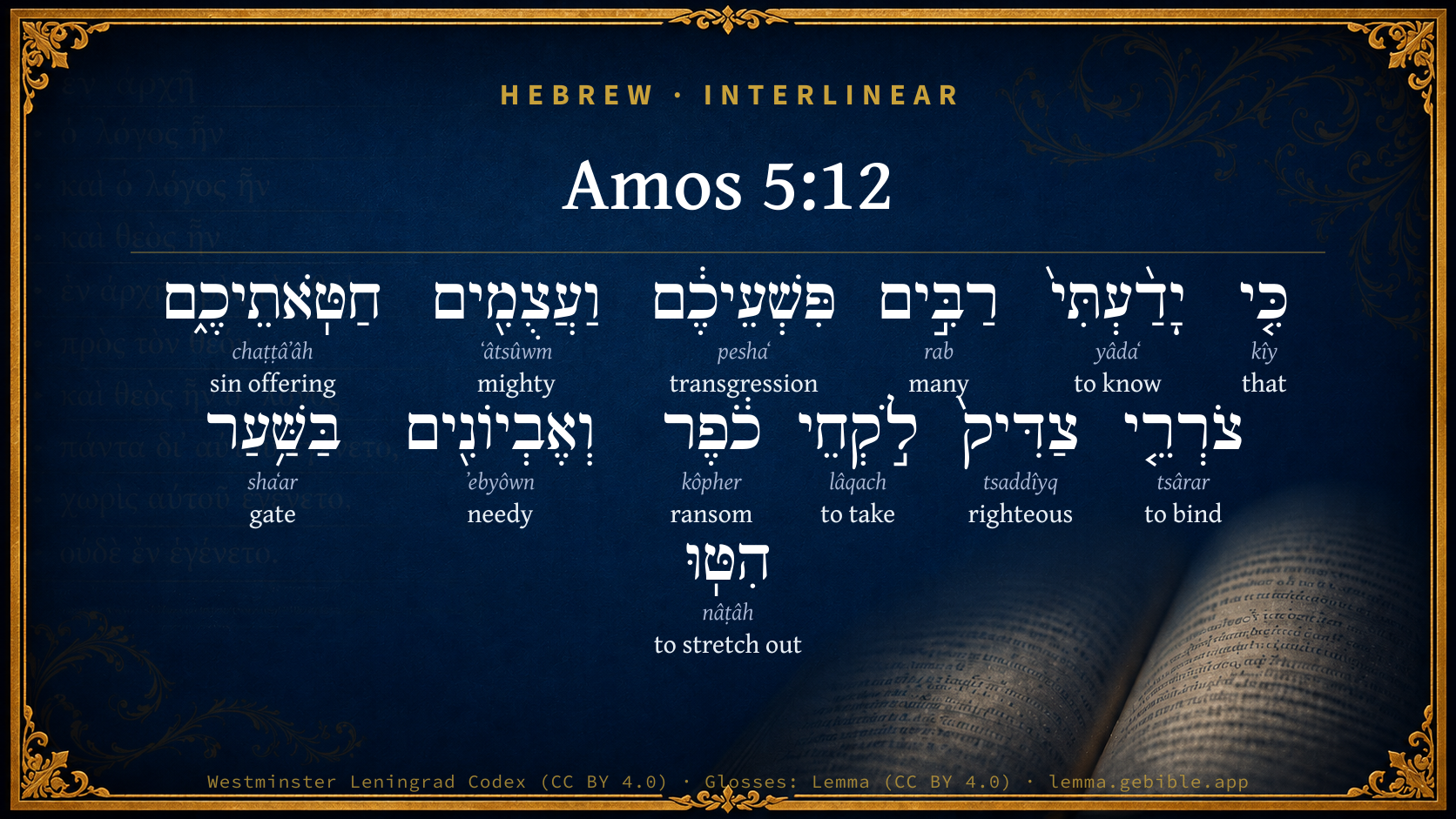
Hebrew (Westminster Leningrad Codex) Amos 5:12 appears in the Hebrew Old Testament. The text above is from the Westminster Leningrad Codex. Each word links to its Strong’s number, a concise gloss, and parsing drawn from the Open Scriptures Hebrew Bible morphology. Click any word for its full Brown-Driver-Briggs (BDB) entry.
Download image
Cite this verse

Amos 5:12 (World English Bible). Public Domain. Lemma interlinear Bible study tool, https://lemma.gebible.app/v/amos/5/12.

Show BibTeX & RIS
BibTeX
RIS
English Translation
For I know how many your offenses, And how great are your sins-- You who afflict the just, Who take a bribe, And who turn aside the needy in the courts.
World English Bible · Public Domain
Download a study sheet

One document with this verse’s original text, its word-by-word gloss line, the meaning frame, cross-references with their text, attributed commentary, and full source and license credits — printable, and it pastes into notes with its structure intact.

This verse Autodidact and up

Study sheet (.html) Plain text (.txt)

A passage Seminary Student

Up to 50 verses in one chapter. A passage sheet keeps up to 6 commentary sources and 12 cross-references per verse, in the order this page ranks them, and says so on the sheet whenever that leaves anything out. Ask for a single verse and you get the Autodidact verse sheet above.

Everything on this page stays free to read, with no account — the sheet is a download of what is already on screen, not access to it.

Want to remove ads? Support Godless Engineer
Compare translations 3

The same verse in 3 English versions, stacked beneath the original-language interlinear above. Click any original word for its lexicon entry.

Each is an independent rendering of the whole verse — the interlinear is not word-aligned to these translations.

Highlighted words mark where these versions differ — a whole-verse word diff, not a word-by-word alignment.

  • World English Bible Public Domain
    For I know how many your offenses, And how great are your sins-- You who afflict the just, Who take a bribe, And who turn aside the needy in the courts.
  • King James Version Public Domain
    For I know your manifold transgressions and your mighty sins: they afflict the just, they take a bribe, and they turn aside the poor in the gate from their right.
  • unfoldingWord Literal Text CC BY-SA 4.0
    For I know how many are your offenses and how great are your sins— you who afflict the just, take bribes, and turn aside the needy in the city gate.

unfoldingWord Literal Text — © unfoldingWord, licensed CC BY-SA 4.0. Word-aligned USFM3 via Door43 (git.door43.org/unfoldingWord/en_ult).

Versions to compare (up to 4)

3 of 4 selected

Show all 18 translations

Every available English version of this verse, each an independent rendering of the whole verse.

  • World English Bible Public Domain
    For I know how many your offenses, And how great are your sins-- You who afflict the just, Who take a bribe, And who turn aside the needy in the courts.
  • Berean Standard Bible Public Domain
    For I know that your transgressions are many and your sins are numerous. You oppress the righteous by taking bribes; you deprive the poor of justice in the gate.
  • Majority Standard Bible Public Domain
    For I know that your transgressions are many and your sins are numerous. You oppress the righteous by taking bribes; you deprive the poor of justice in the gate.
  • King James Version Public Domain
    For I know your manifold transgressions and your mighty sins: they afflict the just, they take a bribe, and they turn aside the poor in the gate from their right.
  • American Standard Version (1901) Public Domain
    For I know how manifold are your transgressions, and how mighty are your sins-ye that afflict the just, that take a bribe, and that turn aside the needy in the gate `from their right'.
  • Revised Version (1885) Public Domain
    For I know how manifold are your transgressions, and how mighty are your sins; ye that afflict the just, that take a bribe, and that turn aside the needy in the gate from their right.
  • Geneva Bible (1599) Public Domain
    For I know your manifold transgressions, and your mightie sinnes: they afflict the iust, they take rewards, and they oppresse the poore in ye gate.
  • Douay-Rheims (1899) Public Domain
    Because I know your manifold crimes, and your grievous sine: enemies of the just, taking bribes, and oppressing the poor in the gate.
  • Young's Literal Translation Public Domain
    For I have known -- many `are' your transgressions, And mighty your sins, Adversaries of the righteous, taking ransoms, And the needy in the gate ye turned aside.
  • Literal Standard Version CC BY-SA 4.0
    For I have known—many [are] your transgressions, || And mighty your sins, || Adversaries of the righteous, taking ransoms, || And you turned aside the needy in the gate.
  • Unlocked Literal Bible CC BY-SA 4.0
    For I know how many are your offenses and how great are your sins— you who afflict the just, take bribes, and turn aside the needy in the city gate.
  • unfoldingWord Literal Text CC BY-SA 4.0
    For I know how many are your offenses and how great are your sins— you who afflict the just, take bribes, and turn aside the needy in the city gate.
  • Darby Bible Public Domain
    For I know how manifold are your transgressions and your sins mighty: they afflict the just, they take a bribe, and they turn aside [the right of] the needy in the gate.
  • World Messianic Bible Public Domain
    For I know how many are your offenses, and how great are your sins— you who afflict the just, who take a bribe, and who turn away the needy in the courts.
  • Webster's Bible Public Domain
    For I know your manifold transgressions and your mighty sins: they afflict the just, they take a bribe, and they turn aside the poor in the gate from their right.
  • Free Bible Version CC BY-SA 4.0
    For I know the extent of your wrongdoing and your numerous sins. You oppress good people by taking bribes, and you prevent the poor from getting justice in the courts.
  • Bible in Basic English Public Domain
    For I have seen how your evil-doing is increased and how strong are your sins, you troublers of the upright, who take rewards and do wrong to the cause of the poor in the public place.
  • JPS Tanakh (1917) Public Domain
    For I know how manifold are your transgressions, and how mighty are your sins; ye that afflict the just, that take a ransom, and that turn aside the needy in the gate.

Literal Standard Version (2020), Covenant Press — licensed CC BY-SA 4.0. Text via the HelloAO Bible API (eBible.org). Unlocked Literal Bible (unfoldingWord) — licensed CC BY-SA 4.0. Text via the HelloAO Bible API (eBible.org). unfoldingWord Literal Text — © unfoldingWord, licensed CC BY-SA 4.0. Word-aligned USFM3 via Door43 (git.door43.org/unfoldingWord/en_ult). Free Bible Version, Dr. Jonathan Gallagher — licensed CC BY-SA 4.0. Text via the HelloAO Bible API (eBible.org).

Word by word

More ways to search: Search by grammar → Find every occurrence → Compare this word →

Practice this passage: Drill this verse → Learn its vocabulary →

כֹ֔פֶר
kôpher
H3724
“ransom”
Noun, Common, Masculine, Singular, Absolute
Part of Speech
Noun
Type
Common
Gender
Masculine
Number
Singular
State
Absolute
Full BDB Definition

Origin: from H3722

TWOT: 1025b

price of a life, ransom, bribe - asphalt, pitch (as a covering) - the henna plant, name of a plant (henna?) - village
  1. כִּ֤י kîy H3588 “that” Conjunction
  2. יָדַ֨עְתִּי֙ yâdaʻ H3045 “to know” Verb, Qal, Perfect, 1st Person, Common, Singular
  3. רַבִּ֣ים rab H7227 “many” Adjective, Adjective, Masculine, Plural, Absolute
  4. פִּשְׁעֵיכֶ֔ם peshaʻ H6588 “transgressions · your” Noun, Common, Masculine, Plural, Construct + Suffix, Personal, 2nd Person, Masculine, Plural
  5. וַעֲצֻמִ֖ים ʻâtsûwm H6099 “and · mighty” Conjunction + Adjective, Adjective, Masculine, Plural, Absolute
  6. חַטֹּֽאתֵיכֶ֑ם chaṭṭâʼâh H2403 “sin offerings · your” Noun, Common, Feminine, Plural, Construct + Suffix, Personal, 2nd Person, Masculine, Plural
  7. צֹרְרֵ֤י tsârar H6887 “binding” Verb, Qal, Participle Active, Masculine, Plural, Construct
  8. צַדִּיק֙ tsaddîyq H6662 “righteous” Adjective, Adjective, Masculine, Singular, Absolute
  9. לֹ֣קְחֵי lâqach H3947 “taking” Verb, Qal, Participle Active, Masculine, Plural, Construct
  10. וְאֶבְיוֹנִ֖ים ʼebyôwn H34 “and · needy” Conjunction + Adjective, Adjective, Masculine, Plural, Absolute
  11. בַּשַּׁ֥עַר shaʻar H8179 “in/at the · gate” Preposition, Determined + Noun, Common, Masculine, Singular, Absolute
  12. הִטּֽוּ nâṭâh H5186 “to stretch out” Verb, Hiphil, Perfect, 3rd Person, Common, Plural

About this verse

These counts appear in no published source. They are computed here, from the morphology-tagged text and Lemma’s own curated glosses. What Lemma adds →

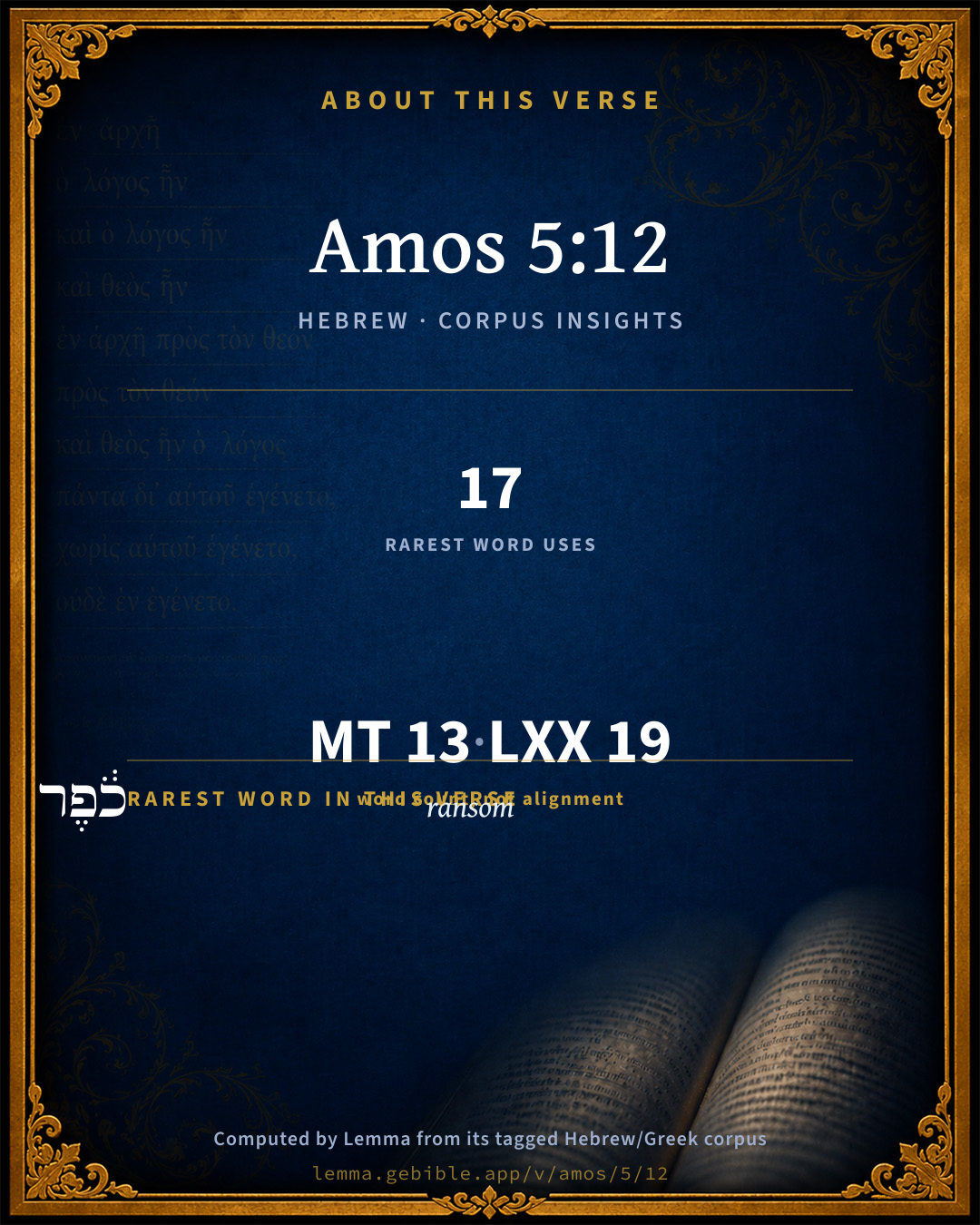
13
words
13
distinct lemmas
Prophets
section

Notable vocabulary

The rarest word here is כֹ֔פֶר ransom H3724 — appearing just 17 times in the whole Hebrew Bible.

Shared distinctive vocabulary

כֹ֔פֶר ransom H3724 occurs in 17 verses of the Hebrew Bible. Also found in:

Grammatical profile

  • 4 verbs
  • 4 nouns
  • 4 adjectives
  • 1 conjunction

Verb forms

  • יָדַ֨עְתִּי֙ Qal · Perfect
  • צֹרְרֵ֤י Qal · Participle Active
  • לֹ֣קְחֵי Qal · Participle Active
  • הִטּֽוּ Hiphil · Perfect

Hebrew & Septuagint length

In English translation the verse runs 31 words from the Hebrew and 28 from the Septuagint (LXX English) — closely comparable.

A rough comparison of the two English renderings, which tokenize alike — not a word-level alignment.

Word counts can differ between the Hebrew and the Greek without any difference in meaning — e.g. the Hebrew direct-object marker אֵת has no separate Greek word, and Greek often adds the article ὁ.

In the original languages it is 13 Hebrew tokens and 19 Greek tokens — but the two are counted differently (Hebrew bundles its prefixes and suffixes into one token; the Greek is in lemma form), so that isn’t a like-for-like length.

Cross-references

29

Topical passages linked to Amos 5:12 in the Treasury of Scripture Knowledge — connected by theme and wording, ordered by reader-vote popularity; previews shown in the World English Bible.

  • Amos 2:6–7 Thus says Yahweh: "For three transgressions of Israel, yes, for four, I will not turn away its punishment; Because they have sold the righteous for silver, And the needy for a pair of shoes;
  • Amos 5:10 They hate him who reproves in the gate, And they abhor him who speaks blamelessly.
  • Isaiah 1:23 Your princes are rebellious, and companions of thieves. Everyone loves bribes, and follows after rewards. They don't judge the fatherless, Neither does the cause of the widow come to them.
  • 1 Samuel 8:3 His sons didn't walk in his ways, but turned aside after lucre, and took bribes, and perverted justice.
  • Psalms 26:9–10 Don't gather my soul with sinners, Nor my life with bloodthirsty men;
  • Malachi 3:5 I will come near to you to judgment; and I will be a swift witness against the sorcerers, and against the adulterers, and against the perjurers, and against those who oppress the hireling in his wages, the widow, and the fatherless, and who deprive the foreigner of justice, and don't fear me," says Yahweh of Hosts.
  • Acts 7:52 Which of the prophets didn't your fathers persecute? They killed those who foretold the coming of the Righteous One, of whom you have now become betrayers and murderers.
  • James 5:4 Behold, the wages of the laborers who mowed your fields, which you have kept back by fraud, cry out, and the cries of those who reaped have entered into the ears of the Lord of Hosts.
  • Deuteronomy 16:18 Judges and officers shall you make you in all your gates, which Yahweh your God gives you, according to your tribes; and they shall judge the people with righteous judgment.
  • Deuteronomy 31:21 It shall happen, when many evils and troubles are come on them, that this song shall testify before them as a witness; for it shall not be forgotten out of the mouths of their seed: for I know their imagination which they frame this day, before I have brought them into the land which I swore.
  • Ruth 4:1 Now Boaz went up to the gate, and sat him down there: and, behold, the near kinsman of whom Boaz spoke came by; to whom he said, Ho, such a one! turn aside, sit down here. He turned aside, and sat down.
  • 2 Kings 17:7–17 It was so, because the children of Israel had sinned against Yahweh their God, who brought them up out of the land of Egypt from under the hand of Pharaoh king of Egypt, and had feared other gods,
  • Job 29:7–25 When I went forth to the city gate, When I prepared my seat in the street,
  • Job 31:21 If I have lifted up my hand against the fatherless, Because I saw my help in the gate:
  • Proverbs 22:22 Don't exploit the poor, because he is poor; And don't crush the needy in court;
  • Isaiah 5:23 Who acquit the guilty for a bribe, But deny justice for the innocent!
  • Isaiah 10:2 to turn aside the needy from justice, and to rob the poor of my people of their right, that widows may be their spoil, and that they may make the fatherless their prey!
  • Isaiah 29:21 that make a man an offender in [his] cause, and lay a snare for him who reproves in the gate, and turn aside the just with a thing of nothing.
  • Isaiah 33:15 He who walks righteously, and speaks blamelessly; he who despises the gain of oppressions, who shakes his hands from taking a bribe, who stops his ears from hearing of blood, and shuts his eyes from looking on evil:
  • Isaiah 47:9 but these two things shall come to you in a moment in one day, the loss of children, and widowhood; in their full measure shall they come on you, in the multitude of your sorceries, and the great abundance of your enchantments.
  • Isaiah 66:18 For I [know] their works and their thoughts: [the time] comes, that I will gather all nations and languages; and they shall come, and shall see my glory.
  • Jeremiah 29:23 because they have worked folly in Israel, and have committed adultery with their neighbors' wives, and have spoken words in my name falsely, which I didn't command them; and I am he who knows, and am witness, says Yahweh.
  • Lamentations 3:34 To crush under foot all the prisoners of the earth,
  • Amos 2:16 And he who is courageous among the mighty will flee away naked in that day," says Yahweh.
  • Micah 3:11 Her leaders judge for bribes, And her priests teach for a price, And her prophets of it tell forturnes for money: Yet they lean on Yahweh, and say, Isn't Yahweh in the midst of us? No disaster will come on us.
  • Micah 7:3 Their hands are on that which is evil to do it diligently. The ruler and judge ask for a bribe; And the powerful man dictates the evil desire of his soul. Thus they conspire together.
  • Acts 3:13–14 The God of Abraham, Isaac, and Jacob, the God of our fathers, has glorified his Servant Jesus, whom you delivered up, and denied in the presence of Pilate, when he had determined to release him.
  • Hebrews 4:12–13 For the word of God is living, and active, and sharper than any two-edged sword, and piercing even to the dividing of soul and spirit, of both joints and marrow, and is able to discern the thoughts and intentions of the heart.
  • James 5:6 You have condemned, you have murdered the righteous one. He doesn't resist you.

Cross-references courtesy of OpenBible.info (CC BY 4.0).

Hebrew and Greek witnesses Masoretic Hebrew ↔ Greek Septuagint

The same verse in the two great witnesses to the Old Testament, shown verse-for-verse.

These are two independent witnesses, not word-aligned to each other, and the Septuagint is shown in lemma (dictionary) form.

Hebrew Amos 5:12 Masoretic · Westminster Leningrad Codex

כִּ֤י יָדַ֨עְתִּי֙ רַבִּ֣ים פִּשְׁעֵיכֶ֔ם וַעֲצֻמִ֖ים חַטֹּֽאתֵיכֶ֑ם צֹרְרֵ֤י צַדִּיק֙ לֹ֣קְחֵי כֹ֔פֶר וְאֶבְיוֹנִ֖ים בַּשַּׁ֥עַר הִטּֽוּ

For I know how many your offenses, And how great are your sins-- You who afflict the just, Who take a bribe, And who turn aside the needy in the courts.

World English Bible · Public Domain

Greek LXX Amos 5:12 Septuagint · lemma form

ὅτι γιγνώσκω πολύς ἀσέβεια σύ καί ἰσχυρός ὁ ἁμαρτία σύ καταπατέω δίκαιος λαμβάνω ἄλλαγμα καί πένης ἐν πύλη ἐκκλίνω

For I know your many transgressions, and your sins are great, trampling on the just, taking bribes, and turning aside the judgment of the poor in the gates.

LXX2012 (modern English Septuagint) · Public Domain

On this verse, The Pulpit Commentary discusses the Septuagint’s reading. Read the note in Commentary ↓

Hebrew: Westminster Leningrad Codex (CC BY 4.0). Greek: Septuagint (public domain); English from LXX2012 (modern English Septuagint) (Public Domain). How the Septuagint differs from the Hebrew →

Targum (Aramaic paraphrase)

1

The Targum is the ancient Jewish Aramaic paraphrase of the Hebrew Scriptures — an interpretive translation, not the Hebrew text itself. Onkelos (literal) and Pseudo-Jonathan (expansive) render the Torah, and Jonathan the Prophets. Coverage is partial: where no permissively-licensed English translation exists for a verse, only the Aramaic is shown. This is verse-level text, not a word-by-word alignment to the Hebrew.

  1. Targum Jonathan Prophets (Joshua–Malachi)
    אֲרֵי גְלֵי קֳדָמַי דְסַגִיאִין מֵירְדֵיכוֹן וְתַקִיפָן חוֹבָתֵיכוֹן מְעִיקִין לֵיהּ לְזַכָּאָה בְּדִיל לְקַבָּלָא מָמוֹן דִשְׁקַר וְדִין חֲשִׁיכַיָא בְּבֵית כְּנִישְׁתֵּיהִוֹן מַסְטָן:

    (no public-domain English translation for this verse)

    Targum Jonathan — Aramaic: “Mikraot Gedolot” (public domain). English: “Sefaria Community Translation” (CC0 1.0 (public-domain dedication)); “London "Chaldee Paraphrase," 1871” (public domain). Text via Sefaria.

Commentary

Notes on Amos 5:12 from classic Christian and Jewish commentators (each source and its license shown beneath its notes). The classic Christian expositions comment on the surrounding passage and are grouped to its opening verse, so a note may address several verses; the Jewish commentaries on the Tanakh (Rashi and others) are per-verse, so they appear only where the commentator wrote on this verse.

Lemma curates 59 commentaries, every one of them public domain or Creative Commons licensed, each selected and text-cleaned for this edition rather than reprinted as found. About our sources →

Trapp's Complete Commentary

John Trapp

Amo 5:12 For I know your manifold transgressions and your mighty sins: they afflict the just, they take a bribe, and they turn aside the poor in the gate [from their right].

Ver. 12. For I know your manifold transgressions, and your mighty sins] I know them, and can easily set them in an order before your eyes, Psa 50:21, bring them out (as they did the vessels of the sanctuary) by number and by weight, Ezr 8:34 : make you answer for all with flames about your ears, lay open your many transgressions, and mighty sins, fortia peccata. The Hebrew hath it, your bony, or big boned sins; huge, heinous, and monstrous, capable of all manner of aggravations. All these I know, saith God, they are all in print in heaven, and I will one day read them aloud in the ears of all the world. Fac ergo confitendo propitium, quem tacendo non facis nescium, saith Austin. Make, therefore, God thy friend, by confessing thy sins to him, which thou canst not by any means conceal from him.

They afflict the just] They pinch and distress him by their oppressions, which are often here laid in their dish, as an abomination to the Lord; for he is merciful, see Amo 2:6.

They take a bribe] A ransom to blind their eyes (Copher), as 1Sa 12:3, or a pacification of their pretended displeasure against heinous crimes brought before them. Olim didiei quid sint munera, said a worthy man: Once I have learned long since, how dangerous a thing it is for men in place to meddle with gifts. A public person, as he should have nothing to lose, so nothing to get; he should be above all price or sale.

They turn aside the poor in the gate] That is, in the place of judicature. This makes many that go to law, to be at length of Themistocles’ mind; who professed that if two ways were shown him, one to hell, and the other to the bar, he would choose that which went to hell, and forsake the other. Another said, that he wondered much at two sorts of men; viz. those that go to sea, and those that go to law: not so much that they did so at first, but that, after trial, they would ever go a second time.

John Trapp, A Commentary or Exposition upon All the Books of the Old and New Testament (1647–1656) — public domain. Text from a community e-Sword module.

Jamieson, Fausset & Brown

Robert Jamieson, A. R. Fausset & David Brown

they afflict . . . they take--rather, "(ye) who afflict . . . take."

bribe--literally, a price with which one who has an unjust cause ransoms himself from your sentence (Sa1 12:3, Margin; Pro 6:35).

turn aside the poor in the gate--refuse them their right in the place of justice (Amo 2:7; Isa 29:21).

Jamieson, Fausset & Brown — Commentary Critical and Explanatory on the Whole Bible (1871) — public domain (CC PDM 1.0). Text via the HelloAO Bible API.

Adam Clarke's Commentary

Verse 12. I know your manifold transgressions] I have marked the multitude of your smaller crimes, as well as your mighty offenses. Among their greater offenses were,

1. Their afflicting the righteous.

2. Taking bribes to blind their eyes in judgment. And,

3. Refusing to hear the poor, who had no money to give them.

Adam Clarke's Commentary on the Bible (1810–1826) — public domain. Text from a community e-Sword/MySword module.

John Calvin's Commentaries

The Prophet introduces God here as the speaker, that the threatening might be more authoritative: for we know, at it has been before stated, that the Prophets were despised by haughty men; but when God himself appeared as it were before them, it was strange if no fear laid hold on them; they had at least no excuse for their presumption, if God’s name did not touch their hearts and humble them.

I know, he says, your iniquities; as though he said, “Ye do not think yourselves bound to render an account to men, as probably no such account; will be rendered by you; but how will you be able, think you, to escape my tribunal? for I am your judge, and mine is the government: however ferociously ye now tread on the poor, and evasively contend with me, your crimes must necessarily be judged by me; I know your crimes. And as the rich by their splendor covered every wickedness, particularly the magistrates, who were adorned with a public character, God says that their turpitude was fully known to him: as though he said “Contend as much as you please, still your iniquities are sufficiently apparent to me; ye will gain nothing by your subtle evasions.” Moreover, he reprehends them not merely for slight offenses, but says that they were wholly past being borne with. When something is done amiss by the highest power, indulgence is commonly granted; for nothing is more difficult than for one who sustains so great and heavy a burden, to retain so much integrity as to be free from every blame: but the Lord shows here that they were not lightly culpable, but that their crimes were so grievous and flagrant that they could not be endured. We now then understand what was the object of the Prophet.

When therefore their own greatness dazzles the eyes of proud men, let us know that they cannot deprive God of his right; for though he may not judge them to-day, he will yet shortly ascend his tribunal: and he reminds them, that those pompous displays by which they cover their many crimes, are only shadows which will vanish. This is what the Prophet means.

Then he calls them, The oppressors of the just He enumerates here some particulars, with regard to which, the iniquity of the judges whom he now addresses might be, as it were, felt to be gross and abominable. Ye oppress he says, the just; this was one thing: then follows another, They take כפר, capher, expiation, or, the price of redemption. The Prophet, I have no doubt, meant to point out here something different from the former crime. Though interpreters blend these two things, I yet think them to be wholly different; for these mercenary judges made an agreement with the wicked, whenever any homicide or other violence was perpetrated; in short, whenever any one implicated himself in any grievous sin, they saw that there was a prey taken, and anxiously gaped for it: they wished murders to be committed daily, that they might acquire gain. Since, then, these judges were thus intent on bribery, the Prophet accuses them as being takers of ransom. They ought to have punished crimes; this they did not; but they let go the wicked unpunished; they spared murderers, and adulterers, and robbers, and sorcerers not indeed without rewards, for they brought the price of redemption, and departed as if they were innocent.

We now perceive what the Prophet means here; and well would it be were this crime not so common: but at this day, the cruelty of many judges appears especially in this — that they hunt for crimes for the sake of gain, which seems to be as it were a ransom; for this is the proper meaning of the word כפר, capher. As then this evil commonly prevails it is no wonder that the Prophet, while reprehending the corruptions of his time, says, that judges took a ransom.

Then he adds, The poor they turn aside from judgment in the gate This is the third crime: the Prophet complains, that they deprived miserable men of their right, because they could not bring so large a bribe as the rich; though relying on the goodness of their cause, they thought themselves sure of victory. The Prophet complains, that they were disappointed of their hope, and their right was denied them in the gate, that is, in the court of justice; for we know that it was an ancient custom for judges to sit in the gates, and there to administer justice; And hence Amos mentions here gate twice: and what he complains of was the more disgraceful, inasmuch as the judicial court was, as it were, a sacred asylum, to which injured men resorted, that they might have their wrongs redressed. When this became the den of robbers, what any more remained for them? We now then see that the Prophet speaks not here of the common people, but that he mainly levels his reproofs against the rulers. Let us go on —

John Calvin's Commentaries (1540-1563) — public domain. Text from the Calvin Translation Society English edition (1840s-50s) via the Christian Classics Ethereal Library (ccel.org). Calvin's coverage is partial (roughly two-thirds of the Bible); uncommented books and verses are honest gaps, never fabricated. The 19th-century editor's footnotes and remarks are omitted so the notes are faithfully Calvin's own voice.

Ellicott's Commentary for English Readers

(12) I know.—Most of the commentators imply that the “I” is Jehovah, but it is more likely to be the prophet himself. The adjectives “manifold,” “mighty,” should be rendered as predicates, That manifold are your transgressions, and mighty your sins, ye afflicters of the just and takers of a bribe, and ye who bow down the poor in the gate. The idea involved in the word rendered “bribe” is the ransom which the poor and defenceless were obliged to pay to a tyrannical judge, in order to escape a harsh sentence. The “gate” is the place where judgment is passed by the chief men.

A Bible Commentary for English Readers, edited by Charles John Ellicott (1878–1897) — public domain. Text from a community e-Sword module.

The Cambridge Bible for Schools and Colleges

gen. ed. J. J. S. Perowne

12. For I know how manifold are your transgressions, and how mighty are your sins] Jehovah’s knowledge of what they imagine He is ignorant of (Psa_73:11; Job_22:13), is the ground of the sentence expressed in Amo_5:11.

they afflict the just] Amo_2:6, Amo_3:9 f., &c.

they take a bribe] a ransom or price of a life, the proper meaning of the word (kôpher—not shôḥad); see e.g. Exo_21:30, and especially Num_35:31, where the Israelites are strictly forbidden to “take a ransom (kôpher)” for the life of a murderer. But here the venal judges are represented as accepting such a ‘kôpher’; thus the rich murderer was acquitted, while the innocent, if unable to pay the price which the judge demanded, could get no redress for his wrongs.

turn aside the needy in the gate] The ‘gate,’ as Amo_5:10 : “turn aside” (sc. from their right, Isa_10:2), as Isa_29:21; Mal_3:5.

12–13. Israel’s desperate moral condition, a justification of the sentence just pronounced upon it.

The Cambridge Bible for Schools and Colleges (gen. ed. J. J. S. Perowne; Cambridge University Press, 1878–1918) — public domain. Text from a community e-Sword module.

John Gill's Exposition

For I know your manifold transgressions and your mighty sins,.... Their sins were numerous, and of the first magnitude, attended with very heavy aggravations; and these with all their circumstances were well known to the omniscient God, and therefore he determined to punish them as he had threatened. Some of their transgressions are pointed out, as follow:

they afflict the just; who are so both in a moral and evangelic sense; not comparatively only, but really; and particularly whose cause was just, and yet were vexed and distressed by unjust judges, who gave the cause against them, made them pay all costs and charges, and severely mulcted them: they take a bribe; of those that were against the just, and gave the cause for them. The word signifies "a ransom" (f). The Targum it false mammon. Corrupt and unjust judges are here taxed:

and they turn aside the poor in the gate from their right; in the court of judicature, where they should have done them justice, such courts being usually held in the gates of cities; but instead of that they perverted their judgment, and did them wrong.

(f) "pretium redemptionis", Mercerus, Liveleus, Drusius, Lytron, Cocceius.

John Gill's Exposition of the Whole Bible (1746–1763) — public domain (CC PDM 1.0). Text via the HelloAO Bible API.

Albert Barnes' Notes on the Bible

For I know - Literally, “I have known.” They thought that God did not know, because He did not avenge; as the Psalmist says, “Thy judgments are far above out of his sight” Psa 10:5. People who do not act with the thought of God, cease to know Him, and forget that He knows them. “Your manifold transgressions;” literally, “many are your transgressions and mighty your sins.” Their deeds, they knew, were mighty, strong, vigorous, decided. God says, that their “sins” were so, not many and great only, but “mighty, strong” , “issuing not out of ignorance and infirmity, but out of proud strength” , “‘strong’ in the oppression of the poor and in provoking God,” and bringing down His wrath. So Asaph says of the prosperous; “Pride encompasseth them, as a chain; they are corrupt, they speak oppression wickedly; they speak from on high” Psa 73:6, Psa 73:8.

They afflict the just - Literally, “afflicters of the just,” that is, such as habitually afflicted him; whose habit and quality it was to afflict him. Our version mostly renders the word “enemies.” Originally, it signifies “afflicting, persecuting” enemies. Yet it is used also of the enemies of God, perhaps such as persecute Him in His people, or in His Son when in the flesh. The unjust hate the just, as is said in the book of Wisdom; “The ungodly said, Therefore let us lie in wait for the righteous, because he is not for our turn, and is clean contrary to our doings: he upbraideth us with our offending the law. He profeseth to have the knowledge of God, and he calleth himself the child of the Lord. He was made to reprove our thoughts. He is grievous unto us even to behold, for his life is not as other people’s, his ways are of another fashion” (Wisdom Psa 2:1, Psa 2:12-15). So when the Truth and Righteousness came into the world, the Scribes and Pharisees hated Him because He reproved them, “denied” Act 3:14 and crucified “the Holy one and the Just, and desired a murderer to be granted unto” them, haters and “enemies of the Just,” and preferring to Him the unjust.

That take a bribe - Literally, “a ransom.” It may be that, contrary to the law, which forbade, in these same words Num 35:22, “to take any ransom for the life of a murderer,” they took some ransom to set free rich murderers, and so, (as we have seen for many years to be the effect of unjust acquittals,) blood was shed with impunity, and was shed the more, because it was disregarded. The word, however, is used in one place apparently of any bribe, through which a man connives at injustice 1Sa 12:3.

Albert Barnes' Notes on the Bible (1834–1885) — public domain. Text from a community e-Sword/MySword module.

Haydock's Catholic Bible Commentary

Grievous. Hebrew also, "numerous."

George Leo Haydock (1774–1849), Haydock's Catholic Family Bible and Commentary, 1859 edition — public domain. Excludes Psalms (Douay-Rheims chapter numbering differs from Protestant) and Deuterocanonical books (Catholic canon only).

Matthew Poole's English Annotations

For; wonder not at the threatened severity, as if it were too rigorous; it is but proportioned to your sins.

I, the Lord, whom you provoke, who have threatened you, know, clearly, fully, and in all the circumstances of them, what moves you to do so, what pretences of law you make: all your evasions are vain and foolish.

Your manifold transgressions; the increased number of your sins, and the greatness of them too, as the word importeth.

Your mighty sins; which mightily wrong and break the poor and needy.

They afflict, besiege, or with hostile minds watch against, and gladly take any occasion to wrong and grieve, the just; not absolutely and sinlessly just, but such as are comparatively just, or those whose cause is just, or those that live with regard to all the commands of God, and follow righteousness: it was the mighty sin of the corrupt rulers in Samaria and Israel at that day, that they were enemies to all righteousness.

They take a bribe; in civil causes bribes carried it; see Amo 2:6; here bribes set criminals free, a ransom. as the word in the Hebrew, buys off the punishment appointed by the law against murderers, adulterers, &c.

They turn aside the poor in the gate; the poor, who appear in their courts for justice, they turn them away, or delay to hear, or hear and judge unjustly, and so send them away wronged and crying.

From their right: these words fully express the prophet’s meaning, and are therefore well supplied in our version.

Matthew Poole's English Annotations on the Holy Bible (1683–1685) — public domain. Text from a community e-Sword/MySword module.

The Pulpit Commentary

Your punishment is richly deserved, for "I know how many are your transgressions and how mighty are your sins," especially, as it follows, your sins of oppression and injustice. They afflict the just. The construction is continuous: "afflicters of the just." Hostes justi (Vulgate); katapatountev dikaion, "trampling down the just" (Septuagint); comp. RAPC Wis 2:12-15. They take a bribe. The translation of kopher as "bribe" is justified, perhaps, by 1Sa_12:3; but the word is elsewhere used for "ransom," redemption money paid to escape the consequences of crime, (Pro_6:35) in direct opposition to the Law innontev Num_35:31, which forbade any ransom to be taken for the life of a murderer. The Septuagint has, lamba) ajllagmata "taking wares;" the Vulgate (with which the Syriac agrees), accipientes munus. Turn aside the poor in the gate from their right; or, bow down the needy in the gate, i.e. in the place of judgment (see note on ver. 10). Vulgate, pauperes deprimentes in porta; Septuagint, penhtav ejn pulaiv ejkklinontev, "turning aside the poor in the gates." The crime specified is that of wresting judgment in the case of the poor, or not giving the poor man justice unless he could pay for it. (comp. Exo_23:6; Deu_16:19)

The Pulpit Commentary (1880–1919), ed. H.D.M. Spence-Jones & Joseph S. Exell — public domain. Text from a community e-Sword module.

John Wesley's Explanatory Notes

In the gate - In their courts of justice.

John Wesley, Explanatory Notes Upon the Whole Bible (1754–1765) — public domain. Text via the GEBible commentary corpus.

unfoldingWord translationNotes

Door43 World Missions Community

afflict the just, take bribes, and turn aside the needy in the city gate

This is a list of some of their sins.

the just

The word "just" is a nominal adjective that refers to just people. AT: "just people" or "righteous people" (See: Nominal Adjectives)

take bribes

"let people pay you to do bad things" or "let people pay you to lie about people"

turn aside the needy in the city gate

Here "turn aside the needy" represents telling the needy people to leave. It can be made clear why the needy were at the city gate. AT: "do not allow poor people to bring their cases to the judges in the city gate" (See: Assumed Knowledge and Implicit Information)

the needy

The word "needy" is a nominal adjective that refers to people who are in need. AT: "people in need" (See: Nominal Adjectives)

any prudent person is silent

Those who do not want the evil people to harm them will not speak out against the evil deeds. AT: "wise people do not speak about the evil things people are doing"

for it is an evil time

Here "an evil time" represents a time when people are evil and do evil deeds. AT: "for it is a time when people are evil" or "for people do evil things" (See: Metonymy)

translationWords

sin

afflicted

just

bribe

gate

evil

unfoldingWord translationNotes — © Distant Shores Media and the Door43 World Missions Community, licensed CC BY-SA 4.0. Source: git.door43.org/Door43/en_tn.

Rashi

Rabbi Shlomo Yitzchaki (Rashi)

you who oppress the just—[Jonathan renders:] who oppress the innocent.

turning aside... in the gate—In the gates of your courts, they turned aside the judgment of the needy.

Rashi on the Tanakh — English translations: “The Judaica Press complete Tanach with Rashi, translated by A. J. Rosenberg” (CC BY 4.0); “Pentateuch with Rashi's commentary by M. Rosenbaum and A.M. Silbermann, 1929-1934” (public domain); “The Metsudah Tanach series, Lakewood, N.J” (CC BY 4.0); and “The Book of Joshua, Metsudah Publications, 1997” (CC BY 4.0). Text via Sefaria.

Lesson kit

Teaching starters — assembled from the data on this page, not authored interpretation. Every prompt links to the verse data it draws on. Edit before teaching.

Amos, in the Prophets, opens this verse with 13 words (13 distinct Hebrew lemmas). Its most distinctive word is kôpher (“ransom”). A historical commentator’s framing appears above. Read the whole chapter for the surrounding context.

Discussion questions

  1. How does “ransom” (kôpher) shape what this verse is saying?
  2. Genesis 6:14 shares the word «ransom» with this verse. How do the two illuminate each other?
  3. These translations render this verse differently. What is at stake in choosing one wording over another?
  4. The verb «יָדַ֨עְתִּי֙» is Qal Perfect. How does its form color the action?
  5. Reading how Trapp's Complete Commentary and Jamieson, Fausset & Brown read this verse, where do the two commentators agree and where do they part?

Things to notice

Reading settings

Reading text

Shown beneath each verse's original-language words.

Old Testament
Old Testament edition

Read the OT as the Masoretic Hebrew (MT) or the Greek Septuagint (LXX).

English shown for the Greek Septuagint (in the Hebrew ↔ Greek comparison).

Comparing translations? Open the Compare panel on any verse page to stack up to four side by side.