1 Kings 2:38

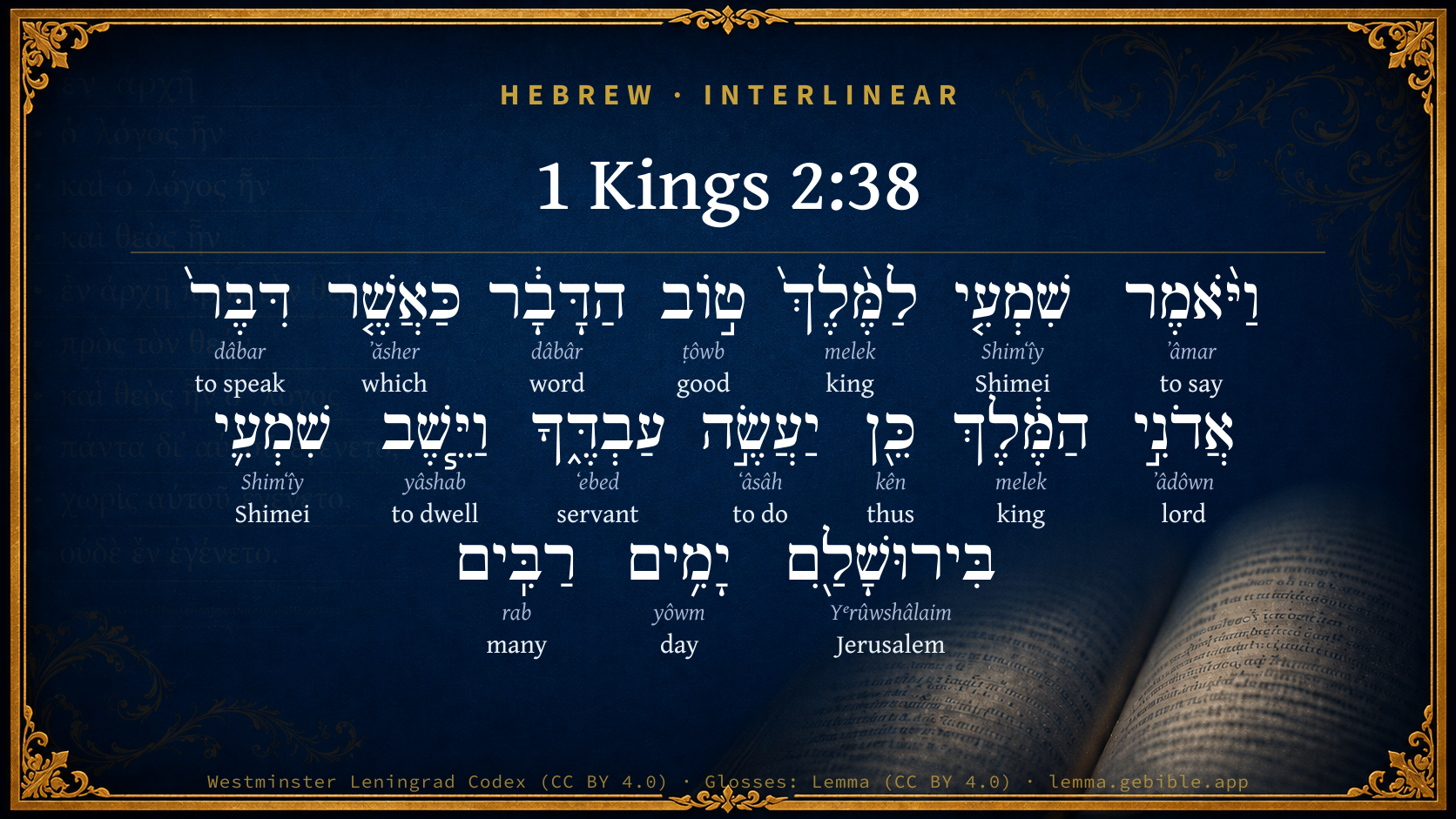
Hebrew (Westminster Leningrad Codex) 1 Kings 2:38 appears in the Hebrew Old Testament. The text above is from the Westminster Leningrad Codex. Each word links to its Strong’s number, a concise gloss, and parsing drawn from the Open Scriptures Hebrew Bible morphology. Click any word for its full Brown-Driver-Briggs (BDB) entry.
Download image
Cite this verse

1 Kings 2:38 (World English Bible). Public Domain. Lemma interlinear Bible study tool, https://lemma.gebible.app/v/1-kings/2/38.

Show BibTeX & RIS
BibTeX
RIS
English Translation
Shimei said to the king, The saying is good: as my lord the king has said, so will your servant do. Shimei lived in Jerusalem many days.
World English Bible · Public Domain
Download a study sheet

One document with this verse’s original text, its word-by-word gloss line, the meaning frame, cross-references with their text, attributed commentary, and full source and license credits — printable, and it pastes into notes with its structure intact.

This verse Autodidact and up

Study sheet (.html) Plain text (.txt)

A passage Seminary Student

Up to 50 verses in one chapter. A passage sheet keeps up to 6 commentary sources and 12 cross-references per verse, in the order this page ranks them, and says so on the sheet whenever that leaves anything out. Ask for a single verse and you get the Autodidact verse sheet above.

Everything on this page stays free to read, with no account — the sheet is a download of what is already on screen, not access to it.

Want to remove ads? Support Godless Engineer
Compare translations 3

The same verse in 3 English versions, stacked beneath the original-language interlinear above. Click any original word for its lexicon entry.

Each is an independent rendering of the whole verse — the interlinear is not word-aligned to these translations.

Highlighted words mark where these versions differ — a whole-verse word diff, not a word-by-word alignment.

  • World English Bible Public Domain
    Shimei said to the king, The saying is good: as my lord the king has said, so will your servant do. Shimei lived in Jerusalem many days.
  • King James Version Public Domain
    And Shimei said unto the king, The saying is good: as my lord the king hath said, so will thy servant do. And Shimei dwelt in Jerusalem many days.
  • unfoldingWord Literal Text CC BY-SA 4.0
    And Shimei said to the king, “The word is good. Just as my lord the king has spoken, thus will your servant do.” And Shimei dwelled in Jerusalem many days.

unfoldingWord Literal Text — © unfoldingWord, licensed CC BY-SA 4.0. Word-aligned USFM3 via Door43 (git.door43.org/unfoldingWord/en_ult).

Versions to compare (up to 4)

3 of 4 selected

Show all 18 translations

Every available English version of this verse, each an independent rendering of the whole verse.

  • World English Bible Public Domain
    Shimei said to the king, The saying is good: as my lord the king has said, so will your servant do. Shimei lived in Jerusalem many days.
  • Berean Standard Bible Public Domain
    “The sentence is fair,” Shimei replied. “Your servant will do as my lord the king has spoken.” And Shimei lived in Jerusalem for a long time.
  • Majority Standard Bible Public Domain
    “The sentence is fair,” Shimei replied. “Your servant will do as my lord the king has spoken.” And Shimei lived in Jerusalem for a long time.
  • King James Version Public Domain
    And Shimei said unto the king, The saying is good: as my lord the king hath said, so will thy servant do. And Shimei dwelt in Jerusalem many days.
  • American Standard Version (1901) Public Domain
    And Shimei said unto the king, The saying is good: as my lord the king hath said, so will thy servant do. And Shimei dwelt in Jerusalem many days.
  • Revised Version (1885) Public Domain
    And Shimei said unto the king, The saying is good: as my lord the king hath said, so will thy servant do. And shimei dwelt in Jerusalem many days.
  • Geneva Bible (1599) Public Domain
    And Shimei sayd vnto the King, The thing is good: as my lord the King hath sayd, so wil thy seruant doe. So Shimei dwelt in Ierusalem many dayes.
  • Douay-Rheims (1899) Public Domain
    And Semei said to the king: The saying is good: as my lord the king hath said, so will thy servant do. And Semei dwelt in Jerusalem, many days.
  • Young's Literal Translation Public Domain
    And Shimei saith to the king, `The word `is' good; as my lord the king hath spoken so doth thy servant do;' and Shimei dwelleth in Jerusalem many days.
  • Literal Standard Version CC BY-SA 4.0
    And Shimei says to the king, “The word [is] good; as my lord the king has spoken so your servant does”; and Shimei dwells in Jerusalem many days.
  • Unlocked Literal Bible CC BY-SA 4.0
    So Shimei said to the king, “What you say is good. As my master the king has said, so your servant will do.” So Shimei lived in Jerusalem for many days.
  • unfoldingWord Literal Text CC BY-SA 4.0
    And Shimei said to the king, “The word is good. Just as my lord the king has spoken, thus will your servant do.” And Shimei dwelled in Jerusalem many days.
  • Darby Bible Public Domain
    And Shimei said to the king, The saying is good: as my lord the king has said, so will thy servant do. And Shimei dwelt in Jerusalem many days.
  • World Messianic Bible Public Domain
    Shimei said to the king, “What you say is good. As my lord the king has said, so will your servant do.” Shimei lived in Jerusalem many days.
  • Webster's Bible Public Domain
    And Shimei said to the king, The saying is good: as my lord the king hath said, so will thy servant do. And Shimei dwelt in Jerusalem many days.
  • Free Bible Version CC BY-SA 4.0
    “What Your Majesty says is fair,” Shimei replied. “Your servant will do as my lord the king has ordered.” Shimei lived in Jerusalem for a long time.
  • Bible in Basic English Public Domain
    And Shimei said to the king, Very well! as my lord the king has said, so will your servant do. And for a long time Shimei went on living in Jerusalem.
  • JPS Tanakh (1917) Public Domain
    And Shimei said unto the king: 'The saying is good; as my lord the king hath said, so will thy servant do.' And Shimei dwelt in Jerusalem many days.

Literal Standard Version (2020), Covenant Press — licensed CC BY-SA 4.0. Text via the HelloAO Bible API (eBible.org). Unlocked Literal Bible (unfoldingWord) — licensed CC BY-SA 4.0. Text via the HelloAO Bible API (eBible.org). unfoldingWord Literal Text — © unfoldingWord, licensed CC BY-SA 4.0. Word-aligned USFM3 via Door43 (git.door43.org/unfoldingWord/en_ult). Free Bible Version, Dr. Jonathan Gallagher — licensed CC BY-SA 4.0. Text via the HelloAO Bible API (eBible.org).

Word by word

More ways to search: Search by grammar → Find every occurrence → Compare this word →

Practice this passage: Drill this verse → Learn its vocabulary →

שִׁמְעִ֤י
Shimʻîy
H8096
“Shimei”
Noun, Proper
Part of Speech
Noun
Type
Proper
Full BDB Definition

Origin: from H8088

TWOT: None

Shimei or Shimhi or Shimi or Shimea = "renowned" - a Benjamite, son of Gera of the house of Saul in the time of David - a Benjamite, son of Elah and commissariat officer in the time of Solomon - the Ramathite in charge of the vineyards of David - son of Gershon and grandson of Levi - a Levite, son of Jeduthun and chief of the 10th division of singers in the time of David - a Levite of the sons of Heman who took part in the purification of the temple in the time of king Hezekiah of Judah - a Levite, brother of Cononiah in charge of receiving the tithes and offerings in the reign of king Hezekiah of Judah - a Levite who had a foreign wife in the time of Ezra - a Judaite, son of Pedaiah and brother of Zerubbabel - a Simeonite, son of Zacchur - a Reubenite, son of Gog and father of Micah - one of the sons of Hashum who had a foreign wife in the time of Ezra - one of the sons of Bani who had a foreign wife in the time of Ezra - a Benjamite, son of Kish, father of Jair, and grandfather of Mordecai in the time of Esther - a Levite, son of Jahath, grandson of Gershon, and great grandson of Levi - Benjamite, father of Adaiah, Beraiah, and Shimrath. Spelled 'Shimhi'

  1. וַיֹּ֨אמֶר ʼâmar H559 “and · to say” Conjunction + Verb, Qal, Sequential Imperfect, 3rd Person, Masculine, Singular
  2. לַמֶּ֨לֶךְ֙ melek H4428 “to/for the · king” Preposition, Determined + Noun, Common, Masculine, Singular, Absolute
  3. ט֣וֹב ṭôwb H2896 “good” Adjective, Adjective, Masculine, Singular, Absolute
  4. הַדָּבָ֔ר dâbâr H1697 “the · word” Particle, Definite Article + Noun, Common, Masculine, Singular, Absolute
  5. כַּאֲשֶׁ֤ר ʼăsher H834 “like/as · which” Preposition + Particle, Relative
  6. דִּבֶּר֙ dâbar H1696 “to speak” Verb, Piel, Perfect, 3rd Person, Masculine, Singular
  7. אֲדֹנִ֣י ʼâdôwn H113 “lord · my” Noun, Common, Masculine, Singular, Construct + Suffix, Personal, 1st Person, Common, Singular
  8. הַמֶּ֔לֶךְ melek H4428 “the · king” Particle, Definite Article + Noun, Common, Masculine, Singular, Absolute
  9. כֵּ֖ן kên H3651 “thus” Particle, Demonstrative
  10. יַעֲשֶׂ֣ה ʻâsâh H6213 “to do” Verb, Qal, Imperfect, 3rd Person, Masculine, Singular
  11. עַבְדֶּ֑ךָ ʻebed H5650 “servant · your” Noun, Common, Masculine, Singular, Construct + Suffix, Personal, 2nd Person, Masculine, Singular
  12. וַיֵּ֧שֶׁב yâshab H3427 “and · to dwell” Conjunction + Verb, Qal, Sequential Imperfect, 3rd Person, Masculine, Singular
  13. שִׁמְעִ֛י Shimʻîy H8096 “Shimei” Noun, Proper
  14. בִּירוּשָׁלִַ֖ם Yᵉrûwshâlaim H3389 “in/at · Jerusalem” Preposition + Noun, Proper
  15. יָמִ֥ים yôwm H3117 “days” Noun, Common, Masculine, Plural, Absolute
  16. רַבִּֽים rab H7227 “many” Adjective, Adjective, Masculine, Plural, Absolute

About this verse

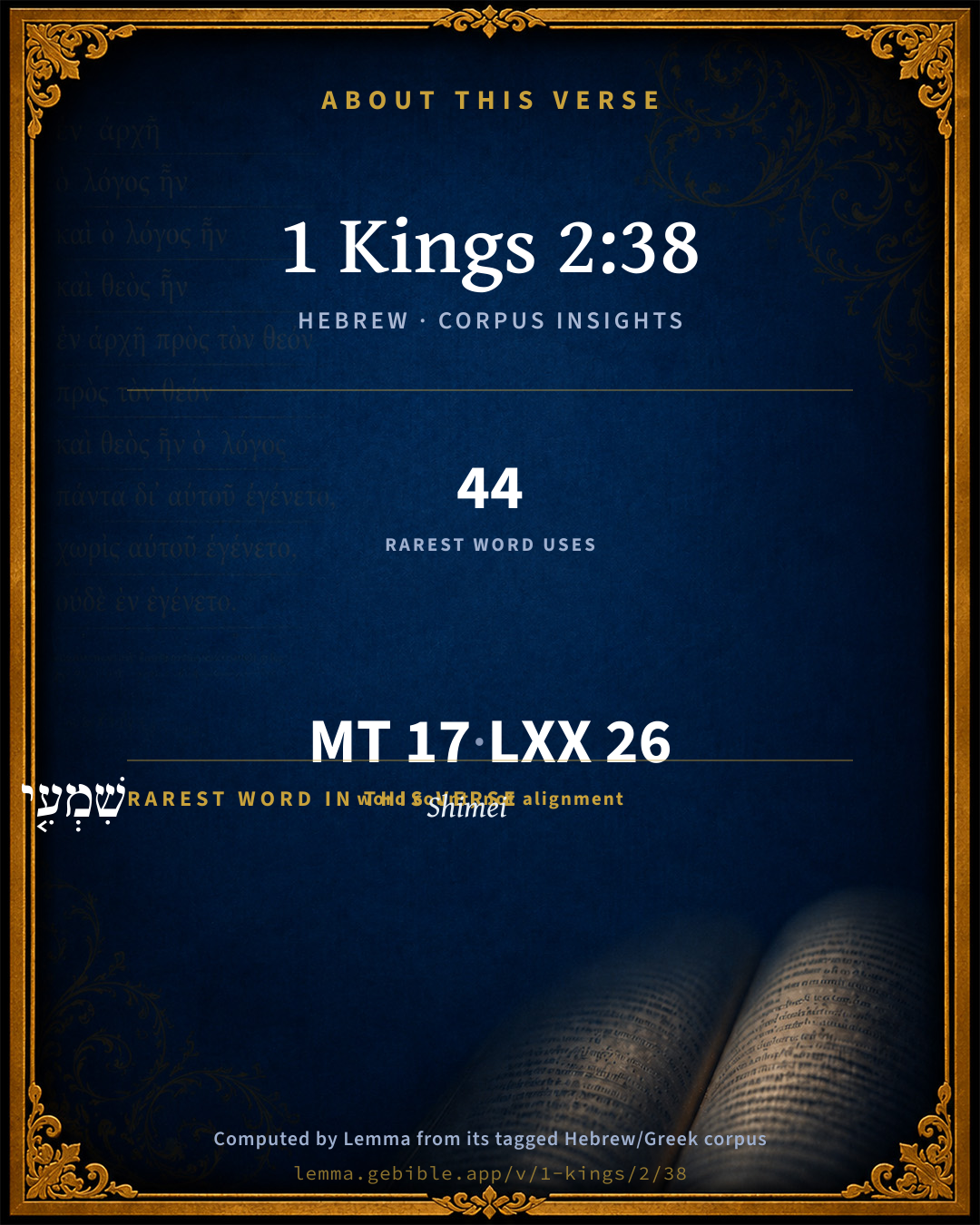
These counts appear in no published source. They are computed here, from the morphology-tagged text and Lemma’s own curated glosses. What Lemma adds →

17
words
15
distinct lemmas
Historical
section

Shared distinctive vocabulary

שִׁמְעִ֤י Shimei H8096 occurs in 40 verses of the Hebrew Bible. Also found in:

Grammatical profile

  • 4 verbs
  • 9 nouns
  • 2 adjectives
  • 2 particles

Verb forms

  • וַיֹּ֨אמֶר Qal · Sequential Imperfect
  • דִּבֶּר֙ Piel · Perfect
  • יַעֲשֶׂ֣ה Qal · Imperfect
  • וַיֵּ֧שֶׁב Qal · Sequential Imperfect

Repetition

Words recur within this verse — often emphatic in Hebrew:

  • שִׁמְעִ֤י Shimei H8096 ×2
  • לַמֶּ֨לֶךְ֙ king H4428 ×2

Hebrew & Septuagint length

In the original languages it is 17 Hebrew tokens and 26 Greek tokens — but the two are counted differently (Hebrew bundles its prefixes and suffixes into one token; the Greek is in lemma form), so that isn’t a like-for-like length.

Cross-references

2

Topical passages linked to 1 Kings 2:38 in the Treasury of Scripture Knowledge — connected by theme and wording, ordered by reader-vote popularity; previews shown in the World English Bible.

  • 1 Kings 20:4 The king of Israel answered, It is according to your saying, my lord, O king; I am yours, and all that I have.
  • 2 Kings 20:19 Then said Hezekiah to Isaiah, Good is the word of Yahweh which you have spoken. He said moreover, Isn't it so, if peace and truth shall be in my days?

Cross-references courtesy of OpenBible.info (CC BY 4.0).

Hebrew and Greek witnesses Masoretic Hebrew ↔ Greek Septuagint

The same verse in the two great witnesses to the Old Testament, shown verse-for-verse.

These are two independent witnesses, not word-aligned to each other, and the Septuagint is shown in lemma (dictionary) form.

Hebrew 1 Kings 2:38 Masoretic · Westminster Leningrad Codex

וַיֹּ֨אמֶר שִׁמְעִ֤י לַמֶּ֨לֶךְ֙ ט֣וֹב הַדָּבָ֔ר כַּאֲשֶׁ֤ר דִּבֶּר֙ אֲדֹנִ֣י הַמֶּ֔לֶךְ כֵּ֖ן יַעֲשֶׂ֣ה עַבְדֶּ֑ךָ וַיֵּ֧שֶׁב שִׁמְעִ֛י בִּירוּשָׁלִַ֖ם יָמִ֥ים רַבִּֽים

Shimei said to the king, The saying is good: as my lord the king has said, so will your servant do. Shimei lived in Jerusalem many days.

World English Bible · Public Domain

Greek LXX 1 Kings 2:38 Septuagint · lemma form

καί εἶπον σεμεϊ πρός ὁ βασιλεύς ἀγαθός ὁ ῥῆμα ὅς λαλέω κύριος ἐγώ βασιλεύς οὕτως ποιέω ὁ δοῦλος σύ καί καταἵζω σεμεϊ ἐν ἰερουσαλήμ τρεῖς ἔτος

No English rendering of this Greek verse — the small residue in the structurally divergent books.

On this verse, The Cambridge Bible for Schools and Colleges discusses the Septuagint’s reading. Read the note in Commentary ↓

Hebrew: Westminster Leningrad Codex (CC BY 4.0). Greek: Septuagint (public domain); English from a public-domain English Septuagint. How the Septuagint differs from the Hebrew →

Targum (Aramaic paraphrase)

1

The Targum is the ancient Jewish Aramaic paraphrase of the Hebrew Scriptures — an interpretive translation, not the Hebrew text itself. Onkelos (literal) and Pseudo-Jonathan (expansive) render the Torah, and Jonathan the Prophets. Coverage is partial: where no permissively-licensed English translation exists for a verse, only the Aramaic is shown. This is verse-level text, not a word-by-word alignment to the Hebrew.

  1. Targum Jonathan Prophets (Joshua–Malachi)
    וַאֲמַר שִׁמְעִי לְמַלְכָּא תַּקִין פִּתְגָמָא כְּמָא דְמַלֵיל רִבּוֹנִי מַלְכָּא כֵּן יַעְבֵּיד עַבְדָךְ וִיתֵיב שִׁמְעִי בִּירוּשְׁלֵם יוֹמִין סַגִיאִין:

    (no public-domain English translation for this verse)

    Targum Jonathan — Aramaic: “Mikraot Gedolot” (public domain). English: “Sefaria Community Translation” (CC0 1.0 (public-domain dedication)); “London "Chaldee Paraphrase," 1871” (public domain). Text via Sefaria.

Commentary

Notes on 1 Kings 2:38 from classic Christian and Jewish commentators (each source and its license shown beneath its notes). The classic Christian expositions comment on the surrounding passage and are grouped to its opening verse, so a note may address several verses; the Jewish commentaries on the Tanakh (Rashi and others) are per-verse, so they appear only where the commentator wrote on this verse.

Lemma curates 59 commentaries, every one of them public domain or Creative Commons licensed, each selected and text-cleaned for this edition rather than reprinted as found. About our sources →

Trapp's Complete Commentary

John Trapp

1Ki 2:38 And Shimei said unto the king, The saying [is] good: as my lord the king hath said, so will thy servant do. And Shimei dwelt in Jerusalem many days.

Ver. 38. The saying is good: … so will thy servant do.] The false heart praiseth the law and promiseth obedience, but faileth in performance; here it "starteth aside, like a deceitful bow." {Psa 78:57} {See Trapp on "Psa 78:57"}

And Shimei dwelt in Jerusalem many days.] Till he had an occasion of doing otherwise. Augustine thanks God that the heart and temptation met not together.

John Trapp, A Commentary or Exposition upon All the Books of the Old and New Testament (1647–1656) — public domain. Text from a community e-Sword module.

Joseph Benson's Commentary

1Ki 2:38. The saying is good — Thy sentence is much more merciful than I expected or deserve. As my lord hath said, so will thy servant do — And it appears from 1Ki 2:42-43, that he not only promised this, but confirmed his promise by an oath, being required by Solomon so to do.

Joseph Benson's Commentary on the Old and New Testaments (1811–1818) — public domain. Text from a community e-Sword module.

The Cambridge Bible for Schools and Colleges

gen. ed. J. J. S. Perowne

38. many days] The LXX. has τρία ἔτη, three years, a reading evidently drawn from the next verse.

The Cambridge Bible for Schools and Colleges (gen. ed. J. J. S. Perowne; Cambridge University Press, 1878–1918) — public domain. Text from a community e-Sword module.

John Gill's Exposition

And it came to pass, at the end of three years,.... He had dwelt at Jerusalem:

that two of the servants of Shimei ran away to Achish the son of Maachah king of Gath; and they told Shimei, saying, behold, thy servant be in Gath; he being a churlish, ill-natured man, always cursing or beating them, or imposing too hard service upon them, or not allowing them the necessaries of life; wherefore they broke away from him, and fled to Gath, and put themselves under the protection of the king of that place, who was now at peace with Israel, and a tributary to them: if this Achish was the same that was David's friend, who sheltered him when persecuted by, Saul, he must be an old man; for that was between forty or fifty years ago; and as he seems to be, since he is called the son of Maoch, Sa1 27:2; which may be thought to be the same with Maachah here.

John Gill's Exposition of the Whole Bible (1746–1763) — public domain (CC PDM 1.0). Text via the HelloAO Bible API.

Matthew Poole's English Annotations

The saying is good; thy sentence is much more merciful than I expected or deserved. So will thy servant do; and Shimei did not only promise it, but also swore to it; being required by Solomon to do so, as is manifest from 1Ki 2:42,43.

Matthew Poole's English Annotations on the Holy Bible (1683–1685) — public domain. Text from a community e-Sword/MySword module.

The Pulpit Commentary

And Shimei said to the king, The saying or thing, matter, rb; D; like logov% rJhma, in Greek (cf. Sache, in Germ., from sagen) means (1) word and (2) deed is good Shimei cannot complain of the condition, remembering what he had done (2Sa_15:5-7) and that Solomon was not bound by his father"s oath (2Sa_19:23) as my lord the king hath said, so will thy servant do. And Shimei dwelt in obedience to this behest in Jerusalem many days.

The Pulpit Commentary (1880–1919), ed. H.D.M. Spence-Jones & Joseph S. Exell — public domain. Text from a community e-Sword module.

John Wesley's Explanatory Notes

Is good - Thy sentence is more merciful than I expected, or deserved.

John Wesley, Explanatory Notes Upon the Whole Bible (1754–1765) — public domain. Text via the GEBible commentary corpus.

Lesson kit

Teaching starters — assembled from the data on this page, not authored interpretation. Every prompt links to the verse data it draws on. Edit before teaching.

1 Kings, in the Historical, opens this verse with 17 words (15 distinct Hebrew lemmas). Its most distinctive word is Shimʻîy (“Shimei”). A historical commentator’s framing appears above. Read the whole chapter for the surrounding context.

Discussion questions

  1. How does “Shimei” (Shimʻîy) shape what this verse is saying?
  2. Exodus 6:17 shares the word «Shimei» with this verse. How do the two illuminate each other?
  3. “Shimei” occurs 2× in this one verse. What is the effect of the repetition?
  4. The translations on this page render this verse differently — a whole-verse word diff, not a word-by-word alignment. What might account for the different wordings?
  5. The verb «וַיֹּ֨אמֶר» is Qal Sequential Imperfect. How does its form color the action?
  6. Reading how Trapp's Complete Commentary and Joseph Benson's Commentary read this verse, where do the two commentators agree and where do they part?

Things to notice

Reading settings

Reading text

Shown beneath each verse's original-language words.

Old Testament
Old Testament edition

Read the OT as the Masoretic Hebrew (MT) or the Greek Septuagint (LXX).

English shown for the Greek Septuagint (in the Hebrew ↔ Greek comparison).

Comparing translations? Open the Compare panel on any verse page to stack up to four side by side.