2 Chronicles 15:3

Hebrew (Westminster Leningrad Codex) 2 Chronicles 15:3 appears in the Hebrew Old Testament. The text above is from the Westminster Leningrad Codex. Each word links to its Strong’s number, a concise gloss, and parsing drawn from the Open Scriptures Hebrew Bible morphology. Click any word for its full Brown-Driver-Briggs (BDB) entry.
Download image
Cite this verse

2 Chronicles 15:3 (World English Bible). Public Domain. Lemma interlinear Bible study tool, https://lemma.gebible.app/v/2-chronicles/15/3.

Show BibTeX & RIS
BibTeX
RIS
English Translation
Now for a long season Israel was without the true God, and without a teaching priest, and without law:
World English Bible · Public Domain
Download a study sheet

One document with this verse’s original text, its word-by-word gloss line, the meaning frame, cross-references with their text, attributed commentary, and full source and license credits — printable, and it pastes into notes with its structure intact.

This verse Autodidact and up

Study sheet (.html) Plain text (.txt)

A passage Seminary Student

Up to 50 verses in one chapter. A passage sheet keeps up to 6 commentary sources and 12 cross-references per verse, in the order this page ranks them, and says so on the sheet whenever that leaves anything out. Ask for a single verse and you get the Autodidact verse sheet above.

Everything on this page stays free to read, with no account — the sheet is a download of what is already on screen, not access to it.

Want to remove ads? Support Godless Engineer
Compare translations 3

The same verse in 3 English versions, stacked beneath the original-language interlinear above. Click any original word for its lexicon entry.

Each is an independent rendering of the whole verse — the interlinear is not word-aligned to these translations.

Highlighted words mark where these versions differ — a whole-verse word diff, not a word-by-word alignment.

  • World English Bible Public Domain
    Now for a long season Israel was without the true God, and without a teaching priest, and without law:
  • King James Version Public Domain
    Now for a long season Israel hath been without the true God, and without a teaching priest, and without law.
  • unfoldingWord Literal Text CC BY-SA 4.0
    And many days were to Israel without the true God, and without a priest teaching, and without the law.

unfoldingWord Literal Text — © unfoldingWord, licensed CC BY-SA 4.0. Word-aligned USFM3 via Door43 (git.door43.org/unfoldingWord/en_ult).

Versions to compare (up to 4)

3 of 4 selected

Show all 18 translations

Every available English version of this verse, each an independent rendering of the whole verse.

  • World English Bible Public Domain
    Now for a long season Israel was without the true God, and without a teaching priest, and without law:
  • Berean Standard Bible Public Domain
    For many years Israel has been without the true God, without a priest to instruct them, and without the law.
  • Majority Standard Bible Public Domain
    For many years Israel has been without the true God, without a priest to instruct them, and without the law.
  • King James Version Public Domain
    Now for a long season Israel hath been without the true God, and without a teaching priest, and without law.
  • American Standard Version (1901) Public Domain
    Now for a long season Israel was without the true God, and without a teaching priest, and without law:
  • Revised Version (1885) Public Domain
    Now for long seasons Israel hath been without the true God, and without a teaching priest, and without law:
  • Geneva Bible (1599) Public Domain
    Nowe for a long season Israel hath bene without the true God, and without Priest to teach and without Lawe.
  • Douay-Rheims (1899) Public Domain
    And many days shall pass in Israel without the true God, and without a priest a teacher, and without the law.
  • Young's Literal Translation Public Domain
    and many days `are' to Israel without a true God, and without a teaching priest, and without law,
  • Literal Standard Version CC BY-SA 4.0
    and many days [are] to Israel without [the] true God, and without a teaching priest, and without law,
  • Unlocked Literal Bible CC BY-SA 4.0
    Now for a long period, Israel was without the true God, without a teaching priest, and without the law.
  • unfoldingWord Literal Text CC BY-SA 4.0
    And many days were to Israel without the true God, and without a priest teaching, and without the law.
  • Darby Bible Public Domain
    Now for a long while Israel [was] without the true God, and without a teaching priest, and without law;
  • World Messianic Bible Public Domain
    Now for a long time Israel was without the true God, without a teaching priest, and without law.
  • Webster's Bible Public Domain
    Now for a long season Israel hath been without the true God, and without a teaching priest, and without law.
  • Free Bible Version CC BY-SA 4.0
    For many years Israel was without the true God, without a priest to teach them, and without the law.
  • Bible in Basic English Public Domain
    Now for a long time Israel has been without the true God, and without a teaching priest and without the law;
  • JPS Tanakh (1917) Public Domain
    Now for long seasons Israel was without the true God, and without a teaching priest, and without law;

Literal Standard Version (2020), Covenant Press — licensed CC BY-SA 4.0. Text via the HelloAO Bible API (eBible.org). Unlocked Literal Bible (unfoldingWord) — licensed CC BY-SA 4.0. Text via the HelloAO Bible API (eBible.org). unfoldingWord Literal Text — © unfoldingWord, licensed CC BY-SA 4.0. Word-aligned USFM3 via Door43 (git.door43.org/unfoldingWord/en_ult). Free Bible Version, Dr. Jonathan Gallagher — licensed CC BY-SA 4.0. Text via the HelloAO Bible API (eBible.org).

Word by word

More ways to search: Search by grammar → Find every occurrence → Compare this word →

Practice this passage: Drill this verse → Learn its vocabulary →

מוֹרֶ֖ה
yârâh
H3384
“throwing”
Verb, Hiphil, Participle Active, Masculine, Singular, Absolute
Part of Speech
Verb
Stem
Hiphil
Form
Participle Active
Gender
Masculine
Number
Singular
State
Absolute
Full BDB Definition

Origin: a primitive root

TWOT: 910

to throw, shoot, cast, pour - (Qal) - to throw, cast - to cast, lay, set - to shoot arrows - to throw water, rain - (Niphal) to be shot - (Hiphil) - to throw, cast - to shoot - to point out, show - to direct, teach, instruct - to throw water, rain
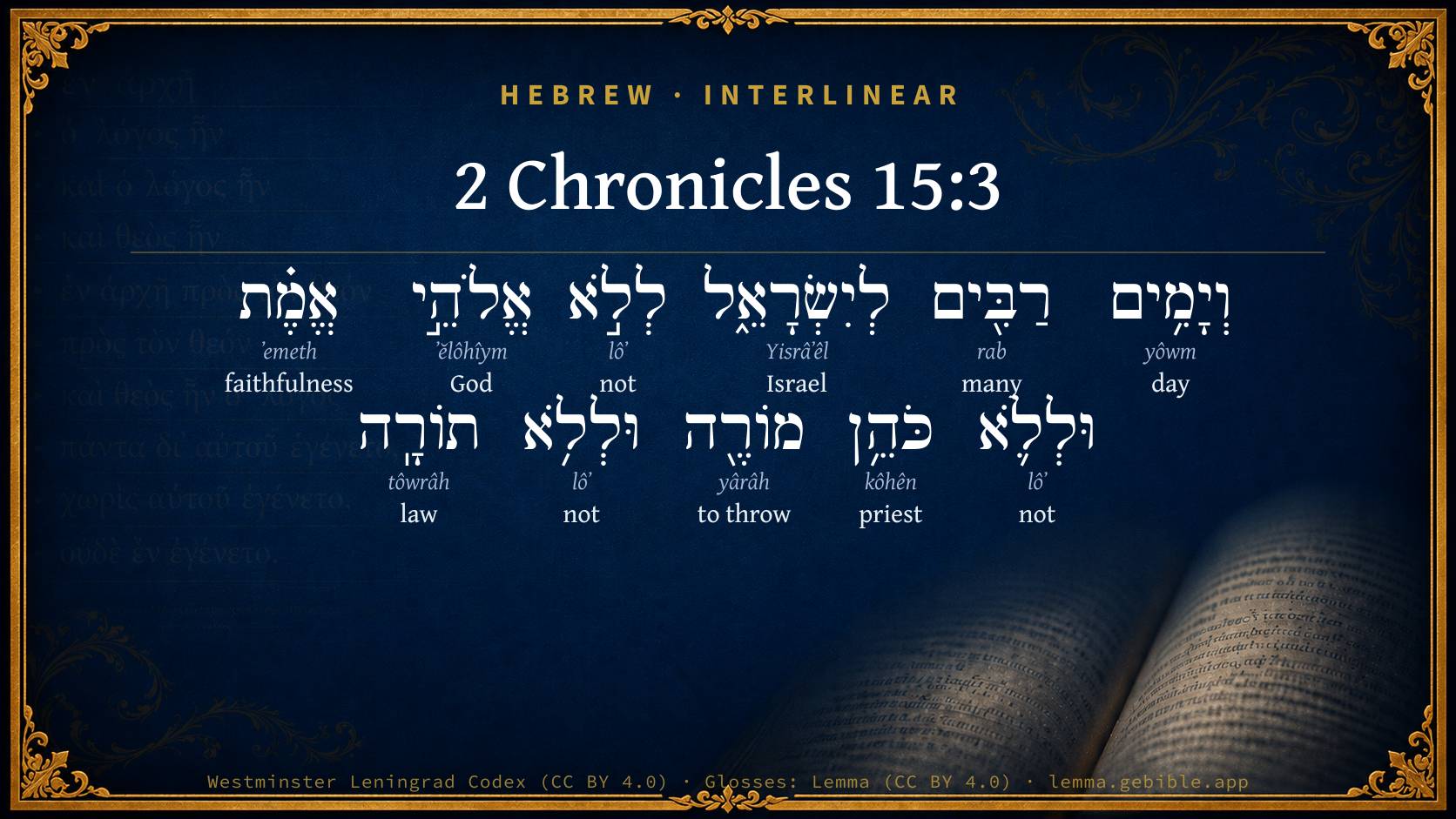
  1. וְיָמִ֥ים yôwm H3117 “and · days” Conjunction + Noun, Common, Masculine, Plural, Absolute
  2. רַבִּ֖ים rab H7227 “many” Adjective, Adjective, Masculine, Plural, Absolute
  3. לְיִשְׂרָאֵ֑ל Yisrâʼêl H3478 “to/for · Israel” Preposition + Noun, Proper
  4. לְלֹ֣א lôʼ H3808 “to/for · not” Preposition + Particle, Negative
  5. אֱלֹהֵ֣י ʼĕlôhîym H430 “God(s) of” Noun, Common, Masculine, Plural, Construct
  6. אֱמֶ֗ת ʼemeth H571 “faithfulness” Noun, Common, Feminine, Singular, Absolute
  7. וּלְלֹ֛א lôʼ H3808 “and · to/for · not” Conjunction + Preposition + Particle, Negative
  8. כֹּהֵ֥ן kôhên H3548 “priest” Noun, Common, Masculine, Singular, Absolute
  9. וּלְלֹ֥א lôʼ H3808 “and · to/for · not” Conjunction + Preposition + Particle, Negative
  10. תוֹרָֽה tôwrâh H8451 “law” Noun, Common, Feminine, Singular, Absolute

About this verse

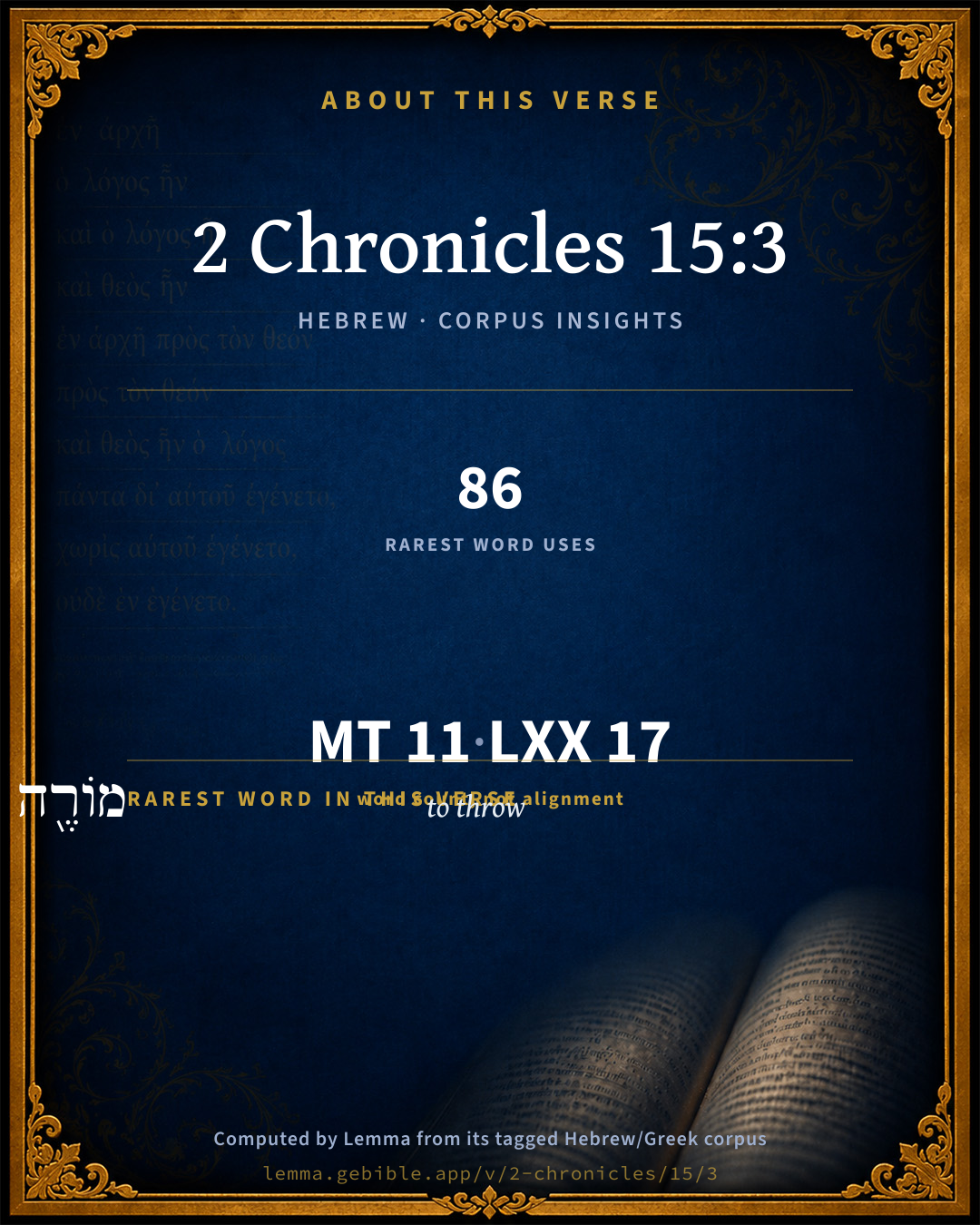
These counts appear in no published source. They are computed here, from the morphology-tagged text and Lemma’s own curated glosses. What Lemma adds →

11
words
9
distinct lemmas
Historical
section

Grammatical profile

  • 1 verb
  • 6 nouns
  • 1 adjective
  • 3 particles

Verb forms

  • מוֹרֶ֖ה Hiphil · Participle Active

Repetition

A word recurs within this verse — often emphatic in Hebrew:

  • לְלֹ֣א not H3808 ×3

Hebrew & Septuagint length

In English translation the verse runs 19 words from the Hebrew and 23 from the Septuagint (LXX English) — closely comparable.

A rough comparison of the two English renderings, which tokenize alike — not a word-level alignment.

Word counts can differ between the Hebrew and the Greek without any difference in meaning — e.g. the Hebrew direct-object marker אֵת has no separate Greek word, and Greek often adds the article ὁ.

In the original languages it is 11 Hebrew tokens and 17 Greek tokens — but the two are counted differently (Hebrew bundles its prefixes and suffixes into one token; the Greek is in lemma form), so that isn’t a like-for-like length.

Cross-references

18

Topical passages linked to 2 Chronicles 15:3 in the Treasury of Scripture Knowledge — connected by theme and wording, ordered by reader-vote popularity; previews shown in the World English Bible.

  • Nehemiah 8:9 Nehemiah, who was the governor, and Ezra the priest the scribe, and the Levites who taught the people, said to all the people, This day is holy to Yahweh your God; don't mourn, nor weep. For all the people wept, when they heard the words of the law.
  • Leviticus 10:11 and that you are to teach the children of Israel all the statutes which Yahweh has spoken to them by Moses."
  • 2 Chronicles 17:8–9 and with them the Levites, even Shemaiah, and Nethaniah, and Zebadiah, and Asahel, and Shemiramoth, and Jehonathan, and Adonijah, and Tobijah, and Tob-adonijah, the Levites; and with them Elishama and Jehoram, the priests.
  • Jeremiah 10:10 But Yahweh is the true God; he is the living God, and an everlasting King: at his wrath the earth trembles, and the nations are not able to abide his indignation.
  • Ezekiel 44:21–23 Neither shall any of the priests drink wine, when they enter into the inner court.
  • Hosea 3:4 For the children of Israel shall abide many days without king, and without prince, and without sacrifice, and without sacred stone, and without ephod or idols.
  • Micah 3:11 Her leaders judge for bribes, And her priests teach for a price, And her prophets of it tell forturnes for money: Yet they lean on Yahweh, and say, Isn't Yahweh in the midst of us? No disaster will come on us.
  • Malachi 2:7 For the priest's lips should keep knowledge, and they should seek the law at his mouth; for he is the messenger of Yahweh of Hosts.
  • Matthew 2:4–5 Gathering together all the chief priests and scribes of the people, he asked them where the Christ would be born.
  • Deuteronomy 33:10 They shall teach Jacob your ordinances, Israel your law: They shall put incense before you, Whole burnt offering on your altar.
  • 1 Kings 12:28–33 Whereupon the king took counsel, and made two calves of gold; and he said to them, It is too much for you to go up to Jerusalem: see your gods, Israel, which brought you up out of the land of Egypt.
  • Romans 2:12 For as many as have sinned without law will also perish without the law. As many as have sinned under the law will be judged by the law.
  • John 17:3 This is eternal life, that they should know you, the only true God, and him whom you sent, Jesus Christ.
  • Romans 7:8–9 But sin, finding occasion through the commandment, produced in me all kinds of coveting. For apart from the law, sin is dead.
  • 1 Corinthians 9:21 to those who are without law, as without law (not being without law toward God, but under law toward Christ), that I might win those who are without law.
  • 1 Thessalonians 1:9 For they themselves report concerning us what kind of a reception we had from you; and how you turned to God from idols, to serve a living and true God,
  • 1 Timothy 3:2 The overseer therefore must be without reproach, the husband of one wife, temperate, sensible, modest, hospitable, good at teaching;
  • 1 John 5:20 We know that the Son of God has come, and has given us an understanding, that we know him who is true, and we are in him who is true, in his Son Jesus Christ. This is the true God, and eternal life.

Cross-references courtesy of OpenBible.info (CC BY 4.0).

Hebrew and Greek witnesses Masoretic Hebrew ↔ Greek Septuagint

The same verse in the two great witnesses to the Old Testament, shown verse-for-verse.

These are two independent witnesses, not word-aligned to each other, and the Septuagint is shown in lemma (dictionary) form.

Hebrew 2 Chronicles 15:3 Masoretic · Westminster Leningrad Codex

וְיָמִ֥ים רַבִּ֖ים לְיִשְׂרָאֵ֑ל לְלֹ֣א אֱלֹהֵ֣י אֱמֶ֗ת וּלְלֹ֛א כֹּהֵ֥ן מוֹרֶ֖ה וּלְלֹ֥א תוֹרָֽה

Now for a long season Israel was without the true God, and without a teaching priest, and without law:

World English Bible · Public Domain

Greek LXX 2 Chronicles 15:3 Septuagint · lemma form

καί ἡμέρα πολύς ὁ ἰσραήλ ἐν οὐ θεός ἀληθινός καί οὐ ἱερεύς ὑποδεικνύω καί ἐν οὐ νόμος

And Israel has been a long time without the true God, and without a priest to expound the truth, and without the law.

LXX2012 (modern English Septuagint) · Public Domain

Hebrew: Westminster Leningrad Codex (CC BY 4.0). Greek: Septuagint (public domain); English from LXX2012 (modern English Septuagint) (Public Domain). How the Septuagint differs from the Hebrew →

Commentary

Notes on 2 Chronicles 15:3 from classic Christian and Jewish commentators (each source and its license shown beneath its notes). The classic Christian expositions comment on the surrounding passage and are grouped to its opening verse, so a note may address several verses; the Jewish commentaries on the Tanakh (Rashi and others) are per-verse, so they appear only where the commentator wrote on this verse.

Lemma curates 59 commentaries, every one of them public domain or Creative Commons licensed, each selected and text-cleaned for this edition rather than reprinted as found. About our sources →

The Cambridge Bible for Schools and Colleges

gen. ed. J. J. S. Perowne

3. for a long season] R.V. for long seasons. 2Ch_15:3-6 contain the reflections of the Chronicler himself on the whole previous course of Israelite history. Azariah’s own exhortation is continued in 2Ch_15:7.

without a teaching priest, and without law] The connexion between these two is closer than the English suggests. “Law” (Heb. torah) is properly “teaching, guidance.” A “teaching” (Heb. moreh) priest is one who gives “torah” or “guidance” on doubtful points of morality or ritual. Cp. Mal_2:7.

The Cambridge Bible for Schools and Colleges (gen. ed. J. J. S. Perowne; Cambridge University Press, 1878–1918) — public domain. Text from a community e-Sword module.

Trapp's Complete Commentary

John Trapp

2Ch 15:3 Now for a long season Israel [hath been] without the true God, and without a teaching priest, and without law.

Ver. 3. Now for a long season.] For about thirty years.

Israel.] The ten revolted tribes.

Hath been without the true God.] So were our ancestors the old Britons, whose idols were portenta diabolica, saith Gildas, pene numero Aegyptiaca vincentia, monstrous idols.

And without a teaching priest.] No wonder, therefore, that they were "without God in the world," stark atheists, sine lege, sine rege, sine fide, "without law, king or fidelity" as the Brazilians are said to be.

John Trapp, A Commentary or Exposition upon All the Books of the Old and New Testament (1647–1656) — public domain. Text from a community e-Sword module.

The Biblical Illustrator

Joseph S. Exell

2Ch_15:3-4

Now for a long season.

The schism of the ten tribes

These words--

I. Suggest a warning. A land without teaching priests soon realises the rest of the text by becoming without the true God, and without law.

II. Give encouragement to send teaching priests on their holy mission to bring the people to the law and to the testimony, so that they may hear the whole counsel of God. (Joseph B. Owen, M.A.)

The Biblical Illustrator, edited by Joseph S. Exell (c. 1880s–1900s) — public domain. Text from a community e-Sword module.

Joseph Benson's Commentary

2Ch 15:3-4. For a long season Israel hath been, &c. — Hebrew, many days have been to Israel without the true God, &c. — The prophet’s design here is evidently to set before them the miserable consequences of forsaking God and his ordinances, and that if they should forsake him, there would be no way of having their grievances redressed, but by repenting and returning to him. In proof of this point he argues from facts, and observes, that in time past, when Israel forsook their duty, they were overrun with a deluge of atheism, impiety, irreligion, and all irregularities; and were continually embarrassed with vexations, and destructive wars, foreign and domestic. But when their troubles drove them to God, they found it not in vain to seek him. He seems to refer especially to the times of the judges. For then they were frequently, though not wholly and universally, yet in a very great measure, without God and his law, and teaching priests: and then, indeed, they were brought to suffer all the exigencies and calamities here mentioned. They were harassed by grievous wars, both foreign and domestic, and frequently oppressed by one enemy or other, as by the Moabites, Midianites, Ammonites, and other neighbouring nations, and were vexed with all adversity, 2Ch 15:6; yet when, in their perplexity, they turned to God by repentance, prayer, and reformation, he raised up deliverers for them. Thus that maxim, that God is with us, while we are with him, was often verified in those times. This seems to be the most obvious sense of the passage, taking Israel for the whole nation, and not for the ten tribes merely, who had revolted under Jeroboam, to whom part of the prophet’s speech is not at all applicable; for it could not with truth be said of them, that when they were in trouble they turned unto the Lord, and sought him, and he was found of them. Some think, among whom is Houbigant, that the whole passage is prophetical, and looks forward to future times; and that it ought to be read in the future tense, thus: Now, for a long season, Israel shall be without the true God, &c. But when, in their trouble, they shall turn unto the Lord God of Israel, and seek him, he will be found of them: see Hos 3:4. But the former explication seems to be more agreeable, both to the Hebrew text, and to the context preceding and following, and to be much more suitable to the design of the prophet, as stated above.

Joseph Benson's Commentary on the Old and New Testaments (1811–1818) — public domain. Text from a community e-Sword module.

Tyndale Open Study Notes

Tyndale Open Resources

15:3-6 The dark times, described as resulting from the lack of knowing God (cp. Hos 3:4-5), seem best to fit the period of the judges.

Tyndale Open Study Notes — © Tyndale Open Resources, licensed CC BY-SA 4.0. Text via the HelloAO Bible API.

Geneva Bible (1599)

Geneva Bible translators

For the space of twelve years under Rehoboam, and three years under Abijah, religion was neglected, and idolatry planted.

Geneva Bible (1599) marginal notes — public domain. Text via Bolls.life.

Jamieson, Fausset & Brown

Robert Jamieson, A. R. Fausset & David Brown

Now for a long season Israel hath been without the true God, &c.--Some think that Azariah was referring to the sad and disastrous condition to which superstition and idolatry had brought the neighboring kingdom of Israel. His words should rather be taken in a wider sense, for it seems manifest that the prophet had his eye upon many periods in the national history, when the people were in the state described--a state of spiritual destitution and ignorance--and exhibited its natural result as widespread anarchy, mutual dissension among the tribes, and general suffering (Jdg 9:23; Jdg 12:4; Jdg 20:21; Ch2 13:17). These calamities God permitted to befall them as the punishment of their apostasy. Azariah's object in these remarks was to establish the truth of his counsel (Ch2 15:2), threatening, in case of neglecting it by describing the uniform course of the divine procedure towards Israel, as shown in all periods of their history. Then after this appeal to national experience, he concluded with an earnest exhortation to the king to prosecute the work of reformation so well begun [Ch2 15:7].

Jamieson, Fausset & Brown — Commentary Critical and Explanatory on the Whole Bible (1871) — public domain (CC PDM 1.0). Text via the HelloAO Bible API.

Adam Clarke's Commentary

Verse 3. Now for a long season Israel] "Israel hath followed Jeroboam, and they have not worshipped the true God. They have burnt incense to their golden calves; their priestlings [כומריא cumeraiya, their black, sooty sacrificers] have burnt perfumes with a strange worship, and have not exercised themselves in the law." - Targum. These priests could not teach, because they had not learnt; and as they had abandoned the law of the Lord, consequently they had no proper matter for instruction.

There is a great diversity of opinions concerning the meaning of this text. Some consider it a prophecy relative to the future state of this people, and the final destruction of the Jews as to their political existence: others consider it as referring to the state of the people under the reigns of Rehoboam and Abijah, which were happily changed under that of Asa; and this appears to me to be the most natural sense of the words.

Adam Clarke's Commentary on the Bible (1810–1826) — public domain. Text from a community e-Sword/MySword module.

Ellicott's Commentary for English Readers

(3) Now for a long season Israel hath been.—Literally, And many days to Israel, without true God, and without teaching priest, and without teaching. This is clearly an illustration of the general truth asserted in last verse. “Many a time hath Israel been without true God,” etc. Periods of religious decline, such as those recorded in the Book of Judges, as well as those of later times, especially since the division of the kingdom, are adduced as historical proof of the statement that the Lord was with Israel while they were with him. (Comp. Jdg_2:11-19; Jdg_3:7-10; also Hos_3:4-5.)

Without.—Lĕlô’, only here in this sense.

The true God.—Jer_10:9 : “Jehovah is true God” (’elohîm ’emeth).

Teaching priest.—Kôhçn môreh. (See Lev_10:11; Deu_17:9; Deu_33:10; Deu_24:8; Eze_44:23; Jer_18:18; Mal_2:6-7.) The priests instructed the people in the Torah, or divine Law (literally, teaching).

A Bible Commentary for English Readers, edited by Charles John Ellicott (1878–1897) — public domain. Text from a community e-Sword module.

John Gill's Exposition

Now for a long season Israel hath been without the true God,.... The fear, worship, and service of him being greatly neglected by them for a long time; what period of time is referred to is not expressed, whether past, present, or to come, but left to be supplied; the Targum refers this to the time of the separation of the ten tribes, and the days of Jeroboam, when the calves were worshipped, and not the true God, and the teaching priests of the Lord were cast out, and the law of the Lord, especially with respect to worship, was not regarded, in which it is followed by many interpreters; others think it refers to time to come, and to what would be the case, should they forsake the Lord; and was fulfilled in the Babylonish captivity, see Hos 3:4 and the Jews (k) say, that"Oded prophesied that the days should come, when Israel would be "without the true God", since judgment should not be done in the world: and "without a teaching priest"; since the high priesthood should cease, (see Heb 7:12) "and without the law"; since the sanhedrim should cease;''but according to our supplement, and which seems most correct, it refers to time past; not to the case of the ten tribes from the times of Jeroboam; nor to the case of Judah from the times of Rehoboam; but to times more remote, even the times of the judges, when they worshipped Baal and Ashtaroth, and not the true God, Jdg 2:10, yet at the same time suggesting, that should the present inhabitants of Judah go into the same practices, their case would be like theirs, described in the following verses:

and without a teaching priest: as they were under the judges, from the times of Phinehas to those of Eli, which was a long space of time:

and without law; every man doing as he pleased, there being no king in Israel, nor any regard paid to the law of God, moral or ceremonial, Jdg 17:6.

(k) Vajikra Rabba, sect. 19. fol. 160. 4.

John Gill's Exposition of the Whole Bible (1746–1763) — public domain (CC PDM 1.0). Text via the HelloAO Bible API.

Albert Barnes' Notes on the Bible

“Israel” here is used generally for the whole people of God; and the reference is especially to the many apostasies in the days of the Judges, which were followed by repentance and deliverance.

Albert Barnes' Notes on the Bible (1834–1885) — public domain. Text from a community e-Sword/MySword module.

Haydock's Catholic Bible Commentary

Shall pass, is not found in Hebrew, &c., and many supply, "had been." (Du Hamel) --- The Jews, and some interpreters, would explain all this of what had passed already; (Calmet) and this is the idea of the Protestants, "Now, for a long season, Israel hath been without," &c. (Haydock) --- But the conclusion convinces us that this is a prediction; (ver. 7) take courage. You shall not be involved in these miseries. Some explain the whole of the kingdom of Israel, which, from its commencement till after its final ruin, persevered in its rebellion against the true God. (Sanctius) --- Others think the kingdom of Juda was also concerned, and its state of captivity at Babylon foretold. (Lyranus) --- But its full completion includes the latter ages, particularly after the murder of the Messias, (Tirinus) and seems of the same nature as the prophecy of Osee, (iii. 4.) as our Saviour himself insinuates, Matthew xxiv. 6, 9, 13. (Calmet)

George Leo Haydock (1774–1849), Haydock's Catholic Family Bible and Commentary, 1859 edition — public domain. Excludes Psalms (Douay-Rheims chapter numbering differs from Protestant) and Deuterocanonical books (Catholic canon only).

Matthew Poole's English Annotations

Heb. For many days have been to Israel

without the true God, & c, i.e. they have long lived without the sound knowledge and worship of the true God. The prophet confirms his foregoing exhortation, and the threatening annexed to it, that if they forsook God, he would forsake them, from the usual manner of God’s dealing with Israel formerly, and therefore in the same case they may expect the same usage. Israel, here mentioned and propounded as an example, is here understood, either,

1. Specially of the ten tribes, distinguished by that name from the kingdom of Judah; whose condition had been, since Jeroboam’s revolt, and now was such in some measure, as is here described, they having been, and still being, without God and his true worship, and therefore exposed to many vexations, and wars, and miseries. But these had not as yet turned unto God, or sought him, nor was God yet found of them, as is said of this Israel, 2Ch 15:4. Nor had they as yet been exercised with those grievous and continual vexations, and wars, and mutual destructions of which he here speaks, 2Ch 15:5,6, and which in succeeding times they felt; for except that one blow which they had from Abijah, 2Ch 13, we read of none other great mischiefs which befell them. Or rather,

2. Generally of the whole nation of Israel in former times, and especially in the times of the judges; to which all that follows suits very well; for then many times they were, though not wholly and universally, yet in a very great measure, and for the generality of them, without God, and his law, and teaching priests, as plainly appears from divers passages in the Book of the Judges; and then indeed they were brought to all the exigencies and calamities here following; then they had grievous wars, both foreign and domestic; and then they did sometimes turn to the Lord and sought him, and he was found of them, and did raise up judges and saviours to them; of which see Jdg 2 at large, and Jdg 3:9; Jdg 3:15; 10:10, &c.

Matthew Poole's English Annotations on the Holy Bible (1683–1685) — public domain. Text from a community e-Sword/MySword module.

Whedon's Commentary on the Bible

Daniel D. Whedon

3. Now for a long season — Literally, and many clays to Israel to be without a God of truth, etc. The period here referred to by the long season, or many days, has been variously understood. Some refer it to the kingdom of the ten tribes at that time; others to the past history of the nation, especially the age of the Judges; and others make it a prophecy of the future. No doubt the passage states facts which were true of various periods in the history of Israel, and conveys moral lessons applicable to all times; but it seems more natural for the prophet to speak in this connexion of things which had actually taken place, so as to base his counsels on matters of fact, and the allusions in 2Ch_15:4-6 are most obviously to the state of things often experienced in the times of the Judges. With this more special reference in mind, but at the same time remembering the wider application of the statement, we may convey the true sense of the passage thus: Many a time has Israel been without the true God, etc.

Without a teaching priest — Israel always had priests enough, such as they were; but many a time were they destitute of wise and pious priests who were competent to instruct the people in the true knowledge of Jehovah.

Without law — That is, when the law was ill understood and worse observed, and “every man did that which was right in his own eyes.” Jdg_17:6; Jdg_21:25.

Daniel D. Whedon (gen. ed.), Commentary on the Old and New Testaments (1874–1909) — public domain. Text from a community e-Sword module.

The Pulpit Commentary

Now for a long season. This translation is wrong; translate rather first, And many the days to Israel to not have true God, and to not have teaching priest, and to not have Law. So far no tense is limited, however naturally through the very drift of the passage it may seem that experience is being challenged, and so necessarily the past tense desiderated, not, however, in aorist shape, but in what some French grammarians call present perfect. For Azariah may well contemplate his illustration as good from long of old, to the very moment he was speaking. The unfortunate wealth of illustration to hand of his position may pardon the doubtfulness of commentators as to the source from which it may be supposed he would have drawn his most effective instances. It will not be the unlikeliest guide to follow the triple description of the alleged apostasy, misfortune, or iniquity "of Israel," e.g. (say) it happened to them to not have the true God; happened to them to not have teaching priest; happened to them to not have the Law (this meaning, to not have it authoritatively proclaimed, taught, ministered). When did these three things happen altogether most notoriously? They describe, not the transgressions of an individual king, but the state of the people and kingdom as a whole. If it were possible to conceive the description as a flagrant anachronism, a retrospective post-Captivity amplification, which the writer (in his glow of work and thought) was unconsciously and irresistibly betrayed into putting into the lips of the Prophet Azariah, all doubt would end; for the description would suit no state of things and no period better than that of the divided kingdoms, especially applying to the career of the separate kingdom of Israel. Our account, unfortunately, is unchecked just here by a parallel. It is, however, impossible to suppose this without any tittle of external authority for it, much less enough to proceed upon. Some so crave the illustration that they are prepared to suppose all the tenses of these verses present and future rather than past and "present perfect." But, in fact, no doubt the history of Israel since the death of Moses illustrated the language of Azariah passim to a degree beyond all "that is written" or that we know. And then we may certainly consider theft the expression chosen, "many days" (which some translate "many a day," "many a time"), even the word "years" not being employed, leaves it open to us to go to short episodes of an irreligious and disastrous character in the history of Israel. Lastly, the long stretch of fully three hundred years, extending throughout the Book of Judges (its last five chapters in right order or wrong)into the opening seven chapters of 1 Samuel, provides one running comment, superabundant almost to repetitiousness, for the illustration of our vers. 37; in many cases absolutely picking out the very colours to match. (e.g. Jud_1:5:6 20:29, 31, compared with our ver. 5) To distinguish and separate the very numerous references that might be made is merely supererogatory, and spoils the unmatched mosaic work of the history (Jud_1:2:15, 18, 19 3:12-15 4:1-3 5:6, 19-21, 31:6:1-5, 7-10 9:32-37 10:6-16 11:19, 20 12:5, 6 17:5, 6, 13 20:29, 31; 1Sa_2:30 35 4:9-22 7:3, 8 13:19-22) It is a long-stretched-out history of a practically atheistic, priest-less, lawless life; divided into narratives of invasion, oppression, servitude (sevenfold, the Mesopotamian, Moabite, Canaanitish, Midianitish, Ammonitish, Philistine, and, it may be added, in order to comprehend all internal strife, Ishmaelitish larger and lesser, yet surprisingly general), smart, cry for help manifestly more the cry of pain and cowardice than of penitence and repentance, resolution and vow, and for another trial and still another of Divine pity, forbearance, and deliverance.

The Pulpit Commentary (1880–1919), ed. H.D.M. Spence-Jones & Joseph S. Exell — public domain. Text from a community e-Sword module.

John Wesley's Explanatory Notes

Now Israel - They have long lived without the found knowledge and worship of the true God. Israel is here understood of the whole nation of Israel in former times, and especially in the times of the Judges: for then many times they were in a great measure, without God and his law, and teaching priests, as plainly appears from the book of the Judges; they were brought to all the exigencies and calamities following; and they sometimes turned to the Lord, and he was found of them.

John Wesley, Explanatory Notes Upon the Whole Bible (1754–1765) — public domain. Text via the GEBible commentary corpus.

unfoldingWord translationNotes

Door43 World Missions Community

Israel was without the true God

Here "Israel" refers to the people of Israel. This refers to a time when the people of Israel did not worship the true God. AT: "The people of Israel did not worship the true God" (See: Metonymy)

without a teaching priest

"without a priest who taught them"

he was found by them

This can be stated in active form. AT: "they found him" or "he permitted them to find him" (See: Active or Passive)

for him who traveled away, nor for him who traveled to here

This phrase is an idiom that refers to a person who travels anywhere away from home. AT: "for the person who traveled anywhere" (See: Idiom)

great troubles were on all the inhabitants of the lands

The people experiencing great troubles is spoken of as if those troubles were objects that were on the people. AT: "all the inhabitants of the lands experienced great troubles" (See: Metaphor)

translationWords

Israel

true

God

priest

law

turn

Israel

peace

trouble

unfoldingWord translationNotes — © Distant Shores Media and the Door43 World Missions Community, licensed CC BY-SA 4.0. Source: git.door43.org/Door43/en_tn.

Rashi

Rabbi Shlomo Yitzchaki (Rashi)

Now there were many days for Israel without a true God until you came.

and without an instructing priest Since no one asks them words of Torah, the priests will not instruct you.

Rashi on the Tanakh — English translations: “The Judaica Press complete Tanach with Rashi, translated by A. J. Rosenberg” (CC BY 4.0); “Pentateuch with Rashi's commentary by M. Rosenbaum and A.M. Silbermann, 1929-1934” (public domain); “The Metsudah Tanach series, Lakewood, N.J” (CC BY 4.0); and “The Book of Joshua, Metsudah Publications, 1997” (CC BY 4.0). Text via Sefaria.

Lesson kit

Teaching starters — assembled from the data on this page, not authored interpretation. Every prompt links to the verse data it draws on. Edit before teaching.

2 Chronicles, in the Historical, opens this verse with 11 words (9 distinct Hebrew lemmas). Its most distinctive word is yârâh (“to throw”). A historical commentator’s framing appears above. Read the whole chapter for the surrounding context.

Discussion questions

  1. What does “to throw” (yârâh) contribute to the verse as a whole?
  2. How does Nehemiah 8:9, which shares this passage’s theme, read alongside this verse?
  3. What does the repetition of “not” (3× in this one verse) do in this verse?
  4. These translations render this verse differently; the difference is in the English rendering, not the original. What questions does that raise?
  5. «מוֹרֶ֖ה» is a Hiphil Participle Active verb. How does that grammatical form shape the action described?
  6. Compare how The Cambridge Bible for Schools and Colleges and Trapp's Complete Commentary read this verse. Where do they agree or differ?

Things to notice

Reading settings

Reading text

Shown beneath each verse's original-language words.

Old Testament
Old Testament edition

Read the OT as the Masoretic Hebrew (MT) or the Greek Septuagint (LXX).

English shown for the Greek Septuagint (in the Hebrew ↔ Greek comparison).

Comparing translations? Open the Compare panel on any verse page to stack up to four side by side.