Deuteronomy 3:19

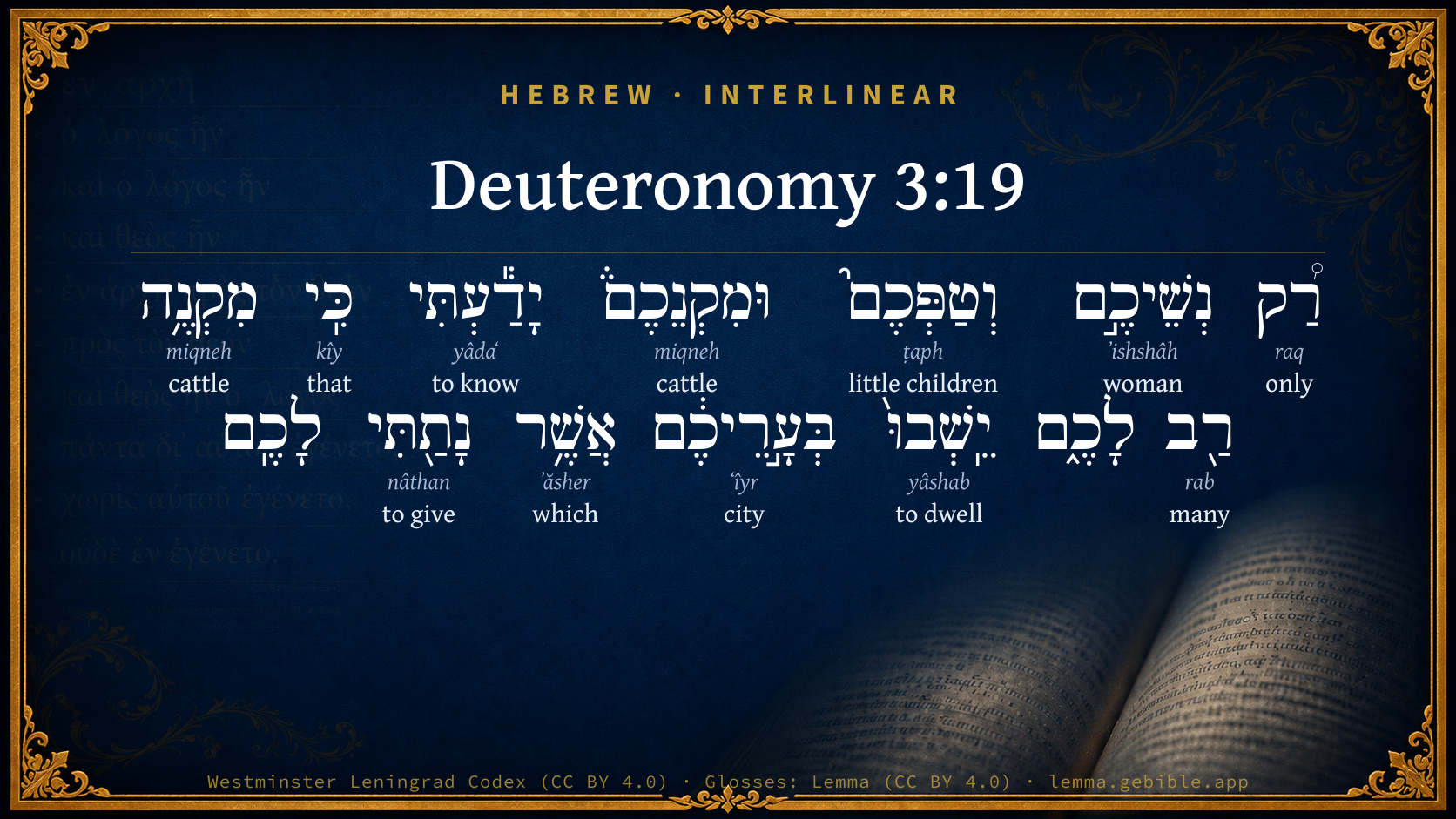
Hebrew (Westminster Leningrad Codex) Deuteronomy 3:19 appears in the Hebrew Old Testament. The text above is from the Westminster Leningrad Codex. Each word links to its Strong’s number, a concise gloss, and parsing drawn from the Open Scriptures Hebrew Bible morphology. Click any word for its full Brown-Driver-Briggs (BDB) entry.
Download image
Cite this verse

Deuteronomy 3:19 (World English Bible). Public Domain. Lemma interlinear Bible study tool, https://lemma.gebible.app/v/deuteronomy/3/19.

Show BibTeX & RIS
BibTeX
RIS
English Translation
But your wives, and your little ones, and your cattle, (I know that you have much cattle), shall abide in your cities which I have given you,
World English Bible · Public Domain
Download a study sheet

One document with this verse’s original text, its word-by-word gloss line, the meaning frame, cross-references with their text, attributed commentary, and full source and license credits — printable, and it pastes into notes with its structure intact.

This verse Autodidact and up

Study sheet (.html) Plain text (.txt)

A passage Seminary Student

Up to 50 verses in one chapter. A passage sheet keeps up to 6 commentary sources and 12 cross-references per verse, in the order this page ranks them, and says so on the sheet whenever that leaves anything out. Ask for a single verse and you get the Autodidact verse sheet above.

Everything on this page stays free to read, with no account — the sheet is a download of what is already on screen, not access to it.

Want to remove ads? Support Godless Engineer
Compare translations 3

The same verse in 3 English versions, stacked beneath the original-language interlinear above. Click any original word for its lexicon entry.

Each is an independent rendering of the whole verse — the interlinear is not word-aligned to these translations.

Highlighted words mark where these versions differ — a whole-verse word diff, not a word-by-word alignment.

  • World English Bible Public Domain
    But your wives, and your little ones, and your cattle, (I know that you have much cattle), shall abide in your cities which I have given you,
  • King James Version Public Domain
    But your wives, and your little ones, and your cattle, (for I know that ye have much cattle,) shall abide in your cities which I have given you;
  • unfoldingWord Literal Text CC BY-SA 4.0
    Only your women and your children, and your cattle (I know that you have much cattle), will stay in your cities that I have given to you

unfoldingWord Literal Text — © unfoldingWord, licensed CC BY-SA 4.0. Word-aligned USFM3 via Door43 (git.door43.org/unfoldingWord/en_ult).

Versions to compare (up to 4)

3 of 4 selected

Show all 18 translations

Every available English version of this verse, each an independent rendering of the whole verse.

  • World English Bible Public Domain
    But your wives, and your little ones, and your cattle, (I know that you have much cattle), shall abide in your cities which I have given you,
  • Berean Standard Bible Public Domain
    But your wives, your children, and your livestock—I know that you have much livestock—may remain in the cities I have given you,
  • Majority Standard Bible Public Domain
    But your wives, your children, and your livestock—I know that you have much livestock—may remain in the cities I have given you,
  • King James Version Public Domain
    But your wives, and your little ones, and your cattle, (for I know that ye have much cattle,) shall abide in your cities which I have given you;
  • American Standard Version (1901) Public Domain
    But your wives, and your little ones, and your cattle, (I know that ye have much cattle,) shall abide in your cities which I have given you,
  • Revised Version (1885) Public Domain
    But your wives, and your little ones, and your cattle, (I know that ye have much cattle,) shall abide in your cities which I have given you;
  • Geneva Bible (1599) Public Domain
    Your wiues onely, and your children, and your cattel (for I know that ye haue much cattel) shall abide in your cities, which I haue giuen you,
  • Douay-Rheims (1899) Public Domain
    Leaving your wives and children and cattle. For I know you have much cattle, and they must remain in the cities, which I have delivered to you.
  • Young's Literal Translation Public Domain
    Only, your wives, and your infants, and your cattle -- I have known that ye have much cattle -- do dwell in your cities which I have given to you,
  • Literal Standard Version CC BY-SA 4.0
    Only your wives, and your infants, and your livestock—I have known that you have much livestock—dwell in your cities which I have given to you,
  • Unlocked Literal Bible CC BY-SA 4.0
    But your wives, your little ones, and your cattle (I know that you have much cattle), will stay in your cities that I have given you,
  • unfoldingWord Literal Text CC BY-SA 4.0
    Only your women and your children, and your cattle (I know that you have much cattle), will stay in your cities that I have given to you
  • Darby Bible Public Domain
    Only your wives, and your little ones, and your cattle, -- I know that ye have much cattle, -- shall abide in your cities which I have given you,
  • World Messianic Bible Public Domain
    But your wives, and your little ones, and your livestock, (I know that you have much livestock), shall live in your cities which I have given you,
  • Webster's Bible Public Domain
    But your wives, and your little ones, and your cattle, (for I know that ye have many cattle,) shall abide in your cities which I have given you;
  • Free Bible Version CC BY-SA 4.0
    However, your wives, your children, and your livestock (I know that you have plenty of livestock) can stay behind in the towns I have given you,
  • Bible in Basic English Public Domain
    But your wives and your little ones and your cattle (for it is clear that you have much cattle) may go on living in the towns I have given you;
  • JPS Tanakh (1917) Public Domain
    But your wives, and your little ones, and your cattle — I know that ye have much cattle — shall abide in your cities which I have given you;

Literal Standard Version (2020), Covenant Press — licensed CC BY-SA 4.0. Text via the HelloAO Bible API (eBible.org). Unlocked Literal Bible (unfoldingWord) — licensed CC BY-SA 4.0. Text via the HelloAO Bible API (eBible.org). unfoldingWord Literal Text — © unfoldingWord, licensed CC BY-SA 4.0. Word-aligned USFM3 via Door43 (git.door43.org/unfoldingWord/en_ult). Free Bible Version, Dr. Jonathan Gallagher — licensed CC BY-SA 4.0. Text via the HelloAO Bible API (eBible.org).

Word by word

More ways to search: Search by grammar → Find every occurrence → Compare this word →

Practice this passage: Drill this verse → Learn its vocabulary →

וְטַפְּכֶם֮
ṭaph
H2945
“and · little children · your”
Conjunction + Noun, Common, Masculine, Singular, Construct + Suffix, Personal, 2nd Person, Masculine, Plural
Part of Speech
Conjunction + Noun
Type
Common
Gender
Masculine
Number
Singular
State
Construct
Full BDB Definition

Origin: from H2952 (perhaps referring to the tripping gait of children)

TWOT: 821a

children, little children, little ones
  1. רַ֠ק raq H7535 “only” Particle, Accusative
  2. נְשֵׁיכֶ֣ם ʼishshâh H802 “women · your” Noun, Common, Feminine, Plural, Construct + Suffix, Personal, 2nd Person, Masculine, Plural
  3. וּמִקְנֵכֶם֒ miqneh H4735 “and · cattle · your” Conjunction + Noun, Common, Masculine, Singular, Construct + Suffix, Personal, 2nd Person, Masculine, Plural
  4. יָדַ֕עְתִּי yâdaʻ H3045 “to know” Verb, Qal, Perfect, 1st Person, Common, Singular
  5. כִּֽי kîy H3588 “that” Conjunction
  6. מִקְנֶ֥ה miqneh H4735 “cattle” Noun, Common, Masculine, Singular, Absolute
  7. רַ֖ב rab H7227 “many” Adjective, Adjective, Masculine, Singular, Absolute
  8. יֵֽשְׁבוּ֙ yâshab H3427 “to dwell” Verb, Qal, Imperfect, 3rd Person, Masculine, Plural
  9. בְּעָ֣רֵיכֶ֔ם ʻîyr H5892 “in/at · cities · your” Preposition + Noun, Common, Feminine, Plural, Construct + Suffix, Personal, 2nd Person, Masculine, Plural
  10. אֲשֶׁ֥ר ʼăsher H834 “which” Particle, Relative
  11. נָתַ֖תִּי nâthan H5414 “to give” Verb, Qal, Perfect, 1st Person, Common, Singular

About this verse

These counts appear in no published source. They are computed here, from the morphology-tagged text and Lemma’s own curated glosses. What Lemma adds →

14
words
11
distinct lemmas
Pentateuch
section

Shared distinctive vocabulary

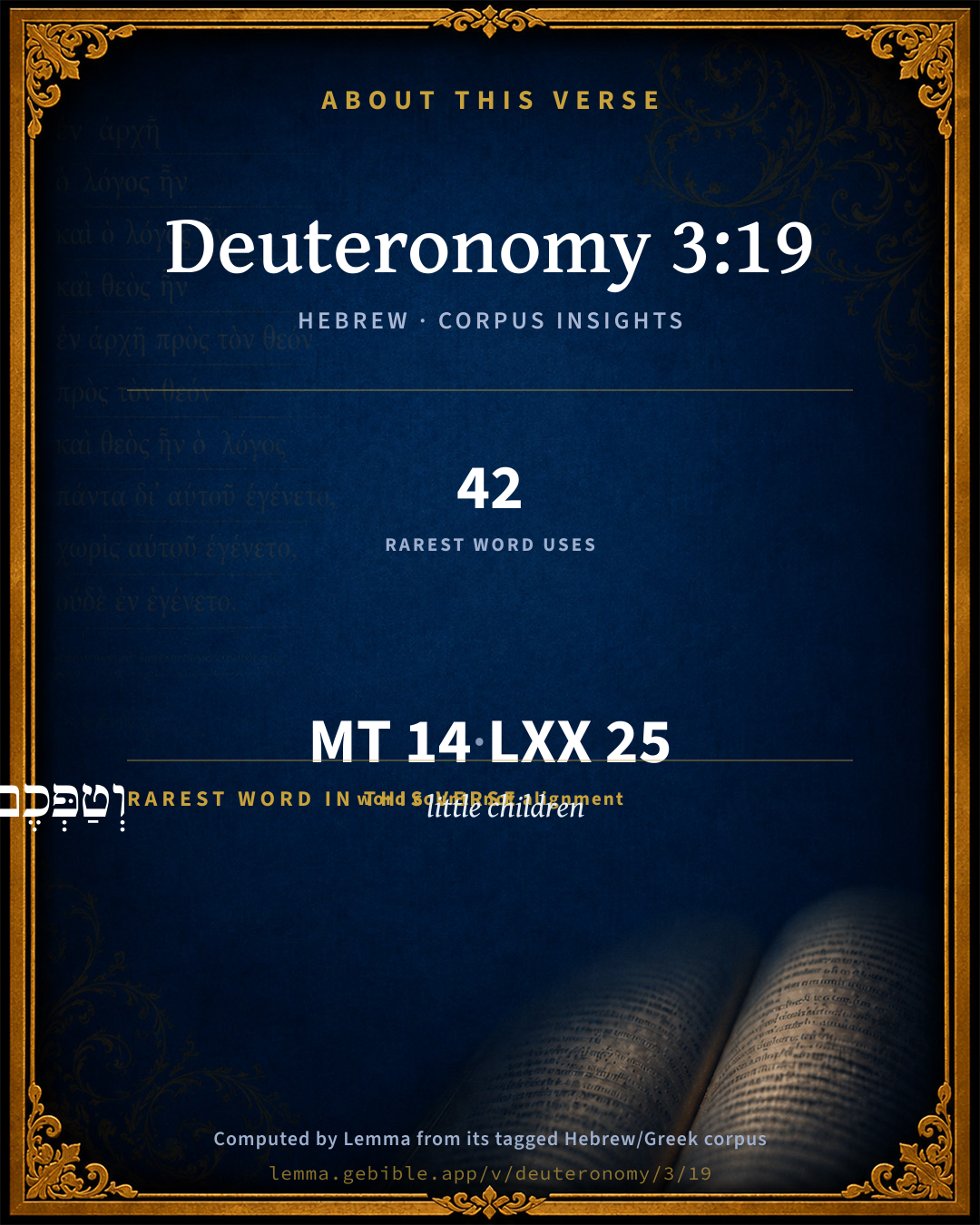
וְטַפְּכֶם֮ little children H2945 occurs in 42 verses of the Hebrew Bible. Also found in:

Grammatical profile

  • 3 verbs
  • 5 nouns
  • 1 adjective
  • 2 prepositions
  • 1 conjunction
  • 2 particles

Verb forms

  • יָדַ֕עְתִּי Qal · Perfect
  • יֵֽשְׁבוּ֙ Qal · Imperfect
  • נָתַ֖תִּי Qal · Perfect

Repetition

A word recurs within this verse — often emphatic in Hebrew:

  • וּמִקְנֵכֶם֒ cattle H4735 ×2

Hebrew & Septuagint length

In English translation the verse runs 27 words from the Hebrew and 27 from the Septuagint (LXX English) — the same length.

A rough comparison of the two English renderings, which tokenize alike — not a word-level alignment.

Word counts can differ between the Hebrew and the Greek without any difference in meaning — e.g. the Hebrew direct-object marker אֵת has no separate Greek word, and Greek often adds the article ὁ.

In the original languages it is 14 Hebrew tokens and 25 Greek tokens — but the two are counted differently (Hebrew bundles its prefixes and suffixes into one token; the Greek is in lemma form), so that isn’t a like-for-like length.

Hebrew and Greek witnesses Masoretic Hebrew ↔ Greek Septuagint

The same verse in the two great witnesses to the Old Testament, shown verse-for-verse.

These are two independent witnesses, not word-aligned to each other, and the Septuagint is shown in lemma (dictionary) form.

Hebrew Deuteronomy 3:19 Masoretic · Westminster Leningrad Codex

רַ֠ק נְשֵׁיכֶ֣ם וְטַפְּכֶם֮ וּמִקְנֵכֶם֒ יָדַ֕עְתִּי כִּֽי מִקְנֶ֥ה רַ֖ב לָכֶ֑ם יֵֽשְׁבוּ֙ בְּעָ֣רֵיכֶ֔ם אֲשֶׁ֥ר נָתַ֖תִּי לָכֶֽם

But your wives, and your little ones, and your cattle, (I know that you have much cattle), shall abide in your cities which I have given you,

World English Bible · Public Domain

Greek LXX Deuteronomy 3:19 Septuagint · lemma form

πλήν ὁ γυνή σύ καί ὁ τέκνον σύ καί ὁ κτῆνος σύ οἶδα ὅτι πολύς κτῆνος σύ καταοἰκέω ἐν ὁ πόλις σύ ὅς δίδωμι σύ

Only your wives and your children and your cattle (I know that you⌃ have much cattle), let them dwell in your cities which I have given you;

LXX2012 (modern English Septuagint) · Public Domain

Hebrew: Westminster Leningrad Codex (CC BY 4.0). Greek: Septuagint (public domain); English from LXX2012 (modern English Septuagint) (Public Domain). How the Septuagint differs from the Hebrew →

Targum (Aramaic paraphrase)

2

The Targum is the ancient Jewish Aramaic paraphrase of the Hebrew Scriptures — an interpretive translation, not the Hebrew text itself. Onkelos (literal) and Pseudo-Jonathan (expansive) render the Torah, and Jonathan the Prophets. Coverage is partial: where no permissively-licensed English translation exists for a verse, only the Aramaic is shown. This is verse-level text, not a word-by-word alignment to the Hebrew.

  1. Targum Onkelos Torah (Genesis–Deuteronomy)
    לְחוֹד נְשֵׁיכוֹן וְטַפְלְכוֹן וּבְעִירְכוֹן יְדַעְנָא אֲרֵי בְעִיר סַגִי לְכוֹן יֵתְבוּן בְּקִרְוֵיכוֹן דִי יְהָבִית לְכוֹן

    (no public-domain English translation for this verse)

    Targum Onkelos — Aramaic: “Onkelos Genesis” (public domain); “Onkelos Exodus” (public domain); “Onkelos Leviticus” (public domain); “Onkelos Numbers” (public domain); “Onkelos Deuteronomy” (public domain). English: “Sefaria Community Translation” (CC0 1.0 (public-domain dedication)); “J.W. Etheridge. The Targums of Onkelos and Jonathan Ben Uzziel on the Pentateuch. London: Longmans, Green, 1862” (public domain). Text via Sefaria.

  2. Targum Pseudo-Jonathan Torah (Genesis–Deuteronomy)
    לְחוֹד נְשֵׁיכוֹן טַפְלְכוֹן וּבְעִירֵיכוֹן יָדַעְנָא אֲרוּם בְּעִיר סַגִי לְכוֹן יֵתְבוּן בְּקִירְוֵיכוֹן דִּי יְהָבִית לְכוֹן

    Only your wives, your children, and your cattle, (for I know that you have much cattle,) shall abide in your cities which I have given you,

    Targum Pseudo-Jonathan — Aramaic: “Targum Jonathan on Genesis” (public domain); “Targum Jonathan on Exodus” (public domain); “Targum Jonathan on Leviticus” (public domain); “Targum Jonathan on Numbers” (public domain); “Targum Jonathan on Deuteronomy” (public domain). English: “The Targum of Jonathan ben Uzziel, trans. J. W. Etheridge, London, 1862” (public domain). Text via Sefaria.

Commentary

Notes on Deuteronomy 3:19 from classic Christian and Jewish commentators (each source and its license shown beneath its notes). The classic Christian expositions comment on the surrounding passage and are grouped to its opening verse, so a note may address several verses; the Jewish commentaries on the Tanakh (Rashi and others) are per-verse, so they appear only where the commentator wrote on this verse.

Lemma curates 59 commentaries, every one of them public domain or Creative Commons licensed, each selected and text-cleaned for this edition rather than reprinted as found. About our sources →

The Cambridge Bible for Schools and Colleges

gen. ed. J. J. S. Perowne

19. much cattle] Cp. Num_32:1. In the O.T. Mo‘ab, Gile‘ad and Bashan, the seats of the two and a half tribes, are celebrated for their cattle, imported thence to W. Palestine, which has inferior pastures. See the writer’s Jerusalem, i. 307, 321 ff. and HGHL, 523 f.

which I have given you] Deu_3:12 f.; so Num_32:29; Num_32:33; Num_32:40.

The Cambridge Bible for Schools and Colleges (gen. ed. J. J. S. Perowne; Cambridge University Press, 1878–1918) — public domain. Text from a community e-Sword module.

John Gill's Exposition

Until the Lord have given rest unto your brethren, as well as unto you,.... Rest from their enemies, and habitations to dwell quietly in; so the land of Canaan is called a rest, Deu 12:9 typical of the rest which remains for the people of God:

and until they also possess the land which the Lord your God hath given them beyond Jordan; for so Canaan was with respect to Moses and the people with him, who were then in the plains of Moab; otherwise the country in which he was with respect to Canaan is usually called beyond Jordan; this the Lord had given in promise to Israel, and they were just now ready to enter into and possess it, by virtue of his gift, and which made it sure unto them:

and then shall ye return every man unto his possession, which I have given you; as accordingly they did, Jos 22:1.

John Gill's Exposition of the Whole Bible (1746–1763) — public domain (CC PDM 1.0). Text via the HelloAO Bible API.

unfoldingWord translationNotes

Door43 World Missions Community

General Information:

Moses continues speaking to the tribes of Reuben and Gad and half of the tribe of Manasseh.

Yahweh gives rest to your brothers

The writer speaks as if the ability to rest were a physical object that could be given as a gift. The word "rest" is also a metaphor for peaceful life in which there is no war. AT: "Yahweh allows your brothers to rest" or "Yahweh allows your brothers to stop fighting wars and live peacefully" (See: Metaphor)

beyond the Jordan

This refers to the land across the Jordan River, to the east of Israel. Moses was east of the Jordan when he said this. See how you translated these words in Deuteronomy 1:1. AT: "east of the Jordan River"

then will you return

Moses is emphasizing that the other tribes must possess their land before Yahweh will permit these three tribes to possess their land. "only then are you to return."

translationWords

cow

Yahweh

rest

brother

possess

God

Jordan River

unfoldingWord translationNotes — © Distant Shores Media and the Door43 World Missions Community, licensed CC BY-SA 4.0. Source: git.door43.org/Door43/en_tn.

Lesson kit

Teaching starters — assembled from the data on this page, not authored interpretation. Every prompt links to the verse data it draws on. Edit before teaching.

Deuteronomy, in the Pentateuch, opens this verse with 14 words (11 distinct Hebrew lemmas). Its most distinctive word is ṭaph (“little children”). A historical commentator’s framing appears above. Read the whole chapter for the surrounding context.

Discussion questions

  1. The word ṭaph carries the sense “little children.” How does it shape the verse?
  2. Genesis 34:29 shares the word «little children» with this verse. How do the two illuminate each other?
  3. “cattle” occurs 2× in this one verse. What is the effect of the repetition?
  4. The translations on this page render this verse differently — a whole-verse word diff, not a word-by-word alignment. What might account for the different wordings?
  5. The verb «יָדַ֕עְתִּי» is Qal Perfect. How does its form color the action?
  6. Reading how The Cambridge Bible for Schools and Colleges and John Gill's Exposition read this verse, where do the two commentators agree and where do they part?

Things to notice

Reading settings

Reading text

Shown beneath each verse's original-language words.

Old Testament
Old Testament edition

Read the OT as the Masoretic Hebrew (MT) or the Greek Septuagint (LXX).

English shown for the Greek Septuagint (in the Hebrew ↔ Greek comparison).

Comparing translations? Open the Compare panel on any verse page to stack up to four side by side.