Exodus 23:29

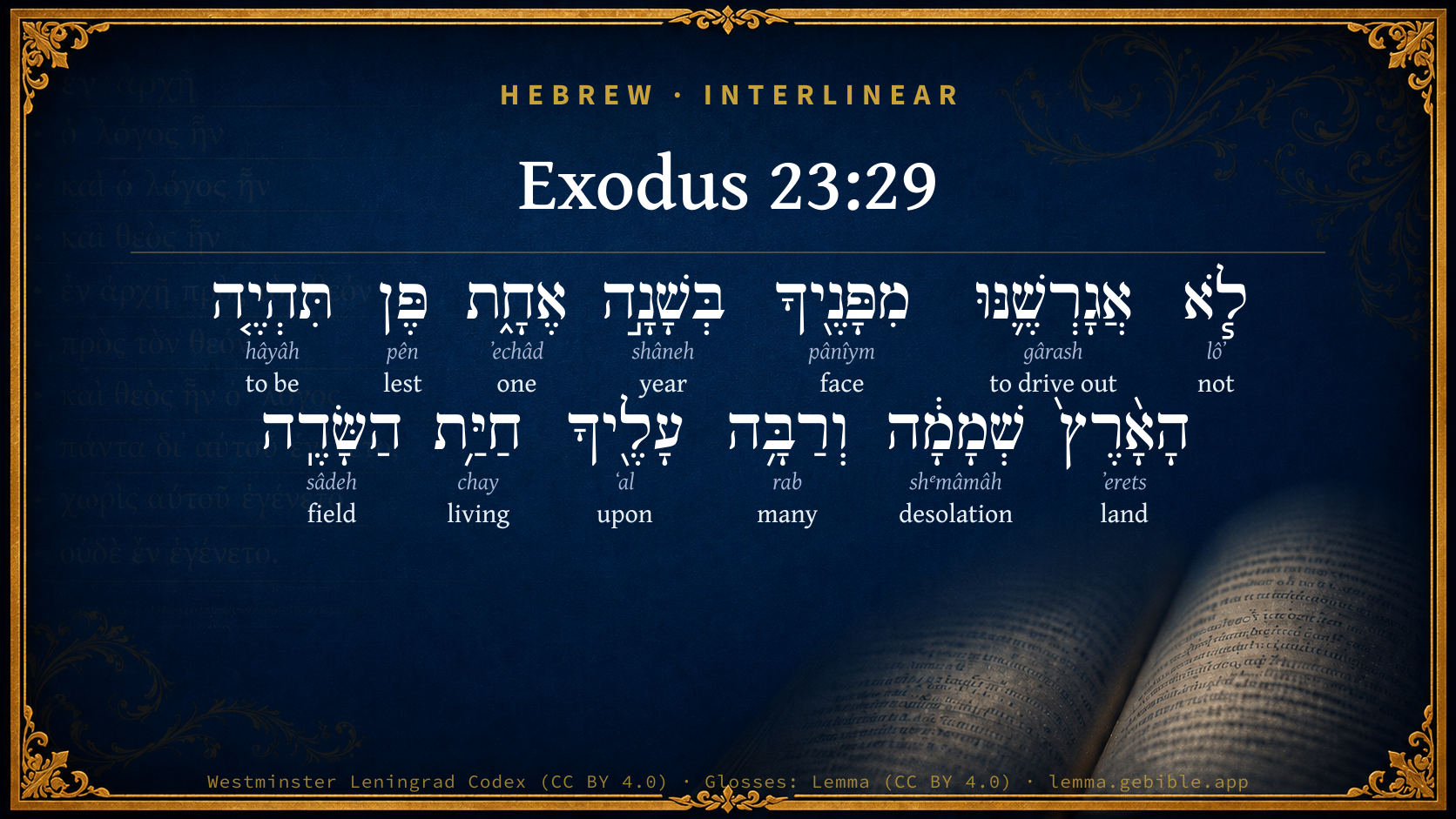
Hebrew (Westminster Leningrad Codex) Exodus 23:29 appears in the Hebrew Old Testament. The text above is from the Westminster Leningrad Codex. Each word links to its Strong’s number, a concise gloss, and parsing drawn from the Open Scriptures Hebrew Bible morphology. Click any word for its full Brown-Driver-Briggs (BDB) entry.
Download image
Cite this verse

Exodus 23:29 (World English Bible). Public Domain. Lemma interlinear Bible study tool, https://lemma.gebible.app/v/exodus/23/29.

Show BibTeX & RIS
BibTeX
RIS
English Translation
I will not drive them out from before you in one year, lest the land become desolate, and the animals of the field multiply against you.
World English Bible · Public Domain
Highlights
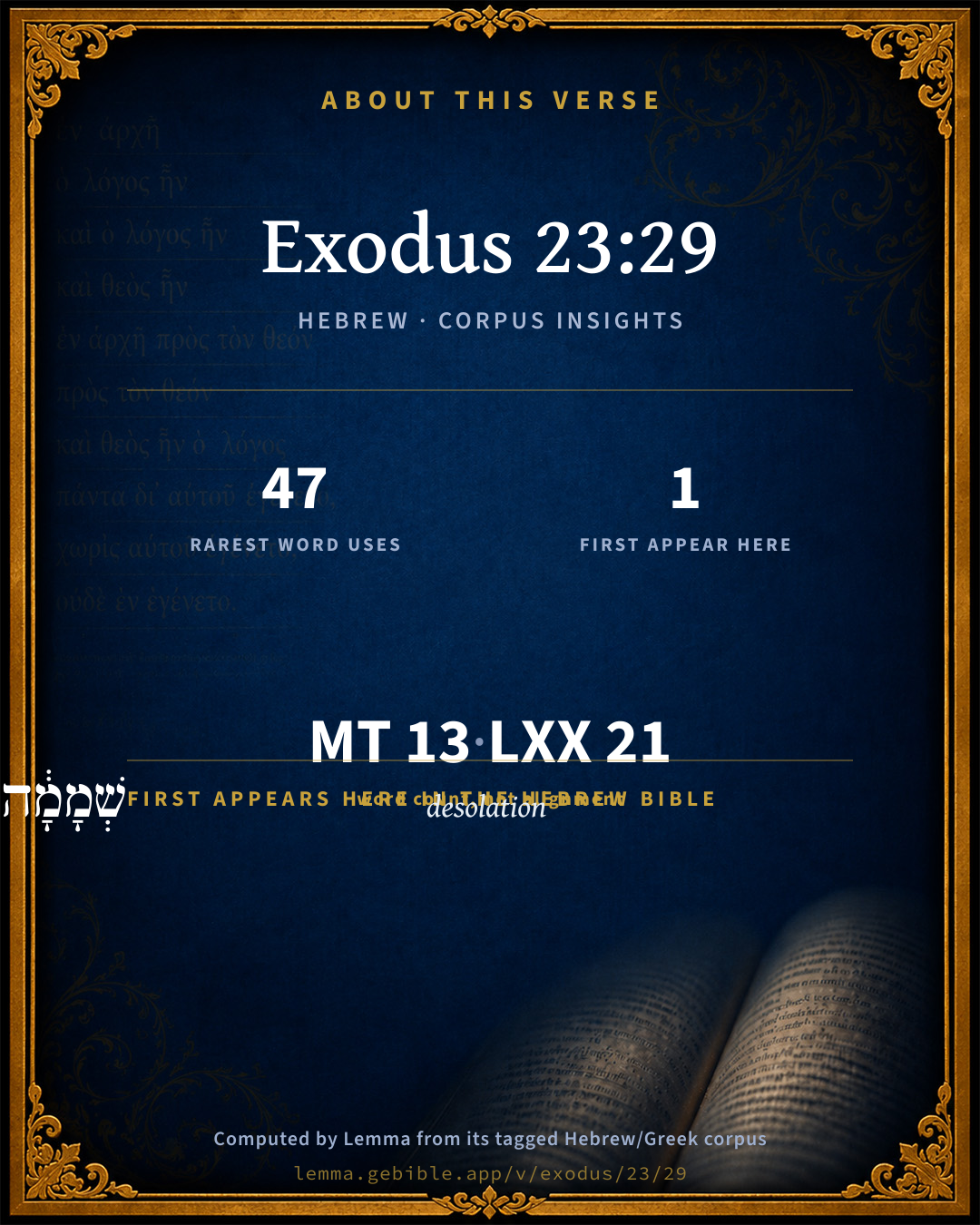
  • 1 first appearance in the Hebrew Bible
Full analysis ↓
Download a study sheet

One document with this verse’s original text, its word-by-word gloss line, the meaning frame, cross-references with their text, attributed commentary, and full source and license credits — printable, and it pastes into notes with its structure intact.

This verse Autodidact and up

Study sheet (.html) Plain text (.txt)

A passage Seminary Student

Up to 50 verses in one chapter. A passage sheet keeps up to 6 commentary sources and 12 cross-references per verse, in the order this page ranks them, and says so on the sheet whenever that leaves anything out. Ask for a single verse and you get the Autodidact verse sheet above.

Everything on this page stays free to read, with no account — the sheet is a download of what is already on screen, not access to it.

Want to remove ads? Support Godless Engineer
Compare translations 3

The same verse in 3 English versions, stacked beneath the original-language interlinear above. Click any original word for its lexicon entry.

Each is an independent rendering of the whole verse — the interlinear is not word-aligned to these translations.

Highlighted words mark where these versions differ — a whole-verse word diff, not a word-by-word alignment.

  • World English Bible Public Domain
    I will not drive them out from before you in one year, lest the land become desolate, and the animals of the field multiply against you.
  • King James Version Public Domain
    I will not drive them out from before thee in one year; lest the land become desolate, and the beast of the field multiply against thee.
  • unfoldingWord Literal Text CC BY-SA 4.0
    I will not drive them out from before your face in one year, lest the land become desolate and the animals of the field become too many for you.

unfoldingWord Literal Text — © unfoldingWord, licensed CC BY-SA 4.0. Word-aligned USFM3 via Door43 (git.door43.org/unfoldingWord/en_ult).

Versions to compare (up to 4)

3 of 4 selected

Show all 18 translations

Every available English version of this verse, each an independent rendering of the whole verse.

  • World English Bible Public Domain
    I will not drive them out from before you in one year, lest the land become desolate, and the animals of the field multiply against you.
  • Berean Standard Bible Public Domain
    I will not drive them out before you in a single year; otherwise the land would become desolate and wild animals would multiply against you.
  • Majority Standard Bible Public Domain
    I will not drive them out before you in a single year; otherwise the land would become desolate and wild animals would multiply against you.
  • King James Version Public Domain
    I will not drive them out from before thee in one year; lest the land become desolate, and the beast of the field multiply against thee.
  • American Standard Version (1901) Public Domain
    I will not drive them out from before thee in one year, lest the land become desolate, and the beasts of the field multiply against thee.
  • Revised Version (1885) Public Domain
    I will not drive them out from before thee in one year; lest the land become desolate, and the beast of the field multiply against thee.
  • Geneva Bible (1599) Public Domain
    I will not cast them out from thy face in one yeere, least the land grow to a wildernes: and the beasts of the field multiplie against thee.
  • Douay-Rheims (1899) Public Domain
    I will not cast them out from thy face in one year: lest the land be brought into a wilderness, and the beasts multiply against thee.
  • Young's Literal Translation Public Domain
    I cast them not out from before thee in one year, lest the land be a desolation, and the beast of the field hath multiplied against thee;
  • Literal Standard Version CC BY-SA 4.0
    I do not cast them out from before you in one year, lest the land be a desolation, and the beast of the field has multiplied against you;
  • Unlocked Literal Bible CC BY-SA 4.0
    I will not drive them out from before you in one year, or the land would become abandoned, and the wild animals would become too many for you.
  • unfoldingWord Literal Text CC BY-SA 4.0
    I will not drive them out from before your face in one year, lest the land become desolate and the animals of the field become too many for you.
  • Darby Bible Public Domain
    I will not drive them out from before thee in one year: lest the land become desolate, and the beast of the field multiply against thee.
  • World Messianic Bible Public Domain
    I will not drive them out from before you in one year, lest the land become desolate, and the animals of the field multiply against you.
  • Webster's Bible Public Domain
    I will not drive them out from before thee in one year; lest the land should become desolate, and the beast of the field should multiply against thee.
  • Free Bible Version CC BY-SA 4.0
    I will not drive them out in just one year, because the land would become desolate and you would have to deal with increased numbers of wild animals.
  • Bible in Basic English Public Domain
    I will not send them all out in one year, for fear that their land may become waste, and the beasts of the field be increased overmuch against you.
  • JPS Tanakh (1917) Public Domain
    I will not drive them out from before thee in one year, lest the land become desolate, and the beasts of the field multiply against thee.

Literal Standard Version (2020), Covenant Press — licensed CC BY-SA 4.0. Text via the HelloAO Bible API (eBible.org). Unlocked Literal Bible (unfoldingWord) — licensed CC BY-SA 4.0. Text via the HelloAO Bible API (eBible.org). unfoldingWord Literal Text — © unfoldingWord, licensed CC BY-SA 4.0. Word-aligned USFM3 via Door43 (git.door43.org/unfoldingWord/en_ult). Free Bible Version, Dr. Jonathan Gallagher — licensed CC BY-SA 4.0. Text via the HelloAO Bible API (eBible.org).

Word by word

More ways to search: Search by grammar → Find every occurrence → Compare this word →

Practice this passage: Drill this verse → Learn its vocabulary →

אֲגָרְשֶׁ֛נּוּ
gârash
H1644
“to drive out · him”
Verb, Piel, Imperfect, 1st Person, Common, Singular + Suffix, Personal, 3rd Person, Masculine, Singular
Part of Speech
Verb
Stem
Piel
Form
Imperfect
Person
1st Person
Gender
Common
Number
Singular
Full BDB Definition

Origin: a primitive root

TWOT: 388

to drive out, expel, cast out, drive away, divorce, put away, thrust away, trouble, cast up - (Qal) to thrust out, cast out - (Niphal) to be driven away, be tossed - (Piel) to drive out, drive away - (Pual) to be thrust out
  1. לֹ֧א lôʼ H3808 “not” Particle, Negative
  2. מִפָּנֶ֖יךָ pânîym H6440 “from · face(s) · your” Preposition + Noun, Common, Both, Plural, Construct + Suffix, Personal, 2nd Person, Masculine, Singular
  3. בְּשָׁנָ֣ה shâneh H8141 “in/at · year” Preposition + Noun, Common, Feminine, Singular, Absolute
  4. אֶחָ֑ת ʼechâd H259 “one” Adjective, Cardinal number, Feminine, Singular, Absolute
  5. פֶּן pên H6435 “lest” Conjunction
  6. תִּהְיֶ֤ה hâyâh H1961 “to be” Verb, Qal, Imperfect, 3rd Person, Feminine, Singular
  7. הָאָ֨רֶץ֙ ʼerets H776 “the · land” Particle, Definite Article + Noun, Common, Both, Singular, Absolute
  8. שְׁמָמָ֔ה shᵉmâmâh H8077 “desolation” Noun, Common, Feminine, Singular, Absolute
  9. וְרַבָּ֥ה rab H7227 “and · many” Conjunction + Verb, Qal, Sequential Perfect, 3rd Person, Feminine, Singular
  10. עָלֶ֖יךָ ʻal H5921 “upon · you” Preposition + Suffix, Personal, 2nd Person, Masculine, Singular
  11. חַיַּ֥ת chay H2416 “living of” Noun, Common, Feminine, Singular, Construct
  12. הַשָּׂדֶֽה sâdeh H7704 “the · field” Particle, Definite Article + Noun, Common, Masculine, Singular, Absolute

About this verse

These counts appear in no published source. They are computed here, from the morphology-tagged text and Lemma’s own curated glosses. What Lemma adds →

13
words
13
distinct lemmas
Pentateuch
section

First appearance in Scripture

This word makes its first canonical appearance in the Hebrew Bible here:

  • שְׁמָמָ֔ה desolation H8077

Shared distinctive vocabulary

אֲגָרְשֶׁ֛נּוּ to drive out H1644 occurs in 45 verses of the Hebrew Bible. Also found in:

Grammatical profile

  • 3 verbs
  • 6 nouns
  • 1 adjective
  • 1 preposition
  • 1 conjunction
  • 1 particle

Verb forms

  • אֲגָרְשֶׁ֛נּוּ Piel · Imperfect
  • תִּהְיֶ֤ה Qal · Imperfect
  • וְרַבָּ֥ה Qal · Sequential Perfect

Hebrew & Septuagint length

In English translation the verse runs 26 words from the Hebrew and 23 from the Septuagint (LXX English) — closely comparable.

A rough comparison of the two English renderings, which tokenize alike — not a word-level alignment.

Word counts can differ between the Hebrew and the Greek without any difference in meaning — e.g. the Hebrew direct-object marker אֵת has no separate Greek word, and Greek often adds the article ὁ.

In the original languages it is 13 Hebrew tokens and 21 Greek tokens — but the two are counted differently (Hebrew bundles its prefixes and suffixes into one token; the Greek is in lemma form), so that isn’t a like-for-like length.

Cross-references

5

Topical passages linked to Exodus 23:29 in the Treasury of Scripture Knowledge — connected by theme and wording, ordered by reader-vote popularity; previews shown in the World English Bible.

  • Deuteronomy 7:22 Yahweh your God will cast out those nations before you by little and little: you may not consume them at once, lest the animals of the field increase on you.
  • Joshua 17:12–13 Yet the children of Manasseh couldn't drive out [the inhabitants of] those cities; but the Canaanites would dwell in that land.
  • Judges 3:1–4 Now these are the nations which Yahweh left, to prove Israel by them, even as many [of Israel] as had not known all the wars of Canaan;
  • Joshua 15:63 As for the Jebusites, the inhabitants of Jerusalem, the children of Judah couldn't drive them out: but the Jebusites dwell with the children of Judah at Jerusalem to this day.
  • Joshua 16:10 They didn't drive out the Canaanites who lived in Gezer: but the Canaanites dwell in the midst of Ephraim to this day, and are become servants to do forced labor.

Cross-references courtesy of OpenBible.info (CC BY 4.0).

Hebrew and Greek witnesses Masoretic Hebrew ↔ Greek Septuagint

The same verse in the two great witnesses to the Old Testament, shown verse-for-verse.

These are two independent witnesses, not word-aligned to each other, and the Septuagint is shown in lemma (dictionary) form.

Hebrew Exodus 23:29 Masoretic · Westminster Leningrad Codex

לֹ֧א אֲגָרְשֶׁ֛נּוּ מִפָּנֶ֖יךָ בְּשָׁנָ֣ה אֶחָ֑ת פֶּן תִּהְיֶ֤ה הָאָ֨רֶץ֙ שְׁמָמָ֔ה וְרַבָּ֥ה עָלֶ֖יךָ חַיַּ֥ת הַשָּׂדֶֽה

I will not drive them out from before you in one year, lest the land become desolate, and the animals of the field multiply against you.

World English Bible · Public Domain

Greek LXX Exodus 23:29 Septuagint · lemma form

οὐ ἐκβάλλω αὐτός ἐν ἐνιαυτός εἷς ἵνα μή γίγνομαι ὁ γῆ ἔρημος καί πολύς γίγνομαι ἐπί σύ ὁ θηρίον ὁ γῆ

I will not cast them out in one year, lest the land become desolate, and the beasts of the field multiply against you.

LXX2012 (modern English Septuagint) · Public Domain

On this verse, The Cambridge Bible for Schools and Colleges discusses the Septuagint’s reading. Read the note in Commentary ↓

Hebrew: Westminster Leningrad Codex (CC BY 4.0). Greek: Septuagint (public domain); English from LXX2012 (modern English Septuagint) (Public Domain). How the Septuagint differs from the Hebrew →

Targum (Aramaic paraphrase)

2

The Targum is the ancient Jewish Aramaic paraphrase of the Hebrew Scriptures — an interpretive translation, not the Hebrew text itself. Onkelos (literal) and Pseudo-Jonathan (expansive) render the Torah, and Jonathan the Prophets. Coverage is partial: where no permissively-licensed English translation exists for a verse, only the Aramaic is shown. This is verse-level text, not a word-by-word alignment to the Hebrew.

  1. Targum Onkelos Torah (Genesis–Deuteronomy)
    לָא אֱתָרֵכִנוּן מִן קֳדָמָךְ בְּשַׁתָּא חֲדָא דִילְמָא תְהֵי אַרְעָא צַדְיָא וְתִסְגֵי עֲלָךְ חֵיוַת בָּרָא:

    (no public-domain English translation for this verse)

    Targum Onkelos — Aramaic: “Onkelos Genesis” (public domain); “Onkelos Exodus” (public domain); “Onkelos Leviticus” (public domain); “Onkelos Numbers” (public domain); “Onkelos Deuteronomy” (public domain). English: “Sefaria Community Translation” (CC0 1.0 (public-domain dedication)); “J.W. Etheridge. The Targums of Onkelos and Jonathan Ben Uzziel on the Pentateuch. London: Longmans, Green, 1862” (public domain). Text via Sefaria.

  2. Targum Pseudo-Jonathan Torah (Genesis–Deuteronomy)
    לָא אֵיתָרֵיכִינוּן מִן קֳדָמָךְ בְּשַׁתָּא חֲדָא דִלְמָא תְהֵי אַרְעָא צַדְיָא וְיִסְגוּן עֲלָךְ חֵיוַת בָּרָא כַּד יֵיתוּן לְמֵיכוּל פִּיגְרֵיהוֹן וְיִנְזְקוּן בָּךְ

    I will not expel them before thee in one year, lest the land become a wilderness, and the beasts of the field multiply upon thee, when they come to eat their carcasses, and injure thee.

    Targum Pseudo-Jonathan — Aramaic: “Targum Jonathan on Genesis” (public domain); “Targum Jonathan on Exodus” (public domain); “Targum Jonathan on Leviticus” (public domain); “Targum Jonathan on Numbers” (public domain); “Targum Jonathan on Deuteronomy” (public domain). English: “The Targum of Jonathan ben Uzziel, trans. J. W. Etheridge, London, 1862” (public domain). Text via Sefaria.

Commentary

Notes on Exodus 23:29 from classic Christian and Jewish commentators (each source and its license shown beneath its notes). The classic Christian expositions comment on the surrounding passage and are grouped to its opening verse, so a note may address several verses; the Jewish commentaries on the Tanakh (Rashi and others) are per-verse, so they appear only where the commentator wrote on this verse.

Lemma curates 59 commentaries, every one of them public domain or Creative Commons licensed, each selected and text-cleaned for this edition rather than reprinted as found. About our sources →

Trapp's Complete Commentary

John Trapp

Exo 23:29 I will not drive them out from before thee in one year; lest the land become desolate, and the beast of the field multiply against thee.

Ver. 29. In one year.] God’s time is best: and to prescribe to him is to set the sun by our dial. His help seems long, because we are short. Wait upon him, who waits to show us mercy. {Isa 30:18}

John Trapp, A Commentary or Exposition upon All the Books of the Old and New Testament (1647–1656) — public domain. Text from a community e-Sword module.

Joseph Benson's Commentary

Exo 23:29. Lest the land be desolate — The Israelites were not numerous enough to people all the land immediately. Providence had likewise another end in view in suffering some of the Canaanites to remain in the land: they were to prove Israel, and show whether they would hearken unto the commandment of the Lord, Jdg 3:4. And the beast of the field multiply — The wild beasts from Arabia Deserta made frequent inroads into Canaan, in quest of prey, and were not to be driven out but by continual hunting.

Joseph Benson's Commentary on the Old and New Testaments (1811–1818) — public domain. Text from a community e-Sword module.

Tyndale Open Study Notes

Tyndale Open Resources

23:29-31 I will: God, not Israel, would take the land. The land would be a gift from their Covenant Lord. Israel was being granted possession of it as long as they faithfully fulfilled the covenant.

Tyndale Open Study Notes — © Tyndale Open Resources, licensed CC BY-SA 4.0. Text via the HelloAO Bible API.

Jamieson, Fausset & Brown

Robert Jamieson, A. R. Fausset & David Brown

I will not drive . . . out . . . in one year; lest the land become desolate--Many reasons recommend a gradual extirpation of the former inhabitants of Canaan. But only one is here specified--the danger lest, in the unoccupied grounds, wild beasts should inconveniently multiply; a clear proof that the promised land was more than sufficient to contain the actual population of the Israelites.

Next: Exodus Chapter 24

Jamieson, Fausset & Brown — Commentary Critical and Explanatory on the Whole Bible (1871) — public domain (CC PDM 1.0). Text via the HelloAO Bible API.

Ellicott's Commentary for English Readers

(29) The beast of the field.—Comp. 2Ki_17:25-26, where we find that this result followed the deportation of the Samaritans by the Assyrians.

A Bible Commentary for English Readers, edited by Charles John Ellicott (1878–1897) — public domain. Text from a community e-Sword module.

The Cambridge Bible for Schools and Colleges

gen. ed. J. J. S. Perowne

29, 30. The expulsion of the Canaanites will however be gradual: it will not be completed till the Israelites are numerous enough to fill effectually the territory vacated by them. Hence, with verbal variations, Deu_7:22. The representation is in striking contrast to the idealized pictures of rapid conquests drawn in the Deuteronomic sections of the book of Joshua, from which the popular conception of the ‘extermination of the Canaanites’ is derived (e.g. Jos_10:28-43; Jos_11:16-23; Jos_21:43-45); but it agrees with the accounts given in the older strata of Joshua and Judges, according to which there were many districts from which the Israelites were unable to expel the Canaanites, and the country as a whole was only occupied by them gradually (Jos_13:13; Jos_15:63; Jos_16:10; Jos_17:11-18, Jdg_1:19; Jdg_1:21; Jdg_1:27-35; Jdg_1:9). The historical reason why the Canaanites thus remained so long in many parts of the land was because the Israelites had not the military resources enabling them to cope with them (cf. Jdg_1:19); but the fact nevertheless remained one which many religiously-minded Israelites found it difficult to reconcile with their sense of Jehovah’s sovereignty; and different moral, or religious, theories were framed to account for it. Here it is explained as due to Jehovah’s care that unoccupied spots should not be left in the land, on which wild beasts might multiply and become a danger to the Israelites (2Ki_17:25 f.; cf. Lev_26:22, Eze_14:15; Eze_14:21): for other theories, see Jdg_2:20 to Jdg_3:4 (comp. LOT.8 p. 165 f.).

31a. Israel’s territory will reach, beyond Canaan itself, from the Red Sea to the ‘sea of the Philistines’ (i.e. the SE. coast of the Medit. Sea including the Philistine territory itself), and from ‘the wilderness (i.e. the wilderness on the S. of Palestine) to the Euphrates. An ideal description of the extent of Isr. territory, once, at least according to tradition, realised in history, under Solomon (1Ki_4:21). For similar promises, see Gen_15:18, Deu_11:24 (whence Jos_1:4); and cf. (in the picture of the restored Israel of the future) Isa_27:12.

the River] i.e. the River, κατʼ ἐξοχήν, to the Hebrews, the Euphrates. The word, when the Euphrates is intended, is always in RV. printed with a capital R: see e.g. Isa_7:20; Isa_27:12, Psa_72:8; Psa_80:11.

31b–33. Regarded by We., Di., Bä. and most critics as another expansion of the original text, similar to vv. 23–25a, partly because reverts to the subject of Israel’s attitude towards the gods of Canaan, already dealt with in v. 24, but chiefly because, whereas in vv. 27—Jehovah promises that He will Himself drive out the Canaanites before Israel, here their expulsion is laid as a duty upon Israel.

32, 33. No treaty of friendship or alliance to be entered into with the Canaanites, lest Israel be seduced by them into idolatry. The same warning (with the consequences of such alliance more fully developed), Exo_34:12-16, Deu_7:2-5; cf. Jos_23:12-13 (D2[197]), Jdg_2:2-3 (compiler).

[197] Deuteronomic passages in Josh., Jud., Kings.

33. for thou wilt serve their gods, for it will become a snare unto thee. So the Heb. literally. There must be some fault in the text; but the general sense of the passage is no doubt correctly given. ‘And thou shalt not serve,’ &c. (LXX., Pesh.; cf. Deu_7:16 b) would be the simplest change; but it is not easy palaeographically (ולא for כי).

a snare] i.e.—not, an enticement to sin, but—a lure to destruction. Cf. on Exo_10:7; and see esp. 1Sa_18:21. Of the gods of Canaan, as here, Exo_34:12, and in the reminiscences, Deu_7:16, Jdg_2:3; and of the Canaanites themselves, Jos_23:13 (D2[198]). Warnings against holding intercourse with the Canaanites, and commands to overthrow their altars, &c. (vv. 23–25a, and 31b–33), are also characteristic of Deuteronomy: see e.g. Deu_7:2-5; Deu_12:2-3; Deu_12:29-31.

[198] Deuteronomic passages in Josh., Jud., Kings.

The Cambridge Bible for Schools and Colleges (gen. ed. J. J. S. Perowne; Cambridge University Press, 1878–1918) — public domain. Text from a community e-Sword module.

John Gill's Exposition

And I will set thy bounds,.... The bounds of the land of Canaan, which in process of time it should reach unto, though not at once, not until the times of David and Solomon, Sa2 8:1 which bounds were as follow:

from the Red sea even unto the sea of the Philistines: the Red sea was the boundary eastward, as the sea of the Philistines, or the Mediterranean sea, was the boundary westward:

and from the desert unto the river; the desert of Shur or Arabia, towards Egypt, was the boundary southward, as the river Euphrates was the boundary northward, and is the river here meant, as the Targum of Jonathan expresses it; and so Jarchi interprets it, and generally others:

for I will deliver the inhabitants of the land into your hand; the greater part upon their entrance into it, and settlement in it, and the rest afterwards:

and thou shalt drive them out before thee; not all at once, but by degrees, as before observed.

John Gill's Exposition of the Whole Bible (1746–1763) — public domain (CC PDM 1.0). Text via the HelloAO Bible API.

Albert Barnes' Notes on the Bible

Beast of the field - i. e. destructive animals.

Albert Barnes' Notes on the Bible (1834–1885) — public domain. Text from a community e-Sword/MySword module.

Haydock's Catholic Bible Commentary

Beasts. Herod the great killed many in hunting. (Josephus, Jewish Wars i. 16.) Two bears rushed upon the children, 4 Kings ii. 24. How much would they have increased in all the countries from the Euphrates to the Nile, had they been destitute of any other inhabitants but the Hebrews, (Calmet) many of whom perished in the desert!

George Leo Haydock (1774–1849), Haydock's Catholic Family Bible and Commentary, 1859 edition — public domain. Excludes Psalms (Douay-Rheims chapter numbering differs from Protestant) and Deuterocanonical books (Catholic canon only).

Matthew Poole's English Annotations

Desolate, void of inhabitants in a great measure, because thy present number is not sufficient to occupy and manage their whole land.

Matthew Poole's English Annotations on the Holy Bible (1683–1685) — public domain. Text from a community e-Sword/MySword module.

Whedon's Commentary on the Bible

Daniel D. Whedon

29. Lest the land become desolate — And so the promised Canaan be turned into a howling wilderness instead of being a land flowing with milk and honey.

Beast of the field multiply — As was actually the case long afterward by depopulating the cities of Samaria after the deportation of the northern tribes of Israel. 2Ki_17:25-26.

Daniel D. Whedon (gen. ed.), Commentary on the Old and New Testaments (1874–1909) — public domain. Text from a community e-Sword module.

The Pulpit Commentary

I will not drive them out from before thee in one year. The Divine action is for the most part "slack, as men count slackness it is not hasty, spasmodic, precipitate, as human action is too often. Men are impatient; God is strangely, wonderfully patient. He would not drive out the Canaanitish nations all at once

1. Lest the land should become desolate, there being an insufficient population to keep down the weeds and maintain the tillage; and

2. Lest the beast of the field should multiply so as to become a danger to the new-comers. It is related that when the kingdom of Samaria was depopulated by the removal of the Ten Tribes, there was a great increase of lions, which preyed upon the scanty remnant left. (2Ki_17:25) Even in France, after the Franco-German war, it was found that in many districts wolves increased. A third reason why the nations were not subdued all at once, not mentioned here, is touched in Jud 2:21-23 Lord left those nations, without driving them out hastily, thatthrough them he might prove Israel, whether they would keep the way of the Lord to walk therein, or not."

The Pulpit Commentary (1880–1919), ed. H.D.M. Spence-Jones & Joseph S. Exell — public domain. Text from a community e-Sword module.

Rashi

Rabbi Shlomo Yitzchaki (Rashi)

שממה DESOLATE — empty of human beings, for you are but few and not sufficient to fill it all up.

ורבה עליך means, [LEST THE ANIMALS OF THE FIELD] MULTIPLY AGAINST THEE.

Rashi on the Tanakh — English translations: “The Judaica Press complete Tanach with Rashi, translated by A. J. Rosenberg” (CC BY 4.0); “Pentateuch with Rashi's commentary by M. Rosenbaum and A.M. Silbermann, 1929-1934” (public domain); “The Metsudah Tanach series, Lakewood, N.J” (CC BY 4.0); and “The Book of Joshua, Metsudah Publications, 1997” (CC BY 4.0). Text via Sefaria.

Lesson kit

Teaching starters — assembled from the data on this page, not authored interpretation. Every prompt links to the verse data it draws on. Edit before teaching.

Exodus, in the Pentateuch, opens this verse with 13 words (13 distinct Hebrew lemmas). Its most distinctive word is gârash (“to drive out”). A historical commentator’s framing appears above. Read the whole chapter for the surrounding context.

Discussion questions

  1. What does “to drive out” (gârash) contribute to the verse as a whole?
  2. The word “desolation” first appears here in Scripture. What is being introduced at this debut?
  3. Genesis 3:24 shares the word «to drive out» with this verse. How do the two illuminate each other?
  4. These translations render this verse differently; the difference is in the English rendering, not the original. What questions does that raise?
  5. The verb «אֲגָרְשֶׁ֛נּוּ» is Piel Imperfect. How does its form color the action?
  6. Reading how Trapp's Complete Commentary and Joseph Benson's Commentary read this verse, where do the two commentators agree and where do they part?

Things to notice

Reading settings

Reading text

Shown beneath each verse's original-language words.

Old Testament
Old Testament edition

Read the OT as the Masoretic Hebrew (MT) or the Greek Septuagint (LXX).

English shown for the Greek Septuagint (in the Hebrew ↔ Greek comparison).

Comparing translations? Open the Compare panel on any verse page to stack up to four side by side.