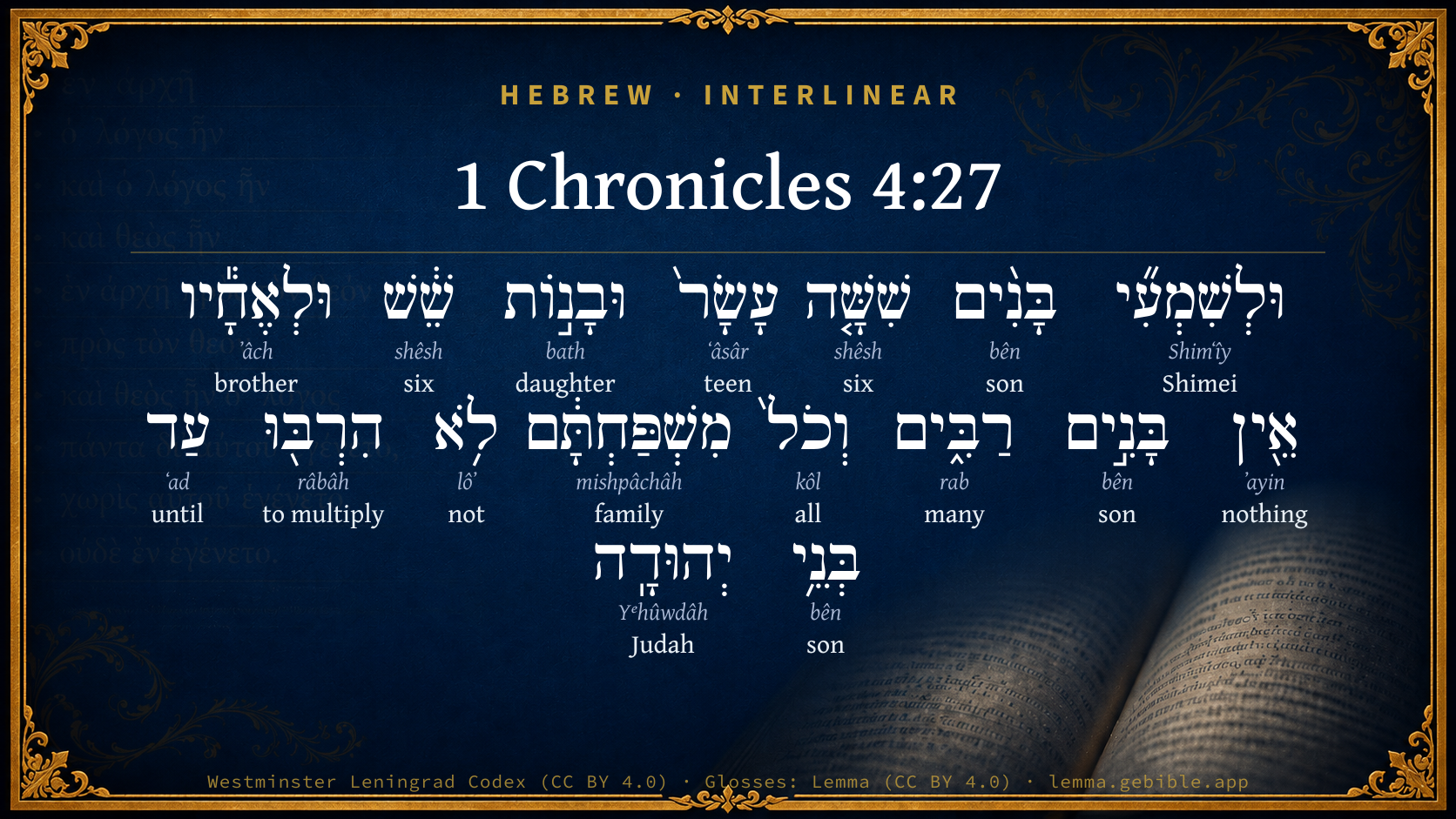
1 Chronicles 4:27

Hebrew (Westminster Leningrad Codex) 1 Chronicles 4:27 appears in the Hebrew Old Testament. The text above is from the Westminster Leningrad Codex. Each word links to its Strong’s number, a concise gloss, and parsing drawn from the Open Scriptures Hebrew Bible morphology. Click any word for its full Brown-Driver-Briggs (BDB) entry.
Download image
Cite this verse

1 Chronicles 4:27 (World English Bible). Public Domain. Lemma interlinear Bible study tool, https://lemma.gebible.app/v/1-chronicles/4/27.

Show BibTeX & RIS
BibTeX
RIS
English Translation
Shimei had sixteen sons and six daughters; but his brothers didn't have many children, neither did all their family multiply like the children of Judah.
World English Bible · Public Domain
Download a study sheet

One document with this verse’s original text, its word-by-word gloss line, the meaning frame, cross-references with their text, attributed commentary, and full source and license credits — printable, and it pastes into notes with its structure intact.

This verse Autodidact and up

Study sheet (.html) Plain text (.txt)

A passage Seminary Student

Up to 50 verses in one chapter. A passage sheet keeps up to 6 commentary sources and 12 cross-references per verse, in the order this page ranks them, and says so on the sheet whenever that leaves anything out. Ask for a single verse and you get the Autodidact verse sheet above.

Everything on this page stays free to read, with no account — the sheet is a download of what is already on screen, not access to it.

Want to remove ads? Support Godless Engineer
Compare translations 3

The same verse in 3 English versions, stacked beneath the original-language interlinear above. Click any original word for its lexicon entry.

Each is an independent rendering of the whole verse — the interlinear is not word-aligned to these translations.

Highlighted words mark where these versions differ — a whole-verse word diff, not a word-by-word alignment.

  • World English Bible Public Domain
    Shimei had sixteen sons and six daughters; but his brothers didn't have many children, neither did all their family multiply like the children of Judah.
  • King James Version Public Domain
    And Shimei had sixteen sons and six daughters: but his brethren had not many children, neither did all their family multiply, like to the children of Judah.
  • unfoldingWord Literal Text CC BY-SA 4.0
    And to Shimei 16 sons and 6 daughters, but to his brothers not many sons, so all of their clan did not multiply as much as the sons of Judah.

unfoldingWord Literal Text — © unfoldingWord, licensed CC BY-SA 4.0. Word-aligned USFM3 via Door43 (git.door43.org/unfoldingWord/en_ult).

Versions to compare (up to 4)

3 of 4 selected

Show all 18 translations

Every available English version of this verse, each an independent rendering of the whole verse.

  • World English Bible Public Domain
    Shimei had sixteen sons and six daughters; but his brothers didn't have many children, neither did all their family multiply like the children of Judah.
  • Berean Standard Bible Public Domain
    Shimei had sixteen sons and six daughters, but his brothers did not have many children, so their whole clan did not become as numerous as the sons of Judah.
  • Majority Standard Bible Public Domain
    Shimei had sixteen sons and six daughters, but his brothers did not have many children, so their whole clan did not become as numerous as the sons of Judah.
  • King James Version Public Domain
    And Shimei had sixteen sons and six daughters: but his brethren had not many children, neither did all their family multiply, like to the children of Judah.
  • American Standard Version (1901) Public Domain
    And Shimei had sixteen sons and six daughters; but his brethren had not many children, neither did all their family multiply like to the children of Judah.
  • Revised Version (1885) Public Domain
    And Shimei had sixteen sons and six daughters; but his brethren had not many children, neither did all their family multiply, like to the children of Judah.
  • Geneva Bible (1599) Public Domain
    And Shimei had sixteene sonnes, and sixe daughters, but his brethren had not many children, neither was all their familie like to the children of Iudah in multitude.
  • Douay-Rheims (1899) Public Domain
    The sons of Semei were sixteen, and six daughters: but his brethren had not many sons, and the whole kindred could not reach to the sum of the children of Juda.
  • Young's Literal Translation Public Domain
    And to Shimei `are' sixteen sons and six daughters, and to his brethren there are not many sons, and none of their families have multiplied as much as the sons of Judah.
  • Literal Standard Version CC BY-SA 4.0
    And to Shimei [are] sixteen sons and six daughters, and to his brothers there are not many sons, and none of their families have multiplied as much as the sons of Judah.
  • Unlocked Literal Bible CC BY-SA 4.0
    Shimei had sixteen sons and six daughters. His brothers did not have many children, so their clans did not increase greatly in numbers as the people of Judah did.
  • unfoldingWord Literal Text CC BY-SA 4.0
    And to Shimei 16 sons and 6 daughters, but to his brothers not many sons, so all of their clan did not multiply as much as the sons of Judah.
  • Darby Bible Public Domain
    and Shimei had sixteen sons and six daughters. And his brethren had not many sons; neither did all their family multiply like to the sons of Judah.
  • World Messianic Bible Public Domain
    Shimei had sixteen sons and six daughters; but his brothers didn’t have many children, and all their family didn’t multiply like the children of Judah.
  • Webster's Bible Public Domain
    And Shimei had sixteen sons and six daughters; but his brethren had not many children, neither did all their family multiply, like the children of Judah.
  • Free Bible Version CC BY-SA 4.0
    Shimei had sixteen sons and six daughters, but his brothers did not have many children; so their tribe was not as large as that of Judah.
  • Bible in Basic English Public Domain
    And Shimei had sixteen sons and six daughters, but his brothers had only a small number of children, and their family was not as fertile as the children of Judah.
  • JPS Tanakh (1917) Public Domain
    And Shimei had sixteen sons and six daughters; but his brethren had not many children, neither did all their family multiply, like to the children of Judah.

Literal Standard Version (2020), Covenant Press — licensed CC BY-SA 4.0. Text via the HelloAO Bible API (eBible.org). Unlocked Literal Bible (unfoldingWord) — licensed CC BY-SA 4.0. Text via the HelloAO Bible API (eBible.org). unfoldingWord Literal Text — © unfoldingWord, licensed CC BY-SA 4.0. Word-aligned USFM3 via Door43 (git.door43.org/unfoldingWord/en_ult). Free Bible Version, Dr. Jonathan Gallagher — licensed CC BY-SA 4.0. Text via the HelloAO Bible API (eBible.org).

Word by word

More ways to search: Search by grammar → Find every occurrence → Compare this word →

Practice this passage: Drill this verse → Learn its vocabulary →

וּלְשִׁמְעִ֞י
Shimʻîy
H8096
“and · to/for · Shimei”
Conjunction + Preposition + Noun, Proper
Part of Speech
Conjunction + Preposition + Noun
Type
Proper
Full BDB Definition

Origin: from H8088

TWOT: None

Shimei or Shimhi or Shimi or Shimea = "renowned" - a Benjamite, son of Gera of the house of Saul in the time of David - a Benjamite, son of Elah and commissariat officer in the time of Solomon - the Ramathite in charge of the vineyards of David - son of Gershon and grandson of Levi - a Levite, son of Jeduthun and chief of the 10th division of singers in the time of David - a Levite of the sons of Heman who took part in the purification of the temple in the time of king Hezekiah of Judah - a Levite, brother of Cononiah in charge of receiving the tithes and offerings in the reign of king Hezekiah of Judah - a Levite who had a foreign wife in the time of Ezra - a Judaite, son of Pedaiah and brother of Zerubbabel - a Simeonite, son of Zacchur - a Reubenite, son of Gog and father of Micah - one of the sons of Hashum who had a foreign wife in the time of Ezra - one of the sons of Bani who had a foreign wife in the time of Ezra - a Benjamite, son of Kish, father of Jair, and grandfather of Mordecai in the time of Esther - a Levite, son of Jahath, grandson of Gershon, and great grandson of Levi - Benjamite, father of Adaiah, Beraiah, and Shimrath. Spelled 'Shimhi'

  1. בָּנִ֨ים bên H1121 “sons” Noun, Common, Masculine, Plural, Absolute
  2. שִׁשָּׁ֤ה shêsh H8337 “six” Adjective, Cardinal number, Masculine, Singular, Absolute
  3. עָשָׂר֙ ʻâsâr H6240 “teen” Adjective, Cardinal number, Masculine, Singular, Absolute
  4. וּבָנ֣וֹת bath H1323 “and · daughters” Conjunction + Noun, Common, Feminine, Plural, Absolute
  5. שֵׁ֔שׁ shêsh H8337 “six” Adjective, Cardinal number, Feminine, Singular, Absolute
  6. וּלְאֶחָ֕יו ʼâch H251 “and · to/for · brothers · his” Conjunction + Preposition + Noun, Common, Masculine, Plural, Construct + Suffix, Personal, 3rd Person, Masculine, Singular
  7. אֵ֖ין ʼayin H369 “nothing” Particle, Negative
  8. בָּנִ֣ים bên H1121 “sons” Noun, Common, Masculine, Plural, Absolute
  9. רַבִּ֑ים rab H7227 “many” Adjective, Adjective, Masculine, Plural, Absolute
  10. וְכֹל֙ kôl H3605 “and · all of” Conjunction + Noun, Common, Masculine, Singular, Construct
  11. מִשְׁפַּחְתָּ֔ם mishpâchâh H4940 “family · their” Noun, Common, Feminine, Singular, Construct + Suffix, Personal, 3rd Person, Masculine, Plural
  12. לֹ֥א lôʼ H3808 “not” Particle, Negative
  13. הִרְבּ֖וּ râbâh H7235 “to multiply” Verb, Hiphil, Perfect, 3rd Person, Common, Plural
  14. עַד ʻad H5704 “until” Preposition
  15. בְּנֵ֥י bên H1121 “sons of” Noun, Common, Masculine, Plural, Construct
  16. יְהוּדָֽה Yᵉhûwdâh H3063 “Judah” Noun, Proper

About this verse

These counts appear in no published source. They are computed here, from the morphology-tagged text and Lemma’s own curated glosses. What Lemma adds →

17
words
14
distinct lemmas
Historical
section

Shared distinctive vocabulary

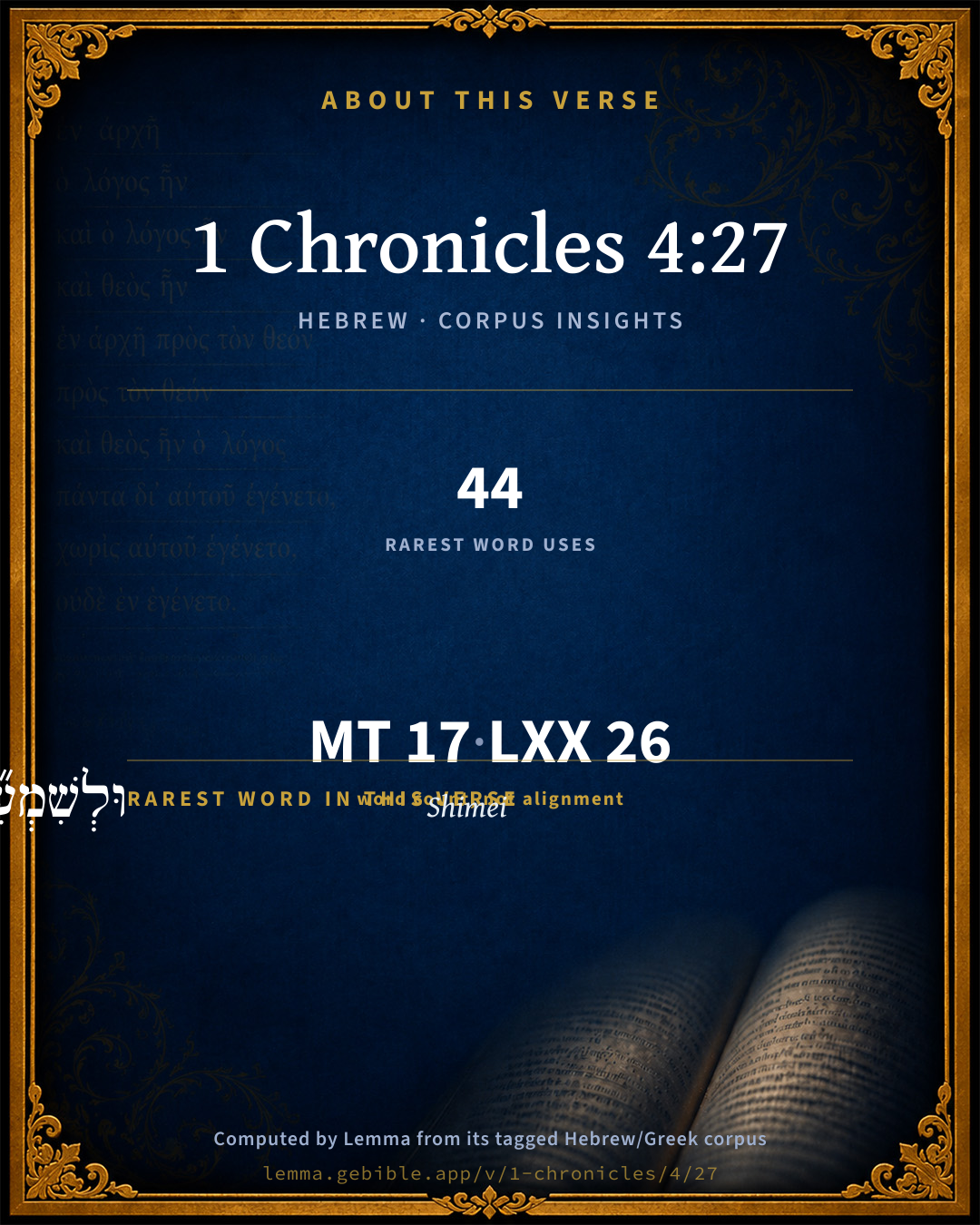
וּלְשִׁמְעִ֞י Shimei H8096 occurs in 40 verses of the Hebrew Bible. Also found in:

Grammatical profile

  • 1 verb
  • 9 nouns
  • 4 adjectives
  • 1 preposition
  • 2 particles

Verb forms

  • הִרְבּ֖וּ Hiphil · Perfect

Repetition

Words recur within this verse — often emphatic in Hebrew:

  • בָּנִ֨ים son H1121 ×3
  • שִׁשָּׁ֤ה six H8337 ×2

Hebrew & Septuagint length

In English translation the verse runs 25 words from the Hebrew and 25 from the Septuagint (LXX English) — the same length.

A rough comparison of the two English renderings, which tokenize alike — not a word-level alignment.

Word counts can differ between the Hebrew and the Greek without any difference in meaning — e.g. the Hebrew direct-object marker אֵת has no separate Greek word, and Greek often adds the article ὁ.

In the original languages it is 17 Hebrew tokens and 26 Greek tokens — but the two are counted differently (Hebrew bundles its prefixes and suffixes into one token; the Greek is in lemma form), so that isn’t a like-for-like length.

Cross-references

4

Topical passages linked to 1 Chronicles 4:27 in the Treasury of Scripture Knowledge — connected by theme and wording, ordered by reader-vote popularity; previews shown in the World English Bible.

  • Numbers 26:14 These are the families of the Simeonites, twenty-two thousand two hundred.
  • Numbers 2:13 His division, and those who were numbered of them, were fifty-nine thousand three hundred.
  • Numbers 26:22 These are the families of Judah according to those who were numbered of them, seventy-six thousand five hundred.
  • Numbers 2:4 His division, and those who were numbered of them, were seventy-four thousand six hundred.

Cross-references courtesy of OpenBible.info (CC BY 4.0).

Hebrew and Greek witnesses Masoretic Hebrew ↔ Greek Septuagint

The same verse in the two great witnesses to the Old Testament, shown verse-for-verse.

These are two independent witnesses, not word-aligned to each other, and the Septuagint is shown in lemma (dictionary) form.

Hebrew 1 Chronicles 4:27 Masoretic · Westminster Leningrad Codex

וּלְשִׁמְעִ֞י בָּנִ֨ים שִׁשָּׁ֤ה עָשָׂר֙ וּבָנ֣וֹת שֵׁ֔שׁ וּלְאֶחָ֕יו אֵ֖ין בָּנִ֣ים רַבִּ֑ים וְכֹל֙ מִשְׁפַּחְתָּ֔ם לֹ֥א הִרְבּ֖וּ עַד בְּנֵ֥י יְהוּדָֽה

Shimei had sixteen sons and six daughters; but his brothers didn't have many children, neither did all their family multiply like the children of Judah.

World English Bible · Public Domain

Greek LXX 1 Chronicles 4:27 Septuagint · lemma form

καί ὁ σεμεϊ υἱός ἑκκαίδεκα καί θυγάτηρ τρεῖς καί ὁ ἀδελφός αὐτός οὐ εἰμί υἱός πολύς καί πᾶς ὁ πατριά αὐτός οὐ πλεονάζω ὡς υἱός ἰουδά

Semei had sixteen sons, and six daughters; and his brethren had not many sons, neither did all their families multiply as the sons of Juda.

LXX2012 (modern English Septuagint) · Public Domain

On this verse, The Cambridge Bible for Schools and Colleges discusses the Septuagint’s reading. Read the note in Commentary ↓

Hebrew: Westminster Leningrad Codex (CC BY 4.0). Greek: Septuagint (public domain); English from LXX2012 (modern English Septuagint) (Public Domain). How the Septuagint differs from the Hebrew →

Commentary

Notes on 1 Chronicles 4:27 from classic Christian and Jewish commentators (each source and its license shown beneath its notes). The classic Christian expositions comment on the surrounding passage and are grouped to its opening verse, so a note may address several verses; the Jewish commentaries on the Tanakh (Rashi and others) are per-verse, so they appear only where the commentator wrote on this verse.

Lemma curates 59 commentaries, every one of them public domain or Creative Commons licensed, each selected and text-cleaned for this edition rather than reprinted as found. About our sources →

Trapp's Complete Commentary

John Trapp

1Ch 4:27 And Shimei had sixteen sons and six daughters; but his brethren had not many children, neither did all their family multiply, like to the children of Judah.

Ver. 27. And Shimei had sixteen sons.] None mentioned in these genealogies had so many.

John Trapp, A Commentary or Exposition upon All the Books of the Old and New Testament (1647–1656) — public domain. Text from a community e-Sword module.

Joseph Benson's Commentary

1Ch 4:27. Neither did their family multiply like the children of Judah — The tribe of Simeon did not increase proportionably to the tribe of Judah in which they dwelt, as appears by those two catalogues, Num 1:22; Num 26:14; which is to be ascribed to God’s curse upon them, delivered by the month of holy Jacob, (Genesis 49.,) and signified by Moses’s neglect of them, when he blessed all the other tribes.

Joseph Benson's Commentary on the Old and New Testaments (1811–1818) — public domain. Text from a community e-Sword module.

Jamieson, Fausset & Brown

Robert Jamieson, A. R. Fausset & David Brown

his brethren had not many children--(see Num 1:22; Num 26:14).

Jamieson, Fausset & Brown — Commentary Critical and Explanatory on the Whole Bible (1871) — public domain (CC PDM 1.0). Text via the HelloAO Bible API.

Adam Clarke's Commentary

Verse 27. Neither did all their family multiply] In Nu 1:23 the number of all the families of Simeon was fifty-nine thousand three hundred; and that of Judah was, Nu 1:27, not less than seventy-four thousand six hundred. When the next census was made, Num. 26, the tribe of Judah amounted to seventy-six thousand five hundred, an increase of one thousand nine hundred; while the tribe of Simeon amounted only to twenty-two thousand two hundred, a decrease of thirty-seven thousand one hundred. It was at that time the smallest tribe in Israel.

Adam Clarke's Commentary on the Bible (1810–1826) — public domain. Text from a community e-Sword/MySword module.

Ellicott's Commentary for English Readers

(27) His brethren had not many children.—His brethren, i.e., his fellow-tribesmen. The other Simeonite clans (Num_26:12), are meant.

Neither did all their family multiply.—Rather, nor did they multiply their whole clan. The word clan (mishpahath) is here used in the wider sense of tribe. This remark is borne out by what we otherwise know of the tribe of Simeon. It was never historically important, and appears to have ultimately been absorbed by Judah, within which its domain was included (Jos_19:1). (Comp. Gen_49:7 : “I will divide them in Jacob, and scatter them in Israel.”)

A Bible Commentary for English Readers, edited by Charles John Ellicott (1878–1897) — public domain. Text from a community e-Sword module.

The Cambridge Bible for Schools and Colleges

gen. ed. J. J. S. Perowne

27. six daughters] LXX. three daughters.

The Cambridge Bible for Schools and Colleges (gen. ed. J. J. S. Perowne; Cambridge University Press, 1878–1918) — public domain. Text from a community e-Sword module.

John Gill's Exposition

And they dwelt at Beersheba,.... posterity of Simeon; and this and the other places of their habitation are mentioned in the same order, and with very little variation of names to the end of Ch1 4:31, as in Jos 19:2 and here, at Ch1 4:31 it is added:

these were their cities unto the reign of David; when, according to Kimchi, and other Jewish writers, he expelled them from thence, and restored them to the tribe of Judah.

John Gill's Exposition of the Whole Bible (1746–1763) — public domain (CC PDM 1.0). Text via the HelloAO Bible API.

Haydock's Catholic Bible Commentary

Juda, probably, not even in the following cities, which they inhabited along with them. This tribe of Simeon was always the weakest, and kept close to Juda. See Numbers xxvi. 14.

George Leo Haydock (1774–1849), Haydock's Catholic Family Bible and Commentary, 1859 edition — public domain. Excludes Psalms (Douay-Rheims chapter numbering differs from Protestant) and Deuterocanonical books (Catholic canon only).

Matthew Poole's English Annotations

The tribe of Simeon did not increase proportionably to the tribe of Judah, in which they dwelt; as appears by those two catalogues, Num 1:22; 26:14; which is to be ascribed to God’s curse upon them delivered by the mouth of holy Jacob, Ge 49, and signified by Moses’s neglect of them, when he blessed all the other tribes.

Matthew Poole's English Annotations on the Holy Bible (1683–1685) — public domain. Text from a community e-Sword/MySword module.

John Wesley's Explanatory Notes

Of Judah - The tribe of Simeon did not increase proportionably to the tribe of Judah in which they dwelt; as appears by those two catalogues, Num. i, 22; xxvi, 14, which is to be ascribed to God's curse upon them, delivered by the mouth of holy Jacob, Gen. xlix, 5-7, and signified by Moses's neglect of them when he blessed all the other tribes.

John Wesley, Explanatory Notes Upon the Whole Bible (1754–1765) — public domain. Text via the GEBible commentary corpus.

Keil & Delitzsch

C. F. Keil & F. Delitzsch

And they dwelt at Beersheba,.... posterity of Simeon; and this and the other places of their habitation are mentioned in the same order, and with very little variation of names to the end of Ch1 4:31, as in Jos 19:2 and here, at Ch1 4:31 it is added:

these were their cities unto the reign of David; when, according to Kimchi, and other Jewish writers, he expelled them from thence, and restored them to the tribe of Judah.

Keil & Delitzsch — Biblical Commentary on the Old Testament (1861–1891) — public domain (CC PDM 1.0). Text via the HelloAO Bible API. (Old Testament only.)

unfoldingWord translationNotes

Door43 World Missions Community

sixteen sons and six daughters

"16 sons and 6 daughters" (See: Numbers)

Moladah ... Hazar Shual

These are the names of towns. (See: How to Translate Names)

translationWords

clan

people group

Judah

Beersheba

unfoldingWord translationNotes — © Distant Shores Media and the Door43 World Missions Community, licensed CC BY-SA 4.0. Source: git.door43.org/Door43/en_tn.

Rashi

Rabbi Shlomo Yitzchaki (Rashi)

but his brothers did not have many sons and all their family did not multiply as much as the children of Judah They did not have as many children as the children of Judah. Since they were few, and Judah’s territory was too large for them, Judah accepted Simeon in its territory, because Simeon had no share in the land of Israel, as it says (Gen. 49:7): “I shall divide them in Jacob and scatter them in Israel,” and we learned in Genesis Rabbah (Shittah Hadashah): “I shall divide them among the Children of Israel to station scribes in Israel in the synagogues, etc.” Now how do we know that they agreed [to give them a share of their territory]? For it is written (Jos. 19:9): “Out of the lot of the children of Judah was the inheritance of the children of Simeon, for the portion of the children of Judah was too large for them; therefore the children of Simeon inherited in the midst of their inheritance,” lest the beasts of the field outnumber them. Now as regards the verse (ibid. v. 1): “And the second lot came out to Simeon,” this is what happened: They cast lots to choose which tribe would accept Simeon in its territory, and the lot fell upon the territory of Judah. And the meaning of the verse (Jud. 1:3): “And Judah said to Simeon his brother: Come up with me into my lot, and we will fight against the Canaanites, and I will also go with you into your lot,” refers to “the lot I have given you.”

Rashi on the Tanakh — English translations: “The Judaica Press complete Tanach with Rashi, translated by A. J. Rosenberg” (CC BY 4.0); “Pentateuch with Rashi's commentary by M. Rosenbaum and A.M. Silbermann, 1929-1934” (public domain); “The Metsudah Tanach series, Lakewood, N.J” (CC BY 4.0); and “The Book of Joshua, Metsudah Publications, 1997” (CC BY 4.0). Text via Sefaria.

Lesson kit

Teaching starters — assembled from the data on this page, not authored interpretation. Every prompt links to the verse data it draws on. Edit before teaching.

1 Chronicles, in the Historical, opens this verse with 17 words (14 distinct Hebrew lemmas). Its most distinctive word is Shimʻîy (“Shimei”). A historical commentator’s framing appears above. Read the whole chapter for the surrounding context.

Discussion questions

  1. What does “Shimei” (Shimʻîy) contribute to the verse as a whole?
  2. Exodus 6:17 shares the word «Shimei» with this verse. How do the two illuminate each other?
  3. “son” occurs 3× in this one verse. What is the effect of the repetition?
  4. These translations render this verse differently. What is at stake in choosing one wording over another?
  5. The verb «הִרְבּ֖וּ» is Hiphil Perfect. How does its form color the action?
  6. Reading how Trapp's Complete Commentary and Joseph Benson's Commentary read this verse, where do the two commentators agree and where do they part?

Things to notice

Reading settings

Reading text

Shown beneath each verse's original-language words.

Old Testament
Old Testament edition

Read the OT as the Masoretic Hebrew (MT) or the Greek Septuagint (LXX).

English shown for the Greek Septuagint (in the Hebrew ↔ Greek comparison).

Comparing translations? Open the Compare panel on any verse page to stack up to four side by side.