Numbers 9:19

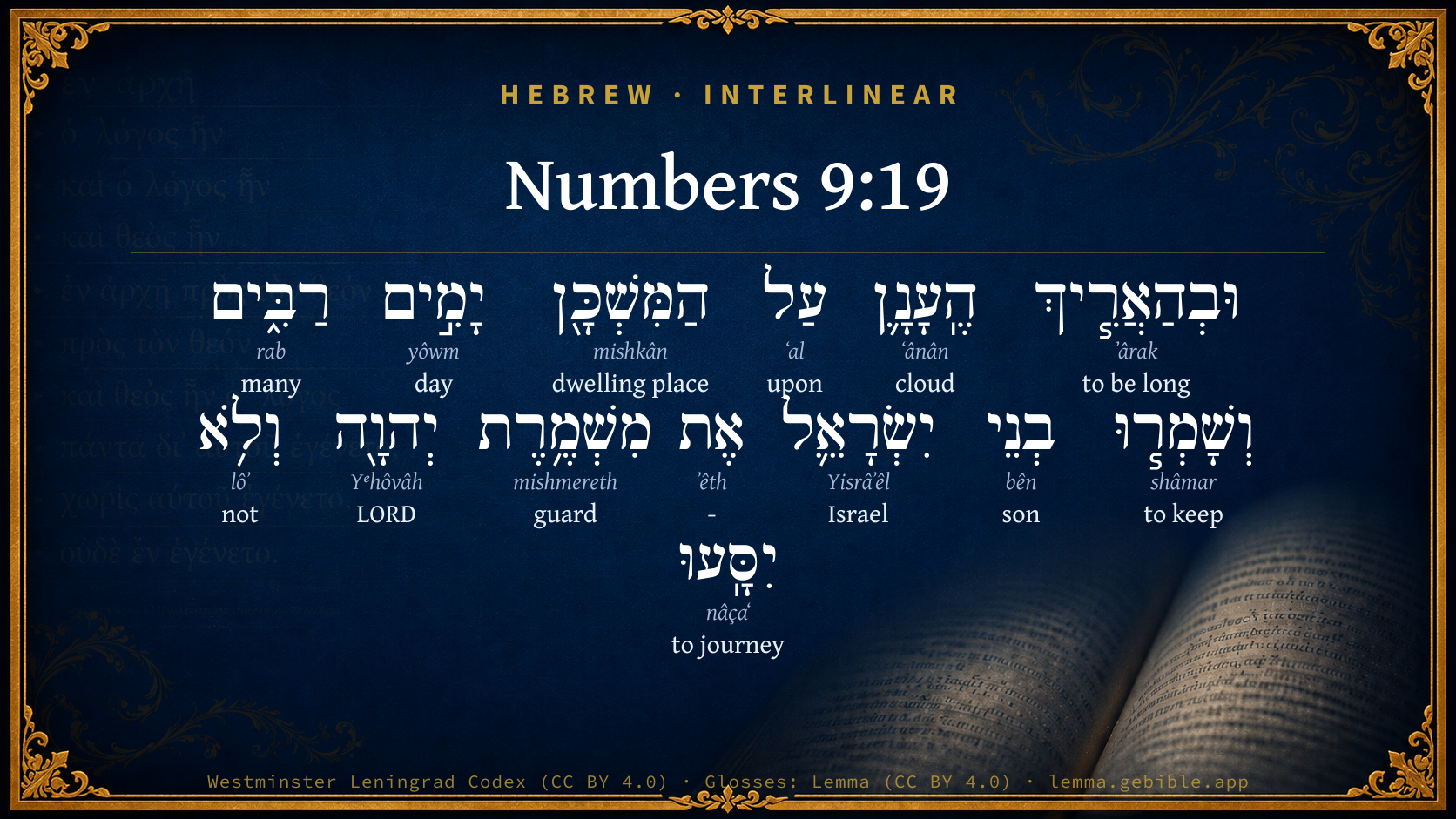
Hebrew (Westminster Leningrad Codex) Numbers 9:19 appears in the Hebrew Old Testament. The text above is from the Westminster Leningrad Codex. Each word links to its Strong’s number, a concise gloss, and parsing drawn from the Open Scriptures Hebrew Bible morphology. Click any word for its full Brown-Driver-Briggs (BDB) entry.
Download image
Cite this verse

Numbers 9:19 (World English Bible). Public Domain. Lemma interlinear Bible study tool, https://lemma.gebible.app/v/numbers/9/19.

Show BibTeX & RIS
BibTeX
RIS
English Translation
When the cloud stayed on the tabernacle many days, then the children of Israel kept the charge of Yahweh, and didn't travel.
World English Bible · Public Domain
Download a study sheet

One document with this verse’s original text, its word-by-word gloss line, the meaning frame, cross-references with their text, attributed commentary, and full source and license credits — printable, and it pastes into notes with its structure intact.

This verse Autodidact and up

Study sheet (.html) Plain text (.txt)

A passage Seminary Student

Up to 50 verses in one chapter. A passage sheet keeps up to 6 commentary sources and 12 cross-references per verse, in the order this page ranks them, and says so on the sheet whenever that leaves anything out. Ask for a single verse and you get the Autodidact verse sheet above.

Everything on this page stays free to read, with no account — the sheet is a download of what is already on screen, not access to it.

Want to remove ads? Support Godless Engineer
Compare translations 3

The same verse in 3 English versions, stacked beneath the original-language interlinear above. Click any original word for its lexicon entry.

Each is an independent rendering of the whole verse — the interlinear is not word-aligned to these translations.

Highlighted words mark where these versions differ — a whole-verse word diff, not a word-by-word alignment.

  • World English Bible Public Domain
    When the cloud stayed on the tabernacle many days, then the children of Israel kept the charge of Yahweh, and didn't travel.
  • King James Version Public Domain
    And when the cloud tarried long upon the tabernacle many days, then the children of Israel kept the charge of the LORD, and journeyed not.
  • unfoldingWord Literal Text CC BY-SA 4.0
    And when the cloud prolongs upon the Dwelling many days, then the sons of Israel keep the keeping of Yahweh, and they do not set out.

unfoldingWord Literal Text — © unfoldingWord, licensed CC BY-SA 4.0. Word-aligned USFM3 via Door43 (git.door43.org/unfoldingWord/en_ult).

Versions to compare (up to 4)

3 of 4 selected

Show all 18 translations

Every available English version of this verse, each an independent rendering of the whole verse.

  • World English Bible Public Domain
    When the cloud stayed on the tabernacle many days, then the children of Israel kept the charge of Yahweh, and didn't travel.
  • Berean Standard Bible Public Domain
    Even when the cloud lingered over the tabernacle for many days, the Israelites kept the LORD’s charge and did not set out.
  • Majority Standard Bible Public Domain
    Even when the cloud lingered over the tabernacle for many days, the Israelites kept the LORD’s charge and did not set out.
  • King James Version Public Domain
    And when the cloud tarried long upon the tabernacle many days, then the children of Israel kept the charge of the LORD, and journeyed not.
  • American Standard Version (1901) Public Domain
    And when the cloud tarried upon the tabernacle many days, then the children of Israel kept the charge of Jehovah, and journeyed not.
  • Revised Version (1885) Public Domain
    And when the cloud tarried upon the tabernacle many days, then the children of Israel kept the charge of the LORD, and journeyed not.
  • Geneva Bible (1599) Public Domain
    And when the cloude taryed stil vpon the Tabernacle a long time, the childre of Israel kept the watch of the Lord, and iourneyed not.
  • Douay-Rheims (1899) Public Domain
    And if it was so that it continued over it a long time, the children of Israel kept the watches of the Lord, and marched not,
  • Young's Literal Translation Public Domain
    And in the cloud prolonging itself over the tabernacle many days, then have the sons of Israel kept the charge of Jehovah, and journey not,
  • Literal Standard Version CC BY-SA 4.0
    And in the cloud prolonging itself over the Dwelling Place many days, then the sons of Israel have kept the charge of YHWH, and do not journey.
  • Unlocked Literal Bible CC BY-SA 4.0
    When the cloud remained on the tabernacle for many days, then the people of Israel would obey Yahweh's instructions and not travel.
  • unfoldingWord Literal Text CC BY-SA 4.0
    And when the cloud prolongs upon the Dwelling many days, then the sons of Israel keep the keeping of Yahweh, and they do not set out.
  • Darby Bible Public Domain
    And when the cloud was long upon the tabernacle many days, then the children of Israel kept the charge of Jehovah, and journeyed not.
  • World Messianic Bible Public Domain
    When the cloud stayed on the tabernacle many days, then the children of Israel kept the LORD’s command, and didn’t travel.
  • Webster's Bible Public Domain
    And when the cloud tarried long upon the tabernacle many days, then the children of Israel kept the charge of the LORD, and journeyed not.
  • Free Bible Version CC BY-SA 4.0
    Even if the cloud didn't move for a long time, the Israelites did what the Lord told them and didn't move on.
  • Bible in Basic English Public Domain
    When the cloud was resting on the House for a long time the children of Israel, waiting for the order of the Lord, did not go on.
  • JPS Tanakh (1917) Public Domain
    And when the cloud tarried upon the tabernacle many days, then the children of Israel kept the charge of the LORD, and journeyed not.

Literal Standard Version (2020), Covenant Press — licensed CC BY-SA 4.0. Text via the HelloAO Bible API (eBible.org). Unlocked Literal Bible (unfoldingWord) — licensed CC BY-SA 4.0. Text via the HelloAO Bible API (eBible.org). unfoldingWord Literal Text — © unfoldingWord, licensed CC BY-SA 4.0. Word-aligned USFM3 via Door43 (git.door43.org/unfoldingWord/en_ult). Free Bible Version, Dr. Jonathan Gallagher — licensed CC BY-SA 4.0. Text via the HelloAO Bible API (eBible.org).

Word by word

More ways to search: Search by grammar → Find every occurrence → Compare this word →

Practice this passage: Drill this verse → Learn its vocabulary →

וּבְהַאֲרִ֧יךְ
ʼârak
H748
“and · in/at · to be long”
Conjunction + Preposition + Verb, Hiphil, Infinitive Construct
Part of Speech
Conjunction + Preposition + Verb
Stem
Hiphil
Form
Infinitive Construct
Full BDB Definition

Origin: a primitive root

TWOT: 162

to be long, prolong - (Qal) to be long - (Hiphil) - to prolong (days) - to make long (tent cords) - to grow long, continue long
  1. הֶֽעָנָ֛ן ʻânân H6051 “the · cloud” Particle, Definite Article + Noun, Common, Masculine, Singular, Absolute
  2. עַל ʻal H5921 “upon” Preposition
  3. הַמִּשְׁכָּ֖ן mishkân H4908 “the · dwelling place” Particle, Definite Article + Noun, Common, Masculine, Singular, Absolute
  4. יָמִ֣ים yôwm H3117 “days” Noun, Common, Masculine, Plural, Absolute
  5. רַבִּ֑ים rab H7227 “many” Adjective, Adjective, Masculine, Plural, Absolute
  6. וְשָׁמְר֧וּ shâmar H8104 “and · to keep” Conjunction + Verb, Qal, Sequential Perfect, 3rd Person, Common, Plural
  7. בְנֵי bên H1121 “sons of” Noun, Common, Masculine, Plural, Construct
  8. יִשְׂרָאֵ֛ל Yisrâʼêl H3478 “Israel” Noun, Proper
  9. אֶת ʼêth H853 “-” Particle, Direct Object
  10. מִשְׁמֶ֥רֶת mishmereth H4931 “guard of” Noun, Common, Feminine, Singular, Construct
  11. יְהוָ֖ה Yᵉhôvâh H3068 “LORD” Noun, Proper
  12. וְלֹ֥א lôʼ H3808 “and · not” Conjunction + Particle, Negative
  13. יִסָּֽעוּ nâçaʻ H5265 “to journey” Verb, Qal, Imperfect, 3rd Person, Masculine, Plural

About this verse

These counts appear in no published source. They are computed here, from the morphology-tagged text and Lemma’s own curated glosses. What Lemma adds →

14
words
14
distinct lemmas
Pentateuch
section

Shared distinctive vocabulary

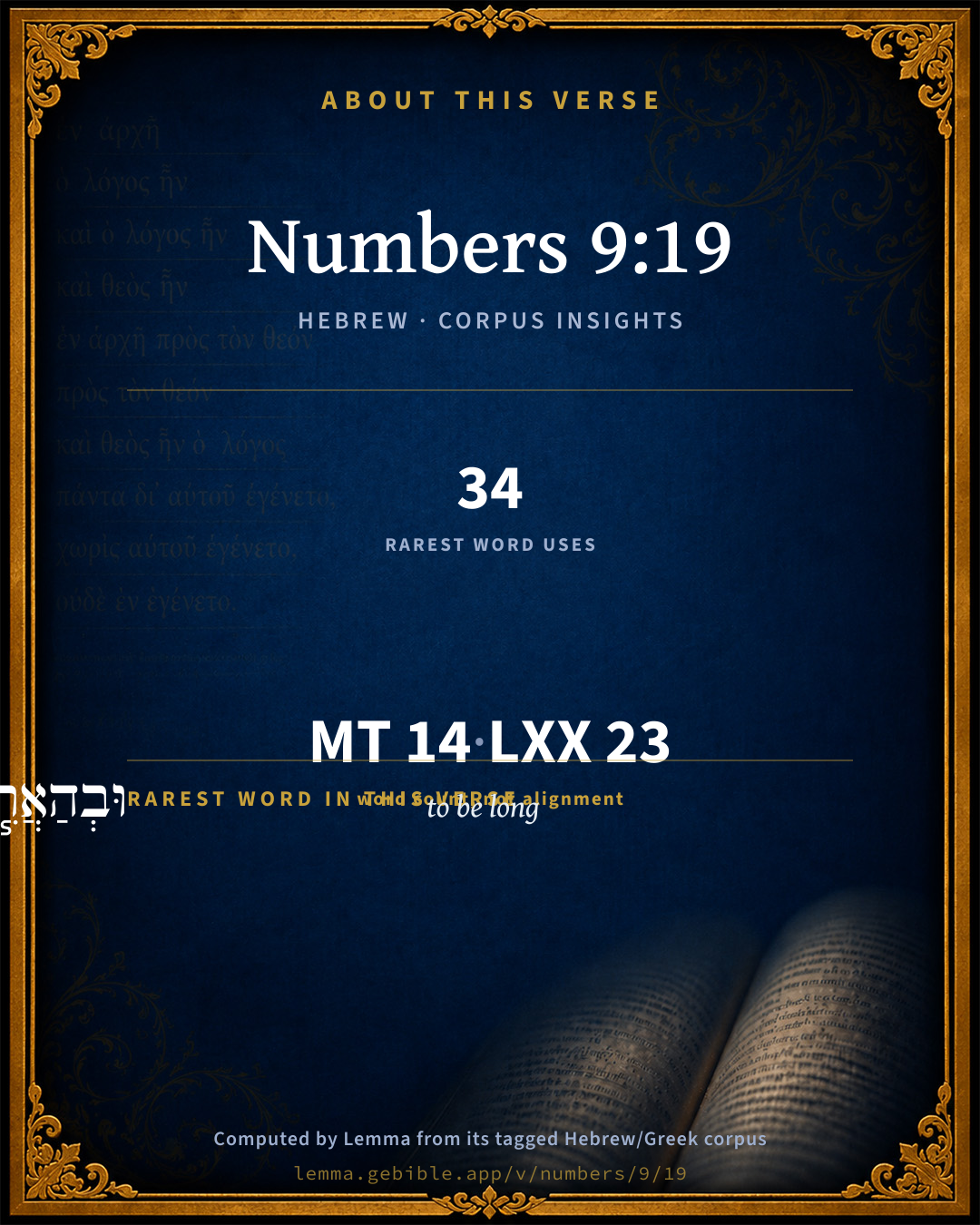
וּבְהַאֲרִ֧יךְ to be long H748 occurs in 34 verses of the Hebrew Bible. Also found in:

Grammatical profile

  • 3 verbs
  • 7 nouns
  • 1 adjective
  • 1 preposition
  • 2 particles

Verb forms

  • וּבְהַאֲרִ֧יךְ Hiphil · Infinitive Construct
  • וְשָׁמְר֧וּ Qal · Sequential Perfect
  • יִסָּֽעוּ Qal · Imperfect

Hebrew & Septuagint length

In English translation the verse runs 22 words from the Hebrew and 32 from the Septuagint (LXX English) — the Septuagint runs noticeably longer here. See the side-by-side →

A rough comparison of the two English renderings, which tokenize alike — not a word-level alignment.

Word counts can differ between the Hebrew and the Greek without any difference in meaning — e.g. the Hebrew direct-object marker אֵת has no separate Greek word, and Greek often adds the article ὁ.

In the original languages it is 14 Hebrew tokens and 23 Greek tokens — but the two are counted differently (Hebrew bundles its prefixes and suffixes into one token; the Greek is in lemma form), so that isn’t a like-for-like length.

Cross-references

3

Topical passages linked to Numbers 9:19 in the Treasury of Scripture Knowledge — connected by theme and wording, ordered by reader-vote popularity; previews shown in the World English Bible.

  • Zechariah 3:7 "Thus says Yahweh of hosts: 'If you will walk in my ways, and if you will keep my charge, then you also shall judge my house, and shall also keep my courts, and I will give you a place of access among these who stand by.
  • Numbers 1:52–53 The children of Israel shall pitch their tents, every man by his own camp, and every man by his own standard, according to their divisions.
  • Numbers 3:8 They shall keep all the furnishings of the Tent of Meeting, and the obligations of the children of Israel, to do the service of the tabernacle.

Cross-references courtesy of OpenBible.info (CC BY 4.0).

Hebrew and Greek witnesses Masoretic Hebrew ↔ Greek Septuagint

The same verse in the two great witnesses to the Old Testament, shown verse-for-verse.

Here the Septuagint runs noticeably longer than the Hebrew — LXX2012 (modern English Septuagint) 32 words vs World English Bible 22. A rough length comparison of the two English translations, not a word-level alignment — read both below.

These are two independent witnesses, not word-aligned to each other, and the Septuagint is shown in lemma (dictionary) form.

Hebrew Numbers 9:19 Masoretic · Westminster Leningrad Codex

וּבְהַאֲרִ֧יךְ הֶֽעָנָ֛ן עַל הַמִּשְׁכָּ֖ן יָמִ֣ים רַבִּ֑ים וְשָׁמְר֧וּ בְנֵי יִשְׂרָאֵ֛ל אֶת מִשְׁמֶ֥רֶת יְהוָ֖ה וְלֹ֥א יִסָּֽעוּ

When the cloud stayed on the tabernacle many days, then the children of Israel kept the charge of Yahweh, and didn't travel.

World English Bible · Public Domain

Greek LXX Numbers 9:19 Septuagint · lemma form

καί ὅταν ἐπιἕλκω ὁ νεφέλη ἐπί ὁ σκηνή ἡμέρα πολύς καί φυλάσσω ὁ υἱός ἰσραήλ ὁ φυλακή ὁ θεός καί οὐ μή ἐκαἴρω

And it shall be, whenever the cloud overshadows the tabernacle a number of days, they shall encamp by the word of the Lord, and shall remove by the command of the Lord.

LXX2012 (modern English Septuagint) · Public Domain

On this verse, The Pulpit Commentary discusses the Septuagint’s reading. Read the note in Commentary ↓

Hebrew: Westminster Leningrad Codex (CC BY 4.0). Greek: Septuagint (public domain); English from LXX2012 (modern English Septuagint) (Public Domain). How the Septuagint differs from the Hebrew →

Targum (Aramaic paraphrase)

2

The Targum is the ancient Jewish Aramaic paraphrase of the Hebrew Scriptures — an interpretive translation, not the Hebrew text itself. Onkelos (literal) and Pseudo-Jonathan (expansive) render the Torah, and Jonathan the Prophets. Coverage is partial: where no permissively-licensed English translation exists for a verse, only the Aramaic is shown. This is verse-level text, not a word-by-word alignment to the Hebrew.

  1. Targum Onkelos Torah (Genesis–Deuteronomy)
    וּבְאוֹרָכוּת עֲנָנָא עַל מַשְׁכְּנָא יוֹמִין סַגִיאִין וְיִטְרוּן בְּנֵי יִשְׂרָאֵל יָת מַטְרַת מֵימְרָא דַיְיָ וְלָא נָטְלִין

    (no public-domain English translation for this verse)

    Targum Onkelos — Aramaic: “Onkelos Genesis” (public domain); “Onkelos Exodus” (public domain); “Onkelos Leviticus” (public domain); “Onkelos Numbers” (public domain); “Onkelos Deuteronomy” (public domain). English: “Sefaria Community Translation” (CC0 1.0 (public-domain dedication)); “J.W. Etheridge. The Targums of Onkelos and Jonathan Ben Uzziel on the Pentateuch. London: Longmans, Green, 1862” (public domain). Text via Sefaria.

  2. Targum Pseudo-Jonathan Torah (Genesis–Deuteronomy)
    וּבְאוֹרְכוּת עֲנָנָא עַל מַשְׁכְּנָא יוֹמִין סַגִיאִין וְיִנְטְרוּן בְּנֵי יִשְרָאֵל יַת מַטְרַת מֵימְרָא דַיְיָ וְלָא נַטְלִין

    And if the Cloud tarried over the Tabernacle many days the children of Israel observed the watch of the Word of the Lord, and did not proceed.

    Targum Pseudo-Jonathan — Aramaic: “Targum Jonathan on Genesis” (public domain); “Targum Jonathan on Exodus” (public domain); “Targum Jonathan on Leviticus” (public domain); “Targum Jonathan on Numbers” (public domain); “Targum Jonathan on Deuteronomy” (public domain). English: “The Targum of Jonathan ben Uzziel, trans. J. W. Etheridge, London, 1862” (public domain). Text via Sefaria.

Commentary

Notes on Numbers 9:19 from classic Christian and Jewish commentators (each source and its license shown beneath its notes). The classic Christian expositions comment on the surrounding passage and are grouped to its opening verse, so a note may address several verses; the Jewish commentaries on the Tanakh (Rashi and others) are per-verse, so they appear only where the commentator wrote on this verse.

Lemma curates 59 commentaries, every one of them public domain or Creative Commons licensed, each selected and text-cleaned for this edition rather than reprinted as found. About our sources →

Trapp's Complete Commentary

John Trapp

Num 9:19 And when the cloud tarried long upon the tabernacle many days, then the children of Israel kept the charge of the LORD, and journeyed not.

Ver. 19. Kept the charge of the Lord.] Or, His wateh - viz., to be ready at any hour to remove. So must we always watch and be in readiness, as not knowing whether at even, or at midnight, or cock crowing, or in the dawning, Christ will come. {Mar 13:35}

John Trapp, A Commentary or Exposition upon All the Books of the Old and New Testament (1647–1656) — public domain. Text from a community e-Sword module.

Tyndale Open Study Notes

Tyndale Open Resources

9:19-23 The fiery cloud, witnessed even by Israel’s enemies (14:14), was a clear symbol of God’s glorious presence and the means by which he directed their movement.

Tyndale Open Study Notes — © Tyndale Open Resources, licensed CC BY-SA 4.0. Text via the HelloAO Bible API.

Geneva Bible (1599)

Geneva Bible translators

They waited when the Lord would signify either their departure, or their abode by the cloud.

Geneva Bible (1599) marginal notes — public domain. Text via Bolls.life.

Jamieson, Fausset & Brown

Robert Jamieson, A. R. Fausset & David Brown

when the cloud tarried long upon the tabernacle, . . . then Israel kept the charge of the Lord, and journeyed not--A desert life has its attractions, and constant movements create a passionate love of change. Many incidents show that the Israelites had strongly imbibed this nomad habit and were desirous of hastening to Canaan. But still the phases of the cloud indicated the command of God: and whatsoever irksomeness they might have felt in remaining long stationary in camp, "when the cloud tarried upon the tabernacle many days, they kept the charge of the Lord, and journeyed not." Happy for them had they always exhibited this spirit of obedience! and happy for all if, through the wilderness of this world, we implicitly follow the leadings of God's Providence and the directions of God's Word!

Next: Numbers Chapter 10

Jamieson, Fausset & Brown — Commentary Critical and Explanatory on the Whole Bible (1871) — public domain (CC PDM 1.0). Text via the HelloAO Bible API.

Ellicott's Commentary for English Readers

(19) Kept the charge of the Lord.—The same expression is used of Aaron and his sons in Lev_8:35, and also in respect to the office of the Levites in Num_3:7, as keeping the charge of Aaron and of the congregation. It is also used of the people generally in 2Ch_23:6, in regard to the charge or “watch” of the Lord. It may imply that the people were to engage in acts of religious worship, or it may denote adherence to the Divine commands and ordinances generally, as in Eze_48:11.

A Bible Commentary for English Readers, edited by Charles John Ellicott (1878–1897) — public domain. Text from a community e-Sword module.

John Gill's Exposition

And so it was, when the cloud was a few days upon the tabernacle,.... Or "days of number", which were so few that they might be easily numbered: the Targum of Jonathan interprets them of the seven days of the week, as if the sense was, when the cloud rested a week on the tabernacle:

according to the commandment of the Lord they abode in their tents; during these few days, be they a week, or more, or less:

and according to the commandment of the Lord they journeyed; when it removed from the tabernacle.

John Gill's Exposition of the Whole Bible (1746–1763) — public domain (CC PDM 1.0). Text via the HelloAO Bible API.

Matthew Poole's English Annotations

The charge of the Lord, i.e. the command of God mentioned before, that they should stay as long as the cloud staid, as the same phrase is manifestly taken below, Num 9:23. And this, saith he, they did, though it were long in one place, which was tedious to them, who desired to change places, and to make haste to Canaan, yet they obeyed God herein against their own inclinations; which because it was remarkable in so obstinate a people, it is so largely and particularly mentioned here, as an instance of their obedience, and as an aggravation of the many following instances of their apostacy and disobedience.

Matthew Poole's English Annotations on the Holy Bible (1683–1685) — public domain. Text from a community e-Sword/MySword module.

The Pulpit Commentary

Tarried long. Hebrew, "to prolong," i.e., the resting. The Septuagint has efelkhtai hmerav pleiouv .

The Pulpit Commentary (1880–1919), ed. H.D.M. Spence-Jones & Joseph S. Exell — public domain. Text from a community e-Sword module.

John Wesley's Explanatory Notes

The charge - That is, the command of God, that they should stay as long as the cloud stayed.

John Wesley, Explanatory Notes Upon the Whole Bible (1754–1765) — public domain. Text via the GEBible commentary corpus.

Ramban (Nachmanides)

Rabbi Moshe ben Nachman (Ramban / Nachmanides)

AND WHEN THE CLOUD TARRIED. This means that if the cloud tarried upon the Tabernacle many days, and the place [where they happened to be camped] was not good in their eyes, so that they very much desired and wanted to journey away from there, they were nonetheless not to transgress the will of G-d; this being the meaning of the verse, and the children of Israel kept the charge of the Eternal, and journeyed not, namely that [it was only] because of their fear of G-d and because they kept the charge of His command that they did not journey. Similarly, if the cloud was there only a few days, for instance two or three days, and the people were very tired because their strength had weakened in the way, they would nonetheless fulfill the will of G-d and walk after the cloud. And Scripture further relates that sometimes they tarried for only one night and journeyed in the [next] morning, although it was a great strain for them. And at times the cloud tarried a day and a night, when they had journeyed throughout the night and arrived at that place in the morning, and the cloud stayed there all that day and all the night, and was taken up on the second morning and they journeyed. This was an even greater trouble for them than the previously-mentioned one, because the people would think that they were to stay there [for a long time], and would unload the wagons and lay down their burdens, as is the custom of those who come from a journey, and when the cloud was taken up they began reloading, and could not make any preparations for the journey. Whether it were two days, and they journeyed at night.It is possible that it happened during their journeys that they had to do as is narrated here, and not in another way, namely that the cloud first tarried from evening until morning, then a day and night, then two days, then a month and finally a year. This is why Scripture mentioned these periods in detail. It [the cloud] would also tarry for many years, as Scripture mentioned at the beginning [of this section], which means “many years.” such as in Kadesh of which Scripture states, And ye abode in Kadesh many days, according to the days that ye abode there. ).

Ramban (Nachmanides) on the Tanakh — English translation: “Commentary on the Torah by Ramban (Nachmanides). Translated and annotated by Charles B. Chavel. New York, Shilo Pub. House, 1971-1976” (CC BY 4.0). Text via Sefaria.

Lesson kit

Teaching starters — assembled from the data on this page, not authored interpretation. Every prompt links to the verse data it draws on. Edit before teaching.

Numbers, in the Pentateuch, opens this verse with 14 words (14 distinct Hebrew lemmas). Its most distinctive word is ʼârak (“to be long”). The Greek Septuagint runs longer here. A historical commentator’s framing appears above. Read the whole chapter for the surrounding context.

Discussion questions

  1. What does “to be long” (ʼârak) contribute to the verse as a whole?
  2. How does Genesis 26:8, which shares the word «to be long», read alongside this verse?
  3. The Septuagint runs longer here than the Hebrew. What might account for the difference?
  4. These translations render this verse differently. What is at stake in choosing one wording over another?
  5. «וּבְהַאֲרִ֧יךְ» is a Hiphil Infinitive Construct verb. How does that grammatical form shape the action described?
  6. Compare how Trapp's Complete Commentary and Tyndale Open Study Notes read this verse. Where do they agree or differ?

Things to notice

Reading settings

Reading text

Shown beneath each verse's original-language words.

Old Testament
Old Testament edition

Read the OT as the Masoretic Hebrew (MT) or the Greek Septuagint (LXX).

English shown for the Greek Septuagint (in the Hebrew ↔ Greek comparison).

Comparing translations? Open the Compare panel on any verse page to stack up to four side by side.