
Ecclesiastes 8:6

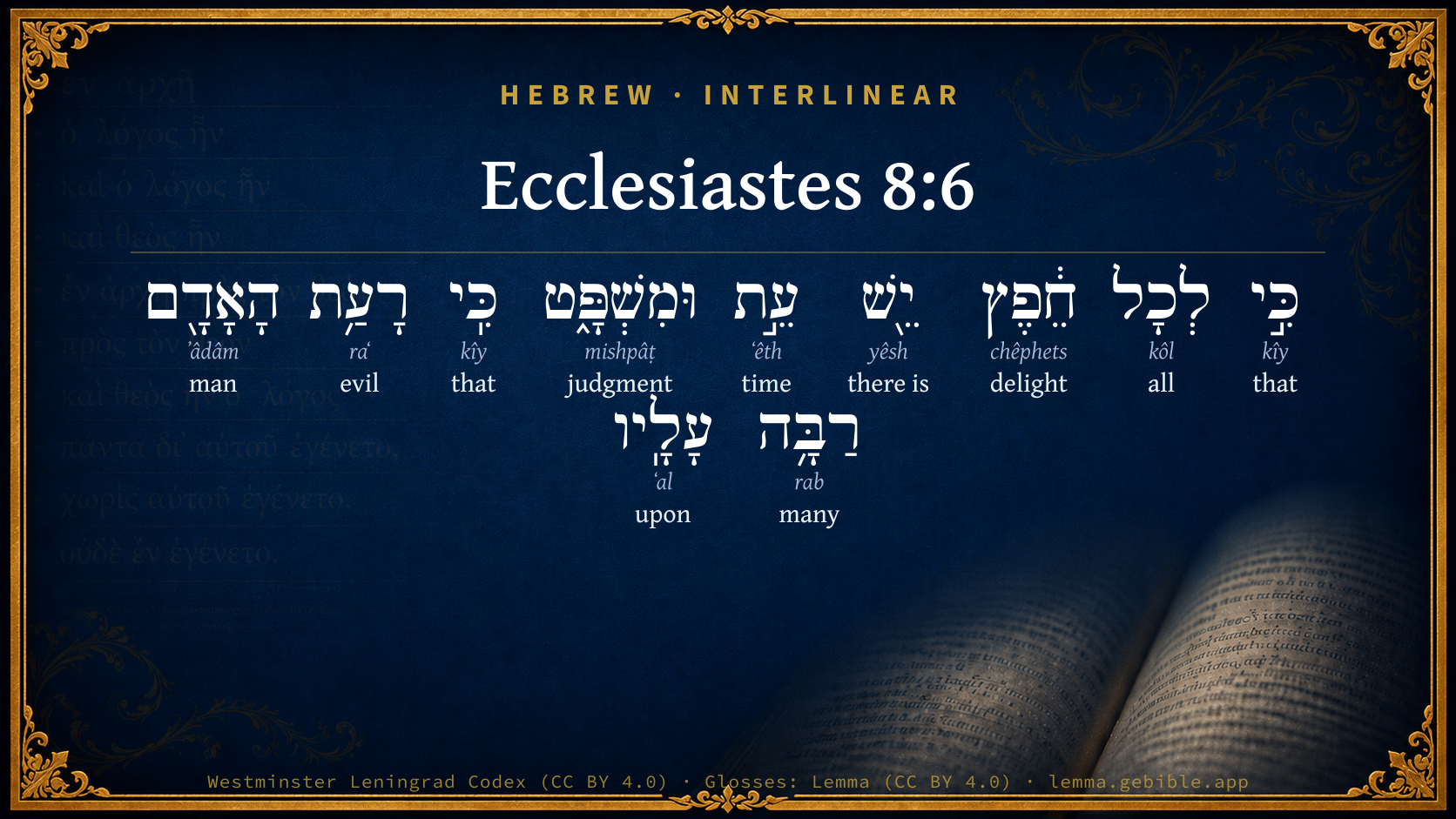
Hebrew (Westminster Leningrad Codex) Ecclesiastes 8:6 appears in the Hebrew Old Testament. The text above is from the Westminster Leningrad Codex. Each word links to its Strong’s number, a concise gloss, and parsing drawn from the Open Scriptures Hebrew Bible morphology. Click any word for its full Brown-Driver-Briggs (BDB) entry.
Download image
Cite this verse

Ecclesiastes 8:6 (World English Bible). Public Domain. Lemma interlinear Bible study tool, https://lemma.gebible.app/v/ecclesiastes/8/6.

Show BibTeX & RIS
BibTeX
RIS
English Translation
For there is a time and procedure for every purpose, although the misery of man is heavy on him.
World English Bible · Public Domain
Download a study sheet

One document with this verse’s original text, its word-by-word gloss line, the meaning frame, cross-references with their text, attributed commentary, and full source and license credits — printable, and it pastes into notes with its structure intact.

This verse Autodidact and up

Study sheet (.html) Plain text (.txt)

A passage Seminary Student

Up to 50 verses in one chapter. A passage sheet keeps up to 6 commentary sources and 12 cross-references per verse, in the order this page ranks them, and says so on the sheet whenever that leaves anything out. Ask for a single verse and you get the Autodidact verse sheet above.

Everything on this page stays free to read, with no account — the sheet is a download of what is already on screen, not access to it.

Want to remove ads? Support Godless Engineer
Compare translations 3

The same verse in 3 English versions, stacked beneath the original-language interlinear above. Click any original word for its lexicon entry.

Each is an independent rendering of the whole verse — the interlinear is not word-aligned to these translations.

Highlighted words mark where these versions differ — a whole-verse word diff, not a word-by-word alignment.

  • World English Bible Public Domain
    For there is a time and procedure for every purpose, although the misery of man is heavy on him.
  • King James Version Public Domain
    Because to every purpose there is time and judgment, therefore the misery of man is great upon him.
  • unfoldingWord Literal Text CC BY-SA 4.0
    because, for every matter, there is a time and procedure, because the misfortune of humanity severe upon him,

unfoldingWord Literal Text — © unfoldingWord, licensed CC BY-SA 4.0. Word-aligned USFM3 via Door43 (git.door43.org/unfoldingWord/en_ult).

Versions to compare (up to 4)

3 of 4 selected

Show all 18 translations

Every available English version of this verse, each an independent rendering of the whole verse.

  • World English Bible Public Domain
    For there is a time and procedure for every purpose, although the misery of man is heavy on him.
  • Berean Standard Bible Public Domain
    For there is a right time and procedure to every purpose, though a man’s misery weighs heavily upon him.
  • Majority Standard Bible Public Domain
    For there is a right time and procedure to every purpose, though a man’s misery weighs heavily upon him.
  • King James Version Public Domain
    Because to every purpose there is time and judgment, therefore the misery of man is great upon him.
  • American Standard Version (1901) Public Domain
    for to every purpose there is a time and judgment; because the misery of man is great upon him:
  • Revised Version (1885) Public Domain
    for to every purpose there is a time and judgment; because the misery of man is great upon him:
  • Geneva Bible (1599) Public Domain
    For to euery purpose there is a time and iudgement, because the miserie of man is great vpon him.
  • Douay-Rheims (1899) Public Domain
    There is a time and opportunity for every business, and great affliction for man:
  • Young's Literal Translation Public Domain
    For to every delight there is a time and a judgment, for the misfortune of man is great upon him.
  • Literal Standard Version CC BY-SA 4.0
    For to every delight there is a time and a judgment, for the misfortune of man is great on him.
  • Unlocked Literal Bible CC BY-SA 4.0
    For every matter there is a correct response and a time to respond, because the troubles of man are great.
  • unfoldingWord Literal Text CC BY-SA 4.0
    because, for every matter, there is a time and procedure, because the misfortune of humanity severe upon him,
  • Darby Bible Public Domain
    For to every purpose there is time and manner. For the misery of man is great upon him;
  • World Messianic Bible Public Domain
    For there is a time and procedure for every purpose, although the misery of man is heavy on him.
  • Webster's Bible Public Domain
    Because to every purpose there is time and judgment, therefore the misery of man is great upon him.
  • Free Bible Version CC BY-SA 4.0
    For there's a right time and a right way for everything, even when things are going badly for you.
  • Bible in Basic English Public Domain
    For every purpose there is a time and a decision, because the sorrow of man is great in him.
  • JPS Tanakh (1917) Public Domain
    For to every matter there is a time and judgment; for the evil of man is great upon him.

Literal Standard Version (2020), Covenant Press — licensed CC BY-SA 4.0. Text via the HelloAO Bible API (eBible.org). Unlocked Literal Bible (unfoldingWord) — licensed CC BY-SA 4.0. Text via the HelloAO Bible API (eBible.org). unfoldingWord Literal Text — © unfoldingWord, licensed CC BY-SA 4.0. Word-aligned USFM3 via Door43 (git.door43.org/unfoldingWord/en_ult). Free Bible Version, Dr. Jonathan Gallagher — licensed CC BY-SA 4.0. Text via the HelloAO Bible API (eBible.org).

Word by word

More ways to search: Search by grammar → Find every occurrence → Compare this word →

Practice this passage: Drill this verse → Learn its vocabulary →

About this verse

These counts appear in no published source. They are computed here, from the morphology-tagged text and Lemma’s own curated glosses. What Lemma adds →

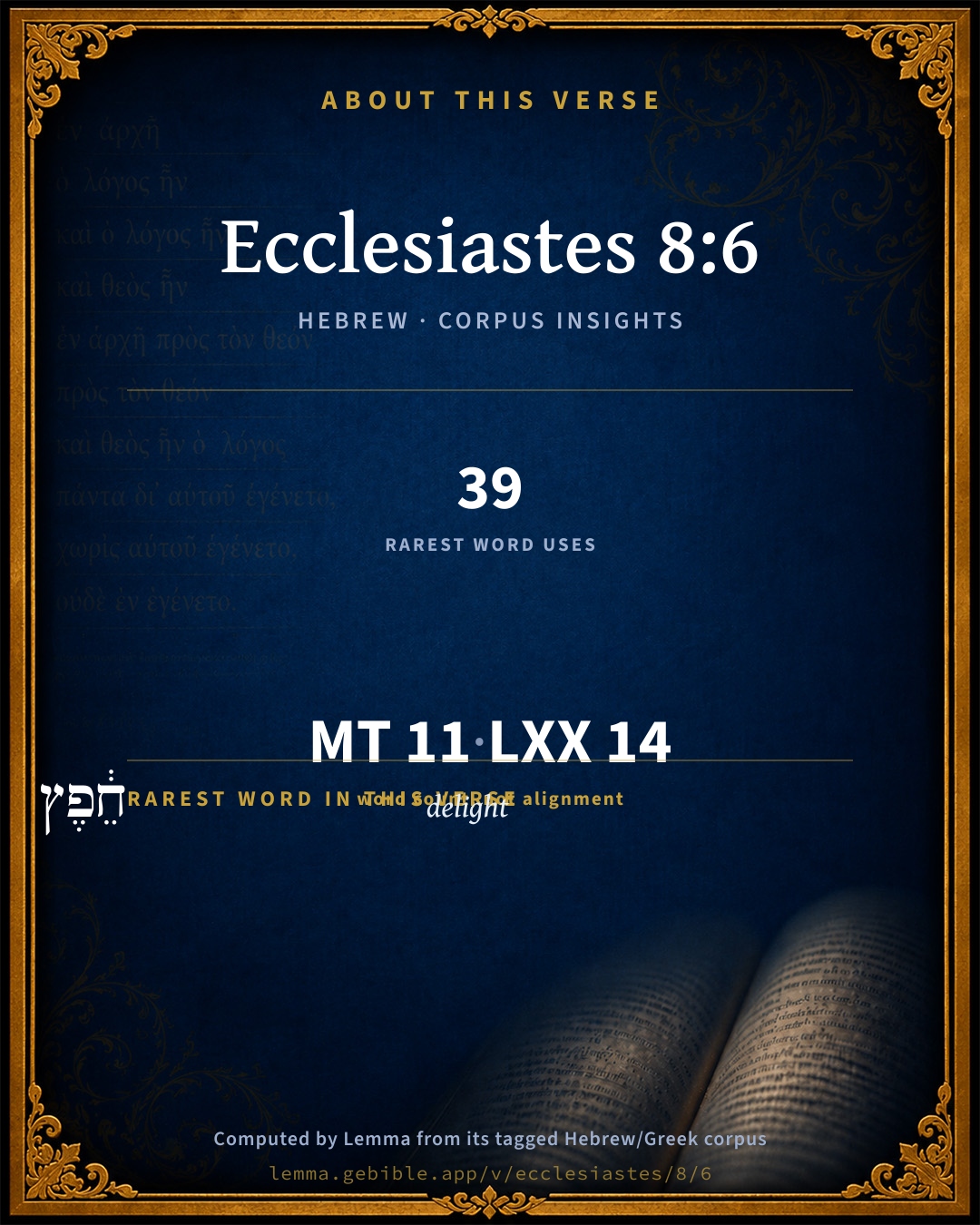
11
words
10
distinct lemmas
Wisdom
section

Shared distinctive vocabulary

חֵ֔פֶץ delight H2656 occurs in 38 verses of the Hebrew Bible. Also found in:

Grammatical profile

  • 6 nouns
  • 1 adjective
  • 1 preposition
  • 2 conjunctions
  • 1 particle

Repetition

A word recurs within this verse — often emphatic in Hebrew:

  • כִּ֣י that H3588 ×2

Hebrew & Septuagint length

In English translation the verse runs 19 words from the Hebrew and 19 from the Septuagint (LXX English) — the same length.

A rough comparison of the two English renderings, which tokenize alike — not a word-level alignment.

Word counts can differ between the Hebrew and the Greek without any difference in meaning — e.g. the Hebrew direct-object marker אֵת has no separate Greek word, and Greek often adds the article ὁ.

In the original languages it is 11 Hebrew tokens and 14 Greek tokens — but the two are counted differently (Hebrew bundles its prefixes and suffixes into one token; the Greek is in lemma form), so that isn’t a like-for-like length.

Cross-references

11

Topical passages linked to Ecclesiastes 8:6 in the Treasury of Scripture Knowledge — connected by theme and wording, ordered by reader-vote popularity; previews shown in the World English Bible.

  • Ecclesiastes 3:1 For everything there is a season, and a time for every purpose under heaven:
  • Ecclesiastes 3:17 I said in my heart, "God will judge the righteous and the wicked; for there is a time there for every purpose and for every work."
  • Ecclesiastes 3:11 He has made everything beautiful in its time. He has also set eternity in their hearts, yet so that man can't find out the work that God has done from the beginning even to the end.
  • Luke 19:42–44 saying, "If you, even you, had known today the things which belong to your peace! But now, they are hidden from your eyes.
  • Ecclesiastes 7:13–14 Consider the work of God, for who can make that straight, which he has made crooked?
  • Luke 17:26–30 As it happened in the days of Noah, even so will it be also in the days of the Son of Man.
  • Ecclesiastes 11:9–12:1 Rejoice, young man, in your youth, And let your heart cheer you in the days of your youth, And walk in the ways of your heart, And in the sight of your eyes; But know that for all these things God will bring you into judgment.
  • Isaiah 3:11–14 Woe to the wicked! Disaster is upon them; For the deeds of his hands will be paid back to him.
  • Isaiah 22:12–14 In that day did the Lord, Yahweh of Hosts, call to weeping, and to mourning, and to baldness, and to girding with sackcloth:
  • Luke 13:25 When once the master of the house has risen up, and has shut the door, and you begin to stand outside, and to knock at the door, saying, 'Lord, Lord, open to us!' then he will answer and tell you, 'I don't know you or where you come from.'
  • Hebrews 3:7–11 Therefore, even as the Holy Spirit says, "Today if you will hear his voice,

Cross-references courtesy of OpenBible.info (CC BY 4.0).

Hebrew and Greek witnesses Masoretic Hebrew ↔ Greek Septuagint

The same verse in the two great witnesses to the Old Testament, shown verse-for-verse.

These are two independent witnesses, not word-aligned to each other, and the Septuagint is shown in lemma (dictionary) form.

Hebrew Ecclesiastes 8:6 Masoretic · Westminster Leningrad Codex

כִּ֣י לְכָל חֵ֔פֶץ יֵ֖שׁ עֵ֣ת וּמִשְׁפָּ֑ט כִּֽי רָעַ֥ת הָאָדָ֖ם רַבָּ֥ה עָלָֽיו

For there is a time and procedure for every purpose, although the misery of man is heavy on him.

World English Bible · Public Domain

Greek LXX Ecclesiastes 8:6 Septuagint · lemma form

ὅτι πᾶς πρᾶγμα εἰμί καιρός καί κρίσις ὅτι γνῶσις ὁ ἄνθρωπος πολύς ἐπί αὐτός

For to every thing there is time and judgment; for the knowledge of a man is great to him.

LXX2012 (modern English Septuagint) · Public Domain

On this verse, Haydock's Catholic Bible Commentary discusses the Septuagint’s reading. Read the note in Commentary ↓

Hebrew: Westminster Leningrad Codex (CC BY 4.0). Greek: Septuagint (public domain); English from LXX2012 (modern English Septuagint) (Public Domain). How the Septuagint differs from the Hebrew →

Commentary

Notes on Ecclesiastes 8:6 from classic Christian and Jewish commentators (each source and its license shown beneath its notes). The classic Christian expositions comment on the surrounding passage and are grouped to its opening verse, so a note may address several verses; the Jewish commentaries on the Tanakh (Rashi and others) are per-verse, so they appear only where the commentator wrote on this verse.

Lemma curates 59 commentaries, every one of them public domain or Creative Commons licensed, each selected and text-cleaned for this edition rather than reprinted as found. About our sources →

Trapp's Complete Commentary

John Trapp

Ecc 8:6 Because to every purpose there is time and judgment, therefore the misery of man [is] great upon him.

Ver. 6. Because to every purpose there is time.] Therefore the wise man seeketh after that nick of time, that punctilio of judgment, that he may do everything well, and order his affairs with discretion. A well chosen season is the greatest advantage of any action, which, as it is seldom found in haste, so it is too often lost in delay.

Therefore the misery of man is great upon him.] Because he discerns not, apprehends not his fittest opportunity, hence he creates himself a great deal of misery. When Saul had taken upon him to sacrifice, God intimates to him by Samuel, that if he had discerned his time, he might have saved his kingdom. So might many a man his life, his livelihood - nay, his soul. "The men of Issachar" in David’s days are famous for this, that they "had understanding of the times, to know what Israel ought to do," {1Ch 12:32} their posterity are set below stork and swallow for want of this skill, {Jer 8:7} and deeply doomed. {Luk 19:44}

John Trapp, A Commentary or Exposition upon All the Books of the Old and New Testament (1647–1656) — public domain. Text from a community e-Sword module.

Joseph Benson's Commentary

Ecc 8:6-7. Because to every purpose there is a time, &c. — There is a fit way and season for the accomplishment of every business, which is known to God, but for the most part hidden from man. See notes on Ecc 3:1. Therefore the misery of man is great — Because there are few who have wisdom to discern this, most men expose themselves to manifold miseries. For he knoweth not that which shall be — Men are generally ignorant of future events, and of the success of their endeavours, and therefore their minds are disquieted, and their expectations frequently are disappointed, and they fall into many mistakes and miscarriages, which they might prevent if they foresaw the issues of things; who can tell when it shall be? — No wise man, no astrologer, no soothsayer can discover this.

Joseph Benson's Commentary on the Old and New Testaments (1811–1818) — public domain. Text from a community e-Sword module.

The Preacher's Complete Homiletical Commentary

Joseph S. Exell (gen. ed.)

CRITICAL NOTES.—

Ecc_8:6. Therefore.] Best rendered by Although. The meaning is, that notwithstanding the present misery of man, in the ways of Providence towards him, there are appointed times. Deep and wise purposes lie behind all this apparent confusion and disorder. Is great upon him.] The form of the word implying something laid upon him as a heavy burden.

Ecc_8:7. When it shall be.] The marginal rendering is to be preferred—how it shall be

Ecc_8:8. Neither shall wickedness deliver those that are given to it.] Lit., its possessors. Opposition, though it may appear for a time to be victorious, will at length prove to be of no avail. This is the principal thought of the verse, and the fit conclusion of the entire section.

MAIN HOMILETICS OF THE PARAGRAPH.—Ecc_8:6-8

THE STERN DOMINION OF THE SUPREME KING

We now turn from earthly kings and their narrow dominions to consider the Great Ruler over all. There are aspects of His government terrible to man.

I. He Uses an Inflexible Method. (Ecc_8:6.) In the government of God over nature and man, we observe a stern regularity which is calculated to inspire us with awe of some mysterious and inflexible power. All seems to us as one vast machine which moves on in invariable method, not knowing, not caring, what injuries it may inflict. In some moments of painful thought, it might seem to us that we are abandoned to the terror of some heartless and unsympathetic power. Some of these harsh aspects of God’s government are here indicated.

1. His purposes are already formed. He does not enter upon His work with rudimentary and imperfect ideas, waiting for a wider experience and more certain knowledge. He uses no methods of trial and error; learns not, as we are obliged to do, from failure and success. His purposes are formed once for all.

2. There is an appointed season for their development. The time is determined beforehand when the purposes of God shall be effected. They ripen slowly and await their proper season, nor can any human power force their growth.

3. They appear to be carried on regardless of human woes. Although “the misery of man is great upon him,” this inexorable dominion continues. The wheel within wheel in the system of nature and Providence may raise our admiration, but their terrible regularity of movement and certainty of effect seem to spurn away imploring misery, and threaten to crush hope. Yet the wise man will discern a “reason” behind all these harsh appearances. Therefore he submits and waits. There is a “set time” also to favour him.

II. He Hides from Man Future Destinies. (Ecc_8:7.) No feeling does more to tame the human breast than our complete ignorance of the future. It is altogether hidden from us.

1. As to what it contains. “He knoweth not that which shall be.” He cannot tell what events shall take place, what new scenes and changes shall be unfolded in the course of time.

2. As to the manner of it. “Who can tell him how it shall be?” He who has studied the past history of mankind with intelligence and calm reflection, can predict the general principles which future events shall illustrate. But in what time and manner those events shall take place, no human sagacity can foresee. This ignorance of future destinies strengthens, in the good man, the feeling of dependence upon God. It makes faith in the love of God a necessity of the religious life. The way may be dark before us, but if we fear the Lord, He will guide us tenderly with more than a father’s care. The oppression of the future becomes light when we are strengthened by a sense of that “loving kindness which is better than life.”

III. He Appoints for Man the Inevitable Hour. (Ecc_8:8.) However varied the fortunes of men, there is one event awaiting all.

1. When the high summons arrives no power or skill can resist it. Our breath of life is in the hands of God. He decrees the time when we shall breathe the last gasp, and when the heart’s emotion shall be stilled. When He permits the last enemy to grasp us, there is no escape. Death knows no awe of rank, nor yields to bribes. That ruthless power cannot be softened by the voice of distressed affection, or forced to spare his victims by any arguments derived from the usefulness or beauty of their lives. No man has power to retain the spirit beyond its appointed time. Nothing can stay its flight when once it starts on the journey to God.

2. There are no grounds upon which we can procure exemption. On the eve of the battle, or when actually engaged in it, the soldier cannot obtain his discharge. No plea can avail him, no sacred demands of home or kindred. We are all under this inexorable law of war. When the stern command is issued, we must enter into the conflict; we can obtain no substitute, purchase no discharge. When summoned to enter the field in mortal conflict with the last enemy, there is no retreat.

3. Rebellious opposition will not avail us. “Neither shall wickedness deliver those that are given to it.” Wicked men put forth wonderful energy in their evil deeds, but when God’s time of judgment arrives, it is in vain that they resist.

SUGGESTIVE COMMENTS ON THE VERSES

Ecc_8:6. If, without the light of a better hope, we survey this scene of man, it would appear as if the Monarch of the world was indifferent to human miseries.

The skill and regularity displayed in God’s works and ways would be of little comfort to us, if we were not assured that behind all there is a loving heart.

God works out His purposes slowly, and (as it appears to us) regardless of the private griefs of men—yea, even of their highest necessities. The world had to wait long ages for the crowning revelation of God’s mercy. Yet all this time men suffered the evils of ignorance, sorrow, and sin.

The degree of mischief, and disappointment, and wretchedness, arising amongst mankind from the want of wise consideration of seasons and circumstances, is beyond calculation. Were men in general more carefully attentive to these, a large proportion of the miseries of which they complain might readily be avoided. But some by their weakness, others by their heedlessness; some by their headstrong obstinacy, others by their excess of pliancy; some by impatient precipitation, others by procrastinating dilatoriness, and thousands in an endless variety of ways, are led to overlook “time and judgment,” and to bring distress upon themselves, or others, or both [Wardlaw].

Ecc_8:7. Our ignorance of the future should teach us—

1. To be superior to the fear of man. If we have God on our side, how little, after all, can weak and ignorant man do to harm us!

2. That we should not envy the temporary prosperity of others. How soon their fortunes may be wrecked, and the evil time come when riches cannot deliver!

3. That we should seek Divine guidance. God will show us, even through all the miseries of the present, what is the path of life.

It is true that no man can tell “what shall be,” and that neither can any one tell him “when it shall be;” but this is no reason why either the “when” or the “what” that may thus lie hidden in the inscrutable future should be to us a matter of no concern. It is not by being utterly careless and indifferent upon the subject that we can escape the evil that may be impending over us. It is true that we may aggravate that evil, or even create it when it has no actual existence, by tormenting ourselves with excessive or groundless anxieties and fears. As regards those futurities against which no foresight can provide, the part of true wisdom is to follow the counsel of our blessed Lord (Mat_6:34) [Buchanan].

Ecc_8:8. The Royal Preacher had spoken of the power of kings (Ecc_8:4). Yet how limited is that power? They cannot resist the decree of the King of Terrors.

Death overwhelms the strength of man. It is the great terror of nature. The very thought of it must fill us with horror, unless we are conscious that the inward man is growing stronger day by day.

Man is sown in weakness here—a weakness most sad and manifest in his closing hours; but he is raised in power, which, if blessed by the vision of God, will be “the power of an endless life.”

This is a field in which every man must advance; and every man must advance alone to single combat; and every man in succession must fall. The enemy to be encountered is himself invulnerable; and whether the struggle be short or long, and however successful for a time our efforts may be to parry or to cover ourselves from his deadly thrust, he will, sooner or later, find his way with certain aim and irresistible force to every heart [Wardlaw].

Death can only destroy the body of our humiliation. Our permanent and immortal essence remains unhurt.

Death meets us everywhere, and is procured by every instrument, and in all chances, and enters in at many doors.… And all this is the law and constitution of nature, it is a punishment to our sins, the unalterable event of Providence, and the decree of heaven. The chains that confine us to this condition are strong as destiny, and immutable as the eternal laws of God [Jeremy Taylor].

The Preacher's Complete Homiletical Commentary (gen. ed. Joseph S. Exell; Funk & Wagnalls, c. 1892) — public domain (pre-1929). A full-Bible homiletical/sermon-outline anthology covering 65 of 66 books (2 John is absent from the source module). Text from a community e-Sword module.

Tyndale Open Study Notes

Tyndale Open Resources

8:6 there is a time . . . for everything: Those who are wise will be ready when an opportune time appears (see 3:1-8; Eph 5:16).

Tyndale Open Study Notes — © Tyndale Open Resources, licensed CC BY-SA 4.0. Text via the HelloAO Bible API.

Geneva Bible (1599)

Geneva Bible translators

Man of himself is miserable, and therefore ought to do nothing to increase the same, but to work all things by wisdom and counsel.

Geneva Bible (1599) marginal notes — public domain. Text via Bolls.life.

Matthew Henry's Commentary

Solomon had said (Ecc 8:5) that a wise man's heart discerns time and judgment, that is, a man's wisdom will go a great way, by the blessing of God, in moral prognostications; but here he shows that few have that wisdom, and that even the wisest may yet be surprised by a calamity which they had not any foresight of, and therefore it is our wisdom to expect and prepare for sudden changes. Observe, 1. All the events concerning us, with the exact time of them, are determined and appointed in the counsel and foreknowledge of God, and all in wisdom: To every purpose there is a time prefixed, and it is the best time, for it is time and judgment, time appointed both in wisdom and righteousness; the appointment is not chargeable with folly or iniquity. 2. We are very much in the dark concerning future events and the time and season of them: Man knows not that which shall be himself; and who can tell him when or how it shall be? Ecc 8:7. It cannot either be foreseen by him or foretold him; the stars cannot foretel a man what shall be, nor any of the arts of divination. God has, in wisdom, concealed from us the knowledge of future events, that we may be always ready for changes. 3. It is our great unhappiness and misery that, because we cannot foresee an evil, we know not how to avoid it, or guard against it, and, because we are not aware of the proper successful season of actions, therefore we lose our opportunities and miss our way: Because to every purpose there is but one way, one method, one proper opportunity, therefore the misery of man is great upon him; because it is so hard to hit that, and it is a thousand to one but he misses it. Most of the miseries men labour under would have been prevented if they could have been foreseen and the happy time discovered to avoid them. Men are miserable because they are not sufficiently sagacious and attentive. 4. Whatever other evils may be avoided, we are all under a fatal necessity of dying, Ecc 8:8. (1.) When the soul is required it must be resigned, and it is to no purpose to dispute it, either by arms or arguments, by ourselves, or by any friend: There is no man that has power over his own spirit, to retain it, when it is summoned to return to God who gave it. It cannot fly any where out of the jurisdiction of death, nor find any place where its writs do not run. It cannot abscond so as to escape death's eye, though it is hidden from the eyes of all living. A man has no power to adjourn the day of his death, nor can he by prayers or bribes obtain a reprieve; no bail will be taken, no essoine [excuse], protection, or imparlance [conference], allowed. We have not power over the spirit of a friend, to retain that; the prince, with all his authority, cannot prolong the life of the most valuable of his subjects, nor the physician with his medicines and methods, nor the soldier with his force, not the orator with his eloquence, nor the best saint with his intercessions. The stroke of death can by no means be put by when our days are determined and the hour appointed us has come. (2.) Death is an enemy that we must all enter the lists with, sooner or later: There is no discharge in that war, no dismission from it, either of the men of business or of the faint-hearted, as there was among the Jews, Deu 20:5, Deu 20:8. While we live we are struggling with death, and we shall never put off the harness till we put off the body, never obtain a discharge till death has obtained the mastery; the youngest is not released as a fresh-water soldier, nor the oldest as miles emeritus - a soldier whose merits have entitled him to a discharge. Death is a battle that must be fought, There is no sending to that war (so some read it), no substituting another to muster for us, no champion admitted to fight for us; we must ourselves engage, and are concerned to provide accordingly, as for a battle. (3.) Men's wickedness, by which they often evade or outface the justice of the prince, cannot secure them from the arrest of death, nor can the most obstinate sinner harden his heart against those terrors. Though he strengthen himself ever so much in his wickedness (Psa 52:7), death will be too strong for him. The most subtle wickedness cannot outwit death, nor the most impudent wickedness outbrave death. Nay, the wickedness which men give themselves to will be so far from delivering them from death that it will deliver them up to death.

Matthew Henry's Commentary on the Whole Bible (1708–1710) — public domain (CC PDM 1.0). Text via the HelloAO Bible API.

Jamieson, Fausset & Brown

Robert Jamieson, A. R. Fausset & David Brown

therefore the misery, &c.--because the foolish sinner does not think of the right "times" and the "judgment."

Jamieson, Fausset & Brown — Commentary Critical and Explanatory on the Whole Bible (1871) — public domain (CC PDM 1.0). Text via the HelloAO Bible API.

Adam Clarke's Commentary

Verse 6. To every purpose there is time] חפץ chaphets, every volition, every thing that depends on the will of man. He has generally the opportunity to do whatever he purposes; and as his purposes are frequently evil, his acts are so too: and in consequence his misery is great.

Adam Clarke's Commentary on the Bible (1810–1826) — public domain. Text from a community e-Sword/MySword module.

Ellicott's Commentary for English Readers

(6) The connecting particles here present difficulties which have not been satisfactorily solved; and it has even been conjectured that some words may have dropped out of the text. The first half of the verse repeats Ecc_3:1; the second almost verbally Ecc_6:1; on this account our translation “misery” is to be preferred to “wickedness” as some render it.

A Bible Commentary for English Readers, edited by Charles John Ellicott (1878–1897) — public domain. Text from a community e-Sword module.

The Cambridge Bible for Schools and Colleges

gen. ed. J. J. S. Perowne

6. Because to every purpose there is time and judgment, therefore] The English conjunctions misrepresent the sequence of thought, and we should read “For to every purpose there is time and judgment, for the misery (or, better, the wickedness) of man …” The wise man waits for the time of judgment, for he knows that such a time must come, and that the evil of the man (i.e. of the tyrant) is great upon him, weighs on him as a burden under which he must at last sink. This seems the most natural and legitimate interpretation, but the sentence is obscure, and has been very differently interpreted. (1) The evil of man (of the oppressor) is heavy upon him (the oppressed). (2) Though there is a time and a judgment, yet the misery of man is great, because (as in the next verse) he knows not when it is to come.

The Cambridge Bible for Schools and Colleges (gen. ed. J. J. S. Perowne; Cambridge University Press, 1878–1918) — public domain. Text from a community e-Sword module.

John Gill's Exposition

Because to every purpose there is time and judgment,.... There is a fit season, and a right and proper manner of doing everything that is to be done; see Ecc 3:1; which a wise man discerns; and which when a man hits upon, it prevents a great deal of mischief, which for want of it comes upon men, as the following clause shows; some refer this to the punishment of the wicked, and to a future judgment. So the Targum,

"to every business there is a time good and evil, and according to the judgment of truth the whole world is judged;''

and to the same purpose Jarchi,

"there is a time fixed for the visitation of the wicked, and there is judgment before the Lord; this is vengeance or punishment;''

therefore the misery of man is great upon him; he not observing the right time and manner of doing what he ought, brings much trouble upon himself; his days are few and full trouble, and every day has a sufficiency of evil in because of the evil of sin, the evil of misery presses upon him, and is a heavy burden on him Jarchi's note is,

"when the wickedness of a man is great, then cometh his visitation.''

John Gill's Exposition of the Whole Bible (1746–1763) — public domain (CC PDM 1.0). Text via the HelloAO Bible API.

Albert Barnes' Notes on the Bible

Because, therefore - , Or, as in Ecc 8:7, “for.”

The possibility of God’s time and judgment being in opposition to a king’s purpose or commandment Ecc 8:5, suggests the thought that such discord is a misery (evil, Ecc 6:1) common to man (or, mankind).

Albert Barnes' Notes on the Bible (1834–1885) — public domain. Text from a community e-Sword/MySword module.

Haydock's Catholic Bible Commentary

Man. Solomon often reminds him of his misery. Septuagint and Theodotion, "man is possessed of much knowledge," as they read dahth for rahth. (Calmet)

George Leo Haydock (1774–1849), Haydock's Catholic Family Bible and Commentary, 1859 edition — public domain. Excludes Psalms (Douay-Rheims chapter numbering differs from Protestant) and Deuterocanonical books (Catholic canon only).

Matthew Poole's English Annotations

There is time and judgment; there is a fit way and season for the happy accomplishment of every business which a man designeth or undertaketh to do, which is known to God, but for the most part hidden from man, as is implied and may be gathered from the following words. See Poole "Ecc 3:1".

Therefore; because there are very few who have that wisdom which is necessary to discern this, as was now said, Ecc 9:5, and most men do by their ignorance and loss of opportunities deprive themselves of many advantages, and expose themselves to manifold miseries.

Matthew Poole's English Annotations on the Holy Bible (1683–1685) — public domain. Text from a community e-Sword/MySword module.

Whedon's Commentary on the Bible

Daniel D. Whedon

6. Therefore — Should be when, as it often implies time. A time of judgment comes when the misery of man becomes intolerable. The Hebrew suggests that the man is the cruel tyrant, and the misery is that which he causes to him, that is, to his subject.

Daniel D. Whedon (gen. ed.), Commentary on the Old and New Testaments (1874–1909) — public domain. Text from a community e-Sword module.

The Pulpit Commentary

Because. This and the three following clauses all begin with ki, "since," "for," and the conjunction ought to have been similarly rendered in all the places. Thus here, for to every purpose there is time and judgment . Here commences a chain of argument to prove the wisdom of keeping quiet under oppression or evil rulers. Everything has its appointed time of duration, and in due course will be brought to judgment. (see Ecc_3:1, Ecc_3:17) Therefore (for) the misery of man is great upon him. This is a further reason, but its exact signification is disputed. Literally, the evil of the man is heavy upon him. (comp. Ecc_6:1) This may mean, as in the Authorized Version, that the affliction which subjects suffer at the hand of a tyrant becomes insupportable, and calls for and receives God"s interposition. Or "the evil" may be the wickedness of the despot, which presses heavily upon him, and under retributive justice will ere long bring him to the ground, and so the oppression will come to an end. This seems to be the most natural interpretation of the passage. The Septuagint, reading differently, has, "For the knowledge of a man is great upon him." Though what tiffs means it is difficult to say.

Vers. 6-8.

The doom of tyrants.

In words which are purposely dark the writer speaks of the fall of unrighteous tyrants. It is with bated breath that he whispers to those who are writhing helplessly under the oppressive rule of cruel despots, that the coil under which they suffer works its own cure in time, and that those who have their own way at present will sooner or later have to succumb to a power greater than their own. it is with considerable difficulty that the drift of the passage is to be made out, but with this clue in our hands it becomes intelligible. In the sixth and seventh verses there are four statements, each introduced by the same conjunction, yKi, "for," or "because," and by retaining it in each case, instead of varying it as is done in our English versions, the sequence of thought becomes clearer. The sense of the verses is as follows: "The heart of the wise man will know the time and judgment, and will keep quiet; for

(1) there is a time and a judgment appointed by God in which the wicked ruler will be duly punished; (cf. Ecc_3:17)

(2) the wickedness of man is heavy upon him, and will entail its own punishment, the misery caused by a tyrant is a weight which will bring him down at last;

(3) no man knows the future, or that which will take place, and therefore no despot is able absolutely to guard himself against the stroke of vengeance; for

(4) who can tell him how the vengeance wilt be brought about? He may look in this direction and in that for the longed-for information, but in vain. (Isa_47:13, etc.) One thing, however, is certain, that whilst the wicked "are drowned in their carousing, they shall be consumed like stubble fully dry". (Nah_1:10) The inexorable nature of the doom which will fall upon the cruel despot is described in highly vivid language. There are four things which are impossible for him to do.

1. "There is no man that hath power over the spirit to retain the spirit." Life can be shortened or cut off at any moment, but can by no art be prolonged beyond the fixed term. The despot cannot by his power escape the (loom of death, any more than can the meanest of his subjects. Or understanding by hWr not "the spirit of man," but "the wind," to which Divine judgments are often likened (Isa_41:16 Isa_57:13; Jer_4:11-13 Jer_22:22) it is as fruitless to try to keep back the Divine judgments as to prevent the wind from bursting forth.

2. There is no one who has power over the day of death, or is able to avert the arrival of that "king of terrors"; (Job_18:14) the pestilence walkethforth in darkness, and the sickness wasteth at noonday. (Psa_91:6)

3. There was no discharge granted from the ranks in the time of war under the vigorous law of Persia, and the Divine law of requital cuts off with equal certainty all hope of escape from the guilty transgressor; and lastly:

4. Wickedness will not deliver its master. When the hour of Divine vengeance strikes, the sinner shall receive the meet reward of his actions. "The wages of sin is death" (Rom_6:23) (Wright). By no lavish bribes, by no use of power, by no arts or endeavors, can the evil-doer, however high his rank may be, avert the day of judgment, which may precede, but which, if it does not precede, will certainly coincide with the day of death. And in that time, when he will have to stand before the tribunal of the King of kings, none of his deeds of cruelty and oppression will be passed over. Such is the teaching half concealed beneath the words of the Preacher; but not so veiled as to be hidden from the discernment of a reader made sensitive by the righteous indignation which oppression excites in a healthy mind. His words pass from an apparent servility of tone into a generous anger, and there is a triumphant ring in his voice as he speaks of the immutability of the law or of the will, upon which the moral government of the world is based. But though horror of injustice and hardness of heart is manifest in his words, they are not instinct with any less worthy feeling. He does not justify revenge, or hint at the advisability of subjects taking the law into their own hands when their patience has been long tried. But he raises the matter to a higher level, and makes faith in God the source of consolation; and in his very words of counsel to subjects adduces considerations which are calculated to weigh with their rulers, and make those of them who are still amenable to reason, pause in a course of oppression and cruelty. J.W.

The Pulpit Commentary (1880–1919), ed. H.D.M. Spence-Jones & Joseph S. Exell — public domain. Text from a community e-Sword module.

John Wesley's Explanatory Notes

Because - There is a fit way and season for the accomplishment of every business, which is known to God, but for the most part hidden from man. Therefore - Because there are few who have wisdom to discern this, most men expose themselves to manifold miseries.

John Wesley, Explanatory Notes Upon the Whole Bible (1754–1765) — public domain. Text via the GEBible commentary corpus.

Keil & Delitzsch

C. F. Keil & F. Delitzsch

"Who is like the wise? and who understandeth the interpretation of things? The wisdom of a man maketh his face bright, and the rudeness of his face is changed." Unlike this saying: "Who is like the wise?" are the formulas חכם מי, Hos 14:9, Jer 11:11, Psa 107:43, which are compared by Hitzig and others. "Who is like the wise?" means: Who is equal to him? and this question, after the scheme מי־כמכה, Exo 15:11, presents him as one who has not his like among men. Instead of כּה the word כּחכם might be used, after לחכם, Ecc 2:16, etc. The syncope is, as at Eze 40:25, omitted, which frequently occurs, particularly in the more modern books, Eze 47:22; Ch2 10:7; Ch2 25:10; Ch2 29:27; Neh 9:19; Neh 12:38. The regular giving of Dagesh to כ after מי, with Jethib, not Mahpach, is as at Ecc 8:7 after כּי; Jethib is a disjunctive. The second question is not כּיודע, but יודע וּמי, and thus does not mean: who is like the man of understanding, but: who understands, viz., as the wise man does; thus it characterizes the incomparably excellent as such. Many interpreters (Oetinger, Ewald, Hitz., Heiligst., Burg., Elst., Zckl.) persuade themselves that דּבר פּשׁר is meant of the understanding of the proverb, 8b. The absence of the art., says Hitzig, does not mislead us: of a proverb, viz., the following; but in this manner determinate ideas may be made from all indeterminate ones. Rightly, Gesenius: explicationem ullius rei; better, as at Ecc 7:8 : cujusvis rei. Ginsburg compares נבון דּבר, Sa1 16:18, which, however, does not mean him who has the knowledge of things, but who is well acquainted with words. It is true that here also the chief idea פּשׁר first leads to the meaning verbum (according to which the lxx, Jer., the Targ., and Syr. translate; the Venet.: ἑρμηνείαν λόγου); but since the unfolding or explaining (pēshěr) refers to the actual contents of the thing spoken, verbi and rei coincide. The wise man knows how to explain difficult things, to unfold mysterious things; in short, he understands how to go to the foundation of things.

Keil & Delitzsch — Biblical Commentary on the Old Testament (1861–1891) — public domain (CC PDM 1.0). Text via the HelloAO Bible API. (Old Testament only.)

Rashi

Rabbi Shlomo Yitzchaki (Rashi)

For every desire has When a person executes his desire and transgresses the Law, there is a time to exact retribution upon him, and justice and punishment are ready.

when the evil of man is great upon him When the evil of man is great and his measure is heaped up, then his punishment arrives; כִּי is used as an expression of “when,” like (Exod. 18:16): “Whenever (כִּי) they have a concern, it comes to me.”

Rashi on the Tanakh — English translations: “The Judaica Press complete Tanach with Rashi, translated by A. J. Rosenberg” (CC BY 4.0); “Pentateuch with Rashi's commentary by M. Rosenbaum and A.M. Silbermann, 1929-1934” (public domain); “The Metsudah Tanach series, Lakewood, N.J” (CC BY 4.0); and “The Book of Joshua, Metsudah Publications, 1997” (CC BY 4.0). Text via Sefaria.

Lesson kit

Teaching starters — assembled from the data on this page, not authored interpretation. Every prompt links to the verse data it draws on. Edit before teaching.

Ecclesiastes, in the Wisdom, opens this verse with 11 words (10 distinct Hebrew lemmas). Its most distinctive word is chêphets (“delight”). A historical commentator’s framing appears above. Read the whole chapter for the surrounding context.

Discussion questions

  1. The word chêphets carries the sense “delight.” How does it shape the verse?
  2. 1 Samuel 15:22 shares the word «delight» with this verse. How do the two illuminate each other?
  3. “that” occurs 2× in this one verse. What is the effect of the repetition?
  4. These translations render this verse differently; the difference is in the English rendering, not the original. What questions does that raise?
  5. Reading how Trapp's Complete Commentary and Joseph Benson's Commentary read this verse, where do the two commentators agree and where do they part?

Things to notice

Reading settings

Reading text

Shown beneath each verse's original-language words.

Old Testament
Old Testament edition

Read the OT as the Masoretic Hebrew (MT) or the Greek Septuagint (LXX).

English shown for the Greek Septuagint (in the Hebrew ↔ Greek comparison).

Comparing translations? Open the Compare panel on any verse page to stack up to four side by side.