Deuteronomy 25:3

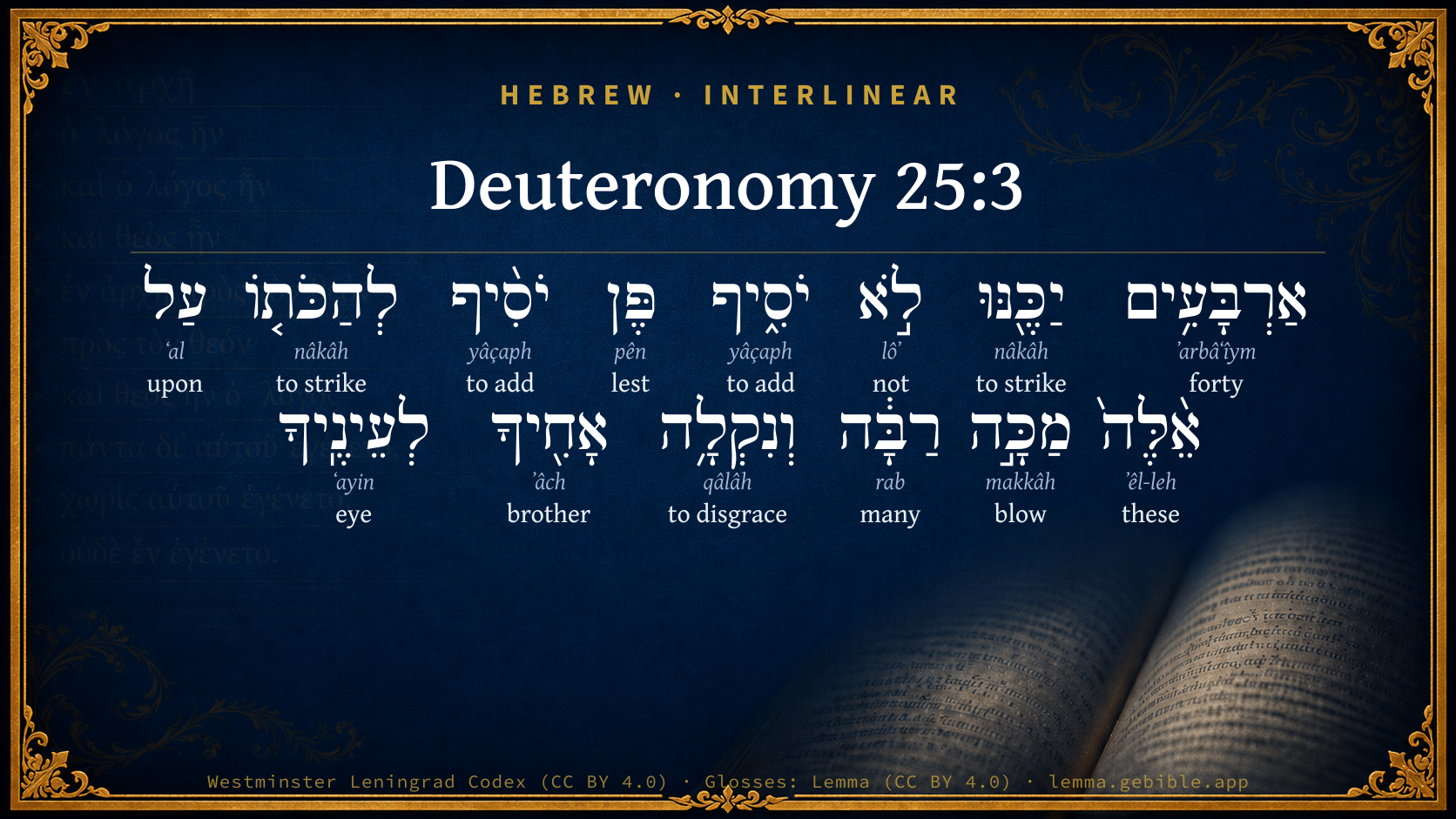
Hebrew (Westminster Leningrad Codex) Deuteronomy 25:3 appears in the Hebrew Old Testament. The text above is from the Westminster Leningrad Codex. Each word links to its Strong’s number, a concise gloss, and parsing drawn from the Open Scriptures Hebrew Bible morphology. Click any word for its full Brown-Driver-Briggs (BDB) entry.
Download image
Cite this verse

Deuteronomy 25:3 (World English Bible). Public Domain. Lemma interlinear Bible study tool, https://lemma.gebible.app/v/deuteronomy/25/3.

Show BibTeX & RIS
BibTeX
RIS
English Translation
Forty stripes he may give him, he shall not exceed; lest, if he should exceed, and beat him above these with many stripes, then your brother should seem vile to you.
World English Bible · Public Domain
Highlights
  • 1 first appearance in the Hebrew Bible
Full analysis ↓
Download a study sheet

One document with this verse’s original text, its word-by-word gloss line, the meaning frame, cross-references with their text, attributed commentary, and full source and license credits — printable, and it pastes into notes with its structure intact.

This verse Autodidact and up

Study sheet (.html) Plain text (.txt)

A passage Seminary Student

Up to 50 verses in one chapter. A passage sheet keeps up to 6 commentary sources and 12 cross-references per verse, in the order this page ranks them, and says so on the sheet whenever that leaves anything out. Ask for a single verse and you get the Autodidact verse sheet above.

Everything on this page stays free to read, with no account — the sheet is a download of what is already on screen, not access to it.

Want to remove ads? Support Godless Engineer
Compare translations 3

The same verse in 3 English versions, stacked beneath the original-language interlinear above. Click any original word for its lexicon entry.

Each is an independent rendering of the whole verse — the interlinear is not word-aligned to these translations.

Highlighted words mark where these versions differ — a whole-verse word diff, not a word-by-word alignment.

  • World English Bible Public Domain
    Forty stripes he may give him, he shall not exceed; lest, if he should exceed, and beat him above these with many stripes, then your brother should seem vile to you.
  • King James Version Public Domain
    Forty stripes he may give him, and not exceed: lest, if he should exceed, and beat him above these with many stripes, then thy brother should seem vile unto thee.
  • unfoldingWord Literal Text CC BY-SA 4.0
    He shall not add to his 40 blows, lest he add his striking of him many blows than these, and your brother is humiliated before your eyes.

unfoldingWord Literal Text — © unfoldingWord, licensed CC BY-SA 4.0. Word-aligned USFM3 via Door43 (git.door43.org/unfoldingWord/en_ult).

Versions to compare (up to 4)

3 of 4 selected

Show all 18 translations

Every available English version of this verse, each an independent rendering of the whole verse.

  • World English Bible Public Domain
    Forty stripes he may give him, he shall not exceed; lest, if he should exceed, and beat him above these with many stripes, then your brother should seem vile to you.
  • Berean Standard Bible Public Domain
    He may receive no more than forty lashes, lest your brother be beaten any more than that and be degraded in your sight.
  • Majority Standard Bible Public Domain
    He may receive no more than forty lashes, lest your brother be beaten any more than that and be degraded in your sight.
  • King James Version Public Domain
    Forty stripes he may give him, and not exceed: lest, if he should exceed, and beat him above these with many stripes, then thy brother should seem vile unto thee.
  • American Standard Version (1901) Public Domain
    Forty stripes he may give him, he shall not exceed; lest, if he should exceed, and beat him above these with many stripes, then thy brother should seem vile unto thee.
  • Revised Version (1885) Public Domain
    Forty stripes he may give him, he shall not exceed: lest, if he should exceed, and beat him above these with many stripes, then thy brother should seem vile unto thee.
  • Geneva Bible (1599) Public Domain
    Fortie stripes shall he cause him to haue and not past, lest if he should exceede and beate him aboue that with many stripes, thy brother should appeare despised in thy sight.
  • Douay-Rheims (1899) Public Domain
    Yet so, that they exceed not the number of forty: lest thy brother depart shamefully torn before thy eyes.
  • Young's Literal Translation Public Domain
    forty `times' he doth smite him -- he is not adding, lest, he is adding to smite him above these -- many stripes, and thy brother is lightly esteemed in thine eyes.
  • Literal Standard Version CC BY-SA 4.0
    he strikes him forty [times]; he is not adding, lest he is adding to strike him above these many stripes, and your brother be lightly esteemed in your eyes.
  • Unlocked Literal Bible CC BY-SA 4.0
    The judge may give him forty blows, but he may not exceed that number; for if he should exceed that number and beat him with many more blows, then your fellow Israelite would be humiliated before your eyes.
  • unfoldingWord Literal Text CC BY-SA 4.0
    He shall not add to his 40 blows, lest he add his striking of him many blows than these, and your brother is humiliated before your eyes.
  • Darby Bible Public Domain
    With forty [stripes] shall they beat him; they shall not exceed, lest, if they continue to beat him with many stripes above these, thy brother become despicable in thine eyes.
  • World Messianic Bible Public Domain
    He may sentence him to no more than forty stripes. He shall not give more, lest if he should give more and beat him more than that many stripes, then your brother will be degraded in your sight.
  • Webster's Bible Public Domain
    Forty stripes he may give him, and not exceed: lest if he should exceed, and beat him above these with many stripes, then thy brother should seem vile to thee.
  • Free Bible Version CC BY-SA 4.0
    They are not to receive more than forty lashes. More than that would be to publicly humiliate them.
  • Bible in Basic English Public Domain
    He may be given forty blows, not more; for if more are given, your brother may be shamed before you.
  • JPS Tanakh (1917) Public Domain
    Forty stripes he may give him, he shall not exceed; lest, if he should exceed, and beat him above these with many stripes, then thy brother should be dishonoured before thine eyes.

Literal Standard Version (2020), Covenant Press — licensed CC BY-SA 4.0. Text via the HelloAO Bible API (eBible.org). Unlocked Literal Bible (unfoldingWord) — licensed CC BY-SA 4.0. Text via the HelloAO Bible API (eBible.org). unfoldingWord Literal Text — © unfoldingWord, licensed CC BY-SA 4.0. Word-aligned USFM3 via Door43 (git.door43.org/unfoldingWord/en_ult). Free Bible Version, Dr. Jonathan Gallagher — licensed CC BY-SA 4.0. Text via the HelloAO Bible API (eBible.org).

Word by word

More ways to search: Search by grammar → Find every occurrence → Compare this word →

Practice this passage: Drill this verse → Learn its vocabulary →

וְנִקְלָ֥ה
qâlâh
H7034
“and · to disgrace”
Conjunction + Verb, Niphal, Sequential Perfect, 3rd Person, Masculine, Singular
Part of Speech
Conjunction + Verb
Stem
Niphal
Form
Sequential Perfect
Person
3rd Person
Gender
Masculine
Number
Singular
Full BDB Definition

Origin: a primitive root

TWOT: 2024

to disgrace, dishonour, be lightly esteemed, be dishonoured, be despised - (Niphal) to be dishonoured, be despised, be lightly esteemed - (Hiphil) to treat with contempt, dishonour, treat shamefully
  1. אַרְבָּעִ֥ים ʼarbâʻîym H705 “forty” Adjective, Cardinal number, Both, Plural, Absolute
  2. יַכֶּ֖נּוּ nâkâh H5221 “to strike · him” Verb, Hiphil, Imperfect, 3rd Person, Masculine, Singular + Suffix, Personal, 3rd Person, Masculine, Singular
  3. לֹ֣א lôʼ H3808 “not” Particle, Negative
  4. יֹסִ֑יף yâçaph H3254 “to add” Verb, Hiphil, Imperfect, 3rd Person, Masculine, Singular
  5. פֶּן pên H6435 “lest” Conjunction
  6. יֹסִ֨יף yâçaph H3254 “to add” Verb, Hiphil, Imperfect, 3rd Person, Masculine, Singular
  7. לְהַכֹּת֤וֹ nâkâh H5221 “to strike · him” Preposition + Verb, Hiphil, Infinitive Construct + Suffix, Personal, 3rd Person, Masculine, Singular
  8. עַל ʻal H5921 “upon” Preposition
  9. אֵ֨לֶּה֙ ʼêl-leh H428 “these” Pronoun, Demonstrative, Common, Plural
  10. מַכָּ֣ה makkâh H4347 “blow” Noun, Common, Feminine, Singular, Absolute
  11. רַבָּ֔ה rab H7227 “many” Adjective, Adjective, Feminine, Singular, Absolute
  12. אָחִ֖יךָ ʼâch H251 “brother · your” Noun, Common, Masculine, Singular, Construct + Suffix, Personal, 2nd Person, Masculine, Singular
  13. לְעֵינֶֽיךָ ʻayin H5869 “to/for · eyes · your” Preposition + Noun, Common, Both, Dual, Construct + Suffix, Personal, 2nd Person, Masculine, Singular

About this verse

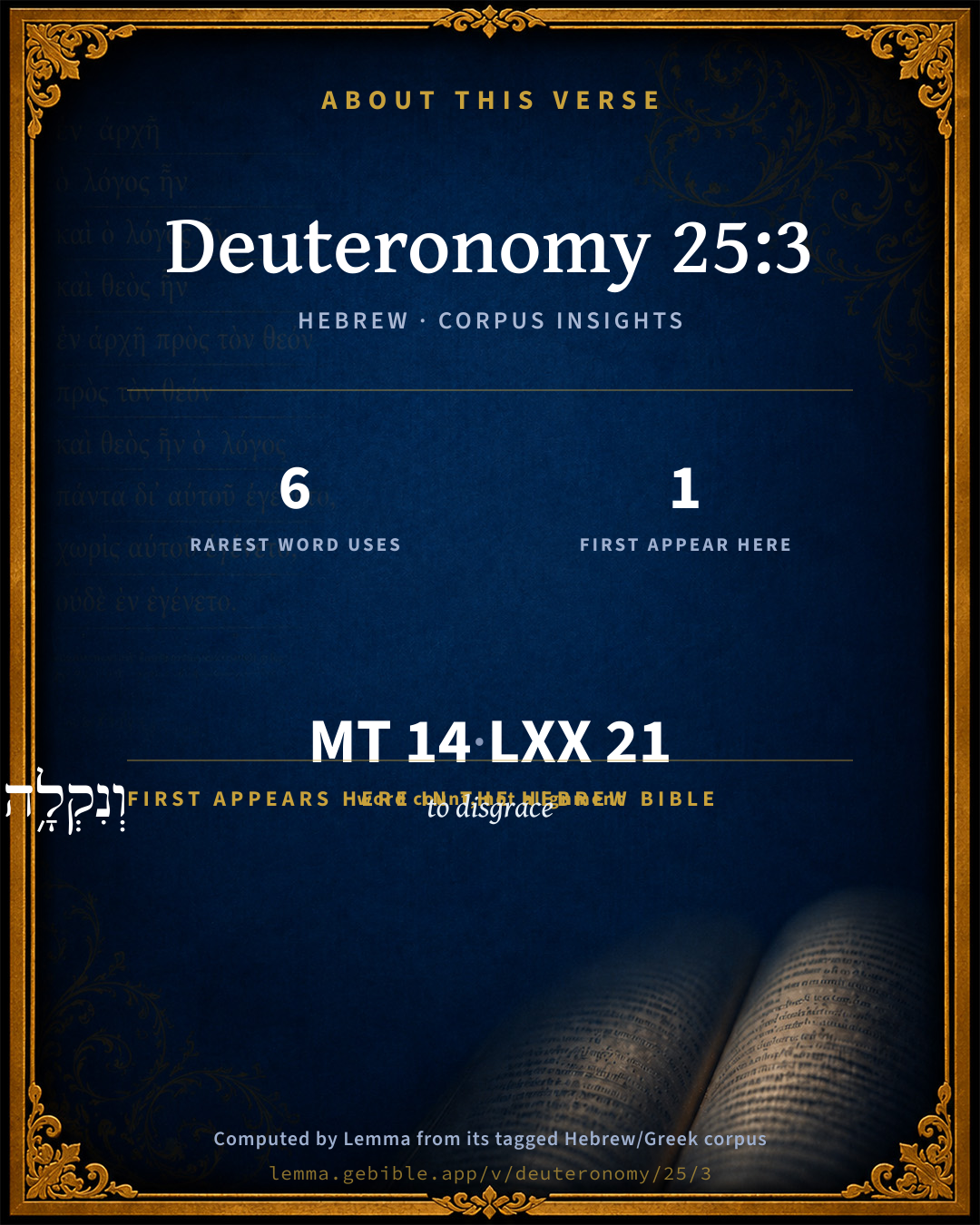
These counts appear in no published source. They are computed here, from the morphology-tagged text and Lemma’s own curated glosses. What Lemma adds →

14
words
12
distinct lemmas
Pentateuch
section

Notable vocabulary

The rarest word here is וְנִקְלָ֥ה to disgrace H7034 — appearing just 6 times in the whole Hebrew Bible.

First appearance in Scripture

This word makes its first canonical appearance in the Hebrew Bible here:

  • וְנִקְלָ֥ה to disgrace H7034

Shared distinctive vocabulary

וְנִקְלָ֥ה to disgrace H7034 occurs in 6 verses of the Hebrew Bible. Also found in:

Grammatical profile

  • 5 verbs
  • 3 nouns
  • 2 adjectives
  • 1 pronoun
  • 1 preposition
  • 1 conjunction
  • 1 particle

Verb forms

  • יַכֶּ֖נּוּ Hiphil · Imperfect
  • יֹסִ֑יף Hiphil · Imperfect
  • יֹסִ֨יף Hiphil · Imperfect
  • לְהַכֹּת֤וֹ Hiphil · Infinitive Construct
  • וְנִקְלָ֥ה Niphal · Sequential Perfect

Repetition

Words recur within this verse — often emphatic in Hebrew:

  • יַכֶּ֖נּוּ to strike H5221 ×2
  • יֹסִ֑יף to add H3254 ×2

Hebrew & Septuagint length

In English translation the verse runs 31 words from the Hebrew and 34 from the Septuagint (LXX English) — closely comparable.

A rough comparison of the two English renderings, which tokenize alike — not a word-level alignment.

Word counts can differ between the Hebrew and the Greek without any difference in meaning — e.g. the Hebrew direct-object marker אֵת has no separate Greek word, and Greek often adds the article ὁ.

In the original languages it is 14 Hebrew tokens and 21 Greek tokens — but the two are counted differently (Hebrew bundles its prefixes and suffixes into one token; the Greek is in lemma form), so that isn’t a like-for-like length.

Cross-references

5

Topical passages linked to Deuteronomy 25:3 in the Treasury of Scripture Knowledge — connected by theme and wording, ordered by reader-vote popularity; previews shown in the World English Bible.

  • Job 18:3 Why are we counted as animals, Which have become unclean in your sight?
  • James 2:2–3 For if a man with a gold ring, in fine clothing, comes into your assembly, and a poor man in filthy clothing also comes in;
  • Luke 15:30 But when this, your son, came, who has devoured your living with prostitutes, you killed the fattened calf for him.'
  • Luke 18:9–12 He spoke also this parable to certain people who were convinced of their own righteousness, and who despised all others.
  • 2 Corinthians 11:24–25 Five times from the Jews I received forty stripes minus one.

Cross-references courtesy of OpenBible.info (CC BY 4.0).

Hebrew and Greek witnesses Masoretic Hebrew ↔ Greek Septuagint

The same verse in the two great witnesses to the Old Testament, shown verse-for-verse.

These are two independent witnesses, not word-aligned to each other, and the Septuagint is shown in lemma (dictionary) form.

Hebrew Deuteronomy 25:3 Masoretic · Westminster Leningrad Codex

אַרְבָּעִ֥ים יַכֶּ֖נּוּ לֹ֣א יֹסִ֑יף פֶּן יֹסִ֨יף לְהַכֹּת֤וֹ עַל אֵ֨לֶּה֙ מַכָּ֣ה רַבָּ֔ה וְנִקְלָ֥ה אָחִ֖יךָ לְעֵינֶֽיךָ

Forty stripes he may give him, he shall not exceed; lest, if he should exceed, and beat him above these with many stripes, then your brother should seem vile to you.

World English Bible · Public Domain

Greek LXX Deuteronomy 25:3 Septuagint · lemma form

τεσσαράκοντα μαστιγόω αὐτός οὐ προςτίθημι ἐάν δέ προςτίθημι μαστιγόω αὐτός ὑπέρ οὗτος ὁ πληγή πολύς ἀσχημονέω ὁ ἀδελφός σύ ἐναντίον σύ

And they shall scourge him with forty stripes in number, they shall not inflict more; for if you should scourge him with more stripes beyond these stripes, your brother will be disgraced before you.

LXX2012 (modern English Septuagint) · Public Domain

Hebrew: Westminster Leningrad Codex (CC BY 4.0). Greek: Septuagint (public domain); English from LXX2012 (modern English Septuagint) (Public Domain). How the Septuagint differs from the Hebrew →

Targum (Aramaic paraphrase)

2

The Targum is the ancient Jewish Aramaic paraphrase of the Hebrew Scriptures — an interpretive translation, not the Hebrew text itself. Onkelos (literal) and Pseudo-Jonathan (expansive) render the Torah, and Jonathan the Prophets. Coverage is partial: where no permissively-licensed English translation exists for a verse, only the Aramaic is shown. This is verse-level text, not a word-by-word alignment to the Hebrew.

  1. Targum Onkelos Torah (Genesis–Deuteronomy)
    אַרְבְּעִין יַלְקִנֵהּ לָא יוֹסֵף דִילְמָא יוֹסֵף לְאַלְקָיוּתֵהּ עַל אִלֵין מָחָא רַבָּא וְיֵקַל אֲחוּךְ לְעֵינָיךְ

    (no public-domain English translation for this verse)

    Targum Onkelos — Aramaic: “Onkelos Genesis” (public domain); “Onkelos Exodus” (public domain); “Onkelos Leviticus” (public domain); “Onkelos Numbers” (public domain); “Onkelos Deuteronomy” (public domain). English: “Sefaria Community Translation” (CC0 1.0 (public-domain dedication)); “J.W. Etheridge. The Targums of Onkelos and Jonathan Ben Uzziel on the Pentateuch. London: Longmans, Green, 1862” (public domain). Text via Sefaria.

  2. Targum Pseudo-Jonathan Torah (Genesis–Deuteronomy)
    אַרְבְּעִין יַצְלִיף וְחָסִיר חַד יַלְקִינֵיהּ לָא יַשְׁלִים דִּלְמָא יוֹסִיף לְמִלְקֵיהּ עַל תְּלָתִין וְתֵשַׁע אִלֵּין מַלְקוּת יַתִּיר וְיִסְתַּכֵּן וְלָא יִתְבַּזֵי אָחוּךְ וְאַנְתְּ חָמֵי לֵיהּ

    Forty (stripes) may be laid upon him, but with one less shall he be beaten, (the full number) shall not be completed, lest he should add to smite him beyond those thirty and nine, exorbitantly, and he be in danger; and that thy brother may not be made despicable in thy sight.

    Targum Pseudo-Jonathan — Aramaic: “Targum Jonathan on Genesis” (public domain); “Targum Jonathan on Exodus” (public domain); “Targum Jonathan on Leviticus” (public domain); “Targum Jonathan on Numbers” (public domain); “Targum Jonathan on Deuteronomy” (public domain). English: “The Targum of Jonathan ben Uzziel, trans. J. W. Etheridge, London, 1862” (public domain). Text via Sefaria.

Commentary

Notes on Deuteronomy 25:3 from classic Christian and Jewish commentators (each source and its license shown beneath its notes). The classic Christian expositions comment on the surrounding passage and are grouped to its opening verse, so a note may address several verses; the Jewish commentaries on the Tanakh (Rashi and others) are per-verse, so they appear only where the commentator wrote on this verse.

Lemma curates 59 commentaries, every one of them public domain or Creative Commons licensed, each selected and text-cleaned for this edition rather than reprinted as found. About our sources →

Adam Clarke's Commentary

Verse 3. Forty stripes he may give him, and not exceed] According to God's institution a criminal may receive forty stripes; not one more! But is the institution from above or not, that for any offence sentences a man to receive three hundred, yea, a thousand stripes? What horrible brutality is this! and what a reproach to human nature, and to the nation in which such shocking barbarities are exercised and tolerated! Most of the inhabitants of Great Britain have heard of Lord Macartney's embassy to the emperor of China, and they have also heard of its complete failure; but they have not heard the cause. It appears to have been partly occasioned by the following circumstance: A soldier had been convicted of some petty traffic with one of the natives, and he was sentenced by a court-martial to receive sixty lashes! Hear my author: -

"The soldiers were drawn up in form in the outer court of the place where we resided; and the poor culprit, being fastened to one of the pillars of the great portico, received his punishment without mitigation. The abhorrence excited in the breasts of the Chinese at this cruel conduct, as it appeared to them, was demonstrably proved by their words and looks. They expressed their astonishment that a people professing the mildest, the most benevolent religion on earth, as they wished to have it believed, could be guilty of such flagrant inattention to its merciful dictates. One of the principal Mandarins, who knew a little English, expressed the general sentiment, Englishmen too much cruel, too much bad." - Accurate account of Lord Macartney's Embassy to China, by an attendant on the embassy, l2mo., 1797, p. 88.

The following is Mr. Ainsworth's note on this verse: "This number forty the Scripture uses sundry times in cases of humiliation, affliction, and punishment. As Moses twice humbled himself in fasting and prayer forty days and forty nights, De 9:9; De 9:18. Elijah fasted forty days, 1Kg 19:8; and our Saviour, Mt 4:2. Forty years Israel was afflicted in the wilderness for their sins, Nu 14:33-34. And forty years Egypt was desolate for treacherous dealing with Israel, Eze 29:11-13. Forty days every woman was in purification for her uncleanness for a man-child that she bare, and twice forty days for a woman-child, Le 12:4-5. Forty days and forty nights it rained at Noah's flood, Ge 7:12. Forty days did Ezekiel bear the iniquity of the house of Judah, Eze 4:6. Jonah preached, Yet forty days and Nineveh shall be overthrown, Jon 3:4. Forty years' space the Canaanites had to repent after Israel came out of Egypt, and wandered so many years in the wilderness, Nu 14:33. And thrice forty years the old world had Noah preaching unto them repentance, Ge 6:3. It was forty days ere Christ ascended into heaven after his resurrection, Ac 1:3; Ac 1:9. And forty years' space he gave unto the Jews, from the time that they killed him, before he destroyed their city and temple by the Romans.

"By the Hebrews this law is expounded thus: How many stripes do they beat (an offender) with? With forty, lacking one: as it is written, (De 25:2; De 25:3,) by number forty, that is, the number which is next to forty, Talmud Bab, in Maccoth, chap. iii. This their understanding is very ancient, for so they practised in the apostles' days; as Paul testified: Of the Jews five times received I forty (stripes) save one; 2Co 11:24. But the reason which they give is not solid; as when they say, If it had been written FORTY IN NUMBER, I would say it were full forty; but being written IN NUMBER FORTY, it means the number which reckons forty next after it, that is, thirty-nine. By this exposition they confound the verses and take away the distinction. I rather think this custom was taken up by reason of the manner of their beating forespoken of, which was with a scourge that had three cords, so that every stroke was counted for three stripes, and then they could not give even forty, but either thirty-nine or forty-two, which was above the number set of God. And hereof they write thus: When they judge (or condemn) a sinner to so many (stripes) as he can bear, they judge not but by strokes that are fit to be trebled [that is, to give three stripes to one stroke, by reason of the three cords.] If they judge that he can bear twenty, they do not say he shall be beaten with one and twenty, to the end that they may treble the stripes, but they give him eighteen. - Maimon in Sanhedrin, chap. xvii., sec. 2. Thus he that was able to bear twenty stripes, had but eighteen: the executioner smote him but six times, for if he had smitten him the seventh they were counted one and twenty stripes, which was above the number adjudged: so he that was adjudged to forty was smitten thirteen times, which being counted one for three, make thirty-nine. And so R. Bechaios, writing hereof, says, The strokes are trebled; that is, every one is three, and three times thirteen are nine and thirty."

Thy brother be vile, or be contemptible. - By this God teaches us to hate and despise the sin, not the sinner, who is by this chastisement to be amended; as the power which the Lord hath given is to edification, not to destruction, 2Co 13:10.

Adam Clarke's Commentary on the Bible (1810–1826) — public domain. Text from a community e-Sword/MySword module.

Trapp's Complete Commentary

John Trapp

Deu 25:3 Forty stripes he may give him, [and] not exceed: lest, [if] he should exceed, and beat him above these with many stripes, then thy brother should seem vile unto thee.

Ver. 3. Should seem vile unto thee.] There is an honour due to all men, {1Pe 2:17} and though we must hate the sin, yet not the sinner.

John Trapp, A Commentary or Exposition upon All the Books of the Old and New Testament (1647–1656) — public domain. Text from a community e-Sword module.

Joseph Benson's Commentary

Deu 25:3. Forty stripes he may give him — The law of Moses very wisely limited the number of stripes, lest severe judges should order delinquents to be lashed to death, as was often done among the Romans, than which, perhaps, a more cruel kind of death can hardly be devised. And it seems not to have been superstition, but prudent caution, in the Jews, when they would not exceed thirty-nine stripes, lest, through mistake or forgetfulness, they should go beyond the bounds which they were commanded to keep. Thy brother should seem vile — Lest the judges, by exceeding the bounds of humanity, and that compassion which was due to a brother, a partaker of human nature in common with themselves, and one of the same nation and community, civil and religious, should be accustomed to think despicably of their poor brethren, and set their lives at naught. Or lest he should be made contemptible to his brethren, either by this cruel usage of him, as if he were a brute beast; or by some deformity or infirmity of body, which excessive beating might produce.

Joseph Benson's Commentary on the Old and New Testaments (1811–1818) — public domain. Text from a community e-Sword module.

Tyndale Open Study Notes

Tyndale Open Resources

25:3 At a flogging, the maximum number of strikes allowed was forty lashes. Fewer could be applied depending on the case (25:2). As people created in the image of God, even wrongdoers were entitled to mercy and respect. In later Judaism, thirty-nine lashes were given (see 2 Cor 11:24 and note).

Tyndale Open Study Notes — © Tyndale Open Resources, licensed CC BY-SA 4.0. Text via the HelloAO Bible API.

Geneva Bible (1599)

Geneva Bible translators

The Jews of superstition afterward took one away, 2 Cor. 11:24.

Geneva Bible (1599) marginal notes — public domain. Text via Bolls.life.

The Cambridge Bible for Schools and Colleges

gen. ed. J. J. S. Perowne

3. Forty stripes] By later law the number was fixed at ‘forty less one’ (Mishna,’ Makkoth,’ Deu_3:10 ff., cp. 2Co_11:24, Josephus, IV. Antt. viii. 21, 23) they were now inflicted with a lash. Ḫammurabi decrees in one case ‘sixty blows of an ox-hide scourge’ (§ 202).

thy brother should seem vile unto thee] Rather, be dishonoured (Deu_27:16), publicly (lit. to thine eyes). To give him the due punishment of his crime (Deu_25:2) was not to take away his honour as a brother, i.e. Israelite; but to flog him indiscriminately was to treat him like an animal.

The Cambridge Bible for Schools and Colleges (gen. ed. J. J. S. Perowne; Cambridge University Press, 1878–1918) — public domain. Text from a community e-Sword module.

John Gill's Exposition

Forty stripes he may give him, and not exceed,.... And that this number might not be exceeded, it is ordered by the Jewish canons that only thirty nine should be given; for it is asked (b),"with how many stripes do they beat him? with forty, save one, as it is said, in number "forty" that is, in the number which is next to forty;''this they make out by joining the last word of Deu 25:2 with the first of this; and that this was an ancient sense of the law, and custom upon it, appears by the execution of it on the Apostle Paul; who was not indulged, but suffered the extremity of it as it was then understood; see Gill on Co2 11:24; moreover, that they might not exceed this number, they used to make a scourge of three lashes, so that every strike they fetched with it was reckoned for three stripes, and thirteen of them made thirty nine; wherefore if they added another stroke, it would have exceeded the number of stripes by two:

lest if he should exceed, and beat him above these with many stripes; they might diminish them, if a man was weak, and not able to bear them; but they might not exceed them, if a man was as strong as Samson, as Maimonides (c) says:

then thy brother should seem vile unto thee; as if he was a beast, and not a man, and much less a brother. The Targum of Jonathan is,"lest he be in danger, and thy brother be vile;''lest he be in danger of his life, and become vile, as a dead carcass; so the apostle calls dead bodies "vile bodies", Phi 3:21; or in danger of being maimed, and becoming lame or deformed, and so be contemptible: and this punishment of beating with the Jews was not reckoned, according to their writers, reproachful, and as fixing a brand of infamy upon a person; but they were still reckoned brethren, and restored to their former dignities, whatsoever they possessed; so Maimonides (d) says,"whoever commits a crime, and is beaten, he returns to his dignity, as it is said, "lest thy brother be vile in thine eyes"; when he is beaten, lo, he is thy brother; an high priest, that commits a crime, is beaten by three (i.e. a bench of three judges, by their order), as the rest of all the people, and he returns to his grandeur; but the head of the session (or court of judicature), that commits a crime, they beat him, but he does not return to his principality, nor even return to be as one of the rest of the sanhedrim; for they ascend in holiness, but do not descend.''And yet Josephus represents it as a most infamous and scandalous punishment, as one would think indeed it should be; his words are (e), speaking of the laws concerning travellers being allowed to gather grapes, and pluck ears of corn as they passed;"he that does contrary to these laws receives forty stripes, save one, with a public scourge; a free man undergoes this most filthy (or disgraceful) punishment, because for the sake of gain he reproaches his dignity.''

(b) Misn. Maccot, c. 3. sect. 10. Vid. Buxtorf. Synagog. Jud. c. 25. p. 522, 523. (c) Hilchot Sanhedrin, c. 17. sect. 1. (d) Ibid. sect. 7, 8, 9. (e) Antiqu. l. 4. c. 8. sect. 21.

John Gill's Exposition of the Whole Bible (1746–1763) — public domain (CC PDM 1.0). Text via the HelloAO Bible API.

Albert Barnes' Notes on the Bible

The Jews to keep within the letter of the law fixed 39 stripes as the maximum (compare the marginal reference.). Forty signifies the full measure of judgment (compare Gen 7:12; Num 14:33-34); but the son of Israel was not to be lashed like a slave at the mercy of another. The judge was always to be present to see that the Law in this particular was not overpassed.

Albert Barnes' Notes on the Bible (1834–1885) — public domain. Text from a community e-Sword/MySword module.

Haydock's Catholic Bible Commentary

Eyes. Hebrew, "depart covered with confusion (or more vile) before thy eyes." Hence the Jews do not consider this chastisement as ignominious. (Calmet)

George Leo Haydock (1774–1849), Haydock's Catholic Family Bible and Commentary, 1859 edition — public domain. Excludes Psalms (Douay-Rheims chapter numbering differs from Protestant) and Deuterocanonical books (Catholic canon only).

Matthew Poole's English Annotations

Not exceed: it seems not superstition, but prudent caution, when the Jews would not exceed thirty-nine stripes, 2Co 11:24, lest through mistake or forgetfulness or eagerness they should go beyond their bounds, which they were commanded to keep, but they were not obliged to go to the utmost extent of them. Thy brother, who, though faulty and chastised, yet still is thy brother by nation, and probably by religion too.

Should seem vile unto thee, i.e. should be made contemptible to his brethren, either by this cruel usage of him, as if he were a slave or brute beast; or by the deformity or infirmity of body which excessive beating might produce.

Matthew Poole's English Annotations on the Holy Bible (1683–1685) — public domain. Text from a community e-Sword/MySword module.

Whedon's Commentary on the Bible

Daniel D. Whedon

3. Forty stripes he may give — The rabbins fixed the number at forty save one, for fear of the letter of the law being transgressed. According to some authorities, as the scourge was made of three thongs, and each stroke was reckoned as three, in practice only thirteen blows were actually given.

Daniel D. Whedon (gen. ed.), Commentary on the Old and New Testaments (1874–1909) — public domain. Text from a community e-Sword module.

John Wesley's Explanatory Notes

Forty stripes - It seems not superstition, but prudent caution, when the Jews would not exceed thirty-nine stripes, lest through mistake or forgetfulness they should go beyond their bounds, which they were commanded to keep. Should seem vile - Should be made contemptible to his brethren, either by this cruel usage of him, as if he were a brute beast: or by the deformity or infirmity of body which excessive beating might produce.

John Wesley, Explanatory Notes Upon the Whole Bible (1754–1765) — public domain. Text via the GEBible commentary corpus.

unfoldingWord translationNotes

Door43 World Missions Community

General Information:

Moses continues speaking to the people of Israel.

The judge may give him forty blows

"The judge may say that they should beat the guilty person 40 times" (See: Numbers)

but he may not exceed that number

"but the judge may not order them to beat him more than 40 times"

for if he should exceed that number and beat him with many more blows

"because if the judge orders them to beat him many more than 40 times"

then your fellow Israelite would be humiliated before your eyes

This may be stated in active form. AT: "then the judge would humiliate your fellow Israelite in front of all of the people of Israel" (See: Active or Passive)

humiliated before your eyes

Here the people are represented by their "eyes" to emphasize what they see. AT: "humiliated, and you would all see it" (See: Synecdoche)

translationWords

judge, judges

Israel

humiliate

unfoldingWord translationNotes — © Distant Shores Media and the Door43 World Missions Community, licensed CC BY-SA 4.0. Source: git.door43.org/Door43/en_tn.

Rashi

Rabbi Shlomo Yitzchaki (Rashi)

לא יסיף HE SHALL NOT EXCEED — From here is derived the prohibition referring to one who strikes his fellow man (Sanhedrin 86b; cf. Ketubot 33a).

ונקלה אחיך WHEN THY BROTHER SHOULD SEEM VILE [UNTO THEE] — All the time it has been calling him “wicked” (vv. 1 and 2), but as soon as he has received the lashes it calls him “thy brother”! (Sifrei Devarim 286:14).

Rashi on the Tanakh — English translations: “The Judaica Press complete Tanach with Rashi, translated by A. J. Rosenberg” (CC BY 4.0); “Pentateuch with Rashi's commentary by M. Rosenbaum and A.M. Silbermann, 1929-1934” (public domain); “The Metsudah Tanach series, Lakewood, N.J” (CC BY 4.0); and “The Book of Joshua, Metsudah Publications, 1997” (CC BY 4.0). Text via Sefaria.

Lesson kit

Teaching starters — assembled from the data on this page, not authored interpretation. Every prompt links to the verse data it draws on. Edit before teaching.

Deuteronomy, in the Pentateuch, opens this verse with 14 words (12 distinct Hebrew lemmas). Its most distinctive word is qâlâh (“to disgrace”). A historical commentator’s framing appears above. Read the whole chapter for the surrounding context.

Discussion questions

  1. How does “to disgrace” (qâlâh) shape what this verse is saying?
  2. This is the first place “to disgrace” appears in Scripture (first appears here). What does its debut here establish?
  3. How does Deuteronomy 27:16, which shares the word «to disgrace», read alongside this verse?
  4. What does the repetition of “to strike” (2× in this one verse) do in this verse?
  5. These translations render this verse differently; the difference is in the English rendering, not the original. What questions does that raise?
  6. «יַכֶּ֖נּוּ» is a Hiphil Imperfect verb. How does that grammatical form shape the action described?
  7. Compare how Adam Clarke's Commentary and Trapp's Complete Commentary read this verse. Where do they agree or differ?

Things to notice

Reading settings

Reading text

Shown beneath each verse's original-language words.

Old Testament
Old Testament edition

Read the OT as the Masoretic Hebrew (MT) or the Greek Septuagint (LXX).

English shown for the Greek Septuagint (in the Hebrew ↔ Greek comparison).

Comparing translations? Open the Compare panel on any verse page to stack up to four side by side.