
Esther 4:3

Hebrew (Westminster Leningrad Codex) Esther 4:3 appears in the Hebrew Old Testament. The text above is from the Westminster Leningrad Codex. Each word links to its Strong’s number, a concise gloss, and parsing drawn from the Open Scriptures Hebrew Bible morphology. Click any word for its full Brown-Driver-Briggs (BDB) entry.
Download image
Cite this verse

Esther 4:3 (World English Bible). Public Domain. Lemma interlinear Bible study tool, https://lemma.gebible.app/v/esther/4/3.

Show BibTeX & RIS
BibTeX
RIS
English Translation
In every province, wherever the king's commandment and his decree came, there was great mourning among the Jews, and fasting, and weeping, and wailing; and many lay in sackcloth and ashes.
World English Bible · Public Domain
Highlights
  • 1 first appearance in the Hebrew Bible
Full analysis ↓
Download a study sheet

One document with this verse’s original text, its word-by-word gloss line, the meaning frame, cross-references with their text, attributed commentary, and full source and license credits — printable, and it pastes into notes with its structure intact.

This verse Autodidact and up

Study sheet (.html) Plain text (.txt)

A passage Seminary Student

Up to 50 verses in one chapter. A passage sheet keeps up to 6 commentary sources and 12 cross-references per verse, in the order this page ranks them, and says so on the sheet whenever that leaves anything out. Ask for a single verse and you get the Autodidact verse sheet above.

Everything on this page stays free to read, with no account — the sheet is a download of what is already on screen, not access to it.

Want to remove ads? Support Godless Engineer
Compare translations 3

The same verse in 3 English versions, stacked beneath the original-language interlinear above. Click any original word for its lexicon entry.

Each is an independent rendering of the whole verse — the interlinear is not word-aligned to these translations.

Highlighted words mark where these versions differ — a whole-verse word diff, not a word-by-word alignment.

  • World English Bible Public Domain
    In every province, wherever the king's commandment and his decree came, there was great mourning among the Jews, and fasting, and weeping, and wailing; and many lay in sackcloth and ashes.
  • King James Version Public Domain
    And in every province, whithersoever the king's commandment and his decree came, there was great mourning among the Jews, and fasting, and weeping, and wailing; and many lay in sackcloth and ashes.
  • unfoldingWord Literal Text CC BY-SA 4.0
    And in every province by province, any place where the decree of the king and his law reached, there was great mourning by the Jews, and fasting and weeping and lamenting; sackcloth and ashes were laid out by the multitudes.

unfoldingWord Literal Text — © unfoldingWord, licensed CC BY-SA 4.0. Word-aligned USFM3 via Door43 (git.door43.org/unfoldingWord/en_ult).

Versions to compare (up to 4)

3 of 4 selected

Show all 18 translations

Every available English version of this verse, each an independent rendering of the whole verse.

  • World English Bible Public Domain
    In every province, wherever the king's commandment and his decree came, there was great mourning among the Jews, and fasting, and weeping, and wailing; and many lay in sackcloth and ashes.
  • Berean Standard Bible Public Domain
    In every province to which the king’s command and edict came, there was great mourning among the Jews. They fasted, wept, and lamented, and many lay in sackcloth and ashes.
  • Majority Standard Bible Public Domain
    In every province to which the king’s command and edict came, there was great mourning among the Jews. They fasted, wept, and lamented, and many lay in sackcloth and ashes.
  • King James Version Public Domain
    And in every province, whithersoever the king's commandment and his decree came, there was great mourning among the Jews, and fasting, and weeping, and wailing; and many lay in sackcloth and ashes.
  • American Standard Version (1901) Public Domain
    And in every province, whithersoever the king's commandment and his decree came, there was great mourning among the Jews, and fasting, and weeping, and wailing; and many lay in sackcloth and ashes.
  • Revised Version (1885) Public Domain
    And in every province, whithersoever the king’s commandment and his decree came, there was great mourning among the Jews, and fasting, and weeping, and wailing; and many lay in sackcloth and ashes.
  • Geneva Bible (1599) Public Domain
    And in euery prouince, and place, whither the Kings charge and his commission came, there was great sorowe among the Iewes, and fasting, and weeping and mourning, and many laye in sackecloth and in ashes.
  • Douay-Rheims (1899) Public Domain
    And in all provinces, towns, and places, to which the king's cruel edict was come, there was great mourning among the Jews, with fasting, wailing, and weeping, many using sackcloth and ashes for their bed.
  • Young's Literal Translation Public Domain
    And in every province and province, the place where the word of the king, even his law, is coming, a great mourning have the Jews, and fasting, and weeping, and lamenting: sackcloth and ashes are spread for many.
  • Literal Standard Version CC BY-SA 4.0
    And in each and every province, the place where the word of the king, even his law, is coming, the Jews have a great mourning, and fasting, and weeping, and lamenting: sackcloth and ashes are spread for many.
  • Unlocked Literal Bible CC BY-SA 4.0
    In every province, wherever the king's command and decree reached, there was great mourning among the Jews, with fasting, weeping, and lamenting. Many of them lay in sackcloth and ashes.
  • unfoldingWord Literal Text CC BY-SA 4.0
    And in every province by province, any place where the decree of the king and his law reached, there was great mourning by the Jews, and fasting and weeping and lamenting; sackcloth and ashes were laid out by the multitudes.
  • Darby Bible Public Domain
    And in every province, wherever the king's commandment and his decree came, there was great mourning among the Jews, and fasting, and weeping, and wailing: many lay in sackcloth and ashes.
  • World Messianic Bible Public Domain
    In every province, wherever the king’s commandment and his decree came, there was great mourning among the Jews, and fasting, and weeping, and wailing; and many lay in sackcloth and ashes.
  • Webster's Bible Public Domain
    And in every province whithersoever the king's commandment and his decree came, there was great mourning among the Jews, and fasting, and weeping, and wailing; and many lay in sackcloth and ashes.
  • Free Bible Version CC BY-SA 4.0
    When the king's decree and orders reached all the different provinces the Jews began to mourn in terrible distress. They fasted, they wept, and they wailed; and many lay in sackcloth and ashes.
  • Bible in Basic English Public Domain
    And in every part of the kingdom, wherever the king's word and his order came, there was great sorrow among the Jews, and weeping and crying and going without food; and numbers of them were stretched on the earth covered with dust and haircloth.
  • JPS Tanakh (1917) Public Domain
    And in every province, whithersoever the king's commandment and his decree came, there was great mourning among the Jews, and fasting, and weeping, and wailing; and many lay in sackcloth and ashes.

Literal Standard Version (2020), Covenant Press — licensed CC BY-SA 4.0. Text via the HelloAO Bible API (eBible.org). Unlocked Literal Bible (unfoldingWord) — licensed CC BY-SA 4.0. Text via the HelloAO Bible API (eBible.org). unfoldingWord Literal Text — © unfoldingWord, licensed CC BY-SA 4.0. Word-aligned USFM3 via Door43 (git.door43.org/unfoldingWord/en_ult). Free Bible Version, Dr. Jonathan Gallagher — licensed CC BY-SA 4.0. Text via the HelloAO Bible API (eBible.org).

Word by word

More ways to search: Search by grammar → Find every occurrence → Compare this word →

Practice this passage: Drill this verse → Learn its vocabulary →

יֻצַּ֖ע
yatsaʻ
H3331
“to spread out”
Verb, Hophal, Imperfect, 3rd Person, Masculine, Singular
Part of Speech
Verb
Stem
Hophal
Form
Imperfect
Person
3rd Person
Gender
Masculine
Number
Singular
Full BDB Definition

Origin: a primitive root

TWOT: 896

to spread out, make a bed - (Hiphil) to lay, spread out - (Hophal) to be laid, be spread out
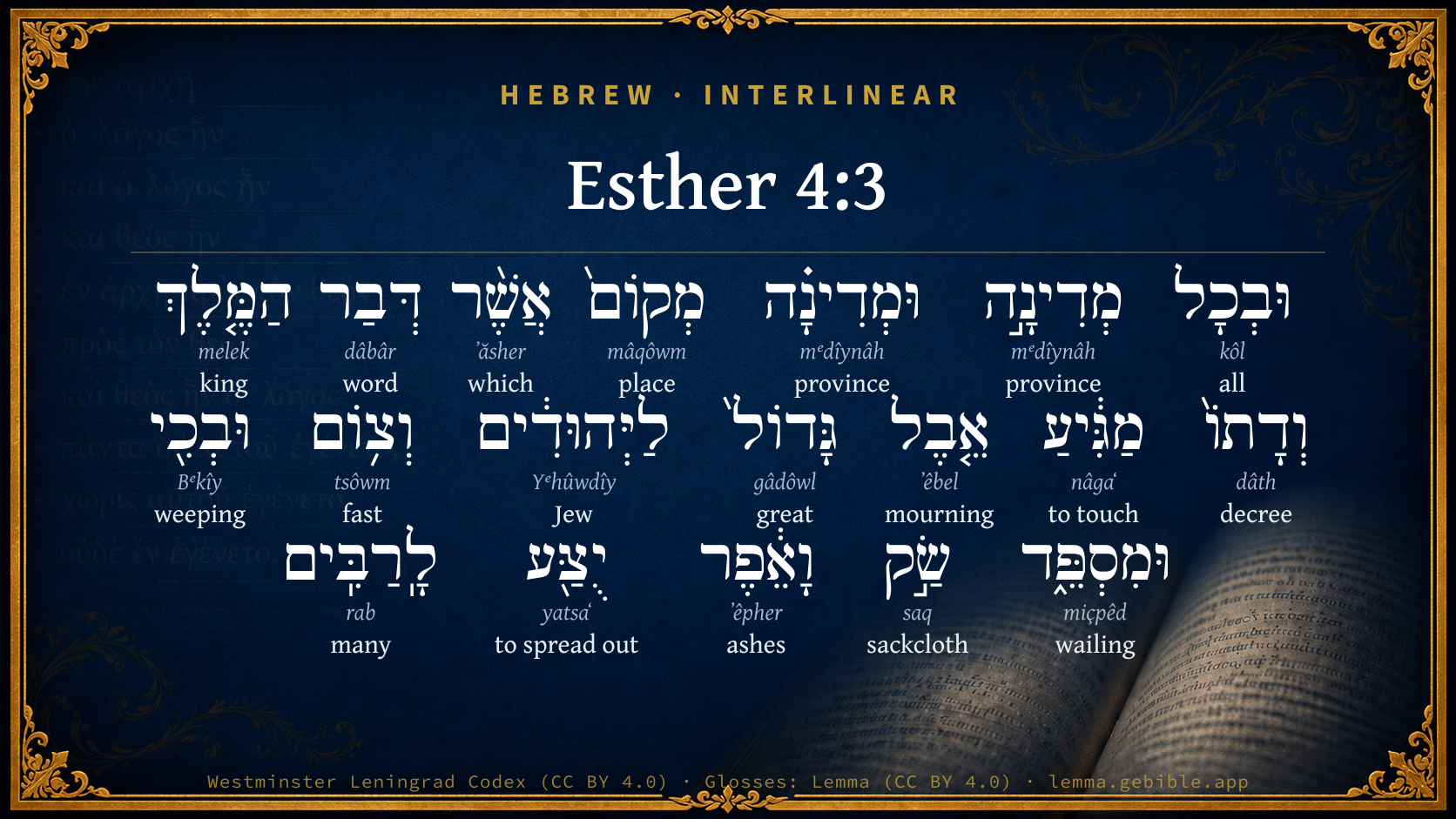
  1. וּבְכָל kôl H3605 “and · in/at · all of” Conjunction + Preposition + Noun, Common, Masculine, Singular, Construct
  2. מְדִינָ֣ה mᵉdîynâh H4082 “province” Noun, Common, Feminine, Singular, Absolute
  3. וּמְדִינָ֗ה mᵉdîynâh H4082 “and · province” Conjunction + Noun, Common, Feminine, Singular, Absolute
  4. מְקוֹם֙ mâqôwm H4725 “place of” Noun, Common, Masculine, Singular, Construct
  5. אֲשֶׁ֨ר ʼăsher H834 “which” Particle, Relative
  6. דְּבַר dâbâr H1697 “word of” Noun, Common, Masculine, Singular, Construct
  7. הַמֶּ֤לֶךְ melek H4428 “the · king” Particle, Definite Article + Noun, Common, Masculine, Singular, Absolute
  8. וְדָתוֹ֙ dâth H1881 “and · decree · his” Conjunction + Noun, Common, Feminine, Singular, Construct + Suffix, Personal, 3rd Person, Masculine, Singular
  9. מַגִּ֔יעַ nâgaʻ H5060 “touching” Verb, Hiphil, Participle Active, Masculine, Singular, Absolute
  10. אֵ֤בֶל ʼêbel H60 “mourning” Noun, Common, Masculine, Singular, Absolute
  11. גָּדוֹל֙ gâdôwl H1419 “great” Adjective, Adjective, Masculine, Singular, Absolute
  12. לַיְּהוּדִ֔ים Yᵉhûwdîy H3064 “to/for the · Jews” Preposition, Determined + Noun, Gentilic, Masculine, Plural, Absolute
  13. וְצ֥וֹם tsôwm H6685 “and · fast” Conjunction + Noun, Common, Masculine, Singular, Absolute
  14. וּבְכִ֖י Bᵉkîy H1065 “and · weeping” Conjunction + Noun, Common, Masculine, Singular, Absolute
  15. וּמִסְפֵּ֑ד miçpêd H4553 “and · wailing” Conjunction + Noun, Common, Masculine, Singular, Absolute
  16. שַׂ֣ק saq H8242 “sackcloth” Noun, Common, Masculine, Singular, Absolute
  17. וָאֵ֔פֶר ʼêpher H665 “and · ashes” Conjunction + Noun, Common, Masculine, Singular, Absolute
  18. לָֽרַבִּֽים rab H7227 “to/for the · many” Preposition, Determined + Adjective, Adjective, Masculine, Plural, Absolute

About this verse

These counts appear in no published source. They are computed here, from the morphology-tagged text and Lemma’s own curated glosses. What Lemma adds →

19
words
18
distinct lemmas
Historical
section

Notable vocabulary

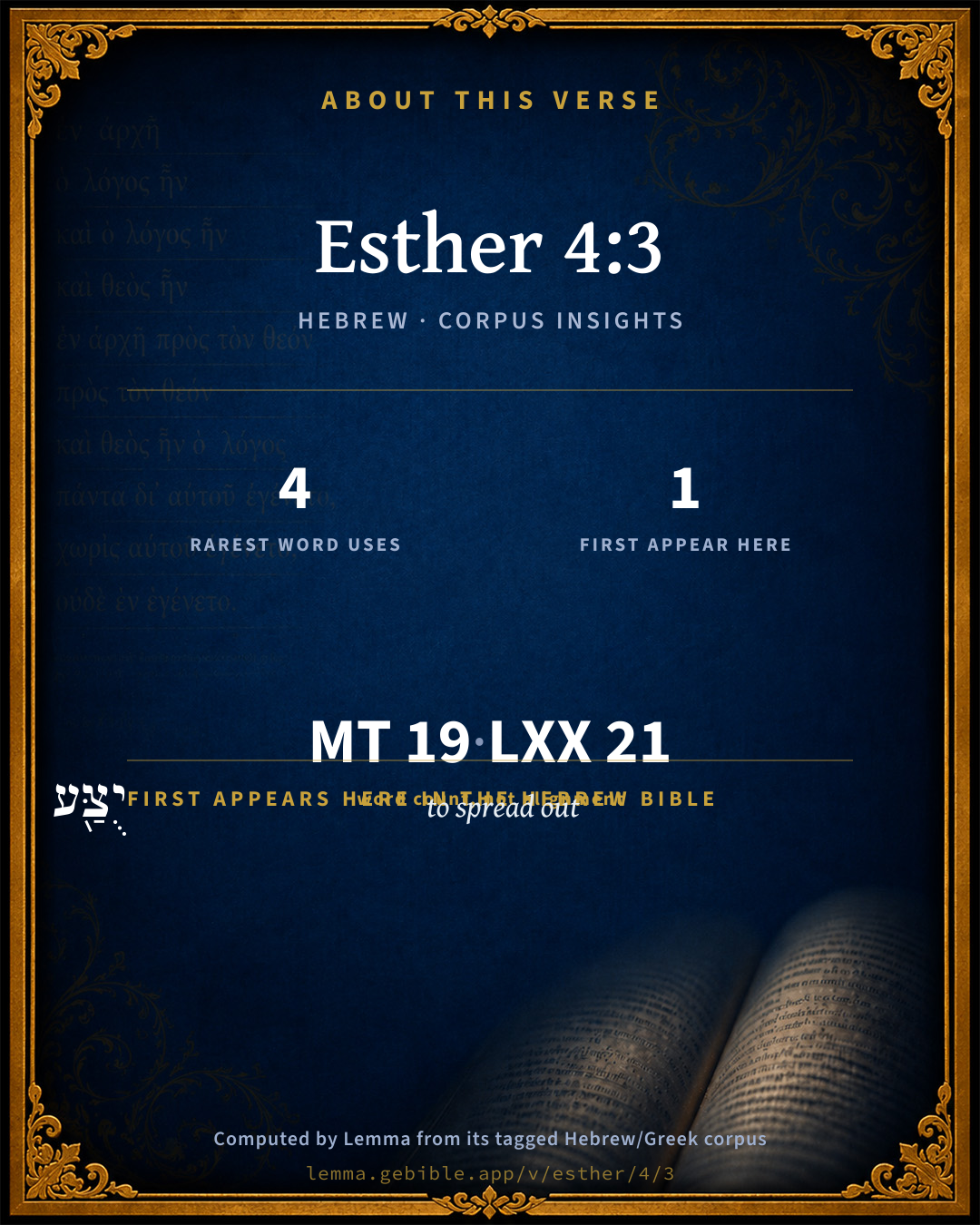
The rarest word here is יֻצַּ֖ע to spread out H3331 — appearing just 4 times in the whole Hebrew Bible.

First appearance in Scripture

This word makes its first canonical appearance in the Hebrew Bible here:

  • יֻצַּ֖ע to spread out H3331

Shared distinctive vocabulary

יֻצַּ֖ע to spread out H3331 occurs in 4 verses of the Hebrew Bible. Also found in:

Grammatical profile

  • 2 verbs
  • 14 nouns
  • 2 adjectives
  • 1 particle

Verb forms

  • מַגִּ֔יעַ Hiphil · Participle Active
  • יֻצַּ֖ע Hophal · Imperfect

Repetition

A word recurs within this verse — often emphatic in Hebrew:

  • מְדִינָ֣ה province H4082 ×2

Hebrew & Septuagint length

In English translation the verse runs 31 words from the Hebrew and 30 from the Septuagint (LXX English) — closely comparable.

A rough comparison of the two English renderings, which tokenize alike — not a word-level alignment.

Word counts can differ between the Hebrew and the Greek without any difference in meaning — e.g. the Hebrew direct-object marker אֵת has no separate Greek word, and Greek often adds the article ὁ.

In the original languages it is 19 Hebrew tokens and 21 Greek tokens — but the two are counted differently (Hebrew bundles its prefixes and suffixes into one token; the Greek is in lemma form), so that isn’t a like-for-like length.

Cross-references

13

Topical passages linked to Esther 4:3 in the Treasury of Scripture Knowledge — connected by theme and wording, ordered by reader-vote popularity; previews shown in the World English Bible.

  • Isaiah 22:12 In that day did the Lord, Yahweh of Hosts, call to weeping, and to mourning, and to baldness, and to girding with sackcloth:
  • Daniel 9:3 I set my face to the Lord God, to seek by prayer and petitions, with fasting and sackcloth and ashes.
  • Esther 3:12 Then were the king's scribes called in the first month, on the thirteenth day of it; and there was written according to all that Haman commanded to the king's satraps, and to the governors who were over every province, and to the princes of every people, to every province according to the writing of it, and to every people after their language; in the name of king Ahasuerus was it written, and it was sealed with the king's ring.
  • Esther 4:16 Go, gather together all the Jews who are present in Shushan, and fast you for me, and neither eat nor drink three days, night or day: I also and my maidens will fast in like manner; and so will I go in to the king, which is not according to the law: and if I perish, I perish.
  • Isaiah 22:4 Therefore said I, Look away from me, I will weep bitterly; don't labor to comfort me for the destruction of the daughter of my people.
  • Isaiah 37:1–3 It happened, when king Hezekiah heard it, that he tore his clothes, and covered himself with sackcloth, and went into the house of Yahweh.
  • Isaiah 58:5 Is such the fast that I have chosen? the day for a man to afflict his soul? Is it to bow down his head as a rush, and to spread sackcloth and ashes under him? will you call this a fast, and an acceptable day to Yahweh?
  • 1 Samuel 4:13–14 When he came, behold, Eli was sitting on his seat by the road watching; for his heart trembled for the ark of God. When the man came into the city, and told it, all the city cried out.
  • Matthew 13:42 and will cast them into the furnace of fire. There will be weeping and the gnashing of teeth.
  • Matthew 22:13 Then the king said to the servants, 'Bind him hand and foot, take him away, and throw him into the outer darkness; there is where the weeping and grinding of teeth will be.'
  • Matthew 25:30 Throw out the unprofitable servant into the outer darkness, where there will be weeping and gnashing of teeth.'
  • 1 Samuel 11:4 Then came the messengers to Gibeah of Saul, and spoke these words in the ears of the people: and all the people lifted up their voice, and wept.
  • Esther 1:1 Now it happened in the days of Ahasuerus (this is Ahasuerus who reigned from India even to Ethiopia, over one hundred twenty-seven provinces),

Cross-references courtesy of OpenBible.info (CC BY 4.0).

Hebrew and Greek witnesses Masoretic Hebrew ↔ Greek Septuagint

The same verse in the two great witnesses to the Old Testament, shown verse-for-verse.

These are two independent witnesses, not word-aligned to each other, and the Septuagint is shown in lemma (dictionary) form.

Hebrew Esther 4:3 Masoretic · Westminster Leningrad Codex

וּבְכָל מְדִינָ֣ה וּמְדִינָ֗ה מְקוֹם֙ אֲשֶׁ֨ר דְּבַר הַמֶּ֤לֶךְ וְדָתוֹ֙ מַגִּ֔יעַ אֵ֤בֶל גָּדוֹל֙ לַיְּהוּדִ֔ים וְצ֥וֹם וּבְכִ֖י וּמִסְפֵּ֑ד שַׂ֣ק וָאֵ֔פֶר יֻצַּ֖ע לָֽרַבִּֽים

In every province, wherever the king's commandment and his decree came, there was great mourning among the Jews, and fasting, and weeping, and wailing; and many lay in sackcloth and ashes.

World English Bible · Public Domain

Greek LXX Esther 4:3 Septuagint · lemma form

καί ἐν πᾶς χώρα οὗ ἐκτίθημι ὁ γράμμα κραυγή καί κοπετός καί πένθος μέγας ὁ ἰουδαῖος σάκκος καί σποδός στρώννυμι ἑαυτοῦ

And in every province where the letters were published, there was crying and lamentation and great mourning on the part of the Jews: they spread for themselves sackcloth and ashes.

LXX2012 (modern English Septuagint) · Public Domain

Hebrew: Westminster Leningrad Codex (CC BY 4.0). Greek: Septuagint (public domain); English from LXX2012 (modern English Septuagint) (Public Domain). How the Septuagint differs from the Hebrew →

Commentary

Notes on Esther 4:3 from classic Christian and Jewish commentators (each source and its license shown beneath its notes). The classic Christian expositions comment on the surrounding passage and are grouped to its opening verse, so a note may address several verses; the Jewish commentaries on the Tanakh (Rashi and others) are per-verse, so they appear only where the commentator wrote on this verse.

Lemma curates 59 commentaries, every one of them public domain or Creative Commons licensed, each selected and text-cleaned for this edition rather than reprinted as found. About our sources →

Trapp's Complete Commentary

John Trapp

Est 4:3 And in every province, whithersoever the king’s commandment and his decree came, [there was] great mourning among the Jews, and fasting, and weeping, and wailing; and many lay in sackcloth and ashes.

Ver. 3. And in every province] Heb. In every province, and province, &c., not only in Shushan, which, say the Hebrews, was called Elam Hammedina, but throughout the king’s dominions.

Whithersoever the king’s commandment and his decree] The latter was irrevocable, and therefore more dreadful.

There was great mourning among the Jews] Not murmuring or mutinying, or meditating revenge against the king and Haman. Not casting away their confidence in God, or committing all to fate and blind fortune. Not crying out of religion, as unhappy, to the professors, (ω τλημων αρετη, said he in the story. Oh miserable virtue! Oh practice of no profit! &c., Brutus apud Dion). Not taking up arms or betaking themselves to flight; (how should poor galley slaves at this day flee out of the middle of Turkey?) prayers and tears were the weapons of these condemned captives and prisoners. It troubled them exceedingly (as well it might), that through fearfulness and negligence they had not, before this, gone back to their own country, with Zerubbabel or some other, when they had good leave to have gone with their brethren; and God himself cried out unto them, "Ho, ho, come forth," &c., Zec 2:6. "Arise, depart; this is not your rest: because it is polluted, it shall destroy you, even with a sore destruction," Mic 2:10. This was now a bodkin at their hearts; like as it shall be one day to those in hell, to think, we might have been delivered.

And fasting] The word signifieth an abstinence from food and sustenance, either a toto, totally, as 2Sa 12:16, or at least a tanto eta tali, partially, as Dan 10:2-3. Hence, it is called a day of restraint, Nηστεια, Joe 2:15. Hence, Zec 8:19, they separated themselves, viz. from work, food, and delights, for the furtherance of their repentance, and the enforcing of their prayers. Preces nobis ieiuniis alendum, et quasi saginandum, saith one, our prayers must be pampered and grain fed with fasting. A practice in use, not among Jews and Christians only, but among Egyptian priests, Persian magi, and Indian wizards of old, and Turks to this day when they are in any great fear of pressure.

And weeping, and wailing] This was the way to get in with God, though they might not come crying to the court. Oh the divine rhetoric and omnipotent efficacy of penitent tears! Psa 6:8, Weeping hath a voice. Christ turned to the weeping women, when going to his cross, and comforted them. He showed great respects to Mary Magdalene, that weeping vine; she had the first sight of the revived Phoenix (though so bleared that she could scarce discern him), and held him fast by those feet which she had once washed with her tears, and wherewith he had lately trod upon the lion and adder, Psa 91:13.

And many lay in sackcloth and ashes] As many as were more deeply affected with their sins, and the sad consequents thereof. David lay on the bare ground, χαμαικοιτης, 2Sa 12:16; these, and those Joe 1:13, lodged in sackcloth and ashes, that they might watch as well as fast. See how they go linked together, Mar 13:33. See Est 4:16.

John Trapp, A Commentary or Exposition upon All the Books of the Old and New Testament (1647–1656) — public domain. Text from a community e-Sword module.

The Biblical Illustrator

Joseph S. Exell

Est_4:3

And in every province . . . there was great mourning among the Jews.

A sentence of death

If a sentence of death pronounced by an earthly sovereign produced such grief, such anxiety, such cries of deliverance, what impression ought to be made on the minds of sinners by that sentence which is passed against them in the court of heaven?--Judgment is come upon all men to condemnation. We are still under that sentence of condemnation if we are not in Christ Jesus. Surely we believe neither law nor gospel, if we can enjoy peace in our own minds, without the humble hope of mercy through our Lord Jesus Christ unto eternal life. (G. Lawson.)

The Biblical Illustrator, edited by Joseph S. Exell (c. 1880s–1900s) — public domain. Text from a community e-Sword module.

Joseph Benson's Commentary

Est 4:3. And many lay in sackcloth and ashes — All day long they fasted, and wept, and lamented; and in the night many lay, not in their beds, but in sack or haircloth strewed with ashes.

Joseph Benson's Commentary on the Old and New Testaments (1811–1818) — public domain. Text from a community e-Sword module.

Tyndale Open Study Notes

Tyndale Open Resources

4:3 great mourning among the Jews: In these reports of lamenting, God’s name is not mentioned, but the lamenting and fasting implies crying out in prayer for God to intervene and save his people (Exod 2:23-25; Ezra 9:5-15; Dan 9:1-19).

Tyndale Open Study Notes — © Tyndale Open Resources, licensed CC BY-SA 4.0. Text via the HelloAO Bible API.

Geneva Bible (1599)

Geneva Bible translators

Hebrew, sackcloth and ashes were spread for many.

Geneva Bible (1599) marginal notes — public domain. Text via Bolls.life.

Adam Clarke's Commentary

Verse 3. Fasting, and weeping, and wailing] How astonishing, that in all this there is not the slightest intimation given of praying to God!

Adam Clarke's Commentary on the Bible (1810–1826) — public domain. Text from a community e-Sword/MySword module.

The Cambridge Bible for Schools and Colleges

gen. ed. J. J. S. Perowne

3. many lay in sackcloth and ashes] lit. sackcloth and ashes were spread under many.

The Cambridge Bible for Schools and Colleges (gen. ed. J. J. S. Perowne; Cambridge University Press, 1878–1918) — public domain. Text from a community e-Sword module.

John Gill's Exposition

And in every province whithersoever the king's commandment and his decree came,.... For destroying the Jews on such a day, in every place where they were to be found:

there was great mourning among the Jews, and weeping, and wailing; which continued all day:

and many lay in sackcloth and ashes: all night; made use of no other bed to lie on, nor clothes to cover them with.

John Gill's Exposition of the Whole Bible (1746–1763) — public domain (CC PDM 1.0). Text via the HelloAO Bible API.

Haydock's Catholic Bible Commentary

Edict. Literally, "dogma;: (Haydock) a word used in this sense, (Acts xv. 16.) and by Demosthenes, &c. (Tirinus) --- Mourning. The most effectual means of redress, is to do works of penance for past transgressions, 1 Corinthians xi. 31. (Worthington)

George Leo Haydock (1774–1849), Haydock's Catholic Family Bible and Commentary, 1859 edition — public domain. Excludes Psalms (Douay-Rheims chapter numbering differs from Protestant) and Deuterocanonical books (Catholic canon only).

The Pulpit Commentary

And in every province. As fast as the news spread, as province after province received the decree, the Jews spontaneously did as Mordecai had done everywhere there was great sorrow, shown commonly by fasting, weeping, and wailing, while in numerous instances the mourners even went the length of putting on sackcloth and ashes. Thus an ever-increasing cloud of grief overshadowed the land.

The Pulpit Commentary (1880–1919), ed. H.D.M. Spence-Jones & Joseph S. Exell — public domain. Text from a community e-Sword module.

Scofield Reference Notes

C. I. Scofield

and many lay

Heb. sackcloth and ashes were laid under many. Isa 58:5; Dan 9:3.

The Scofield Reference Bible (1917 edition), notes by C. I. Scofield — public domain. Text from a community e-Sword module.

Rashi

Rabbi Shlomo Yitzchaki (Rashi)

the king’s orders and his edict When the couriers carrying the letters passed, the edict was given in the city.

Rashi on the Tanakh — English translations: “The Judaica Press complete Tanach with Rashi, translated by A. J. Rosenberg” (CC BY 4.0); “Pentateuch with Rashi's commentary by M. Rosenbaum and A.M. Silbermann, 1929-1934” (public domain); “The Metsudah Tanach series, Lakewood, N.J” (CC BY 4.0); and “The Book of Joshua, Metsudah Publications, 1997” (CC BY 4.0). Text via Sefaria.

Lesson kit

Teaching starters — assembled from the data on this page, not authored interpretation. Every prompt links to the verse data it draws on. Edit before teaching.

Esther, in the Historical, opens this verse with 19 words (18 distinct Hebrew lemmas). Its most distinctive word is yatsaʻ (“to spread out”). A historical commentator’s framing appears above. Read the whole chapter for the surrounding context.

Discussion questions

  1. The word yatsaʻ carries the sense “to spread out.” How does it shape the verse?
  2. The word “to spread out” first appears here in Scripture. What is being introduced at this debut?
  3. Psalms 139:8 shares the word «to spread out» with this verse. How do the two illuminate each other?
  4. “province” occurs 2× in this one verse. What is the effect of the repetition?
  5. These translations render this verse differently; the difference is in the English rendering, not the original. What questions does that raise?
  6. The verb «מַגִּ֔יעַ» is Hiphil Participle Active. How does its form color the action?
  7. Reading how Trapp's Complete Commentary and The Biblical Illustrator read this verse, where do the two commentators agree and where do they part?

Things to notice

Reading settings

Reading text

Shown beneath each verse's original-language words.

Old Testament
Old Testament edition

Read the OT as the Masoretic Hebrew (MT) or the Greek Septuagint (LXX).

English shown for the Greek Septuagint (in the Hebrew ↔ Greek comparison).

Comparing translations? Open the Compare panel on any verse page to stack up to four side by side.