
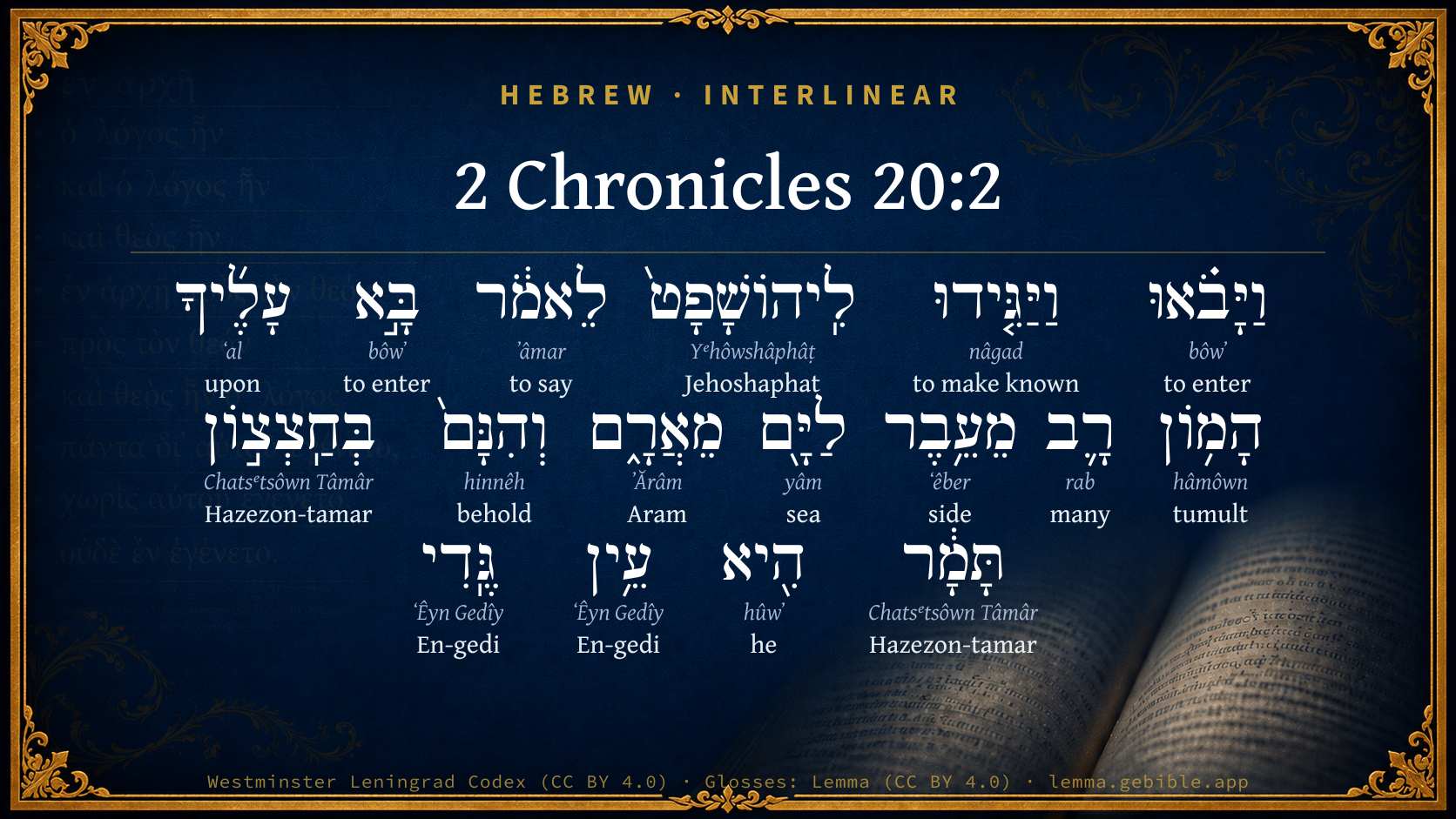
2 Chronicles 20:2

Hebrew (Westminster Leningrad Codex) 2 Chronicles 20:2 appears in the Hebrew Old Testament. The text above is from the Westminster Leningrad Codex. Each word links to its Strong’s number, a concise gloss, and parsing drawn from the Open Scriptures Hebrew Bible morphology. Click any word for its full Brown-Driver-Briggs (BDB) entry.
Download image
Cite this verse

2 Chronicles 20:2 (World English Bible). Public Domain. Lemma interlinear Bible study tool, https://lemma.gebible.app/v/2-chronicles/20/2.

Show BibTeX & RIS
BibTeX
RIS
English Translation
Then there came some who told Jehoshaphat, saying, There comes a great multitude against you from beyond the sea from Syria; and, behold, they are in Hazazon Tamar (the same is En Gedi).
World English Bible · Public Domain
Download a study sheet

One document with this verse’s original text, its word-by-word gloss line, the meaning frame, cross-references with their text, attributed commentary, and full source and license credits — printable, and it pastes into notes with its structure intact.

This verse Autodidact and up

Study sheet (.html) Plain text (.txt)

A passage Seminary Student

Up to 50 verses in one chapter. A passage sheet keeps up to 6 commentary sources and 12 cross-references per verse, in the order this page ranks them, and says so on the sheet whenever that leaves anything out. Ask for a single verse and you get the Autodidact verse sheet above.

Everything on this page stays free to read, with no account — the sheet is a download of what is already on screen, not access to it.

Want to remove ads? Support Godless Engineer
Compare translations 3

The same verse in 3 English versions, stacked beneath the original-language interlinear above. Click any original word for its lexicon entry.

Each is an independent rendering of the whole verse — the interlinear is not word-aligned to these translations.

Highlighted words mark where these versions differ — a whole-verse word diff, not a word-by-word alignment.

  • World English Bible Public Domain
    Then there came some who told Jehoshaphat, saying, There comes a great multitude against you from beyond the sea from Syria; and, behold, they are in Hazazon Tamar (the same is En Gedi).
  • King James Version Public Domain
    Then there came some that told Jehoshaphat, saying, There cometh a great multitude against thee from beyond the sea on this side Syria; and, behold, they be in Hazazontamar, which is Engedi.
  • unfoldingWord Literal Text CC BY-SA 4.0
    And they came and told Jehoshaphat, saying, “A great multitude is coming against you from beyond the sea, from Aram. And behold, they are in Hazezon Tamar,” that is, Engedi.

unfoldingWord Literal Text — © unfoldingWord, licensed CC BY-SA 4.0. Word-aligned USFM3 via Door43 (git.door43.org/unfoldingWord/en_ult).

Versions to compare (up to 4)

3 of 4 selected

Show all 18 translations

Every available English version of this verse, each an independent rendering of the whole verse.

  • World English Bible Public Domain
    Then there came some who told Jehoshaphat, saying, There comes a great multitude against you from beyond the sea from Syria; and, behold, they are in Hazazon Tamar (the same is En Gedi).
  • Berean Standard Bible Public Domain
    Then some men came and told Jehoshaphat, “A vast army is coming against you from Edom, from beyond the Sea; they are already in Hazazon-tamar” (that is, En-gedi).
  • Majority Standard Bible Public Domain
    Then some men came and told Jehoshaphat, “A vast army is coming against you from Edom, from beyond the Sea; they are already in Hazazon-tamar” (that is, En-gedi).
  • King James Version Public Domain
    Then there came some that told Jehoshaphat, saying, There cometh a great multitude against thee from beyond the sea on this side Syria; and, behold, they be in Hazazontamar, which is Engedi.
  • American Standard Version (1901) Public Domain
    Then there came some that told Jehoshaphat, saying, There cometh a great multitude against thee from beyond the sea from Syria; and, behold, they are in Hazazon-tamar (the same is En-gedi).
  • Revised Version (1885) Public Domain
    Then there came some that told Jehoshaphat, saying, There cometh a great multitude against thee from beyond the sea from Syria; and, behold, they be in Hazazon-tamar (the same is En-gedi).
  • Geneva Bible (1599) Public Domain
    Then there came that tolde Iehoshaphat, saying, There commeth a great multitude against thee from beyonde the Sea, out of Aram: and beholde, they bee in Hazzon Tamar, which is En-gedi.
  • Douay-Rheims (1899) Public Domain
    And there came messengers, and told Josaphat, saying: There cometh a great multitude against thee from beyond the sea, and out of Syria, and behold they are in Asasonthamar, which is Engaddi.
  • Young's Literal Translation Public Domain
    And they come in and declare to Jehoshaphat, saying, `Come against thee hath a great multitude from beyond the sea, from Aram, and lo, they `are' in Hazezon-Tamar -- it `is' En-Gedi.'
  • Literal Standard Version CC BY-SA 4.0
    And [some] come in and declare [it] to Jehoshaphat, saying, “A great multitude has come against you from beyond the sea, from Aram, and behold, they [are] in Hazezon-Tamar—it [is] En-Gedi.”
  • Unlocked Literal Bible CC BY-SA 4.0
    Then some came who told Jehoshaphat, saying, “A large multitude is coming against you from beyond the Dead Sea, from Edom. See, they are in Hazezon Tamar,” that is, Engedi.
  • unfoldingWord Literal Text CC BY-SA 4.0
    And they came and told Jehoshaphat, saying, “A great multitude is coming against you from beyond the sea, from Aram. And behold, they are in Hazezon Tamar,” that is, Engedi.
  • Darby Bible Public Domain
    And they came and told Jehoshaphat saying, A great multitude is come against thee from beyond the sea, from Syria; and behold, they are in Hazazon-tamar, which is Engedi.
  • World Messianic Bible Public Domain
    Then some came who told Jehoshaphat, saying, “A great multitude is coming against you from beyond the sea from Syria. Behold, they are in Hazazon Tamar” (that is, En Gedi).
  • Webster's Bible Public Domain
    Then there came some that told Jehoshaphat, saying, There cometh a great multitude against thee from beyond the sea on this side of Syria; and behold, they are in Hazazon-tamar, which is En-gedi.
  • Free Bible Version CC BY-SA 4.0
    Some people came and told Jehoshaphat, “A large army is coming to fight you from Edom, from the other side of the Dead Sea. They have already reached Hazazon-tamar,” (otherwise called En-gedi).
  • Bible in Basic English Public Domain
    And they came to Jehoshaphat with the news, saying, A great army is moving against you from Edom across the sea; and now they are in Hazazon-tamar (which is En-gedi).
  • JPS Tanakh (1917) Public Domain
    Then there came some that told Jehoshaphat, saying: 'There cometh a great multitude against thee from beyond the sea from Aram; and, behold, they are in Hazazon-tamar' — the same is En-gedi.

Literal Standard Version (2020), Covenant Press — licensed CC BY-SA 4.0. Text via the HelloAO Bible API (eBible.org). Unlocked Literal Bible (unfoldingWord) — licensed CC BY-SA 4.0. Text via the HelloAO Bible API (eBible.org). unfoldingWord Literal Text — © unfoldingWord, licensed CC BY-SA 4.0. Word-aligned USFM3 via Door43 (git.door43.org/unfoldingWord/en_ult). Free Bible Version, Dr. Jonathan Gallagher — licensed CC BY-SA 4.0. Text via the HelloAO Bible API (eBible.org).

Word by word

More ways to search: Search by grammar → Find every occurrence → Compare this word →

Practice this passage: Drill this verse → Learn its vocabulary →

בְּחַֽצְצ֣וֹן
Chatsᵉtsôwn Tâmâr
H2688
“in/at · Hazezon-tamar”
Preposition + Noun, Proper
Part of Speech
Preposition + Noun
Type
Proper
Full BDB Definition

Origin: from H2686 and H8558

TWOT: None

Hazezon-tamar = "dividing the date-palm" - an Amorite city - a town situated in the desert Judah; probably Engedi - maybe the 'Tamar' of Solomon's day
  1. וַיָּבֹ֗אוּ bôwʼ H935 “and · to enter” Conjunction + Verb, Qal, Sequential Imperfect, 3rd Person, Masculine, Plural
  2. וַיַּגִּ֤ידוּ nâgad H5046 “and · to make known” Conjunction + Verb, Hiphil, Sequential Imperfect, 3rd Person, Masculine, Plural
  3. לִֽיהוֹשָׁפָט֙ Yᵉhôwshâphâṭ H3092 “to/for · Jehoshaphat” Preposition + Noun, Proper
  4. לֵאמֹ֔ר ʼâmar H559 “to say” Preposition + Verb, Qal, Infinitive Construct
  5. בָּ֣א bôwʼ H935 “to enter” Verb, Qal, Perfect, 3rd Person, Masculine, Singular
  6. עָלֶ֜יךָ ʻal H5921 “upon · you” Preposition + Suffix, Personal, 2nd Person, Masculine, Singular
  7. הָמ֥וֹן hâmôwn H1995 “tumult” Noun, Common, Masculine, Singular, Absolute
  8. רָ֛ב rab H7227 “many” Adjective, Adjective, Masculine, Singular, Absolute
  9. מֵעֵ֥בֶר ʻêber H5676 “from · side” Preposition + Noun, Common, Masculine, Singular, Absolute
  10. לַיָּ֖ם yâm H3220 “to/for the · sea” Preposition, Determined + Noun, Common, Masculine, Singular, Absolute
  11. מֵאֲרָ֑ם ʼĂrâm H758 “from · Aram” Preposition + Noun, Proper
  12. וְהִנָּם֙ hinnêh H2009 “and · behold · them” Conjunction + Particle, Demonstrative + Suffix, Personal, 3rd Person, Masculine, Plural
  13. תָּמָ֔ר Chatsᵉtsôwn Tâmâr H2688 “Hazezon-tamar” Noun, Proper
  14. הִ֖יא hûwʼ H1931 “he” Pronoun, Personal, 3rd Person, Feminine, Singular
  15. עֵ֥ין ʻÊyn Gedîy H5872 “En-gedi” Noun, Proper
  16. גֶּֽדִי ʻÊyn Gedîy H5872 “En-gedi” Noun, Proper

About this verse

These counts appear in no published source. They are computed here, from the morphology-tagged text and Lemma’s own curated glosses. What Lemma adds →

17
words
14
distinct lemmas
Historical
section

Notable vocabulary

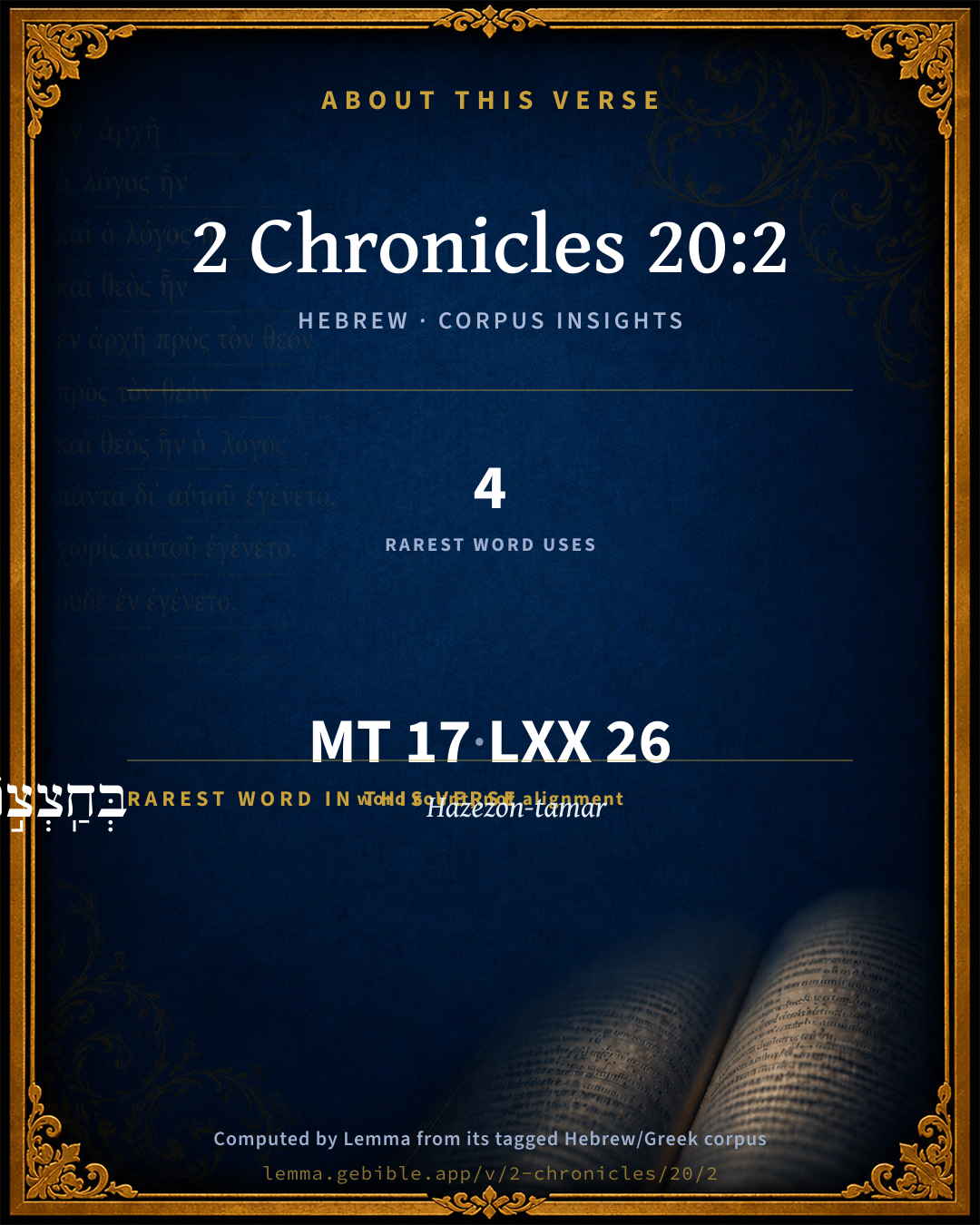
The rarest word here is בְּחַֽצְצ֣וֹן Hazezon-tamar H2688 — appearing just 4 times in the whole Hebrew Bible.

Shared distinctive vocabulary

בְּחַֽצְצ֣וֹן Hazezon-tamar H2688 occurs in 2 verses of the Hebrew Bible. Also found in:

Grammatical profile

  • 4 verbs
  • 9 nouns
  • 1 adjective
  • 1 pronoun
  • 1 preposition
  • 1 particle

Verb forms

  • וַיָּבֹ֗אוּ Qal · Sequential Imperfect
  • וַיַּגִּ֤ידוּ Hiphil · Sequential Imperfect
  • לֵאמֹ֔ר Qal · Infinitive Construct
  • בָּ֣א Qal · Perfect

Repetition

Words recur within this verse — often emphatic in Hebrew:

  • וַיָּבֹ֗אוּ to enter H935 ×2
  • בְּחַֽצְצ֣וֹן Hazezon-tamar H2688 ×2
  • עֵ֥ין En-gedi H5872 ×2

Hebrew & Septuagint length

In English translation the verse runs 33 words from the Hebrew and 31 from the Septuagint (LXX English) — closely comparable.

A rough comparison of the two English renderings, which tokenize alike — not a word-level alignment.

Word counts can differ between the Hebrew and the Greek without any difference in meaning — e.g. the Hebrew direct-object marker אֵת has no separate Greek word, and Greek often adds the article ὁ.

In the original languages it is 17 Hebrew tokens and 26 Greek tokens — but the two are counted differently (Hebrew bundles its prefixes and suffixes into one token; the Greek is in lemma form), so that isn’t a like-for-like length.

Cross-references

7

Topical passages linked to 2 Chronicles 20:2 in the Treasury of Scripture Knowledge — connected by theme and wording, ordered by reader-vote popularity; previews shown in the World English Bible.

  • Genesis 14:7 They returned, and came to En-mishpat (the same is Kadesh), and struck all the country of the Amalekites, and also the Amorites, that lived in Hazazon Tamar.
  • 1 Samuel 23:29 David went up from there, and lived in the strongholds of En Gedi.
  • Genesis 14:3 All these joined together in the valley of Siddim (the same is the Salt Sea).
  • Numbers 34:12 and the border shall go down to the Jordan, and the goings out of it shall be at the Salt Sea. This shall be your land according to the borders of it round about.
  • Joshua 3:16 that the waters which came down from above stood, and rose up in one heap, a great way off, at Adam, the city that is beside Zarethan; and those that went down toward the sea of the Arabah, even the Salt Sea, were wholly cut off: and the people passed over right against Jericho.
  • Joshua 15:62 and Nibshan, and the City of Salt, and En Gedi; six cities with their villages.
  • Song of Solomon 1:14 My beloved is to me a cluster of henna blossoms From the vineyards of En Gedi. Lover

Cross-references courtesy of OpenBible.info (CC BY 4.0).

Hebrew and Greek witnesses Masoretic Hebrew ↔ Greek Septuagint

The same verse in the two great witnesses to the Old Testament, shown verse-for-verse.

These are two independent witnesses, not word-aligned to each other, and the Septuagint is shown in lemma (dictionary) form.

Hebrew 2 Chronicles 20:2 Masoretic · Westminster Leningrad Codex

וַיָּבֹ֗אוּ וַיַּגִּ֤ידוּ לִֽיהוֹשָׁפָט֙ לֵאמֹ֔ר בָּ֣א עָלֶ֜יךָ הָמ֥וֹן רָ֛ב מֵעֵ֥בֶר לַיָּ֖ם מֵאֲרָ֑ם וְהִנָּם֙ בְּחַֽצְצ֣וֹן תָּמָ֔ר הִ֖יא עֵ֥ין גֶּֽדִי

Then there came some who told Jehoshaphat, saying, There comes a great multitude against you from beyond the sea from Syria; and, behold, they are in Hazazon Tamar (the same is En Gedi).

World English Bible · Public Domain

Greek LXX 2 Chronicles 20:2 Septuagint · lemma form

καί ἔρχομαι καί ὑποδεικνύω ὁ ιωσαφατ λέγω ἥκω ἐπί σύ πλῆθος πολύς ἐκ πέραν ὁ θάλασσα ἀπό συρία καί ἰδού εἰμί ἐν ασασανθαμαρ οὗτος εἰμί ενγαδδι

And they came and told Josaphat, saying, There is come against you a great multitude from Syria, from beyond the sea; and, behold, they are in Asasan Thamar, this is Engadi.

LXX2012 (modern English Septuagint) · Public Domain

On this verse, Ellicott's Commentary for English Readers discusses the Septuagint’s reading. Read the note in Commentary ↓

Hebrew: Westminster Leningrad Codex (CC BY 4.0). Greek: Septuagint (public domain); English from LXX2012 (modern English Septuagint) (Public Domain). How the Septuagint differs from the Hebrew →

Commentary

Notes on 2 Chronicles 20:2 from classic Christian and Jewish commentators (each source and its license shown beneath its notes). The classic Christian expositions comment on the surrounding passage and are grouped to its opening verse, so a note may address several verses; the Jewish commentaries on the Tanakh (Rashi and others) are per-verse, so they appear only where the commentator wrote on this verse.

Lemma curates 59 commentaries, every one of them public domain or Creative Commons licensed, each selected and text-cleaned for this edition rather than reprinted as found. About our sources →

Trapp's Complete Commentary

John Trapp

2Ch 20:2 Then there came some that told Jehoshaphat, saying, There cometh a great multitude against thee from beyond the sea on this side Syria; and, behold, they [be] in Hazazontamar, which [is] Engedi.

Ver. 2. From beyond the sea.] The Dead Sea, which ran between Judea and Syria; and about this sea was their rendezvous.

Which is Engedi.] See Jos 15:62. Here were the gardens of balsam, saith Zeigler, and the woods of palm trees.

John Trapp, A Commentary or Exposition upon All the Books of the Old and New Testament (1647–1656) — public domain. Text from a community e-Sword module.

Joseph Benson's Commentary

2Ch 20:2. Then there came some that told Jehoshaphat — That brought him the surprising intelligence of this invasion, when his enemies had already entered his kingdom. Saying, There cometh a great multitude against thee from beyond the sea — The Dead sea, beyond which mount Seir lay; and from this side Syria — Largely so called, and so it includes the Moabites and Ammonites. And it may be thus expressed, to intimate that they came by the instigation of the Syrians, to revenge themselves of Jehoshaphat for joining with Ahab against them.

Joseph Benson's Commentary on the Old and New Testaments (1811–1818) — public domain. Text from a community e-Sword module.

Tyndale Open Study Notes

Tyndale Open Resources

20:2 Translating the word as Edom instead of Aram is consistent with the Chronicler’s later description of the armies (20:10, 22-23) and with the geographical description of the attack from the southeast through En-gedi. (Aram was northeast of Judah.)

Tyndale Open Study Notes — © Tyndale Open Resources, licensed CC BY-SA 4.0. Text via the HelloAO Bible API.

Geneva Bible (1599)

Geneva Bible translators

Called the dead Sea, where God destroyed the five cities for sin.

Geneva Bible (1599) marginal notes — public domain. Text via Bolls.life.

Jamieson, Fausset & Brown

Robert Jamieson, A. R. Fausset & David Brown

from beyond the sea on this side Syria--Instead of "Syria," some versions read "Edom," and many able critics prefer this reading, both because the nomad tribes here mentioned were far from Syria, and because express mention is made of Mount Seir, that is, Edom. The meaning then is: this confederate horde was composed of the different tribes that inhabited the far distant regions bordering on the northern and eastern coasts of the Red Sea. Their progress was apparently by the southern point of the Dead Sea, as far as En-gedi, which, more anciently, was called Hazezon-tamar (Gen 14:7). This is the uniform route taken by the Arabs in their marauding expeditions at the present day; and in coming round the southern end of the Dead Sea, they can penetrate along the low-lying Ghor far north, without letting their movements be known to the tribes and villages west of the mountain chain [ROBINSON]. Thus, anciently, the invading horde in Jehoshaphat's time had marched as far north as En-gedi, before intelligence of their advance was conveyed to the court. En-gedi is recognized in the modern Ainjidy and is situated at a point of the western shore, nearly equidistant from both extremities of the lake [ROBINSON].

Jamieson, Fausset & Brown — Commentary Critical and Explanatory on the Whole Bible (1871) — public domain (CC PDM 1.0). Text via the HelloAO Bible API.

Adam Clarke's Commentary

Verse 2. On this side Syria] Instead of מארם mearam, from Syria, I would read with one of Kennicott's MSS. (89) מאדם meedom, from Edom, which alteration brings it to truth and does not require the change of half a letter, as it consists in the almost imperceptible difference between ר resh and ד daleth. We do not read of any Syrians in this invasion, but we know there were Edomites, or inhabitants of Mount Seir.

Hazazon-tamar] "In the wood of palm trees, that is, in Engedi." - Targum. This is the meaning of the word, and it is probable that they lay hid here.

Adam Clarke's Commentary on the Bible (1810–1826) — public domain. Text from a community e-Sword/MySword module.

Ellicott's Commentary for English Readers

(2) Then there came some that told.—And they (i.e., messengers; Vulg., “nuntii”) came and told.

Cometh.—Is come.

The Sea.—The Dead Sea, east of which lay the territories of Ammon and Moab; while to the south of it, not far from Petra, was Maon.

On this side Syria.—Heb., from Aram; and so LXX. and Vulg. But Edom is probably the true reading—a name often confused with Aram. As the invaders marched round the southern end of the Dead Sea, they were naturally described as coming from Edom. The Syr. and Arab. have: from the other side of the Red Sea.

Hazazon-tamar.—See Gen_14:7.

Engedi (Ain-jidy), midway on the western coast of the Dead Sea (see 1Sa_23:29), about thirty-six miles from Jerusalem. The Syr. and Arab, have Jericho for Hazazon-tamar (? meadow of palms). Jericho was also called “city of palms.”

A Bible Commentary for English Readers, edited by Charles John Ellicott (1878–1897) — public domain. Text from a community e-Sword module.

The Cambridge Bible for Schools and Colleges

gen. ed. J. J. S. Perowne

2. on this side Syria] R.V. from Syria (so LXX.). The text is corrupt, and the words are either a gloss on from beyond the sea or a corruption of the original reading. From Edom is an easy correction.

which is En-gedi] R.V. (the same is En-gedi). Cp. G. A. Smith, Hist. Geography as quoted above, and Bädeker p. 140. En-gedi is on the west coast of the Dead Sea at a point where a rugged pass leads up into the hill-country of Judah.

Hazazon-tamar] Gen_14:7. The name seems to describe the place as stony and as containing palm-trees. It is in fact an oasis.

The Cambridge Bible for Schools and Colleges (gen. ed. J. J. S. Perowne; Cambridge University Press, 1878–1918) — public domain. Text from a community e-Sword module.

John Gill's Exposition

Then there came some that told Jehoshaphat,.... Deserters or spies, or some of the inhabitants of those parts where they had entered, who rode post haste to acquaint him with it:

saying, there cometh a great multitude against thee from beyond the sea on this side Syria; that is, beyond the Dead or Salt sea, the sea of Sodom; the Targum is,"beyond the west of Syria,''that sea being the western boundary of it:

and, behold, they be in Hazazontamar, which is Engedi; See Gill on Gen 14:7.

John Gill's Exposition of the Whole Bible (1746–1763) — public domain (CC PDM 1.0). Text via the HelloAO Bible API.

Albert Barnes' Notes on the Bible

Translate, “from beyond the sea, from Edom.” The “sea” intended is, of course, the Dead Sea. “Syria” (Aram) is probably a mistake of a copyist for “Edom” (compare 2Sa 8:12 note).

On Engedi, see 1Sa 23:29 note.

Albert Barnes' Notes on the Bible (1834–1885) — public domain. Text from a community e-Sword/MySword module.

Haydock's Catholic Bible Commentary

Sea of Sodom, (H.) or the Red Sea. D. --- Syria, which comprised the country of Ammon. M. --- Perhaps Edom might rather have been in the text, as we find no Syrians in this war, but many of the Idumeans. C. --- Adom and Arom, (Syria. H.) have often been confounded, 4 K. xvi. 6. C. --- Asasonthamar, "the palm-tree cottage," (Bochart) between Jericho and the Dead Sea.

George Leo Haydock (1774–1849), Haydock's Catholic Family Bible and Commentary, 1859 edition — public domain. Excludes Psalms (Douay-Rheims chapter numbering differs from Protestant) and Deuterocanonical books (Catholic canon only).

Matthew Poole's English Annotations

From beyond the sea, to wit, the Dead Sea, beyond which Mount Seir lay.

On this side Syria, or, and from Syria, largely so called, and so it includes the Moabites and Ammonites. And it may be thus expressed, to intimate that they came by the instigation of the Syrians, who thought by this means to revenge themselves on Jehoshaphat for joining with Ahab against them.

Matthew Poole's English Annotations on the Holy Bible (1683–1685) — public domain. Text from a community e-Sword/MySword module.

Whedon's Commentary on the Bible

Daniel D. Whedon

2. From beyond the sea — That is, the Dead Sea.

On this side Syria — Better, from Edom. The reading מארם, from Aram, or Syria, is so unsuitable that there is sufficient reason to substitute מאדם, from Edom. Compare the same error in the text of 2Sa_8:13. The invading army approached Jerusalem from the direction of Edom, having marched around the southern end of the Dead Sea. Hazazon-tamar was the more ancient name of En-gedi, the modern Ain Jidy, on the western shore of the Dead Sea. See at Gen_14:7, and Jos_15:62.

Daniel D. Whedon (gen. ed.), Commentary on the Old and New Testaments (1874–1909) — public domain. Text from a community e-Sword module.

The Pulpit Commentary

Beyond the sea on this aide Aram (Syria); i.e. south-east of the Salt Sea, and something west of Edom (the right reading in place of Aram, where a resh had turned out a daleth), Hazon-tamar Engedi; i.e. the place Engedi (Ain-jiddy), a living "spring of water" from a lime-cliff, half-way up the west coast of the Salt Sea, "in the midst of palms" (interpalmas), the compound word "Hazazon-tamar" meaning literally, "the division of the palm."

The Pulpit Commentary (1880–1919), ed. H.D.M. Spence-Jones & Joseph S. Exell — public domain. Text from a community e-Sword module.

John Wesley's Explanatory Notes

The sea - The dead sea, beyond which mount Seir lay. Syria - Largely so called, and so it includes the Moabites and Ammonites. And it may be thus expressed, to intimate that they came by the instigation of the Syrians, to revenge themselves of Jehoshaphat for joining with Ahab against them.

John Wesley, Explanatory Notes Upon the Whole Bible (1754–1765) — public domain. Text via the GEBible commentary corpus.

Keil & Delitzsch

C. F. Keil & F. Delitzsch

Then they came and announced to Jehoshaphat, sc. messengers or fugitives; the subject is indefinite, and is to be supplied from the context. "Against thee there cometh a great multitude from beyond the (Dead) sea." מארם also has no suitable sense here, since in the whole narrative nothing is said of enemies coming out of Syria; we should read מאדם with Calmet and others. As the enemy made their attack from the south end of the Dead Sea, the messengers announce that they were come from Edom. "Behold, they are in Hazazon-tamar," i.e., Engedi, the present Ain Jidy, midway along the west coast of the Dead Sea (see on Jos 15:62 and Gen 14:7), about fifteen hours from Jerusalem.

Keil & Delitzsch — Biblical Commentary on the Old Testament (1861–1891) — public domain (CC PDM 1.0). Text via the HelloAO Bible API. (Old Testament only.)

Rashi

Rabbi Shlomo Yitzchaki (Rashi)

the same is Ein-Gedi i.e., They said to him, “They have already come so close to us.”

Rashi on the Tanakh — English translations: “The Judaica Press complete Tanach with Rashi, translated by A. J. Rosenberg” (CC BY 4.0); “Pentateuch with Rashi's commentary by M. Rosenbaum and A.M. Silbermann, 1929-1934” (public domain); “The Metsudah Tanach series, Lakewood, N.J” (CC BY 4.0); and “The Book of Joshua, Metsudah Publications, 1997” (CC BY 4.0). Text via Sefaria.

Lesson kit

Teaching starters — assembled from the data on this page, not authored interpretation. Every prompt links to the verse data it draws on. Edit before teaching.

2 Chronicles, in the Historical, opens this verse with 17 words (14 distinct Hebrew lemmas). Its most distinctive word is Chatsᵉtsôwn Tâmâr (“Hazezon-tamar”). A historical commentator’s framing appears above. Read the whole chapter for the surrounding context.

Discussion questions

  1. What does “Hazezon-tamar” (Chatsᵉtsôwn Tâmâr) contribute to the verse as a whole?
  2. Genesis 14:7 shares the word «Hazezon-tamar» with this verse. How do the two illuminate each other?
  3. “to enter” occurs 2× in this one verse. What is the effect of the repetition?
  4. The translations on this page render this verse differently — a whole-verse word diff, not a word-by-word alignment. What might account for the different wordings?
  5. The verb «וַיָּבֹ֗אוּ» is Qal Sequential Imperfect. How does its form color the action?
  6. Reading how Trapp's Complete Commentary and Joseph Benson's Commentary read this verse, where do the two commentators agree and where do they part?

Things to notice

Reading settings

Reading text

Shown beneath each verse's original-language words.

Old Testament
Old Testament edition

Read the OT as the Masoretic Hebrew (MT) or the Greek Septuagint (LXX).

English shown for the Greek Septuagint (in the Hebrew ↔ Greek comparison).

Comparing translations? Open the Compare panel on any verse page to stack up to four side by side.