
2 Samuel 22:17

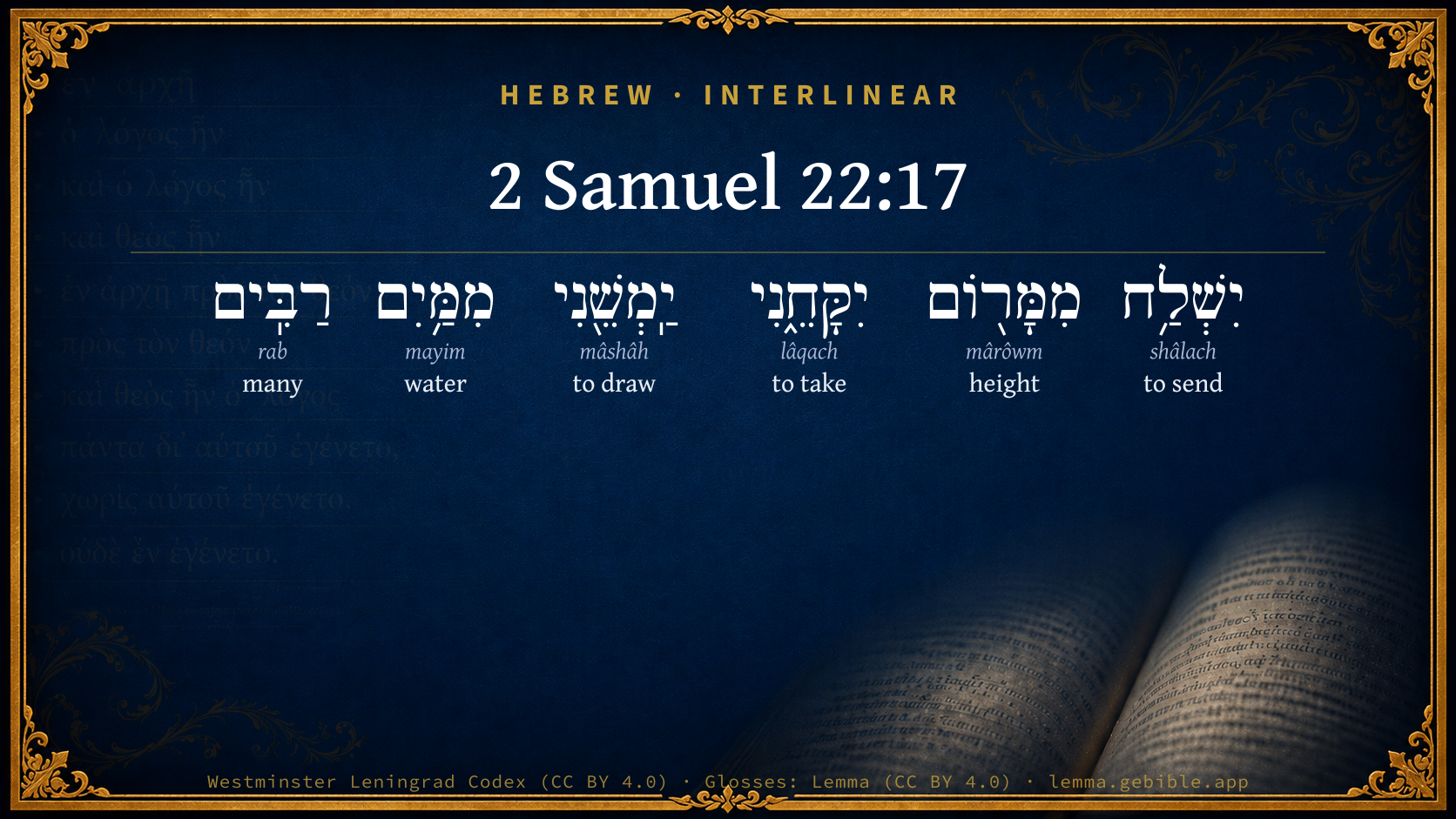
Hebrew (Westminster Leningrad Codex) 2 Samuel 22:17 appears in the Hebrew Old Testament. The text above is from the Westminster Leningrad Codex. Each word links to its Strong’s number, a concise gloss, and parsing drawn from the Open Scriptures Hebrew Bible morphology. Click any word for its full Brown-Driver-Briggs (BDB) entry.
Download image
Cite this verse

2 Samuel 22:17 (World English Bible). Public Domain. Lemma interlinear Bible study tool, https://lemma.gebible.app/v/2-samuel/22/17.

Show BibTeX & RIS
BibTeX
RIS
English Translation
He sent from on high, he took me; He drew me out of many waters;
World English Bible · Public Domain
Download a study sheet

One document with this verse’s original text, its word-by-word gloss line, the meaning frame, cross-references with their text, attributed commentary, and full source and license credits — printable, and it pastes into notes with its structure intact.

This verse Autodidact and up

Study sheet (.html) Plain text (.txt)

A passage Seminary Student

Up to 50 verses in one chapter. A passage sheet keeps up to 6 commentary sources and 12 cross-references per verse, in the order this page ranks them, and says so on the sheet whenever that leaves anything out. Ask for a single verse and you get the Autodidact verse sheet above.

Everything on this page stays free to read, with no account — the sheet is a download of what is already on screen, not access to it.

Want to remove ads? Support Godless Engineer
Compare translations 3

The same verse in 3 English versions, stacked beneath the original-language interlinear above. Click any original word for its lexicon entry.

Each is an independent rendering of the whole verse — the interlinear is not word-aligned to these translations.

Highlighted words mark where these versions differ — a whole-verse word diff, not a word-by-word alignment.

  • World English Bible Public Domain
    He sent from on high, he took me; He drew me out of many waters;
  • King James Version Public Domain
    He sent from above, he took me; he drew me out of many waters;
  • unfoldingWord Literal Text CC BY-SA 4.0
    He stretched out from the height, he took hold of me. He drew me out of many waters.

unfoldingWord Literal Text — © unfoldingWord, licensed CC BY-SA 4.0. Word-aligned USFM3 via Door43 (git.door43.org/unfoldingWord/en_ult).

Versions to compare (up to 4)

3 of 4 selected

Show all 18 translations

Every available English version of this verse, each an independent rendering of the whole verse.

  • World English Bible Public Domain
    He sent from on high, he took me; He drew me out of many waters;
  • Berean Standard Bible Public Domain
    He reached down from on high and took hold of me; He drew me out of deep waters.
  • Majority Standard Bible Public Domain
    He reached down from on high and took hold of me; He drew me out of deep waters.
  • King James Version Public Domain
    He sent from above, he took me; he drew me out of many waters;
  • American Standard Version (1901) Public Domain
    He sent from on high, he took me; He drew me out of many waters;
  • Revised Version (1885) Public Domain
    He sent from on high, he took me; he drew me out of many waters;
  • Geneva Bible (1599) Public Domain
    He sent from aboue, and tooke me: hee drewe me out of many waters.
  • Douay-Rheims (1899) Public Domain
    He sent from on high, and took me, and drew me out of many waters.
  • Young's Literal Translation Public Domain
    He sendeth from above -- He taketh me, He draweth me out of many waters.
  • Literal Standard Version CC BY-SA 4.0
    He sends from above—He takes me, || He draws me out of many waters.
  • Unlocked Literal Bible CC BY-SA 4.0
    He reached down from above; he took hold of me! He pulled me out of the surging water.
  • unfoldingWord Literal Text CC BY-SA 4.0
    He stretched out from the height, he took hold of me. He drew me out of many waters.
  • Darby Bible Public Domain
    He reached forth from above, he took me, He drew me out of great waters;
  • World Messianic Bible Public Domain
    He sent from on high and he took me. He drew me out of many waters.
  • Webster's Bible Public Domain
    He sent from above, he took me; he drew me out of many waters;
  • Free Bible Version CC BY-SA 4.0
    He reached down his hand from above and grabbed hold of me. He dragged me out of the deep water.
  • Bible in Basic English Public Domain
    He sent from on high, he took me, pulling me out of great waters.
  • JPS Tanakh (1917) Public Domain
    He sent from on high, He took me; He drew me out of many waters;

Literal Standard Version (2020), Covenant Press — licensed CC BY-SA 4.0. Text via the HelloAO Bible API (eBible.org). Unlocked Literal Bible (unfoldingWord) — licensed CC BY-SA 4.0. Text via the HelloAO Bible API (eBible.org). unfoldingWord Literal Text — © unfoldingWord, licensed CC BY-SA 4.0. Word-aligned USFM3 via Door43 (git.door43.org/unfoldingWord/en_ult). Free Bible Version, Dr. Jonathan Gallagher — licensed CC BY-SA 4.0. Text via the HelloAO Bible API (eBible.org).

Word by word

More ways to search: Search by grammar → Find every occurrence → Compare this word →

Practice this passage: Drill this verse → Learn its vocabulary →

About this verse

These counts appear in no published source. They are computed here, from the morphology-tagged text and Lemma’s own curated glosses. What Lemma adds →

6
words
6
distinct lemmas
Historical
section

Notable vocabulary

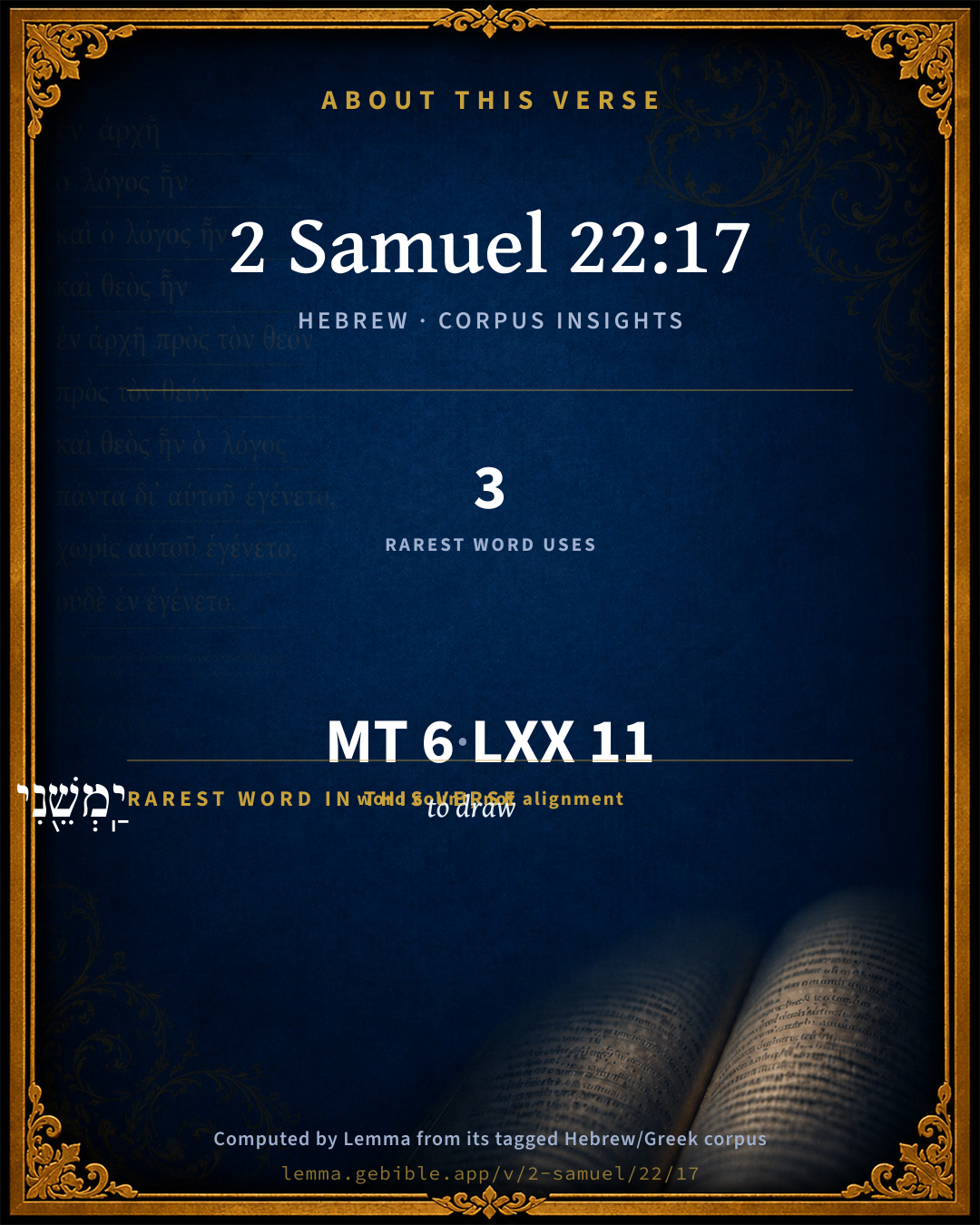
The rarest word here is יַֽמְשֵׁ֖נִי to draw H4871 — appearing just 3 times in the whole Hebrew Bible.

Shared distinctive vocabulary

יַֽמְשֵׁ֖נִי to draw H4871 occurs in 3 verses of the Hebrew Bible. Also found in:

Grammatical profile

  • 3 verbs
  • 2 nouns
  • 1 adjective

Verb forms

  • יִשְׁלַ֥ח Qal · Imperfect
  • יִקָּחֵ֑נִי Qal · Imperfect
  • יַֽמְשֵׁ֖נִי Hiphil · Imperfect

Hebrew & Septuagint length

In English translation the verse runs 15 words from the Hebrew and 14 from the Septuagint (LXX English) — closely comparable.

A rough comparison of the two English renderings, which tokenize alike — not a word-level alignment.

Word counts can differ between the Hebrew and the Greek without any difference in meaning — e.g. the Hebrew direct-object marker אֵת has no separate Greek word, and Greek often adds the article ὁ.

In the original languages it is 6 Hebrew tokens and 11 Greek tokens — but the two are counted differently (Hebrew bundles its prefixes and suffixes into one token; the Greek is in lemma form), so that isn’t a like-for-like length.

Cross-references

11

Topical passages linked to 2 Samuel 22:17 in the Treasury of Scripture Knowledge — connected by theme and wording, ordered by reader-vote popularity; previews shown in the World English Bible.

  • Isaiah 43:2 When you pass through the waters, I will be with you; and through the rivers, they shall not overflow you: when you walk through the fire, you shall not be burned, neither shall the flame kindle on you.
  • Psalms 144:7 Stretch out your hand from above, Rescue me, and deliver me out of great waters, Out of the hands of foreigners;
  • Psalms 18:16 He sent from on high. He took me. He drew me out of many waters.
  • Psalms 32:6 For this, let everyone who is godly pray to you in a time when you may be found. Surely when the great waters overflow, they shall not reach to him.
  • Psalms 130:1 Out of the depths I have cried to you, Yahweh.
  • Psalms 59:1–2 Deliver me from my enemies, my God. Set me on high from those who rise up against me.
  • Psalms 93:3–4 The floods have lifted up, Yahweh, The floods have lifted up their voice. The floods lift up their waves.
  • Psalms 124:4–5 Then the waters would have overwhelmed us, The stream would have gone over our soul;
  • Revelation 17:15 He said to me, "The waters which you saw, where the prostitute sits, are peoples, multitudes, nations, and languages.
  • Exodus 2:10 The child grew, and she brought him to Pharaoh's daughter, and he became her son. She named him Moses, and said, "Because I drew him out of the water."
  • Lamentations 3:54 Waters flowed over my head; I said, I am cut off.

Cross-references courtesy of OpenBible.info (CC BY 4.0).

Hebrew and Greek witnesses Masoretic Hebrew ↔ Greek Septuagint

The same verse in the two great witnesses to the Old Testament, shown verse-for-verse.

These are two independent witnesses, not word-aligned to each other, and the Septuagint is shown in lemma (dictionary) form.

Hebrew 2 Samuel 22:17 Masoretic · Westminster Leningrad Codex

יִשְׁלַ֥ח מִמָּר֖וֹם יִקָּחֵ֑נִי יַֽמְשֵׁ֖נִי מִמַּ֥יִם רַבִּֽים

He sent from on high, he took me; He drew me out of many waters;

World English Bible · Public Domain

Greek LXX 2 Samuel 22:17 Septuagint · lemma form

ἀποστέλλω ἐκ ὕψος καί λαμβάνω ἐγώ ἕλκω ἐγώ ἐκ ὕδωρ πολύς

He sent from above and took me; he drew me out of many waters.

LXX2012 (modern English Septuagint) · Public Domain

Hebrew: Westminster Leningrad Codex (CC BY 4.0). Greek: Septuagint (public domain); English from LXX2012 (modern English Septuagint) (Public Domain). How the Septuagint differs from the Hebrew →

Targum (Aramaic paraphrase)

1

The Targum is the ancient Jewish Aramaic paraphrase of the Hebrew Scriptures — an interpretive translation, not the Hebrew text itself. Onkelos (literal) and Pseudo-Jonathan (expansive) render the Torah, and Jonathan the Prophets. Coverage is partial: where no permissively-licensed English translation exists for a verse, only the Aramaic is shown. This is verse-level text, not a word-by-word alignment to the Hebrew.

  1. Targum Jonathan Prophets (Joshua–Malachi)
    שְׁלַח נְבִיוֹהִי מֶלֶךְ תַּקִיף דְיָתֵיב בִּתְקוֹף רוּמָא דַבַּרְנִי שֵׁיזְבַנִי מֵעַמְמִין סַגִיאִין:

    (no public-domain English translation for this verse)

    Targum Jonathan — Aramaic: “Mikraot Gedolot” (public domain). English: “Sefaria Community Translation” (CC0 1.0 (public-domain dedication)); “London "Chaldee Paraphrase," 1871” (public domain). Text via Sefaria.

Commentary

Notes on 2 Samuel 22:17 from classic Christian and Jewish commentators (each source and its license shown beneath its notes). The classic Christian expositions comment on the surrounding passage and are grouped to its opening verse, so a note may address several verses; the Jewish commentaries on the Tanakh (Rashi and others) are per-verse, so they appear only where the commentator wrote on this verse.

Lemma curates 59 commentaries, every one of them public domain or Creative Commons licensed, each selected and text-cleaned for this edition rather than reprinted as found. About our sources →

The Biblical Illustrator

Joseph S. Exell

2Sa_22:17

He sent from above, he took me; he drew me out of many waters.

Progress from above

All real progress is from God. There is no little truth in the observation of Mephistopheles that the human mind merely advances spirally, and reverts to a spot close to its origin. Dr. R. D. Hitch-cock says: In all human advancement, the motive power has not been a force in man, lifting him upward, or on the earthward side, driving him onward, but the movement has been along an inclined plane, due to an engine drawing from the top. (A. T. Pierson, D. D.)

Christ a deliverer

I have heard of the following story of a Chinaman who had become a disciple of the Lord Jesus. In explaining to others what Christ had done for him, he put it thus: It seemed as if I was at the bottom of a pit in great distress crying for help. Buddha passed and said, If you crawl up, never get clown again. Confucius then came to the pits mouth, and said, I have a rope at home that will go two-thirds down the pit, if you can crawl up one-third, but he left me; then the Lord Jesus, hearing my cry, came quickly to my rescue, put His hand down and helped me out of the pit; put my feet upon a rock, and established my goings; that is what Christ has done for me. (Newton Jones.)

The Biblical Illustrator, edited by Joseph S. Exell (c. 1880s–1900s) — public domain. Text from a community e-Sword module.

The Cambridge Bible for Schools and Colleges

gen. ed. J. J. S. Perowne

17–21. Jehovah’s deliverance of his servant for his faithfulness

17. He sent from above] He reached forth from on high: stretched out His hand and caught hold of the sinking man, and drew him out of the floods of calamity which were engulfing him. Cp. 2Sa_22:5; Psa_144:7.

drew me] A word found elsewhere only in Exo_2:10, and suggesting a parallel, as though David would say, ‘He drew me out of the great waters of distress, as He drew Moses out of the waters of the Nile, to be the deliverer of His people.’

The Cambridge Bible for Schools and Colleges (gen. ed. J. J. S. Perowne; Cambridge University Press, 1878–1918) — public domain. Text from a community e-Sword module.

John Gill's Exposition

As for God, his way is perfect; the word of the Lord is tried: he is a buckler to all them that trust in him. See Gill on Psa 18:30.

.

2 Samuel 22:32

sa2 22:32

sa2 22:32

sa2 22:32For who is God, save the Lord? and who is a rock, save our God? See Gill on Psa 18:31.

John Gill's Exposition of the Whole Bible (1746–1763) — public domain (CC PDM 1.0). Text via the HelloAO Bible API.

Whedon's Commentary on the Bible

Daniel D. Whedon

17. Sends from the height — Or, reaches forth his hand from the lofty seat above the clouds, where his Majesty is represented as appearing.

Great waters — Those billows of death and torrents of wickedness by which, according to 2Sa_22:5, he was surrounded.

Daniel D. Whedon (gen. ed.), Commentary on the Old and New Testaments (1874–1909) — public domain. Text from a community e-Sword module.

The Pulpit Commentary

Vers. 17-20.

He stretched forth his hand from on high; he took me, He drew me out of many waters. He delivered me from my strong enemy, From them that hated me; for they were too mighty for me.

For they attacked me in the day of my misfortune. But Jehovah became my Staff, And he brought me forth into a wide place He delivered me, because he had pleasure in me.

In the midst of this fearful convulsion of nature, while all around are stricken with panic, David sees a hand stretched out from above, ready to deliver him from the overwhelming flood of hatred and peril. Attacked me. The word does not signify "to prevent," or" anticipate," but "to assail" So in ver. 6, "The snares of death assailed me;" and in Isa_37:33, "The King of Assyria shall not attack this city with shield." It is the same verb in all these places. Staff; in the Authorized Version, "stay." But it means something to lean upon, and is rightly translated "staff" in Psa_23:4. A wide place; in opposition to the straits of affliction. He had pleasure in me. In 2Sa_15:26 this confidence is gone, and David doubts whether the favour of Jehovah had not been forfeited by him.

Vers. 17-20.

Rescue from mighty foes.

In vers. 8-16 the psalmist depicts Jehovah as appearing in his glory for the deliverance of his servant. The picture may have been occasioned by a storm which, in one of his battles, had terrified his enemies and aided in their discomfiture. (comp. Jos_10:11; 1Sa_7:10) In the text he narrates the deliverance itself.

I THE ENEMIES. Who were:

1. Malignant. "Hated me." There was not only opposition and contest, but personal hatred. Many of the Christian"s foes have this quality in a high degree, (Joh_17:14) notably their great leader and chief, Satan (equivalent to "adversary,". (1Pe_5:8)

1. Powerful. "My strong enemy too strong for me." In physical strength, or military, or in numbers. David may have had in view such instances as those recorded in 2Sa_8:3-5 and 21:15-17. The Christian"s foes also are "powers". (Eph_6:12) Wherein consists the power of the enemies of the righteous?

1. Their inherent vigour;

2. their adaptation to our lower nature;

3. their number.

4. Subtle. "They prevented me in the day of my calamity." They rushed upon him unexpectedly, when he was enfeebled by calamity, and poorly prepared for them. David may be thinking of the attack of the Syrians of Damascus, while he and his army were engaged with Hadadezer or exhausted by the contest with him; (2Sa_8:5) or of the assault of the giant Ishbi-benob, while he was faint from fighting against the Philistines. (2Sa_21:15, 2Sa_21:16) Thus, also, the Christian"s foes often surprise him when he is preoccupied or distressed by troubles. The day of calamity is a day of spiritual danger.

5. In a measure successful. So that he became as a man struggling for life in "great waters" (comp. vers. 5, 6). It seemed as if he must be swallowed up. Thus, also, the enemies of the Christian may do him much mischief, temporal and even spiritual; but there is a limit to their power. "For the eyes of the Lord run to and fro throughout the whole earth, to show himself strong in the behalf of them whose heart is perfect toward him". (2Ch_16:9)

II THE DELIVERER. Jehovah, the Almighty, whose glorious interposition on behalf of his servant, in answer to his cry of distress, is described in the previous verses. They set forth:

1. His awful majesty.

2. His power over all the forces of nature.

3. The intensity of his interest in his troubled servants. How he rouses himself, as it were, for the rescue of those in whom he delights (ver. 20).

4. His anger against their enemies. (Vers. 8, 9.) With such a Friend, who can neither be surprised, evaded, or resisted, the righteous need not dread the might of any adversary, nor despair of deliverance from the direst troubles.

III THE DELIVERANCE, God:

1. Supported him in his perils. "The Lord was my Stay.

1. He saved him from them. "He stretched forth his hand from on high; he laid hold of me; he drew me out of great waters; he delivered me," etc.

2. God"s hand can reach his servants in the lowest depths of trouble, and is strong to rescue them from the strongest of their foes.

3. He brought him into a condition of freedom and safety. "Into a large place," a broad, open space, where no "cords of Sheol," or "snares of death" (Ver. 6, Revised Version), would embarrass or endanger him; where he could move about with perfect freedom, and yet perfect security. Such help from on high is realized by God"s people in this world; perfectly when the hand of their God lays hold of them and raises them from earth to heaven.

IV THE PRAISE. (See homilies on vers. 2 4, 4, and 7.) The perfections and acts of Jehovah are of such a nature that to merely recite them is to praise him. We should acquaint ourselves as fully as possible with his excellences and works, that we may better praise him by declaring them; but our own experience of his power and goodness will give us the liveliest apprehension of them, and stimulate us to the most ardent praise. G.W.

The Pulpit Commentary (1880–1919), ed. H.D.M. Spence-Jones & Joseph S. Exell — public domain. Text from a community e-Sword module.

Keil & Delitzsch

C. F. Keil & F. Delitzsch

17 He reached out of the height, He laid hold of me;

Drew me out of great waters:

18 Saved me from my enemy strong;

From my haters, because they were too strong for me.

19 They fell upon me in my day of calamity:

Then Jehovah became my stay,

20 And led me out into a broad place;

Delivered me, because He had pleasure in me.

The Lord stretched His hand from the height into the deep abysses, which had been uncovered through the threatening of the wrath of God, and drew out the sinking man. ישׁלח without יד is used to denote the stretching out of the hand, and in the sense of reaching out to a thing (as in Sa2 6:6). רבּים מים (great waters) does not refer to the enemy, but to the calamities and dangers (waves of death and streams of Belial, Sa2 22:5) into which the enemies of the Psalmist had plunged him. ימשׁני, from משׁה (Exo 2:10), from which the name of Moses was derived, to whom there is probably an allusion made. As Moses was taken out of the waters of the Nile, so David was taken out of great (many) waters. This deliverance is still further depicted in a more literal terms in Sa2 22:18. עז איבי, my enemy strong, poetical for my strong enemy, does not refer to one single enemy, namely Saul; but, as the parallel "my haters" shows, is a poetical personification of all his enemies. They were stronger than David, therefore the Lord had to deliver him with an almighty hand. The "day of calamity" in which the enemy fell upon him (קדּם: see at Sa2 22:6) was the time when David wandered about in the desert helpless and homeless, fleeing from the pursuit of Saul. The Lord was then his support, or a staff on which he could support himself (vid., Psa 23:4), and led him out of the strait into the broad, i.e., into a broad space where he could move freely, because God had pleasure in him, and had chosen him in His grace to be His servant. This reason for his deliverance is carried out still further in what follows.

Keil & Delitzsch — Biblical Commentary on the Old Testament (1861–1891) — public domain (CC PDM 1.0). Text via the HelloAO Bible API. (Old Testament only.)

unfoldingWord translationNotes

Door43 World Missions Community

General Information:

This continues David's song to Yahweh. He uses parallelism to emphasize what he is saying. (See: Parallelism)

out of the surging water

David compares his enemies to a flood that threatens to drown him. (See: Metaphor)

He rescued me from my strong enemy

David's enemies were overwhelming. He praises God for delivering him from all his enemies.

unfoldingWord translationNotes — © Distant Shores Media and the Door43 World Missions Community, licensed CC BY-SA 4.0. Source: git.door43.org/Door43/en_tn.

Lesson kit

Teaching starters — assembled from the data on this page, not authored interpretation. Every prompt links to the verse data it draws on. Edit before teaching.

2 Samuel, in the Historical, opens this verse with 6 words (6 distinct Hebrew lemmas). Its most distinctive word is mâshâh (“to draw”). A historical commentator’s framing appears above. Read the whole chapter for the surrounding context.

Discussion questions

  1. What does “to draw” (mâshâh) contribute to the verse as a whole?
  2. How does Exodus 2:10, which shares the word «to draw», read alongside this verse?
  3. These translations render this verse differently; the difference is in the English rendering, not the original. What questions does that raise?
  4. «יִשְׁלַ֥ח» is a Qal Imperfect verb. How does that grammatical form shape the action described?
  5. Compare how The Biblical Illustrator and The Cambridge Bible for Schools and Colleges read this verse. Where do they agree or differ?

Things to notice

Reading settings

Reading text

Shown beneath each verse's original-language words.

Old Testament
Old Testament edition

Read the OT as the Masoretic Hebrew (MT) or the Greek Septuagint (LXX).

English shown for the Greek Septuagint (in the Hebrew ↔ Greek comparison).

Comparing translations? Open the Compare panel on any verse page to stack up to four side by side.