
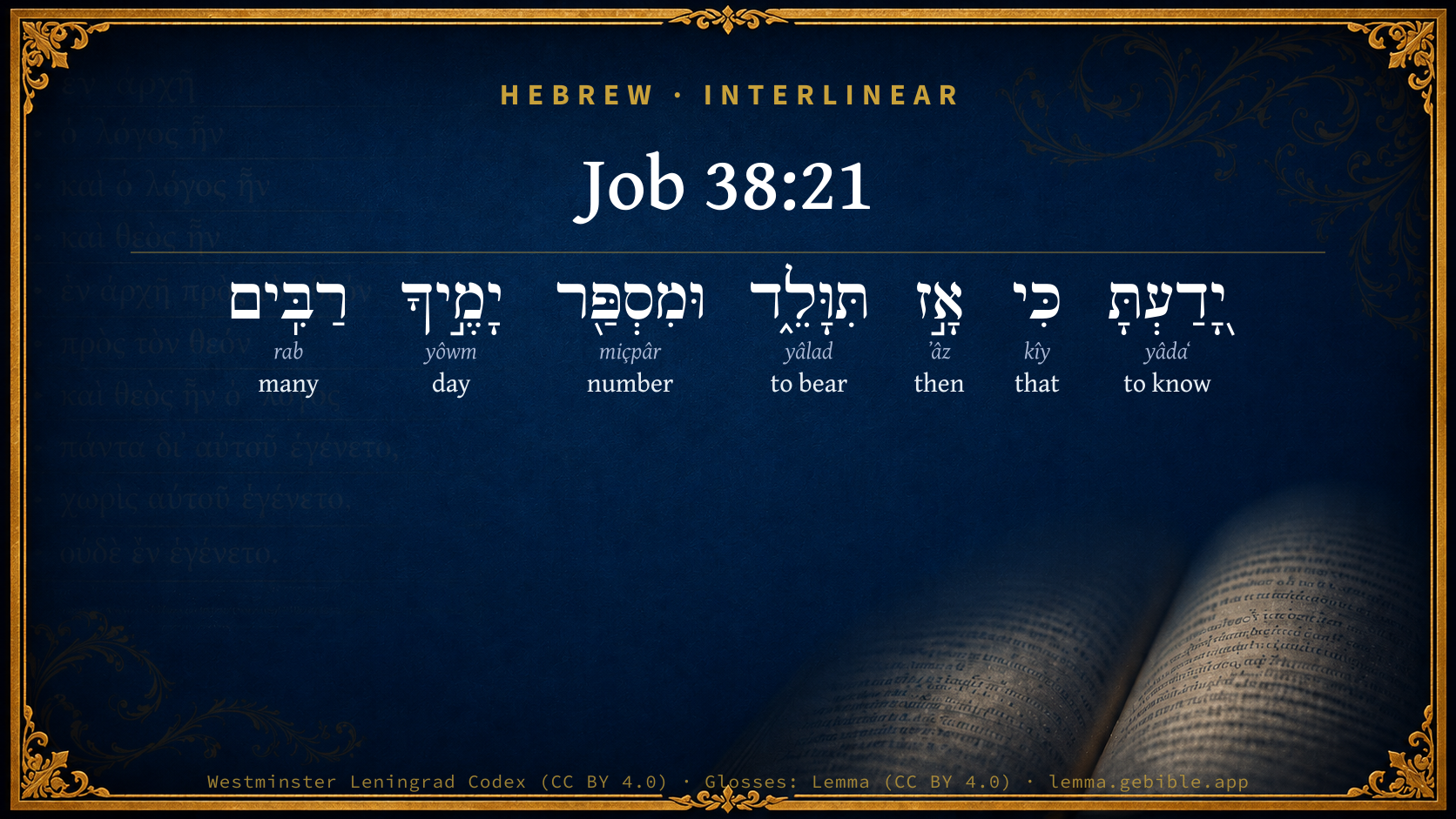
Job 38:21

Hebrew (Westminster Leningrad Codex) Job 38:21 appears in the Hebrew Old Testament. The text above is from the Westminster Leningrad Codex. Each word links to its Strong’s number, a concise gloss, and parsing drawn from the Open Scriptures Hebrew Bible morphology. Click any word for its full Brown-Driver-Briggs (BDB) entry.
Download image
Cite this verse

Job 38:21 (World English Bible). Public Domain. Lemma interlinear Bible study tool, https://lemma.gebible.app/v/job/38/21.

Show BibTeX & RIS
BibTeX
RIS
English Translation
Surely you know, for you were born then, And the number of your days is great!
World English Bible · Public Domain
Download a study sheet

One document with this verse’s original text, its word-by-word gloss line, the meaning frame, cross-references with their text, attributed commentary, and full source and license credits — printable, and it pastes into notes with its structure intact.

This verse Autodidact and up

Study sheet (.html) Plain text (.txt)

A passage Seminary Student

Up to 50 verses in one chapter. A passage sheet keeps up to 6 commentary sources and 12 cross-references per verse, in the order this page ranks them, and says so on the sheet whenever that leaves anything out. Ask for a single verse and you get the Autodidact verse sheet above.

Everything on this page stays free to read, with no account — the sheet is a download of what is already on screen, not access to it.

Want to remove ads? Support Godless Engineer
Compare translations 3

The same verse in 3 English versions, stacked beneath the original-language interlinear above. Click any original word for its lexicon entry.

Each is an independent rendering of the whole verse — the interlinear is not word-aligned to these translations.

Highlighted words mark where these versions differ — a whole-verse word diff, not a word-by-word alignment.

  • World English Bible Public Domain
    Surely you know, for you were born then, And the number of your days is great!
  • King James Version Public Domain
    Knowest thou it, because thou wast then born? or because the number of thy days is great?
  • unfoldingWord Literal Text CC BY-SA 4.0
    You know, for you were born then, and the number of your days many!

unfoldingWord Literal Text — © unfoldingWord, licensed CC BY-SA 4.0. Word-aligned USFM3 via Door43 (git.door43.org/unfoldingWord/en_ult).

Versions to compare (up to 4)

3 of 4 selected

Show all 18 translations

Every available English version of this verse, each an independent rendering of the whole verse.

  • World English Bible Public Domain
    Surely you know, for you were born then, And the number of your days is great!
  • Berean Standard Bible Public Domain
    Surely you know, for you were already born! And the number of your days is great!
  • Majority Standard Bible Public Domain
    Surely you know, for you were already born! And the number of your days is great!
  • King James Version Public Domain
    Knowest thou it, because thou wast then born? or because the number of thy days is great?
  • American Standard Version (1901) Public Domain
    `Doubtless', thou knowest, for thou wast then born, And the number of thy days is great!
  • Revised Version (1885) Public Domain
    Doubtless, thou knowest, for thou wast then born, and the number of thy days is great!
  • Geneva Bible (1599) Public Domain
    Knewest thou it, because thou wast then borne, and because the nomber of thy dayes is great?
  • Douay-Rheims (1899) Public Domain
    Didst thou know then that thou shouldst be born? and didst thou know the number of thy days?
  • Young's Literal Translation Public Domain
    Thou hast known -- for then thou art born And the number of thy days `are' many!
  • Literal Standard Version CC BY-SA 4.0
    You have known—for then you are born, || And the number of your days [are] many!
  • Unlocked Literal Bible CC BY-SA 4.0
    Undoubtedly you know, for you were born then; the number of your days is so large!
  • unfoldingWord Literal Text CC BY-SA 4.0
    You know, for you were born then, and the number of your days many!
  • Darby Bible Public Domain
    Thou knowest, for thou wast then born, and the number of thy days is great!
  • World Messianic Bible Public Domain
    Surely you know, for you were born then, and the number of your days is great!
  • Webster's Bible Public Domain
    Knowest thou it, because thou wast then born? or because the number of thy days is great?
  • Free Bible Version CC BY-SA 4.0
    Of course you know, because you were already born then! You've lived so long!
  • Bible in Basic English Public Domain
    No doubt you have knowledge of it, for then you had come to birth, and the number of your days is great.
  • JPS Tanakh (1917) Public Domain
    Thou knowest it, for thou wast then born, and the number of thy days is great!

Literal Standard Version (2020), Covenant Press — licensed CC BY-SA 4.0. Text via the HelloAO Bible API (eBible.org). Unlocked Literal Bible (unfoldingWord) — licensed CC BY-SA 4.0. Text via the HelloAO Bible API (eBible.org). unfoldingWord Literal Text — © unfoldingWord, licensed CC BY-SA 4.0. Word-aligned USFM3 via Door43 (git.door43.org/unfoldingWord/en_ult). Free Bible Version, Dr. Jonathan Gallagher — licensed CC BY-SA 4.0. Text via the HelloAO Bible API (eBible.org).

Word by word

More ways to search: Search by grammar → Find every occurrence → Compare this word →

Practice this passage: Drill this verse → Learn its vocabulary →

About this verse

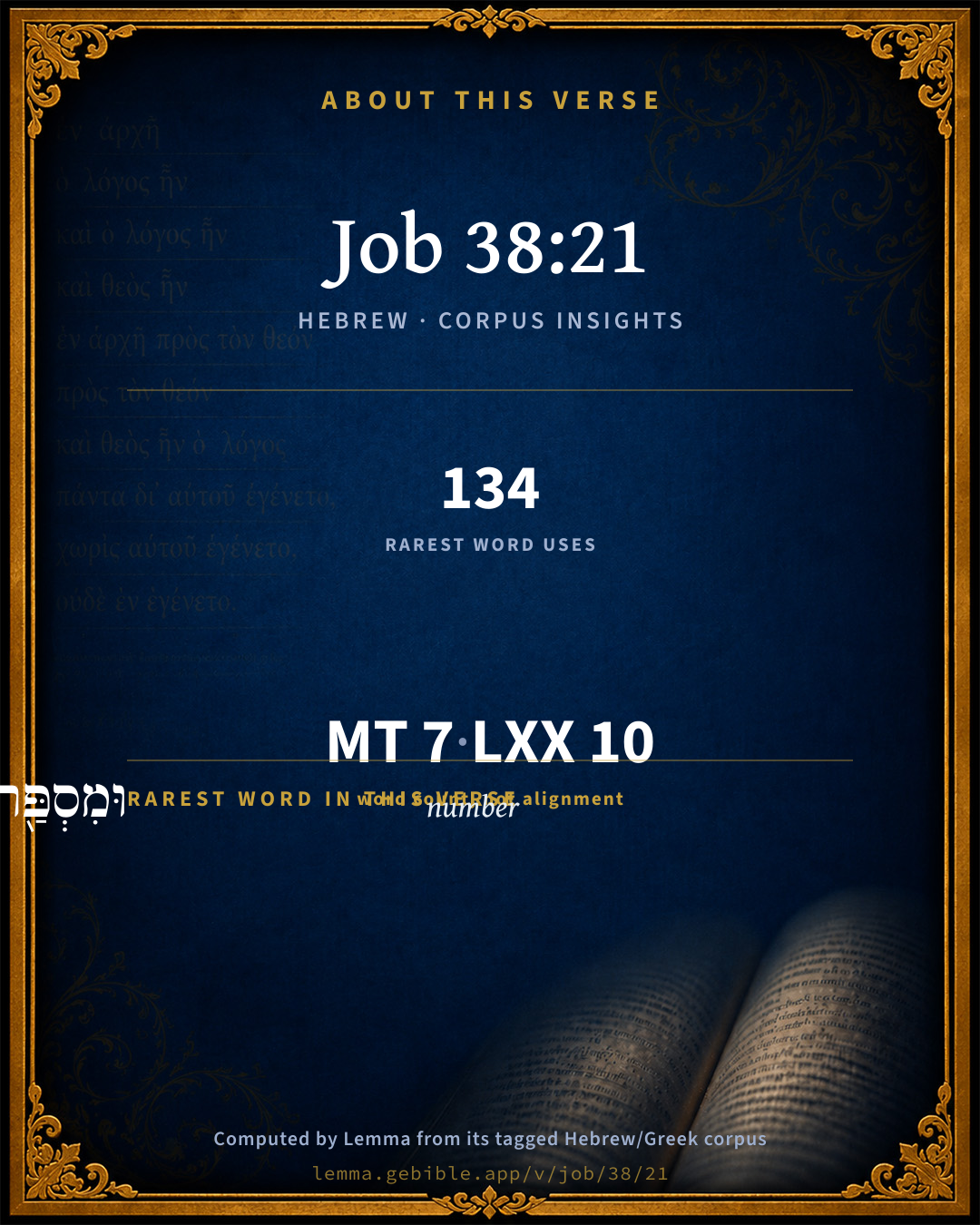
These counts appear in no published source. They are computed here, from the morphology-tagged text and Lemma’s own curated glosses. What Lemma adds →

7
words
7
distinct lemmas
Wisdom
section

Grammatical profile

  • 2 verbs
  • 2 nouns
  • 1 adjective
  • 1 conjunction
  • 1 adverb

Verb forms

  • יָ֭דַעְתָּ Qal · Perfect
  • תִּוָּלֵ֑ד Niphal · Imperfect

Hebrew & Septuagint length

In English translation the verse runs 16 words from the Hebrew and 18 from the Septuagint (LXX English) — closely comparable.

A rough comparison of the two English renderings, which tokenize alike — not a word-level alignment.

Word counts can differ between the Hebrew and the Greek without any difference in meaning — e.g. the Hebrew direct-object marker אֵת has no separate Greek word, and Greek often adds the article ὁ.

In the original languages it is 7 Hebrew tokens and 10 Greek tokens — but the two are counted differently (Hebrew bundles its prefixes and suffixes into one token; the Greek is in lemma form), so that isn’t a like-for-like length.

Cross-references

3

Topical passages linked to Job 38:21 in the Treasury of Scripture Knowledge — connected by theme and wording, ordered by reader-vote popularity; previews shown in the World English Bible.

  • Job 15:7 "Are you the first man who was born? Or were you brought forth before the hills?
  • Job 38:4 "Where were you when I laid the foundations of the earth? Declare, if you have understanding.
  • Job 38:12 "Have you commanded the morning in your days, And caused the dawn to know its place;

Cross-references courtesy of OpenBible.info (CC BY 4.0).

Hebrew and Greek witnesses Masoretic Hebrew ↔ Greek Septuagint

The same verse in the two great witnesses to the Old Testament, shown verse-for-verse.

These are two independent witnesses, not word-aligned to each other, and the Septuagint is shown in lemma (dictionary) form.

Hebrew Job 38:21 Masoretic · Westminster Leningrad Codex

יָ֭דַעְתָּ כִּי אָ֣ז תִּוָּלֵ֑ד וּמִסְפַּ֖ר יָמֶ֣יךָ רַבִּֽים

Surely you know, for you were born then, And the number of your days is great!

World English Bible · Public Domain

Greek LXX Job 38:21 Septuagint · lemma form

οἶδα ἄρα ὅτι τότε γεννάω ἀριθμός δέ ἔτος σύ πολύς

I know then that you were born at that time, and the number of your years is great.

LXX2012 (modern English Septuagint) · Public Domain

Hebrew: Westminster Leningrad Codex (CC BY 4.0). Greek: Septuagint (public domain); English from LXX2012 (modern English Septuagint) (Public Domain). How the Septuagint differs from the Hebrew →

Commentary

Notes on Job 38:21 from classic Christian and Jewish commentators (each source and its license shown beneath its notes). The classic Christian expositions comment on the surrounding passage and are grouped to its opening verse, so a note may address several verses; the Jewish commentaries on the Tanakh (Rashi and others) are per-verse, so they appear only where the commentator wrote on this verse.

Lemma curates 59 commentaries, every one of them public domain or Creative Commons licensed, each selected and text-cleaned for this edition rather than reprinted as found. About our sources →

Trapp's Complete Commentary

John Trapp

Job 38:21 Knowest thou [it], because thou wast then born? or [because] the number of thy days [is] great?

Ver. 21. Knowest thou it, because thou wast then born?] Beza readeth it thus, These things, forsooth, thou knowest, because thou wast then born (viz. when I made them, and appointed what order and course they should keep), and the number of thy days is great, thou art very far grown in years, as having lived ever since the creation, Es annosissimus et antiquissimus, &c. Ironice omnia.

John Trapp, A Commentary or Exposition upon All the Books of the Old and New Testament (1647–1656) — public domain. Text from a community e-Sword module.

Joseph Benson's Commentary

Job 38:21. Knowest thou it, because thou wast then born? — An ironical question. If thou pretendest that thou knowest these things, how camest thou by this knowledge? Was it because thou didst then exist in the full and perfect use of thy faculties, and thereby hadst the opportunity of inspecting my works, and of seeing whence the light came? Or, because thou hast gained this knowledge by long experience, as having lived ever since the creation of the world until this time? Whereas, in truth, thou art but of yesterday, and knowest, comparatively, nothing, Job 8:9.

Joseph Benson's Commentary on the Old and New Testaments (1811–1818) — public domain. Text from a community e-Sword module.

Tyndale Open Study Notes

Tyndale Open Resources

38:21 you were born before it was all created: Cp. Prov 8:25. This sarcasm resembles that of Eliphaz (Job 15:7).

Tyndale Open Study Notes — © Tyndale Open Resources, licensed CC BY-SA 4.0. Text via the HelloAO Bible API.

Jamieson, Fausset & Brown

Robert Jamieson, A. R. Fausset & David Brown

Or without the interrogation, in an ironical sense [UMBREIT].

then--when I created light and darkness (Job 15:7).

Jamieson, Fausset & Brown — Commentary Critical and Explanatory on the Whole Bible (1871) — public domain (CC PDM 1.0). Text via the HelloAO Bible API.

Adam Clarke's Commentary

Verse 21. Knowest thou] This is another strong and biting irony, and the literal translation proves it: "Thou knowest, because thou was then born; and the number of thy days is great," or multitudinous, רבים rabbim, multitudes.

Adam Clarke's Commentary on the Bible (1810–1826) — public domain. Text from a community e-Sword/MySword module.

Ellicott's Commentary for English Readers

(21) Knowest thou it?—It is better to read this verse without an interrogation, as sublime irony. “Doubtless thou knowest all this, for thou wast born then, and the number of thy days is so great!”

A Bible Commentary for English Readers, edited by Charles John Ellicott (1878–1897) — public domain. Text from a community e-Sword module.

The Cambridge Bible for Schools and Colleges

gen. ed. J. J. S. Perowne

21. The verse is ironical,

Thou knowest; for thou wast then born,

And the number of thy days is great.

The words “thou knowest” refer to the question, Job_38:19, Which is the way …? Job knows the way to the place of light, for he was born contemporary with it; he is as old as the dayspring which morning by morning has overspread the earth since creation’s dawn.

“Light is considered here, as in Genesis 1, to be a natural force, with an independent existence, apart from the heavenly luminaries that transmit it. And in this, as is well known, modern investigation coincides with the direct perceptions of antiquity” (Schlottmann, Comm. on Job, p. 468). To this remark it has to be added that in the present passage “darkness” also, no less than light, is regarded as a natural force, with an independent existence, and a “place” where it abides, contiguous to light. Science, to which Scripture is taught to look so humbly for approval, will no doubt confirm this representation also.

The Cambridge Bible for Schools and Colleges (gen. ed. J. J. S. Perowne; Cambridge University Press, 1878–1918) — public domain. Text from a community e-Sword module.

John Gill's Exposition

Knowest thou it, because thou wast then born?.... When light and darkness were first separated, and had their several apartments assigned them; their laws and rules given them, and their bounds and limits set them? No; he was not: and, had he been the first man, could not have been early enough to have been present at the doing of this, and so come at the knowledge thereof; since man was not made until the sixth day of the creation;

or because the number of thy days is great; reach to the beginning of time, and so as old as the creation. This was not the case. Some understand these words ironically; "thou knowest" the places and bounds of light and darkness, since thou art a very old man, born as soon as the world was. Whereas he was of yesterday, and knew nothing; which to convince him of is the design of this biting, cutting, expression. The Targum is,

"didst thou know then that thou shouldest be born, and the number of thy days many?''

No, Job did not know when he was born, nor of whom, and in what circumstances, but by the relation of others; and much less could he know before he was born, that he should be, or how long he should live in the world: but God knows all this beforehand; when men shall come into the world, at what period and of what parents, and how long they shall continue in it.

John Gill's Exposition of the Whole Bible (1746–1763) — public domain (CC PDM 1.0). Text via the HelloAO Bible API.

Albert Barnes' Notes on the Bible

Knowest thou it, because thou wast then born? - This may either be a question, or it may be spoken ironically. According to the former mode of rendering it, it is the same as asking Job whether he had lived long enough to understand where the abode of light was, or whether he had an existence when it was created, and knew where its home was appointed. According to the latter mode, it is keen sarcasm. “Thou must know all this, for thou art so old. Thou hast had an opportunity of observing all this, for thou hast lived through all these changes, and observed all the works of God.” This latter method of interpreting it is adopted by Umbreit, Herder, Noyes, Rosenmuller, and Wemyss. The former, however, seems much better to accord with the connection, and with the dignity and character of the speaker. It is not desirable to represent God as speaking in the language of irony and sarcasm unless the rules of interpretation imperatively demand it.

Albert Barnes' Notes on the Bible (1834–1885) — public domain. Text from a community e-Sword/MySword module.

Matthew Poole's English Annotations

An ironical question: If thou pretendest that thou knowest these things, and canst readily answer these questions, how comest thou by this knowledge? Was it from hence, because thou wast born when I made the world, and that first constitution of the light and darkness in that order and succession which continues to this day, and thereby hadst the opportunity of inspecting my works, and seeing whence the light came, and because thou hast gained this knowledge by long experience, as having lived ever since the creation of the world until this time? whereas in truth thou art but of yesterday, and knowest nothing, as was said, Job 8:9. But the words are and may be otherwise rendered, Dost or didst thou know, either by thy own remembrance, or by the information of others,

that thou wast then born? (to wit, when I made the world. Or, Didst thou know that thou shouldest then be born? then, to wit, when thou wast born. Or, Didst thou then know, the two Hebrew particles being transplaced, as is not unusual in that language, that thou shouldest be born? How couldst thou know this, when thou hadst no being?) and that the number of thy days should be great? that thou shouldst live so long as thou hast lived? Thou couldst neither foreknow the time of thy birth, nor the length of thy life. Or, and is the number of thy days great, i.e. so great that it reacheth to the time of the world’s creation?

Matthew Poole's English Annotations on the Holy Bible (1683–1685) — public domain. Text from a community e-Sword/MySword module.

Whedon's Commentary on the Bible

Daniel D. Whedon

21. Knowest thou it — Thou knowest! for then wast thou born, and the number of thy days is great! The keenest irony. Job knows so much, that he must have come into existence at the time when light and darkness were created!

Daniel D. Whedon (gen. ed.), Commentary on the Old and New Testaments (1874–1909) — public domain. Text from a community e-Sword module.

The Pulpit Commentary

Knowest thou it, because thou wast then born? The irony that has underlain the whole address comes here to the surface, and shows itself palpably. Job, of course, is as old as the Almighty, or, at any rate, coeval with creation; otherwise he could not presume to take the tone which he has taken, and arraign the moral government of the Creator. Or because the number of thy days is great! Compare the sarcasm of Eliphaz. (Job_15:7)

The Pulpit Commentary (1880–1919), ed. H.D.M. Spence-Jones & Joseph S. Exell — public domain. Text from a community e-Sword module.

Rashi

Rabbi Shlomo Yitzchaki (Rashi)

You knew all this.

for then you were born when I created (them).

Rashi on the Tanakh — English translations: “The Judaica Press complete Tanach with Rashi, translated by A. J. Rosenberg” (CC BY 4.0); “Pentateuch with Rashi's commentary by M. Rosenbaum and A.M. Silbermann, 1929-1934” (public domain); “The Metsudah Tanach series, Lakewood, N.J” (CC BY 4.0); and “The Book of Joshua, Metsudah Publications, 1997” (CC BY 4.0). Text via Sefaria.

Lesson kit

Teaching starters — assembled from the data on this page, not authored interpretation. Every prompt links to the verse data it draws on. Edit before teaching.

Job, in the Wisdom, opens this verse with 7 words (7 distinct Hebrew lemmas). Its most distinctive word is miçpâr (“number”). A historical commentator’s framing appears above. Read the whole chapter for the surrounding context.

Discussion questions

  1. The word miçpâr carries the sense “number.” How does it shape the verse?
  2. How does Job 15:7, which shares this passage’s theme, read alongside this verse?
  3. These translations render this verse differently; the difference is in the English rendering, not the original. What questions does that raise?
  4. «יָ֭דַעְתָּ» is a Qal Perfect verb. How does that grammatical form shape the action described?
  5. Compare how Trapp's Complete Commentary and Joseph Benson's Commentary read this verse. Where do they agree or differ?

Things to notice

Reading settings

Reading text

Shown beneath each verse's original-language words.

Old Testament
Old Testament edition

Read the OT as the Masoretic Hebrew (MT) or the Greek Septuagint (LXX).

English shown for the Greek Septuagint (in the Hebrew ↔ Greek comparison).

Comparing translations? Open the Compare panel on any verse page to stack up to four side by side.