Job 31:34

Hebrew (Westminster Leningrad Codex) Job 31:34 appears in the Hebrew Old Testament. The text above is from the Westminster Leningrad Codex. Each word links to its Strong’s number, a concise gloss, and parsing drawn from the Open Scriptures Hebrew Bible morphology. Click any word for its full Brown-Driver-Briggs (BDB) entry.
Download image
Cite this verse

Job 31:34 (World English Bible). Public Domain. Lemma interlinear Bible study tool, https://lemma.gebible.app/v/job/31/34.

Show BibTeX & RIS
BibTeX
RIS
English Translation
Because I feared the great multitude, And the contempt of families terrified me, So that I kept silence, and didn't go out of the door--
World English Bible · Public Domain
Download a study sheet

One document with this verse’s original text, its word-by-word gloss line, the meaning frame, cross-references with their text, attributed commentary, and full source and license credits — printable, and it pastes into notes with its structure intact.

This verse Autodidact and up

Study sheet (.html) Plain text (.txt)

A passage Seminary Student

Up to 50 verses in one chapter. A passage sheet keeps up to 6 commentary sources and 12 cross-references per verse, in the order this page ranks them, and says so on the sheet whenever that leaves anything out. Ask for a single verse and you get the Autodidact verse sheet above.

Everything on this page stays free to read, with no account — the sheet is a download of what is already on screen, not access to it.

Want to remove ads? Support Godless Engineer
Compare translations 3

The same verse in 3 English versions, stacked beneath the original-language interlinear above. Click any original word for its lexicon entry.

Each is an independent rendering of the whole verse — the interlinear is not word-aligned to these translations.

Highlighted words mark where these versions differ — a whole-verse word diff, not a word-by-word alignment.

  • World English Bible Public Domain
    Because I feared the great multitude, And the contempt of families terrified me, So that I kept silence, and didn't go out of the door--
  • King James Version Public Domain
    Did I fear a great multitude, or did the contempt of families terrify me, that I kept silence, and went not out of the door?
  • unfoldingWord Literal Text CC BY-SA 4.0
    because I feared the great multitude and the contempt of the clans terrified me, and I kept silent, I did not go out the door!

unfoldingWord Literal Text — © unfoldingWord, licensed CC BY-SA 4.0. Word-aligned USFM3 via Door43 (git.door43.org/unfoldingWord/en_ult).

Versions to compare (up to 4)

3 of 4 selected

Show all 18 translations

Every available English version of this verse, each an independent rendering of the whole verse.

  • World English Bible Public Domain
    Because I feared the great multitude, And the contempt of families terrified me, So that I kept silence, and didn't go out of the door--
  • Berean Standard Bible Public Domain
    because I greatly feared the crowds and the contempt of the clans terrified me, so that I kept silent and would not go outside—
  • Majority Standard Bible Public Domain
    because I greatly feared the crowds and the contempt of the clans terrified me, so that I kept silent and would not go outside—
  • King James Version Public Domain
    Did I fear a great multitude, or did the contempt of families terrify me, that I kept silence, and went not out of the door?
  • American Standard Version (1901) Public Domain
    Because I feared the great multitude, And the contempt of families terrified me, So that I kept silence, and went not out of the door-
  • Revised Version (1885) Public Domain
    Because I feared the great multitude, and the contempt of families terrified me, so that I kept silence, and went not out of the door—
  • Geneva Bible (1599) Public Domain
    Though I could haue made afraid a great multitude, yet the most contemptible of the families did feare me: so I kept silence, and went not out of the doore.
  • Douay-Rheims (1899) Public Domain
    If I have been afraid at a very great multitude, and the contempt of kinsmen hath terrified me: and I have not rather held my peace, and not gone out of the door.
  • Young's Literal Translation Public Domain
    Because I fear a great multitude, And the contempt of families doth affright me, Then I am silent, I go not out of the opening.
  • Literal Standard Version CC BY-SA 4.0
    Because I fear a great multitude, || And the contempt of families frightens me, || Then I am silent, I do not go out of the opening.
  • Unlocked Literal Bible CC BY-SA 4.0
    (because I feared the great multitude, because the contempt of families terrified me, so that I kept silent and would not go outside), then bring charges against me!
  • unfoldingWord Literal Text CC BY-SA 4.0
    because I feared the great multitude and the contempt of the clans terrified me, and I kept silent, I did not go out the door!
  • Darby Bible Public Domain
    Because I feared the great multitude, and the contempt of families terrified me, so that I kept silence, and went not out of the door,...
  • World Messianic Bible Public Domain
    because I feared the great multitude, and the contempt of families terrified me, so that I kept silence, and didn’t go out of the door—
  • Webster's Bible Public Domain
    Did I fear a great multitude, or did the contempt of families terrify me, that I kept silence, and went not out of the door?
  • Free Bible Version CC BY-SA 4.0
    Was I afraid of what everybody else would think, scared of the contempt families would show me, so that I kept quiet and didn't go outside?
  • Bible in Basic English Public Domain
    For fear of the great body of people, or for fear that families might make sport of me, so that I kept quiet, and did not go out of my door;
  • JPS Tanakh (1917) Public Domain
    Because I feared the great multitude, and the most contemptible among families terrified me, so that I kept silence, and went not out of the door.

Literal Standard Version (2020), Covenant Press — licensed CC BY-SA 4.0. Text via the HelloAO Bible API (eBible.org). Unlocked Literal Bible (unfoldingWord) — licensed CC BY-SA 4.0. Text via the HelloAO Bible API (eBible.org). unfoldingWord Literal Text — © unfoldingWord, licensed CC BY-SA 4.0. Word-aligned USFM3 via Door43 (git.door43.org/unfoldingWord/en_ult). Free Bible Version, Dr. Jonathan Gallagher — licensed CC BY-SA 4.0. Text via the HelloAO Bible API (eBible.org).

Word by word

More ways to search: Search by grammar → Find every occurrence → Compare this word →

Practice this passage: Drill this verse → Learn its vocabulary →

וּבוּז
bûwz
H937
“and · contempt of”
Conjunction + Noun, Common, Masculine, Singular, Construct
Part of Speech
Conjunction + Noun
Type
Common
Gender
Masculine
Number
Singular
State
Construct
Full BDB Definition

Origin: from H936

TWOT: 213a

contempt - springing from evil - springing from prosperity - springing from judgment
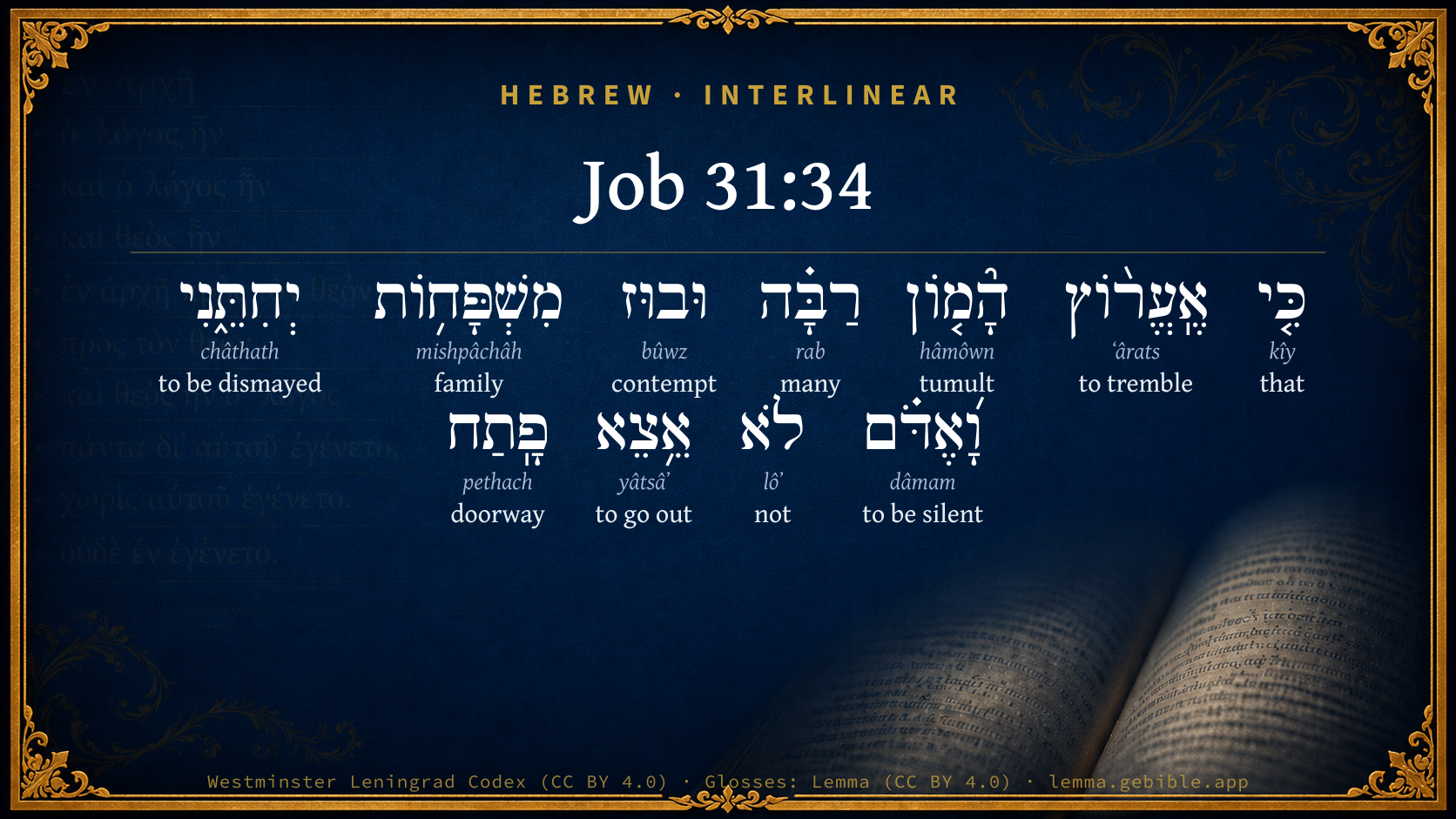
  1. כִּ֤י kîy H3588 “that” Conjunction
  2. אֶֽעֱר֨וֹץ ʻârats H6206 “to tremble” Verb, Qal, Imperfect, 1st Person, Common, Singular
  3. הָ֘מ֤וֹן hâmôwn H1995 “tumult” Noun, Common, Masculine, Singular, Absolute
  4. רַבָּ֗ה rab H7227 “many” Adjective, Adjective, Feminine, Singular, Absolute
  5. מִשְׁפָּח֥וֹת mishpâchâh H4940 “families” Noun, Common, Feminine, Plural, Absolute
  6. יְחִתֵּ֑נִי châthath H2865 “to be dismayed · me” Verb, Hiphil, Imperfect, 3rd Person, Masculine, Singular + Suffix, Personal, 1st Person, Common, Singular
  7. וָ֝אֶדֹּ֗ם dâmam H1826 “and · to be silent” Conjunction + Verb, Qal, Sequential Imperfect, 1st Person, Common, Singular
  8. לֹא lôʼ H3808 “not” Particle, Negative
  9. אֵ֥צֵא yâtsâʼ H3318 “to go out” Verb, Qal, Imperfect, 1st Person, Common, Singular
  10. פָֽתַח pethach H6607 “doorway” Noun, Common, Masculine, Singular, Absolute

About this verse

These counts appear in no published source. They are computed here, from the morphology-tagged text and Lemma’s own curated glosses. What Lemma adds →

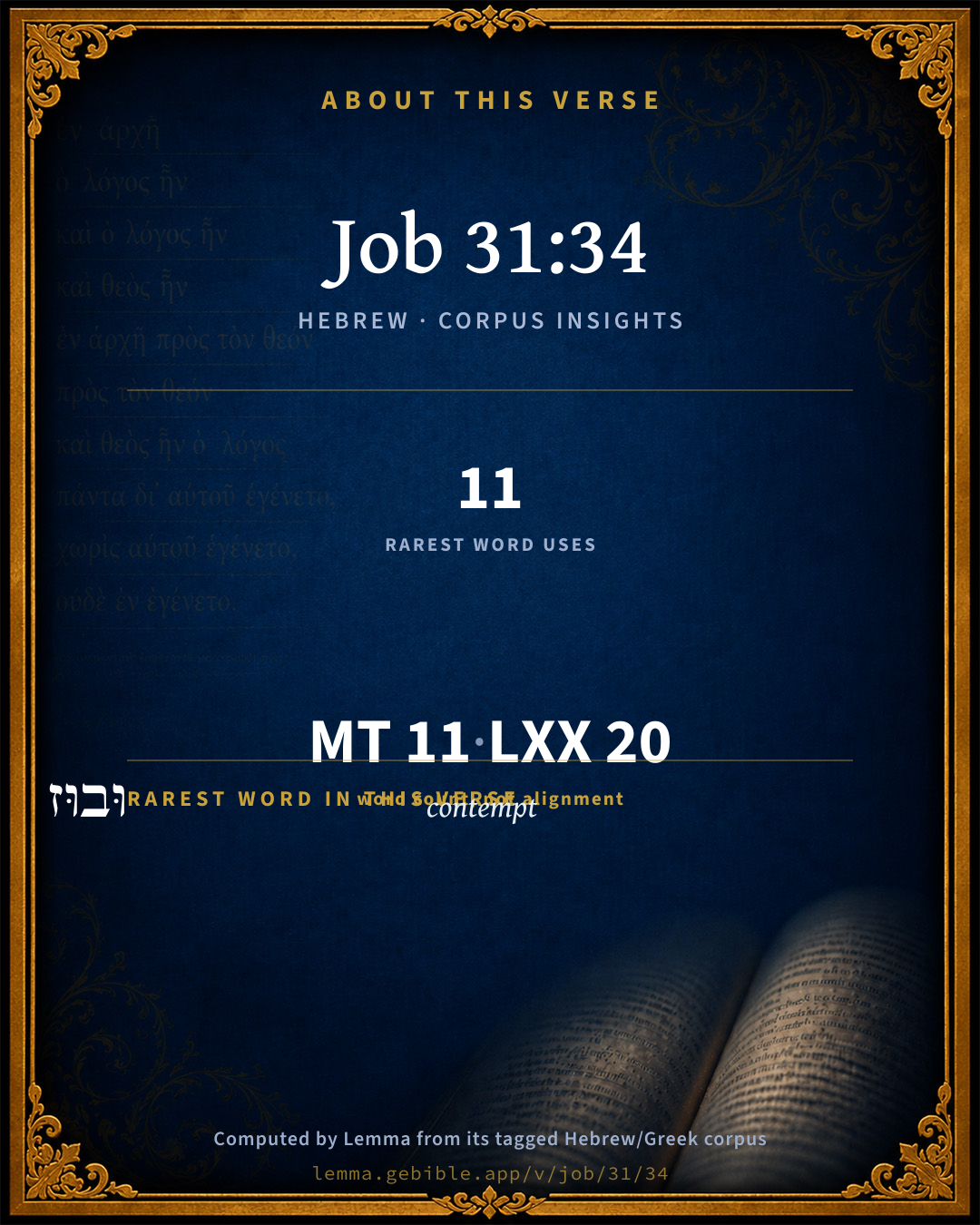
11
words
11
distinct lemmas
Wisdom
section

Notable vocabulary

The rarest word here is וּבוּז contempt H937 — appearing just 11 times in the whole Hebrew Bible.

Shared distinctive vocabulary

וּבוּז contempt H937 occurs in 11 verses of the Hebrew Bible. Also found in:

Grammatical profile

  • 4 verbs
  • 4 nouns
  • 1 adjective
  • 1 conjunction
  • 1 particle

Verb forms

  • אֶֽעֱר֨וֹץ Qal · Imperfect
  • יְחִתֵּ֑נִי Hiphil · Imperfect
  • וָ֝אֶדֹּ֗ם Qal · Sequential Imperfect
  • אֵ֥צֵא Qal · Imperfect

Hebrew & Septuagint length

In English translation the verse runs 25 words from the Hebrew and 37 from the Septuagint (LXX English) — the Septuagint runs noticeably longer here. See the side-by-side →

A rough comparison of the two English renderings, which tokenize alike — not a word-level alignment.

Word counts can differ between the Hebrew and the Greek without any difference in meaning — e.g. the Hebrew direct-object marker אֵת has no separate Greek word, and Greek often adds the article ὁ.

In the original languages it is 11 Hebrew tokens and 20 Greek tokens — but the two are counted differently (Hebrew bundles its prefixes and suffixes into one token; the Greek is in lemma form), so that isn’t a like-for-like length.

Cross-references

19

Topical passages linked to Job 31:34 in the Treasury of Scripture Knowledge — connected by theme and wording, ordered by reader-vote popularity; previews shown in the World English Bible.

  • Exodus 23:2 You shall not follow a crowd to do evil; neither shall you testify in court to side with a multitude to pervert justice;
  • Proverbs 29:25 The fear of man proves to be a snare, But whoever puts his trust in Yahweh is kept safe.
  • Exodus 32:27 He said to them, "Thus says Yahweh, the God of Israel, 'Every man put his sword on his thigh, and go back and forth from gate to gate throughout the camp, and every man kill his brother, and every man his companion, and every man his neighbor."
  • Numbers 25:14–15 Now the name of the man of Israel that was slain, who was slain with the Midianite woman, was Zimri, the son of Salu, a prince of a fathers' house among the Simeonites.
  • Nehemiah 5:7 Then I consulted with myself, and contended with the nobles and the rulers, and said to them, You exact usury, everyone of his brother. I held a great assembly against them.
  • Nehemiah 13:4–8 Now before this, Eliashib the priest, who was appointed over the chambers of the house of our God, being allied to Tobiah,
  • Nehemiah 13:28 One of the sons of Joiada, the son of Eliashib the high priest, was son-in-law to Sanballat the Horonite: therefore I chased him from me.
  • Esther 4:11 All the king's servants, and the people of the king's provinces, do know, that whoever, whether man or woman, shall come to the king into the inner court, who is not called, there is one law for him, that he be put to death, except those to whom the king shall hold out the golden scepter, that he may live: but I have not been called to come in to the king these thirty days.
  • Esther 4:14 For if you altogether hold your peace at this time, then will relief and deliverance arise to the Jews from another place, but you and your father's house will perish: and who knows whether you haven't come to the kingdom for such a time as this?
  • Job 22:8 But as for the mighty man, he had the earth. The honorable man, he lived in it.
  • Job 34:19 Who doesn't respect the persons of princes, Nor regards the rich more than the poor; For they all are the work of his hands.
  • Proverbs 24:11–12 Rescue those who are being led away to death! Indeed, hold back those who are staggering to the slaughter!
  • Jeremiah 38:4–5 Then the princes said to the king, Let this man, we pray you, be put to death; because he weakens the hands of the men of war who remain in this city, and the hands of all the people, in speaking such words to them: for this man doesn't seek the welfare of this people, but the hurt.
  • Jeremiah 38:16 So Zedekiah the king swore secretly to Jeremiah, saying, As Yahweh lives, who made us this soul, I will not put you to death, neither will I give you into the hand of these men who seek your life.
  • Jeremiah 38:19 Zedekiah the king said to Jeremiah, I am afraid of the Jews who are fallen away to the Chaldeans, lest they deliver me into their hand, and they mock me.
  • Amos 5:11–13 Forasmuch therefore as you trample on the poor, And take taxes from him of wheat: You have built houses of hewn stone, But you will not dwell in them. You have planted pleasant vineyards, But you shall not drink their wine.
  • Micah 7:3 Their hands are on that which is evil to do it diligently. The ruler and judge ask for a bribe; And the powerful man dictates the evil desire of his soul. Thus they conspire together.
  • Matthew 27:20–26 Now the chief priests and the elders persuaded the multitudes to ask for Barabbas, and destroy Jesus.
  • 2 Corinthians 5:16 Therefore we know no one after the flesh from now on. Even though we have known Christ after the flesh, yet now we know him so no more.

Cross-references courtesy of OpenBible.info (CC BY 4.0).

Hebrew and Greek witnesses Masoretic Hebrew ↔ Greek Septuagint

The same verse in the two great witnesses to the Old Testament, shown verse-for-verse.

Here the Septuagint runs noticeably longer than the Hebrew — LXX2012 (modern English Septuagint) 37 words vs World English Bible 25. A rough length comparison of the two English translations, not a word-level alignment — read both below.

These are two independent witnesses, not word-aligned to each other, and the Septuagint is shown in lemma (dictionary) form.

Hebrew Job 31:34 Masoretic · Westminster Leningrad Codex

כִּ֤י אֶֽעֱר֨וֹץ הָ֘מ֤וֹן רַבָּ֗ה וּבוּז מִשְׁפָּח֥וֹת יְחִתֵּ֑נִי וָ֝אֶדֹּ֗ם לֹא אֵ֥צֵא פָֽתַח

Because I feared the great multitude, And the contempt of families terrified me, So that I kept silence, and didn't go out of the door--

World English Bible · Public Domain

Greek LXX Job 31:34 Septuagint · lemma form

οὐ γάρ διατρέπω πολυοχλία πλῆθος ὁ μή ἐκἀγορεύω ἐνώπιον αὐτός εἰ δέ καί ἐάω ἀδύνατος ἐκἔρχομαι θύρα ἐγώ κόλπος κενός

(for I did not stand in awe of a great multitude, so as not to declare boldly before them:) and if too I permitted a poor man to go out of my door with an empty bosom:

LXX2012 (modern English Septuagint) · Public Domain

Hebrew: Westminster Leningrad Codex (CC BY 4.0). Greek: Septuagint (public domain); English from LXX2012 (modern English Septuagint) (Public Domain). How the Septuagint differs from the Hebrew →

Commentary

Notes on Job 31:34 from classic Christian and Jewish commentators (each source and its license shown beneath its notes). The classic Christian expositions comment on the surrounding passage and are grouped to its opening verse, so a note may address several verses; the Jewish commentaries on the Tanakh (Rashi and others) are per-verse, so they appear only where the commentator wrote on this verse.

Lemma curates 59 commentaries, every one of them public domain or Creative Commons licensed, each selected and text-cleaned for this edition rather than reprinted as found. About our sources →

Trapp's Complete Commentary

John Trapp

Job 31:34 Did I fear a great multitude, or did the contempt of families terrify me, that I kept silence, [and] went not out of the door?

Ver. 34. Did I fear a great multitude] Or, Though I should have terrified a great multitude, yet the most contemptible of the families frayed me (or humbled me), so that I held my peace, and went not out of doors; q.d. I could by my greatness have borne out my misdemeanors, and who dared have once questioned me, or quacked before me? But this I did not, I dared not; as being reined in by the reverential fear of God; yea, rather, if any one, though but of the meanest rank, had come to me, and admonished me friendly of my faults, or else, more sharply reproved me, I took it well aworth from him, not once opening my mouth to contend with him for my sins, not at all stirring out of doors to do him hurt. Let us fight with our faults, and not with our friends that tell us of them, said that German emperor. And when a poor hermit came to our Richard I, A.D. 1195, and preaching to him the words of eternal life, bade him be mindful of the subversion of Sodom, and abstain from things unlawful; otherwise (said he) the deserved vengeance of God will come upon thee; the king laid these things to heart, and became more devout and charitable to the poor.

That I kept silence, and went not out of the door] I replied, not in defence of what evil I had done; I cried not, as they used to do in courts of justice, Non feci, Not guilty; but Me, me, ego qui feci, I am verily guilty, and for this cause I went not out of doors, but kept me at home as much as I might, through shame and grief for what I had done amiss. I held my tongue, and hid my head. This was right; and this seems to me to be the right interpretation of the text among those many others that are brought by expositors.

John Trapp, A Commentary or Exposition upon All the Books of the Old and New Testament (1647–1656) — public domain. Text from a community e-Sword module.

Joseph Benson's Commentary

Job 31:34. Did I fear a great multitude? — No: all that knew Job, knew him to be a man of resolution, that boldly appeared, spoke, and acted, in defence of religion and justice. He durst not keep silence, or stay within, when called to speak or act for God. He was not deterred by the number, or quality, or insults of the injurious, from reproving them, and doing justice to the injured.

Joseph Benson's Commentary on the Old and New Testaments (1811–1818) — public domain. Text from a community e-Sword module.

Whedon's Commentary on the Bible

Daniel D. Whedon

34. Did I fear, etc. — Because I feared the great multitude, and the contempt of families terrified me, so that I kept silence, and went not out of the door. He affirms with renewed solemnity (with the if as before) that he has covered no transgression (Job_31:33) because he feared the stigma of the families, and the consequent loss of reputation. (Job_31:34.) Had he been such a secret sinner as the friends represented him to be, he would rather have slunk away from society. Brentius cites the case of Demosthenes, who feared to enter the popular assembly lest he should be accused of corruption, and alleged as an excuse for his silence and absence that he had the quinsy, when, so his enemies said, he had the silver-quinsy. — PLUTARCH, Demos., 25.

Daniel D. Whedon (gen. ed.), Commentary on the Old and New Testaments (1874–1909) — public domain. Text from a community e-Sword module.

Geneva Bible (1599)

Geneva Bible translators

I suffered them to speak evil of me, and went not out of my house to revenge it.

That is, I reverenced the most weak and contemned, and was afraid to offend them.

Geneva Bible (1599) marginal notes — public domain. Text via Bolls.life.

Jamieson, Fausset & Brown

Robert Jamieson, A. R. Fausset & David Brown

Rather, the apodosis to Job 31:33, "Then let me be fear-stricken before a great multitude, let the contempt, &c., let me keep silence (the greatest disgrace to a patriot, heretofore so prominent in assemblies), and not go out," &c. A just retribution that he who hides his sin from God, should have it exposed before man (Sa2 12:12). But Job had not been so exposed, but on the contrary was esteemed in the assemblies of the "tribes"--("families"); a proof, he implies, that God does not hold him guilty of hiding sin (Job 24:16, contrast with Job 29:21-25).

Jamieson, Fausset & Brown — Commentary Critical and Explanatory on the Whole Bible (1871) — public domain (CC PDM 1.0). Text via the HelloAO Bible API.

Adam Clarke's Commentary

Verse 34. Did I fear a great multitude] Was I ever prevented by the voice of the many from decreeing and executing what was right? When many families or tribes espoused a particular cause, which I found, on examination, to be wrong, did they put me in fear, so as to prevent me from doing justice to the weak and friendless? Or, in any of these cases, was I ever, through fear, self-seeking, or favour, prevented from declaring my mind, or constrained to keep my house, lest I should be obliged to give judgment against my conscience? Mr. Good thinks it an imprecation upon himself, if he had done any of the evils which he mentions in the preceding verse. He translates thus: -

"Then let me be confounded before the assembled multitude,

And let the reproach of its families quash me!

Yea, let me be struck dumb! let me never appear abroad!"

I am satisfied that Job 31:38-40, should come in either here, or immediately after Job 31:25; and that Job's words should end with Job 31:37, which, if the others were inserted in their proper places, would be Job 31:40. See the reasons at the end of the chapter. See Clarke on Job 31:40.

Adam Clarke's Commentary on the Bible (1810–1826) — public domain. Text from a community e-Sword/MySword module.

The Cambridge Bible for Schools and Colleges

gen. ed. J. J. S. Perowne

34. a great multitude] i. e. the general mass, or the assembly, of the people.

contempt of families] i. e. the great clans or tribes. The verse gives the reason why Job, if he had been conscious of sins, would have refrained from going forth at the door, fear of the contempt of men would have deterred him. The passage ch. Job_29:7 seq. shews that he was deterred by no such fear, he constantly frequented the assembly and “sat as king” in the midst of the people.

What Job affirms in these verses is not of course that, when he was guilty of any transgressions, he did not conceal but openly acknowledged them. On the contrary he affirms that he had no sins which he needed to conceal. He lived in the broad day and without fear confronted all (ch. Job_29:7 seq.) because he had nothing to hide. Job repudiates all hypocritical conduct or secret transgression. This was the charge his friends made against him. And this consciousness of purity of heart, struggling with false accusations of hypocrisy, forces from him a new appeal to God to make known to him the sins laid to his charge, Job_31:35-37. The verses are closely connected with Job_31:33-34.

35. Oh that I had one who would hear me!—

Behold my signature! Let the Almighty answer me!—

And that I had the charge which mine adversary had written!

36. Surely I would carry it upon my shoulder,

I would bind it as a crown unto me;

37. I would declare unto him the number of my steps,

As a prince would I go near unto him.

The Cambridge Bible for Schools and Colleges (gen. ed. J. J. S. Perowne; Cambridge University Press, 1878–1918) — public domain. Text from a community e-Sword module.

John Gill's Exposition

Surely I would take it upon my shoulder,.... The bill of indictment, the charge in writing; this he would take up and carry on his shoulder as a very light thing, having nothing weighty in it, no charge of sin and guilt to bear him down; nothing but what he could easily stand up under, only some trifling matter, which could not be interpreted sin; for anything of that kind would have been a burden too heavy for him to have borne: or else his sense is, that should he be convicted of any sin, he would openly confess the charge, acknowledge the sin in the most public manner, that being visible which is borne upon the shoulder; and would also patiently bear the afflictions and chastisements that were laid upon him for it: though rather the meaning is, that he should take up and carry such a bill, not as a burden, but as an honour, as one bears a sword of state, or carries a sceptre as an ensign of royalty on his shoulder; to which the allusion may be in Isa 9:6; not at all doubting but it would turn out to his glory; which is confirmed by what follows;

and bind it as a crown to me, or "crowns" (q), having various circles of gold hung with jewels; signifying that he would not only take his bill or charge, and carry it on his shoulder, but put it on his head, and wear it there, as a king does his crown; which is an ornament and honour to him, as he should reckon this bill, seeing it would give him an opportunity of clearing himself effectually.

(q) "diademata", Montanus; "corollas", Tigurine version; "coronas", Vatablus, Piscator, Cocceius, Michaelis.

John Gill's Exposition of the Whole Bible (1746–1763) — public domain (CC PDM 1.0). Text via the HelloAO Bible API.

Albert Barnes' Notes on the Bible

Did I fear a great multitude - Our translators have rendered this as if Job meant to say that he had not been deterred from doing what he supposed was right by the fear of others; as if he had been independent, and had done what he knew to be right, undeterred by the fear of popular fury, or the loss of the favor of the great. This version is adopted also by the Vulgate, by Herder, and substantially by Coverdale and Luther. Another interpretation has, however, been proposed, and is adopted by Schultens, Noyes, Good, Umbreit, Dathe, and Scott, which is, that this is to be regarded as an imprecations, or that this is the punishment which he invoked and expected if he had been guilty of the crime which is specified in the previous verses. The meaning then would be “Then let me be confounded before the great multitude! Let the contempt of families cover me with shame! Let me keep silence, and let me never appear abroad!” The Hebrew will admit of either construction, and either of them will accord well with the connection. The latter, however, regarding it as an imprecation, seems to me to be preferable, for two reasons:

(1) It will accord more forcibly with what he had said in the previous verse. The sense then would be, as expressed by Patrick, “If I have studied to appear better than I am, and have not made a free confession, but, like our first parent, have concealed or excused my faults, and, out of self-love, have hidden mine iniquity, because I dread what the people will say of me, or am terrified by the contempt into which the knowledge of my guilt will bring me with the neighboring families, then am I content my mouth should be stopped, and that I never stir out of my door any more.”

(2) This interpretation seems to be required, in order to make a proper close of his remarks. The general course in this chapter has been to specify an offence, and then to utter an imprecation if he had been guilty of it. In the previous verses he had specified crimes of which he had declared himself innocent; but unless this verse be so regarded, there is no invocation of any corresponding punishment if he had been guilty. It seems probable, therefore, that this verse is so to be regarded. According to this, the phrase “Did I fear a great multitude” means, “Then let me be terrified by a multitude - by the opinions of the world, and let this be the punishment of my sin. Since by the fear of others I was led to hide my sin in my bosom, let it be my lot to lose all popular favor, and feel that I am the object of public scorn and contempt!”

Or did the contempt of families terrify me - Let the contempt of families crush me; let me be despised and abhorred by them. If I was led to hide sins in my bosom because I feared them, then let me be doomed to the total loss of their favor, and become wholly the object of their scorn.

That I kept silence - Or let me keep silence as a punishment. That is, let me not be admitted as a counsellor, or allowed to express my sentiments in the public assemblies.

And went not out at the door - That is, “Let me not go out at the door. Let me be confined to my dwelling, and never be allowed to appear in public, to mingle in society, to take part in public affairs - because by the fear of the world I attempted to hide my faults in my bosom. Such a punishment would be appropriate to such an offence. The retribution would be no more than a suitable recompense for such an act of guilt - and I would not shrink from it.”

Albert Barnes' Notes on the Bible (1834–1885) — public domain. Text from a community e-Sword/MySword module.

Haydock's Catholic Bible Commentary

Have not. Hebrew, "that I kept silence, not going out of doors" to defend the innocent. (Haydock) --- Moses commands judges to do their duty without fear, Exodus xxiii. 2. People in such situations ought to be uninfluenced by hatred, love, &c. Cæsar says, justly, (in Sallust) "qui de rebus dubiis consultant, ab adio, amicitia, ira atque misericordia vacuos esse decet. Haud facile animus verum providet, ubi illa officiunt." (Haydock)

George Leo Haydock (1774–1849), Haydock's Catholic Family Bible and Commentary, 1859 edition — public domain. Excludes Psalms (Douay-Rheims chapter numbering differs from Protestant) and Deuterocanonical books (Catholic canon only).

Matthew Poole's English Annotations

This verse either,

1. Contains new matter, and another argument or evidence of his integrity, taken from his courage and faithfulness in the discharge of his duty as a magistrate. The interrogation implies a denial; and so the sense is either,

1. This, I did not for fear of a great multitude, or for any contempt, or reproach, or other inconvenience which might befall me from great and numerous families, or combinations of people, who were engaged for him who had an unrighteous cause, forbear to speak for the poor oppressed and injured person whom they all opposed, or deny to go out of the door of my house to plead his cause, as a timorous and man-pleasing judge would have done. Or,

2. This, Though I could have terrified or violently oppressed

a great multitude, because of my great power and interest, yet did the most contemptible persons or families terrify me, i.e. I was afraid to do them any injury, not for fear of them, as appears from the former clause, but for fear of God; therefore I kept

silence, and went not out of the door, i.e. I durst neither move tongue, nor hand, nor foot against them. Or,

2. It contains an amplification or confirmation of what he said, Job 31:33; either thus, Did I cover or conceal my transgressions, because I was afraid of the rage of the multitude, or of the contempt of families, which would be brought upon me by the confession of my wickedness? Did I therefore keep silence, i.e. forbore to confess my sin, and not go out of my door; but keep at home as one in that case ashamed or afraid to be seen abroad? No, the fear of shame or contempt from men did not hinder me from giving glory to God by confessing my faults. Or rather thus, Did I therefore cover all my oppressions, and frauds, and other wickednesses (wherewith you tax me) with the mask of virtue and piety, and use all possible caution and cunning in my evil courses, because I feared the great multitude, (who were my friends and admirers, but in case of the discovery of my wickedness would have hated and persecuted me,) or because the contempt of so many families (whose favour and good opinion I needed or desired) terrified me? Then (as the particle vau is oft used, i. e. if that were really my case) I should be silent, (I should silently and patiently bear all the strokes of God, and all the reproaches of my friends,) and not go out of the door of my house, as one ashamed to show his face before men. But my condition being through God’s mercy far otherwise, and my conscience bearing me witness of my integrity in these and many other things, I dare now lift up my head, and open my mouth to plead my cause, and I desire nothing more than a fair hearing; Oh that one would hear me! as it follows in the next verse.

Matthew Poole's English Annotations on the Holy Bible (1683–1685) — public domain. Text from a community e-Sword/MySword module.

The Pulpit Commentary

Did I fear a great multitude! rather, because I feared the great multitude" or the great assembly; i.e. the gathering of the people in the gate on occasions of public business. It" Job had been conscious of any great and heinous sins" he would not have led the open and public life which, previously to his calamities, he had always led; (Job_29:7-10, Job_29:21-25) he would have been afraid to make his appearance at public meetings, lest his sins should have become known, and should draw upon him scorn and contempt, instead of the respect and acclamations to which he was accustomed. Or did the contempt of families terrify me? rather, and the contempt of families terrified me. The contempt of the assembled tribes and families, which might have been poured out upon him at such meetings, would have been quite sufficient to prevent his attending them. If by any accident he had found himself at one, and had seen that he was looked upon with disfavour, he must have kept silence in order to avoid observation. Prudence would have counselled that more complete abstention which is implied in the phrase, and went not out of the door; i.e. "stayed at home in mine own house."

The Pulpit Commentary (1880–1919), ed. H.D.M. Spence-Jones & Joseph S. Exell — public domain. Text from a community e-Sword module.

John Wesley's Explanatory Notes

Did I fear - No: all that knew Job knew him to be a man of resolution, that boldly appeared, spoke and acted, in defense of religion and justice. He durst not keep silence, or stay within, when called to speak or act for God. He was not deterred by the number, or quality, or insults of the injurious, from reproving them, and doing justice to the injured.

John Wesley, Explanatory Notes Upon the Whole Bible (1754–1765) — public domain. Text via the GEBible commentary corpus.

Rashi

Rabbi Shlomo Yitzchaki (Rashi)

For I would subdue Originally I would subdue a great multitude of wicked men, but now, even among the Chaldeans—“This people has never been” (Isa. 23:13).

Rashi on the Tanakh — English translations: “The Judaica Press complete Tanach with Rashi, translated by A. J. Rosenberg” (CC BY 4.0); “Pentateuch with Rashi's commentary by M. Rosenbaum and A.M. Silbermann, 1929-1934” (public domain); “The Metsudah Tanach series, Lakewood, N.J” (CC BY 4.0); and “The Book of Joshua, Metsudah Publications, 1997” (CC BY 4.0). Text via Sefaria.

Lesson kit

Teaching starters — assembled from the data on this page, not authored interpretation. Every prompt links to the verse data it draws on. Edit before teaching.

Job, in the Wisdom, opens this verse with 11 words (11 distinct Hebrew lemmas). Its most distinctive word is bûwz (“contempt”). The Greek Septuagint runs longer here. A historical commentator’s framing appears above. Read the whole chapter for the surrounding context.

Discussion questions

  1. The word bûwz carries the sense “contempt.” How does it shape the verse?
  2. Genesis 38:23 shares the word «contempt» with this verse. How do the two illuminate each other?
  3. Compared with the Hebrew, the Septuagint runs longer here. What questions does that raise?
  4. These translations render this verse differently. What is at stake in choosing one wording over another?
  5. The verb «אֶֽעֱר֨וֹץ» is Qal Imperfect. How does its form color the action?
  6. Reading how Trapp's Complete Commentary and Joseph Benson's Commentary read this verse, where do the two commentators agree and where do they part?

Things to notice

Reading settings

Reading text

Shown beneath each verse's original-language words.

Old Testament
Old Testament edition

Read the OT as the Masoretic Hebrew (MT) or the Greek Septuagint (LXX).

English shown for the Greek Septuagint (in the Hebrew ↔ Greek comparison).

Comparing translations? Open the Compare panel on any verse page to stack up to four side by side.