
Judges 7:2

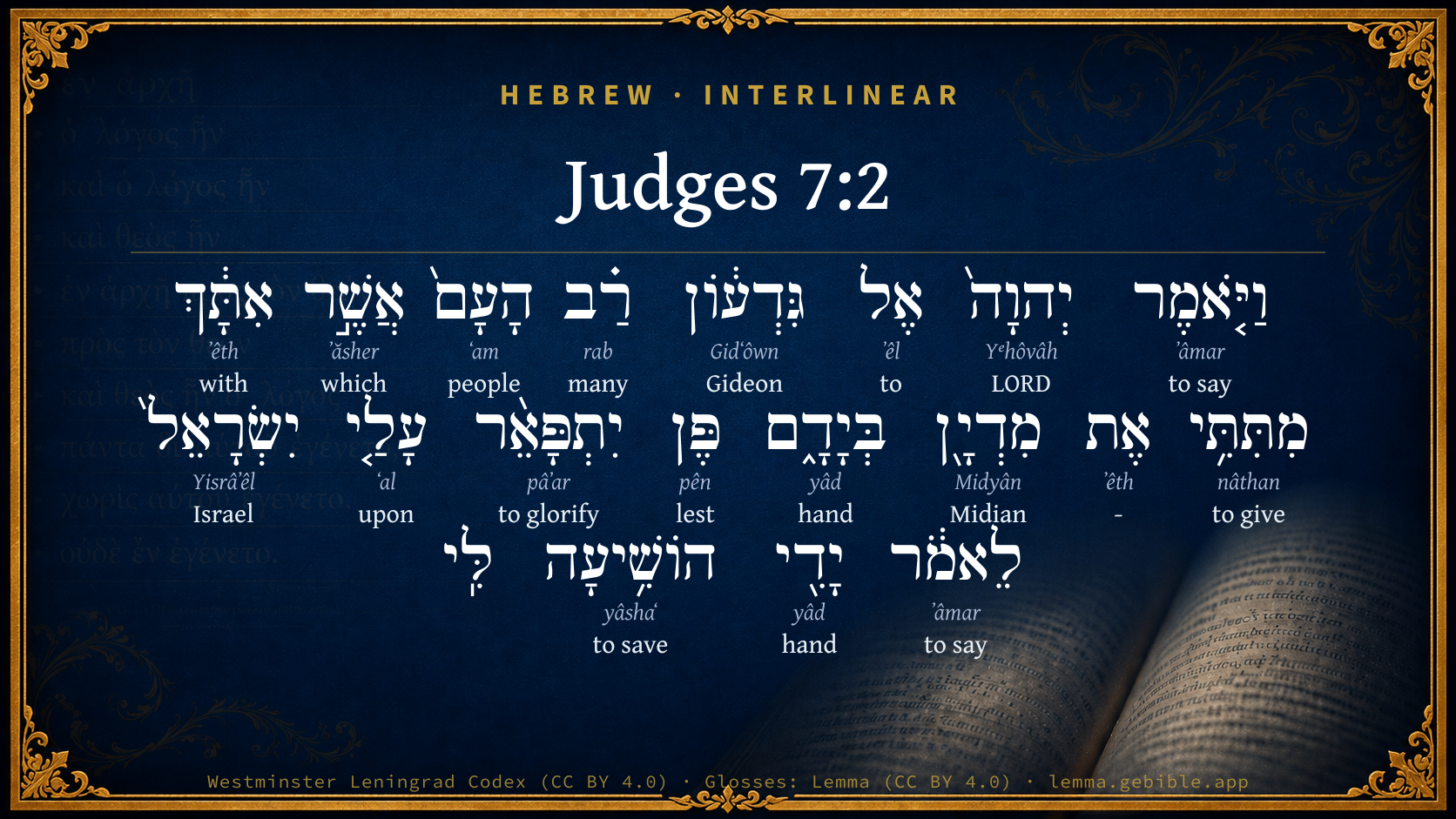
Hebrew (Westminster Leningrad Codex) Judges 7:2 appears in the Hebrew Old Testament. The text above is from the Westminster Leningrad Codex. Each word links to its Strong’s number, a concise gloss, and parsing drawn from the Open Scriptures Hebrew Bible morphology. Click any word for its full Brown-Driver-Briggs (BDB) entry.
Download image
Cite this verse

Judges 7:2 (World English Bible). Public Domain. Lemma interlinear Bible study tool, https://lemma.gebible.app/v/judges/7/2.

Show BibTeX & RIS
BibTeX
RIS
English Translation
Yahweh said to Gideon, The people who are with you are too many for me to give the Midianites into their hand, lest Israel vaunt themselves against me, saying, My own hand has saved me.
World English Bible · Public Domain
Download a study sheet

One document with this verse’s original text, its word-by-word gloss line, the meaning frame, cross-references with their text, attributed commentary, and full source and license credits — printable, and it pastes into notes with its structure intact.

This verse Autodidact and up

Study sheet (.html) Plain text (.txt)

A passage Seminary Student

Up to 50 verses in one chapter. A passage sheet keeps up to 6 commentary sources and 12 cross-references per verse, in the order this page ranks them, and says so on the sheet whenever that leaves anything out. Ask for a single verse and you get the Autodidact verse sheet above.

Everything on this page stays free to read, with no account — the sheet is a download of what is already on screen, not access to it.

Want to remove ads? Support Godless Engineer
Compare translations 3

The same verse in 3 English versions, stacked beneath the original-language interlinear above. Click any original word for its lexicon entry.

Each is an independent rendering of the whole verse — the interlinear is not word-aligned to these translations.

Highlighted words mark where these versions differ — a whole-verse word diff, not a word-by-word alignment.

  • World English Bible Public Domain
    Yahweh said to Gideon, The people who are with you are too many for me to give the Midianites into their hand, lest Israel vaunt themselves against me, saying, My own hand has saved me.
  • King James Version Public Domain
    And the LORD said unto Gideon, The people that are with thee are too many for me to give the Midianites into their hands, lest Israel vaunt themselves against me, saying, Mine own hand hath saved me.
  • unfoldingWord Literal Text CC BY-SA 4.0
    And Yahweh said to Gideon, “The people who with you many for my giving Midian into their hand, lest Israel glorify itself over me, saying, ‘My hand has saved me.’

unfoldingWord Literal Text — © unfoldingWord, licensed CC BY-SA 4.0. Word-aligned USFM3 via Door43 (git.door43.org/unfoldingWord/en_ult).

Versions to compare (up to 4)

3 of 4 selected

Show all 18 translations

Every available English version of this verse, each an independent rendering of the whole verse.

  • World English Bible Public Domain
    Yahweh said to Gideon, The people who are with you are too many for me to give the Midianites into their hand, lest Israel vaunt themselves against me, saying, My own hand has saved me.
  • Berean Standard Bible Public Domain
    Then the LORD said to Gideon, “You have too many people for Me to deliver Midian into their hands, lest Israel glorify themselves over Me, saying, ‘My own hand has saved me.’
  • Majority Standard Bible Public Domain
    Then the LORD said to Gideon, “You have too many men for Me to deliver Midian into their hands, lest Israel glorify themselves over Me, saying, ‘My own hand has saved me.’
  • King James Version Public Domain
    And the LORD said unto Gideon, The people that are with thee are too many for me to give the Midianites into their hands, lest Israel vaunt themselves against me, saying, Mine own hand hath saved me.
  • American Standard Version (1901) Public Domain
    And Jehovah said unto Gideon, The people that are with thee are too many for me to give the Midianites into their hand, lest Israel vaunt themselves against me, saying, Mine own hand hath saved me.
  • Revised Version (1885) Public Domain
    And the LORD said unto Gideon, The people that are with thee are too many for me to give the Midianites into their hand, lest Israel vaunt themselves against me, saying, Mine own hand hath saved me.
  • Geneva Bible (1599) Public Domain
    And the Lord said vnto Gideon, The people that are with thee, are too many for me to giue the Midianites into their hands, lest Israel make their vaunt against me, and say, Mine hand hath saued mee.
  • Douay-Rheims (1899) Public Domain
    And the Lord said to Gedeon: The people that are with thee are many, and Madian shall not be delivered into their hands: lest Israel should glory against me, and say: I was delivered by my own strength.
  • Young's Literal Translation Public Domain
    And Jehovah saith unto Gideon, `Too many `are' the people who `are' with thee for My giving Midian into their hand, lest Israel beautify itself against Me, saying, My hand hath given salvation to me;
  • Literal Standard Version CC BY-SA 4.0
    And YHWH says to Gideon, “The people who [are] with you [are] too many for My giving Midian into their hand, lest Israel beautify itself against Me, saying, My hand has given salvation to me;
  • Unlocked Literal Bible CC BY-SA 4.0
    Yahweh said to Gideon, “There are too many soldiers for me to give you victory over the Midianites, so that Israel may not boast over me, saying, 'Our own power has saved us.'
  • unfoldingWord Literal Text CC BY-SA 4.0
    And Yahweh said to Gideon, “The people who with you many for my giving Midian into their hand, lest Israel glorify itself over me, saying, ‘My hand has saved me.’
  • Darby Bible Public Domain
    The LORD said to Gideon, "The people with you are too many for me to give the Mid'ianites into their hand, lest Israel vaunt themselves against me, saying, 'My own hand has delivered me.'
  • World Messianic Bible Public Domain
    The LORD said to Gideon, “The people who are with you are too many for me to give the Midianites into their hand, lest Israel brag against me, saying, ‘My own hand has saved me.’
  • Webster's Bible Public Domain
    And the LORD said to Gideon, The people that are with thee are too many for me to give the Midianites into their hands, lest Israel vaunt themselves against me, saying, My own hand hath saved me.
  • Free Bible Version CC BY-SA 4.0
    The Lord told Gideon, “There are too many soldiers with you for me to hand over the Midianites to them, otherwise Israel will brag to me, saying, ‘I saved myself by my own strength.’
  • Bible in Basic English Public Domain
    And the Lord said to Gideon, So great is the number of your people, that if I give the Midianites into their hands they will be uplifted in pride over me and will say, I myself have been my saviour.
  • JPS Tanakh (1917) Public Domain
    And the LORD said unto Gideon: 'The people that are with thee are too many for Me to give the Midianites into their hand, lest Israel vaunt themselves against Me, saying: mine own hand hath saved me.

Literal Standard Version (2020), Covenant Press — licensed CC BY-SA 4.0. Text via the HelloAO Bible API (eBible.org). Unlocked Literal Bible (unfoldingWord) — licensed CC BY-SA 4.0. Text via the HelloAO Bible API (eBible.org). unfoldingWord Literal Text — © unfoldingWord, licensed CC BY-SA 4.0. Word-aligned USFM3 via Door43 (git.door43.org/unfoldingWord/en_ult). Free Bible Version, Dr. Jonathan Gallagher — licensed CC BY-SA 4.0. Text via the HelloAO Bible API (eBible.org).

Word by word

More ways to search: Search by grammar → Find every occurrence → Compare this word →

Practice this passage: Drill this verse → Learn its vocabulary →

יִתְפָּאֵ֨ר
pâʼar
H6286
“to glorify”
Verb, Hithpael, Imperfect, 3rd Person, Masculine, Singular
Part of Speech
Verb
Stem
Hithpael
Form
Imperfect
Person
3rd Person
Gender
Masculine
Number
Singular
Full BDB Definition

Origin: a primitive root

TWOT: 1726 , 1727

to glorify, beautify, adorn - (Piel) to glorify, beautify - (Hithpael) - to glorify oneself - to get glory to oneself, be glorified - (Piel) to go over the boughs
  1. וַיֹּ֤אמֶר ʼâmar H559 “and · to say” Conjunction + Verb, Qal, Sequential Imperfect, 3rd Person, Masculine, Singular
  2. יְהוָה֙ Yᵉhôvâh H3068 “LORD” Noun, Proper
  3. אֶל ʼêl H413 “to” Preposition
  4. גִּדְע֔וֹן Gidʻôwn H1439 “Gideon” Noun, Proper
  5. רַ֗ב rab H7227 “many” Adjective, Adjective, Masculine, Singular, Absolute
  6. הָעָם֙ ʻam H5971 “the · people” Particle, Definite Article + Noun, Common, Masculine, Singular, Absolute
  7. אֲשֶׁ֣ר ʼăsher H834 “which” Particle, Relative
  8. אִתָּ֔ךְ ʼêth H854 “with · you” Preposition + Suffix, Personal, 2nd Person, Feminine, Singular
  9. מִתִּתִּ֥י nâthan H5414 “from · to give · me” Preposition + Verb, Qal, Infinitive Construct + Suffix, Personal, 1st Person, Common, Singular
  10. אֶת ʼêth H853 “-” Particle, Direct Object
  11. מִדְיָ֖ן Midyân H4080 “Midian” Noun, Proper
  12. בְּיָדָ֑ם yâd H3027 “in/at · hand · their” Preposition + Noun, Common, Both, Singular, Construct + Suffix, Personal, 3rd Person, Masculine, Plural
  13. פֶּן pên H6435 “lest” Conjunction
  14. עָלַ֤י ʻal H5921 “upon · me” Preposition + Suffix, Personal, 1st Person, Common, Singular
  15. יִשְׂרָאֵל֙ Yisrâʼêl H3478 “Israel” Noun, Proper
  16. לֵאמֹ֔ר ʼâmar H559 “to say” Preposition + Verb, Qal, Infinitive Construct
  17. יָדִ֖י yâd H3027 “hand · my” Noun, Common, Both, Singular, Construct + Suffix, Personal, 1st Person, Common, Singular
  18. הוֹשִׁ֥יעָה yâshaʻ H3467 “to save” Verb, Hiphil, Perfect, 3rd Person, Feminine, Singular

About this verse

These counts appear in no published source. They are computed here, from the morphology-tagged text and Lemma’s own curated glosses. What Lemma adds →

20
words
17
distinct lemmas
Historical
section

Notable vocabulary

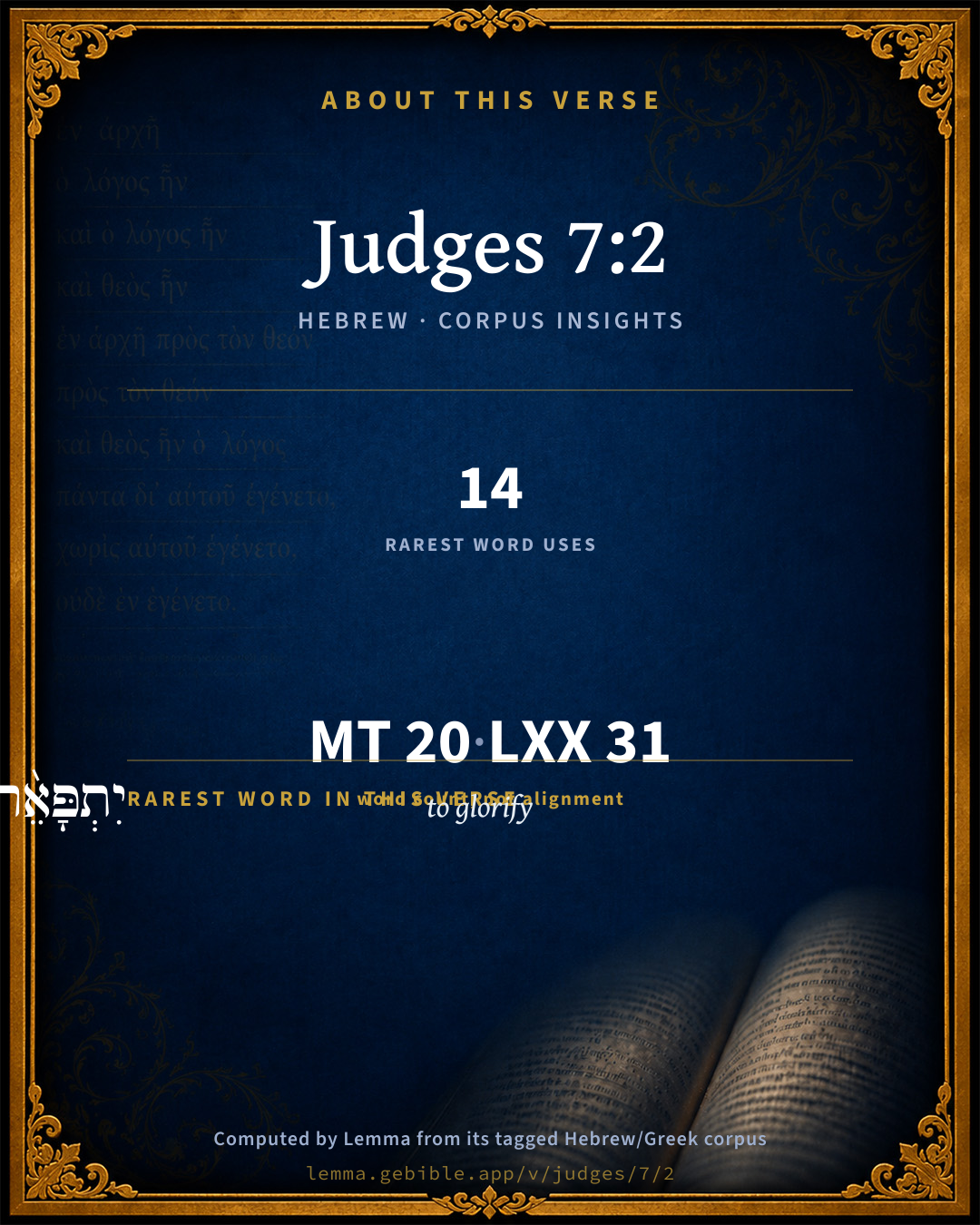
The rarest word here is יִתְפָּאֵ֨ר to glorify H6286 — appearing just 14 times in the whole Hebrew Bible.

Shared distinctive vocabulary

יִתְפָּאֵ֨ר to glorify H6286 occurs in 14 verses of the Hebrew Bible. Also found in:

Grammatical profile

  • 5 verbs
  • 7 nouns
  • 1 adjective
  • 4 prepositions
  • 1 conjunction
  • 2 particles

Verb forms

  • וַיֹּ֤אמֶר Qal · Sequential Imperfect
  • מִתִּתִּ֥י Qal · Infinitive Construct
  • יִתְפָּאֵ֨ר Hithpael · Imperfect
  • לֵאמֹ֔ר Qal · Infinitive Construct
  • הוֹשִׁ֥יעָה Hiphil · Perfect

Repetition

Words recur within this verse — often emphatic in Hebrew:

  • וַיֹּ֤אמֶר to say H559 ×2
  • בְּיָדָ֑ם hand H3027 ×2

Hebrew & Septuagint length

In English translation the verse runs 35 words from the Hebrew and 36 from the Septuagint (LXX English) — closely comparable.

A rough comparison of the two English renderings, which tokenize alike — not a word-level alignment.

Word counts can differ between the Hebrew and the Greek without any difference in meaning — e.g. the Hebrew direct-object marker אֵת has no separate Greek word, and Greek often adds the article ὁ.

In the original languages it is 20 Hebrew tokens and 31 Greek tokens — but the two are counted differently (Hebrew bundles its prefixes and suffixes into one token; the Greek is in lemma form), so that isn’t a like-for-like length.

Cross-references

22

Topical passages linked to Judges 7:2 in the Treasury of Scripture Knowledge — connected by theme and wording, ordered by reader-vote popularity; previews shown in the World English Bible.

  • Deuteronomy 8:17 and [lest] you say in your heart, My power and the might of my hand has gotten me this wealth.
  • 1 Corinthians 1:27–29 but God chose the foolish things of the world that he might put to shame those who are wise. God chose the weak things of the world, that he might put to shame the things that are strong;
  • 2 Corinthians 4:7 But we have this treasure in clay vessels, that the exceeding greatness of the power may be of God, and not from ourselves.
  • Romans 11:18 don't boast over the branches. But if you boast, it is not you who support the root, but the root supports you.
  • Zechariah 4:6 Then he answered and spoke to me, saying, "This is the word of Yahweh to Zerubbabel, saying, 'Not by might, nor by power, but by my Spirit,' says Yahweh of Hosts.
  • Zechariah 12:7 Yahweh also will save the tents of Judah first, that the glory of the house of David and the glory of the inhabitants of Jerusalem not be magnified above Judah.
  • Deuteronomy 32:27 Were it not that I feared the provocation of the enemy, Lest their adversaries should judge wrongly, Lest they should say, Our hand is exalted, Yahweh has not done all this.
  • 1 Samuel 14:6 Jonathan said to the young man who bore his armor, Come, and let us go over to the garrison of these uncircumcised: it may be that Yahweh will work for us; for there is no restraint to Yahweh to save by many or by few.
  • Ezekiel 28:17 Your heart was lifted up because of your beauty; you have corrupted your wisdom by reason of your brightness: I have cast you to the ground; I have laid you before kings, that they may see you.
  • 1 Corinthians 2:4–5 My speech and my preaching were not in persuasive words of human wisdom, but in demonstration of the Spirit and of power,
  • 2 Chronicles 14:11 Asa cried to Yahweh his God, and said, Yahweh, there is none besides you to help, between the mighty and him who has no strength: help us, Yahweh our God; for we rely on you, and in your name are we come against this multitude. Yahweh, you are our God; don't let man prevail against you.
  • Isaiah 10:13 For he has said, By the strength of my hand I have done it, and by my wisdom; for I have understanding: and I have removed the bounds of the peoples, and have robbed their treasures, and like a valiant man I have brought down those who sit [on thrones]:
  • Jeremiah 9:23 Thus says Yahweh, Don't let the wise man glory in his wisdom, neither let the mighty man glory in his might, don't let the rich man glory in his riches;
  • Ezekiel 28:2 Son of man, tell the prince of Tyre, Thus says the Lord Yahweh: Because your heart is lifted up, and you have said, I am a god, I sit in the seat of God, in the midst of the seas; yet you are man, and not God, though you did set your heart as the heart of God;-
  • Daniel 4:30 The king spoke and said, Is not this great Babylon, which I have built for the royal dwelling-place, by the might of my power and for the glory of my majesty?
  • Habakkuk 1:16 Therefore he sacrifices to his net, and burns incense to his dragnet, because by them his life is luxurious, and his food is good.
  • Romans 3:27 Where then is the boasting? It is excluded. By what manner of law? Of works? No, but by a law of faith.
  • Isaiah 2:17 The loftiness of man shall be bowed down, And the haughtiness of men shall be brought low; And Yahweh alone shall be exalted in that day.
  • 2 Corinthians 10:4–5 for the weapons of our warfare are not of the flesh, but mighty before God to the throwing down of strongholds,
  • Ephesians 2:9 not of works, that no one would boast.
  • James 4:6 But he gives more grace. Therefore it says, "God resists the proud, but gives grace to the humble."
  • Isaiah 2:11 The lofty looks of man will be brought low, The haughtiness of men will be bowed down, And Yahweh alone will be exalted in that day.

Cross-references courtesy of OpenBible.info (CC BY 4.0).

Hebrew and Greek witnesses Masoretic Hebrew ↔ Greek Septuagint

The same verse in the two great witnesses to the Old Testament, shown verse-for-verse.

These are two independent witnesses, not word-aligned to each other, and the Septuagint is shown in lemma (dictionary) form.

Hebrew Judges 7:2 Masoretic · Westminster Leningrad Codex

וַיֹּ֤אמֶר יְהוָה֙ אֶל גִּדְע֔וֹן רַ֗ב הָעָם֙ אֲשֶׁ֣ר אִתָּ֔ךְ מִתִּתִּ֥י אֶת מִדְיָ֖ן בְּיָדָ֑ם פֶּן יִתְפָּאֵ֨ר עָלַ֤י יִשְׂרָאֵל֙ לֵאמֹ֔ר יָדִ֖י הוֹשִׁ֥יעָה לִּֽי

Yahweh said to Gideon, The people who are with you are too many for me to give the Midianites into their hand, lest Israel vaunt themselves against me, saying, My own hand has saved me.

World English Bible · Public Domain

Greek LXX Judges 7:2 Septuagint · lemma form

καί εἶπον κύριος πρός γεδεων πολύς ὁ λαός ὁ μετά σύ ὥστε μή παραδίδωμι ἐγώ ὁ μαδιαμ ἐν χείρ αὐτός μήποτε καυχάομαι ἰσραήλ ἐπί ἐγώ λέγω ὁ χείρ ἐγώ σώζω ἐγώ

And the Lord said to Gedeon, The people with you are many, so that I may not deliver Madiam into their hand, lest at any time Israel boast against me, saying, My hand has saved me.

LXX2012 (modern English Septuagint) · Public Domain

Hebrew: Westminster Leningrad Codex (CC BY 4.0). Greek: Septuagint (public domain); English from LXX2012 (modern English Septuagint) (Public Domain). How the Septuagint differs from the Hebrew →

Targum (Aramaic paraphrase)

1

The Targum is the ancient Jewish Aramaic paraphrase of the Hebrew Scriptures — an interpretive translation, not the Hebrew text itself. Onkelos (literal) and Pseudo-Jonathan (expansive) render the Torah, and Jonathan the Prophets. Coverage is partial: where no permissively-licensed English translation exists for a verse, only the Aramaic is shown. This is verse-level text, not a word-by-word alignment to the Hebrew.

  1. Targum Jonathan Prophets (Joshua–Malachi)
    וַאֲמַר יְיָ לְגִדְעוֹן סַגִי עַמָא דִי עִמָךְ מִלְמִמְסַר יַת מִדְיָנָאֵי בִּידֵיהוֹן דִלְמָא יִתְרַבְרְבוּן קֳדָמַי יִשְׂרָאֵל לְמֵימַר יְדָנָא פְרָקַת לָנָא:

    (no public-domain English translation for this verse)

    Targum Jonathan — Aramaic: “Mikraot Gedolot” (public domain). English: “Sefaria Community Translation” (CC0 1.0 (public-domain dedication)); “London "Chaldee Paraphrase," 1871” (public domain). Text via Sefaria.

Commentary

Notes on Judges 7:2 from classic Christian and Jewish commentators (each source and its license shown beneath its notes). The classic Christian expositions comment on the surrounding passage and are grouped to its opening verse, so a note may address several verses; the Jewish commentaries on the Tanakh (Rashi and others) are per-verse, so they appear only where the commentator wrote on this verse.

Lemma curates 59 commentaries, every one of them public domain or Creative Commons licensed, each selected and text-cleaned for this edition rather than reprinted as found. About our sources →

Trapp's Complete Commentary

John Trapp

Jdg 7:2 And the LORD said unto Gideon, The people that [are] with thee [are] too many for me to give the Midianites into their hands, lest Israel vaunt themselves against me, saying, Mine own hand hath saved me.

Ver. 2. Are too many.] They thought themselves too few, and therefore feared. God’s thoughts are not as man’s thoughts: he never complaineth of too few: but saith, as that general did to his fearful soldiers, How many reckon you me for? I alone am a whole army of men. {Isa 52:12}

Lest Israel vaunt themselves.] Which yet they had small reason to do, everything considered. But God knoweth the vanity of men’s minds, and "needeth not that any should testify of man, for he knoweth what is in man." {Joh 2:24-25} So bladder-like is the soul, that filled with the wind of vain glory, it grows great and swells in pride: but if pricked with the least pin of grief or fear, it shrivelleth to nothing.

Mine own hand hath saved me.] Memet meis viribus servavi. Man is a self-ascribing creature. Ajax acknowledged no god but his sword. Sejanus sacrificed to himself. Polyphemus setteth up himself for the sole doer. {a} The Caldeans sacrifice to their own net. {Hab 1:16}

{a} Dio. Euripides.

John Trapp, A Commentary or Exposition upon All the Books of the Old and New Testament (1647–1656) — public domain. Text from a community e-Sword module.

Joseph Benson's Commentary

Jdg 7:2. The people that are with thee are too many — The army consisted of thirty-two thousand men, a small army in comparison of what Israel might have raised on so great an occasion, and a very small one in comparison with that which the Midianites had now brought into the field. Gideon, doubtless, was ready to think they were too few; but God comes to him and tells him they were too many. It is indeed the same thing with God to save by many or by few; but man being prone to attribute every thing to natural causes rather than to God, it is one great design of God in all his dispensations, both of providence and grace, to counteract this evil disposition in our nature which robs God of his glory, and to cause us to consider him, and see his hand more in all things.

Joseph Benson's Commentary on the Old and New Testaments (1811–1818) — public domain. Text from a community e-Sword module.

Geneva Bible (1599)

Geneva Bible translators

God will not that any creature deprive him of his glory.

Geneva Bible (1599) marginal notes — public domain. Text via Bolls.life.

Jamieson, Fausset & Brown

Robert Jamieson, A. R. Fausset & David Brown

the Lord said unto Gideon, The people . . . are too many--Although the Israelitish army mustered only thirty-two thousand (or one-sixth of the Midianitish host), the number was too great, for it was the Lord's purpose to teach Israel a memorable lesson of dependence on Him.

Jamieson, Fausset & Brown — Commentary Critical and Explanatory on the Whole Bible (1871) — public domain (CC PDM 1.0). Text via the HelloAO Bible API.

Adam Clarke's Commentary

Verse 2. The people that are with thee are too many] Had he led up a numerous host against his enemies, the excellence of the power by which they were discomfited might have appeared to be of man and not of God. By the manner in which this whole transaction was conducted, both the Israelites and Midianites must see that the thing was of God. This would inspire the Israelites with confidence, and the Midianites with fear.

Adam Clarke's Commentary on the Bible (1810–1826) — public domain. Text from a community e-Sword/MySword module.

Ellicott's Commentary for English Readers

(2) The people that are with thee are too many for me.—This must have put the faith of Gideon to a severe trial, since the Midianites were 135,000 in number (Jdg_8:10), and Gideon’s forces only 32,000 (Jdg_7:4).

Lest Israel vaunt themselves.—See Deu_8:17.

A Bible Commentary for English Readers, edited by Charles John Ellicott (1878–1897) — public domain. Text from a community e-Sword module.

The Cambridge Bible for Schools and Colleges

gen. ed. J. J. S. Perowne

2. The people that are with thee] Whatever is to be understood by these words in Jdg_7:1, here they must refer to the host mentioned in Jdg_6:35.

lest Israel vaunt themselves against me] For the thought cf. Deu_8:11-17; Deu_9:4 f.; the same word vaunt occurs in Isa_10:15. The army is to be reduced in order that Jehovah’s intervention on behalf of Israel may be the more striking and all the glory His; cf. 1Sa_14:6, Psa_44:3, 1Co_1:25-27.

The Cambridge Bible for Schools and Colleges (gen. ed. J. J. S. Perowne; Cambridge University Press, 1878–1918) — public domain. Text from a community e-Sword module.

John Gill's Exposition

And the Lord said unto Gideon, the people that are with thee are too many,.... It appears, by what follows, that there were 32,000 of them, which was but a small army to engage with one of 100,000 more than they; for such was the army of the Midianites and their associates, see Jdg 8:10 but the people were too many, says the Lord:

for me to give the Midianites into their hands; who would be apt to ascribe the victory to themselves, and not to the Lord; to their number, strength, and valour, and not to the hand of the Lord:

lest Israel vaunt themselves against me, saying, mine own hand hath saved me; or glory over me, take the glory from me, and ascribe it to themselves, boasting that by their power and prowess they had obtained the victory.

John Gill's Exposition of the Whole Bible (1746–1763) — public domain (CC PDM 1.0). Text via the HelloAO Bible API.

Haydock's Catholic Bible Commentary

Lest Israel, &c. by this we see that God will not choose for his instruments in great achievements, which depend purely on his grace, such as, through pride and self-conceit, will take the glory to themselves. (Challoner) --- Yet Gedeon had only 32,000 to encounter 135,000 fighting men; so that if all had remained with him, they would each had to engage above four men, ver. 3., and chap. viii. 10. (Menochius)

George Leo Haydock (1774–1849), Haydock's Catholic Family Bible and Commentary, 1859 edition — public domain. Excludes Psalms (Douay-Rheims chapter numbering differs from Protestant) and Deuterocanonical books (Catholic canon only).

Matthew Poole's English Annotations

Too many for me, i.e. for my purpose; which is, so to deliver Israel, that it may appear to be my own miraculous act, that so I may have all the glory of it, and they may be more strongly obliged to love and serve me.

Matthew Poole's English Annotations on the Holy Bible (1683–1685) — public domain. Text from a community e-Sword/MySword module.

Whedon's Commentary on the Bible

Daniel D. Whedon

2. Lest Israel vaunt themselves — As human nature is ever prone to do. Compare marginal reference.

Daniel D. Whedon (gen. ed.), Commentary on the Old and New Testaments (1874–1909) — public domain. Text from a community e-Sword module.

The Pulpit Commentary

And the Lord said, etc. It must be remembered that this whole movement was essentially a religious one. It began with prayer, (Jud_1:6:6, 7) it was followed up by repentance, (Jud_1:6:27, 28) and the great purpose of it was to turn the hearts of the nation back to the God of their fathers. The Lord himself, therefore, graciously forwarded this end by making it plain that the deliverance from their oppression was his work, and his only. For the general sentiment compare Deu_8:10-18 Psa_44:3-8 Zec_3:6, etc.

"Mine own hand hath saved me.

Nothing more impressive than the secrecy observed by God in bringing on his kingdom. He is not lavish of signs and wonders. Sufficient for the occasion, and no more. Not always asserting himself. So unobtrusive, that vain and empty minds are ready to conclude him non-existent or inoperative. "Verily thou art a God that hidest thyself, O God of Israel, the Saviour." The place of God at the beginnings of things the springs and roots; and the spiritual nature of God accounts for much of this He loves to work by despised instruments and obscure agencies. "Thy gentleness hath made me great.

I HOW PRONE THE NATURAL MIND IS TO THIS IMPRESSION. Israel, as here stated, was constantly imagining it. The moral systems, ancient and modern, social and political nostrums and panaceas, of men show this. The glorification of courage, intellectual gifts, material resources.

II ITS MISCHIEVOUS EFFECTS. Egotism; materialism; intellectual and moral pride. "For they being ignorant of God"s righteousness, and going about to establish their own righteousness, have not submitted themselves unto the righteousness of God". (Rom_10:3) "Ye will not come to me, that ye might have life". (Joh_5:40)

III PROOFS THAT MAN CANNOT BE HIS OWN SAVIOUR.

1. The miraculous deliverances of Israel. The weakness of luxurious andmaterially enriched times. The providences of life. The soul"s inner experiences.

2. The true conception of salvation. A spiritual more than a material fact. Our relation to the law of God. "Not by works of righteousness which we have done," etc. (Tit_3:5) "And be found in him, not having mine own righteousness," etc. (Php_3:9) Inward witness the grace of God I am what I am". M. (1Co_15:10)

HOMILIES BY W.F. ADENEY Ver. 2. Success not dependent on numbers.

One of the first objects of a general"s anxiety is to see that he has a sufficient number of men under his command. But Gideon is made to understand that he has too many, and must reduce his hosts before going to battle with the sanction and assistance of God. In Christian work the tendency is to rely on external appearances of strength manifested by a great array of workers rather than on the inconspicuous spiritual sources of real power. While remembering the need of more labourers of the right kind for God"s field, (Mat_9:37, Mat_9:38) we must also understand that the work may be suffering through excess in numbers of those labourers, whose character and method of work are not of the highest order.

I THE POWER OF GOD IS FAR MORE IMPORTANT THAN ANY HUMAN AGENCY. In all Divine work the real energy is centred in God. We are but the instruments in his hands. The temptation is to forget that the true power and blessing come wholly from him, (Deu_8:17) and to think so much of our labour in planting and watering as to ignore the one most important thing, God giving the increase. (1Co_3:7) A gardener can only minister to the spontaneous life of nature; and if he becomes so infatuated with his skill as to attempt to manufacture a plant, his total reliance on his own resources will, of course, only reveal folly. So anything which leads us to magnify human agencies at the expense of Divine power will as surely produce failure.

1. The imposing appearance of too great numbers may lead us to neglect the aid of God. When we are few we feel our helplessness, and so learn to turn to God for strength; when we are many we imagine ourselves strong, and thus while we are (apparently) strong in ourselves we are really most weak. Presumption takes the place of faith, and human agency is relied on instead of Divine energy. The numbers of the Church, the elaborate organisation of her societies, the gifts and genius of individual men are all snares if they tempt us to neglect the one supreme source of success. The danger of the Church in the present day is to rely too much on the machinery of her institutions, instead of seeking the vital power which can alone inspire the energy of spiritual work.

2. The character of too great numbers may be such as to hinder the bestowal of the help of God. God cannot bestow his spiritual gifts on a people who are not spiritually-minded. If we gain numbers at the expense of spirituality, we do this also at the expense of Divine aid. Better be few, and constituting such a worthy temple that the Holy Ghost can dwell and work in us, than numerous, but possessed by a worldly spirit which degrades the temple into a house of merchandise.

II THE QUALITY OF ANY HUMAN AGENCY IS MORE IMPORTANT THAN THE SIZE OF IT. It has been well said that it would be better for the cause of Christianity in the world "if there were fewer Christians and better ones." Xerxes found the vast numbers of his Asiatic hordes a hindrance to effective warfare with the disciplined Greeks. The great want of the Church is not more labourers, but better ones better ministers, missionaries, teachers; not more sermons, but more able preaching; not a more ponderous library of Christian literature to meet the attacks of unbelief, but a few more powerful works (one book, "Butler"s Analogy was probably more effective in counteracting the influence of Deism than all the rest of the voluminous apologetic writing of the eighteenth century). It would be well if Church discipline were a reality, and Christian workers selected with conscientious care. The workers should be sifted by tests applied to their character and abilities.

1. Tests of courage and zeal are useful; so Gideon dismissed the timid, and only willing men were retained. The only valuable soldiers in Christ"s army are the volunteers who delight in his service.

2. Slight incidents will often reveal character, and serve as tests of the quality of God"s servants (ver. 7). A.

The Pulpit Commentary (1880–1919), ed. H.D.M. Spence-Jones & Joseph S. Exell — public domain. Text from a community e-Sword module.

John Wesley's Explanatory Notes

Too many - For my purpose; which is, so to deliver Israel, that it may appear to be my own act, that so I may have all the glory, and they may be the more strongly obliged to serve me. This may help us to understand those providences, which sometimes seem to weaken the church of Christ. Its friends are too many, too mighty, too wise, for God to work deliverance by. God is taking a course to lessen them, that he may be exalted in his own strength.

John Wesley, Explanatory Notes Upon the Whole Bible (1754–1765) — public domain. Text via the GEBible commentary corpus.

unfoldingWord translationNotes

Door43 World Missions Community

for me to give you victory over the Midianites

The word "victory" is an abstract noun that can be translated as a verb or an adjective. AT: "for me to allow you to defeat the Midianites" or "for me to cause you to be victorious over the Midianites" (See: Abstract Nouns)

Our own power has saved us

Here "power" represents the people themselves. AT: "We have saved ourselves without God's help" (See: Metonymy)

Now

This does not mean "at this moment," but is used to draw attention to the important point that follows.

proclaim in the ears of the people

Here "the ears" refers to the whole person. AT: "proclaim to the people" (See: Synecdoche)

Whoever is afraid, whoever trembles

Both of these phrases have the same meaning. (See: Parallelism)

trembles

This word describes fear that causes a person to uncontrollably shake. AT: "shakes with fear"

let him return

You can make explicit where he will go. AT: "let him return to his home" (See: Assumed Knowledge and Implicit Information)

Mount Gilead

This is the name of a mountain in the region of Gilead. (See: How to Translate Names)

twenty-two thousand

"22,000" (See: Numbers)

ten thousand remained

The word "people" or "men" is understood. AT: "10,000 people remained" or "10,000 men remained" (See: Ellipsis)

ten thousand

"10,000" (See: Numbers)

translationWords

Yahweh

Gideon

Midian

Israel

boast

power

save

preach

Gilead

unfoldingWord translationNotes — © Distant Shores Media and the Door43 World Missions Community, licensed CC BY-SA 4.0. Source: git.door43.org/Door43/en_tn.

Rashi

Rabbi Shlomo Yitzchaki (Rashi)

Glorify. "Vanter" in old French.

Rashi on the Tanakh — English translations: “The Judaica Press complete Tanach with Rashi, translated by A. J. Rosenberg” (CC BY 4.0); “Pentateuch with Rashi's commentary by M. Rosenbaum and A.M. Silbermann, 1929-1934” (public domain); “The Metsudah Tanach series, Lakewood, N.J” (CC BY 4.0); and “The Book of Joshua, Metsudah Publications, 1997” (CC BY 4.0). Text via Sefaria.

Lesson kit

Teaching starters — assembled from the data on this page, not authored interpretation. Every prompt links to the verse data it draws on. Edit before teaching.

Judges, in the Historical, opens this verse with 20 words (17 distinct Hebrew lemmas). Its most distinctive word is pâʼar (“to glorify”). A historical commentator’s framing appears above. Read the whole chapter for the surrounding context.

Discussion questions

  1. How does “to glorify” (pâʼar) shape what this verse is saying?
  2. How does Exodus 8:9, which shares the word «to glorify», read alongside this verse?
  3. What does the repetition of “to say” (2× in this one verse) do in this verse?
  4. The translations on this page render this verse differently — a whole-verse word diff, not a word-by-word alignment. What might account for the different wordings?
  5. «וַיֹּ֤אמֶר» is a Qal Sequential Imperfect verb. How does that grammatical form shape the action described?
  6. Compare how Trapp's Complete Commentary and Joseph Benson's Commentary read this verse. Where do they agree or differ?

Things to notice

Reading settings

Reading text

Shown beneath each verse's original-language words.

Old Testament
Old Testament edition

Read the OT as the Masoretic Hebrew (MT) or the Greek Septuagint (LXX).

English shown for the Greek Septuagint (in the Hebrew ↔ Greek comparison).

Comparing translations? Open the Compare panel on any verse page to stack up to four side by side.