
Numbers 14:18

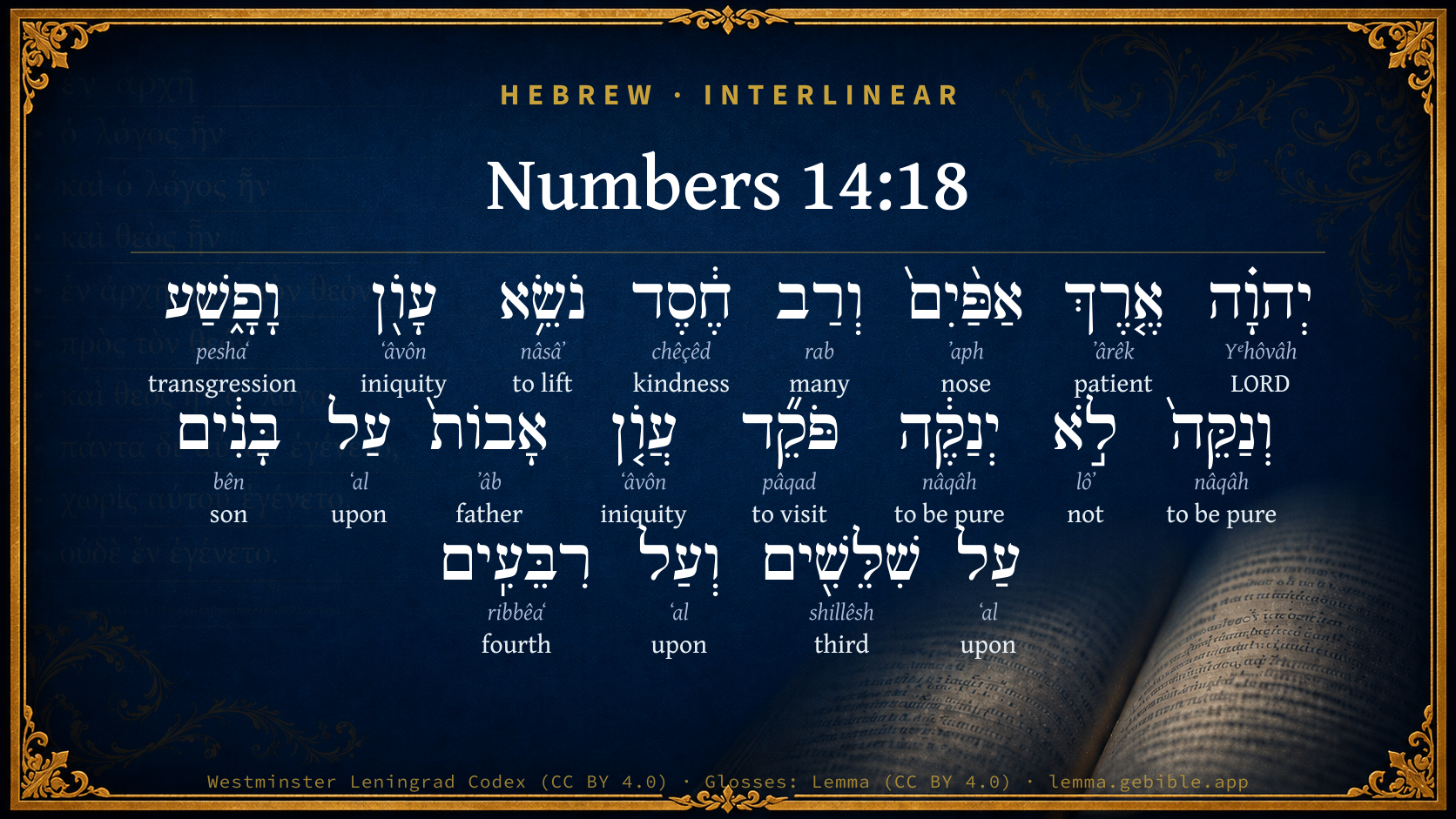
Hebrew (Westminster Leningrad Codex) Numbers 14:18 appears in the Hebrew Old Testament. The text above is from the Westminster Leningrad Codex. Each word links to its Strong’s number, a concise gloss, and parsing drawn from the Open Scriptures Hebrew Bible morphology. Click any word for its full Brown-Driver-Briggs (BDB) entry.
Download image
Cite this verse

Numbers 14:18 (World English Bible). Public Domain. Lemma interlinear Bible study tool, https://lemma.gebible.app/v/numbers/14/18.

Show BibTeX & RIS
BibTeX
RIS
English Translation
Yahweh is slow to anger, and abundant in loving kindness, forgiving iniquity and disobedience; and that will by no means clear [the guilty], visiting the iniquity of the fathers on the children, on the third and on the fourth generation.
World English Bible · Public Domain
Download a study sheet

One document with this verse’s original text, its word-by-word gloss line, the meaning frame, cross-references with their text, attributed commentary, and full source and license credits — printable, and it pastes into notes with its structure intact.

This verse Autodidact and up

Study sheet (.html) Plain text (.txt)

A passage Seminary Student

Up to 50 verses in one chapter. A passage sheet keeps up to 6 commentary sources and 12 cross-references per verse, in the order this page ranks them, and says so on the sheet whenever that leaves anything out. Ask for a single verse and you get the Autodidact verse sheet above.

Everything on this page stays free to read, with no account — the sheet is a download of what is already on screen, not access to it.

Want to remove ads? Support Godless Engineer
Compare translations 3

The same verse in 3 English versions, stacked beneath the original-language interlinear above. Click any original word for its lexicon entry.

Each is an independent rendering of the whole verse — the interlinear is not word-aligned to these translations.

Highlighted words mark where these versions differ — a whole-verse word diff, not a word-by-word alignment.

  • World English Bible Public Domain
    Yahweh is slow to anger, and abundant in loving kindness, forgiving iniquity and disobedience; and that will by no means clear [the guilty], visiting the iniquity of the fathers on the children, on the third and on the fourth generation.
  • King James Version Public Domain
    The LORD is long-suffering, and of great mercy, forgiving iniquity and transgression, and by no means clearing the guilty, visiting the iniquity of the fathers upon the children unto the third and fourth generation.
  • unfoldingWord Literal Text CC BY-SA 4.0
    ‘Yahweh long of nostrils and great of covenant faithfulness, lifting up iniquity and transgression. But leaving unpunished, he will not leave unpunished, visiting iniquity of fathers upon sons, upon thirds, and upon fourths.’

unfoldingWord Literal Text — © unfoldingWord, licensed CC BY-SA 4.0. Word-aligned USFM3 via Door43 (git.door43.org/unfoldingWord/en_ult).

Versions to compare (up to 4)

3 of 4 selected

Show all 18 translations

Every available English version of this verse, each an independent rendering of the whole verse.

  • World English Bible Public Domain
    Yahweh is slow to anger, and abundant in loving kindness, forgiving iniquity and disobedience; and that will by no means clear [the guilty], visiting the iniquity of the fathers on the children, on the third and on the fourth generation.
  • Berean Standard Bible Public Domain
    ‘The LORD is slow to anger and abounding in loving devotion, forgiving iniquity and transgression. Yet He will by no means leave the guilty unpunished; He will visit the iniquity of the fathers upon their children to the third and fourth generation.’
  • Majority Standard Bible Public Domain
    ‘The LORD is slow to anger and abounding in loving devotion, forgiving iniquity and transgression. Yet He will by no means leave the guilty unpunished; He will visit the iniquity of the fathers upon their children to the third and fourth generation.’
  • King James Version Public Domain
    The LORD is long-suffering, and of great mercy, forgiving iniquity and transgression, and by no means clearing the guilty, visiting the iniquity of the fathers upon the children unto the third and fourth generation.
  • American Standard Version (1901) Public Domain
    Jehovah is slow to anger, and abundant in lovingkindness, forgiving iniquity and transgression; and that will by no means clear `the guilty', visiting the iniquity of the fathers upon the children, upon the third and upon the fourth generation.
  • Revised Version (1885) Public Domain
    The LORD is slow to anger, and plenteous in mercy, forgiving iniquity and transgression, and that will by no means clear the guilty; visiting the iniquity of the fathers upon the children, upon the third and upon the fourth generation.
  • Geneva Bible (1599) Public Domain
    The Lord is slowe to anger, and of great mercie, and forgiuing iniquitie, and sinne, but not making the wicked innocent, and visiting the wickednes of the fathers vpon the children, in the thirde and fourth generation:
  • Douay-Rheims (1899) Public Domain
    The Lord is patient and full of mercy, taking away iniquity and wickedness, and leaving no man clear, who visitest the sins of the fathers upon the children unto the third and fourth generation.
  • Young's Literal Translation Public Domain
    Jehovah `is' slow to anger, and of great kindness; bearing away iniquity and transgression, and not entirely acquitting, charging iniquity of fathers on sons, on a third `generation', and on a fourth; --
  • Literal Standard Version CC BY-SA 4.0
    YHWH [is] slow to anger and of great kindness, bearing away iniquity and transgression, and not entirely acquitting, charging iniquity of fathers on sons, on a third and on a fourth [generation]—
  • Unlocked Literal Bible CC BY-SA 4.0
    'Yahweh is slow to anger and abundant in covenant faithfulness. He forgives iniquity and transgression. He will by no means clear the guilty when he brings the punishment of the ancestors' sin on their descendants, to the third and fourth generation.'
  • unfoldingWord Literal Text CC BY-SA 4.0
    ‘Yahweh long of nostrils and great of covenant faithfulness, lifting up iniquity and transgression. But leaving unpunished, he will not leave unpunished, visiting iniquity of fathers upon sons, upon thirds, and upon fourths.’
  • Darby Bible Public Domain
    Jehovah is slow to anger, and abundant in goodness, forgiving iniquity and transgression, but by no means clearing [the guilty], visiting the iniquity of the fathers upon the children, upon the third and fourth [generation].
  • World Messianic Bible Public Domain
    ‘The LORD is slow to anger, and abundant in loving kindness, forgiving iniquity and disobedience; and he will by no means clear the guilty, visiting the iniquity of the fathers on the children, on the third and on the fourth generation.’
  • Webster's Bible Public Domain
    The LORD is long-suffering, and of great mercy, forgiving iniquity and transgression, and by no means clearing the guilty, visiting the iniquity of the fathers upon the children to the third and fourth generation.
  • Free Bible Version CC BY-SA 4.0
    The Lord is slow to become angry and is full of trustworthy love, forgiving sin and rebellion. However, he will not allow the guilty to go unpunished, bringing the consequences of the parents' sin on their children, grandchildren, and great-grandchildren.
  • Bible in Basic English Public Domain
    The Lord is slow to wrath and great in mercy, overlooking wrongdoing and evil, and will not let wrongdoers go free; sending punishment on children for the sins of their fathers, to the third and fourth generation.
  • JPS Tanakh (1917) Public Domain
    The LORD is slow to anger, and plenteous in lovingkindness, forgiving iniquity and transgression, and that will by no means clear the guilty; visiting the iniquity of the fathers upon the children, upon the third and upon the fourth generation.

Literal Standard Version (2020), Covenant Press — licensed CC BY-SA 4.0. Text via the HelloAO Bible API (eBible.org). Unlocked Literal Bible (unfoldingWord) — licensed CC BY-SA 4.0. Text via the HelloAO Bible API (eBible.org). unfoldingWord Literal Text — © unfoldingWord, licensed CC BY-SA 4.0. Word-aligned USFM3 via Door43 (git.door43.org/unfoldingWord/en_ult). Free Bible Version, Dr. Jonathan Gallagher — licensed CC BY-SA 4.0. Text via the HelloAO Bible API (eBible.org).

Word by word

More ways to search: Search by grammar → Find every occurrence → Compare this word →

Practice this passage: Drill this verse → Learn its vocabulary →

רִבֵּעִֽים
ribbêaʻ
H7256
“fourth generation”
Noun, Common, Masculine, Plural, Absolute
Part of Speech
Noun
Type
Common
Gender
Masculine
Number
Plural
State
Absolute
Full BDB Definition

Origin: from H7251

TWOT: 2107d

pertaining to the fourth
  1. יְהוָ֗ה Yᵉhôvâh H3068 “LORD” Noun, Proper
  2. אֶ֤רֶךְ ʼârêk H750 “patient of” Adjective, Adjective, Masculine, Singular, Construct
  3. אַפַּ֨יִם֙ ʼaph H639 “nostrils” Noun, Common, Masculine, Dual, Absolute
  4. וְרַב rab H7227 “and · many of” Conjunction + Adjective, Adjective, Masculine, Singular, Construct
  5. חֶ֔סֶד chêçêd H2617 “kindness” Noun, Common, Masculine, Singular, Absolute
  6. נֹשֵׂ֥א nâsâʼ H5375 “lifting” Verb, Qal, Participle Active, Masculine, Singular, Absolute
  7. עָוֺ֖ן ʻâvôn H5771 “iniquity” Noun, Common, Both, Singular, Absolute
  8. וָפָ֑שַׁע peshaʻ H6588 “and · transgression” Conjunction + Noun, Common, Masculine, Singular, Absolute
  9. וְנַקֵּה֙ nâqâh H5352 “and · to be pure” Conjunction + Verb, Piel, Infinitive Absolute
  10. לֹ֣א lôʼ H3808 “not” Particle, Negative
  11. יְנַקֶּ֔ה nâqâh H5352 “to be pure” Verb, Piel, Imperfect, 3rd Person, Masculine, Singular
  12. פֹּקֵ֞ד pâqad H6485 “visiting” Verb, Qal, Participle Active, Masculine, Singular, Absolute
  13. עֲוֺ֤ן ʻâvôn H5771 “iniquity of” Noun, Common, Both, Singular, Construct
  14. אָבוֹת֙ ʼâb H1 “fathers” Noun, Common, Masculine, Plural, Absolute
  15. עַל ʻal H5921 “upon” Preposition
  16. בָּנִ֔ים bên H1121 “sons” Noun, Common, Masculine, Plural, Absolute
  17. עַל ʻal H5921 “upon” Preposition
  18. שִׁלֵּשִׁ֖ים shillêsh H8029 “third generation” Noun, Common, Masculine, Plural, Absolute
  19. וְעַל ʻal H5921 “and · upon” Conjunction + Preposition

About this verse

These counts appear in no published source. They are computed here, from the morphology-tagged text and Lemma’s own curated glosses. What Lemma adds →

20
words
16
distinct lemmas
Pentateuch
section

Notable vocabulary

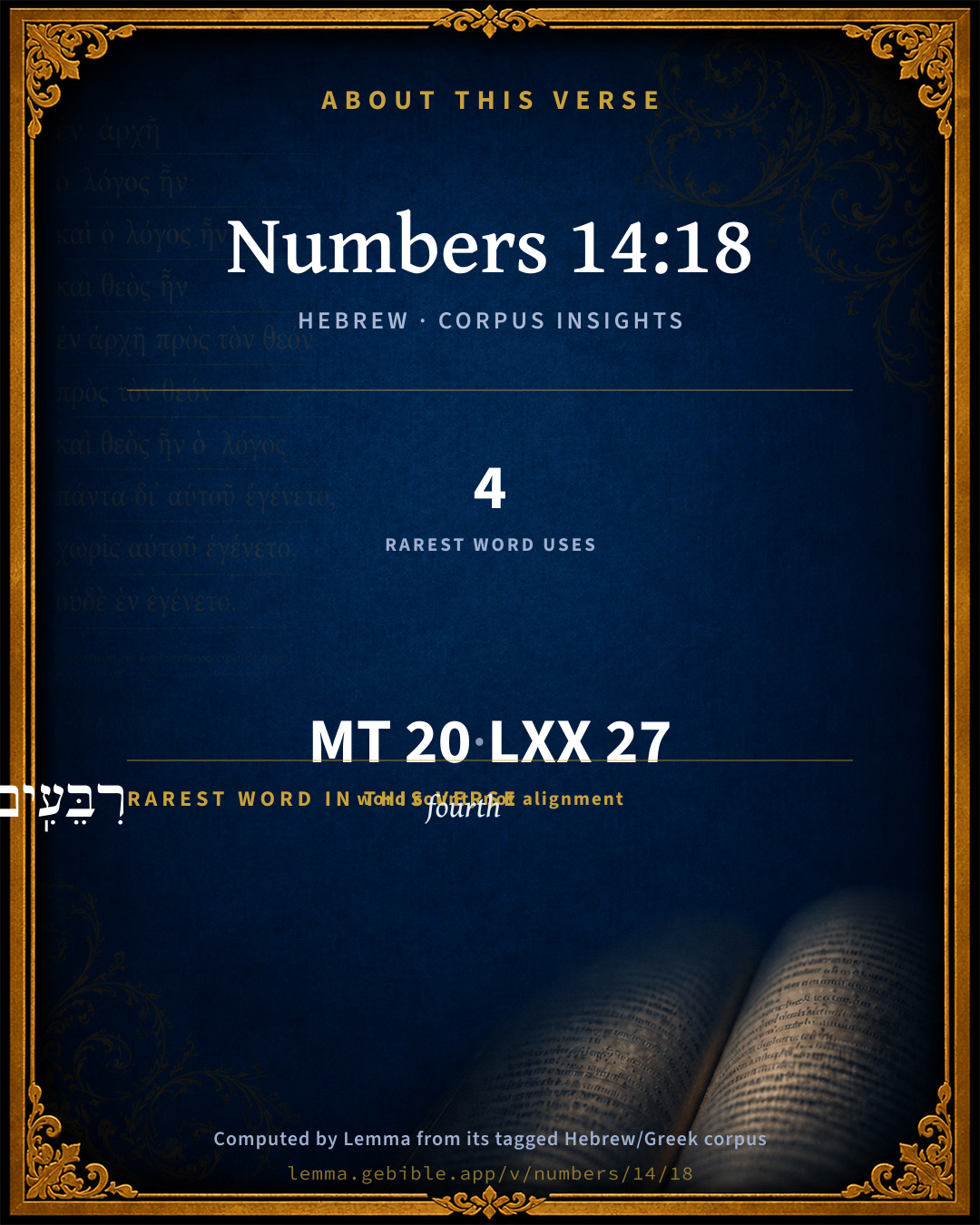
The rarest word here is רִבֵּעִֽים fourth H7256 — appearing just 4 times in the whole Hebrew Bible.

Shared distinctive vocabulary

רִבֵּעִֽים fourth H7256 occurs in 4 verses of the Hebrew Bible. Also found in:

Grammatical profile

  • 4 verbs
  • 10 nouns
  • 2 adjectives
  • 3 prepositions
  • 1 particle

Verb forms

  • נֹשֵׂ֥א Qal · Participle Active
  • וְנַקֵּה֙ Piel · Infinitive Absolute
  • יְנַקֶּ֔ה Piel · Imperfect
  • פֹּקֵ֞ד Qal · Participle Active

Repetition

Words recur within this verse — often emphatic in Hebrew:

  • עַל upon H5921 ×3
  • עָוֺ֖ן iniquity H5771 ×2
  • וְנַקֵּה֙ to be pure H5352 ×2

Hebrew & Septuagint length

In English translation the verse runs 40 words from the Hebrew and 38 from the Septuagint (LXX English) — closely comparable.

A rough comparison of the two English renderings, which tokenize alike — not a word-level alignment.

Word counts can differ between the Hebrew and the Greek without any difference in meaning — e.g. the Hebrew direct-object marker אֵת has no separate Greek word, and Greek often adds the article ὁ.

In the original languages it is 20 Hebrew tokens and 27 Greek tokens — but the two are counted differently (Hebrew bundles its prefixes and suffixes into one token; the Greek is in lemma form), so that isn’t a like-for-like length.

Cross-references

12

Topical passages linked to Numbers 14:18 in the Treasury of Scripture Knowledge — connected by theme and wording, ordered by reader-vote popularity; previews shown in the World English Bible.

  • Exodus 34:6–7 Yahweh passed by before him, and proclaimed, "Yahweh! Yahweh, a merciful and gracious God, slow to anger, and abundant in loving kindness and truth,
  • Psalms 145:8 Yahweh is gracious, merciful, Slow to anger, and of great loving kindness.
  • Exodus 20:5 you shall not bow yourself down to them, nor serve them, for I, Yahweh your God, am a jealous God, visiting the iniquity of the fathers on the children, on the third and on the fourth generation of those who hate me,
  • Jonah 4:2 He prayed to Yahweh, and said, "Please, Yahweh, wasn't this what I said when I was still in my own country? Therefore I hurried to flee to Tarshish, for I knew that you are a gracious God, and merciful, slow to anger, and abundant in loving kindness, and you repent of the evil.
  • Nahum 1:2–3 Yahweh is a jealous God and avenges. Yahweh avenges and is full of wrath. Yahweh takes vengeance on his adversaries, and he maintains wrath against his enemies.
  • Psalms 103:8 Yahweh is merciful and gracious, Slow to anger, and abundant in loving kindness.
  • Micah 7:18 Who is a God like you, who pardons iniquity, And passes over the disobedience of the remnant of his heritage? He doesn't retain his anger forever, Because he delights in loving kindness.
  • Deuteronomy 5:9 you shall not bow down yourself to them, nor serve them; for I, Yahweh, your God, am a jealous God, visiting the iniquity of the fathers on the children, and on the third and on the fourth generation of those who hate me;
  • Jeremiah 23:2 Therefore thus says Yahweh, the God of Israel, against the shepherds who feed my people: You have scattered my flock, and driven them away, and have not visited them; behold, I will visit on you the evil of your doings, says Yahweh.
  • Romans 3:24–26 being justified freely by his grace through the redemption that is in Christ Jesus;
  • Ephesians 1:7–8 in whom we have our redemption through his blood, the forgiveness of our trespasses, according to the riches of his grace,
  • Romans 5:21 that as sin reigned in death, even so might grace reign through righteousness to eternal life through Jesus Christ our Lord.

Cross-references courtesy of OpenBible.info (CC BY 4.0).

Hebrew and Greek witnesses Masoretic Hebrew ↔ Greek Septuagint

The same verse in the two great witnesses to the Old Testament, shown verse-for-verse.

These are two independent witnesses, not word-aligned to each other, and the Septuagint is shown in lemma (dictionary) form.

Hebrew Numbers 14:18 Masoretic · Westminster Leningrad Codex

יְהוָ֗ה אֶ֤רֶךְ אַפַּ֨יִם֙ וְרַב חֶ֔סֶד נֹשֵׂ֥א עָוֺ֖ן וָפָ֑שַׁע וְנַקֵּה֙ לֹ֣א יְנַקֶּ֔ה פֹּקֵ֞ד עֲוֺ֤ן אָבוֹת֙ עַל בָּנִ֔ים עַל שִׁלֵּשִׁ֖ים וְעַל רִבֵּעִֽים

Yahweh is slow to anger, and abundant in loving kindness, forgiving iniquity and disobedience; and that will by no means clear [the guilty], visiting the iniquity of the fathers on the children, on the third and on the fourth generation.

World English Bible · Public Domain

Greek LXX Numbers 14:18 Septuagint · lemma form

κύριος μακρόθυμος καί πολυέλεος καί ἀληθινός ἀποαἱρέω ἀνομία καί ἀδικία καί ἁμαρτία καί καθαρισμός οὐ καθαρίζω ὁ ἔνοχος ἀποδίδωμι ἁμαρτία πατήρ ἐπί τέκνον ἕως τρίτος καί τέταρτος

The Lord is longsuffering and merciful, and true, removing transgressions and iniquities and sins, and he will by no means clear the guilty, visiting the sins of the fathers upon the children to the third and fourth generation.

LXX2012 (modern English Septuagint) · Public Domain

On this verse, Haydock's Catholic Bible Commentary discusses the Septuagint’s reading. Read the note in Commentary ↓

Hebrew: Westminster Leningrad Codex (CC BY 4.0). Greek: Septuagint (public domain); English from LXX2012 (modern English Septuagint) (Public Domain). How the Septuagint differs from the Hebrew →

Targum (Aramaic paraphrase)

2

The Targum is the ancient Jewish Aramaic paraphrase of the Hebrew Scriptures — an interpretive translation, not the Hebrew text itself. Onkelos (literal) and Pseudo-Jonathan (expansive) render the Torah, and Jonathan the Prophets. Coverage is partial: where no permissively-licensed English translation exists for a verse, only the Aramaic is shown. This is verse-level text, not a word-by-word alignment to the Hebrew.

  1. Targum Onkelos Torah (Genesis–Deuteronomy)
    יְיָ מַרְחֵק רְגַז וּמַסְגֵי לְמֶעְבַּד טַבְוָן (וּקְשׁוֹט) שָׁבֵק לַעֲוָיָן וְלִמְרוֹד וּלְחוֹבִין סַלַח לִדְתַיְיבִין לְאוֹרַיְתֵהּ וּדְלָא תַיְיבִין לָא מְזַכֵּי מַסְעַר חוֹבֵי אֲבָהָן עַל בְּנִין מְרָדִין עַל דַר תְּלִיתָאֵי וְעַל דַר רְבִיעָאֵי

    (no public-domain English translation for this verse)

    Targum Onkelos — Aramaic: “Onkelos Genesis” (public domain); “Onkelos Exodus” (public domain); “Onkelos Leviticus” (public domain); “Onkelos Numbers” (public domain); “Onkelos Deuteronomy” (public domain). English: “Sefaria Community Translation” (CC0 1.0 (public-domain dedication)); “J.W. Etheridge. The Targums of Onkelos and Jonathan Ben Uzziel on the Pentateuch. London: Longmans, Green, 1862” (public domain). Text via Sefaria.

  2. Targum Pseudo-Jonathan Torah (Genesis–Deuteronomy)
    יְיָ אֲרִיךְ רוּחַ וְקָרִיב רַחֲמִין שְׁרֵי לְתוּבִין וּמְכַפֵּר עַל סוּרְחָנוּן מַזְכֵּי לִדְתַיְיבִין לְאוֹרַיְיתָא וְלִדְלָא תַיְיבִין לָא מְזַכֵּי מַסְעַר חוֹבֵי אַבְהָן רַשִׁיעִין עַל בְּנִין מְרוֹדִין עַל דַר תְּלִיתָאֵי וְעַל דַר רְבִיעָאֵי

    The Lord is long­ suffering, and nigh in mercy, forgiving sins and covering transgressions, justifying such as return to His law though them who turn not He will not absolve, but will visit the sins of wicked fathers upon rebellious children unto the third and fourth generation.

    Targum Pseudo-Jonathan — Aramaic: “Targum Jonathan on Genesis” (public domain); “Targum Jonathan on Exodus” (public domain); “Targum Jonathan on Leviticus” (public domain); “Targum Jonathan on Numbers” (public domain); “Targum Jonathan on Deuteronomy” (public domain). English: “The Targum of Jonathan ben Uzziel, trans. J. W. Etheridge, London, 1862” (public domain). Text via Sefaria.

Commentary

Notes on Numbers 14:18 from classic Christian and Jewish commentators (each source and its license shown beneath its notes). The classic Christian expositions comment on the surrounding passage and are grouped to its opening verse, so a note may address several verses; the Jewish commentaries on the Tanakh (Rashi and others) are per-verse, so they appear only where the commentator wrote on this verse.

Lemma curates 59 commentaries, every one of them public domain or Creative Commons licensed, each selected and text-cleaned for this edition rather than reprinted as found. About our sources →

Trapp's Complete Commentary

John Trapp

Num 14:18 The LORD [is] longsuffering, and of great mercy, forgiving iniquity and transgression, and by no means clearing [the guilty], visiting the iniquity of the fathers upon the children unto the third and fourth [generation].

Ver. 18. And by no means clearing the guilty.] This last letter in God’s dreadful name ought much to be marked. God may pardon men’s sins, and yet lay it on their skin, to humble themselves, and to warn others. "Thou forgavest them, though thou tookest vengeance of their inventions." {Psa 99:8}

John Trapp, A Commentary or Exposition upon All the Books of the Old and New Testament (1647–1656) — public domain. Text from a community e-Sword module.

Joseph Benson's Commentary

Num 14:18. By no means clearing the guilty — These words may seem to be improperly mentioned, as being a powerful argument to move God to destroy this wicked people, and not to pardon them. But Moses uses these and the preceding words together, because he would not sever what God had put together; and to show that at the same time that he desired pardon for the penitent, he did not expect God to reverse his own laws, and clear them who, notwithstanding all they had heard and known, would not come unto God for mercy, put their trust in him, and obey his commands. It is true the word guilty is not in the original, but, as is observed in the note on Exo 34:7, it is necessarily supplied to make the sense complete. And the interpretation of the words there given is perfectly consistent with the context, and with Moses’s intention here, which was not to beg that the people might be so pardoned as not to be chastised; for Moses certainly judged it proper that they should be chastised, and that severely; but that they might not be quite destroyed, or extirpated, as the Lord had threatened, Num 14:12, and as Moses feared would be accomplished.

Joseph Benson's Commentary on the Old and New Testaments (1811–1818) — public domain. Text from a community e-Sword module.

Adam Clarke's Commentary

Verse 18. The Lord is longsuffering] See Clarke on Ex 34:6.

Adam Clarke's Commentary on the Bible (1810–1826) — public domain. Text from a community e-Sword/MySword module.

John Gill's Exposition

The Lord is longsuffering,.... Towards all men, and especially towards his own people:

and of great mercy, being abundant in goodness, and keeping mercy for thousands:

forgiving iniquity and transgression, all sorts of sin:

and by no means clearing the guilty, visiting the iniquity of the fathers upon the children unto the third and fourth generation; which may seem to make against the plea of Moses for mercy and forgiveness; but the reason of these words being expressed seems to be, because they go along with the others in the passage referred to, and are no contradiction to the forgiving mercy of God in a way of justice; nor did Moses request to have the guilty cleared from punishment altogether, but that God would show mercy, at least to such a degree as not to cut off the whole nation, and leave no posterity to inherit the land; which is supposed in visiting the sin of the fathers to the third or fourth generation.

John Gill's Exposition of the Whole Bible (1746–1763) — public domain (CC PDM 1.0). Text via the HelloAO Bible API.

Haydock's Catholic Bible Commentary

Mercy. Septuagint, "merciful and true," as Exodus xxxiv. 6, 7. On that occasion, it is not written that God swore. (Haydock) --- But equal credit is to be given to his word, as to an oath. (Menochius) --- Clear, or, as St. Jerome expresses it in Exodus, and no man of himself is innocent before thee. (Calmet) --- By these titles God will be addressed; and therefore Moses mentions them all, though some of them might seem to obstruct his petition of pardon. (Menochius) --- He knew that none of God’s perfections were contrary to one another, or to his nature of consummate goodness; and he sued for the pardon of his people, with all due submission to the dictates of his justice. (Haydock)

George Leo Haydock (1774–1849), Haydock's Catholic Family Bible and Commentary, 1859 edition — public domain. Excludes Psalms (Douay-Rheims chapter numbering differs from Protestant) and Deuterocanonical books (Catholic canon only).

Matthew Poole's English Annotations

These words may seem to be very improperly mentioned, as being a powerful argument to move God to destroy this wicked people, and not to pardon them. It may be answered, that Moses useth these words together with the rest, partly because he would not sever what God had put. together, and partly to show that he did not desire a fulfil and absolute pardon, (but was willing that God should execute his vengeance upon the principal authors of this rebellion, and leave some character of his displeasure upon all the people, as God did,) but only that God would not disinherit them, Num 14:12, nor kill all the people as one man, Num 14:15, nor destroy them both root and branch, because he, had promised not to extend his wrath against them in punishing their sins beyond the third and fourth generation. But the truer answer seems to be, that these words are to be translated otherwise, and in destroying he will not utterly destroy, though he visit the iniquity of the fathers upon the children,

unto the third and fourth generation. Of which See Poole "Exo 34:7", where all this verse is explained.

Matthew Poole's English Annotations on the Holy Bible (1683–1685) — public domain. Text from a community e-Sword/MySword module.

Whedon's Commentary on the Bible

Daniel D. Whedon

18. Visiting the iniquity of the fathers — For the distinction between the natural consequences of sin and punishment, see Exo_20:5, note.

Daniel D. Whedon (gen. ed.), Commentary on the Old and New Testaments (1874–1909) — public domain. Text from a community e-Sword module.

John Wesley's Explanatory Notes

Visiting the iniquity - These words may seem to be improperly mentioned, as being a powerful argument to move God to destroy this wicked people, and not to pardon them. It may be answered, that Moses useth these words together with the rest, because he would not sever what God had put together. But the truer answer seems to be, that these words are to be translated otherwise, And in destroying he will not utterly destroy, though he visit the iniquity of the fathers upon the children, unto the third and fourth generation.

John Wesley, Explanatory Notes Upon the Whole Bible (1754–1765) — public domain. Text via the GEBible commentary corpus.

Rashi

Rabbi Shlomo Yitzchaki (Rashi)

ה' אֶרֶךְ אַפַּיִם “The Lord is long suffering” towards both the righteous and the wicked. When Moses ascended to Heaven to receive the Law he found the Holy One, blessed be He, engaged in writing: “The Lord is long-suffering”. He asked, “Surely only to the righteous?” The Holy One, blessed be He, answered him, “To the wicked also!” Whereupon Moses said: “The wicked — let them perish!” He (the Lord) replied to him: “I swear by your life that you shall eventually need this thing (the extension of My mercy also to the wicked)”. When the Israelites sinned at the incident of the Golden Calf and at that of the spies, Moses offered prayer before Him, with mention of God’s attribute of ארך אפים (of His being long suffering). The Holy One, blessed be He, then said to him: Did you not say, “Surely only to the righteous!?” Whereupon Moses replied, “But did You not tell me, ‘To the wicked also’?” Let then — Moses added — the strength of My Lord be great [even as Thou didst say] — by fulfilling Thy statement and not mine! (Sanhedrin 111a).

ונקה AND HE CLEARS those who repent,

לא ינקה BUT DOES NOT CLEAR those who do not repent (Yoma 86a; cf. Onkelos and Rashi on Exodus 34:7).

Rashi on the Tanakh — English translations: “The Judaica Press complete Tanach with Rashi, translated by A. J. Rosenberg” (CC BY 4.0); “Pentateuch with Rashi's commentary by M. Rosenbaum and A.M. Silbermann, 1929-1934” (public domain); “The Metsudah Tanach series, Lakewood, N.J” (CC BY 4.0); and “The Book of Joshua, Metsudah Publications, 1997” (CC BY 4.0). Text via Sefaria.

Lesson kit

Teaching starters — assembled from the data on this page, not authored interpretation. Every prompt links to the verse data it draws on. Edit before teaching.

Numbers, in the Pentateuch, opens this verse with 20 words (16 distinct Hebrew lemmas). Its most distinctive word is ribbêaʻ (“fourth”). A historical commentator’s framing appears above. Read the whole chapter for the surrounding context.

Discussion questions

  1. What does “fourth” (ribbêaʻ) contribute to the verse as a whole?
  2. Exodus 20:5 shares the word «fourth» with this verse. How do the two illuminate each other?
  3. “upon” occurs 3× in this one verse. What is the effect of the repetition?
  4. These translations render this verse differently. What is at stake in choosing one wording over another?
  5. The verb «נֹשֵׂ֥א» is Qal Participle Active. How does its form color the action?
  6. Reading how Trapp's Complete Commentary and Joseph Benson's Commentary read this verse, where do the two commentators agree and where do they part?

Things to notice

Reading settings

Reading text

Shown beneath each verse's original-language words.

Old Testament
Old Testament edition

Read the OT as the Masoretic Hebrew (MT) or the Greek Septuagint (LXX).

English shown for the Greek Septuagint (in the Hebrew ↔ Greek comparison).

Comparing translations? Open the Compare panel on any verse page to stack up to four side by side.