
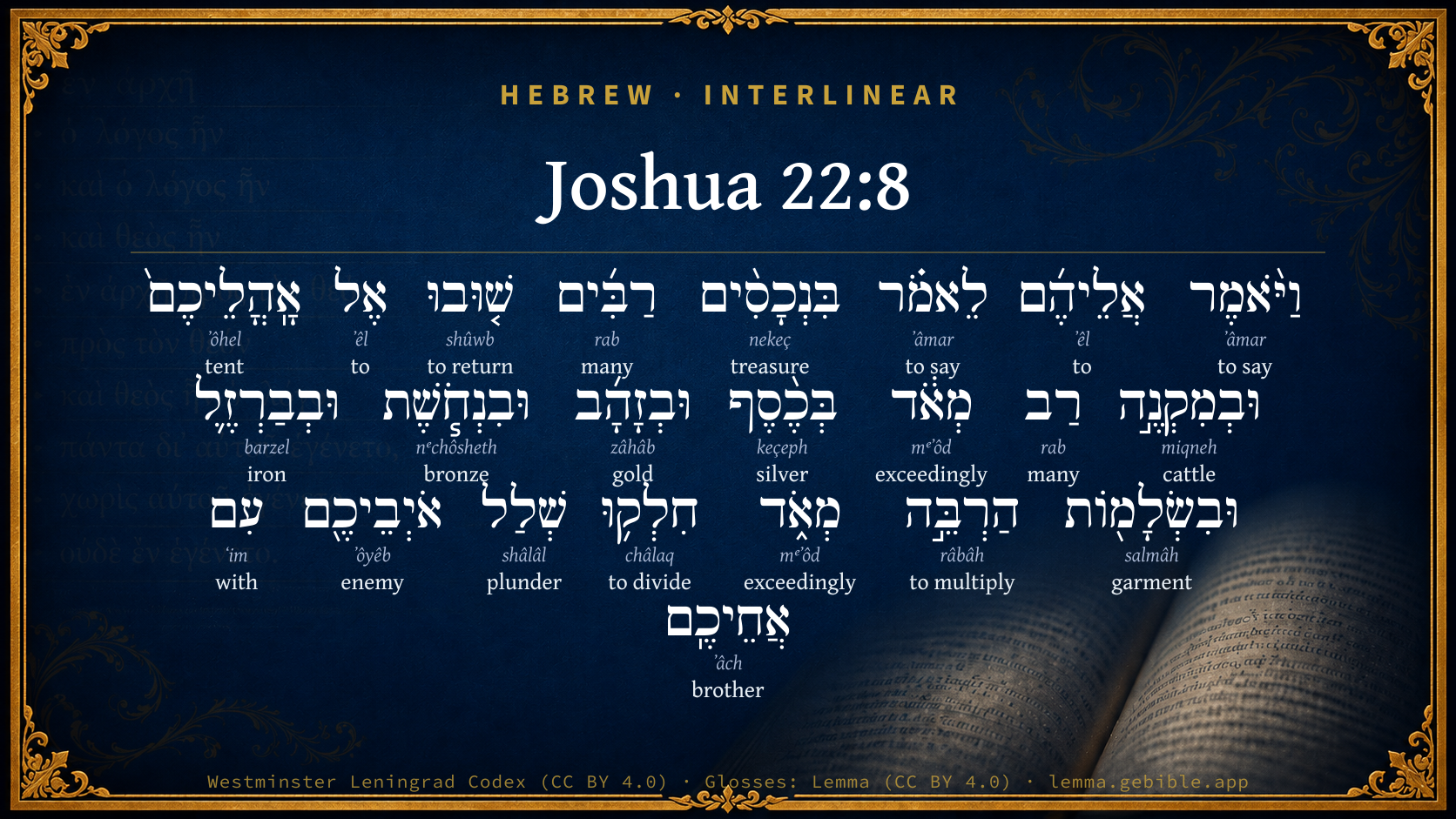
Joshua 22:8

Hebrew (Westminster Leningrad Codex) Joshua 22:8 appears in the Hebrew Old Testament. The text above is from the Westminster Leningrad Codex. Each word links to its Strong’s number, a concise gloss, and parsing drawn from the Open Scriptures Hebrew Bible morphology. Click any word for its full Brown-Driver-Briggs (BDB) entry.
Download image
Cite this verse

Joshua 22:8 (World English Bible). Public Domain. Lemma interlinear Bible study tool, https://lemma.gebible.app/v/joshua/22/8.

Show BibTeX & RIS
BibTeX
RIS
English Translation
and spoke to them, saying, Return with much wealth to your tents, and with very much cattle, with silver, and with gold, and with brass, and with iron, and with very much clothing: divide the spoil of your enemies with your brothers.
World English Bible · Public Domain
Highlights
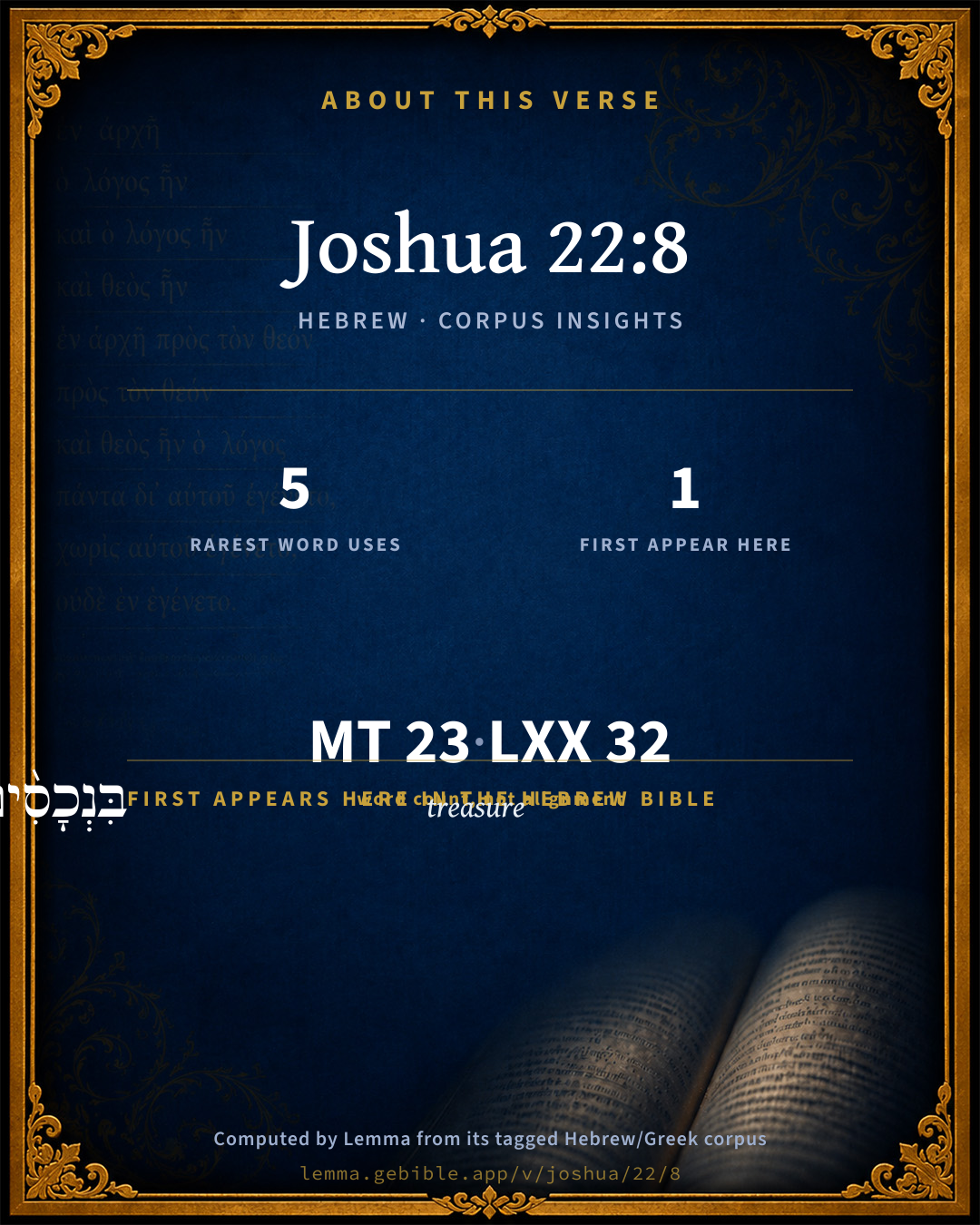
  • 1 first appearance in the Hebrew Bible
Full analysis ↓
Download a study sheet

One document with this verse’s original text, its word-by-word gloss line, the meaning frame, cross-references with their text, attributed commentary, and full source and license credits — printable, and it pastes into notes with its structure intact.

This verse Autodidact and up

Study sheet (.html) Plain text (.txt)

A passage Seminary Student

Up to 50 verses in one chapter. A passage sheet keeps up to 6 commentary sources and 12 cross-references per verse, in the order this page ranks them, and says so on the sheet whenever that leaves anything out. Ask for a single verse and you get the Autodidact verse sheet above.

Everything on this page stays free to read, with no account — the sheet is a download of what is already on screen, not access to it.

Want to remove ads? Support Godless Engineer
Compare translations 3

The same verse in 3 English versions, stacked beneath the original-language interlinear above. Click any original word for its lexicon entry.

Each is an independent rendering of the whole verse — the interlinear is not word-aligned to these translations.

Highlighted words mark where these versions differ — a whole-verse word diff, not a word-by-word alignment.

  • World English Bible Public Domain
    and spoke to them, saying, Return with much wealth to your tents, and with very much cattle, with silver, and with gold, and with brass, and with iron, and with very much clothing: divide the spoil of your enemies with your brothers.
  • King James Version Public Domain
    And he spake unto them, saying, Return with much riches unto your tents, and with very much cattle, with silver, and with gold, and with brass, and with iron, and with very much raiment: divide the spoil of your enemies with your brethren.
  • unfoldingWord Literal Text CC BY-SA 4.0
    and he spoke to them, saying, “Return to your tents with many riches and with very much livestock, with silver and with gold and with bronze and with iron and with very many garments. Divide the spoil of your enemies with your brothers.”

unfoldingWord Literal Text — © unfoldingWord, licensed CC BY-SA 4.0. Word-aligned USFM3 via Door43 (git.door43.org/unfoldingWord/en_ult).

Versions to compare (up to 4)

3 of 4 selected

Show all 18 translations

Every available English version of this verse, each an independent rendering of the whole verse.

  • World English Bible Public Domain
    and spoke to them, saying, Return with much wealth to your tents, and with very much cattle, with silver, and with gold, and with brass, and with iron, and with very much clothing: divide the spoil of your enemies with your brothers.
  • Berean Standard Bible Public Domain
    saying, “Return to your homes with your great wealth, with immense herds of livestock, with silver, gold, bronze, iron, and very many clothes. Divide with your brothers the spoil of your enemies.”
  • Majority Standard Bible Public Domain
    saying, “Return to your homes with your great wealth, with immense herds of livestock, with silver, gold, bronze, iron, and very many clothes. Divide with your brothers the spoil of your enemies.”
  • King James Version Public Domain
    And he spake unto them, saying, Return with much riches unto your tents, and with very much cattle, with silver, and with gold, and with brass, and with iron, and with very much raiment: divide the spoil of your enemies with your brethren.
  • American Standard Version (1901) Public Domain
    and spake unto them, saying, Return with much wealth unto your tents, and with very much cattle, with silver, and with gold, and with brass, and with iron, and with very much raiment: divide the spoil of your enemies with your brethren.
  • Revised Version (1885) Public Domain
    and spake unto them, saying, Return with much wealth unto your tents, and with very much cattle, with silver, and with gold, and with brass, and with iron, and with very much raiment: divide the spoil of your enemies with your brethren.
  • Geneva Bible (1599) Public Domain
    Thus he spake vnto them, saying, Returne with much riches vnto your tents, and with a great multitude of cattell, with siluer and with golde, with brasse and with yron, and with great abundance of rayment: deuide the spoyle of your enemies with your brethren.
  • Douay-Rheims (1899) Public Domain
    He said to them: With much substance and riches, you return to your settlements, with silver and gold, brass and iron, and variety of raiment: divide the prey of your enemies with your brethren.
  • Young's Literal Translation Public Domain
    and speak unto them, saying, `With great riches turn ye back unto your tents, and with very much cattle, with silver, and with gold, and with brass, and with iron, and with very much raiment; divide the spoil of your enemies with your brethren.'
  • Literal Standard Version CC BY-SA 4.0
    and speaks to them, saying, “Turn back to your tents with great riches, and with very much livestock, with silver, and with gold, and with bronze, and with iron, and with very much raiment; divide the spoil of your enemies with your brothers.”
  • Unlocked Literal Bible CC BY-SA 4.0
    and said to them, “Return to your tents with much money, and with very much livestock, and with silver and gold, and with bronze and iron, and with very many garments. Divide the plunder from your enemies with your brothers.”
  • unfoldingWord Literal Text CC BY-SA 4.0
    and he spoke to them, saying, “Return to your tents with many riches and with very much livestock, with silver and with gold and with bronze and with iron and with very many garments. Divide the spoil of your enemies with your brothers.”
  • Darby Bible Public Domain
    and spoke to them, saying, Return unto your tents with much wealth and with very much cattle, with silver, and with gold, and with copper, and with iron, and with clothing, in very great quantity; divide the spoil of your enemies with your brethren.
  • World Messianic Bible Public Domain
    and spoke to them, saying, “Return with much wealth to your tents, with very much livestock, with silver, with gold, with bronze, with iron, and with very much clothing. Divide the plunder of your enemies with your brothers.”
  • Webster's Bible Public Domain
    And he spoke to them, saying, Return with much riches to your tents, and with very many cattle, with silver, and with gold, and with brass, and with iron, and with very much raiment: divide the spoil of your enemies with your brethren.
  • Free Bible Version CC BY-SA 4.0
    He told them, “Take all the wealth you have gained back home: the great herds of livestock, the things made of gold, silver, copper, and iron, the huge quantity of clothes. Share all this plunder with your brothers.”
  • Bible in Basic English Public Domain
    And said to them, Go back with much wealth to your tents, and with very much cattle, with silver and gold and brass and iron, and with a very great store of clothing; give your brothers a part of the goods taken in the war.
  • JPS Tanakh (1917) Public Domain
    and spoke unto them, saying: 'Return with much wealth unto your tents, and with very much cattle, with silver, and with gold, and with brass, and with iron, and with very much raiment; divide the spoil of your enemies with your brethren.'

Literal Standard Version (2020), Covenant Press — licensed CC BY-SA 4.0. Text via the HelloAO Bible API (eBible.org). Unlocked Literal Bible (unfoldingWord) — licensed CC BY-SA 4.0. Text via the HelloAO Bible API (eBible.org). unfoldingWord Literal Text — © unfoldingWord, licensed CC BY-SA 4.0. Word-aligned USFM3 via Door43 (git.door43.org/unfoldingWord/en_ult). Free Bible Version, Dr. Jonathan Gallagher — licensed CC BY-SA 4.0. Text via the HelloAO Bible API (eBible.org).

Word by word

More ways to search: Search by grammar → Find every occurrence → Compare this word →

Practice this passage: Drill this verse → Learn its vocabulary →

בִּנְכָסִ֨ים
nekeç
H5233
“in/at · treasures”
Preposition + Noun, Common, Masculine, Plural, Absolute
Part of Speech
Preposition + Noun
Type
Common
Gender
Masculine
Number
Plural
State
Absolute
Full BDB Definition

Origin: from an unused root meaning to accumulate

TWOT: 1367

riches, treasures
  1. וַיֹּ֨אמֶר ʼâmar H559 “and · to say” Conjunction + Verb, Qal, Sequential Imperfect, 3rd Person, Masculine, Singular
  2. אֲלֵיהֶ֜ם ʼêl H413 “to · them” Preposition + Suffix, Personal, 3rd Person, Masculine, Plural
  3. לֵאמֹ֗ר ʼâmar H559 “to say” Preposition + Verb, Qal, Infinitive Construct
  4. רַבִּ֜ים rab H7227 “many” Adjective, Adjective, Masculine, Plural, Absolute
  5. שׁ֤וּבוּ shûwb H7725 “return” Verb, Qal, Imperative, 2nd Person, Masculine, Plural
  6. אֶל ʼêl H413 “to” Preposition
  7. אָֽהֳלֵיכֶם֙ ʼôhel H168 “tents · your” Noun, Common, Masculine, Plural, Construct + Suffix, Personal, 2nd Person, Masculine, Plural
  8. וּבְמִקְנֶ֣ה miqneh H4735 “and · in/at · cattle” Conjunction + Preposition + Noun, Common, Masculine, Singular, Absolute
  9. רַב rab H7227 “many” Adjective, Adjective, Masculine, Singular, Absolute
  10. מְאֹ֔ד mᵉʼôd H3966 “exceedingly” Adverb
  11. בְּכֶ֨סֶף keçeph H3701 “in/at · silver” Preposition + Noun, Common, Masculine, Singular, Absolute
  12. וּבְזָהָ֜ב zâhâb H2091 “and · in/at · gold” Conjunction + Preposition + Noun, Common, Masculine, Singular, Absolute
  13. וּבִנְחֹ֧שֶׁת nᵉchôsheth H5178 “and · in/at · bronze” Conjunction + Preposition + Noun, Common, Feminine, Singular, Absolute
  14. וּבְבַרְזֶ֛ל barzel H1270 “and · in/at · iron” Conjunction + Preposition + Noun, Common, Masculine, Singular, Absolute
  15. וּבִשְׂלָמ֖וֹת salmâh H8008 “and · in/at · garments” Conjunction + Preposition + Noun, Common, Feminine, Plural, Absolute
  16. הַרְבֵּ֣ה râbâh H7235 “to multiply” Verb, Hiphil, Infinitive Absolute
  17. מְאֹ֑ד mᵉʼôd H3966 “exceedingly” Adverb
  18. חִלְק֥וּ châlaq H2505 “divide” Verb, Qal, Imperative, 2nd Person, Masculine, Plural
  19. שְׁלַל shâlâl H7998 “plunder of” Noun, Common, Masculine, Singular, Construct
  20. אֹיְבֵיכֶ֖ם ʼôyêb H341 “enemy · you” Verb, Qal, Participle Active, Masculine, Plural, Construct + Suffix, Personal, 2nd Person, Masculine, Plural
  21. עִם ʻim H5973 “with” Preposition
  22. אֲחֵיכֶֽם ʼâch H251 “brothers · your” Noun, Common, Masculine, Plural, Construct + Suffix, Personal, 2nd Person, Masculine, Plural

About this verse

These counts appear in no published source. They are computed here, from the morphology-tagged text and Lemma’s own curated glosses. What Lemma adds →

23
words
19
distinct lemmas
Historical
section

Notable vocabulary

The rarest word here is בִּנְכָסִ֨ים treasure H5233 — appearing just 5 times in the whole Hebrew Bible.

First appearance in Scripture

This word makes its first canonical appearance in the Hebrew Bible here:

  • בִּנְכָסִ֨ים treasure H5233

Shared distinctive vocabulary

בִּנְכָסִ֨ים treasure H5233 occurs in 5 verses of the Hebrew Bible. Also found in:

Grammatical profile

  • 6 verbs
  • 10 nouns
  • 2 adjectives
  • 3 prepositions
  • 2 adverbs

Verb forms

  • וַיֹּ֨אמֶר Qal · Sequential Imperfect
  • לֵאמֹ֗ר Qal · Infinitive Construct
  • שׁ֤וּבוּ Qal · Imperative
  • הַרְבֵּ֣ה Hiphil · Infinitive Absolute
  • חִלְק֥וּ Qal · Imperative
  • אֹיְבֵיכֶ֖ם Qal · Participle Active

Repetition

Words recur within this verse — often emphatic in Hebrew:

  • וַיֹּ֨אמֶר to say H559 ×2
  • רַבִּ֜ים many H7227 ×2
  • מְאֹ֔ד exceedingly H3966 ×2
  • אֲלֵיהֶ֜ם to H413 ×2

Hebrew & Septuagint length

In English translation the verse runs 42 words from the Hebrew and 32 from the Septuagint (LXX English) — closely comparable.

A rough comparison of the two English renderings, which tokenize alike — not a word-level alignment.

Word counts can differ between the Hebrew and the Greek without any difference in meaning — e.g. the Hebrew direct-object marker אֵת has no separate Greek word, and Greek often adds the article ὁ.

In the original languages it is 23 Hebrew tokens and 32 Greek tokens — but the two are counted differently (Hebrew bundles its prefixes and suffixes into one token; the Greek is in lemma form), so that isn’t a like-for-like length.

Cross-references

11

Topical passages linked to Joshua 22:8 in the Treasury of Scripture Knowledge — connected by theme and wording, ordered by reader-vote popularity; previews shown in the World English Bible.

  • Numbers 31:27 and divide the prey into two parts: between the men skilled in war, who went out to battle, and all the congregation.
  • Deuteronomy 8:9–14 a land in which you shall eat bread without scarceness, you shall not lack anything in it; a land whose stones are iron, and out of whose hills you may dig copper.
  • Deuteronomy 8:17–18 and [lest] you say in your heart, My power and the might of my hand has gotten me this wealth.
  • 1 Samuel 30:24 Who will listen to you in this matter? for as his share is who goes down to the battle, so shall his share be who tarries by the baggage: they shall share alike.
  • Proverbs 3:16 Length of days is in her right hand. In her left hand are riches and honor.
  • 1 Samuel 30:16 When he had brought him down, behold, they were spread abroad over all the ground, eating and drinking, and dancing, because of all the great spoil that they had taken out of the land of the Philistines, and out of the land of Judah.
  • 2 Chronicles 17:5 Therefore Yahweh established the kingdom in his hand; and all Judah brought to Jehoshaphat tribute; and he had riches and honor in abundance.
  • Psalms 68:12 "Kings of armies flee! They flee!" She who waits at home divides the spoil,
  • 1 Corinthians 15:58 Therefore, my beloved brothers, be steadfast, immovable, always abounding in the Lord's work, because you know that your labor is not in vain in the Lord.
  • Hebrews 11:26 accounting the reproach of Christ greater riches than the treasures of Egypt; for he looked to the reward.
  • 2 Chronicles 32:27 Hezekiah had exceeding much riches and honor: and he provided him treasuries for silver, and for gold, and for precious stones, and for spices, and for shields, and for all manner of goodly vessels;

Cross-references courtesy of OpenBible.info (CC BY 4.0).

Hebrew and Greek witnesses Masoretic Hebrew ↔ Greek Septuagint

The same verse in the two great witnesses to the Old Testament, shown verse-for-verse.

These are two independent witnesses, not word-aligned to each other, and the Septuagint is shown in lemma (dictionary) form.

Hebrew Joshua 22:8 Masoretic · Westminster Leningrad Codex

וַיֹּ֨אמֶר אֲלֵיהֶ֜ם לֵאמֹ֗ר בִּנְכָסִ֨ים רַבִּ֜ים שׁ֤וּבוּ אֶל אָֽהֳלֵיכֶם֙ וּבְמִקְנֶ֣ה רַב מְאֹ֔ד בְּכֶ֨סֶף וּבְזָהָ֜ב וּבִנְחֹ֧שֶׁת וּבְבַרְזֶ֛ל וּבִשְׂלָמ֖וֹת הַרְבֵּ֣ה מְאֹ֑ד חִלְק֥וּ שְׁלַל אֹיְבֵיכֶ֖ם עִם אֲחֵיכֶֽם

and spoke to them, saying, Return with much wealth to your tents, and with very much cattle, with silver, and with gold, and with brass, and with iron, and with very much clothing: divide the spoil of your enemies with your brothers.

World English Bible · Public Domain

Greek LXX Joshua 22:8 Septuagint · lemma form

καί ἐν χρῆμα πολύς ἀποἔρχομαι εἰς ὁ οἶκος αὐτός καί κτῆνος πολύς σφόδρα καί ἀργύριον καί χρυσίον καί σίδηρος καί ἱματισμός πολύς καί διααἱρέω ὁ προνομή ὁ ἐχθρός μετά ὁ ἀδελφός αὐτός

And they departed with much wealth to their houses, and they divided the spoil of their enemies with their brethren; very much cattle, and silver, and gold, and iron, and much raiment.

LXX2012 (modern English Septuagint) · Public Domain

On this verse, Haydock's Catholic Bible Commentary discusses the Septuagint’s reading. Read the note in Commentary ↓

Hebrew: Westminster Leningrad Codex (CC BY 4.0). Greek: Septuagint (public domain); English from LXX2012 (modern English Septuagint) (Public Domain). How the Septuagint differs from the Hebrew →

Targum (Aramaic paraphrase)

1

The Targum is the ancient Jewish Aramaic paraphrase of the Hebrew Scriptures — an interpretive translation, not the Hebrew text itself. Onkelos (literal) and Pseudo-Jonathan (expansive) render the Torah, and Jonathan the Prophets. Coverage is partial: where no permissively-licensed English translation exists for a verse, only the Aramaic is shown. This is verse-level text, not a word-by-word alignment to the Hebrew.

  1. Targum Jonathan Prophets (Joshua–Malachi)
    וַאֲמַר לְהוֹן לְמֵימָר בְּנִכְסִין סַגִיאִין תּוּבוּ לְקִרְוֵיכוֹן וּבִבְעִירָא סַגִי לַחֲדָא בְּכַסְפָּא וּבְדַהֲבָא וּבִנְחָשָׁא וּבְפַרְזְלָא וּבִלְבוּשִׁין סַגִי לַחֲדָא פַּלִיגוֹ בִּזַת בַּעֲלֵי דְבָבֵיכוֹן עִם אֲחֵיכוֹן:

    (no public-domain English translation for this verse)

    Targum Jonathan — Aramaic: “Mikraot Gedolot” (public domain). English: “Sefaria Community Translation” (CC0 1.0 (public-domain dedication)); “London "Chaldee Paraphrase," 1871” (public domain). Text via Sefaria.

Commentary

Notes on Joshua 22:8 from classic Christian and Jewish commentators (each source and its license shown beneath its notes). The classic Christian expositions comment on the surrounding passage and are grouped to its opening verse, so a note may address several verses; the Jewish commentaries on the Tanakh (Rashi and others) are per-verse, so they appear only where the commentator wrote on this verse.

Lemma curates 59 commentaries, every one of them public domain or Creative Commons licensed, each selected and text-cleaned for this edition rather than reprinted as found. About our sources →

Trapp's Complete Commentary

John Trapp

Jos 22:8 And he spake unto them, saying, Return with much riches unto your tents, and with very much cattle, with silver, and with gold, and with brass, and with iron, and with very much raiment: divide the spoil of your enemies with your brethren.

Ver. 8. Return with much riches.] War is generally hateful - the poets fain that Mars, of all their gods, was most hated by Jupiter - and hurtful to mankind: yet the Hollanders are said to grow rich by it. These in the text did so, for a reward of their good service. "By humility and the fear of the Lord are riches, and honour, and life." {Pro 22:4}

Divide the spoil, &c.] Praecipit illis dilectionem proximi. Let those share with you, that, staying at home, tilled your grounds and safe-guarded your families. This was agreeable to a law made by Moses, {Num 31:27} and revived by David. {1Sa 30:24-25}

John Trapp, A Commentary or Exposition upon All the Books of the Old and New Testament (1647–1656) — public domain. Text from a community e-Sword module.

Joseph Benson's Commentary

Jos 22:8. Divide the spoil with your brethren — That is, with them who stayed beyond Jordan for the defence of their land, and wives, and children, who therefore were to have a share, though not an equal share with these. “Nothing could be more just,” says Dr. Dodd, “than this command; for, notwithstanding those who remained beyond Jordan had not shared in the dangers of the war, like those who had gone through it; yet they had, during that period, watched over the families of the latter, and defended their possessions against the inroads of their surrounding enemies. This seems to have been constantly the custom among the Israelites: those who were detached upon any military expedition, gave the rest of the army a share of the booty they had taken from the enemy; the pagans acted in like manner; God himself enjoined this practice after the war against the Midianites. Those who fought kept half the spoil of the enemy, and gave the other half to the rest of the people. Probably the same proportion was observed on this occasion. David, on his return from pursuing the Amalekites, changed this custom into a law, 1Sa 30:24-25.”

Joseph Benson's Commentary on the Old and New Testaments (1811–1818) — public domain. Text from a community e-Sword module.

Tyndale Open Study Notes

Tyndale Open Resources

22:8 The great wealth represented these tribes’ share of the spoils from the cities Israel had taken. • Share . . . with your relatives: While most of the fighting men assisted the rest of Israel, some men had remained to protect the women, children, and herds.

Tyndale Open Study Notes — © Tyndale Open Resources, licensed CC BY-SA 4.0. Text via the HelloAO Bible API.

Geneva Bible (1599)

Geneva Bible translators

Which remained at home and went not to the war, Num. 31:27; 1 Sam. 30:24.

Geneva Bible (1599) marginal notes — public domain. Text via Bolls.life.

Jamieson, Fausset & Brown

Robert Jamieson, A. R. Fausset & David Brown

he spake unto them, saying, Return with much riches--in cattle, clothes, and precious metals.

divide the spoil of your enemies with your brethren--(See on Num 31:25-39).

Jamieson, Fausset & Brown — Commentary Critical and Explanatory on the Whole Bible (1871) — public domain (CC PDM 1.0). Text via the HelloAO Bible API.

Adam Clarke's Commentary

Verse 8. Return with much riches] It appears they had their full proportion of the spoils that were taken from the Canaanites, and that these spoils consisted in cattle, silver, gold, brass, iron, and raiment.

Divide the spoil - with your brethren.] It was right that those who stayed at home to defend the families of those who had been in the wars, and to cultivate the ground, should have a proper proportion of the spoils taken from the enemy, for had they not acted as they did the others could not have safely left their families.

Adam Clarke's Commentary on the Bible (1810–1826) — public domain. Text from a community e-Sword/MySword module.

John Calvin's Commentaries

8. Return with much riches, etc As it was formerly seen that the greater part of the two tribes were left in their territories beyond the Jordan, when the others passed over to carry on the war, it was fair that, as they had lived in case with their families, or been only occupied with domestic concerns, they should be contented with their own livelihood and the produce of their own labor. And they certainly could not, without dishonesty, have demanded that any part of the booty and spoil should be distributed among them, when they had taken no share in all the toil and the danger. Joshua, however, does not insist on the strictly legal view, but exhorts the soldiers to deal liberally with their countrymen, by sharing the prey with them. Here some one may unseasonably raise the question, Whether or not the booty was common? For Joshua does not decide absolutely that it is their duty to do as he enjoins; he admonishes them that, after they have been enriched by the divine blessing, it would betray a want of proper feeling not to be liberal and kind towards their brethren, especially as it was not their fault that they did not take part in the same expedition. Moreover, when he bids them divide, he does not demand an equal partition, such as that which is usual among partners and equals, but only to bestow something that may suffice to remove all cause of envy and hatred.

John Calvin's Commentaries (1540-1563) — public domain. Text from the Calvin Translation Society English edition (1840s-50s) via the Christian Classics Ethereal Library (ccel.org). Calvin's coverage is partial (roughly two-thirds of the Bible); uncommented books and verses are honest gaps, never fabricated. The 19th-century editor's footnotes and remarks are omitted so the notes are faithfully Calvin's own voice.

The Cambridge Bible for Schools and Colleges

gen. ed. J. J. S. Perowne

8. with your brethren] i.e. with the members of the tribes who had remained on the east side of the Jordan, to whom, according to Num_31:27, one half belonged.

The Cambridge Bible for Schools and Colleges (gen. ed. J. J. S. Perowne; Cambridge University Press, 1878–1918) — public domain. Text from a community e-Sword module.

John Gill's Exposition

And the children of Reuben, and the children of Gad, and the half tribe of Manasseh, returned,.... First to the camp to take their substance, and then set forward to their own land:

and departed from the children of Israel; from the rest of them, for otherwise they were children of Israel also:

out of Shiloh, which is in the land of Canaan; for here the camp of Israel was, as well as the tabernacle:

to go unto the country of Gilead, to the land of their possession,

whereof they were possessed; Gilead is put for the whole country on the other side Jordan, as the land of Jazer, and the kingdom of Bashan, which the two tribes of Reuben and Gad, and the half tribe of Manasseh, were possessed of:

according to the word of the Lord by the hand of Moses; for when they moved to have that country, Moses, it seems, consulted the Lord about it, who declared it to be his will they should have it, on performing what they promised, see Num 32:1.

John Gill's Exposition of the Whole Bible (1746–1763) — public domain (CC PDM 1.0). Text via the HelloAO Bible API.

Haydock's Catholic Bible Commentary

Riches. Hebrew, Septuagint, &c., "cattle." --- Brethren. Grotius pretends that they were to keep what they had gotten. But his proofs rather shew that they were to follow the ancient custom and law, which prescribed that those who had remained at home to guard the country, should share the booty with those who had gone to battle, 1 Kings xxx. 24., and Numbers xxxi. 27. Some suppose that the booty was divided into equal parts, and the 40,000 would retain as much as all the rest of their brethren, who had been less exposed. The Israelites, however, made all alike, as other nations seem to have been, Exodus xv. 9., &c.

George Leo Haydock (1774–1849), Haydock's Catholic Family Bible and Commentary, 1859 edition — public domain. Excludes Psalms (Douay-Rheims chapter numbering differs from Protestant) and Deuterocanonical books (Catholic canon only).

Matthew Poole's English Annotations

i.e. With them who staid beyond Jordan for the defence of their land, and wives, and children, who therefore were to have a share, though not an equal share, with these. See Num 31:27. But for them, 1Sa 30:24, their share was equal, because their danger was equal.

Matthew Poole's English Annotations on the Holy Bible (1683–1685) — public domain. Text from a community e-Sword/MySword module.

Whedon's Commentary on the Bible

Daniel D. Whedon

8. Much riches — Since the Canaanites were quite advanced in arts, manufactures, and agriculture, it is natural that they should have a large amount of the precious metals and costly articles embodying wealth.

Much raiment — Fashions in dress never change in the East. Hence the people make permanent investments of their wealth in dresses. Hence the Saviour’s exhortation, “Lay not up for yourselves treasures upon earth, where the moth doth corrupt,” evidently refers to accumulations of garments. Says a traveller in Palestine, “Not unfrequently one sees among the inhabitants of a wretched little hamlet, consisting of the merest hovels, a number of persons dressed in handsome silks.”

Divide the spoil — On a previous occasion (Num_31:27) Moses commanded that those who did service at home should share equally with those who had perilled their lives in battle, for the obvious reason that guarding the household and raising supplies for the army are just as necessary and as patriotic as hurling javelins and storming hostile cities.

Daniel D. Whedon (gen. ed.), Commentary on the Old and New Testaments (1874–1909) — public domain. Text from a community e-Sword module.

The Pulpit Commentary

Riches. The word here used is an uncommon one, and occurs only here and in the later Hebrew. Divide the spoil of your enemies with your brethren. This was the just reward for their toils. And here, as elsewhere, we may observe the strict and scrupulous integrity of Joshua. The division of the spoil by other leaders has often been the cause of heart burnings and even of mutiny. Here each man has his due, and no room is left for reproach or dissatisfaction.

The Pulpit Commentary (1880–1919), ed. H.D.M. Spence-Jones & Joseph S. Exell — public domain. Text from a community e-Sword module.

John Wesley's Explanatory Notes

With your brethren -- that is, with them who stayed beyond Jordan for the defense of their land, and wives, and children, who therefore were to have a share, though not an equal share with these. But for them, 1 Sam. xxx, 24, their share was equal, because their danger was equal.

John Wesley, Explanatory Notes Upon the Whole Bible (1754–1765) — public domain. Text via the GEBible commentary corpus.

Rashi

Rabbi Shlomo Yitzchaki (Rashi)

[Divide the spoils] with your brothers— Referring to Bnei Gad and Bnei Reuvein. There are some who interpret “brothers” in referrence to those who remained behind to guard the cities and the women and children. [Even though] they did not cross the Jordan— with the armed division, nevertheless they received a share of the spoils.

Rashi on the Tanakh — English translations: “The Judaica Press complete Tanach with Rashi, translated by A. J. Rosenberg” (CC BY 4.0); “Pentateuch with Rashi's commentary by M. Rosenbaum and A.M. Silbermann, 1929-1934” (public domain); “The Metsudah Tanach series, Lakewood, N.J” (CC BY 4.0); and “The Book of Joshua, Metsudah Publications, 1997” (CC BY 4.0). Text via Sefaria.

Lesson kit

Teaching starters — assembled from the data on this page, not authored interpretation. Every prompt links to the verse data it draws on. Edit before teaching.

Joshua, in the Historical, opens this verse with 23 words (19 distinct Hebrew lemmas). Its most distinctive word is nekeç (“treasure”). A historical commentator’s framing appears above. Read the whole chapter for the surrounding context.

Discussion questions

  1. How does “treasure” (nekeç) shape what this verse is saying?
  2. The word “treasure” first appears here in Scripture. What is being introduced at this debut?
  3. 2 Chronicles 1:11 shares the word «treasure» with this verse. How do the two illuminate each other?
  4. “to say” occurs 2× in this one verse. What is the effect of the repetition?
  5. These translations render this verse differently; the difference is in the English rendering, not the original. What questions does that raise?
  6. The verb «וַיֹּ֨אמֶר» is Qal Sequential Imperfect. How does its form color the action?
  7. Reading how Trapp's Complete Commentary and Joseph Benson's Commentary read this verse, where do the two commentators agree and where do they part?

Things to notice

Reading settings

Reading text

Shown beneath each verse's original-language words.

Old Testament
Old Testament edition

Read the OT as the Masoretic Hebrew (MT) or the Greek Septuagint (LXX).

English shown for the Greek Septuagint (in the Hebrew ↔ Greek comparison).

Comparing translations? Open the Compare panel on any verse page to stack up to four side by side.