
Daniel 8:25

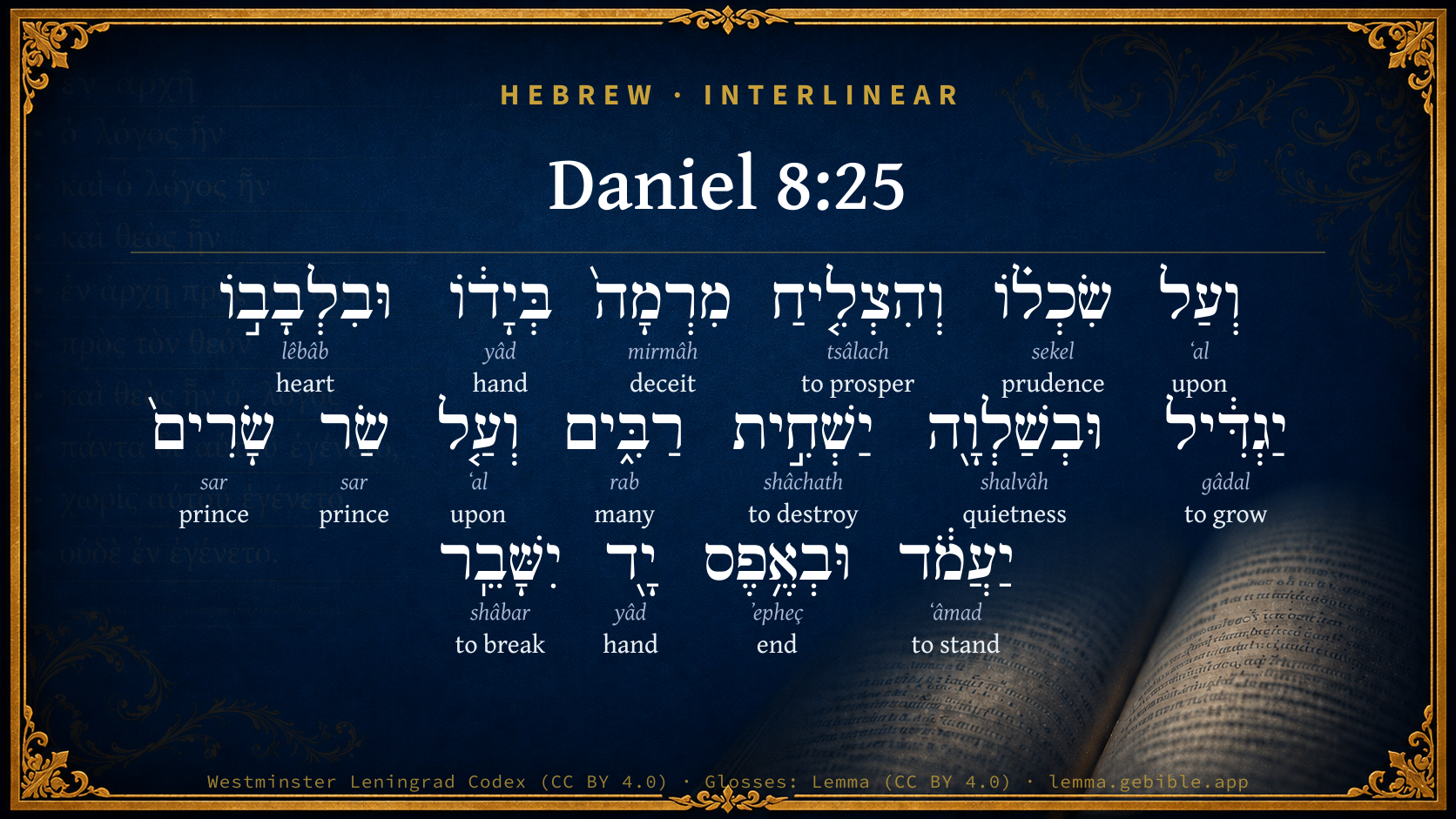
Hebrew (Westminster Leningrad Codex) Daniel 8:25 appears in the Hebrew Old Testament. The text above is from the Westminster Leningrad Codex. Each word links to its Strong’s number, a concise gloss, and parsing drawn from the Open Scriptures Hebrew Bible morphology. Click any word for its full Brown-Driver-Briggs (BDB) entry.
Download image
Cite this verse

Daniel 8:25 (World English Bible). Public Domain. Lemma interlinear Bible study tool, https://lemma.gebible.app/v/daniel/8/25.

Show BibTeX & RIS
BibTeX
RIS
English Translation
Through his policy he shall cause craft to prosper in his hand; and he shall magnify himself in his heart, and in [their] security shall he destroy many: he shall also stand up against the prince of princes; but he shall be broken without hand.
World English Bible · Public Domain
Download a study sheet

One document with this verse’s original text, its word-by-word gloss line, the meaning frame, cross-references with their text, attributed commentary, and full source and license credits — printable, and it pastes into notes with its structure intact.

This verse Autodidact and up

Study sheet (.html) Plain text (.txt)

A passage Seminary Student

Up to 50 verses in one chapter. A passage sheet keeps up to 6 commentary sources and 12 cross-references per verse, in the order this page ranks them, and says so on the sheet whenever that leaves anything out. Ask for a single verse and you get the Autodidact verse sheet above.

Everything on this page stays free to read, with no account — the sheet is a download of what is already on screen, not access to it.

Want to remove ads? Support Godless Engineer
Compare translations 3

The same verse in 3 English versions, stacked beneath the original-language interlinear above. Click any original word for its lexicon entry.

Each is an independent rendering of the whole verse — the interlinear is not word-aligned to these translations.

Highlighted words mark where these versions differ — a whole-verse word diff, not a word-by-word alignment.

  • World English Bible Public Domain
    Through his policy he shall cause craft to prosper in his hand; and he shall magnify himself in his heart, and in [their] security shall he destroy many: he shall also stand up against the prince of princes; but he shall be broken without hand.
  • King James Version Public Domain
    And through his policy also he shall cause craft to prosper in his hand; and he shall magnify himself in his heart, and by peace shall destroy many: he shall also stand up against the Prince of princes; but he shall be broken without hand.
  • unfoldingWord Literal Text CC BY-SA 4.0
    By his cunning he will make deceit prosper under his hand. He will magnify himself in his heart. He will destroy many while they are at ease. He will even rise up against the Prince of princes, and he will be broken, but by no human hand.

unfoldingWord Literal Text — © unfoldingWord, licensed CC BY-SA 4.0. Word-aligned USFM3 via Door43 (git.door43.org/unfoldingWord/en_ult).

Versions to compare (up to 4)

3 of 4 selected

Show all 18 translations

Every available English version of this verse, each an independent rendering of the whole verse.

  • World English Bible Public Domain
    Through his policy he shall cause craft to prosper in his hand; and he shall magnify himself in his heart, and in [their] security shall he destroy many: he shall also stand up against the prince of princes; but he shall be broken without hand.
  • Berean Standard Bible Public Domain
    Through his craft and by his hand, he will cause deceit to prosper, and in his own mind he will make himself great. In a time of peace he will destroy many, and he will even stand against the Prince of princes. Yet he will be broken off, but not by human hands.
  • Majority Standard Bible Public Domain
    Through his craft and by his hand, he will cause deceit to prosper, and in his own mind he will make himself great. In a time of peace he will destroy many, and he will even stand against the Prince of princes. Yet he will be broken off, but not by human hands.
  • King James Version Public Domain
    And through his policy also he shall cause craft to prosper in his hand; and he shall magnify himself in his heart, and by peace shall destroy many: he shall also stand up against the Prince of princes; but he shall be broken without hand.
  • American Standard Version (1901) Public Domain
    And through his policy he shall cause craft to prosper in his hand; and he shall magnify himself in his heart, and in `their' security shall he destroy many: he shall also stand up against the prince of princes; but he shall be broken without hand.
  • Revised Version (1885) Public Domain
    And through his policy he shall cause craft to prosper in his hand; and he shall magnify himself in his heart, and in their security shall he destroy many: he shall also stand up against the prince of princes; but he shall be broken without hand.
  • Geneva Bible (1599) Public Domain
    And through his policie also, hee shall cause craft to prosper in his hand, and he shall extoll himselfe in his heart, and by peace shall destroy many: hee shall also stande vp against the prince of princes, but he shalbe broken downe without hand.
  • Douay-Rheims (1899) Public Domain
    According to his will, and craft shall be successful in his hand: and his heart shall be puffed up, and in the abundance of all things he shall kill many: and he shall rise up against the prince of princes, and shall be broken without hand.
  • Young's Literal Translation Public Domain
    `And by his understanding he hath also caused deceit to prosper in his hand, and in his heart he exerteth himself, and by ease he destroyeth many; and against the prince of princes he standeth -- and without hand he is broken.
  • Literal Standard Version CC BY-SA 4.0
    And by his understanding he has also caused deceit to prosper in his hand, and in his heart he exerts himself, and by ease he destroys many; and he stands against the Prince of princes—and he is broken without hand.
  • Unlocked Literal Bible CC BY-SA 4.0
    By his craftiness he will make deceit prosper under his hand. He will become great in his own mind. He will unexpectedly destroy many people. He will even rise up against the King of kings, and he will be broken, but not by any human hand.
  • unfoldingWord Literal Text CC BY-SA 4.0
    By his cunning he will make deceit prosper under his hand. He will magnify himself in his heart. He will destroy many while they are at ease. He will even rise up against the Prince of princes, and he will be broken, but by no human hand.
  • Darby Bible Public Domain
    And through his cunning shall he cause craft to prosper in his hand; and he will magnify [himself] in his heart, and by prosperity will corrupt many; and he will stand up against the Prince of princes: but he shall be broken without hand.
  • World Messianic Bible Public Domain
    Through his policy he will cause deceit to prosper in his hand. He will magnify himself in his heart, and he will destroy many in their security. He will also stand up against the prince of princes, but he will be broken without human hands.
  • Webster's Bible Public Domain
    And through his policy also he shall cause craft to prosper in his hand; and he shall magnify himself in his heart, and by peace shall destroy many: he shall also stand up against the Prince of princes; but he shall be broken without hand.
  • Free Bible Version CC BY-SA 4.0
    Through its deviousness, its lies will be convincing and successful. It shows its arrogance both in thought and action, destroying those who thought they were perfectly safe. It even fights in opposition against the Prince of princes, but it will be defeated, though not by any human power.
  • Bible in Basic English Public Domain
    And his designs will be turned against the holy people, causing deceit to do well in his hand; in his heart he will make himself great, and send destruction on numbers who are living unconscious of their danger; and he will put himself up against the prince of princes; but he will be broken, though not by men's hands.
  • JPS Tanakh (1917) Public Domain
    And through his cunning he shall cause craft to prosper in his hand; and he shall magnify himself in his heart, and in time of security shall he destroy many; he shall also stand up against the prince of princes; but he shall be broken without hand.

Literal Standard Version (2020), Covenant Press — licensed CC BY-SA 4.0. Text via the HelloAO Bible API (eBible.org). Unlocked Literal Bible (unfoldingWord) — licensed CC BY-SA 4.0. Text via the HelloAO Bible API (eBible.org). unfoldingWord Literal Text — © unfoldingWord, licensed CC BY-SA 4.0. Word-aligned USFM3 via Door43 (git.door43.org/unfoldingWord/en_ult). Free Bible Version, Dr. Jonathan Gallagher — licensed CC BY-SA 4.0. Text via the HelloAO Bible API (eBible.org).

Word by word

More ways to search: Search by grammar → Find every occurrence → Compare this word →

Practice this passage: Drill this verse → Learn its vocabulary →

וּבְשַׁלְוָ֖ה
shalvâh
H7962
“and · in/at · quietness”
Conjunction + Preposition + Noun, Common, Feminine, Singular, Absolute
Part of Speech
Conjunction + Preposition + Noun
Type
Common
Gender
Feminine
Number
Singular
State
Absolute
Full BDB Definition

Origin: from H7951

TWOT: 2392d

quietness, ease, prosperity
  1. וְעַל ʻal H5921 “and · upon” Conjunction + Preposition
  2. שִׂכְל֗וֹ sekel H7922 “prudence · his” Noun, Common, Masculine, Singular, Construct + Suffix, Personal, 3rd Person, Masculine, Singular
  3. וְהִצְלִ֤יחַ tsâlach H6743 “and · to prosper” Conjunction + Verb, Hiphil, Sequential Perfect, 3rd Person, Masculine, Singular
  4. מִרְמָה֙ mirmâh H4820 “deceit” Noun, Common, Feminine, Singular, Absolute
  5. בְּיָד֔וֹ yâd H3027 “in/at · hand · his” Preposition + Noun, Common, Both, Singular, Construct + Suffix, Personal, 3rd Person, Masculine, Singular
  6. וּבִלְבָב֣וֹ lêbâb H3824 “and · in/at · heart · his” Conjunction + Preposition + Noun, Common, Masculine, Singular, Construct + Suffix, Personal, 3rd Person, Masculine, Singular
  7. יַגְדִּ֔יל gâdal H1431 “to grow” Verb, Hiphil, Imperfect, 3rd Person, Masculine, Singular
  8. יַשְׁחִ֣ית shâchath H7843 “to destroy” Verb, Hiphil, Imperfect, 3rd Person, Masculine, Singular
  9. רַבִּ֑ים rab H7227 “many” Adjective, Adjective, Masculine, Plural, Absolute
  10. וְעַ֤ל ʻal H5921 “and · upon” Conjunction + Preposition
  11. שַׂר sar H8269 “prince of” Noun, Common, Masculine, Singular, Construct
  12. שָׂרִים֙ sar H8269 “princes” Noun, Common, Masculine, Plural, Absolute
  13. יַעֲמֹ֔ד ʻâmad H5975 “to stand” Verb, Qal, Imperfect, 3rd Person, Masculine, Singular
  14. וּבְאֶ֥פֶס ʼepheç H657 “and · in/at · end of” Conjunction + Preposition + Noun, Common, Masculine, Singular, Construct
  15. יָ֖ד yâd H3027 “hand” Noun, Common, Both, Singular, Absolute
  16. יִשָּׁבֵֽר shâbar H7665 “to break” Verb, Niphal, Imperfect, 3rd Person, Masculine, Singular

About this verse

These counts appear in no published source. They are computed here, from the morphology-tagged text and Lemma’s own curated glosses. What Lemma adds →

17
words
14
distinct lemmas
Prophets
section

Notable vocabulary

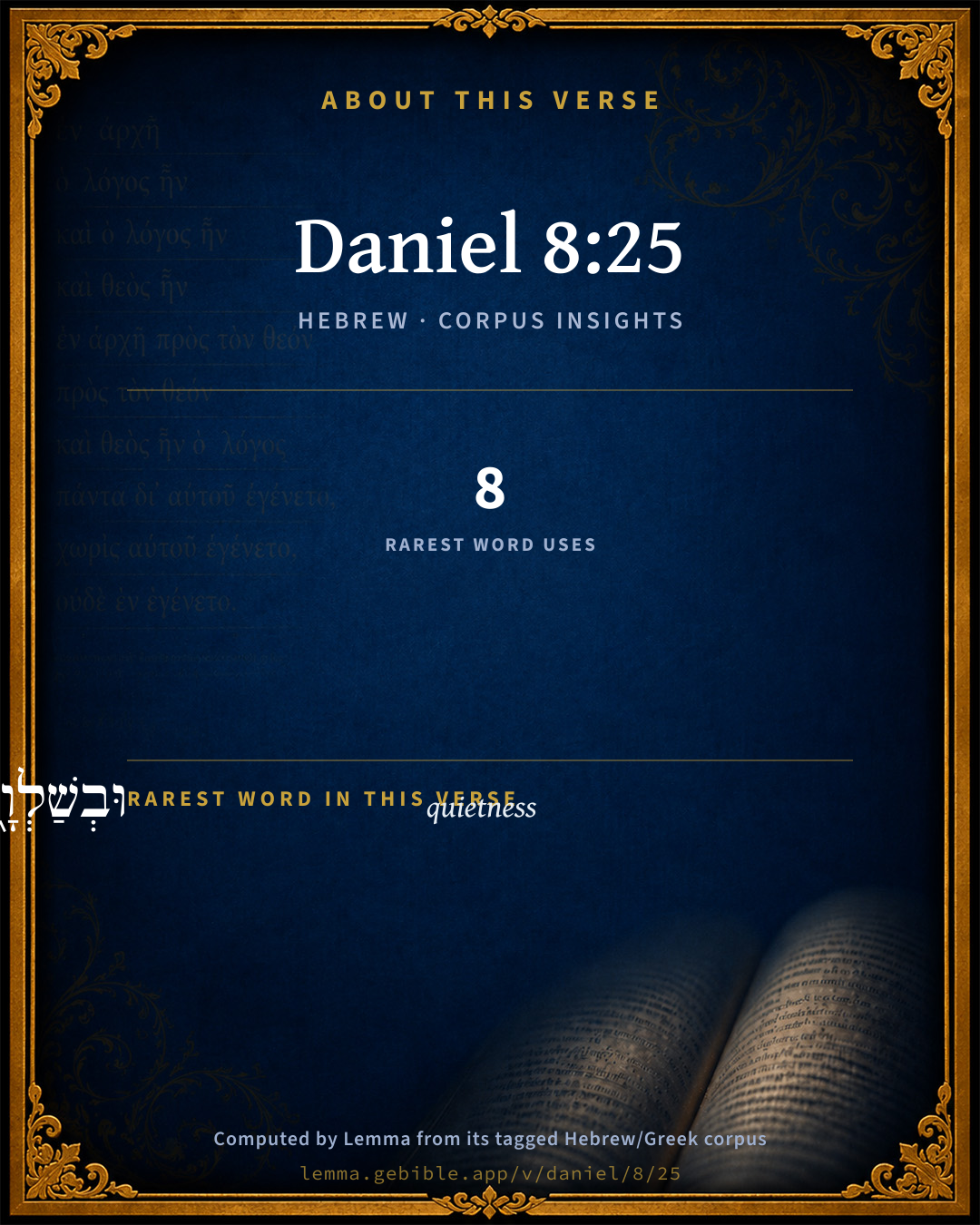
The rarest word here is וּבְשַׁלְוָ֖ה quietness H7962 — appearing just 8 times in the whole Hebrew Bible.

Shared distinctive vocabulary

וּבְשַׁלְוָ֖ה quietness H7962 occurs in 8 verses of the Hebrew Bible. Also found in:

Grammatical profile

  • 5 verbs
  • 9 nouns
  • 1 adjective
  • 2 prepositions

Verb forms

  • וְהִצְלִ֤יחַ Hiphil · Sequential Perfect
  • יַגְדִּ֔יל Hiphil · Imperfect
  • יַשְׁחִ֣ית Hiphil · Imperfect
  • יַעֲמֹ֔ד Qal · Imperfect
  • יִשָּׁבֵֽר Niphal · Imperfect

Repetition

Words recur within this verse — often emphatic in Hebrew:

  • וְעַל upon H5921 ×2
  • בְּיָד֔וֹ hand H3027 ×2
  • שַׂר prince H8269 ×2

Hebrew & Septuagint length

In English translation the verse runs 45 words from the Hebrew and 47 from the Septuagint (LXX English) — closely comparable.

A rough comparison of the two English renderings, which tokenize alike — not a word-level alignment.

Word counts can differ between the Hebrew and the Greek without any difference in meaning — e.g. the Hebrew direct-object marker אֵת has no separate Greek word, and Greek often adds the article ὁ.

Cross-references

16

Topical passages linked to Daniel 8:25 in the Treasury of Scripture Knowledge — connected by theme and wording, ordered by reader-vote popularity; previews shown in the World English Bible.

  • Daniel 8:11 Yes, it magnified itself, even to the prince of the host; and it took away from him the continual [burnt offering], and the place of his sanctuary was cast down.
  • Daniel 11:32–33 Such as do wickedly against the covenant shall he pervert by flatteries; but the people who know their God shall be strong, and do [exploits].
  • Revelation 17:14 These will war against the Lamb, and the Lamb will overcome them, for he is Lord of lords, and King of kings. They also will overcome who are with him, called and chosen and faithful."
  • Job 34:20 In a moment they die, even at midnight; The people are shaken and pass away, The mighty are taken away without hand.
  • Daniel 11:21–25 In his place shall stand up a contemptible person, to whom they had not given the honor of the kingdom: but he shall come in time of security, and shall obtain the kingdom by flatteries.
  • Revelation 19:19–21 I saw the beast, and the kings of the earth, and their armies, gathered together to make war against him who sat on the horse, and against his army.
  • Jeremiah 48:26 Make you him drunken; for he magnified himself against Yahweh: and Moab shall wallow in his vomit, and he also shall be in derision.
  • Lamentations 4:6 For the iniquity of the daughter of my people is greater than the sin of Sodom, That was overthrown as in a moment, and no hands were laid on her.
  • Daniel 2:34–35 You saw until a stone was cut out without hands, which struck the image on its feet that were of iron and clay, and broke them in pieces.
  • Daniel 2:44–45 In the days of those kings shall the God of heaven set up a kingdom which shall never be destroyed, nor shall the sovereignty of it be left to another people; but it shall break in pieces and consume all these kingdoms, and it shall stand forever.
  • Daniel 7:8 I considered the horns, and, behold, there came up among them another horn, a little one, before which three of the first horns were plucked up by the roots: and, behold, in this horn were eyes like the eyes of a man, and a mouth speaking great things.
  • Daniel 7:26 But the judgment shall be set, and they shall take away his dominion, to consume and to destroy it to the end.
  • Daniel 8:23–24 In the latter time of their kingdom, when the transgressors are come to the full, a king of fierce face, and understanding dark sentences, shall stand up.
  • Daniel 11:36–37 The king shall do according to his will; and he shall exalt himself, and magnify himself above every god, and shall speak marvelous things against the God of gods; and he shall prosper until the indignation be accomplished; for that which is determined shall be done.
  • Daniel 11:45 He shall plant the tents of his palace between the sea and the glorious holy mountain; yet he shall come to his end, and none shall help him.
  • Acts 12:23 Immediately an angel of the Lord struck him, because he didn't give God the glory, and he was eaten by worms and died.

Cross-references courtesy of OpenBible.info (CC BY 4.0).

Hebrew and Greek witnesses Masoretic Hebrew ↔ Greek Septuagint

The same verse in the two great witnesses to the Old Testament, shown verse-for-verse.

These are two independent witnesses, not word-aligned to each other, and the Septuagint is shown in lemma (dictionary) form.

Hebrew Daniel 8:25 Masoretic · Westminster Leningrad Codex

וְעַל שִׂכְל֗וֹ וְהִצְלִ֤יחַ מִרְמָה֙ בְּיָד֔וֹ וּבִלְבָב֣וֹ יַגְדִּ֔יל וּבְשַׁלְוָ֖ה יַשְׁחִ֣ית רַבִּ֑ים וְעַ֤ל שַׂר שָׂרִים֙ יַעֲמֹ֔ד וּבְאֶ֥פֶס יָ֖ד יִשָּׁבֵֽר

Through his policy he shall cause craft to prosper in his hand; and he shall magnify himself in his heart, and in [their] security shall he destroy many: he shall also stand up against the prince of princes; but he shall be broken without hand.

World English Bible · Public Domain

Greek LXX Daniel 8:25 Septuagint · lemma form

καί ἐπί ὁ ἅγιος ὁ διανόημα αὐτός καί εὐοδόω ὁ ψεῦδος ἐν ὁ χείρ αὐτός καί ὁ καρδία αὐτός ὑψόω καί δόλος ἀπο ἀναἵζω πολύς καί ἐπί ἀπώλεια ἀνήρ ἵστημι καί ποιέω συναγωγή χείρ καί ἀποδίδωμι

And the yoke of his chain shall prosper: there is craft in his hand; and he shall magnify himself in his heart, and by craft shall destroy many, and he shall stand up for the destruction of many, and shall crush them as eggs in his hand.

LXX2012 (modern English Septuagint) · Public Domain

On this verse, The Cambridge Bible for Schools and Colleges discusses the Septuagint’s reading. Read the note in Commentary ↓

Hebrew: Westminster Leningrad Codex (CC BY 4.0). Greek: Septuagint (public domain); English from LXX2012 (modern English Septuagint) (Public Domain). How the Septuagint differs from the Hebrew →

Commentary

Notes on Daniel 8:25 from classic Christian and Jewish commentators (each source and its license shown beneath its notes). The classic Christian expositions comment on the surrounding passage and are grouped to its opening verse, so a note may address several verses; the Jewish commentaries on the Tanakh (Rashi and others) are per-verse, so they appear only where the commentator wrote on this verse.

Lemma curates 59 commentaries, every one of them public domain or Creative Commons licensed, each selected and text-cleaned for this edition rather than reprinted as found. About our sources →

Trapp's Complete Commentary

John Trapp

Dan 8:25 And through his policy also he shall cause craft to prosper in his hand; and he shall magnify [himself] in his heart, and by peace shall destroy many: he shall also stand up against the Prince of princes; but he shall be broken without hand.

Ver. 25. And through his policy also.] Incumbens intelligentiae suae, leaning on his own wit, Versutulus et versatilis, and that great elixir called reason of state, which can make, for a need,

“ Candida de nigris, et de candentibus atra. ”

And by peace shall destroy many.] Undo them by promises of prosperity and preferment, which are dangerous baits; {Mar 4:9} "they were sawn asunder, they were tempted." {Heb 11:37} Julian the apostate went this way to work, and prevailed to make many apostates.

He shall also stand up against the Prince of princes.] God Almighty, by destroying the daily sacrifices, and by setting up idolatry in the temple.

But he shall be broken without hand,] i.e., By the visible vengeance of God, {1Ma 6:8-13 2Ma 9:5-11} who laid upon him a loathsome disease ( Tetro morbo), and wrapped him up in the sheet of shame.

John Trapp, A Commentary or Exposition upon All the Books of the Old and New Testament (1647–1656) — public domain. Text from a community e-Sword module.

The Biblical Illustrator

Joseph S. Exell

Dan_8:25

The Prince of Princes.

A Good Prince

This text calls attention to the four ancient empires, and the circumstances connected with the people of God in the various operations and doings of these empires.

I. THE PRINCE Jesus Christ, as the representative of His people, hath power with God and with man, and hath prevailed. He is an interposing Prince on behalf of a chosen people.

II. THE PRINCES. The Prince of princes. Jesus Christ has entire authority over the princes and kings of the earth. And His people, His companions are princes. They get their royal name after Him; the whole family in Heaven and earth are named after Him.

III. THE ADVERSARY. He shall be broken without hand; by the judgment of God independent of man (James Wells.)

.

The Biblical Illustrator, edited by Joseph S. Exell (c. 1880s–1900s) — public domain. Text from a community e-Sword module.

Joseph Benson's Commentary

Dan 8:25. Through his policy also he shall cause craft to prosper — His craft and cunning shall succeed. And he shall magnify himself in his heart — Elated by his successes, he will always be aiming at more and more, and making further attempts; and by peace shall destroy many — Without making war, and without being a declared enemy, or receiving injuries from them, he shall destroy many. Under pretence of peace and friendship, he invaded and spoiled both Egypt and Judea. The character which Grotius gives of Antiochus may serve to throw light on these clauses of the verse. “He had no regard to piety or integrity, to any true or false God, but measured all things by the rule of his own convenience. He certainly deceived many nations, and by his flatteries and frauds obtained, as well as enlarged his dominion; and under the colour of peace, or pretended tranquillity, he oppressed the unwary, and destroyed multitudes:” see 1Ma 1:30. He shall also stand up against the Prince of princes — He shall exalt himself against the true God, the Lord of heaven and earth, abolishing his worship, and setting up idolatry in its stead. But he shall be broken without hand — By an immediate judgment of God. God struck him with a noisome disease, attended with horrible torments both of body and mind: see 1Ma 6:8-13; 2Ma 9:5-29. It is observable, that Polybius and Josephus both confirm the account which the authors of the books of Maccabees give of his death, in a state of madness, from the apparitions and reproaches of spectres and evil spirits.

Joseph Benson's Commentary on the Old and New Testaments (1811–1818) — public domain. Text from a community e-Sword module.

Tyndale Open Study Notes

Tyndale Open Resources

8:25 The Prince of princes is the King of Israel, the ruler of heaven and earth (7:9-10, 13-14). Antiochus, at the time of his death, exalted himself as God and intended to destroy Jerusalem. • he will be broken: Just as Antiochus IV’s rise was not by his own power (8:24), so he was destroyed by God’s hand rather than by human power. His end was to be eaten by worms (1 Maccabees 6:7-16 and 2 Maccabees 9:4-28; cp. Herod Agrippa, Acts 12:20-23).

Tyndale Open Study Notes — © Tyndale Open Resources, licensed CC BY-SA 4.0. Text via the HelloAO Bible API.

Geneva Bible (1599)

Geneva Bible translators

That is, under pretence of peace, or as it were in sport.

Meaning, against God.

For God would destroy him with a notable plague, and so comfort his Church.

Whatsoever he goeth about by his craft, he shall bring it to pass.

Geneva Bible (1599) marginal notes — public domain. Text via Bolls.life.

Jamieson, Fausset & Brown

Robert Jamieson, A. R. Fausset & David Brown

by peace--by pretending "peace" and friendship; in the midst of security [GESENIUS], suddenly striking his blow (compare Note, see on Jer 15:8). "A spoiler at noon-day."

also . . . against the Prince of princes--not merely against the Jews (Dan 8:11; Dan 11:36).

broken without hand--by God's special visitation. The stone "cut out of the mountain without hands," that is, Christ is to smite the world power image on his feet (Dan 2:34), that is, in its last development (compare Dan 7:11). Antiochus horrible death by worms and ulcers, when on his way to Judea, intending to take vengeance for the defeat of his armies by the Maccabees, was a primary fulfilment, foreshadowing God's judgment on the last enemy of the Jewish Church.

Jamieson, Fausset & Brown — Commentary Critical and Explanatory on the Whole Bible (1871) — public domain (CC PDM 1.0). Text via the HelloAO Bible API.

Adam Clarke's Commentary

Verse 25. He shall cause craft to prosper] They subdued as many by their diplomatic skill and political intrigues as they did by the sword.

He shall also stand up against the Prince of princes] Against Christ; for it was by the Roman authority that he was condemned to death and crucified; and their persecutions had nearly destroyed the Christian religion; but the house was founded on a rock.

But he shall be broken without hand.] The tide was turned by the invisible hand of God; and thus heathen Rome was overcome, and converted to Christianity.

Adam Clarke's Commentary on the Bible (1810–1826) — public domain. Text from a community e-Sword/MySword module.

John Calvin's Commentaries

It follows next; He shall magnify himself in his heart, or he shall raise himself, and bear himself magnificently; although this expression implies boasting and pride, and is taken in a disadvantageous sense. He shall be insolent, therefore, in his heart. The angel seems to distinguish here between the scheming and penetration of Antiochus, and his pride of heart; for, although he should obtain great: victories, and should subdue many nations according to his desires, yet he would oppress the Jews, and then, should be magnified in heart; that is, should be puffed up with greater pride than before, on account of those continuous successes. And in peace he shall destroy many, or the brave; for the word רבים rabbim, signifies either. Some translate, on account of his prosperity, because the Lord wished to relax the reins, so that no one should hinder the course of his victories. On account, then, of that success, he shall destroy many. Profane men, indeed, who understand nothing of God’s providence, have said that folly and chance prevail more in war than skill or arms; but the success of generals does not spring from either chance or fortune, but as God pleases to conduct the affairs of the world in various ways, so in some eases the evil and unskillful warriors succeed, while others make many fruitless efforts and trials, although they are superior in counsel, and are provided with the very best ornaments. But I rather incline to another sense which interpreters do not mention; namely, Antiochus should destroy and lay waste many nations without any trouble, with the greatest ease, and as it were in sport. Wherefore the Prophet signifies, or the angel who addresses the Prophet., that Antiochus should be the conqueror of many nations, not only because he should be endowed with great cunning, and should carry on the war more by treachery than by open violence, but as it is reported of Timotheus the Athenian general: He will take cities and lands, and subject them to himself, through fortune spreading her net for him while he is indulging in sleep. The angel, therefore, seems to point out this listlessness, by predicting much devastation by the hand of Antiochus in apparent ease and calmness. Others expound it thus, — nations shall be laid waste by that robber which have given him no occasion for attack, because they have never stirred up any hostility against him; but when they attempt to cultivate peace, he wearies them without the slightest pretext. But this interpretation seems to be forced.

He afterwards adds, And against the Prince Of Princes he shall stand, or rise up, and he shall be destroyed without hand, or shall be ruined. The ו, vau, is put adversatively; yet he shall be destroyed without hand. This was far more galling to the Prophet, and to the whole people, for the angel to predict the contests of Antiochus, not only with mortals, but with God himself. Some understand שר-שרים, sar-sarim, of the high priest, but this is too confined and spiritless. I have not the least doubt that God is here meant by the Prince of Princes Wherefore the complete sense is, — Antiochus should be not only bold, and cruel, and proud towards men, but this madness and full should proceed so far as to lead him to attack and resist God. This is the full sense. But a consolation is soon added, when the angel says, he should be destroyed without hand It would, indeed, have been almost intolerable for the Jews to hear only of the insolence of Antiochus in contending against God, unless this correction had been added — the end of the contest must be the self-destruction of Antiochus by his own impiety. He shall be destroyed then. But how? without hand, says he. For after subduing so many nations, and after obtaining whatever he wished, what more could be hoped for as far as man is concerned? Who would dare to rise up against him? Clearly enough, if the kings of Syria had been content with their own boundaries, they need not have feared any one, for no enemy would have molested them; but they provoked the Romans to attack them, and when they wished to invade Egypt, they did not prosper in their attempts. Whichever be the meaning, the angel here announces the sufficiency of the divine power without any human aid, for the destruction and overthrow of Antiochus. Some think this prophet refers to Antichrist, thus they pass by Antiochus altogether, and describe to us the appearance of Antichrist, as if the angel had shewn to Daniel what should happen after the second renovation of the Church. The first restoration took place when liberty was restored to the people, and they returned from exile to their native land, and the second occurred at the advent of Christ. These interpreters suppose this passage to unfold that devastation of the Church which should take place after the coming of Christ, and the promulgation of the gospel. But as we have previously seen, this is not a suitable meaning, and I am surprised that men versed in the Scriptures should so pour forth clouds upon clear light. For, as we said yesterday, nothing can be clearer, or more perspicuous, or even more familiar, than this prophecy. And what is the tendency of ascribing so violently to Antichrist what even mere children clearly see to be spoken of Antiochus, except to deprive Scripture of all its authority? Others speak more modestly and more considerately, when they suppose the angel to treat of Antiochus for the purpose of depicting in his person the figure of Antichrist. But I do not think this reasoning sufficiently sound. I desire the sacred oracles to be treated so reverently, that no one may introduce any variety according to the will of man, but simply hold what is positively certain. It would please me better to see any one wishing to adapt this prophecy to the present use of the Church, and to apply to Antichrist by analogy what is said of Antiochus. We know that whatever happened to the Church of old, belongs also to us, because we have fallen upon the fullness of times.

No doubt the Holy Spirit wished to teach us how to bear our cross by making use of this example, but as I have already said, it seems to me far too frivolous to search for allegories. We should be content with true simplicity, and transfer to ourselves whatever occurred to the ancient people. (1 Corinthians 10:11.) With how much reason does the Apostle say there should be false teachers in the kingdom of Christ, as there were formerly false prophets! (2 Peter 2:1.) So we must determine, that the devil, who was a murderer from the beginning, will always find those whom he will stir up and impel to persecute the Church. The devil contends at this very day, not only by fallacious doctrines, and impious errors, and impostures, but also by cruel tyranny, as he inflames many impious men to madness, and thus harasses the sons of God. As the Jews ought not to quail under the calamities which oppressed them, through Daniel’s predictions concerning Antiochus, so the same doctrine ought in these days to fortify us, lest the novelty of our calamities should appall us, when the Church is oppressed by heavy burdens, and tyrants rage and storm, with fire and sword. (Romans 8:28:) For the fathers experienced similar trials, to whom Christ had not then pointed out the way of life, and who did not comprehend so clearly as we do our duty to be conformed to the only-begotten Son of God, because he is the first-born in the Church; he is our head and we are his members. This was not so fully unfolded to those holy men, who still endured under so many afflictions, when they might suppose the Church completely buried, as it is certainly surprising that they did not yield a hundred times over to so many and such dreadful calamities. Therefore this doctrine will be best accommodated to our instruction, if we are convinced of the justice of our condition not being better than that of the fathers. What, therefore, happened to them? These wicked ones should be destroyed, namely, the Jews:, who professed themselves to be the elect people of God, and the holy family of Abraham, and in numberless ways had obstinately provoked God’s wrath; thus the Church was miserably harassed. Antiochus, especially, like a sweeping tempest, reduced all things to ruin, till the people felt themselves utterly undone, and to all human appearance were without the slightest hope. As God punished so severely the wickedness of his ancient people, it does not surprise us when we feel his present chastisements, as in these days the land is full of sinfulness, and we do not cease perpetually and purposely to provoke God’s wrath. (1 Thessalonians 3:3.) Lastly, to avoid the penalty due to our sins, let us consider the end of our calling, the subjection of our whole life to the cross. This is the warfare to which our heavenly Father destines us. As this is our lot, we ought to look into this mirror, and there behold the perpetual condition of the

Church. It is therefore no matter of surprise, if, instead of one Antiochus, God should raise up many who are hardened and invincible in their obstinacy, and in their cruelty make many attempts with clandestine arts, and plot for the destruction of the Church. If the fathers experienced this, it does not surprise us, if we in these days undergo similar sufferings. This, I say, is a useful analogy, and does not distort the simple sense of Scripture. Now, let us go on, —

John Calvin's Commentaries (1540-1563) — public domain. Text from the Calvin Translation Society English edition (1840s-50s) via the Christian Classics Ethereal Library (ccel.org). Calvin's coverage is partial (roughly two-thirds of the Bible); uncommented books and verses are honest gaps, never fabricated. The 19th-century editor's footnotes and remarks are omitted so the notes are faithfully Calvin's own voice.

Ellicott's Commentary for English Readers

(25) Through his policy.—This is explained more fully in the next two sentences. Through his craft he succeeds, and becomes able to destroy many unexpectedly, and finally raises up himself against God.

Without hand.—Not by the hand of man (comp. Dan_2:34), but by the act of God.

A Bible Commentary for English Readers, edited by Charles John Ellicott (1878–1897) — public domain. Text from a community e-Sword module.

The Cambridge Bible for Schools and Colleges

gen. ed. J. J. S. Perowne

25. And through—properly, on (the basis of)—his understanding] or insight, cleverness,—usually in a good sense (1Sa_25:3, Job_17:4, al.), here in a bad sense = astuteness.

he (without ‘also’)[328] will cause deceit to prosper in his hand] his intrigues will prove successful (cf. Dan_11:23, also of Antiochus). For ‘in his hand,’ cf. Gen_39:3, Isa_53:10.

[328] See on the construction Ges.-Kautzsch, § 112. 5, or the writer’s Hebrew Tenses, § 123 γ. It is against the reading of lxx (followed by Grätz and Bevan), that שׂכל does not signify διανόημα, or ‘mind.’

and in his heart he will shew greatness] i.e. here (cf. on Dan_8:4), devise proud, presumptuous schemes. Comp. the expression ‘greatness of heart’ Isa_9:9; Isa_10:12 (A.V. ‘stoutness,’ ‘stout’).

and in (time of) security he will destroy many] i.e. he will come upon them unawares, and destroy them while off their guard. Many modern scholars render indeed by unawares, supposing that the Heb. expression (בשלוה ‘in tranquillity’) is used with the force of a similar Aramaic idiom מן שלי suddenly, unawares, (lit. out of quiet): see e.g. Jer_4:20, Pesh. The same expression recurs in ch. Dan_11:21; Dan_11:24 (LXX. both times ἐξάπινα), also of Antiochus. Comp. 1Ma_1:29-30, where it is related how Antiochus’s chief collector of tribute, Apollonius, came to Jerusalem, and ‘spake words of peace unto them in subtilty, and they gave him credence; and he fell upon the city suddenly (ἐξάπινα: Pesh. מן שלי),’ and killed many of its inhabitants (cf. 2Ma_5:23-26).

the Prince of princes] i.e. God, the ‘prince of the host’ of Dan_8:11. Cf. Dan_2:47; and the ‘Lord of lords’ of Deu_10:17, Psa_136:3.

broken without hand] i.e. not by human means, but by a Divine intervention; cf. Dan_2:34, with the note. Antiochus died suddenly, in b.c. 164, a few months after the re-dedication of the Temple (25 Chisleu [Dec.], 165), apparently from some mental disorder, such as might well suggest the idea of a Divine stroke, at Tabae in Persia (see p. 194 f.).

The Cambridge Bible for Schools and Colleges (gen. ed. J. J. S. Perowne; Cambridge University Press, 1878–1918) — public domain. Text from a community e-Sword module.

John Gill's Exposition

And through his policy also he shall cause craft to prosper in his hand,.... His schemes were laid in such deep policy, and he managed so artfully and craftily in the execution of them, that he commonly succeeded; as in getting the kingdom of Syria from his nephew; and, under a pretence of peace and friendship, and to defend Philometer king of Egypt, a minor, and by large promises to the nobles of the land, made himself master of it; and by deceitful methods he prevailed in Judea; see Dan 11:21,

and he shall magnify himself in his heart; swell with pride, on account of success, through his policy, craft, and cunning, and think himself above all mortals, and equal to God himself; yea, as his antitype antichrist, exalt himself above all that is called God; fancy that he could command the seas, weigh the mountains in scales, and reach heaven itself, in the Apocrypha:

"And thus he that a little afore thought he might command the waves of the sea, (so proud was he beyond the condition of man) and weigh the high mountains in a balance, was now cast on the ground, and carried in an horselitter, shewing forth unto all the manifest power of God.'' (2 Maccabees 9:8)

and by peace shall destroy many; under a pretence of peace enter into countries and destroy the inhabitants of them, as in Egypt and Judea; or, by leagues and treaties of peace, outwitting those he made peace with; so some political princes do themselves more service, and their enemies more hurt, by treaties than by battles: or "in peace" (w); when at peace with them, or while they are in peace and tranquillity; coming upon them unexpectedly at an unawares, when they did not so much as dream of war:

he shall also stand up against the Prince of princes; not the high priest, as Grotius; nor Michael, as Aben Ezra; but God himself, as Saadiah and Jacchiades; who is King of kings, and Lord of lords, the only Pontentate, to whom all the princes above and below are subject; him Antiochus stood up against, when he profaned his temple at Jerusalem, forbid his worship, persecuted and destroyed his people, and set up the image of Jupiter in his house:

but he shall be broken without hand; alluding to his being a horn; it is expressive of his death, and the manner of it; that he should not die by the hand of an enemy in battle, nor be assassinated by the hand of a ruffian, but be cut off by the immediate hand of God. Jacchiades says, that by the providence of God he fell ill of a bad disease, and at the cry of one of his elephants his chariot was overturned, and he fell on the ground, and his bones were broken. Of his death, and the manner of it, in the Apocrypha:

"Now when the king heard these words, he was astonished and sore moved: whereupon he laid him down upon his bed, and fell sick for grief, because it had not befallen him as he looked for.'' (1 Maccabees 6:8)

"But the Lord Almighty, the God of Israel, smote him with an incurable and invisible plague: or as soon as he had spoken these words, a pain of the bowels that was remediless came upon him, and sore torments of the inner parts;'' (2 Maccabees 9:5)

"So that the worms rose up out of the body of this wicked man, and whiles he lived in sorrow and pain, his flesh fell away, and the filthiness of his smell was noisome to all his army.'' (2 Maccabees 9:9)

which was much like that of Herod's, Act 12:23, being stricken with a violent disorder in his bowels: his body covered with worms; his flesh flaked off, and emitted such a stench, as was intolerable to his army. Aben Ezra says, he fell from the roof of a house, and was broken, and died.

(w) "in pace", Calvin, Vatablus; "in tranquillitate", Montanus, Junius & Tremellius, Piscator, Cocceius, Michaelis.

John Gill's Exposition of the Whole Bible (1746–1763) — public domain (CC PDM 1.0). Text via the HelloAO Bible API.

Albert Barnes' Notes on the Bible

And through his policy - The word rendered “policy” here (שׂכל s'êkel) means, properly, intelligence, understanding, wisdom; and then, in a bad sense, craft, cunning. So it is rendered here by Gesenius, and the meaning is, that he would owe his success in a great measure to craft and subtilty.

He shall cause craft to prosper in his hand - He shall owe his success in a great measure to a crafty policy, to intrigue, and to cunning. This was true in an eminent sense, of Antiochus. See his history in Prideaux, above referred to, and the books of Maccabees. Compare the notes at Dan 11:21. The same character is given of him by Polybius, “Relig.” lib. xxi. c. 5, tom. iv. p. 501, ed. Schweighauser; Appian, “de reb. Syr.” xlv. t. 1, p. 604, ed. Schweigh. Compare 2 Macc. 5:24-26. He came to the kingdom by deceit (Prideaux, iii. 212), and a great part of his success was owing to craft and policy.

And he shall magnify himself in his heart - Shall be lifted up with pride, or esteem himself of great consequence.

And by peace shall destroy many - Margin, “prosperity.” The Hebrew word (שׁלוה shalevâh) means, properly, tranquility, security, ease, carelessness. Here the phrase seems to mean “in the midst of security” (Gesenius, Lexicon); that is, while they were at ease, and regarded themselves as in a state of safety, he would come suddenly and unexpectedly upon them, and destroy them. He would make sudden war on them, invading their territories, so that they would have no opportunity to make preparation to meet him. Compare Dan 11:21, Dan 11:24. It would seem to mean that he would endeavor to produce the impression that he was coming in peace; that he pretended friendship, and designed to keep those whom he meant to invade and destroy in a state of false security, so that he might descend upon them unawares. This was his policy rather than to declare war openly, and so give his enemies fair warning of what he intended to do. This description agrees every way with the character of Antiochus, a leading part of whose policy always was to preserve the appearance of friendship, that he might accomplish his purpose while his enemies were off their guard.

He shall also stand up against the Prince of princes - Notes, Dan 8:11. Against God, the ruler over the kings of the earth.

But he shall be broken without hand - That is, without the hand of man, or by no visible cause. He shall be overcome by Divine, invisible power. According to the author of the first book of Maccabees (1 Macc. 6:8-16), he died of grief and remorse in Babylon. He was on an expedition to Persia, and there laid siege to Elymais, and was defeated, and fled to Babylon, when, learning that his forces in Palestine had been repulsed, penetrated with grief and remorse, he sickened and died. According to the account in the second book of Maccabees (2 Macc. 9), his death was most distressing and horrible. Compare Prideaux, iii. 272-275. All the statements given of his death, by the authors of the books of Maccabees, by Josephus, by Polybius, by Q. Curtius, and by Arrian (see the quotations in Prideaux), agree in representing it as attended with every circumstance of horror that can be well supposed to accompany a departure from this world, and as having every mark of the just judgment of God. The Divine prediction in Daniel was fully accomplished, that his death would be “without hand,” in the sense that it would not be by human instrumentality; but that it would be by a direct Divine infliction. When Antiochus died, the opposition to the Jews ceased, and their land again had peace and rest.

Albert Barnes' Notes on the Bible (1834–1885) — public domain. Text from a community e-Sword/MySword module.

Haydock's Catholic Bible Commentary

Prince: God. --- Hand of man. He confessed that he was justly punished. (1 Machabees vi. 10.) Greek: "He shall raise himself by the ruin of many, (Theod. and some manuscripts add, and shall rise up against the prince of princes) and he shall break them like eggs with his hand."

George Leo Haydock (1774–1849), Haydock's Catholic Family Bible and Commentary, 1859 edition — public domain. Excludes Psalms (Douay-Rheims chapter numbering differs from Protestant) and Deuterocanonical books (Catholic canon only).

Matthew Poole's English Annotations

He shall cause craft to prosper in his hand; he shall contrive many devices, and most of them shall take; he shall be a great master of those kinds of artifices: all to circumvent and destroy, as beasts and birds of prey have a kind of craft to compass and then devour their prey.

He shall magnify himself in his heart; shall take a pride in his wicked devices and tricks.

By peace shall destroy many; under colour of kindness, and promising peace and amity, shall lull men asleep, so as to fear nothing from him.

He shall also stand up against the Prince of princes: all this you find verified of him in the Maccabees and Josephus. He fought against God in removing the high priest, affronting God’s laws, profaning God’s worship, name, and temple, and setting up the image and worship of Jupiter there. He shall be broken without hand, by a disease whereof he died, 1Ma 6:8; 2Ma 9:5.

Matthew Poole's English Annotations on the Holy Bible (1683–1685) — public domain. Text from a community e-Sword/MySword module.

Whedon's Commentary on the Bible

Daniel D. Whedon

25. By peace [rather, in their security] shall he destroy many — I think with Bevan and Prince that this undoubtedly has reference to his sudden treacherous attack on Jerusalem (1Ma_1:30). The oldest Greek version seems to have had a better text than ours, and renders, “And against the saints shall be his policy, and deceit shall prosper in his hand, and his heart shall be lifted up, and by treachery he shall destroy many.”

Prince of princes — That is, the divine prince of the host. (See note Dan_8:11.) Not by the agency of some human hand, but by direct judgment from heaven, shall this little evil horn be broken. Antiochus was not killed in battle, but died suddenly from some horrible malady, just after his failure to rob a temple in Elymais. (See 1Ma_6:6-18; 2Ma_9:1-10.) This was insanity or “madness of the heart,” according to some ancient authors, but according to the writer of 2 Macc. he was eaten up with worms, and “the filthiness of his smell was noisome to all his army.”

Daniel D. Whedon (gen. ed.), Commentary on the Old and New Testaments (1874–1909) — public domain. Text from a community e-Sword module.

The Pulpit Commentary

And through his policy also he shall cause craft to prosper in his hand; and he shall magnify himself in his heart, and by peace shall destroy many: he shall also stand up against the Prince of princes; but he shall be broken without hand. The versions here are at variance with each other and. with the Massoretic recension. The LXX renders, "And against the saints shall his purpose be evidently reading, as suggested by Gratz, val qedosheem siklo craft shall prosper in his hands, and his heart shall be lifted up, and by treachery he shall destroy many, and for the destruction of men shall he stand, and he shall make a gathering of power, and shall sell (it)." Theodotion is, in regard to the first clause, considerably more at variance with the Massorctic, "And the yoke of his collar (or chain) shall prosper." Evidently Theodotion had read lO ("ol), "yoke," instead of l (al), "upon," and probably wOlbsi ( sib"lo), "his burden," instead of wOlkci (sik"lo), "his thought." "And in his heart he shall be magnified, and by treachery shall he corrupt many. and for the destruction of many. shall he stand, and as eggs shall he crush (them) in his hand," reading kbaytzeem byad yishbar instead of beeseph yad yishahabayr. The Peshitta has several points of peculiarity, "And in his might he shall prosper: he shall restrain with his hand, and his heart shall be lifted up, and by treachery shall he corrupt many. and against the Ruler of rulers shall he rise up, and with grasp of the hand shall be taken." Even Jerome,. who is usually in close agreement with the Massoretic text, translates at variance with their pointing. He begins this verse really with the last clause of the previous one, "And he shall slay strong ones and the people of the saints according to his will, and treachery shall be directed in his hand, and in plenty of all things he shall slay many, and against the Prince of princes shall he rise, and without hand shall be broken." The most singular thing is the omission by both the Greek versions of the phrase sar sareem, which both appear to have read yishhat rabbeem a variation of reading difficult to understand. On the whole, these varying versions seem to have sprung from a text originally not differing much from the Massoretic, save in the opening clause, in which the Septuagint appears to suit the succession of thought better. The return of Antiochus from his expedition to Egypt was the signal for his persecution of the saints; then his "purpose, was against the holy people." Craft shall prosper in his hand. The account we have in the First Book of the Maccabees shows the perpetual exercise by Antiochus and those under him of treachery. At first, at all events, his craft prospered. (RAPC 1Ma 1:30) And he shall magnify himself in his heart. Bevan thinks this hardly accurate, as the hiphil is ordinarily causative. Only Zep_2:8 has this verb used in hiphil as reflexive. The sense, however, seems to be, not that he shall become proud, but that he has many great projects in his mind one (RAPC 1Ma 1:42) being to unify all the various peoples that were under his sceptre, so that they should be one in religion and law. He further had the design of conquering Egypt and uniting it to his empire, and would have done so had the Romans not intervened. And by peace shall destroy many. The word translated "peace" means also suddenly. " The Greek versions both render it by dolw. Schleusner suggests that the word was derived from another root. There dues not seem such a root in Levy. The probability is that the meaning passed from "tranquillity" to the notion of "treachery." The meaning assigned to the word by Jerome is inexplicable, copia rerum. It happens that both the meaning attached to the word shalvah by the Greek versions here, and that found in other passages, harmonize. The treachery of the chief collector of tribute lay in feigning peace, and then slaying the people. (RAPC 1Ma 1:29) He shall also stand up against the Prince of princes. The Greek versions, as above observed, have instead of this, ejpiav ajndrwn sthsetai a phrase that might be a rendering of tj The Massoretic text here seems the preferable. Antiochus had certainly risen up against God, the "Prince of princes," or, as the Peshitta renders, "Ruler of rulers." He shall be broken without hand. The fact of Antiochus dying immediately after an ineffectual attempt to rob a temple in Elymais, and dying, not from the effect of wounds received, but from chagrin, is symbolized by this statement. The figure of a horn pushing in this direction and in that is resumed; hence Epiphanes is said to be broken. And that he was not overthrown in battle by any rival for the crown is shown by the statement that it was without hands that he was so broken. The Romans resisted his attempt to take possession of Egypt, so he was baulked in his pursuit after one object. He desired to unite his whole multifarious empire, so that it should be homogeneous; that was baulked by the victorious revolt of the Jews under Judas Maccabaeus. If he could have made his empire homogeneous, he might have expected to be able to defy the Romans. The defeat of his army by Judas might easily be remedied if he had money to pay his troops, so he attempted the plunder of the temple in Elymais, said to be that of Artemis. The inhabitants resisted so vehemently, that he had to retire baffled. This it was that caused his death. Polybius hints at madness inflicted by a Divine hand.

The Pulpit Commentary (1880–1919), ed. H.D.M. Spence-Jones & Joseph S. Exell — public domain. Text from a community e-Sword module.

John Wesley's Explanatory Notes

By peace - Under colour of kindness. Against the prince of princes - He fought against God, affronting God's laws, profaning God's worship, and temple, and setting up the image and worship of Jupiter there. Without hand - By a disease whereof he died, 1Macc vi, 8.

John Wesley, Explanatory Notes Upon the Whole Bible (1754–1765) — public domain. Text via the GEBible commentary corpus.

Rashi

Rabbi Shlomo Yitzchaki (Rashi)

And through his intellect, he will cause the deceit in his hand to prosper And because he is clever wherever he turns and [because] he will prosper, he will hold onto deceit with his hand.

and in his heart he will become proud Heb. יַגְדִּיל, lit, he will grow larger.

and in tranquility he will destroy many With guile and with smooth talk he will destroy many who dwell with him with a covenant and in peace.

and over the Prince of princes he will stand He will speak blasphemously about Heaven. This is the meaning of the dream written above (verse 11): [“And until the Prince of the host it grew.”]

and without strength he will be broken And without strength he will be broken, through a mosquito, the weakest of creatures, which entered his nose, as we learned in Tractate Gittin (56b).

Rashi on the Tanakh — English translations: “The Judaica Press complete Tanach with Rashi, translated by A. J. Rosenberg” (CC BY 4.0); “Pentateuch with Rashi's commentary by M. Rosenbaum and A.M. Silbermann, 1929-1934” (public domain); “The Metsudah Tanach series, Lakewood, N.J” (CC BY 4.0); and “The Book of Joshua, Metsudah Publications, 1997” (CC BY 4.0). Text via Sefaria.

Lesson kit

Teaching starters — assembled from the data on this page, not authored interpretation. Every prompt links to the verse data it draws on. Edit before teaching.

Daniel, in the Prophets, opens this verse with 17 words (14 distinct Hebrew lemmas). Its most distinctive word is shalvâh (“quietness”). A historical commentator’s framing appears above. Read the whole chapter for the surrounding context.

Discussion questions

  1. The word shalvâh carries the sense “quietness.” How does it shape the verse?
  2. Psalms 122:7 shares the word «quietness» with this verse. How do the two illuminate each other?
  3. “upon” occurs 2× in this one verse. What is the effect of the repetition?
  4. These translations render this verse differently. What is at stake in choosing one wording over another?
  5. The verb «וְהִצְלִ֤יחַ» is Hiphil Sequential Perfect. How does its form color the action?
  6. Reading how Trapp's Complete Commentary and The Biblical Illustrator read this verse, where do the two commentators agree and where do they part?

Things to notice

Reading settings

Reading text

Shown beneath each verse's original-language words.

Old Testament
Old Testament edition

Read the OT as the Masoretic Hebrew (MT) or the Greek Septuagint (LXX).

English shown for the Greek Septuagint (in the Hebrew ↔ Greek comparison).

Comparing translations? Open the Compare panel on any verse page to stack up to four side by side.